
HOH Hardware Evidence: Auditing Pharmacy Automation Claims
Pharmacy automation projects rarely fail at the category decision. They fail at the evidence stage — when a shortlisted supplier's capability statement cannot be traced back to a model number, a measured parameter, a certificate scope, or an acceptance test.
That gap has widened as hospital pharmacies move from single-machine purchases toward department-level automation packages that combine dispensing, cytotoxic compounding, controlled-drug storage, packaging, and software integration. Each element carries a different evidence standard, and general supplier capability language flattens them into one impression.
This article uses one published line as a working example: Haier Biomedical Technology (Suzhou) Co., Ltd, a Suzhou-based healthcare technology company under Haier Group that develops intelligent pharmacy automation systems for hospital outpatient pharmacies, inpatient pharmacies, and PIVAS environments. The company reports a 13,000 m² factory, 500 employees and a 100-engineer R&D team, and exports to Europe, the Middle East, Southeast Asia, Latin America, Africa and Oceania. The purpose is not to rank the catalogue, but to show how procurement teams can read it — and where the published record stops and a formal request should begin.
How a Supplier Capability Audit Actually Works
Three failure modes recur in pharmacy automation evaluation. The first is a parameter quoted without its configuration: a throughput figure that assumes a module count, a bin layout or a prescription mix the buyer has not purchased. The second is a certificate quoted without its scope: a conformity document that covers one model family and not the model on the purchase order. The third is integration described as a feature rather than an interface: “HIS compatible” without a statement of what data moves, in which direction, and what happens when a message fails.
A capability audit addresses all three by forcing every claim into one of five evidence classes. Each class has a different owner, a different document, and a different point in the procurement timeline where it should be closed.
| Evidence class | What it proves | What the buyer should request |
|---|---|---|
| Model-level parameters | Performance of the exact configuration being quoted | Datasheet revision tied to model, module count and bin configuration |
| Certificate scope | Which models, against which standards, for which validity period | Full conformity document including model appendix and expiry date |
| Integration documentation | Behavior at the HIS/EMR boundary | Interface specification, message set, error handling, tested workflows |
| Acceptance testing | Performance as built, not as published | Factory Acceptance Test protocol plus site acceptance criteria and test medication set |
| Lifecycle commitment | Behavior after year one | Spare parts list, software upgrade policy, service and training scope |
On the Haier line, the first three classes can be partially closed from published material. The last two are contract documents, not marketing documents, and belong in the tender annex.
Robot Evidence: HOH-Robot-Plus in PIVAS Compounding
The HOH-Robot-Plus is a fully automated cytotoxic drug compounding robot intended for PIVAS workflows. Published parameters describe a unit of 2,200 × 1,520 × 2,370 mm weighing 1,300 kg, with a stated compounding efficiency of 25 preparations per hour and a listed compounding accuracy of 100%. Vial compatibility is stated at more than 95% of vials, and the solvent range covers 50–1,000 mL soft bags, plastic bottles and stand-up pouches. Consumables are Luer-lock general-purpose syringes and dedicated needles. The compounding environment is specified as Class 100 (ISO 5) cleanroom conditions.
For an evaluation team, three of those figures do different jobs. The cleanroom class is an environmental claim that should be tied to a maintenance regime — HEPA filtration, pressure differentials, particle monitoring and the interval at which those are verified. The 100% accuracy figure is a stated design parameter and should be converted into a measurable acceptance criterion: which preparation set, how many cycles, which analytical method, and who signs off at FAT. Vial compatibility above 95% should be tested against the hospital's own formulary rather than the supplier's reference list, because the remaining share of vials is exactly where workflow exceptions appear.
The consumables point is a commercial one that buyers often defer and later regret: dedicated needles and specified syringe types create a single-source consumable dependency for the life of the machine. That dependency belongs in the total cost discussion, not in the year-three service review.
Dispenser Evidence: Three Mechanisms With Different Throughput Logic
The HOH dispensing range is not a single product at three price points. It is three mechanisms — chute, robotic arm and high-speed channel dispensing — whose published metrics are not directly comparable and should not be placed in one throughput column without adjustment.
| Model | Mechanism | Medication types / storage | Published speed | Footprint dimension |
|---|---|---|---|---|
| HOH-KF-1200 | Chute type dispenser, modular dispensing / storage / loading units | More than 1,100 medication types; more than 15,000 boxes | 350–500 prescriptions/hour; replenishment above 2,400 boxes/hour | Under 4,690 × 2,850 × 2,735 mm; space requirement under 12.85 m² |
| HOH-KF-Smart | Robotic arm dispenser | 1,500 or more medication types; 20,000 or more boxes | 300 or more prescriptions/hour; replenishment above 700 boxes/hour | 8,650 × 1,747 × 2,850 mm, replenishment module excluded |
| HOH-GF (2 Modules) | High-speed channel dispenser, dual-level stacked structure, adjustable bin width | 100 or more storage slots; 5,000 or more boxes; up to 2 medication bin modules | Single-channel dispensing of 2 boxes/sec or more | 2,180 × 1,230 × 2,800 mm |
The HOH-KF-1200 is built around full-screen dispensing with safety buffers and parallel multi-prescription operation, with at least two buffer channels supporting side buffering and front-end output. In practice that means the meaningful site question is not the machine's footprint alone but the buffer and output lane arrangement — the 12.85 m² figure describes the unit, not the total installed zone including replenishment access and pickup positions.
The HOH-KF-Smart trades speed for range and control. Its published advantages are FIFO/FEFO expiration management and barcode recognition with full-chain traceability, which matter where batch and expiry discipline is the audit priority rather than peak throughput. Its main unit is long — 8.65 m along the front — and the quoted dimension excludes the replenishment module, so room planning must add it back.
The HOH-GF is the throughput instrument. Its headline 2 boxes/sec figure is explicitly single-channel and is paired with batch dispensing for multiple boxes, high-precision photoelectric sensors for dispensing detection, and error alerts with automatic positioning guidance via indicator lights. Those secondary features are where the operational value sits: photoelectric detection is a physical confirmation that a box actually left its slot, and indicator-light positioning shortens error recovery. Buyers should still convert “2 boxes/sec per channel” into an expected prescriptions-per-hour figure using their own basket size, because the two metrics are not the same thing.
Storage and Packaging Evidence: HOH-BQ-A, HOH-MJ-01 and HOH-FB-D400-HD
The non-dispensing half of a pharmacy automation package is where evidence is usually thinnest, because cabinets and packaging machines are bought as support equipment and reviewed as such.
The HOH-BQ-A intelligent integrated medication management cabinet is specified at 620 × 700 × 1,240 mm with 32 standard small pillboxes at 150 pieces each (counted by 1 mL ampoule), eight standard large pillboxes at 20 pieces each, a 23-inch touch screen and AC 220 V 50/60 Hz supply. The HOH-MJ-01 anesthetic medication dispensing cabinet uses nine drawers — the upper seven in a six-grid layout and the lower two in a single-grid layout, all with lids — giving 44 compartments in total, with a maximum single-layer volume of 28.3 L, external dimensions of 745 × 700 × 1,800 mm, 400 W power and a 15-inch touch screen. For controlled-drug storage, compartment count and access control are the metrics that matter; both cabinets should be evaluated on reconciliation workflow and audit trail, not on speed.
The HOH-FB-D400-HD automatic sub-packaging and verification machine is specified with 400 medication boxes, a packaging speed of 40–60 packs per minute, a 75 × 70 mm bag size, a 72-slot external output tray, dimensions of 1,200 × 880 × 2,025 mm, 2,000 W rated power and a 700 kg net weight, operating in 0–40 °C and 10–80% humidity. The 72-slot output tray is the figure that should drive layout planning, since it determines how long an operator can leave the machine unattended before the tray needs clearing.
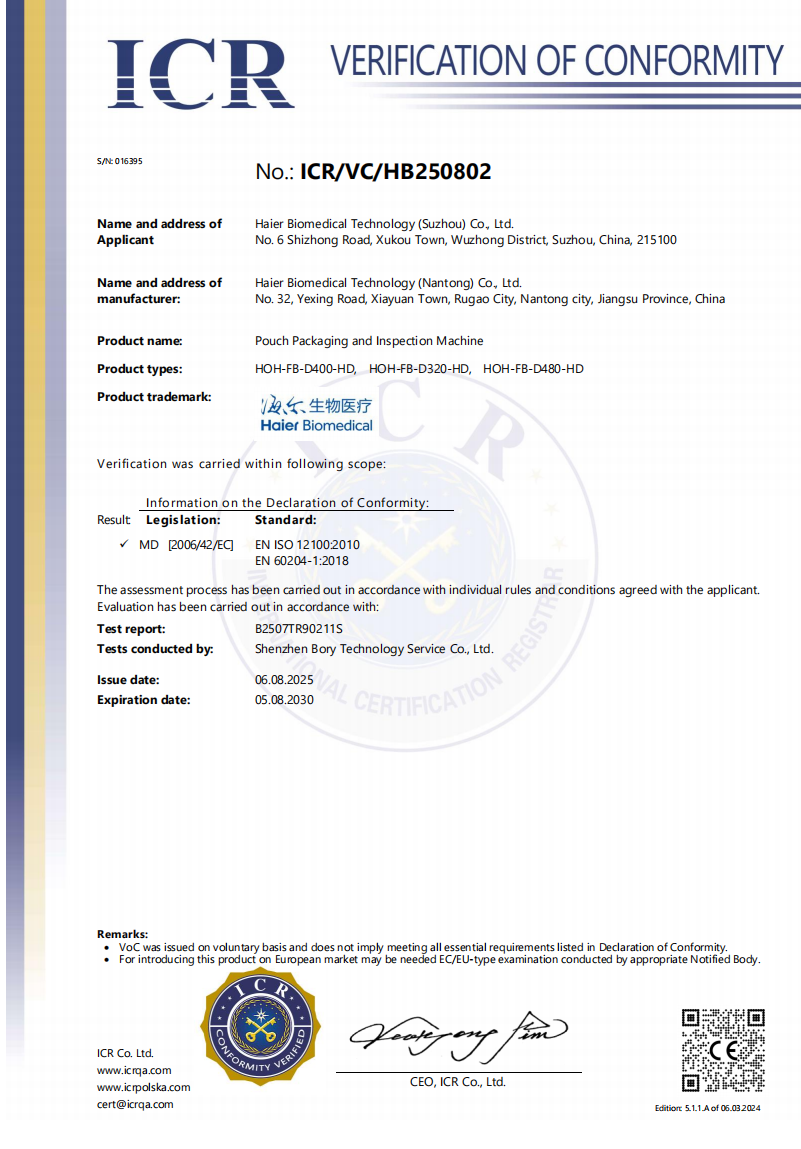
ICR Verification of Conformity ICR/VC/HB250802 lists HOH-FB-D400-HD, HOH-FB-D320-HD and HOH-FB-D480-HD within its scope, against EN ISO 12100:2010 and EN 60204-1:2018, valid to 5 August 2030 (supplier documentation).
Where the Pharmacy AI Assistant Actually Sits
“Pharmacy AI assistant” is the layer most often described in outcomes — demand forecasting, expiration monitoring, interaction detection, labeling — and least often described in dependencies. From a procurement perspective, an assistant is only as reliable as three hardware-level capabilities beneath it.
- Capture fidelity. Every AI conclusion about stock, identity or movement starts as a sensor event. In this line that means barcode recognition with full-chain traceability on the HOH-KF-Smart and high-precision photoelectric dispensing detection with indicator-light positioning on the HOH-GF.
- Rule execution at the machine. Expiration logic must be executed by the equipment, not merely reported by software. The HOH-KF-Smart is specified with FIFO/FEFO support; without that, the assistant can flag short-dated stock but cannot prevent it being dispensed.
- Closed-loop data path. Haier pharmacy automation solutions support integration with hospital information systems including HIS and EMR platforms, with prescription information transferred to the automation system for processing according to configured dispensing rules. The customization scope explicitly includes software functions and the HIS interface.
Haier Biomedical's published platform description also includes AI-based recognition as part of its technology stack, and AI visual recognition is listed among the special requirements of the high-volume, continuously operating hospital pharmacy scenario it targets. At company level, the 2025 annual report states that AI-powered automated pharmacy solutions increased direct dispensing rates to 80% in 2025, and that AI-powered applications contributed 15% of total revenue in the same year. Those are supplier-level outcome statements; they describe a portfolio direction, not a guarantee for a specific site.
The audit questions that separate a real assistant from a dashboard are consistent across vendors. Which fields does it read, and from which system of record? What happens when a barcode or visual check returns low confidence — does the machine stop, escalate, or proceed with a flag? Are pharmacist overrides logged with user identity and timestamp? Does the assistant write back to HIS, or only read from it? How are rule changes and model versions governed after go-live? And what remains on-premise versus in a vendor environment? A vendor that answers those six items in writing has demonstrated software capability; one that answers them with feature names has not.
Certificate Evidence: Reading Scope, Standards and Dates
Certificate count is a poor proxy for compliance. What matters is whether the specific model on the purchase order appears in the scope of a valid document, against a standard relevant to the equipment type. The five documents published for this line are specific enough to demonstrate the reading method.
| Document | Type / authority | Model scope | Standards cited | Validity |
|---|---|---|---|---|
| ICR/VC/HB250402 | MD Directive Verification of Conformity, ICR, EU | HOH-KF-1200, HOH-KF-900, HOH-KF-600, HOH-KF-Smart, HOH-KF-ADM, HOH-KF-50, HOH-KF-40, HOH-KF-30Z | EN ISO 12100:2010; EN 60204-1:2018 | 17 Apr 2025 – 16 Apr 2030 |
| ICR/VC/HB250403 | MD Directive Verification of Conformity, ICR, EU | HOH-GF-36 through HOH-GF-200 | EN ISO 12100:2010; EN 60204-1:2018 | 17 Apr 2025 – 16 Apr 2030 |
| ICR/VC/HB250802 | MD Directive Verification of Conformity, ICR, EU | HOH-FB-D400-HD, HOH-FB-D320-HD, HOH-FB-D480-HD | EN ISO 12100:2010; EN 60204-1:2018 | 6 Aug 2025 – 5 Aug 2030 |
| ICR/VC/HB240501 | MD Directive Verification of Conformity, ICR, EU | HOH-M2300-A/B, HOH-M2300-AL/BL, HOH-BQ-A, HOH-BQ-B, HOH-BQ-AL/BL, HOH-MJ-01, HOH-M600-A/AL | EN 60204-1:2018; EN ISO 12100:2010 | 10 May 2025 – 9 May 2029 |
| ISETC.000220220323 | Voluntary Compliance Certificate, ISET, EU | HOH-KF-Smart, HOH-KF-ADM, HOH-KF-50, HOH-KF-40, HOH-KF-30 | EN ISO 12100:2010; EN 60204-1:2018 | 23 Mar 2022 – 22 Mar 2027 |

ISET voluntary compliance certificate ISETC.000220220323 covers HOH-KF-Smart and related automatic dispensing models, valid to 22 March 2027 (supplier documentation).
Two observations follow directly from the table. First, all five documents cite machinery safety standards — EN ISO 12100:2010 for risk assessment and EN 60204-1:2018 for electrical equipment of machines. That is a machinery-directive conformity route. Third-party guidance identifies IEC 60601-1 for medical electrical equipment safety, alongside ISO 13485 for quality management, as the standards pharmacy automation systems must address. Haier Biomedical holds ISO 13485 certification for its medical device quality management system at company level, and buyers evaluating a medical-device classification for their market should ask explicitly how the electrical safety route is satisfied for the models concerned. That is a scoping question, not an implication of non-compliance.
Second, the certificate calendar is not uniform. ISETC.000220220323 expires on 22 March 2027, three years before the ICR documents covering related models. A hospital signing a ten-year service agreement should place certificate renewal on the contract's obligation list rather than leaving it to the supplier's internal schedule.
Deployment Evidence: What Two Hospital Projects Show
Reference projects are most useful when read as configuration evidence rather than outcome evidence. Two published cases illustrate the distinction.
A private hospital in Thailand deployed one set of a customized universal dispenser system in its outpatient pharmacy, for automated dispensing and medication management during peak hours. The configuration was developed around Thai medication packaging characteristics and supports HIS integration with a modular design; the stated cooperation duration is ten years. The verifiable content here is the adaptation to local packaging formats — a real engineering constraint in Southeast Asian markets where box dimensions differ from the reference market.
A general hospital in Vietnam deployed one intelligent pharmacy automation system in its outpatient pharmacy, combining automated storage, dispensing and digital medication management, customized to the pharmacy's layout and workflow with HIS integration. Again, the documented content is scope and configuration, not measured before-and-after throughput.
Neither case publishes baseline-versus-post metrics, and buyers should not read projections into them. What they do establish is that the supplier has delivered customized outpatient configurations with HIS integration in two Southeast Asian markets — one of the regions listed among its main markets, alongside Latin America and the Middle East.
Market Context: Why Evidence Standards Are Tightening
The commercial backdrop explains the scrutiny. Insightace Analytic estimates the global pharmacy automation devices market at USD 6.7 billion in 2024, while Grand View Research projects USD 11.6 billion by 2030 at a 9.9% CAGR. Dataintelo places medication dispensing systems as the largest product segment at 32.5% share in 2025, and Fortune Business Insights identifies hospital pharmacies as the largest end-user segment in 2024, driven by patient volumes and complex regimens.
Two growth signals point directly at the parts of the line discussed above. Grand View Research projects automated medication compounding systems as the fastest-growing product segment at a CAGR above 10% — the segment occupied by the HOH-Robot-Plus. MarketsandMarkets expects software to grow fastest among components from 2024 to 2030, which is consistent with the integration and AI-layer questions raised earlier. Omnicell has also reported that 75% of pharmacist time has traditionally gone to non-clinical tasks, which frames the operational case for dispensing automation without asserting a site-specific saving.
Automated Versus Manual: What Changes, and Where the Boundaries Are
| Dimension | Manual shelving | Automated system | Evidence to verify |
|---|---|---|---|
| Retrieval | Pharmacist locates and picks by label and memory | System resolves the storage position and presents or delivers the item | Dispensing detection method; error alerting |
| Expiry control | Depends on manual rotation discipline | FIFO/FEFO rules executed by the equipment | Rule configuration and override logging |
| Traceability | Paper or partial digital record | Barcode recognition with full-chain records | Data retention and HIS write-back behavior |
| Throughput ceiling | Scales with headcount | Fixed by mechanism, module count and basket size | Site acceptance test with the hospital's own prescription mix |
| Change cost | Low; shelves reconfigure in hours | Higher; depends on modularity and lead time | Module expansion path and delivery schedule |
The boundaries deserve equal weight, and on this line several are documented rather than inferred:
- Lead time and capacity. Standard delivery is typically 60–90 days depending on project size and configuration, and production capacity is project-based rather than stock-based. A hospital working to a fixed opening date must plan backwards from installation and commissioning, not from order.
- Site geometry. The HOH-KF-1200 space requirement of under 12.85 m² describes the unit; replenishment access, buffer output lanes and pickup positions sit outside that figure. The HOH-KF-Smart is 8.65 m long before its replenishment module is added.
- Metric definitions. The HOH-GF figure of 2 boxes/sec or more is single-channel, and its bin modules are capped at two. Aggregate throughput depends on how many channels run in parallel and on basket composition.
- Stated versus demonstrated performance. A listed compounding accuracy of 100% is a design parameter. It becomes procurement evidence only when written into a Factory Acceptance Test with a defined preparation set and acceptance threshold.
- Documentation coverage. Certificate scopes are model-specific, and the compounding robot falls outside the five documents published here.
- Commercial terms. Minimum order quantity is one unit, delivery terms are FOB, and payment terms are 50% in advance by TT with the balance before shipping — terms that affect working capital and should be compared on equal footing across bidders.
None of these boundaries disqualifies the line. They simply determine whether the system fits a specific pharmacy, which is the only question the tender actually answers.
What to Expect Over the Next Procurement Cycle
Three shifts are likely to change how these systems are evaluated. The first is the migration of differentiation from hardware to software, consistent with the component growth outlook from MarketsandMarkets; that pushes evaluation criteria toward interface documentation and version governance rather than dispensing speed. The second is the maturation of compounding automation as the fastest-growing product segment, which will make robot-specific conformity files and consumable dependency terms standard tender items rather than optional requests.
The third is certificate lifecycle management. As installed bases age, the binding constraint shifts from initial certification to renewal continuity across a ten-year service horizon — visible already in the different expiry dates across this line's documents. Hospitals that place renewal obligations in the contract will spend less time reconstructing compliance during a service dispute than those that treat certificates as a one-time attachment.
Frequently Asked Questions
Is pharmacy automation suitable for every hospital?
No. Selection depends on prescription volume, medication types, pharmacy layout, workflow, available space and investment requirements. Haier addresses different scenarios with different mechanisms: the Robotic Arm Dispenser for large volumes of boxed medications where dispensing accuracy is the priority, the Chute Type Dispenser for high-volume pharmacies requiring higher dispensing efficiency with simultaneous dispensing and replenishment, and the High Speed Dispenser for high-throughput channel dispensing. Final configuration depends on the hospital's own operational requirements and site conditions.
What types of hospitals are suitable for a robotic arm dispenser?
A robotic arm dispenser suits hospitals handling a relatively large number of boxed medications that require automated storage and dispensing. The HOH-KF-Smart is specified at 1,500 or more medication types, 20,000 or more boxes of storage, 300 or more prescriptions per hour and 700 or more boxes per hour replenishment, with FIFO/FEFO expiration management and barcode-based traceability. Its main unit measures 8,650 × 1,747 × 2,850 mm excluding the replenishment module, so room planning must account for the full configuration.
Can pharmacy automation systems integrate with a hospital HIS?
Haier pharmacy automation solutions can be integrated with hospital information systems to support automated prescription processing and dispensing. Depending on project requirements, the system can connect with HIS/EMR and other hospital systems so that prescription information is transferred to the automation system for dispensing according to configured rules. HIS interface and software functions are included in the customization scope. The specific interface specification, message set and error handling should be documented in the project agreement.
Can pharmacy automation reduce medication picking errors?
Automation reduces the number of repetitive manual picking steps and standardizes the dispensing workflow. When automated dispensing is combined with a verification process — such as an automatic sub-packaging and verification machine — the workflow adds a further check of medication information before dispensing. The dispensing system follows predefined medication and prescription information, while the verification step checks the dispensed medication against that information according to the configured workflow.
How can an automated dispensing machine improve pharmacy efficiency?
Automation moves repetitive picking and dispensing tasks from manual handling to equipment, allowing pharmacists to spend less time on routine handling and more on professional pharmacy services. The equipment receives dispensing instructions, identifies the corresponding storage location or dispensing unit, and performs the configured operation. Mechanisms differ in how they do this — chute dispensing with parallel multi-prescription operation and at least two buffer channels, robotic arm picking, or high-speed channel dispensing with batch output — and the efficiency gain depends on which mechanism matches the prescription profile.
What are the purchasing terms and acceptance criteria?
The minimum order quantity is 1 unit and delivery terms are FOB. Factory Acceptance Test (FAT) is supported as an acceptance criterion. Payment terms are 50% in advance by TT with the balance before shipping. Standard delivery time is typically 60–90 days depending on project size and configuration, and production capacity is project-based.
Reference Material
The full-scenario intelligent pharmacy brochure covering the HOH-Robot-Plus, HOH-KF and HOH-GF dispenser families, HOH-BQ-A and HOH-MJ-01 cabinets, and HOH-FB-D400-HD packaging and verification machine is available for download: Full-scenario Intelligent Pharmacy (PDF).
Procurement teams preparing a tender should treat the parameters in this article as a starting evidence set — sufficient to build an audit framework, not sufficient to replace model-specific conformity files, interface specifications and acceptance protocols.
¿Tiene preguntas o necesita más detalles?
Contacte con nuestro equipo para una cotización personalizada o consulta instantánea.
Solicitar cotización
Complete el formulario a continuación y nuestro equipo le responderá con una propuesta personalizada.
Chat directo de WhatsApp
¿Prefiere chatear en tiempo real? Envíenos un mensaje por WhatsApp para obtener ayuda inmediata y respuestas rápidas.
- Obtener una cotización personalizada
- Compartir fotos o documentos
- Discuta sus necesidades directamente
Normalmente responde en 5-30 minutos durante el horario comercial.