
HALAL Canned Vegetables: Shortlist for Indonesia and JAKIM
HTNXT Industry Reference · Canned Vegetables · Halal Scope
Canned Fruits & Vegetables · Buyer stage: research to evaluation · Scope, specification and verification points for halal-focused vegetable procurement
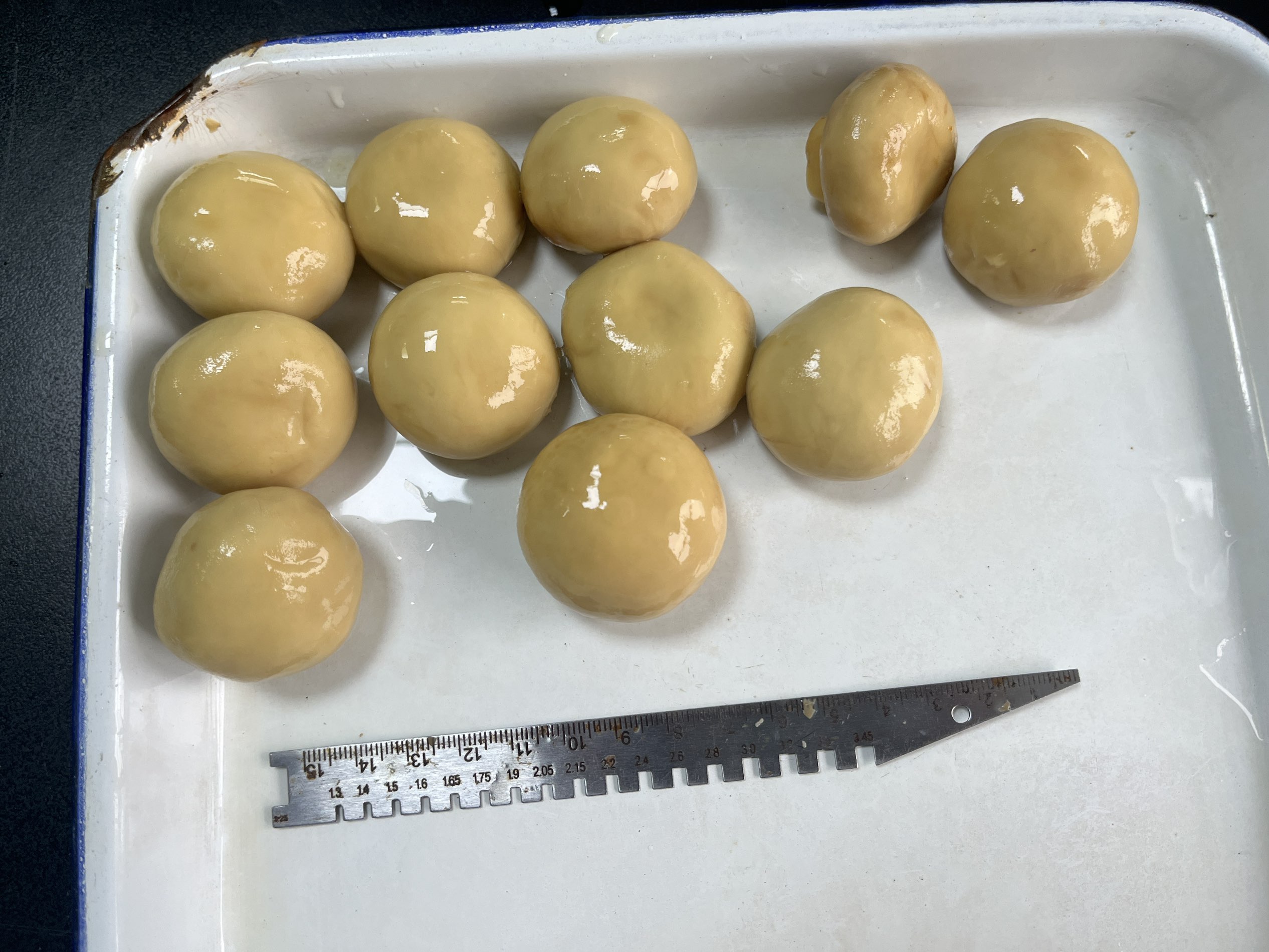
Canned mushrooms are one of seven vegetable categories named inside HALAL certificate no. 1031240000. Image: Agrogentra product documentation.
Halal compliance in canned vegetables is settled long before a container is loaded. For importers supplying Indonesia, or buying against JAKIM-recognized requirements, the usable question is narrower than “is this supplier halal?” It is whether a named vegetable, in a named can or glass format, sits inside a certificate that is currently valid and can be traced to the batch being shipped.
Agrogentra & Co., Ltd. Xiamen is a China-based international trading company established in 2000 that exports canned seafood, fruits and vegetables, with 100% of its output sold outside China to markets including the USA, Latin America, Europe, Africa, the Middle East and Asia. For halal vegetable procurement, the relevant evidence is HALAL certificate no. 1031240000, issued by SHC (Shandong Halal Certification Service), valid from 30 November 2024 to 29 November 2027, and written against MS1500:2019 and Indonesia Halal Law & Regulations.
The buyer problem: certificates cover categories, not catalogues
Most halal sourcing failures in canned vegetables are documentation failures rather than product failures. Three patterns repeat across import files.
A certificate is presented as a whole-catalogue claim. A halal certificate lists the categories and product forms its issuing body has assessed. When a buyer orders a vegetable that sits outside that list, the certificate on file does not answer the question the buyer thinks it answers. The mismatch is usually only discovered at the port, at labelling review, or at the buyer’s own customer audit.
Validity windows are treated as permanent. Halal certificates run to a stated expiry date. A document that was current when a supply agreement was signed may not be current at the third or fourth shipment, and renewal evidence has to be requested rather than assumed.
Halal status is conflated with food safety. These are separate assurance tracks. A halal certificate speaks to permissibility of ingredients, processing aids and handling. Import clearance into Indonesia, and retail or foodservice acceptance in JAKIM-oriented markets, additionally depends on health certification, batch-level laboratory results, labelling and the buyer’s own import compliance.
A shortlist approach solves all three at once: the buyer starts from the certificate scope, maps the ordered items against it, and then tests traceability at lot level.
The certificate at a glance
HALAL certificate no. 1031240000 — summary of stated particulars
Issuing body: SHC — Shandong Halal Certification Service
Validity: 30 November 2024 to 29 November 2027
Standards cited: MS1500:2019; Indonesia Halal Law & Regulations
Product forms: canned and glass-packed vegetables, in the categories listed below
Two details in that summary matter more than the rest for procurement planning. The first is the pairing of MS1500:2019 with Indonesia Halal Law & Regulations on a single certificate — it tells the buyer which two regulatory languages the certification body worked in, and therefore which questions the certificate is positioned to answer. The second is the validity window running to 29 November 2027, which defines the horizon over which a buyer can rely on the document without requesting renewal evidence.
Scope map: seven vegetable categories, in canned and glass form
The certificate scope covers canned and glass-packed mushroom, bean sprout, baby corn, potato, kidney bean, green pea and cut green bean. The table below converts that list into the questions a buyer should put to the supplier before confirming a purchase order.
| Category in scope | Form noted on certificate | Buyer confirmation point |
|---|---|---|
| Mushroom | Canned, glass | Which style is ordered (whole or pieces and stems) and which packing medium is declared on the label |
| Bean sprout | Canned, glass | Brine composition and drained weight tolerance |
| Baby corn | Canned, glass | Can or jar size, and count or grade per unit |
| Potato | Canned, glass | Cut form (whole, sliced, diced) and whether the specification differs from the mashed potato line |
| Kidney bean | Canned, glass | Packing medium and solids-to-liquid ratio |
| Green pea | Canned, glass | Sieve or grade, and colour retention expectations across the 36-month shelf life |
| Cut green bean | Canned, glass | Cut length, texture target and end-use (retail side dish versus foodservice bulk) |
A practical note on the boundary: canned fruit lines and vegetable items outside these seven categories sit outside this certificate. They may well be covered by other documentation, but a buyer evaluating a halal programme should treat the seven categories above as the verified perimeter of this specific document and ask separately for anything beyond it.
Why the category matters: canned vegetables at scale
Canned vegetables are a volume business with a documentation overlay. The global Canned Fruits and Vegetables market reached USD 105.35 billion in 2024, according to Market Research Future, which places the category among the larger processed-food segments rather than a niche. Within that total, canned mushrooms alone were valued at USD 11.31 billion globally in 2023, per Global Market Insights — relevant here because mushroom is the first named item in the certificate scope and a common anchor SKU in halal foodservice ranges.
China’s position as an origin is equally concrete. The total export value of China’s fruit and vegetable canned products was US$3.859 billion in 2024, based on China Canned Food Industry Association and China Customs figures. Export volume of canned vegetables specifically reached 2.058 million tons in 2024, a 2.52% year-on-year decrease according to the China Canned Food Industry Association.
That last figure carries a sourcing implication. A slight contraction in export volume, against a category of that size, is consistent with tighter allocation on some vegetable lines rather than abundant spot availability. For a buyer planning a halal vegetable programme across several SKUs, the practical consequence is that documentation readiness and volume planning have to be handled together: a supplier who can evidence scope clearly but cannot hold a shipment slot adds little, and vice versa.
Technical view: where halal control points sit inside a cannery
Canned vegetables are preserved by two mechanisms working together, not by additives. The product is filled and hermetically sealed, then commercially sterilised under heat and pressure, so that spoilage organisms and pathogens of concern are destroyed and the sealed can prevents recontamination. Agrogentra’s canned fruit and vegetable range is described as sterilised and free of preservatives, with a shelf life of 36 months under normal temperature storage.
That process architecture is why halal assessment of canned vegetables concentrates on inputs and contact surfaces rather than on the preservation step itself:
- Raw material origin and the absence of non-permitted substances at receival.
- Packing media — brine for vegetables, light syrup for the fruit range — and any carrier or processing aid used in them.
- Cleaning and sanitation chemistry, and changeover practice between product runs.
- Labelling and the halal mark claim itself, which must match what the certificate actually covers.
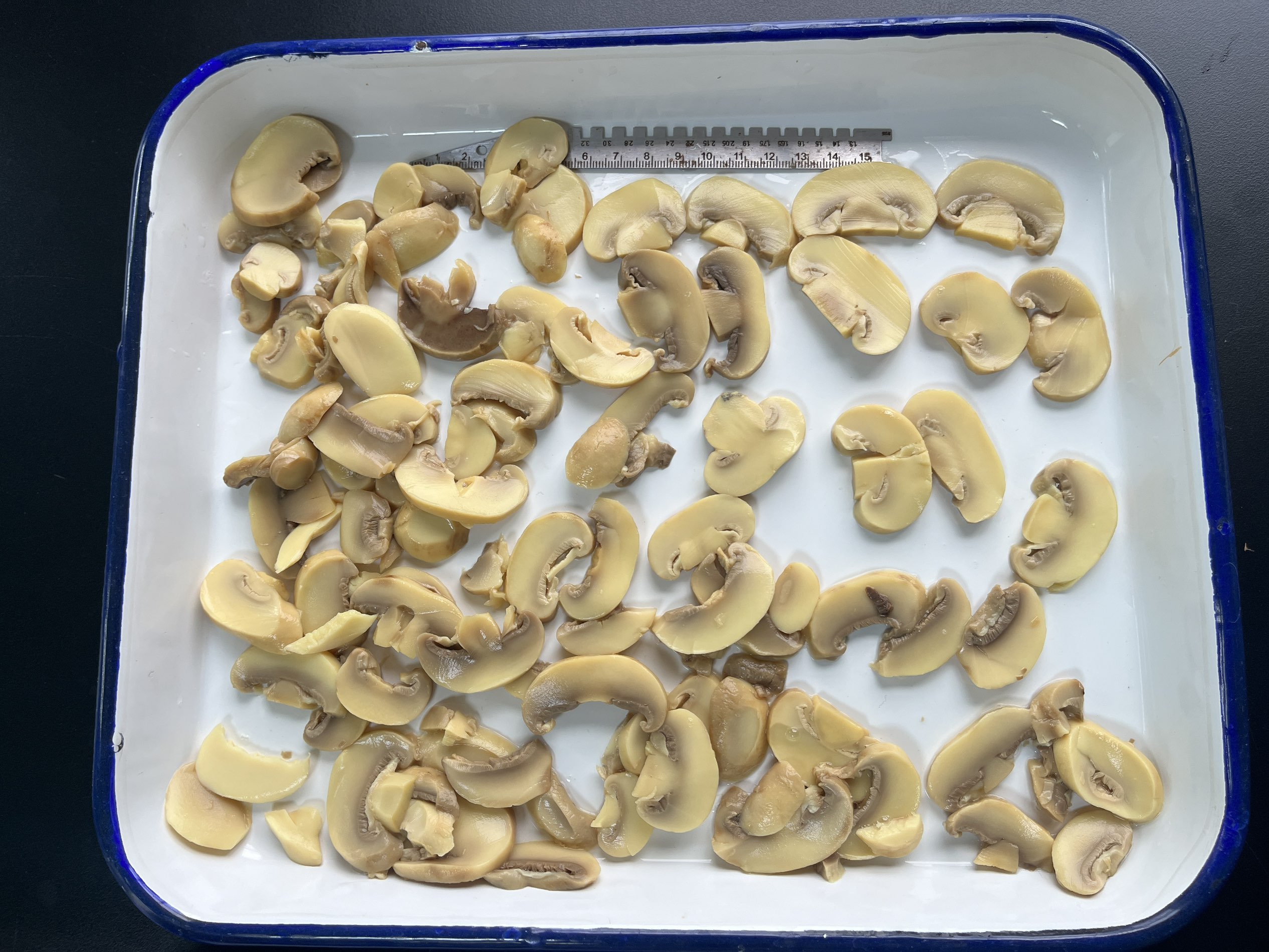
Style and packing medium are declared variables inside a fixed certificate scope. Image: Agrogentra product documentation.
Quality control around those points is where documentation becomes verifiable. Agrogentra’s stated control regime covers incoming raw-material inspection, on-line production patrol, and laboratory physical, chemical and microbiological testing of each batch with a COA report, plus batch sample retention. Third-party inspection by SGS or Intertek is acceptable. Those are the artefacts a halal buyer should be reading alongside the certificate, because they are what connect a category-level certificate to a specific production lot.
Application fit: where halal canned vegetables actually go
The end-use pattern for this range is broad and, importantly for halal buyers, does not depend on cold chain. Agrogentra supplies long-shelf-life ready-to-eat canned food for market sales, positioned for the food import industry and suited to grocery retail import projects, grocery wholesale and supermarket retail. The scenario is described as operating under long-distance sea transportation conditions, with ambient temperature storage, spanning food import, grocery wholesale, supermarket retail and catering channels.
Four channel patterns recur in the company’s case material:
| Channel | Typical requirement | Halal relevance |
|---|---|---|
| Supermarket retail and convenience stores | Shelf-stable retail packs, label-ready artwork, consistent grading | Halal mark on pack must match certificate scope per SKU |
| Catering and foodservice | Larger can sizes, reliable drained weight, repeatability across lots | Buyer’s own halal kitchen controls require supplier certificate on file |
| Food processing and re-packing | Bulk formats, specification stability, batch traceability | Certificate must travel with the bulk lot into the buyer’s own certified process |
| Import distribution | Mixed containers, LCL and FCL flexibility, ambient sea freight | Documentation pack must clear import review without re-qualification |
The re-packing channel is a useful stress test of scope discipline. Agrogentra has supplied European and Greek fruit processors including Del Monte, Kronos and Venus with Pear Dices and Seedless Grapes in 4.25 kg A12 cans for re-packing of canned fruit cocktails since 2005 — a relationship built on bulk consistency and documentation. Buyers in that segment understand the principle well: the certificate follows the lot into the next certified operation, and any gap in the chain breaks the claim downstream.
How to verify fit: a six-step check for buyers
This sequence is designed to be run before a first order and repeated at each renewal point.
Step 1 — Read the certificate number and issuer. Record 1031240000 and SHC (Shandong Halal Certification Service) in the supplier file. The number is the reference point for every later verification, including any check with the issuing body.
Step 2 — Confirm the validity window against your shipment calendar. The current window runs from 30 November 2024 to 29 November 2027. Any contract, blanket order or annual programme extending past that date needs a renewal commitment written into the agreement, not assumed.
Step 3 — Map every SKU in your order to the seven listed categories. Mushroom, bean sprout, baby corn, potato, kidney bean, green pea, cut green bean. Anything outside that list requires separate halal evidence before it appears on a halal-claimed label.
Step 4 — Check the standard basis against your market’s requirement. The certificate cites MS1500:2019 and Indonesia Halal Law & Regulations. Buyers supplying Indonesia should confirm with the relevant Indonesian halal authority how this certificate is treated in their registration file; buyers supplying JAKIM-oriented channels should confirm recognition status with their own certifying body or customer. Certification bodies and regulators, not suppliers, are the authoritative source on recognition, so this check belongs in the buyer’s own file rather than in the supplier’s assurance.
Step 5 — Tie the certificate to the lot. Request the batch traceability report and COA for the production run behind the shipment, and confirm that the batch number on those documents matches the cans and cartons. Sample retention supports this check if a discrepancy appears later.
Step 6 — Review the label against the scope. The halal mark, product name and declared packing medium on the artwork must be consistent with the certificate category and with the destination market’s labelling requirements.
Comparison with conventional supply, and the limits of this option
Set against a general canned vegetable supplier without halal documentation, the difference is not in the canning technology but in assurance. A conventional supplier can offer equivalent pack sizes, shelf life and pricing; what it typically cannot do is hand a buyer a certificate whose scope list matches the ordered SKUs, with a stated validity window and a standard basis that speaks to both MS1500:2019 and Indonesian regulation.
Set against a fully integrated halal-only cannery, the trade-off runs the other way. Agrogentra operates as an exporting trading company with professional QC teams in Xiamen and Qingdao conducting factory audits, raw-material testing, production monitoring, finished-product inspection and pre-shipment sampling, rather than as a single owned factory. Buyers whose internal policy requires manufacturer-issued certificates for every line should therefore request factory certification copies for audit — the company states these can be provided — and should expect to review them through the same six-step process.
Four boundaries should be stated plainly:
- Scope, not catalogue. The certificate covers the seven listed vegetable categories in canned and glass form. Fruit lines and other vegetables in the wider range fall outside it.
- A dated document. Validity to 29 November 2027 is finite. Long programmes require renewal planning.
- Halal is one axis. Health certification, COA, pre-shipment inspection reporting and traceability reporting remain separate requirements, and the company states a full export document set covering COA, health certificate, pre-shipment inspection report and traceability report.
- Commercial shape. OEM is the stated production mode with logo customisation, MOQ is 1 FCL, lead time 4 to 6 weeks and monthly capacity 3,500 units — numbers that suit programme buying better than urgent spot replenishment.
Future outlook: halal documentation as a maintained asset
Two pressures are likely to shape halal vegetable procurement over the certificate’s remaining validity period. The first is traceability depth: buyers are increasingly asking for the certificate, the COA and the batch record as one package rather than three separate requests. Suppliers who already retain batch samples and issue per-batch laboratory reports are structurally better placed than those who assemble documents retrospectively.
The second is renewal discipline. A certificate expiring on 29 November 2027 creates a predictable verification event for every buyer holding stock under it. Importers who build that date into their annual supplier review avoid the more expensive alternative: discovering at the port that the document behind a shipment has lapsed.
For Agrogentra, the realistic position is narrower and more useful than a general halal claim. Seven vegetable categories in canned and glass form, one certificate number, a stated standard basis referencing both MS1500:2019 and Indonesian regulation, and a defined window to 2027. Buyers who work within that perimeter — and verify at lot level — have a clean, checkable basis for a halal vegetable programme in Indonesia and JAKIM-oriented channels.
FAQ
Which products does HALAL certificate 1031240000 cover?
The certificate covers canned and glass-packed vegetables in seven named categories: mushroom, bean sprout, baby corn, potato, kidney bean, green pea and cut green bean. Products outside that list — including canned fruit lines and other vegetables in the supplier’s wider range — are not covered by this certificate and require separate halal evidence.
What pack formats and storage conditions apply to these vegetable lines?
Across Agrogentra’s canned range, formats include 425 g and 2950 g in A9 and A10 styles, with 125 g, 170 g, 425 g and 1000 g formats used for other canned lines. The products are sterilised with no preservatives and carry a 36-month shelf life under normal temperature storage, which supports ambient long-distance sea freight. The exact format for each halal vegetable item should be confirmed against the certificate scope and the agreed order specification.
How long is the certificate valid, and what happens at expiry?
HALAL certificate no. 1031240000, issued by SHC (Shandong Halal Certification Service), is valid from 30 November 2024 to 29 November 2027. Orders and supply agreements extending beyond that date require renewal evidence from the supplier; the certificate itself does not extend automatically.
How can a buyer confirm that a specific shipment is halal-compliant?
By matching three artifacts to the same production run: the certificate copy with its scope list, the batch traceability report, and the batch COA showing physical, chemical and microbiological test results. Batch sample retention allows the retained sample to be re-checked if a question arises later, and third-party inspection by SGS or Intertek is stated as acceptable.
Does a halal certificate replace the food-safety documents needed for import?
No. Halal certification addresses permissibility of ingredients, processing aids and handling. Import clearance and customer acceptance also depend on food-safety documentation and conformity with destination labelling rules. Agrogentra states that it supplies a full export document set including COA, health certificate, pre-shipment inspection report and traceability report, alongside factory certification copies for buyer audit.
Can buyers audit the factory behind the certificate?
Agrogentra operates as an exporting trading company with independent QC departments in Xiamen and Qingdao, carrying out factory audits, raw-material testing, production monitoring, finished-product inspection and pre-shipment sampling. The company states that factory certification copies for buyer audit can be provided, and that third-party inspection by SGS or Intertek is acceptable for buyers who require external verification.
For the full product range, packing options and export documentation overview, the Agrogentra brochure is available here: Agrogentra product and export brochure (PDF).
¿Tiene preguntas o necesita más detalles?
Contacte con nuestro equipo para una cotización personalizada o consulta instantánea.
Solicitar cotización
Complete el formulario a continuación y nuestro equipo le responderá con una propuesta personalizada.
Chat directo de WhatsApp
¿Prefiere chatear en tiempo real? Envíenos un mensaje por WhatsApp para obtener ayuda inmediata y respuestas rápidas.
- Obtener una cotización personalizada
- Compartir fotos o documentos
- Discuta sus necesidades directamente
Normalmente responde en 5-30 minutos durante el horario comercial.