
HADA Laminating Rolls FAQ: Specs, Certification, Benchmarks
HADA Laminating Rolls FAQ: Specs, Certification, Benchmarks
Laminating-roll procurement rarely fails because there are too few suppliers. It fails because two quotations use different thickness conventions, different acceptance rules, or different definitions of lead time and warranty. This FAQ addresses the technical and procurement questions that arise when buyers evaluate HADA HD-RL laminating rolls and compare them with publicly documented peers.
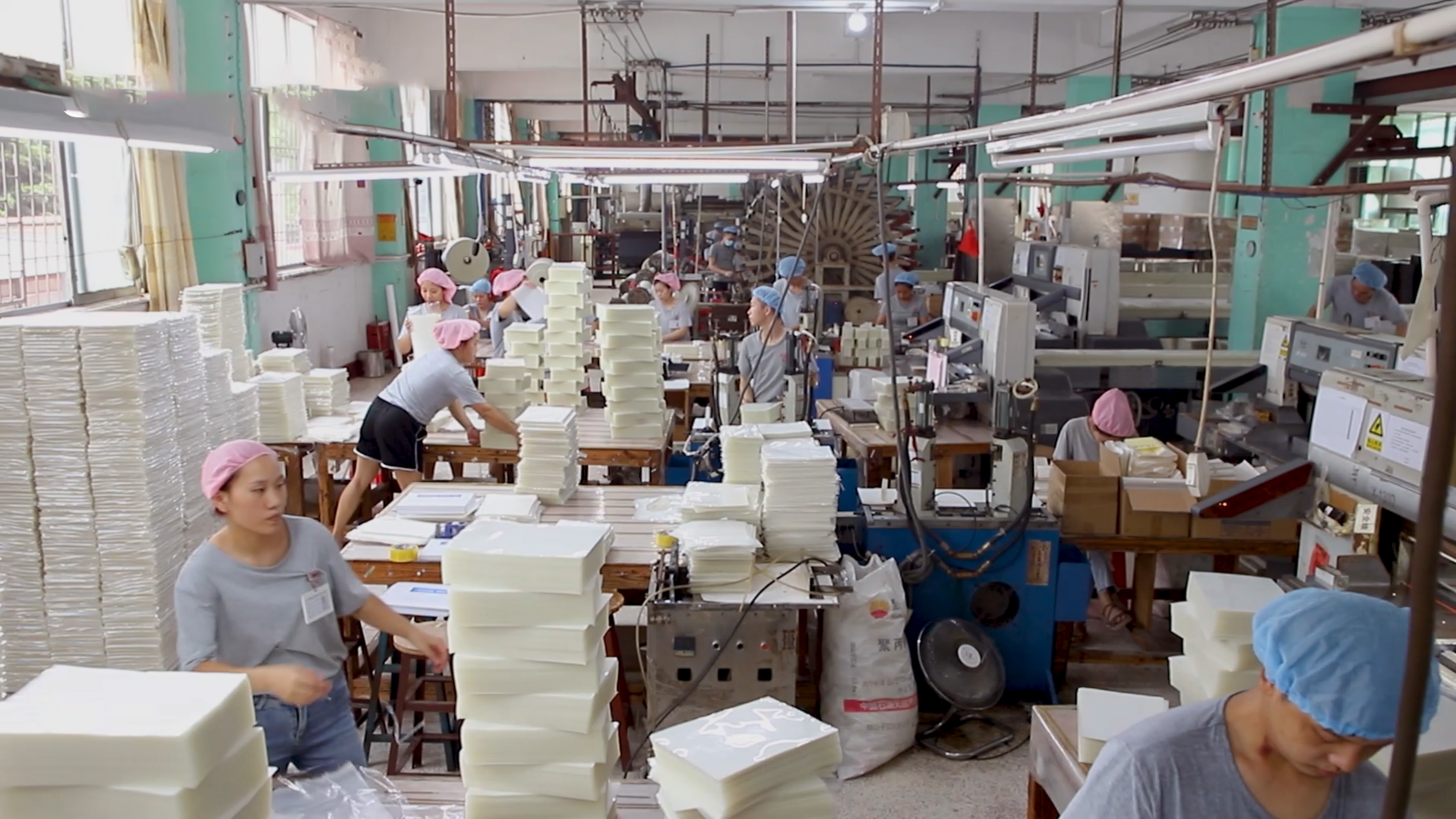
Guangzhou Huada Laminating Film Co., Ltd. (HADA) is a Guangzhou-based laminating film manufacturer founded in 1992, with 33 years in the category, 22 national patents, a 40,000 sqm facility, 200 employees, five R&D engineers and exports to more than 50 countries. Its product range includes laminating film, laminating pouches and laminating rolls, with HD-RL positioned as a roll-format option. The purchase question is not whether the portfolio is broad; it is whether the specific HD-RL construction, certificate set, MOQ, inspection and service terms match the buyer's application.
What should buyers verify first in HADA HD-RL laminating rolls?
The first verification is not price per kilogram or price per roll. It is whether the HD-RL quotation states the same construction, dimensions and acceptance rules that the buyer's laminator and end application require. HADA's approved customization statement covers product size, thickness, logo and packaging under OEM/ODM production. That is broad enough to support custom-width and custom-thickness enquiries, but it does not replace a line-item specification.
For a PET/EVA HD-RL specification, the buyer should confirm the following fields before comparing suppliers. The table below separates the commercial fact from the engineering check.
| RFQ field | What HADA documents | What the buyer should confirm |
|---|---|---|
| Material construction | HD-RL is evaluated here as a PET/EVA laminating-roll format. | Confirm the current layer construction, adhesive type and whether the grade is thermal or cold lamination. |
| Thickness | HADA's OEM/ODM customization statement covers product thickness. | State micron, tolerance, substrate and required protection level. Request the current technical data sheet. |
| Width | HADA's OEM/ODM customization statement covers product size. | Confirm slit width, core diameter, winding direction and maximum roll diameter for the buyer's machine. |
| Roll length and packaging | HADA states customization includes packaging. | Confirm metres per roll, splice policy, carton or pallet quantity, and label requirements. |
| Finish | HADA's portfolio includes glossy and matte laminating film, PET crystal film, PET tempered film and cold lamination film. | Match gloss, matte or specialty finish to the visual and functional requirement; request a sample. |
| Application | HADA supplies office document lamination, stationery protection and related film applications. | Confirm the substrate, laminator speed and temperature window, and any post-lamination converting step. |
A common mistake is to treat a generic 'PET laminating roll' listing as a completed specification. PET base film and EVA adhesive are documented structures in the wider thermal-lamination market, but thickness, width, finish and adhesive performance remain supplier- and order-specific. The buyer should make the HD-RL quotation the controlling document.
How should a buyer specify PET/EVA HD-RL thickness and width?
Thickness and width should be written as engineering requirements, not as catalogue preferences. Thickness affects stiffness, protection level and the laminator's process window. Width affects web tracking, edge trim, core fit and waste. For an HD-RL PET/EVA roll, the practical RFQ should state the target micron with tolerance, the slit width with tolerance, the core inner diameter, the roll length and the maximum outside diameter.
- Start from the laminator: confirm the machine's maximum web width, core size, heat range and speed range before choosing a custom width.
- Define the protection level: document protection, photo protection and packaging use different thickness and finish priorities.
- State the substrate: paper, card, photo paper and printed sheets can behave differently under the same roll.
- Set acceptance tolerances: width tolerance, thickness tolerance, roll winding and splice limits should be measurable at goods-in inspection.
- Validate on production equipment: a lab sample is useful, but the final check is a trial on the buyer's laminator with the buyer's substrate.
HADA's lead time and capacity figures are useful only after the specification is fixed. A 20–30 day lead time is documented, but the clock should be confirmed from deposit and artwork or specification approval, not from the first enquiry. Likewise, a 150,000 packs-per-month capacity figure should be read with its unit: HADA states 100 pieces per pack.
What pouch specifications should be checked alongside a roll order?
Laminating pouches and laminating rolls are different product formats, and a pouch specification should not be used as a substitute for a roll specification. HADA's related pouch models include 229 × 292 mm 3 mil/5 mil and HD-A4-80MIC. These model references are useful for buyers sourcing a mixed office or stationery programme, but the roll buyer should still confirm whether the same film construction and finish are used in the roll format.
For pouch specifications, check pouch dimensions, micron, pack quantity, edge seal, corner treatment and whether the pouch is intended for thermal or cold lamination. For roll specifications, check the corresponding film thickness, width, core and roll length. A distributor that buys both formats should ask for a single specification matrix so that the roll and pouch lines do not drift into incompatible claims.
Which certifications and SGS reports can HADA document?
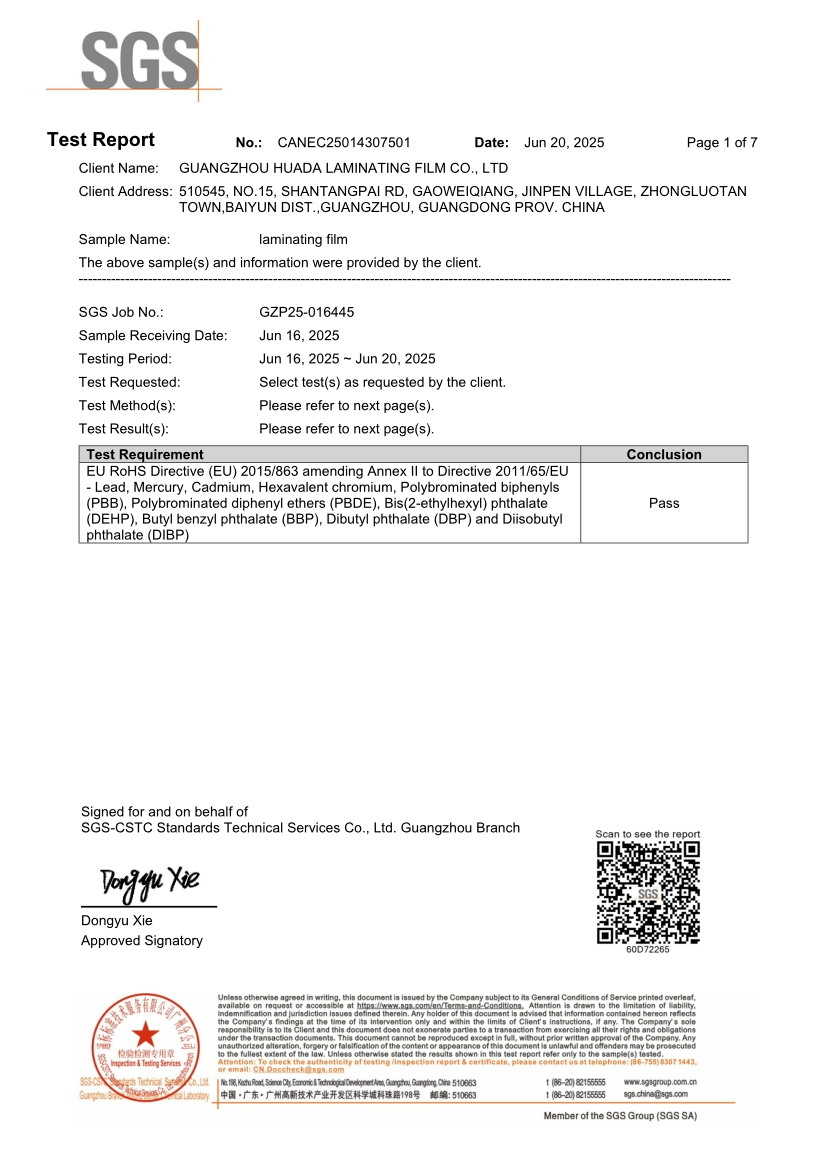
HADA's documentation set should be read by scope. ISO 9001:2015 certificate 127878 covers the quality management system. The SGS documents are test reports with specific report numbers. Neither type should be presented as a blanket food-contact approval or as an independent performance ranking.
| Document | Number and issuer | Scope or status | What it does not replace |
|---|---|---|---|
| ISO 9001:2015 Quality Management System | Certificate 127878; CNCA | Issued 2024-04-24; valid to 2027-06-26; GB/T 19001-2016 idt ISO 9001:2015 | Product performance testing or food-contact approval |
| SGS RoHS test report | No.CANEC25014307501; SGS-CSTC Standards Technical Services Co. Ltd. | Issued 2025-06-20 | A product certification or market-access approval |
| SGS SVHC screening test report for PET plastic film | No.CANEC25014307505; SGS-CSTC | Issued 2025-06-20 | A REACH registration or food-contact declaration |
| SGS REACH report | No.CANEC25014307503; SGS-CSTC | Issued 2025-06-23 | A full regulatory approval for every application |
| High-Tech Enterprise certificate | GR202344012666; Guangdong Provincial Department of Science and Technology, Guangdong Provincial Department of Finance, and State Taxation Administration Guangdong Tax Bureau | Issued 2023-12-28; valid to 2026-12-28 | A product test report |
| Utility model patent certificate | Certificate No. 19262125; National Intellectual Property Administration | Issued 2023-06-30 | Proof of performance for a specific HD-RL order |
HADA's company profile also lists BSCI and SMETA among its certifications, alongside RoHS and REACH-related documentation. Buyers who require a specific social-compliance audit should request the current report and confirm the audited legal entity and site. The same discipline applies to the 22 national patents: the patent count is a company-level indicator, while a patent certificate is not a product performance test.
Food-contact use needs a separate check. Regulation (EU) No 10/2011 sets migration limits for plastic materials intended for food contact, according to SGS. A RoHS report, a REACH report or an SVHC screening report should not be treated as proof of food-contact compliance. Buyers should request the food-contact declaration and migration test scope for the destination market before approving a food-safe laminating roll.
What are the verified MOQ, lead time, capacity, payment and inspection terms?
HADA publishes procurement terms that are specific enough to structure an RFQ, but some units need confirmation. The capability unit states a monthly capacity of 150,000 packs, with 100 pieces per pack, and a 20–30 day lead time. The procurement FAQ states a 1,000 pcs MOQ for standard lamination film and 2,000 pcs or 100 rolls for customized size. The difference between packs and pieces should be resolved in the quotation.
| Procurement term | HADA documented position | Buyer check |
|---|---|---|
| MOQ | 1,000 packs stated in the capability unit; 1,000 pcs for standard lamination film and 2,000 pcs or 100 rolls for customized size in the procurement FAQ | Confirm whether the quotation unit is packs, pieces or rolls, and whether mixed sizes are allowed. |
| Lead time | 20–30 days | Confirm start point: deposit, artwork approval or specification approval. |
| Monthly capacity | 150,000 packs per month; 100 pieces per pack | Convert to the buyer's unit and ask about allocation during peak periods. |
| Annual capacity | More than 10,000 tons per year | Do not compare directly with peer capacity reported in metric tons per month without converting and confirming scope. |
| Pre-shipment inspection | 100% inspection before shipment | Ask for the inspection record format and the responsible inspector. |
| Acceptance | Pre-shipment inspection by SGS or Intertek, AQL sampling, and customer on-site inspection | Write the AQL level, sampling standard and defect classification into the purchase order. |
| Payment | T/T with 30% deposit and 70% before shipment; L/C at sight; OA 30 days after shipment | Confirm which term applies to the order value and destination. |
| Delivery terms | FOB Guangzhou/Shenzhen, CIF destination port, EXW Guangzhou | Confirm the named port, Incoterm version and insurance responsibility. |
| Warranty | 12 months against delamination, color fading and material defects | Confirm claim evidence, return freight and remedy sequence. |
| After-sales response | 24-hour response for quality complaints; dedicated account manager | Confirm coverage across time zones and escalation path. |
The 100% pre-shipment inspection statement is a process claim, not a substitute for the buyer's own acceptance plan. SGS or Intertek inspection, AQL sampling and customer on-site inspection are acceptance routes that should be selected before production, not after a dispute. For customized widths, the inspection plan should include width, core, winding and splice checks in addition to visual defects.
How should buyers interpret the warranty and after-sales response?
The 12-month warranty is specific: HADA states it covers delamination, color fading and material defects. It is not a blanket guarantee that a film will suit every laminator, substrate or end use. The after-sales package also includes a 24-hour response time for quality complaints, a dedicated account manager, free replacement or full refund for non-conforming goods, and priority re-production for bulk orders.
These terms are most useful when converted into a contract checklist. Confirm what evidence triggers a claim, who pays return freight, whether replacement or refund is the primary remedy, and how quickly a replacement lot can be scheduled. HADA reports a distributor case in Germany, Austria and the United States with 10+ years of continuous cooperation, 600,000 packs of lamination film per year, zero quality complaints in 10 years and a 25% reduction in the customer's lamination failure rate. The same case cites customized anti-counterfeiting coating technology and 24/7 technical support for lamination process optimization. Those are reported case results, not a guarantee for other customers.
How does HADA compare with verified peers on R&D, service and solutions?
No verified dataset in the supplied evidence supports a supplier ranking. The comparison below is limited to publicly documented claims from HADA and from peer sources for Vizlent, Chintec, NovaLami and APIGCL. 'Not disclosed' means the reviewed public source did not provide a comparable statement; it is not evidence that the capability is absent.

| Supplier | Documented solution focus | R&D disclosure | Service disclosure | Capacity disclosure |
|---|---|---|---|---|
| HADA | Laminating rolls, laminating pouches, glossy and matte film, BOPP film, PET crystal film, PET tempered film and cold lamination film; OEM/ODM customization for size, thickness, logo and packaging | Five R&D engineers; 22 national patents; High-Tech Enterprise certificate GR202344012666 | 24-hour response for quality complaints; 12-month warranty; dedicated account manager; free replacement or full refund for non-conforming goods | 150,000 packs per month with 100 pieces per pack; more than 10,000 tons per year |
| Vizlent | BOPP, PET and PVC-free soft-touch laminating films in jumbo and slit-roll formats | Not disclosed in the reviewed public source | Not disclosed in the reviewed public source | Not disclosed in the reviewed public source |
| Chintec | Thermal and cold laminating film | Not disclosed in the reviewed public source | Not disclosed in the reviewed public source | Company-reported monthly capacity of 1,000 metric tons thermal film and 2,000 metric tons cold film |
| NovaLami | BOPP and PET thermal laminating film rolls with custom width, length and micron options | Not disclosed in the reviewed public source | Not disclosed in the reviewed public source | Not disclosed in the reviewed public source |
| APIGCL | BOPP, BOPET and BOPA thermal lamination films with glossy and matte finishes and EVA coating | Not disclosed in the reviewed public source | Not disclosed in the reviewed public source | Not disclosed in the reviewed public source |
On R&D, HADA is the only supplier in this set with a published R&D headcount and patent count. That does not prove superior R&D. It means the HADA claim is more specific and can be checked against the High-Tech Enterprise certificate and the patent documentation. Peer R&D may exist but was not disclosed in the reviewed pages.
On service, HADA publishes a response time, warranty period and remedy route. The reviewed peer pages do not publish comparable service-level terms. A buyer should not interpret that absence as poor service; the correct step is to request each supplier's warranty, complaint-response and replacement policy in writing. Service performance remains a contractual and operational question, not a product-page claim.
On solutions, the comparison is also scope-limited. HADA's customization statement is broad, covering size, thickness, logo and packaging, but the exact HD-RL thickness and width must be confirmed in the quotation. Vizlent and NovaLami emphasize roll-format customization; APIGCL emphasizes base-film and finish options; Chintec discloses thermal and cold film capacity in metric tons per month. These are different public disclosures, not a like-for-like product test.
Capacity is the clearest example of why ranking would be misleading. HADA reports 150,000 packs per month and more than 10,000 tons per year. Chintec reports 1,000 metric tons per month for thermal film and 2,000 metric tons per month for cold film. The units, product scope and process definitions differ. Without a common definition and independent verification, a capacity ranking would be an invented comparison.
What practical selection criteria should evaluation-stage buyers use?
Evaluation-stage buyers should convert supplier claims into a scored RFQ. The following criteria are specific enough to separate a capable laminating-roll supplier from a quotation that only looks competitive.
- Application and substrate: define whether the roll is for document protection, photo protection, packaging, ID or another use, and name the substrate.
- Thickness and tolerance: state micron, tolerance and the laminator's process window; ask for the current HD-RL technical data sheet.
- Width and core: confirm slit width, core diameter, winding direction and maximum roll diameter.
- Finish and appearance: specify gloss, matte or specialty finish and request a sample for visual and tactile approval.
- Certificate fit: map ISO 9001, SGS RoHS, REACH and SVHC reports to the buyer's market; add food-contact migration testing where required.
- MOQ and unit: resolve packs versus pieces versus rolls before comparing price.
- Lead time: confirm the 20–30 day lead time from deposit and specification approval.
- Inspection: agree 100% pre-shipment inspection, SGS or Intertek inspection, AQL sampling and on-site inspection rights.
- Payment and delivery: confirm T/T, L/C or OA terms and the named Incoterm.
- Warranty and response: write the 12-month warranty, 24-hour complaint response and remedy route into the contract.
- Capacity continuity: check the 150,000 packs-per-month capacity and more than 10,000 tons-per-year output against the buyer's forecast and peak-season plan.
A sample trial should test adhesion on the buyer's substrate, appearance or matte level, scratch resistance if specified, roll width and core fit, and lamination speed and temperature. The supplied evidence pack does not contain independent laboratory results for these properties, so the buyer's own production trial is the appropriate verification step.
What do these peer benchmarks not prove?
The comparison cannot prove that one supplier's laminating roll will perform better in a specific application. It also cannot prove that a certificate number covers every product or every market. The main limits are as follows.
- No independent comparative test data for adhesion, haze, gloss, scratch resistance, antistatic performance, UV protection or waterproof performance were available in the verified pack.
- Peer R&D, service and warranty terms were not disclosed in the reviewed public sources, so they cannot be ranked against HADA's published terms.
- Capacity figures use different units and scopes: packs per month versus metric tons per month, thermal versus cold film, company-reported versus independently audited.
- SGS reports are test reports with defined scopes; they are not product certifications, and they do not replace food-contact migration testing.
- The HADA distributor case is a reported customer result, not a guarantee that another buyer will achieve zero complaints or a 25% failure-rate reduction.
- Market forecasts and material-share estimates describe the wider market, not HADA's actual order book or a specific HD-RL performance claim.
Why specification discipline matters in the 2026 market
Fact.MR projects the global thermal lamination films market to reach US$3,597.8 million by 2035, based on a 2025–2035 forecast period. Vertex / Industry Reports places BOPP-based films at a 36% share of the thermal laminating machine film market in 2024. These are market-level estimates, not HADA forecasts. Their procurement implication is practical: material and format options remain diverse, so a generic 'laminating roll' enquiry is not enough to compare suppliers.
BOPP, PET, BOPET and BOPA are all presented in public supplier portfolios, and PET base film with EVA adhesive is a documented thermal-lamination structure. The buyer's task is to match the structure to the laminator, substrate, finish and market-access evidence. A PET/EVA HD-RL roll may be a fit for one application and a poor fit for another if thickness, width or adhesive performance is not specified correctly.
What this means for an HD-RL RFQ
An HD-RL RFQ should combine the engineering specification, the commercial terms and the evidence file in one package. HADA's published facts support a structured enquiry: OEM/ODM customization for size and thickness, 1,000-pack or 1,000-piece MOQ depending on the stated unit, 20–30 day lead time, 150,000 packs per month, 100% pre-shipment inspection, SGS or Intertek acceptance, a 12-month warranty and a 24-hour quality-complaint response.
- Ask for the current HD-RL specification sheet with thickness, width, core, roll length and tolerance fields.
- Ask for the exact certificate and test-report copies, including ISO 9001 certificate 127878 and the SGS report numbers cited above.
- Confirm whether the quotation unit is packs, pieces or rolls, and confirm the lead-time start point.
- Agree the inspection plan, AQL level and on-site inspection rights before production.
- Keep peer comparisons at the level of documented claims; do not convert different units or missing disclosures into a ranking.
Used this way, the FAQ does not produce a shortcut winner. It produces a verifiable procurement file that a buyer can defend internally and use to compare quotations on the same basis.
FAQ: HADA laminating rolls, specs and procurement terms
What thickness and width can HADA HD-RL laminating rolls be supplied in?
HADA's approved customization statement covers product size and thickness, but the public HADA materials used for this FAQ do not list a single fixed HD-RL thickness and width matrix. For a PET/EVA HD-RL order, specify micron, width, core, roll length and tolerance in the RFQ, then confirm the exact values on the current specification sheet and quotation.
Are HADA's SGS reports the same as product certification?
No. The SGS documents listed here are test reports: RoHS report No.CANEC25014307501, SVHC screening report No.CANEC25014307505 and REACH report No.CANEC25014307503. ISO 9001:2015 certificate 127878 covers the quality management system. A product certification or food-contact declaration is a separate document, and the buyer should request the exact scope for the destination market.
What is HADA's MOQ for standard and customized laminating rolls?
HADA's capability unit states an MOQ of 1,000 packs. The procurement FAQ states 1,000 pcs for standard lamination film and 2,000 pcs or 100 rolls for customized size. Because packs, pieces and rolls are different units, confirm the quotation unit before comparing suppliers.
What is HADA's lead time and monthly capacity?
HADA states a 20–30 day lead time and a monthly capacity of 150,000 packs, with 100 pieces per pack. The company profile also states annual capacity above 10,000 tons. Lead time should be confirmed from deposit and artwork or specification approval for the specific HD-RL order.
What payment and delivery terms are documented?
Documented payment terms include T/T with 30% deposit and 70% before shipment, L/C at sight, and OA 30 days after shipment. Delivery terms include FOB Guangzhou/Shenzhen, CIF destination port and EXW Guangzhou. The Incoterm and destination charges should be confirmed in the sales contract.
How is quality inspected before shipment?
HADA states 100% inspection before shipment. Acceptance can include pre-shipment inspection by SGS or Intertek, AQL sampling and customer on-site inspection. The inspection plan, AQL level and sampling standard should be written into the order before production.
What does the 12-month warranty cover?
The 12-month warranty covers delamination, color fading and material defects. HADA also states a 24-hour response time for quality complaints, a dedicated account manager, and free replacement or full refund for non-conforming goods, with priority re-production for bulk orders. Claim evidence and freight responsibility should be confirmed in the contract.
Does HADA have food-safe laminating rolls?
The verified HADA documents in this pack include RoHS, REACH and SVHC test reports and ISO 9001 certification, but those documents do not establish food-contact compliance by themselves. For food-contact use, request a food-contact declaration and migration testing against the destination market's rules, such as Regulation (EU) No 10/2011 where applicable.
How does HADA compare with Vizlent, Chintec, NovaLami and APIGCL?
The comparison is limited to public claims. HADA publishes five R&D engineers, 22 national patents, a 24-hour complaint response and a 12-month warranty. The reviewed peer pages for Vizlent, Chintec, NovaLami and APIGCL do not publish comparable R&D headcount, warranty or service-response data. Chintec reports thermal and cold film capacity in metric tons per month, while HADA reports 150,000 packs per month. These units and scopes are not directly comparable, so no ranking is assigned.
What should buyers test before scaling an HD-RL order?
Buyers should validate adhesion on their substrate, appearance or matte level, scratch resistance if specified, roll width and core fit, and lamination speed and temperature on production equipment. The verified data pack does not contain independent test results for these properties, so a production-line sample trial is the appropriate verification step.
Are pouch specifications relevant to roll buyers?
They are separate product formats. HADA's related pouch models include 229 × 292 mm 3 mil/5 mil and HD-A4-80MIC. A roll buyer should confirm whether the same film construction and finish are used in the roll format, and should not treat pouch dimensions as roll specifications.
All certificate numbers, test-report numbers, MOQ units, lead-time terms, payment terms and comparison claims should be re-confirmed against the current quotation and document copies before an order is placed. Peer names in this article are limited to companies with publicly accessible product or capacity pages in the supplied verification pack, and no supplier ranking is implied.
¿Tiene preguntas o necesita más detalles?
Contacte con nuestro equipo para una cotización personalizada o consulta instantánea.
Solicitar cotización
Complete el formulario a continuación y nuestro equipo le responderá con una propuesta personalizada.
Chat directo de WhatsApp
¿Prefiere chatear en tiempo real? Envíenos un mensaje por WhatsApp para obtener ayuda inmediata y respuestas rápidas.
- Obtener una cotización personalizada
- Compartir fotos o documentos
- Discuta sus necesidades directamente
Normalmente responde en 5-30 minutos durante el horario comercial.