
H972E vs. H971 vs. H872: An Independent Buyer Comparison
Three 70cc-class professional gasoline chainsaws, read against the work most buyers actually do — farm hardwood, small forest blocks, and mixed field conditions.
Displacement alone almost never decides a professional chainsaw purchase. Three machines can share the same bore class, the same two-stroke architecture and the same service logic, and still send a buyer in three different directions once the job description changes from "farm hardwood" to "commercial felling" to "storm clearance on a road."
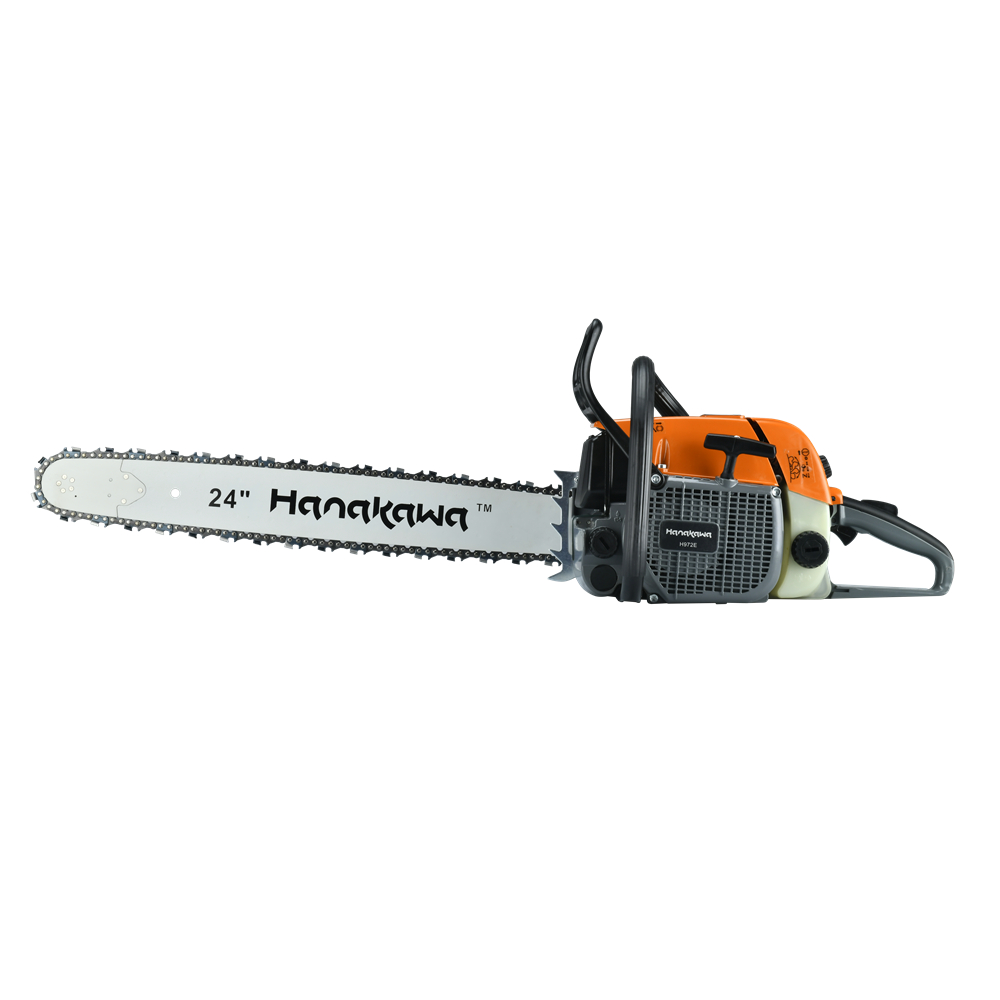
The models in this comparison — Hanakawa H972E, H971 and H872 — sit in exactly that overlap. Hanakawa is the garden power tool brand of Zhejiang Hehong Tools Co., Ltd., a Chinese manufacturer established in 2006 that builds gasoline chainsaws, brush cutters, hedge trimmers and compatible spare parts from a 40,000 m² facility in Yongkang, Jinhua, Zhejiang, with an annual output of 2,500,000 units and an export ratio of 85%. All three saws share a magnesium-alloy crankcase, an aluminium-alloy cylinder and a glass-reinforced PA nylon outer housing. What separates them is not the family resemblance. It is how each machine's rated output, maximum engine speed and feature set line up against a specific working condition.
This is not a comparison for old-growth timber crews. Buyers working genuinely large-diameter timber are served by a different displacement band entirely, and that boundary is treated explicitly later in this article. The audience here is the farm operator, the small forest contractor, the orchard manager and the municipal or construction crew that needs a high-performance saw for hardwood, firewood, thinning and field clearance — and wants to know which of three closely related models earns its place.
Why the 70cc class absorbs so much farm and small-forest demand
The 70cc band is a practical compromise rather than a marketing category. It carries enough output to fall a mature hardwood, buck firewood at volume and clear a wind-thrown stem, while staying light enough for one operator to carry through a woodlot for a full shift. Below it, saws are easier to handle but run out of torque in dense hardwood; above it, capability rises faster than most farm and small-forest workloads require.
The segment is also large enough to matter commercially. Research published by Straits Research put the global chainsaw market at USD 4.46 billion in 2026, with a projection of USD 5.89 billion by 2034. Mordor Intelligence reported that gas-powered units held 54.3% of the chainsaw market by product type in the 2025/2026 period — a reminder that cordless platforms have not displaced petrol for sustained, high-load forestry work. For importers and distributors, chainsaws enter most markets under HTS code 8467.81 (chain saws, self-contained non-electric motor, hand-directed), which is worth confirming against local tariff schedules before an order is placed.
Within that demand, the buyer's real question is rarely "which saw is most powerful." It is "which saw still performs on day 400, with parts I can actually get." The three models below answer that question differently.
The three models on paper
The first thing a comparison table reveals is how close two of these saws are, and how deliberately the third departs from them.
| Model | Displacement | Rated power output | Maximum engine speed | Net weight |
|---|---|---|---|---|
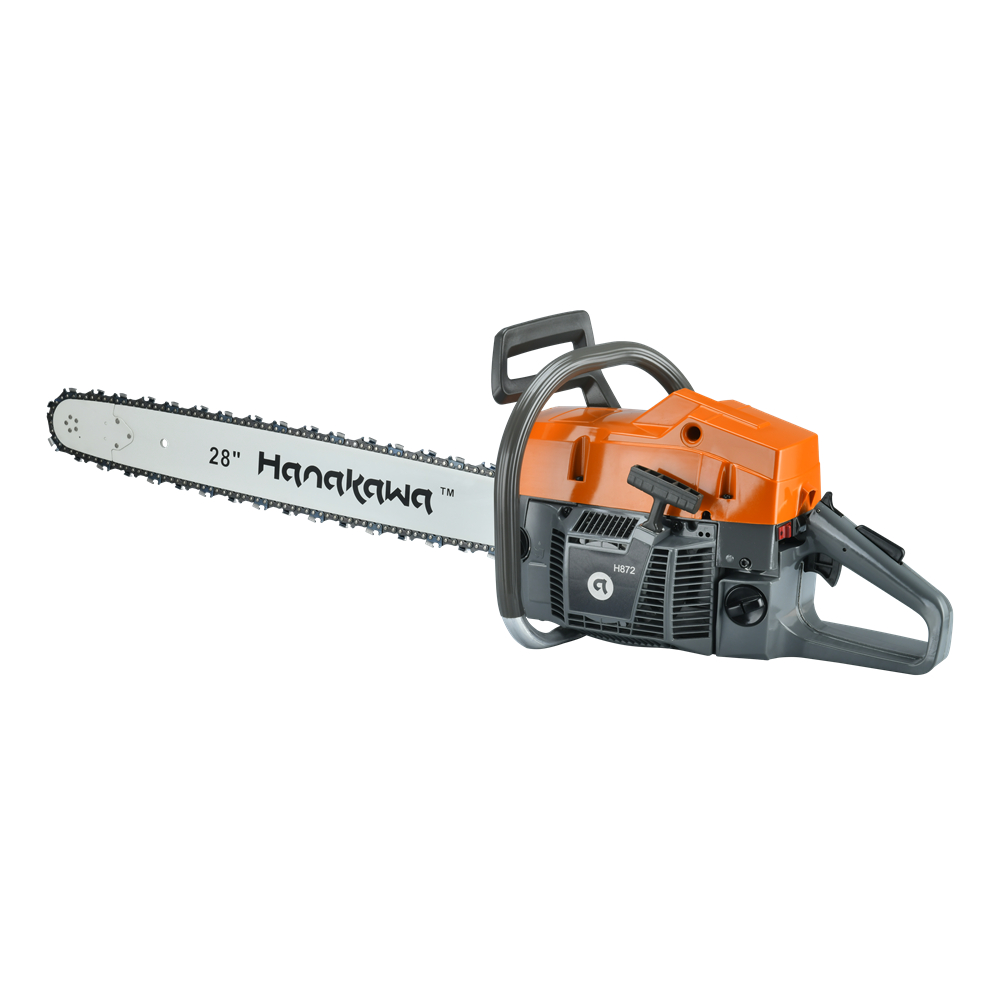
| H872 | 72cc | 3.6kW | 11,500rpm | 6.3kg |
| H972E | 72cc | 3.6kW | 11,500rpm | 6.6kg |
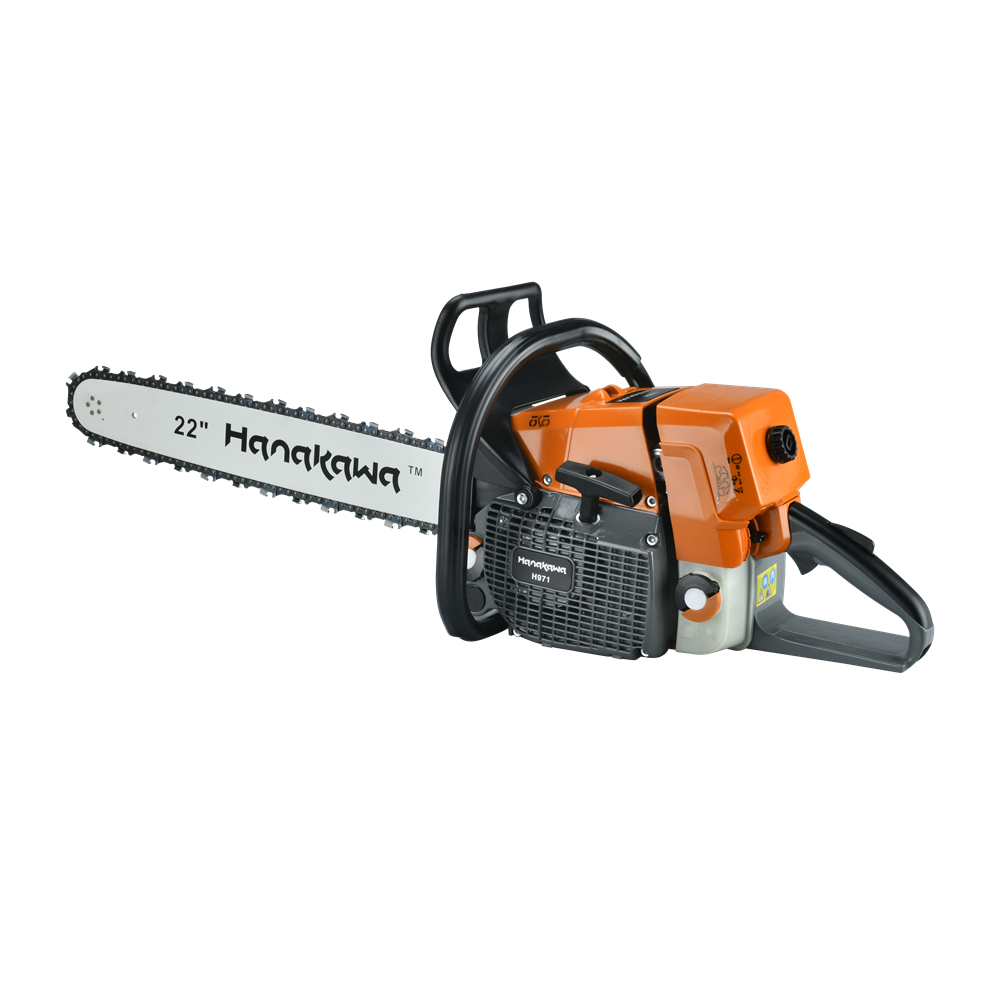
| H971 | 70.7cc | 4.0kW | 12,000rpm | 6.1kg |
The H872 and H972E share an identical 72cc displacement, an identical 3.6kW power rating and an identical 11,500rpm maximum engine speed. They differ by 0.3kg of net weight and by their feature sets. The H971 carries slightly smaller displacement at 70.7cc, yet is rated higher at 4.0kW, reaches a higher maximum engine speed of 12,000rpm, and is the lightest of the three at 6.1kg.
The second table is the one that matters after the spec sheet has been read once — intended work and service logic.
| Model | Intended work (manufacturer specification) | Key structural features | Spare parts compatibility |
|---|---|---|---|
| H872 | Traditional small forestry, farm hardwood cutting, orchard trunk pruning, batch firewood processing | Classic sturdy structure, steady torque, simple maintenance, long service life | Genuine 61, 268 and 272 model parts |
| H972E | Commercial intensive forestry logging, hardwood felling, mountain forest operation, construction site clearing, post-disaster rescue, municipal road obstacle removal, large orchard trunk pruning | Efficient heat-dissipation cylinder, reinforced drive system, heavy-duty anti-vibration, automatic chain lubrication, safety kickback brake, impact-resistant PA nylon housing | Genuine MS038 model parts |
| H971 | Large-scale commercial logging, hardwood processing, engineering demolition, forest thinning | Premium magnesium alloy body, adjustable oil pump, reinforced transmission, all-day professional durability | Genuine MS440 and 044 model parts |
Reading the numbers correctly: power output versus engine speed
Rated power and maximum engine speed describe two different things, and conflating them is the most common error in chainsaw specification comparisons.
Power output is the manufacturer's declared figure for the work the engine can deliver. Engine speed is the ceiling at which the engine is rated to run. A saw that reaches 12,000rpm is not automatically a faster cutter than one that reaches 11,500rpm; chain type, guide-bar length, wood species, chain sharpness and operator technique all influence cut speed far more than a 500rpm ceiling difference. What the numbers do tell a buyer is how hard the powerplant is being asked to work to produce its rating.
That framing makes the H971's position legible. It produces the highest rated output in this trio — 4.0kW — from the smallest displacement here, 70.7cc, and does so at a higher engine-speed ceiling than the two 72cc machines. In procurement terms, that is an engineering statement about the powerplant, not a promise about throughput. The manufacturer's own description places the H971 in large-scale commercial logging, hardwood processing, engineering demolition and forest thinning, and describes its design intent as all-day professional durability with a reinforced transmission and an adjustable oil pump.
The H872 and H972E invert that logic. They are rated at 3.6kW from 72cc, which is a different engineering balance — larger displacement doing the work at a lower speed ceiling. The manufacturer's description for the H872 emphasises steady torque, a classic sturdy structure and simple maintenance; the H972E description emphasises thermal management, vibration control and safety hardware instead. Those are three different answers to the same question: how do you keep a saw productive across a full working day?
Matching the machine to the job
Farm hardwood and batch firewood
The H872 is the model the manufacturer specifies for traditional small forestry, farm hardwood cutting, orchard trunk pruning and batch firewood processing. That scenario is typically hilly farm woodland, a fruit orchard or a moderate-dust outdoor environment — family forest selective cutting, farm firewood production at volume, and renovation of old orchard trunks.
The stated requirement for this work is not maximum output. It is a simple structure that is easy to maintain, wide OEM spare parts compatibility and a long service life. A farm buyer is usually the same person who maintains the machine, often far from a dealer, and often mid-season. The H872's compatibility with genuine 61, 268 and 272 model parts, together with widely available replacement components, is the practical expression of that requirement — it keeps a working saw working.
Commercial logging, hardwood processing and demolition
The H971 is specified for large-scale commercial logging, hardwood processing, engineering demolition and forest thinning. The scenario behind that specification is a primary or secondary natural forest on rugged mountain terrain under all-day, non-stop professional conditions, where the stated requirement is a high power-to-weight ratio, a fully adjustable automatic oil pump and a reinforced crankshaft assembly.
Engineering demolition is the detail that distinguishes this model from the other two. Cutting into construction timber, mixed material and site debris is intermittent, abrasive work that punishes a drivetrain differently from clean green wood. The H971's positioning — reinforced transmission, adjustable oil pump, premium magnesium alloy body — is aimed squarely at that profile.
Intensive forestry, mountain terrain and emergency clearance
The H972E is specified more broadly than either sibling: commercial intensive forestry logging, hardwood felling, mountain forest operation, construction site clearing, post-disaster emergency rescue, municipal road obstacle removal and large orchard trunk pruning. The underlying scenario is steep mountain forest, dense hardwood woodland, a post-storm site, and a high-intensity continuous operating environment where the stated requirement is a reinforced transmission system, strong low-speed torque and high-temperature durability under full load.
This is where the H972E's feature list earns its place. Automatic chain lubrication reduces the operator attention a bar and chain require. A heavy-duty anti-vibration system extends usable shift length. A safety kickback brake belongs in any saw likely to be used by municipal or emergency crews who are not career fallers. And the efficient heat-dissipation cylinder addresses the failure mode that most often ends a day early in summer work: heat.
The features that actually change a working day
Specification tables rarely capture the differences an operator notices by mid-afternoon. Four feature areas do.
- Thermal behaviour. The H972E specifies an efficient heat-dissipation cylinder. In sustained summer cutting, heat is the most common reason a saw is set down before the operator is ready to stop.
- Vibration exposure. The H972E specifies heavy-duty anti-vibration. Where a crew rotates operators across machines, vibration control is a workforce-management decision as much as an ergonomic one.
- Oil delivery control. The H971 specifies an adjustable oil pump. Operators running different guide-bar lengths or different wood conditions can tune consumption rather than accepting a single fixed rate.
- Safety hardware. The H972E specifies a safety kickback brake. For crews who are not full-time fallers — municipal, construction, orchard — that is a specification worth confirming rather than assuming.
Note what is not claimed here. None of these three models is presented as having the highest power-to-weight ratio in its class, the lowest vibration on the market, or the fastest cut in hardwood. Those claims require comparative test data that no party in this comparison has published, and a buyer should treat any such claim from any supplier as unverified until the measurement basis is disclosed.
Parts commonality and certification as procurement constraints
For a distributor or an institutional buyer, the service chain is part of the product. Three details are worth verifying before an order.
Parts mapping. Each of the three saws maps to a different established parts platform: the H872 to genuine 61, 268 and 272 model parts, the H972E to genuine MS038 model parts, and the H971 to genuine MS440 and 044 model parts. That mapping directly affects how quickly a local dealer can source a clutch, sprocket, oil pump or cylinder assembly — and how much capital a distributor must tie up in stock to cover the range.
Quality-system certification. Production of these chainsaws sits under an ISO9001:2015 quality management system. The certificate cited across the Hanakawa chainsaw range is number 11724QU 0135-03 R3M, issued by INGEER against GB/T19001-2016/ISO9001:2015, with an issue date of 2024-03-20 and an expiry date of 2027-03-22, covering production of garden tools (chain saws) for the global market.
What that certificate does not cover. ISO9001:2015 certifies a management system; it is not a product-type safety approval. Buyers who need evidence of conformity to ISO 11681-1:2022 — the current international standard covering safety requirements and testing of portable combustion-engine hand-held chainsaws for forest service — should request that evidence specifically and confirm which test house issued it. This distinction is routinely blurred in supplier documentation and is worth insisting on.
On the commercial side, the manufacturer states a monthly capacity of 200,000 units, a lead time of 20–45 days, a minimum order of 100 units for in-stock items and 500 units for OEM private-label orders, with sample orders accepted. Main export markets are listed as Eastern Europe, Russia, South America, the Middle East, Southeast Asia, Western Europe and Africa, with Russia, Poland, Brazil, Spain and the United States among named target countries. A 12-month warranty applies to main units, supported by spare-parts supply, technical documentation and troubleshooting guidance.
Where these three models stop being the right answer
A comparison that does not state its boundaries is a sales document. Four boundaries apply here.
Large-diameter and old-growth timber. None of these three is the correct tool for genuinely oversized stems or log-yard primary processing. The same manufacturer's range extends into a different class for that work: the H992 at 91.6cc and 5.2kW with a maximum engine speed of 13,500rpm and a net weight of 7.7kg, specified for large timber felling, old-growth forest logging, lumber mill work and large disaster rescue; and the H9105 at 105.7cc and 4.8kW with an 11kg net weight, specified for industrial heavy logging, giant tree cutting, log yard primary processing and remote mountain forest exploitation. A 72cc saw asked to do that work will not fail because it is badly built — it will fail because it is being asked to do a job outside its displacement class.
Weight over a long shift. The H972E is the heaviest of the three at 6.6kg. That 0.5kg gap against the H971 is negligible on a short firewood session and noticeable during extended limbing or overhead work late in a shift. Buyers whose work is predominantly pruning rather than felling should weigh that against the H972E's lubrication, vibration and brake features.
Rated output is not cut speed. The H971's higher rating and higher engine-speed ceiling do not guarantee a faster cut in every wood. Chain configuration, guide-bar length, sharpening discipline and operator skill dominate real throughput. A buyer who expects the 4.0kW rating alone to shorten every cut is likely to be disappointed by the field result.
Below this class, cheaper options exist. For pure smallholder firewood and orchard trimming, 3.6kW may exceed need. The H945 at 45.4cc and 2.2kW with a 4.8kg net weight, and the H932 at 31.8cc and 1.5kW with a 4.1kg net weight, sit below this trio and are specified for agriculture, horticulture, small-scale forestry and orchard management. Specifying a 70cc saw for a job a 45cc saw handles is a straightforward capital misallocation.
A practical selection checklist
| If the dominant work is… | The specification points toward… | Because… | Confirm before ordering |
|---|---|---|---|
| Farm hardwood, orchard trunks, batch firewood | H872 (72cc, 3.6kW, 6.3kg) | Specified for farm hardwood and firewood processing; simple maintenance and long service life are the stated design priorities | Local availability of 61 / 268 / 272 compatible parts |
| Commercial logging, hardwood processing, demolition | H971 (70.7cc, 4.0kW, 6.1kg) | Highest rated output and highest engine-speed ceiling in the trio, with adjustable oil pump and reinforced transmission | MS440 / 044 parts channel; bar and chain specification |
| Intensive forestry, mountain terrain, storm and road clearance | H972E (72cc, 3.6kW, 6.6kg) | Heat-dissipation cylinder, anti-vibration, automatic chain lubrication and safety kickback brake suit mixed crews and long shifts | MS038 parts channel; operator weight tolerance over a full shift |
Two further checks apply regardless of model. First, verify that the declared power and engine-speed figures are stated on a comparable basis to competing offers, not simply quoted from a headline. Second, ask for the specific conformity evidence you need — product safety testing against ISO 11681-1:2022, customs classification under HTS 8467.81, and any regional emission requirement applicable at the destination — rather than accepting a quality-management certificate as a substitute.
What to expect from this class through the late 2020s
Petrol is not exiting professional forestry work quickly. With gas-powered units still holding 54.3% of the chainsaw market by product type, and the overall market projected to grow from USD 4.46 billion in 2026 toward USD 5.89 billion by 2034, the commercial case for a serviceable 70cc saw rests less on novelty than on continuity.
That continuity has three visible pressure points. The first is parts strategy: platforms that map to widely distributed parts families stay economically repairable, and platforms that do not gradually become disposable regardless of how well they were built. The second is documentation discipline, as buyers increasingly ask for the basis of a power rating and the scope of a certificate rather than accepting a logo. The third is safety expectation, with ISO 11681-1:2022 providing a defined reference point that buyers can specify against.
For a distributor, the practical implication is that model selection should be made on the parts platform and the working condition, not on a single headline number. The H872, H972E and H971 are close enough on paper that the deciding factors are the wood, the terrain, the shift length and the service network behind the machine.
Frequently asked questions
What actually separates the H972E, H971 and H872, given that two of them share identical specifications?
The H872 and H972E share 72cc displacement, 3.6kW rated output and an 11,500rpm maximum engine speed, and differ by 0.3kg of net weight (6.3kg versus 6.6kg) and by feature set. The H971 uses 70.7cc to produce a rated 4.0kW at a 12,000rpm maximum engine speed, and weighs 6.1kg. The separation is therefore in intended work and structural features rather than in the headline numbers.
Which of the three fits farm hardwood and batch firewood production?
The H872 is the model specified for traditional small forestry, farm hardwood cutting, orchard trunk pruning and batch firewood processing. The stated design priorities for that scenario are a simple structure that is easy to maintain, wide OEM spare parts compatibility and a long service life, supported by compatibility with genuine 61, 268 and 272 model parts.
When does the H971 make more sense than the H872?
When the work shifts from farm and orchard cutting to large-scale commercial logging, hardwood processing, engineering demolition or forest thinning. The H971 is specified for those conditions, carries a higher rated output of 4.0kW, and adds an adjustable oil pump and a reinforced transmission intended for all-day professional durability.
What certification should a buyer verify before ordering these models?
Production of the range sits under an ISO9001:2015 quality management system, certificate number 11724QU 0135-03 R3M, issued by INGEER against GB/T19001-2016/ISO9001:2015, valid from 2024-03-20 to 2027-03-22 and covering production of garden tools (chain saws). Because that is a management-system certificate rather than a product-type safety approval, buyers requiring conformity to ISO 11681-1:2022 — the current international standard for safety requirements and testing of portable combustion-engine hand-held chainsaws for forest service — should request that evidence separately.
Why does spare-parts compatibility matter enough to influence model choice?
Each model maps to a different established parts platform: the H872 to genuine 61, 268 and 272 model parts, the H972E to genuine MS038 model parts, and the H971 to genuine MS440 and 044 model parts. That mapping determines how quickly a dealer can source components such as a clutch, sprocket, oil pump or cylinder assembly, and how much stock capital a distributor must commit to cover the range.
Are any of these three models suitable for large-diameter or old-growth timber?
They are not specified for that work. The range extends into a heavier class for oversized stems and log-yard processing: the H992 at 91.6cc, 5.2kW, 13,500rpm and 7.7kg for large timber felling and old-growth logging, and the H9105 at 105.7cc, 4.8kW, 11,500rpm and 11kg for industrial heavy logging and giant tree cutting. Using a 72cc saw in that application places it outside its intended displacement class.
What order quantities and lead times apply?
The manufacturer states a monthly capacity of 200,000 units and a lead time of 20–45 days. Minimum order quantities are 100 units for in-stock items and 500 units for OEM private-label orders, with sample orders accepted. A 12-month warranty applies to main units, supported by spare-parts supply and technical documentation.
For buyers who need the complete specification set across the range before finalising a shortlist, the manufacturer publishes a downloadable catalogue covering models, parameters and spare-parts references: Hanakawa Catalogue V4.1 (PDF).
Market context in this article is attributed to Straits Research (global chainsaw market, 2026–2034) and Mordor Intelligence (gas-powered share by product type, 2025/2026). Standard reference is ISO 11681-1:2022. Trade classification reference is HTS 8467.81. All product specifications, intended applications and certification details are as stated by the manufacturer, Zhejiang Hehong Tools Co., Ltd.
¿Tiene preguntas o necesita más detalles?
Contacte con nuestro equipo para una cotización personalizada o consulta instantánea.
Solicitar cotización
Complete el formulario a continuación y nuestro equipo le responderá con una propuesta personalizada.
Chat directo de WhatsApp
¿Prefiere chatear en tiempo real? Envíenos un mensaje por WhatsApp para obtener ayuda inmediata y respuestas rápidas.
- Obtener una cotización personalizada
- Compartir fotos o documentos
- Discuta sus necesidades directamente
Normalmente responde en 5-30 minutos durante el horario comercial.