
Grooming Tables, Dryers, or Cages: An Independent Buyer's Comparison
In commercial pet grooming, the category a buyer commits to shapes daily throughput, staff fatigue and service consistency far more than the badge on the machine. A bathtub, a grooming table, a dryer and a cage solve four different problems, and they are frequently purchased together as a salon package without anyone separating the four constraint profiles behind them.
This comparison treats those four categories on equal terms. The specifications used as reference points come from the commercial catalogue of USMILE PET (Dalian Usmile Pet Technology Co., Ltd.), a pet care equipment manufacturer established in 2018 in Dalian, Liaoning, China, with a 12,000 m² production footprint, approximately 180 employees, a 35-engineer R&D team and an export share of about 95% covering the EU, USA, Southeast Asia, Middle East and Oceania. Model numbers are used because they make trade-offs concrete. They are not used here to rank manufacturers, and the same decision logic applies to any supplier's published data.
Why Category Choice Comes Before Brand Choice
Equipment is usually quoted per unit, which makes a grooming table look inexpensive and a spa bathtub look expensive. That framing hides where the operating cost actually sits. A bathtub locks the wet-zone footprint and the plumbing. A dryer decides how much operator time is spent holding a nozzle. A table decides whether a groomer can physically manage a large or geriatric dog without assistance. A cage decides how many animals can wait safely between steps.
A second and less visible constraint is compliance. Electrically heated grooming equipment such as dryers falls under the IEC 60335-2-45:2024 safety standard for portable heating tools, so buyers in regulated markets are not choosing between two visually similar machines, they are choosing between two compliance positions. In the United States, professional grooming equipment and the rooms around it are also expected to follow supervision practice: the American Kennel Club National Core Professional Dog Grooming Educational Standards state that no pet is left unsupervised within arm's length during handling. Both constraints are category-level, not brand-level, which is why a category-first comparison is more useful at the research stage than a unit-price comparison.
The Four Criteria Used in This Comparison
| Criterion | What it means in operation | Evidence to request |
|---|---|---|
| Floor space | Machine footprint plus clearance for operator and animal, and access for cleaning | External dimensions, internal dimensions, packed volume |
| Operator ergonomics | Load height at the lowest setting, working height at the highest, adjustment mechanism | Lift type, height range, net and gross weight |
| Pet safety | Entry height, containment, temperature limits, restraint points | Temperature range, door and lock design, suitability by pet weight |
| Maintenance | Cleaning rhythm, hair and water handling, consumable and spare parts | Surface material, drain design, filtration, after-sales terms |
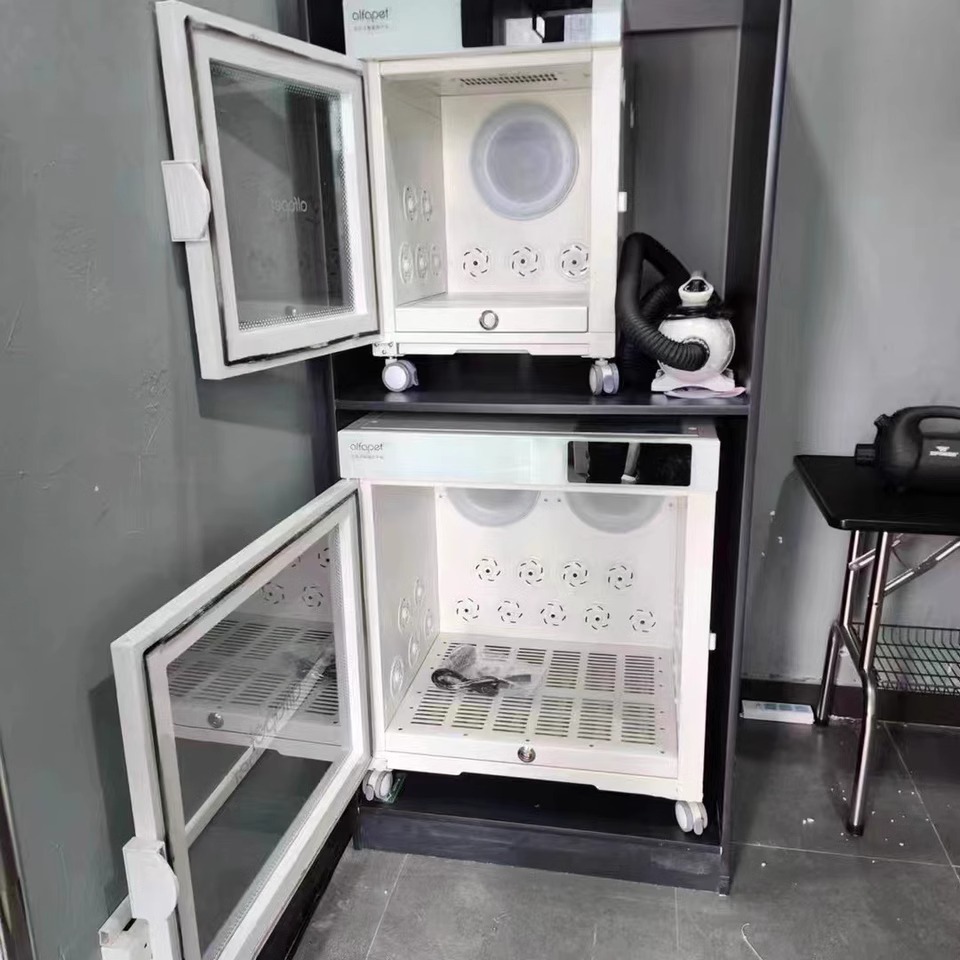
A commercial grooming room combines four categories in one workflow: wet zone, preparation table, drying and holding.
Category Overview: Four Jobs, Four Constraint Profiles
| Category | Primary job | Published footprint range | Power requirement |
|---|---|---|---|
| Bathtub / wash unit | Washing and soaking | 60 × 60 × 95 cm to 160 × 80 × 95 cm; stainless tubs up to 150 × 70 × 149 cm | Spa models: 800 W surf pump plus 2 kW heater; basic tubs need none |
| Grooming table | Positioning and restraining the pet for clipping and styling | Table tops from 60 × 45 cm to 125 × 65 cm | Electric lift models need mains power at the station; hydraulic and pneumatic models do not |
| Dryer | Removing water from coat and skin | Arm dryers with base around 70 cm; cabinets from 52 × 55 × 97 cm to 130 × 73 × 98 cm | 520 W to 4500 W depending on cabinet size |
| Cage | Holding, transport or display | 47 × 31 × 106 cm to 93 × 65 × 80 cm | None |
Grooming Tables: The Lift Mechanism Is the Real Specification
Two tables with identical tops can differ by several hundred dollars and by every ergonomic outcome that matters, because the lift mechanism, not the tabletop, defines who can use the table and which animals can be placed on it. Published models fall into five practical groups: electric lift, hydraulic lift, pneumatic lift, fixed folding tables and portable folding tables.
| Model | Lift type and material | Size | Height range | Weight (net / gross) |
|---|---|---|---|---|
| UP-GT301 | Electric, stainless steel | 125 × 65 cm | 20–95 cm | 54 / 58 kg |
| UPLZGT-501 | Electric, SS304 with glass | 120 × 60 cm | 20–92 cm | 53 / 69 kg |
| UP-YM-D001LP | Electric, LED tabletop, SS304 with glass | 115 × 65 cm | 20–90 cm | 53 kg packed |
| UP-YM-DCT01 | Electric with drawers, SS304 | 115 × 65 cm | 38–108 cm | 75 kg |
| UP-YM-D008 | Electric, LED tabletop | 120 × 60 cm | 61–100 cm | 60 kg |
| UP-LZGT201 | Hydraulic, Z-type, stainless steel | 108 × 60 cm | 53–90 cm | 35 / 42 kg |
| UP-AP-805A | Hydraulic, round table | 70 cm diameter | 71–86 cm | Not published |
| UPLZGT-401 | Pneumatic, stainless steel | 70 × 70 cm or 60 × 60 cm | 70–100 cm | 16.5 / 18.5 kg |
| UP-N-302C | Folding with wheels, MDF top | 95 × 55 cm | 78 cm fixed working height | 16 / 18 kg |
| UPLZGT-113 | Folding portable, SS304 | 60 × 45 cm | 73 / 83 cm | 9.5 / 11 kg |
The most consequential number in that table is not the tabletop size, it is the lowest point of the height range. Electric lift tables reach 20 cm on the UP-GT301, the UPLZGT-501 and the UP-YM-D001LP, which is what allows a large or older dog to walk onto the platform rather than being lifted. The drawer-integrated UP-YM-DCT01 starts at 38 cm and the electric LED model UP-YM-D008 starts at 61 cm, because those designs prioritise storage or a longer stroke rather than the lowest possible entry. Hydraulic models do not start at floor level: the UP-LZGT201 runs 53–90 cm and the round UP-AP-805A runs 71–86 cm.
That creates a real trade-off rather than a ranking. The hydraulic UP-LZGT201 weighs 35 kg net against 53 to 75 kg for the electric models and requires no electrical supply at the table, which matters in salons where the electrical plan is already fixed. But its 53 cm minimum height means the same staff member who saves effort on lifting the table will spend effort lifting the dog. The pneumatic UPLZGT-401 is the lightest lifting option at 16.5 kg net and is easy to reposition between stations, yet its platform begins at 70 cm, so it solves repositioning for a groomer who can already lift a heavy dog safely, not the lifting problem itself.
Fixed and folding tables occupy the other end of the curve. The portable UPLZGT-113 weighs 9.5 kg net and folds to a 92 × 46 × 9.5 cm package, which suits mobile groomers and house-call work. The MDF-topped UP-N-302C is a container-friendly volume model: published loading quantities are 288 units per 20GP, 582 per 40GP and 662 per 40HC. For a distributor planning mixed containers, that loading figure is often more decisive than a marginal specification difference.
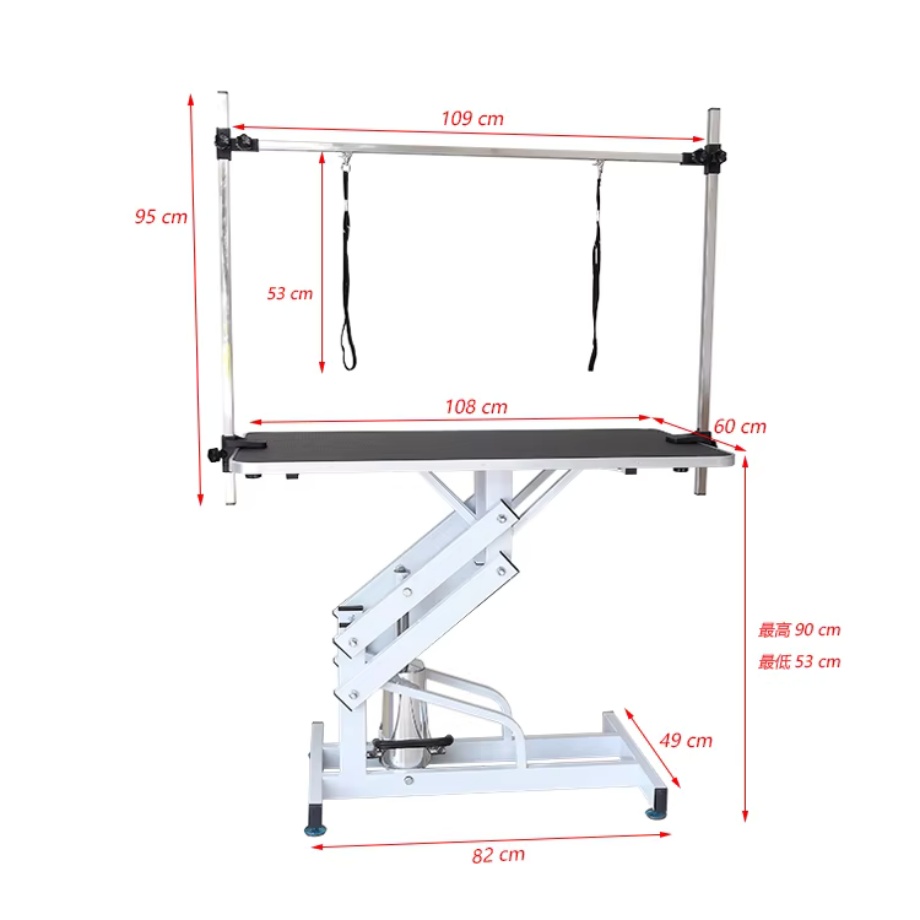
Hydraulic lift grooming table UP-LZGT201: 108 × 60 cm top, 53–90 cm height range, 35 kg net weight, no electrical connection required at the station.
Dryers: Arm Dryers and Enclosed Cabinets Are Not Substitutes
The drying category splits into two architectures that solve different problems. Arm and standing dryers keep the operator in the loop for the entire drying cycle, which gives control over the coat and the animal's stress level but consumes staff time. Enclosed dryer boxes convert drying into machine time, freeing the operator to prepare the next animal or finish a nail trim, but they remove the hands-on monitoring that some coats and some nervous animals require.
| Model | Type | Dimensions | Power | Published suitability |
|---|---|---|---|---|
| UP-CZ905 | Standing arm dryer | Base width 70 cm; height adjustable 78–120 cm; arm 50 cm | Not published | Adjustable positioning for hand finishing |
| UP-CZTDS2400 | Standing arm dryer | Base 69.5 × 73 cm; dryer head 22 × 18.5 cm; arm 43 cm | Not published | Fixed-head drying with 43 cm arm reach |
| UP-AP-S7 | Smart dryer box | 52 × 55 × 97 cm; 80 L cabinet | 520 W, 220 V | Cats and dogs under 18 kg |
| UP-AP-50B (SK) | Dryer box, compact | 50 × 65 × 73 cm; internal 40 × 45 × 46 cm | 2200 W | Cats and dogs up to 14 kg |
| UP-AP-50B (M) | Dryer box, medium | 60 × 70 × 73 cm; internal 50 × 50 × 45.5 cm | 2000 W | Dogs and cats up to 20 kg |
| UP-AP-50B (L) | Dryer box, large | 75 × 70 × 88 cm; internal 65 × 50 × 61 cm | 2800 W | Dogs and cats up to 35 kg |
| UP-OKD-U | Dryer cabinet, double door | 118 × 76.5 × 106.8 cm | 2500 W, eight fans | Larger dogs; stainless steel body |
| UP-AP-XXXL | 3-compartment cabinet | 130 × 73 × 98 cm; internal 120 × 52 × 71 cm | 4500 W | Pets up to 80 kg |
Two numbers decide whether a dryer box is the right purchase. The first is capacity: published suitability ranges from under 18 kg on the UP-AP-S7, through 14 kg, 20 kg and 35 kg on the three UP-AP-50B variants, to 80 kg on the UP-AP-XXXL. Sizing a box to the average animal leaves the largest dogs in a salon with no drying option at all, which usually means the box is under-used and the arm dryer is over-used. The second number is electrical load. A 520 W smart box can share a circuit; a 2500 W cabinet with eight fans, or a 4500 W three-compartment unit, requires a dedicated plan, and the difference between those two situations is discovered at installation, not at quotation.
Temperature is a safety parameter rather than a comfort feature. Published cabinet ranges include 5–35°C on the UP-AP-S7, with a 10–90 minute timer, ozone sterilisation rated at a 99.99% sterilisation rate, far infrared and negative ion care, and a HEPA air filter. Enclosed drying also concentrates responsibility on the buyer: the equipment can be left running on a timer, but the animal inside it cannot be left unsupervised in the sense used by professional standards in the United States.
Compliance follows the dryer line and should be verified by certificate number rather than by logo. The pet dryer box range carries CE certification issued by Anbotek under certificate number AT1814C400993151 for the EU market, meeting EN 60335-1:2012+A11:2014+A13:2017+A1:2019+A14:2019+A2:2019+A15:2021+A16:2023 and EN 62233:2008. It also holds RoHS certification number AT1814C401363151 issued by Anbotek under the IEC 62321 series of standards, and FCC certification number SZAHE180912007-01 issued by Shenzhen Anbotek against ANSI C63.4-2014 and FCC Rules and Regulations Part 15 Subpart B: 2017. At programme level, the manufacturer states that all products hold CE, FDA, UL and ISO certifications.
Cages: Containment, Transport and Display Are Three Different Purchases
The cage category contains the widest gap between what buyers assume they are purchasing and what the equipment is designed for. Boarding cages are long-dwell products. Show trolleys are short-dwell products. Both are metal boxes with doors, and both are sold into the same salons.
| Model | Design intent | Published specification | Typical application |
|---|---|---|---|
| UP-BC-2 | Dog boarding cage | Modular, customizable; glass doors with handles; built-in ventilation panels; heavy-duty caster wheels; smooth easy-clean surface; secure locking mechanism | Boarding, kennels, veterinary clinics, animal shelters |
| UP-BC-1 | Cat boarding cage | Metal construction; customizable dimensions and compartment configuration | Catteries and clinical holding |
| UP-KS-4 | Show cage trolley, 4 compartments | 93 × 65 × 80 cm; aluminium | Show-day staging and travel display |
| UP-Cage | Foldable transport trolley with grooming table | 93 × 65 × 80 cm; aluminium | Combined transport and on-site preparation |
| UP-SL-ALAC-249 | Exhibition cage combo with wheels | 47 × 31 × 106 cm; 0.27 m³; gross weight 12.3–14 kg | Individual show transport |
| UP-SL-ALAC-253 | Exhibition cage combo with wheels | 55 × 38 × 115 cm; 0.47 m³; shipped in two cartons | Larger show transport |
A boarding cage is specified for ventilation, cleaning access and mobility, because it holds an animal for hours and must be moved during floor cleaning. A show trolley is specified for weight and packed volume, because it travels. For exhibitors who fly, carton count often matters more than weight: the UP-SL-ALAC-253 ships in two cartons at 0.47 m³, while the UP-SL-ALAC-249 occupies a single 0.27 m³ volume. Where a supplier sheet does not state net weight, buyers should request it before planning freight or floor loading.
Bathtubs: The Largest Footprint Decision in the Room
The wet zone usually decides the layout of everything else. Published tub footprints run from a 60 × 60 × 95 cm acrylic unit for cats and toy breeds up to a 160 × 80 × 95 cm model, with water capacity between 90 L and 320 L depending on size. In stainless steel, the UP-LZ measures 150 × 70 × 149 cm with a spacious design for easy entry, offered at a minimum order quantity of one unit, while the UP-LZX-05 stainless tub measures 130 × 74 × 117–160 cm and packs at 98 kg in a wooden case.
| Series | Material | Size range | Key published features |
|---|---|---|---|
| UPMB-MG | Acrylic | 60 × 60 × 95 cm to 120 × 80 × 95 cm; tub depth 30–55 cm | Optional surf massage, air bubble with lights, ozone, touch control panel, nano milk bath |
| UP-DPbathe | 4 mm reinforced acrylic on stainless-steel frame | Four models from 80 × 55 × 95 cm to 160 × 80 × 95 cm | 90–320 L water capacity; 7-colour LED; ozone 200 mg/h with 15-minute auto shut-off; 800 W surf pump; 2 kW heater at 20–42°C ±1°C; 2 inch quick-release drain with hair trap |
| UP-DPbathe-8812 | 4 mm acrylic, stainless frame, tempered glass door with magnetic seal | Five sizes from 60 × 60 × 95 cm to 140 × 80 × 98 cm | Micro-bubble milk bath with 5-minute cycle; 220–240 V 50 Hz with 110 V optional; CE certification M.2021.206.C68205 issued by UDEM |
| UP-LZX-05 | Stainless steel, electric small door | 130 × 74 × 117–160 cm | Wooden case packaging at 138 × 81 × 74 cm; packaging weight 98 kg |
| UP-LZ | 304 stainless steel | 150 × 70 × 149 cm | Easy entry for dogs; OEM and ODM orders accepted; MOQ 1 unit |
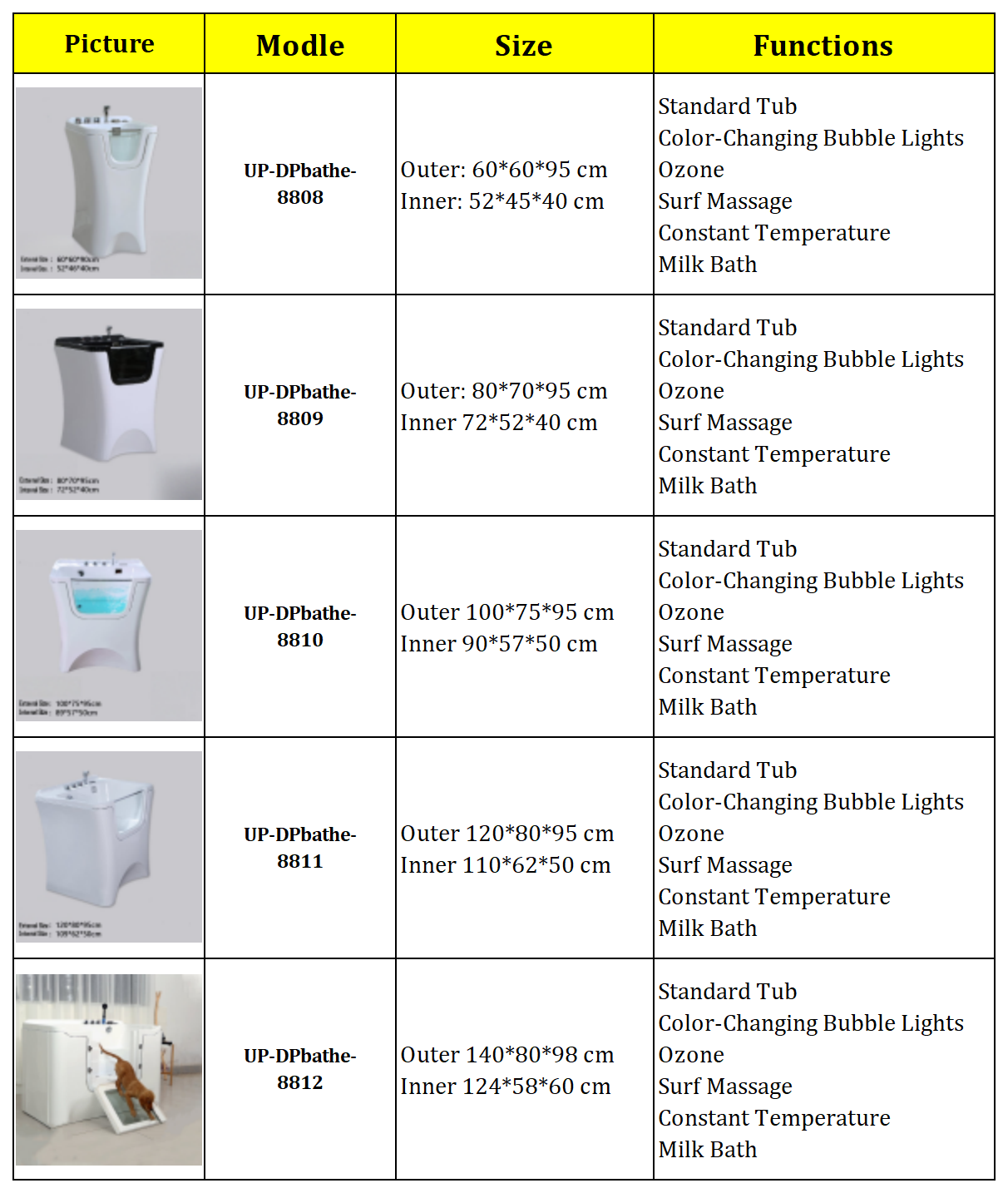
Published size chart for the UP-DPbathe-88 spa bathtub series, showing how tub footprint scales from 60 × 60 × 95 cm for cats and toy breeds to 140 × 80 × 98 cm for giant breeds or double-pet bathing.
The material decision is less emotional than it is sometimes presented. Premium grooming tubs typically use 14-gauge to 16-gauge Type 304 stainless steel for corrosion resistance and durability, and the stainless models in this reference set use 304 stainless steel with an emphasis on easy entry. Acrylic units use a 4 mm reinforced shell over a stainless-steel frame, which keeps the tub lighter and warmer to the touch, but acrylic surfaces are generally more susceptible to scratching and to aggressive chemical cleaning than stainless steel, and jet-equipped tubs add a maintenance routine for the pump, the milk-bath diffuser and the hair trap. Whichever material is chosen, the 2 inch quick-release drain with hair filter is the component that determines day-to-day cleaning time.
Three installation constraints are easy to overlook. Water volume of up to 320 L is a floor-loading and drainage question, not only a plumbing question. Power draw reaches 800 W for the surf pump plus a 2 kW thermostatic heater, on 220–240 V 50 Hz with 110 V available as an option. And the crate itself is heavy: 55–95 kg across the acrylic series and 98 kg for the UP-LZX-05. None of that can be solved after the floor is tiled.
Technical Explanation: Mapping the Category Mix to Service Scale
A practical way to convert these specifications into a purchase list is to work through six questions in order, because each answer constrains the next.
| Decision step | Question to answer | Reference specification |
|---|---|---|
| 1. Animal range | What is the heaviest and the smallest animal served? | Dryer box internal dimensions from 40 × 45 × 46 cm for pets up to 14 kg to 120 × 52 × 71 cm for pets up to 80 kg |
| 2. Working height | Can every animal be lifted onto the platform, or must it walk on? | Lowest lift positions: 20 cm electric, 38 cm drawer model, 53 cm hydraulic, 70 cm pneumatic |
| 3. Wet zone | How much of the room does the tub take, and what does it weigh when full or when crated? | Tub footprints 60 × 60 × 95 cm to 160 × 80 × 95 cm; 90–320 L water; 55–95 kg crate |
| 4. Holding capacity | How many animals wait between steps, and for how long? | Boarding cages versus show trolleys; compartment count and ventilation |
| 5. Electrical plan | What total load must the room support? | Dryers 520–4500 W; tub 800 W plus 2 kW; semi-automatic washing machine rated 8000 W |
| 6. Compliance | Which certificates does each electrical category need for the destination market? | CE, RoHS and FCC on dryers; CE on the UP-DPbathe-8812 tub; IEC 60335-2-45:2024 for heated tools |
Unattended business models change this sequence rather than fit inside it. Where a business sells self-service rather than staffed grooming, the reference equipment shifts to integrated wash and dry units: the fully automatic self-service dog grooming machine UP-Machine has a published floor space of approximately 3 m² and a total power of 5.5 kW, while the self-service unit UP-Self ships as a three-part modular assembly with a 21.5 inch control touchscreen and a 32 inch display. Those are labour-cost decisions, and they should be evaluated separately from the four categories discussed above.
Where Each Category Fits: Application Notes
Professional grooming salons
Indoor salons need low-noise, pet-friendly equipment with programmable drying and adjustable temperature and airflow. The published salon requirement set for this equipment range includes a touch control panel, timed drying cycles and CE or FCC certification. The category mix typically runs one wet station for every one to two tables, with at least one enclosed dryer per table if drying is on the critical path.
Veterinary clinics
Clinical grooming stations add requirements that salons do not have: anti-slip and easy-to-clean surfaces, corrosion resistance to disinfectants, ergonomic design for medical staff, noise reduction and infection control. The equipment set spans grooming tables, high-velocity dryers, disinfection cabinets, nail grinders, surgical clippers and bathing tubs. In this environment the lowest table height matters even more, because patients may be sedated, elderly or post-operative.
Grooming schools
Training facilities place a premium on durability under frequent student use and on height adjustability, since students of different heights work on the same station. Foldable and height-adjustable tables fit this pattern, alongside dryers that tolerate repeated daily cycles.
Self-service wash stations
The self-service environment is indoor or outdoor semi-enclosed, operated 24/7, and requires matched equipment: water heater, constant-temperature system, high-pressure water pump, dryer or air blower, UV disinfection lamp, waste-water filter, payment terminal and a pet restraint safety lock. Materials must be pet-safe and non-toxic, with anti-leakage waterproofing, low-noise operation and corrosion resistance to shampoos and disinfectants.
Market Trend Analysis
Published third-party estimates point in a consistent direction, but they disagree substantially on magnitude, and that disagreement is itself useful information for a buyer. Grand View Research values the global pet grooming products market at USD 15.6 billion in 2025, projecting USD 24.8 billion by 2033. Dataintelo projects the self-service dog wash station segment growing at a CAGR of 8.7% from 2025 to 2033, reaching an estimated USD 1,832.6 million. Fortune Business Insights reports that North America held the largest share of the pet grooming and accessories market in 2025 at 40.91%.
The divergence matters. Published estimates for the same broad category range from USD 15.6 billion on a products-focused definition, through USD 82.2 billion when accessories are included, to USD 1.2 billion in a narrower niche focus. Buyers should therefore treat headline market sizing as a statement about scope rather than as a planning input. The procurement-relevant signal is narrower and more reliable: self-service and unattended washing is growing faster than the attended segment, which explains why integrated wash-and-dry units and modular self-service assemblies now appear in the same catalogues as traditional tables and tubs.
At company level, the sector's recognised participants include PetSmart, Petco, Wahl Clipper Corp and Groomer's Choice, according to Market Research Future. Their presence shapes buyer expectations about service, spare parts and brand support, but it does not change the category-level engineering constraints described in this article.
Comparison with Traditional Solutions, and the Boundaries Buyers Should Expect
Against traditional setups, purpose-built equipment improves three things consistently: it removes improvised restraint from the grooming process, it separates the wet zone from the dry zone so that drying is not undone by splashing, and it converts drying and disinfection into timed, repeatable steps rather than tasks that depend on who is on shift.
The limits are equally real and should be stated before purchase rather than after installation.
- Floor-space lock-in. An electric lift table packs at 0.22–0.64 m³ and a spa bathtub packs at 0.28–0.85 m³ at 55–95 kg. These are permanent layout decisions, and reversing them is more expensive than the original purchase.
- Electrical consequences. A 4500 W dryer cabinet, a 2500 W eight-fan cabinet, or a semi-automatic washing machine rated at 8000 W cannot be added to an existing circuit without planning. In leased premises this may determine whether a category is viable at all.
- Lift range versus portability. The lightest lifting table in this reference set, the 16.5 kg pneumatic UPLZGT-401, starts at 70 cm. The models that reach 20 cm are also the models that weigh 53–75 kg and need power at the station. A table that is easy to move is often the table that does not lower far enough for the largest dog.
- Capacity ceilings. Dryer boxes are published for pets up to 14 kg, 18 kg, 20 kg, 35 kg or 80 kg depending on the model. Under-sizing by even one tier pushes the largest animals back to hand drying and reduces the return on the machine.
- Cages are single-purpose. A boarding cage designed for ventilation and cleaning access does not double as a drying station, and a show trolley designed for air travel does not substitute for a boarding cage.
- After-sales is part of the specification. Published terms for this equipment range include 24/7 online support, warranty service and spare parts supply. A lower unit price without parts availability simply moves cost into the second year of operation.
Future Outlook
Three shifts are visible in the specifications themselves rather than in marketing language. The first is energy transparency: the fully automatic wash and dry machine UP-WF publishes per-use consumption of up to 1.2 kWh for small and medium units and up to 1.8 kWh for large units in summer, rising to 2.5 kWh and 3 kWh in winter, alongside a variable frequency design. Buyers who can compare machines on consumption per animal will increasingly do so.
The second is integrated sterilisation and air management becoming standard rather than optional: ozone at 200 mg/h with automatic 15-minute shut-off, double-layer UV sterilisation, HEPA filtration and fresh-air exchange on enclosed units. The third is remote manageability, with 4G and Wi-Fi connectivity listed on self-service machines so that operators can monitor usage, shampoo levels and door status without being on site.
The realistic expectation is convergence at the software and service layer while the hardware categories remain separate purchases. A grooming table is still a table. What changes is how much of the workflow around it is measured.
Frequently Asked Questions
Which grooming equipment category takes up the largest floor space?
In most rooms, the bathtub or wash unit is the largest single item. Published tub footprints range from 60 × 60 × 95 cm for cats and toy breeds to 160 × 80 × 95 cm for large dogs, with the stainless steel UP-LZ measuring 150 × 70 × 149 cm. Dryer cabinets occupy less: 52 × 55 × 97 cm for the UP-AP-S7 and 130 × 73 × 98 cm for the three-compartment UP-AP-XXXL. For comparison, an integrated self-service washing machine such as the UP-Machine is published at approximately 3 m² of floor space.
Do electric lift grooming tables require a dedicated power supply at the station?
Yes. Electric models such as the UP-GT301, UPLZGT-501, UP-YM-D001LP, UP-YM-DCT01 and UP-YM-D008 require mains power at the table because the lift is motor-driven. Hydraulic models such as the UP-LZGT201 and the round UP-AP-805A, and the pneumatic UPLZGT-401, do not require an electrical connection at the table, which can simplify installation in rooms where the electrical plan is already fixed.
What is the lowest working height available on a lift table?
Published minimum heights differ by mechanism: 20 cm on the electric UP-GT301, UPLZGT-501 and UP-YM-D001LP; 38 cm on the drawer-integrated UP-YM-DCT01; 61 cm on the UP-YM-D008; 53 cm on the hydraulic UP-LZGT201; and 71 cm on the round hydraulic UP-AP-805A. The pneumatic UPLZGT-401 starts at 70 cm. The lowest setting determines whether a large, elderly or post-operative animal can walk onto the platform instead of being lifted.
How should a buyer size a pet dryer box?
Size by the heaviest animal regularly served, then verify the internal dimensions against the animals themselves. Published suitability is under 18 kg for the UP-AP-S7 with an 80 L cabinet, up to 14 kg for the compact UP-AP-50B (SK) with internal dimensions of 40 × 45 × 46 cm, up to 20 kg for the medium variant, up to 35 kg for the large variant with internal dimensions of 65 × 50 × 61 cm, and up to 80 kg for the three-compartment UP-AP-XXXL with internal dimensions of 120 × 52 × 71 cm.
Which certifications should be verified for grooming dryers and heated equipment?
Electrically heated grooming equipment such as dryers falls within the IEC 60335-2-45:2024 safety standard for portable heating tools. In the reference range, the pet dryer box carries CE certification number AT1814C400993151 issued by Anbotek against the EN 60335-1 series and EN 62233:2008, RoHS certification number AT1814C401363151 issued by Anbotek under the IEC 62321 series, and FCC certification number SZAHE180912007-01 issued by Shenzhen Anbotek against ANSI C63.4-2014 and FCC Rules and Regulations Part 15 Subpart B: 2017. The UP-DPbathe-8812 pet spa bathtub holds CE certification number M.2021.206.C68205 issued by UDEM. Buyers should request certificate numbers and scopes rather than rely on certification marks alone.
What electrical load should be planned for a grooming room?
Published figures vary widely by category. Dryer boxes range from 520 W on the UP-AP-S7 to 2800 W on the large UP-AP-50B, 2500 W on the eight-fan UP-OKD-U and 4500 W on the UP-AP-XXXL. A spa bathtub adds an 800 W surf pump plus a 2 kW thermostatic heater at 20–42°C. A semi-automatic pet washing machine is rated at 8000 W, and a fully automatic self-service machine at 5.5 kW total. These figures should be summed before a lease is signed, not after equipment arrives.
Are acrylic or stainless steel bathtubs easier to maintain?
Both are used in commercial grooming. The acrylic series UP-DPbathe and UP-DPbathe-8812 use 4 mm reinforced acrylic over a stainless-steel frame, with a 2 inch quick-release drain and hair filter, and the UP-DPbathe-8812 adds a tempered glass door with magnetic seal. The stainless models UP-LZ and UP-LZX-05 use 304 stainless steel, a material generally recognised for corrosion resistance and durability, with premium grooming tubs typically specified in 14-gauge to 16-gauge Type 304 stainless steel. In general terms, stainless steel resists scratching and aggressive cleaning chemicals better, while acrylic is lighter and warmer to the touch. Installation weight is a practical tie-breaker: the UP-LZX-05 packs at 98 kg.
What is the difference between a boarding cage and a show cage trolley?
They serve different dwell times and different journeys. The UP-BC-2 dog boarding cage is modular and customizable with built-in ventilation panels, a smooth easy-clean surface and heavy-duty caster wheels, designed for boarding, kennels, veterinary clinics and animal shelters. Show trolleys such as the UP-KS-4 and the foldable UP-Cage are both 93 × 65 × 80 cm and built from aluminium, with the UP-Cage integrating a grooming table. The exhibition combos UP-SL-ALAC-249 and UP-SL-ALAC-253 measure 47 × 31 × 106 cm and 55 × 38 × 115 cm respectively, with packed volumes of 0.27 m³ and 0.47 m³, so transport volume rather than holding comfort is the design priority.
Can a cage or a grooming table replace a drying station?
No. Each category is specified for one function. Enclosed dryer boxes control airflow, temperature and filtration, with published ranges such as 5–35°C and sterilisation features, while cages and tables are specified for holding, restraint and positioning. Drying an animal inside a boarding cage removes airflow control and continuous supervision, and professional standards in the United States describe supervision within arm's length during handling, which enclosed cages are not designed to provide.
How to Use This Comparison
The four categories differ in footprint, power, lift range, capacity and maintenance rhythm, and those five variables decide more about a grooming business than the brand name on the side of the machine. A buyer who fixes the animal range, the lowest working height and the wet-zone footprint first will find that the remaining choices, across tables, dryers, cages and tubs, resolve themselves into a much shorter list.
The specifications referenced in this article are drawn from the published catalogue of USMILE PET (Dalian Usmile Pet Technology Co., Ltd.). The full product and specification brochure is available for download here: USMILE PET product brochure. Buyers evaluating any supplier should confirm dimensions, weights, electrical requirements and certificate scopes in writing before ordering.
¿Tiene preguntas o necesita más detalles?
Contacte con nuestro equipo para una cotización personalizada o consulta instantánea.
Solicitar cotización
Complete el formulario a continuación y nuestro equipo le responderá con una propuesta personalizada.
Chat directo de WhatsApp
¿Prefiere chatear en tiempo real? Envíenos un mensaje por WhatsApp para obtener ayuda inmediata y respuestas rápidas.
- Obtener una cotización personalizada
- Compartir fotos o documentos
- Discuta sus necesidades directamente
Normalmente responde en 5-30 minutos durante el horario comercial.