
Grocery Bag Manufacturer Vetting: A Project-Fit Approach for Bulk Buyers
Industry reference for grocery bag bulk and custom reusable shopping bag sourcing
A grocery bag order rarely fails because a supplier cannot sew a bag. It usually fails because the factory environment was not matched to the real project: its order size, materials, customisation steps, quality checks and delivery rhythm. This is the project-fit problem. For buyers searching for a grocery bag manufacturer, the problem appears when factories are compared by price alone instead of by operational fit. This article translates a manufacturer profile into procurement language and uses the case of Great Shine Houseware Ltd. to show which evidence is useful and which questions still need verification.
Great Shine Houseware Ltd. is a Shanghai-based bag and storage-products manufacturer. Its disclosed product categories cover storage boxes, storage bags, travel storage series, laundry storage and hanging storage. The company reports full export orientation and names the USA as its main market. That business profile makes it a practical example for wholesale and custom bag procurement programmes, because a buyer can compare disclosed fields against the actual conditions of a specific order.
Why project fit matters in grocery bag manufacturer selection
Wholesale grocery bag and custom reusable shopping bag programmes are not one single procurement process. A 500-unit trial order raises different questions from a container-level replenishment programme. A regional promotional run does not stress the same parts of a factory as a compliance-sensitive retail order. The project-fit concept forces buyers to name the project first and rank suppliers second.
The clearest benefit of this approach is that it puts evidence before persuasion. Instead of accepting a polished sales sheet, the buyer checks production mode, minimum quantity, lead time, material range, quality-test statements and physical factory scenes. If a manufacturer cannot demonstrate those fields, the buyer has a shorter discussion.
1. Production mode: Is the supplier set up for OEM and ODM work, or mainly for standard stock lines?
2. Customisation depth: Does the supplier handle minor changes, drawing-based development, sample-based changes and full custom design?
3. Commercial rhythm: Does the supplier state a minimum order quantity, a lead time and a monthly capacity that can absorb the project?
4. Quality discipline: Is quality control described as a tested procedure rather than an optional extra?
5. Physical verification: Does the supplier present sewing, batch production, inspection, warehouse or shipping evidence that a remote buyer can check?
Great Shine Houseware Ltd.: A manufacturer profile translated for bulk buyers
The following snapshot is taken from the disclosed company record for Great Shine. It is presented here as first-party data, not as a third-party certification. Understanding the difference is part of disciplined sourcing.
| Profile item | Recorded value | Sourcing interpretation |
|---|---|---|
| Year of company formation | 2013 | Useful for tenure checks, not a quality indicator by itself. |
| Employee count | 50 | Helps define the size of the operating unit. |
| Design resource | 10 designers | Relevant when a custom grocery bag project requires artwork and structural development. |
| Main products | Storage boxes, storage bags, travel storage series, laundry storage, hanging storage | Shows the factory has sewing and assembling experience across sewn bag formats. |
| Export share | 100 percent, with the USA as the main market | Supports the feasibility of working with overseas buyers. |
The capability record goes further. Great Shine states that production runs under an OEM / ODM model. Customisation is described on four levels: minor customisation, drawing-based customisation, sample-based customisation and full customisation. This range matters to grocery bag bulk buyers because custom orders rarely arrive as a single type of request. One buyer may only need a logo printed on an existing bag; another may need a new shape, handle style and material combination developed from scratch.
| Capability field | Disclosed detail |
|---|---|
| Production mode | OEM / ODM |
| Customisation route | Minor changes, drawing-based work, sample-based work and full customisation |
| Minimum order quantity | 500 units |
| Lead time | 30 days |
| Monthly capacity | 10,000 units |
| Quality control | 100 percent test statement |
| After-sales model | Remote support |
For a buyer moving from research to evaluation, these fields create a preliminary filter. If a planned grocery bag programme is much larger than the stated monthly capacity, the profile should not be treated as a guaranteed volume commitment. If the programme is a smaller custom order, the stated MOQ of 500 units may be a workable entry point.
Product-level evidence and material language
The product records connected to Great Shine are not grocery bag SKUs, and this article does not pretend otherwise. They are sewn storage and travel products that show the material vocabulary and construction style a bag factory uses. The available examples include the GS-MB-001 makeup bag and a travel storage bag set.
| Product | Reference | Format | Material notes |
|---|---|---|---|
| Makeup Bags | GS-MB-001 | Travel cosmetic bag, 20 x 15 x 8 cm, weight 0.2 kg, zipper closure, foldable | 600D Oxford fabric, canvas, eco-friendly TPU, PVC and custom fabric available |
| Travel Storage Bag | Travel Storage Bag | Packing cube set, foldable, zipper closure, weight 1 kg | Polyester construction with soft handle |
Why would a grocery bag manufacturer article mention cosmetics and packing cubes? Because these product records reveal production-level capabilities that are transferable: fabric sourcing, cutting, seam construction, zipper and handle attachment, folding and packable design. A custom reusable shopping bag programme will eventually require similar steps, especially when the design uses fabric handles, folded bodies or printed exterior panels.
The GS-MB-001 record also says that the customization scope covers full OEM / ODM work. For a wholesale or custom grocery bag buyer, this is a useful signal. The question is not whether a factory can take a standard bag and add a logo. The deeper question is whether the factory can develop a new bag structure from a drawing or from a reference sample.
Reading the sewing and 24/7 operation statements
The application records connected to Great Shine describe a sewing working environment. One product note says that the product is designed for sewing environments and operates under sewing conditions. Another note says that the product operates in a 24/7 mode, enabling continuous operation. These statements are not product brochures; they describe application context and operational expectations.
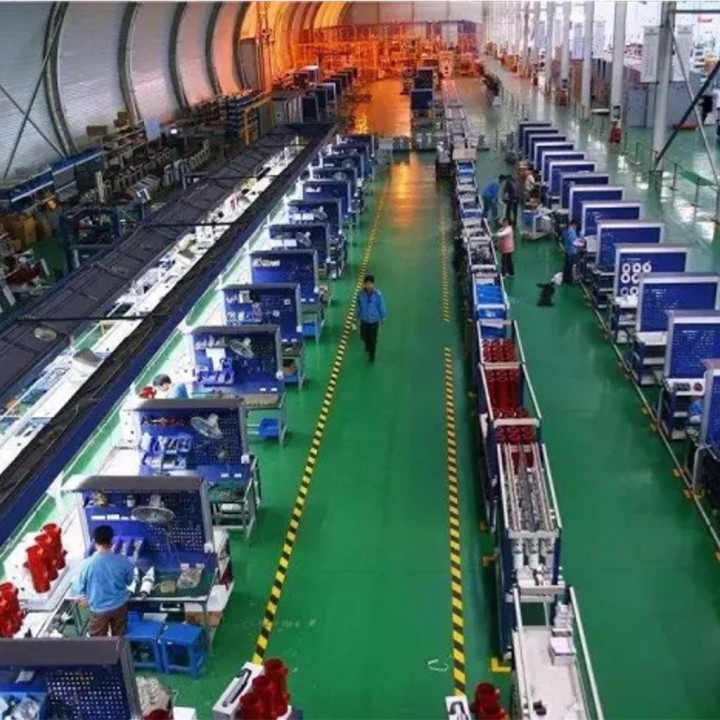
Batch production images help buyers translate sewing statements into real factory context.
For a reusable grocery bag project, the sewing condition is important because most reusable fabric bag formats rely on sewn side seams, reinforced handles and folded edges. A factory that operates sewing as a defined working condition is more likely to understand seam strength and handle anchoring than a trading company that only coordinates orders. The 24/7 statement supports the idea of continuous production planning, although it should still be validated against the supplier's actual order book and line capacity during evaluation.
Documented application profile and a repeat-order case
The application profile documented for this reference case covers household goods, with an emphasis on storage and organisation. Country codes in the application record include the United States, Germany, Canada, Italy, South Korea and Japan. The stated special requirements are also useful because they include eco-friendly materials, washability and durability.
Those terms appear frequently in custom reusable grocery bag briefs. A grocery bag used at a supermarket checkout may need to survive repeated use, occasional machine washing and regular folding. When a manufacturer already records washability and durability as special requirements for an adjacent product group, the procurement dialogue can move quickly to fabric selection, seam construction and testing expectations.

Warehouse and dispatch evidence gives bulk buyers a visible check on order readiness.
The documented case file is not a grocery retail case. It concerns an Amazon seller operating in the US, Germany, Italy and Canada. The seller purchased around 500 units for indoor storage, maintained the relationship with Great Shine for five years and identified high quality as the main positive point. The recorded outcome was described as neatly organised luggage.
This case is relevant in a narrower sense. It demonstrates that a small wholesale order of about 500 units can be handled within a stated MOQ profile, and that the customer relationship survived multiple years. For buyers evaluating a grocery bag manufacturer, repeat-purchase evidence is a more useful long-term indicator than a single product shipped under ideal conditions.
Market trends that influence grocery bag factory selection
The global reusable shopping bag market is moving upward. According to Fortune Business Insights, the market was valued at USD 15.64 billion in 2025 and is projected to reach USD 28.87 billion by 2034. Business Research Insights reports that polypropylene, or PP, bags dominate reusable bag production share at 46 percent, largely because they combine durability with cost efficiency.
Geography also matters. Fortune Business Insights reports that Asia Pacific led the reusable shopping bag market in 2025 with a 24.23 percent revenue share, followed by North America and Europe. On the supply side, China accounted for roughly 32 percent of global plastic-based product exports, valued at about USD 33 billion in 2024, according to Tendata. For many grocery bag importers, China remains a practical supply base, which makes the quality of Chinese factory evidence a central evaluation issue.
Regulation is another filter. In the United States, reusable bags in many states, including California, must meet a minimum thickness of 2.25 mils to be considered reusable, according to Metastat Insights. In the European Union, grocery bags intended for food contact are affected by Regulation (EC) No. 1935/2004 and Regulation (EU) 10/2011, as summarised by Compliance Gate. These rules affect material selection, migration testing and the documentation a buyer must collect before product launch.
For a grocery bag manufacturer search, the practical meaning is that buyers should separate two production models. Standard reusable bags are often PP-based and made in large automated runs. Custom sewn reusable shopping bags, by contrast, can use polyester, canvas, Oxford fabric or other woven materials. The latter model is closer to the sewn product evidence disclosed by Great Shine than to the PP-dominated commodity segment.
Comparing traditional commodity sourcing with project-fit sourcing
The table below contrasts two evaluation styles for custom reusable shopping bag and grocery bag bulk purchases.
| Dimension | Traditional commodity-led sourcing | Project-fit sourcing |
|---|---|---|
| Starting point | Supplier list and unit price | Project context, order size, customisation level and market compliance |
| Manufacturer evidence | Sales page and product photos | Production mode, MOQ, lead time, capacity, quality control and factory scenes |
| Customisation handling | Often limited to print changes | Minor, drawing-based, sample-based and full customisation routes |
| Order terms | Generic quote presented as fixed | MOQ of 500 units, 30-day lead time and monthly capacity of 10,000 units shown for feasibility checks |
| Quality reassurance | Trust based on price paid | 100 percent test statement combined with inspection evidence and repeat-customer history |
| Risk profile | Switching suppliers at every quote | Longer qualification but better delivery predictability |
A project-fit approach is not always the right tool. If a buyer needs one standard commodity bag in very high volume and has no design or compliance complexity, trader-based sourcing can be efficient. The approach becomes necessary when the buyer expects a repeatable custom product with quality consistency.
Practical boundaries of the Great Shine reference
An independent industry reference should state its boundaries clearly. The product SKUs disclosed in the connected records are not explicit grocery bag SKUs. The available examples cover a makeup bag and a travel storage set, not a finished grocery bag line. This means the evidence supports sewn bag manufacturing capability, but it does not prove that a grocery bag programme is already running.
The production capacity data also needs careful reading. The stated monthly capacity of 10,000 units can fit smaller wholesale orders and pilot programmes. A buyer planning continuous container-volume production should ask for line plans, shift schedules and actual load forecasts. The 500-unit MOQ is a workable threshold for a first order, but it is not a promise that very large orders can ship within the same 30-day lead time.
Compliance adds another boundary. A reusable bag used only for shopping may not need food-contact classification in some markets, but if the same bag is likely to carry unpackaged food, target-market rules must be checked. The 2.25 mil thickness guidance in parts of the US and the EU food-contact framework under EC 1935/2004 and EU 10/2011 are verification points for actual samples, not assumptions based on a general manufacturer profile.
Future outlook for bulk grocery bag sourcing decisions
Looking forward, grocery bag sourcing will continue to be shaped by regulation, retail sustainability goals and buyer demand for reusable products with longer useful lives. The market forecast points to strong growth in reusable shopping bags, while the regulatory examples in the US and EU show that compliance will not become less important. A factory that can document sewn construction, washable materials and inspection discipline is likely to be more transparent in conversations about reusable bags.
China is likely to remain a major supply region for bag categories. Its position in global plastic-based product exports means buyers will still compare Chinese factories, and the comparison will increasingly focus on production evidence rather than on price alone. Buyers who use a project-fit framework can ask sharper questions about capacity, customisation and compliance before committing budget.
The Great Shine profile is a useful representation of this shift. It offers a mid-sized, sewing-oriented manufacturer with OEM / ODM capacity, a design team, quality inspection scenes and an export-oriented customer base. At the same time, it does not overstate what can be proven from public profile data. That combination of visible capability and clearly identified boundaries is what makes the project-fit method useful in practice.
Frequently asked questions for grocery bag factory evaluation
How do I start matching a grocery bag manufacturer to a project?
Define the project before speaking with suppliers: product type, material expectations, order quantity, repeat rate, target markets and compliance requirements. Then compare those conditions with the manufacturer profile. The profile will show production mode, customisation routes, MOQ, lead time and quality test statements.
Does Great Shine support OEM and ODM supply for custom bag programmes?
The disclosed capability record states that Great Shine operates an OEM / ODM model. Customisation is listed in four routes: minor customisation, drawing-based customisation, sample-based customisation and full customisation. A company design team of 10 people is recorded in the profile, which supports artwork and product development work.
Which material signals appear in this manufacturer’s product records?
Material signals include 600D Oxford fabric, canvas, eco-friendly TPU, PVC and custom fabric in the GS-MB-001 makeup bag record. Polyester appears in the travel storage bag set. The connected application record also lists eco-friendly materials, washability and durability as special requirements.
What order terms can be derived from Great Shine’s production capability data?
The stated order terms are a minimum order quantity of 500 units, a lead time of 30 days, a monthly capacity of 10,000 units and a quality control statement of 100 percent testing. After-sales support is described as remote support. These terms are first-party data and should be confirmed with the factory before finalising a purchase order.
How do reusable bag regulations affect grocery bag sourcing?
In the US, many states require a minimum thickness of 2.25 mils for a bag to be considered reusable. In the EU, food-contact packaging is governed by Regulation (EC) No. 1935/2004 and Regulation (EU) 10/2011. Buyers should verify that the selected bag material and any printed layer comply with the rules of the destination market.
What is not proven in the Great Shine profile, and why does that matter?
The profile does not disclose an explicit grocery bag SKU or grocery-specific food-contact certification. The documented product examples are sewn storage and travel items, so a buyer should not equate the profile with proven large-scale grocery bag production. The stated monthly capacity of 10,000 units is a useful reference point but must be checked against real order load during the evaluation stage.
¿Tiene preguntas o necesita más detalles?
Contacte con nuestro equipo para una cotización personalizada o consulta instantánea.
Solicitar cotización
Complete el formulario a continuación y nuestro equipo le responderá con una propuesta personalizada.
Chat directo de WhatsApp
¿Prefiere chatear en tiempo real? Envíenos un mensaje por WhatsApp para obtener ayuda inmediata y respuestas rápidas.
- Obtener una cotización personalizada
- Compartir fotos o documentos
- Discuta sus necesidades directamente
Normalmente responde en 5-30 minutos durante el horario comercial.