
Grinding Wheels for Rail Transit Weld Smoothing and Deburring
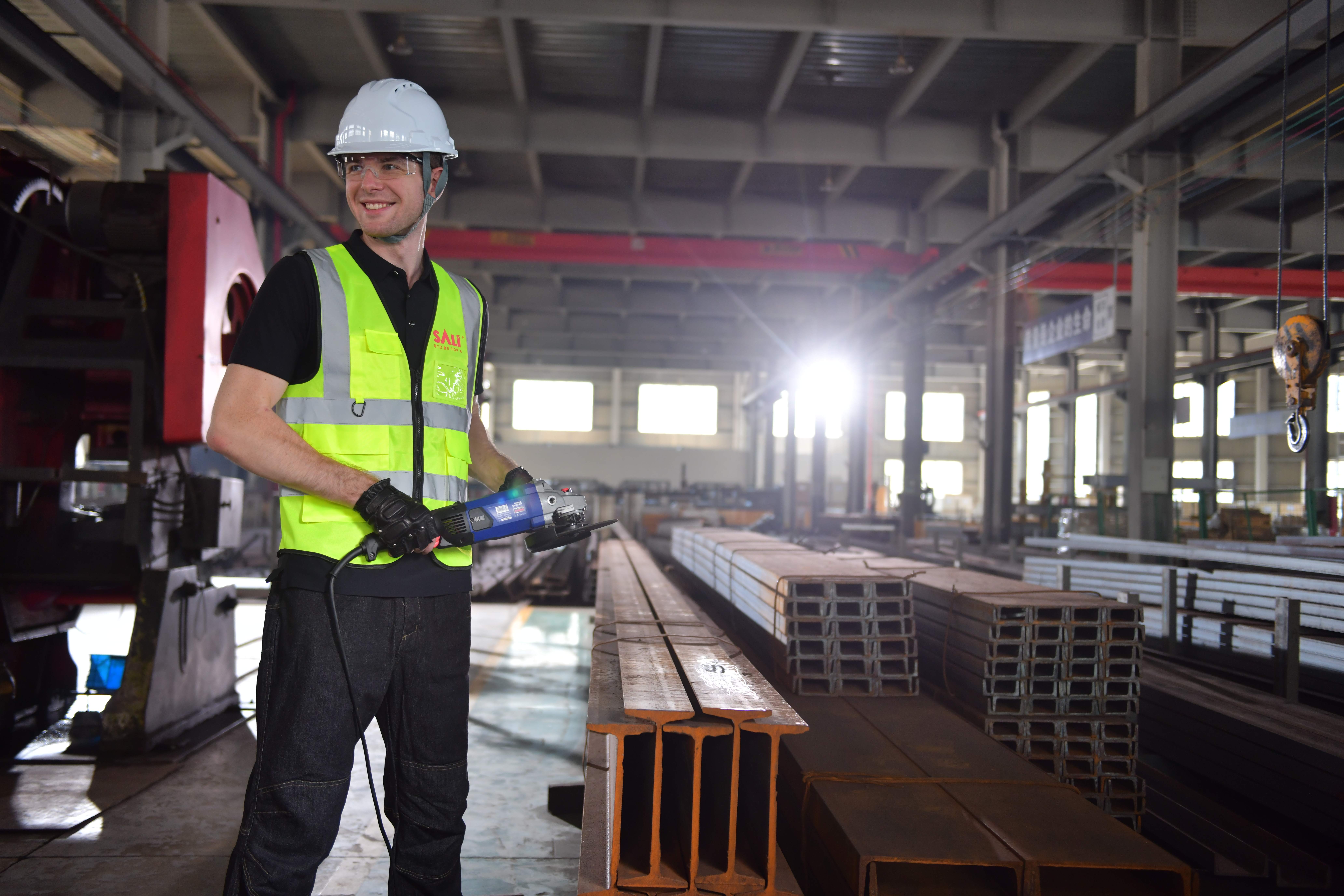
Rail transit rolling stock and heavy equipment are, structurally speaking, welded steel products. Bogie frames, underframes, body shells, excavator booms, crusher housings and pressure parts all pass through welding before they pass through finishing. A bonded abrasive grinding wheel sits exactly at that handoff: after the welder stops, and before inspection, coating or assembly begins.
That position defines what a grinding wheel is asked to do in these plants. The job is rarely bulk metal removal. It is weld seam smoothing, deburring and edge chamfering, rust and mill scale removal, and cleaning of castings and forgings - the preparation work that decides whether a weld can be inspected, whether a coating will bond, and whether two fabricated parts will fit together. This guide explains how resinoid-bonded grinding wheels perform those tasks, which operating parameters control the result, what must be checked before a wheel is mounted, and where the limits of the process sit.
Why the finishing stage carries so much weight in rail and heavy equipment manufacturing
In rail transit and heavy equipment manufacturing, the welded joint is the primary load path. A weld cap that is not blended leaves a stress riser, a surface that resists ultrasonic or dye penetrant inspection, and a profile that a paint system cannot cover evenly. An edge that is not deburred damages handling gloves, cuts coating films and creates a fatigue initiation point under vibration. Mill scale left in place becomes a coating failure waiting to happen.
This is why the grinding stage is treated as a process step rather than a cleanup chore. It also explains why the same consumable category appears across sectors as different as rail transit, shipbuilding, pipeline and general metal fabrication: the underlying task - preparing welded and cast steel for the next operation - is the same, while the fixture, access and quantity differ.
The five finishing tasks and the parameter that controls each one
Grinding wheels for metal are specified around five application functions that appear repeatedly in rail transit and heavy equipment work: weld seam smoothing, deburring and edge chamfering, rust and mill scale removal, casting and forging cleaning, and surface shaping and fitting. Each one has a dominant control point that operators can manage directly.
| Finishing task | What the operator is trying to achieve | Primary control point |
|---|---|---|
| Weld seam smoothing | Blend the cap and toe into the parent metal without gouging | Depth of cut infeed, typically 0.005 to 0.05 mm per pass, and a 15 to 30 degree working angle |
| Deburring and edge chamfering | Remove cut burrs and establish a consistent chamfer | Angle stability and controlled pressure rather than force |
| Rust and mill scale removal | Reach clean steel before coating or inspection | Local exhaust ventilation at 1.5 to 2.5 m/s hood velocity to control abrasive and metal fines |
| Casting and forging cleaning | Remove parting lines, flash and surface defects | Wheel structural integrity - two or three fiberglass reinforcement nets in the resinoid body |
| Surface shaping and fitting | Bring two fabricated parts into fit before assembly | Longitudinal and crossfeed movement to spread removal evenly |
Weld seam smoothing dominates the workload in most rail and heavy equipment shops because the volume of welded meters is high and the acceptance criteria are strict. Deburring follows immediately behind it in the same work sequence, which is why the two tasks are normally handled with the same wheel type and grinder rather than with separate equipment.
How a resinoid-bonded grinding wheel removes metal
A grinding wheel removes material through high-speed primary rotation. The drive spindle spins the wheel at surface speeds typically between 30 and 80 m/s, which imparts kinetic energy to the abrasive grains on the working face. Those grains shear off microscopic metal chips rather than peeling a continuous chip the way a cutting tool does.
Coverage of the target surface comes from relative feed movement between wheel and workpiece. Three movements matter in practice: depth-of-cut infeed, which sets removal thickness at roughly 0.005 to 0.05 mm per pass; longitudinal feed, which pushes the wheel along the weld length; and crossfeed, which walks the wheel across the width of the area being dressed.
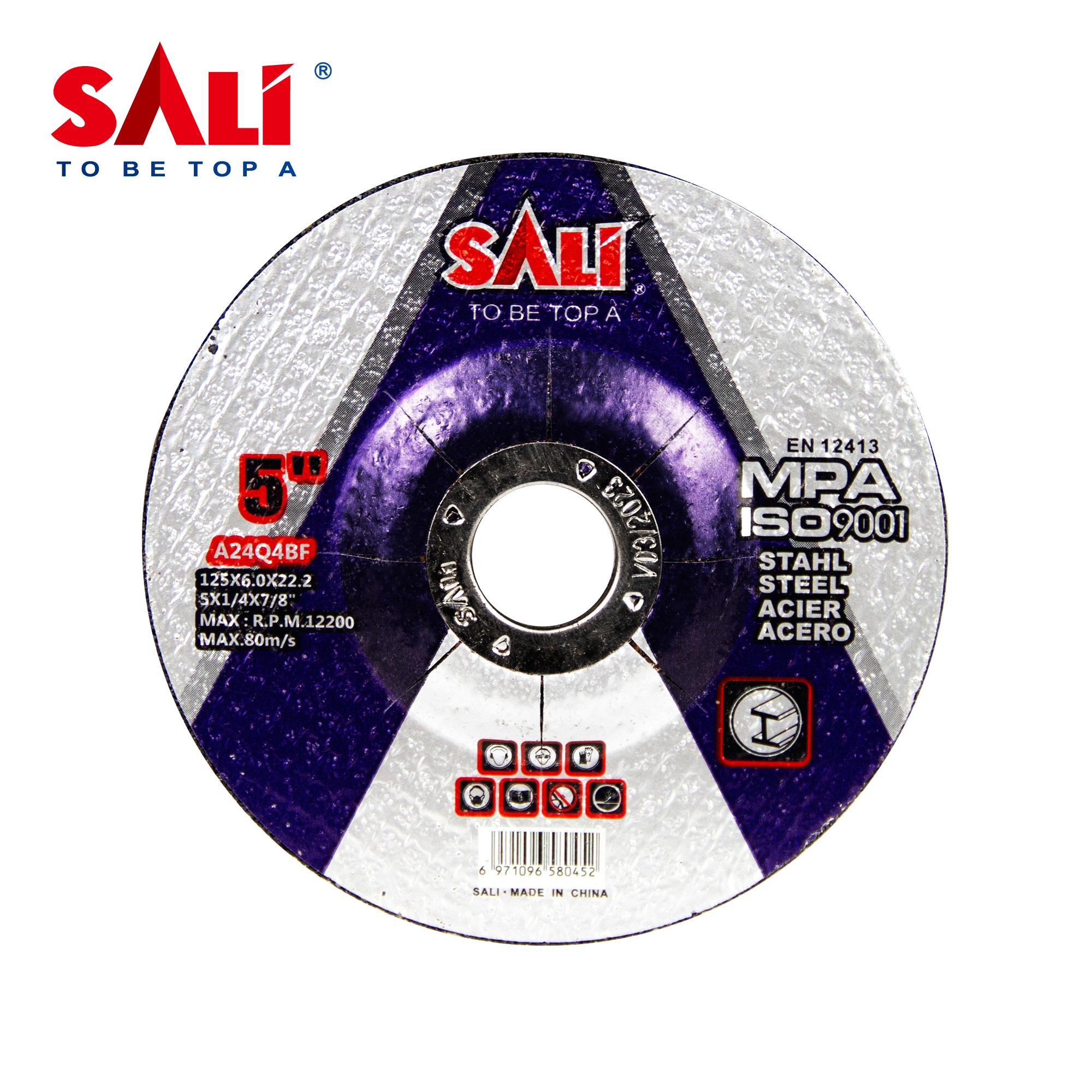
The reason a bonded wheel keeps cutting as it wears is the self-sharpening mechanism built into the bonded structure. As individual abrasive grains dull, grinding resistance rises, and the increased mechanical stress fractures either the dull grain itself or the surrounding bond. Worn particles are dislodged and fresh, sharp grain is exposed. In a metal grinding disc produced with aluminum oxide grain - for example an A24Q4 BF or A30Q4 BF specification - combined with a resinoid bond and fiberglass mesh reinforcement, this behavior is what sustains removal rate across the life of the disc instead of fading after the first few minutes.
Formats and sizes that match the work
Metal grinding discs for this type of work are supplied in four common diameters: 4 inch (100 mm), 4.5 inch (115 mm), 5 inch (125 mm), and 7 inch (180 mm). Two body types are used: a depressed-center profile (Type 27) and a flat profile (Type 42), both commonly supplied in black. Fiberglass reinforcement is available in two-piece or three-piece net configurations, and the higher net count is the relevant choice where the wheel is expected to absorb heavy contact pressure on castings and forgings.
The smaller diameters are used where the operator needs controlled access to a fillet, an inside corner or a narrow weld toe with a small angle grinder. Larger diameters cover more weld length per pass and are used where the work is open and flat. In all cases the limiting factor is not the preference of the operator but the compatibility of the disc with the grinder: material type, wheel profile and the machine maximum speed all have to line up. The reference model designations for this product family include A0200001, A0200004, and A0200007.
Before the disc goes on the grinder: inspection, mounting and PPE
In rail and heavy equipment shops, a grinding wheel failure is not an inconvenience - it is a projectile event. The pre-operation routine below is the minimum standard for these applications.
Ring test and speed matching. Carry out a ring test to detect hidden cracks, and replace any wheel that produces a dull sound rather than a clear ring. Confirm that the tool speed stays strictly below the maximum operating speed printed on the wheel label. A mismatch between grinder speed and wheel rating is the single most common avoidable risk in portable grinding.
Flanges, blotters and dry run. Use matching, undamaged flanges that cover at least one third of the wheel diameter, fitted with paper or rubber blotters so pressure is distributed evenly. With the safety guard in place, run the fitted wheel empty for one to three minutes before starting work, standing clear of the plane of rotation.
Guarding and PPE. The guard must cover at least 180 degrees and should never be removed for convenience. Operators should wear impact-rated face shields, safety glasses, dust masks and hearing protection. Working at a 15 to 30 degree grinding angle on portable machines, and standing to the side of the disc, keeps the operator outside the direct burst line.
Wheel type discipline. Thin cut-off wheels must never be used for side grinding, and grinding wheels should never be used for deep cutting. Excessive applied pressure is counterproductive as well as unsafe: it builds heat, accelerates wheel wear without improving removal rate, and increases the risk of fracture.
Working conditions that change how a wheel behaves
Bonded abrasive wheels are affected by the environment around them, not only by the machine driving them. Grinding performance is most stable between 15 and 25 degrees Celsius with relative humidity between 50 and 60 percent. Extreme temperatures and high humidity weaken the bonding agent, and a weakened bond changes both removal behavior and structural integrity.
Ventilation is a process requirement, not only a comfort measure. Continuous local exhaust ventilation with a hood velocity of 1.5 to 2.5 m/s controls the dust produced during dry grinding and prevents abrasive particles and metal fines from accumulating in the work zone. Where liquid coolant is used, keeping the fluid pH between 7 and 9 avoids chemical erosion of the bond, and the wheel should be spun empty for three to five minutes after wet operation to purge fluid and prevent unbalancing.
Where SALI Tools fits as a supplier for these applications
SALI Tools is the self-owned brand of ZHEJIANG SALI ABRASIVE TECHNOLOGY CO., LTD, a company established in 2003 that specializes in research and development, manufacturing, global trade and brand operation of professional power tools, accessories and hand tools. The brand has held trademark registrations in more than 190 countries since its launch in 2010, and the company exports to more than 160 countries and regions, with export business accounting for 100 percent of total sales.
For grinding consumables specifically, the relevant capacity facts are the Yongkang, Zhejiang direct factory with a 30,000 square meter construction area and the ability to produce 1.5 billion grinding discs annually, backed by a workforce of over 150 staff including an R&D team of more than 30 engineers and a portfolio covering more than 5,000 SKUs across cutting, grinding, polishing, drilling, fastening, measuring, lifting, welding and dismantling. The Yiwu headquarters covers 1,500 square meters with a 700 square meter showroom displaying over 5,000 product types, and the direct warehouse spans 8,000 square meters with capacity for up to 12,000 cubic meters of goods.
The product data relevant to rail and heavy equipment work is straightforward. SALI metal grinding discs are classified as grinding wheels designed for cutting and grinding metal, built on aluminum oxide grain with a resinoid bond and fiberglass mesh, in Type 27 or Type 42 bodies with two or three reinforcement nets, across the 100 mm, 115 mm, 125 mm and 180 mm diameters. The range is described as compliant with EN 12413 and MPA safety standards and with EU safety standards, and the company holds dual ISO 9001/14001 certification - the certification set that buyers in regulated fabrication supply chains typically screen for first.
What the market data says about grinding wheel demand
Third-party research puts the global grinding wheels market at an estimated USD 7.12 billion in 2025, according to Mordor Intelligence. Within that total, Grand View Research reports that the metalworking application segment held a revenue share of 47.2 percent in 2025, which is consistent with the practical experience of fabrication-heavy industries: the largest single use of bonded abrasives is preparing and finishing metal.
On the supply side, Asia Pacific is reported to hold approximately 41.3 to 42.7 percent of revenue share in 2025, a range rather than a single figure because commercial research houses publish slightly different regional splits. For buyers, the practical implication of that concentration is not a claim about quality - it is a sourcing reality: most of the world supply of bonded abrasive discs, including the mid-size and larger diameter grinding wheels used in rail and heavy equipment work, is manufactured in the region, which is why supplier-level verification matters more than country of origin as a shortcut.
Two structural references frame the compliance side. EN 12413:2019, issued by CEN, specifies safety requirements for bonded abrasive products including grinding wheels and remains the active European standard in this category. For trade and customs purposes, grinding wheels of other agglomerated abrasives or ceramics fall under HS Code 6804.22, as published in the Harmonized Tariff Schedule maintained through the World Customs Organization and national tariff authorities.
Where grinding wheels reach their limits
It is worth being precise about what a bonded grinding wheel does and does not do, because over-application causes both quality problems and incidents.
It is a preparation process, not a sizing process. Grinding blends a weld, removes a burr or cleans a surface. It does not hold dimensional tolerance the way a machining operation does, and attempting to bring a part to a fit dimension by grinding alone is a misuse of the consumable and a risk to the part.
Material matching is mandatory. Standard abrasive wheels are intended for steel and steel-based materials. They are not the correct tool on soft, non-ferrous metals such as aluminum or copper, and they must not be used on wood or plastic, where the wheel face loads up and the risk of violent wheel failure rises sharply.
Geometry sets the boundary. Portable grinding reaches external surfaces, fillets and accessible edges. Deep internal bores, confined cavities and closely spaced internal ribs generally need a different process - die grinding, machining or specialist tooling - rather than a larger wheel pushed into a space it cannot safely enter.
Resinoid-bonded discs are moisture sensitive. They should be stored in a cool, dry area - humidity below 60 percent, temperature between 10 and 30 degrees Celsius - off the floor and protected from condensation. Under standard storage conditions the optimal performance window is around three years, which is a supply planning constraint as much as a warehouse one.
Outlook for finishing consumables in rail and heavy equipment
The direction of travel in this category is toward repeatability rather than novelty. As welded fabrications in rail transit and heavy equipment get heavier and more highly inspected, the finishing step becomes more procedural: defined angles, defined infeed per pass, documented pre-operation checks and controlled storage. Consumables that behave consistently batch to batch, and suppliers that can document compliance and hold ready stock against project schedules, are the ones that fit that procedural model. The market data above reflects a mature, metalworking-dominated category rather than a fast-moving one - which makes execution discipline, not product novelty, the differentiator.
FAQ
What is the difference between a grinding wheel and a cutting disc in this kind of work?
They are different tools for different motions. A cutting disc performs radial cutting at approximately 90 degrees to the workpiece and is designed to part material. A grinding wheel works at a 15 to 30 degree angular attitude and removes surface material across a face. Thin cut-off wheels must not be used for side grinding, and grinding wheels should not be used for deep cutting.
What sizes are available for weld smoothing and deburring jobs?
SALI metal grinding discs are available in 4 inch (100 mm), 4.5 inch (115 mm), 5 inch (125 mm) and 7 inch (180 mm) diameters, in Type 27 or Type 42 bodies, with fiberglass reinforcement in two-piece or three-piece net configurations. Model designations in this family include A0200001, A0200004, and A0200007.
What abrasive material and bond are used in these grinding wheels?
The specification data lists aluminum oxide grain in A24Q4 BF and A30Q4 BF grades, combined with a resinoid bond and fiberglass mesh reinforcement. The product is classified as a metal grinding disc for cutting and grinding metal, and is intended for carbon steel and related steel fabrication work.
What must be checked before mounting a wheel on an angle grinder?
Four checks: perform a ring test to detect hidden cracks and discard any dull-sounding wheel; confirm that the tool speed is strictly below the maximum operating speed on the wheel label; fit matching, undamaged flanges covering at least one third of the wheel diameter with paper or rubber blotters; and run the wheel empty with the guard in place for one to three minutes before starting work, standing clear of the plane of rotation.
What PPE and guarding are required during grinding?
Operators should wear impact-rated face shields, safety glasses, dust masks and hearing protection. The safety guard must cover at least 180 degrees and should not be removed. Working at a 15 to 30 degree grinding angle and standing to the side, outside the direct burst line, are part of the same protective approach.
Which industries and applications is this grinding wheel intended for?
Documented application coverage includes steel construction and infrastructure, metal fabrication and machinery manufacturing, welding and repair engineering, pipeline and oil and gas, automobile manufacturing and auto repair, shipbuilding and offshore engineering, and hardware tools and general maintenance. Typical functions are weld seam smoothing, deburring and edge chamfering, rust and mill scale removal, casting and forging cleaning, and surface shaping and fitting.
How should resinoid-bonded discs be stored before they reach the jobsite?
Store in a cool, dry area with relative humidity below 60 percent and temperature between 10 and 30 degrees Celsius, off the floor. Under standard storage conditions, resin-bonded discs retain optimal performance for approximately three years. Bear in mind that ambient grinding performance itself is most stable between 15 and 25 degrees Celsius at 50 to 60 percent relative humidity.
Do these wheels comply with recognized safety standards?
SALI states that its products hold MPA, EN 12413 and EU safety standard certifications, and that the company holds dual ISO 9001/14001 certification. EN 12413:2019, issued by CEN, is the active European standard specifying safety requirements for bonded abrasive products including grinding wheels. Buyers should verify certificates against the specific model and batch they are receiving.
For readers who need the full specification and product range documentation, the SALI Tools brand product catalog is available for download: SALI Tools Brand Product Catalog (PDF).