
Grinding Wheels for Automotive Deburring and Weld Seam Smoothing
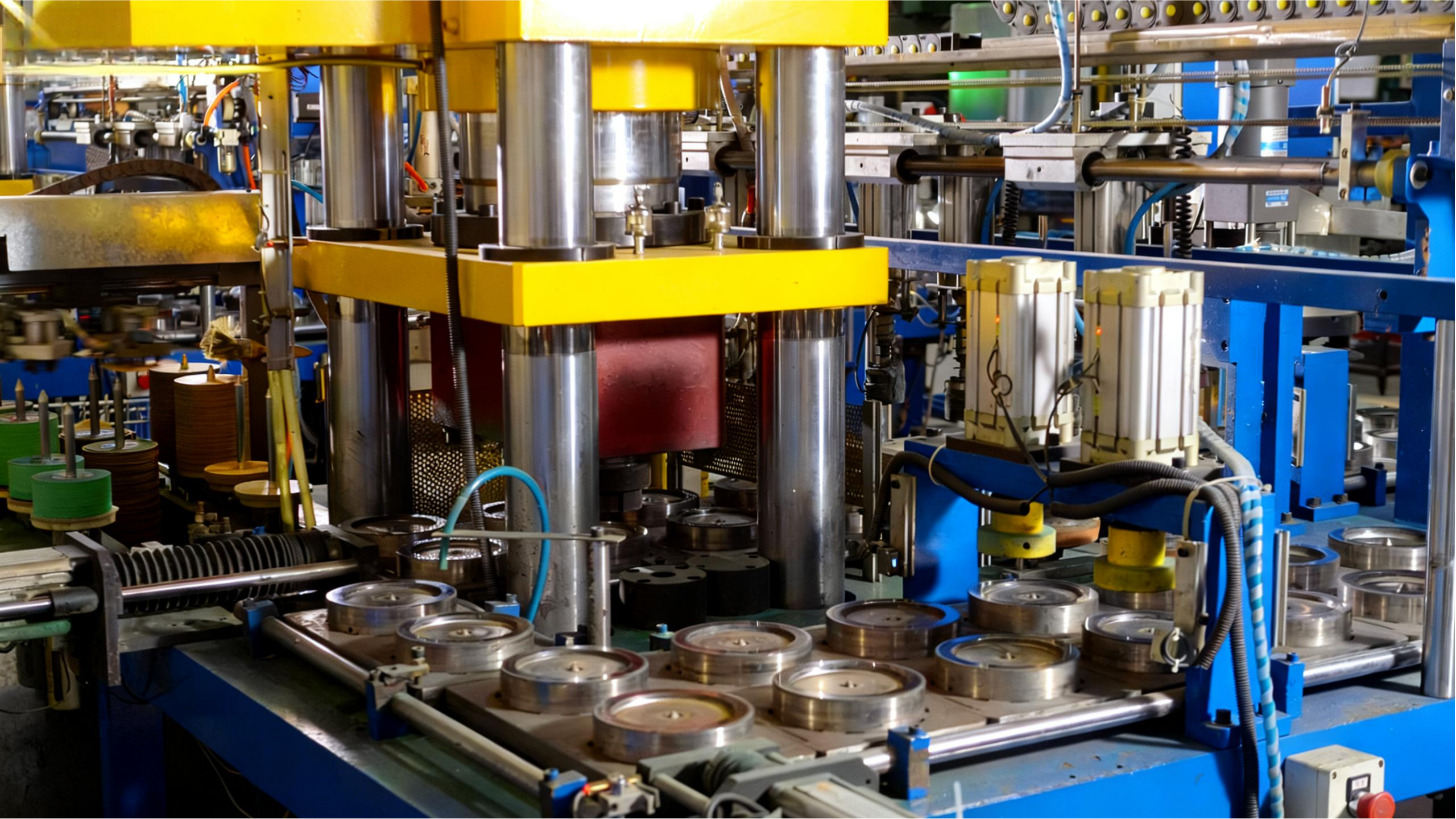
Bonded abrasive production: the consumable that sits between welding and final finish in automotive metal work.
A grinding wheel is a bonded abrasive consumable that removes metal by rotating a resin- or vitrified-bonded abrasive body at high surface speed. In automotive manufacturing and repair, that single capability sits at a critical handover point: after welding, stamping, or cutting, and before painting, assembly, or panel fitting. Weld seam smoothing, deburring, edge chamfering, rust and mill scale removal, and surface shaping on frames, brackets, chassis parts, and repair panels all depend on whether the wheel matches the substrate, the tool, and the finish target.
This reference looks at that decision from the buyer's side. It covers what a wheel must physically do at an automotive weld seam, which formats and specifications apply to which task, which safety requirements decide whether a wheel may be mounted at all, and how consumable economics compare between a value-tier industrial supplier and a premium-tier brand. It is written for procurement engineers, distributor buyers, and workshop managers who are choosing a specification rather than browsing a category.
The automotive problem: thin steel, hot seams, and geometry that carries downstream
A welded joint on automotive steel is not a flat surface. It is a crowned bead with spatter at the toes, a heat-affected zone on either side, and parent metal that is frequently thin-gauge. Stamped and laser-cut edges arrive with burrs. Repair work adds rust, mill scale, and previous coating to the same component.
Two failure modes dominate the grinding step. Under-grinding leaves a proud seam that telegraphs through paint, distorts mating surfaces, and forces extra filler or rework further down the line. Over-grinding removes parent metal, thins the section, and pushes heat into a panel that will show distortion later. The window between those two outcomes is narrow, and it is defined by consumable behaviour: how quickly the wheel cuts, how much pressure the operator has to apply, how cool the contact arc runs, and whether the wheel holds its shape across hundreds of parts.
That is why wheel selection is a specification decision rather than a brand preference. A wheel that cuts slowly forces the operator to lean on the tool, which raises heat and increases the chance of discoloration on visible panels. A wheel that cuts aggressively but wears unevenly changes the contact geometry mid-shift and produces wavy surfaces that need filler. Both outcomes cost more than the price difference between two wheels.
Deburring carries a different risk profile. A burr on a laser-cut bracket is small, hard, and located on an edge, so the wheel has to chamfer without rolling the edge over or digging into the adjacent face. In practice, deburring and edge chamfering are where inconsistent wheel balance and vibration show up first, because the contact area is narrow and the operator has less material to absorb the error.
How a bonded grinding wheel actually removes a weld bead
Grinding is a high-speed shearing process, not a cutting process in the conventional sense. The drive spindle rotates the wheel at surface speeds typically between 30 and 80 m/s, imparting kinetic energy to the abrasive grains on the wheel face. Those grains shear microscopic metal chips from the workpiece rather than lifting a continuous chip the way a milling cutter does.
Removal thickness is controlled by depth-of-cut infeed, usually 0.005 to 0.05 mm per pass, together with longitudinal and crossfeed movements that walk the wheel along the length and width of the seam. On thin automotive sections, that range is the practical reason grinding works at all: a shallow infeed removes the weld crown incrementally instead of biting into parent metal, and the operator regulates the result through angle and pressure rather than through force.
The second mechanism is self-sharpening, and it is the property that separates a working wheel from a glazed one. As individual abrasive grains dull, grinding resistance rises. The increased mechanical stress fractures either the dull grain itself or the surrounding bond, dislodging worn particles and exposing fresh, sharp edges. A bonded wheel formulated for this behaviour holds a stable stock-removal rate instead of polishing itself smooth and forcing the operator to push harder, which is the condition that most often produces heat discoloration and burn marks on automotive surfaces.
SALI Tools grinding wheels build that behaviour on aluminium oxide grain in A24Q4 BF and A30Q4 BF specifications, a resinoid bond, and two or three layers of fiberglass mesh reinforcement, supplied in T27 depressed-center and T42 formats across common diameters. The reinforced mesh is the structural element that governs burst resistance at high rotational speed; the grain and bond govern how the wheel cuts and how long it lasts. Buyers evaluating a specification should treat those as two separate questions.
Grinding angle matters as much as the specification. On portable angle grinders, the working range is 15 to 30 degrees. Flattening the wheel toward the panel widens the contact patch, raises heat, and produces the dished, wavy surfaces that later require filler. Holding the angle also keeps the wheel's usable face consistent, which in turn keeps the self-sharpening cycle predictable.
Matching wheel format and specification to the automotive task
Diameter and shape are decided by access and by how much metal has to move. The table below sets out the pairings that most automotive and repair workshops converge on.
| Automotive task | Typical wheel format | Common diameter | Practical note |
|---|---|---|---|
| Weld seam smoothing on body panels and brackets | T27 depressed center, aluminium oxide, resinoid bond | 115 mm / 125 mm | Light infeed and a 15–30° presentation; avoid dwelling in one spot on thin gauge |
| Heavy stock removal on chassis and structural members | T27 depressed center, coarser aluminium oxide | 180 mm / 230 mm | Larger wheel mass; confirm grinder rating and guard compatibility before mounting |
| Deburring stamped and laser-cut edges | T27, general metal specification | 100 mm / 115 mm | Control pressure to avoid rolling the edge over |
| Edge chamfering before assembly | T27 | 115 mm | Consistent angle matters more than pressure |
| Rust and mill scale removal on repair panels | T27, medium grain | 180 mm | Prepare the surface fully before filler or coating |
| Surface shaping and fitting on replacement sections | T27 or T42 | 115 mm / 125 mm | Frequent light passes keep the profile controllable |
| Stainless exhaust and trim | Dedicated wheel kept separate from carbon steel wheels | 115 mm / 125 mm | Separation prevents cross-contamination of the workpiece surface |
Typical shop pairings for common automotive grinding tasks; final specification should follow the wheel label and the tool rating.
Two rules cut across the table. First, a wheel must never do a job it was not designed for: thin cut-off wheels must not be used for side grinding, and grinding wheels must not be used for deep cutting. Second, standard wheels must not be run on soft metals such as aluminium or copper, or on wood and plastic, because loading causes violent wheel failure.
Safety requirements that decide whether a wheel can be used at all
In automotive work the operator stands close to the workpiece, often inside a bay, frequently at chest or shoulder height, and often in a position where the wheel is between the body and the panel. That geometry makes safety compliance part of the procurement specification rather than a training topic.
Pre-mount checks
- Ring test. On vitreous wheels, a clean ring test detects hidden cracks. A dull sound means the wheel is rejected, regardless of appearance.
- Speed matching. The maximum RPM printed on the wheel must exceed the angle grinder's maximum rated speed. Matching in the other direction is not acceptable.
- Visual inspection. Check for cracks, chips, bends, and moisture damage before every mount, and check the expiration date. Aged bonding agents significantly increase the risk of wheel burst.
- Flanges and blotters. Use matching, undamaged flanges covering at least one third of the wheel diameter, with paper or rubber blotters for even pressure distribution.
- Dry run. Run the fitted wheel empty with the guard in place for one to three minutes, standing clear of the rotation plane.
Personal protective equipment and guarding
Grinding in an automotive bay generates sparks, metal fines, and noise simultaneously. The minimum equipment set is an impact-rated face shield worn over safety glasses, a dust mask, and hearing protection. The safety guard must cover at least 180 degrees, must never be removed for access, and must be positioned with the open side facing away from the operator. The operator should stand off to the side, outside the direct burst line, rather than in line with the wheel.
Environment, dust, and storage
Continuous local exhaust ventilation with a hood velocity of 1.5 to 2.5 m/s is the working requirement for dry grinding; it controls both abrasive particles and metal fines. Ambient conditions of roughly 15 to 25 degrees Celsius and 50 to 60 percent relative humidity suit grinding wheels, because extreme temperature and excessive humidity weaken bonding agents. Where liquid coolants are used, a fluid pH between 7 and 9 prevents chemical erosion of the bond, and the wheel should spin empty for three to five minutes afterwards to purge fluid and avoid unbalance.
Storage is the part of the specification most often ignored. Resin-bonded products are moisture-sensitive and should be stored cool and dry, off the floor, at roughly 10 to 30 degrees Celsius and below 60 percent humidity, where they retain optimal performance for up to three years. A wheel that has absorbed moisture in an unheated store is a safety question before it is a performance question.
Where SALI Tools fits: capacity, testing, and specification evidence
SALI Tools is the brand of ZHEJIANG SALI ABRASIVE TECHNOLOGY CO., LTD., a manufacturer of bonded abrasives, professional power tools, and hand tools headquartered in Yiwu, Zhejiang, China, with a production base in Yongkang. The company was founded in 2003 and launched the SALI brand in 2010; the brand now holds trademark registrations in over 190 countries, and products are exported to more than 160 countries and regions.
For automotive buyers, three capability facts are the ones that affect purchasing decisions rather than brand perception.
Manufacturing depth. The Yongkang direct factory has a construction area of 30,000 square metres and an annual output of 150 million pieces, supported by more than 150 employees and a research and development team of 30 or more engineers. In practical terms, a specification approved at sample stage can be resupplied at volume without a change of production source, which is the point at which most consumable programmes fail.
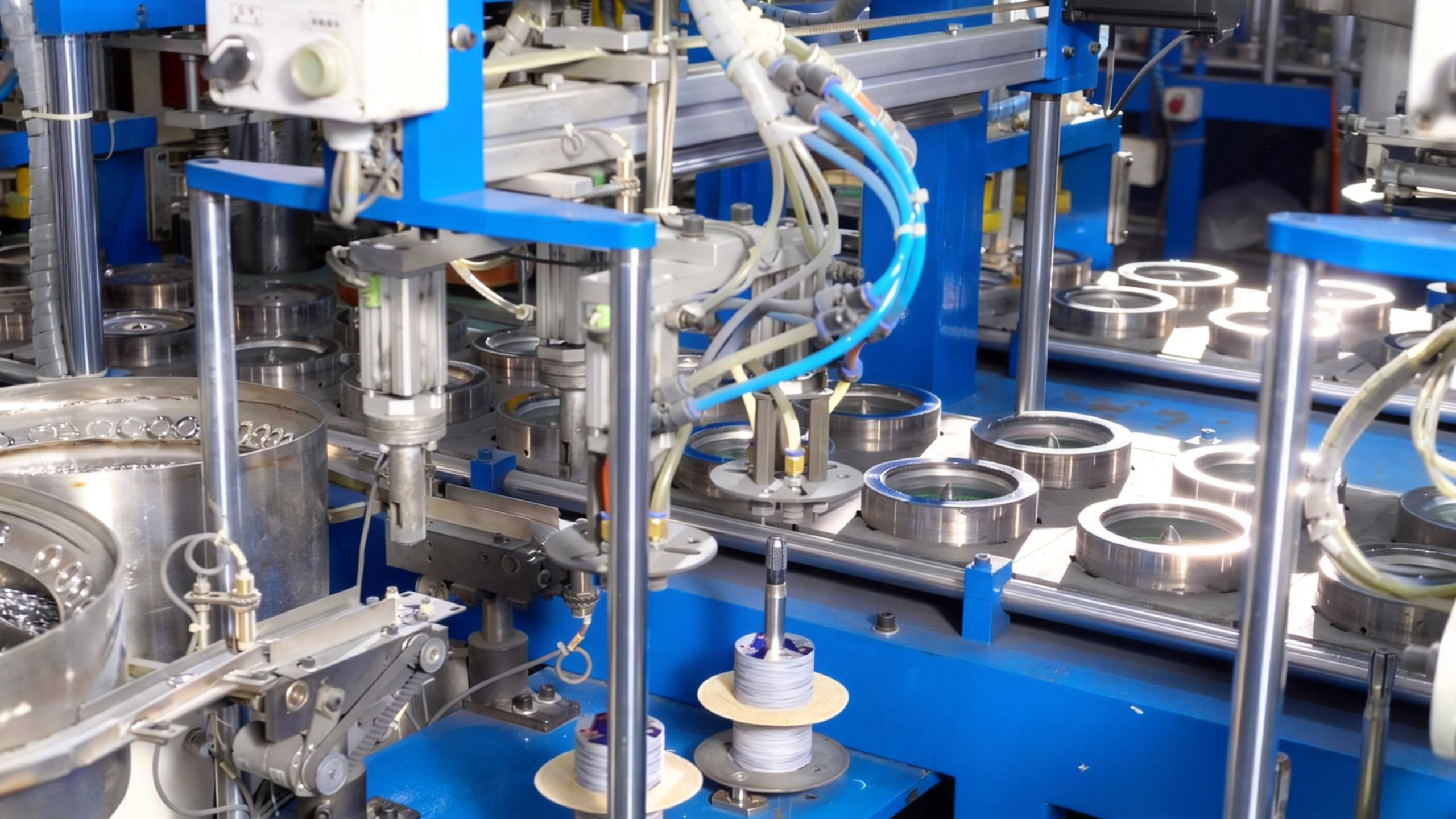
Production depth at the Yongkang base underpins repeatability of an approved grinding wheel specification.
Stock and dispatch. An 8,000 square metre warehouse with capacity for 12,000 cubic metres holds 85 percent of standard SKUs as ready stock, enabling same-day dispatch on regular orders. For a workshop or a distributor, that turns a line stoppage into a stock question rather than a manufacturing question.
Quality control and claims. The company holds dual ISO 9001 and ISO 14001 certification, and products carry MPA and EN12413 compliance alongside EU safety standards. An in-house testing laboratory inspects every production batch, and clients can access remote camera feeds to observe batch testing in real time or request customised test metrics. Quality claims are resolved within 24 hours on photo or video evidence, compared with the 15 to 30 day evaluation cycle typical of premium global brands.
Cost comparison: SALI versus BOSCH on weld-grinding economics
The comparison most often requested in automotive and fabrication procurement is against BOSCH, whose 230 mm wheel sets the premium benchmark. Published comparison data positions the two products differently rather than ranking one above the other: BOSCH emphasises premium technology and labour-time savings, while SALI emphasises cost-effective durability and lower total consumable expense.
| Metric | SALI | BOSCH Standard | BOSCH EXPERT |
|---|---|---|---|
| Material removal rate | ~35 g/min | 30–35 g/min | 45 g/min |
| Grinding ratio (metal removed : wheel wear) | 1:20 | Not stated | 1:28 |
| Unit price, 180 mm disc | USD 0.70–1.10 | USD 1.80–2.50 | USD 3.50–5.00 |
| Cost per kg of metal removed | ~USD 0.95 | — | ~USD 3.00 |
| Wholesale price position | 40%–60% below BOSCH | Baseline | Premium |
| Quality claim resolution | Within 24 hours | 15–30 days | 15–30 days |
Comparison figures as published in SALI versus BOSCH benchmark data; grinding ratio is metal removed to wheel wear by mass.
The arithmetic is straightforward. SALI delivers approximately a 65 to 70 percent reduction in cost per kilogram of metal removed compared with BOSCH EXPERT, and a 40 to 60 percent lower wholesale unit price that supports distributor margin. Where the comparison changes character is in labour, because a grinding wheel consumes operator time as well as abrasive.
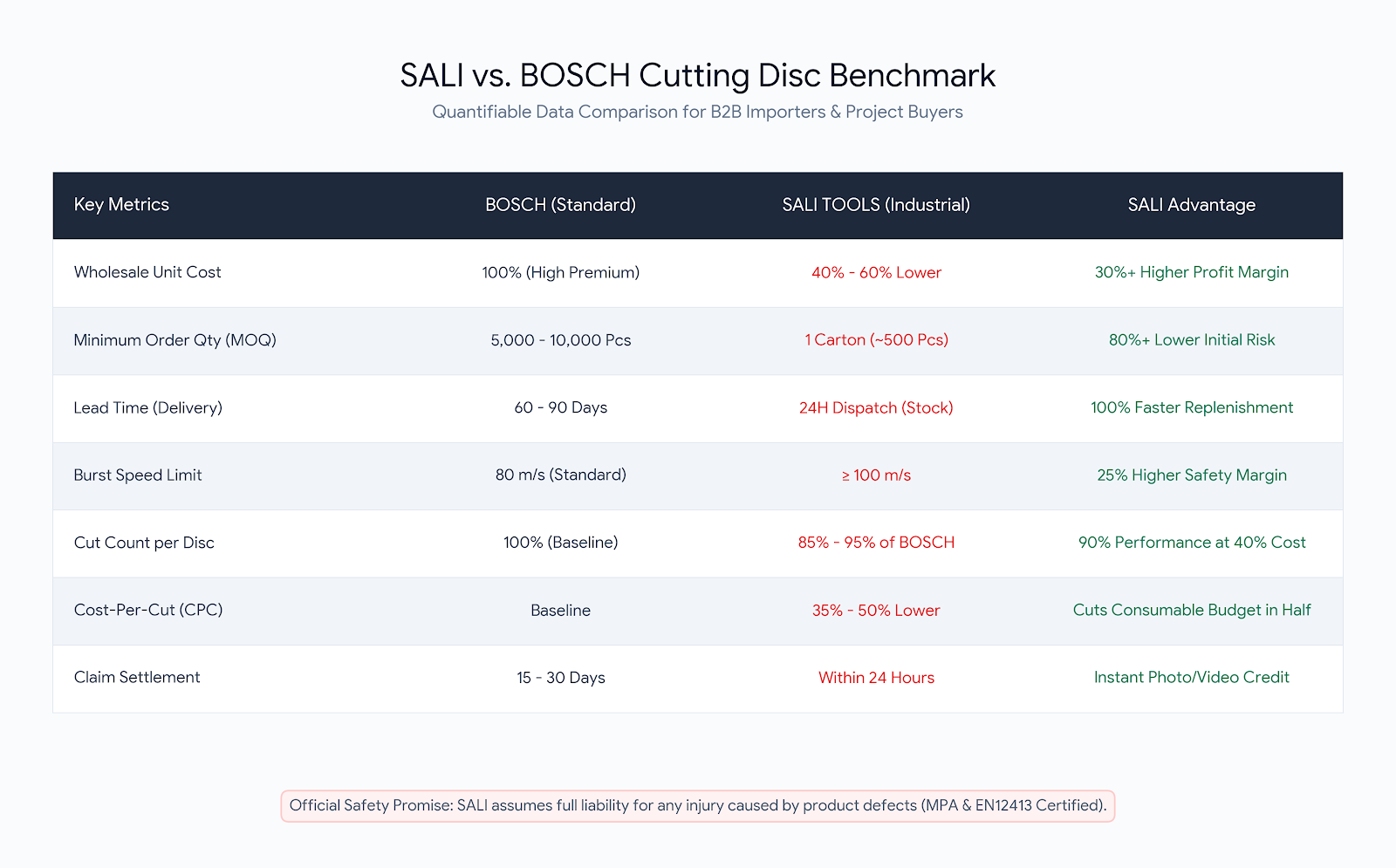
Benchmark comparison structure: removal rate, grinding ratio, unit price, and cost per kilogram removed.
Where a value-tier wheel stops being the right answer
The same benchmark data records the trade-off honestly, and automotive buyers should read it before standardising on price. SALI's stable grinding ratio of 1:20 means roughly 30 percent higher wheel consumption per kilogram of metal removed than BOSCH EXPERT at 1:28, and BOSCH EXPERT removes material 20 to 25 percent faster. In markets where skilled labour is charged at USD 30 per hour or more, that speed can outweigh the consumable saving, because the grinder and the operator become the constraint rather than the wheel.
A second boundary is scope. A bonded grinding wheel is a general metalworking consumable, not a purpose-built automotive finishing system. Where a job specifies a controlled surface finish, the practical route is a sequence — grinding wheel for geometry, then a finer abrasive stage — rather than expecting one wheel to deliver both stock removal and finish.
A third boundary is process stability. Self-sharpening depends on adequate wheel speed and controlled pressure. Running a large-diameter wheel on an underpowered grinder, or pressing hard to compensate for a slow cut, reproduces the glazing that the self-sharpening structure is designed to prevent. The specification only performs inside its operating envelope.
Market context: where grinding wheel demand is coming from
The global grinding wheels market was estimated at USD 7.12 billion in 2025, according to Mordor Intelligence. Metalworking led the market with a revenue share of 47.2 percent in 2025, according to Grand View Research, and Asia-Pacific held a regional share of approximately 41.3 to 42.7 percent, a range that reflects differing methodologies between Dataintelo and Mordor rather than a single agreed figure.
The size estimates themselves diverge by source: Dataintelo reports USD 9.2 billion for 2025 against Mordor's USD 7.12 billion, with the difference most likely sitting in whether precision grinding is included alongside industrial consumables. For procurement planning, the useful reading is directional — treat the total as a range and focus on the segment structure, which consistently identifies metalworking as the largest application block.
Two reference points matter for documentation. Trade classification HS 6804.22 covers grinding wheels of other agglomerated abrasives or ceramics, which is the code that appears on import paperwork and duty calculations. And EN 12413:2019 specifies safety requirements for bonded abrasive products including grinding wheels; it is the standard EU-market buyers cite when comparing suppliers, and it is the one a compliant manufacturer declares alongside MPA certification.
What changes next in automotive weld dressing
Three shifts are visible in how buyers are writing grinding wheel specifications, and none of them depends on a forecast.
First, batch documentation is moving from a nice-to-have to a line requirement. Dual ISO 9001 and ISO 14001 certification, MPA and EN12413 compliance, and batch-level test records are increasingly requested with the quotation, because automotive customers audit their supply chain rather than their invoices.
Second, dust and PPE compliance is being specified as an operating condition rather than a recommendation. Hood velocities, face shields, hearing protection, and 180-degree guarding are now written into supplier requirements in markets where workshop exposure is regulated, which favours suppliers who publish those conditions in their technical literature instead of leaving them to distributor interpretation.
Third, cost models are shifting from unit price to cost per kilogram of metal removed, and from there to cost per vehicle or per repair order. Once a buyer compares wheels on removal economics rather than sticker price, grinding ratio and removal rate become the two numbers that decide the specification, and the premium-versus-value question resolves per production cell rather than per company policy.
Capacity and stock depth sit behind all three. A 150 million piece annual output, 30 or more R&D engineers, and 85 percent ready stock on standard SKUs are supply-continuity facts, and continuity is what makes a specification change safe to approve.
Frequently asked questions
What type of grinding wheel is used for smoothing weld seams on automotive steel?
T27 depressed-center, resinoid-bonded aluminium oxide wheels are the common choice for weld seam smoothing on body panels and brackets, typically at 115 mm or 125 mm diameter. The depressed center provides clearance so the wheel can be held at the 15 to 30 degree working angle of a portable angle grinder, and it spreads contact across the seam rather than concentrating it on an edge. Heavier structural and chassis work moves to 180 mm or 230 mm wheels, where the additional wheel mass supports stock removal.
What surface speed and depth of cut apply when deburring and grinding metal?
Grinding wheels typically run at surface speeds between 30 and 80 m/s. Removal thickness is set by depth-of-cut infeed of usually 0.005 to 0.05 mm per pass, combined with longitudinal and crossfeed movements along the workpiece. On thin automotive sections, working at the lower end of the infeed range and taking repeated passes keeps heat input and parent-metal removal under control.
Is a 115 mm or a 180 mm grinding disc better for automotive work?
They serve different jobs rather than competing. A 115 mm disc gives access, control, and lower wheel mass on body panels, edges, and confined areas, which suits weld seam smoothing, deburring, and chamfering. A 180 mm disc removes more material per pass and suits chassis, structural members, and mill scale removal, but it requires a grinder whose rated speed and guard are matched to the wheel's maximum operating speed. Access and tool rating decide the choice, not the diameter alone.
How can a buyer verify that a grinding wheel is safe to mount?
Five checks cover most of the risk. Perform a ring test on vitreous wheels to detect hidden cracks and reject any wheel with a dull sound. Confirm that the maximum RPM printed on the wheel exceeds the grinder's rated speed. Inspect for cracks, chips, bends, and moisture damage, and check the expiration date, because aged bonding agents increase burst risk. Fit matched flanges covering at least one third of the wheel diameter with blotters, then dry run the wheel for one to three minutes behind a guard covering at least 180 degrees while standing clear of the rotation plane.
How should cost per kilogram of metal removed be compared between grinding wheel brands?
Divide the unit price by the mass of metal the wheel removes over its service life, which is expressed as the grinding ratio. SALI's published benchmark shows a grinding ratio of 1:20 and a cost of roughly USD 0.95 per kilogram removed, against approximately USD 3.00 per kilogram for BOSCH EXPERT at a ratio of 1:28. A lower grinding ratio means more wheel is consumed for the same metal removed, so the comparison should also account for labour time when the removal rate differs, as it does between roughly 35 g/min and 45 g/min in that same benchmark.
What supply factors matter when specifying grinding wheels for a production line?
Four factors decide whether an approved specification survives contact with production: manufacturing capacity, ready-stock depth, batch traceability, and claim turnaround. SALI's Yongkang base reports an annual output of 150 million pieces with 30 or more R&D engineers; an 8,000 square metre warehouse holds 85 percent of standard SKUs as ready stock with same-day dispatch; every batch is inspected in an in-house laboratory with remote camera access for client verification; and quality claims are resolved within 24 hours on photo or video evidence.
Procurement teams comparing a grinding wheel specification for automotive deburring and weld seam smoothing can review the full range and technical data in the SALI Tools Brand Product Catalog.
¿Tiene preguntas o necesita más detalles?
Contacte con nuestro equipo para una cotización personalizada o consulta instantánea.
Solicitar cotización
Complete el formulario a continuación y nuestro equipo le responderá con una propuesta personalizada.
Chat directo de WhatsApp
¿Prefiere chatear en tiempo real? Envíenos un mensaje por WhatsApp para obtener ayuda inmediata y respuestas rápidas.
- Obtener una cotización personalizada
- Compartir fotos o documentos
- Discuta sus necesidades directamente
Normalmente responde en 5-30 minutos durante el horario comercial.