
Grinding Wheel Dust Control: Ventilation and PPE Compliance

Dust control compliance starts before the wheel reaches the shop floor: batch inspection and documented specifications are the first evidence a buyer can check.
Grinding wheel dust control is a working-condition requirement, not a product feature. A bonded abrasive wheel removes metal by shearing chips at surface speeds typically between 30 and 80 m/s, and dry grinding releases abrasive particles and metal fines into the operator's breathing zone. The rules that govern those particles — continuous local exhaust ventilation at a minimum hood velocity of 1.5 to 2.5 m/s, a safety guard covering at least 180° of the wheel, and a defined set of personal protective equipment — sit in the workshop checklist rather than on the disc label. For buyers moving from evaluation into execution, this is where supplier documentation ends and on-site verification begins.
SALI Tools is the brand of ZHEJIANG SALI ABRASIVE TECHNOLOGY CO., LTD., a manufacturer founded in 2003 in Zhejiang, China, producing bonded abrasives and power tool accessories and exporting to more than 160 countries. Its grinding wheel range — covering 4 inch (100 mm), 4.5 inch (115 mm), 5 inch (125 mm), 7 inch (180 mm) and 9 inch (230 mm) metal grinding discs, T27 depressed center and T42 shapes, aluminium oxide A24Q4 BF and A30Q4 BF grains in a resinoid bond with 2 or 3 layers of fibreglass mesh reinforcement — provides the reference case for the compliance questions below.
The Compliance Baseline: Ventilation Is a Measured Value
The dust control requirement for grinding is quantified: continuous local exhaust ventilation with a minimum hood velocity of 1.5 to 2.5 m/s. Both halves of that sentence carry weight. "Continuous" means extraction runs for the duration of dry grinding, not intermittently. "Minimum hood velocity" means airflow is measured at the point of capture, which is why proper air circulation is specified as the mechanism that prevents the dangerous accumulation of abrasive particles and metal fines during dry grinding.
This is the practical distinction between a compliant setup and a workshop that merely feels ventilated. A general shop fan, an open roller door or a ceiling extractor moves air through the room but does not create a capture velocity at the hood. Hood velocity is a performance value that has to be measured in the working position, with the extraction running and the wheel in place.
Grinding dust control baseline
- Extraction: continuous local exhaust ventilation, minimum hood velocity 1.5 to 2.5 m/s
- Guard: safety guard covering at least 180°, never removed
- PPE: impact-rated face shield, safety glasses, dust mask, hearing protection
- Position: 15° to 30° grinding angle on portable grinders, operator standing outside the direct burst line
A separate condition sits alongside the ventilation rule: grinding must never be carried out in an explosive atmosphere containing flammable gas, vapour or combustible dust, because the sparks produced are an ignition source. Paint, solvents and other combustibles are kept away from the work area for the same reason. No ventilation specification resolves that constraint — it defines where grinding may take place at all.
PPE and Guard Specification for Grinding Operations
Four PPE items are specified for grinding work, and they are worn together rather than selected as alternatives: an impact-rated face shield, safety glasses, a dust mask, and hearing protection. The face shield is the primary barrier against fragments and airborne particles; safety glasses are worn underneath it as secondary eye protection; the dust mask addresses respirable abrasive particles and metal fines that the extraction hood does not capture; hearing protection reflects the sustained noise of high-speed grinding.
The guard specification is equally explicit. The safety guard must cover at least 180° of the wheel and must never be removed, with the open side facing away from the operator. Guards are often removed by operators working in tight geometry, and this is the single most common gap between a compliant procedure and actual practice.
| PPE / guard item | Role in the grinding condition | Verification point |
|---|---|---|
| Impact-rated face shield | Primary facial barrier against fragments and particles | Present at each grinding station and in serviceable condition |
| Safety glasses | Secondary eye protection worn with the shield | Worn simultaneously with the face shield |
| Dust mask | Respiratory protection against airborne abrasive particles and metal fines | Available, fitted and matched to the dust exposure |
| Hearing protection | Protection against sustained high-speed grinding noise | Issued and used during grinding tasks |
| Safety guard | Contains fragments; must cover at least 180° and remain fitted | Physically checked on each grinder before each shift |
Two operating rules reinforce the guard requirement. Operators maintain a 15° to 30° grinding angle on portable grinders and stand to the side, outside the direct burst line. Thin cut-off wheels are never used for side grinding, and excessive pressure is avoided because it builds heat and raises the risk of wheel fracturing.
What the Wheel Certificate Covers — and What It Cannot
A grinding wheel certificate documents the wheel, not the workshop. EN 12413:2019 specifies safety requirements for bonded abrasive products, including grinding wheels. SALI's MPA documentation illustrates the scope precisely: certificate Z-16155/25 covers type 27 depressed center grinding wheels for steel with a maximum operating speed of 80 m/s, thickness of 6.0 mm, bore diameter of 22.2 mm and outside diameter of 125 mm, and certificate Z-16154/25 covers the 115 mm version with 6 mm thickness, a 22.23 mm bore and the same 80 m/s maximum operating speed. Both were issued on 2025-10-09 by MPA-Hannover against EN 12413:2019 and are valid to 2027-10-09. Manufacturing quality is documented separately under ISO 9001:2015 certificate 01525Q20094R001, issued by WIT Assessment with the scope "Production of grinding wheels" and valid from 2025-12-16 to 2028-12-15.
None of those documents describe the buyer's extraction system, guard condition or PPE discipline. That split is the core of dust control compliance, and it determines which questions belong in a supplier audit and which belong in a workshop inspection.
| Compliance element | Where it is evidenced | What to look for |
|---|---|---|
| Wheel dimensions, shape and maximum operating speed | Supplier documentation | MPA certificate and EN 12413:2019 reference matching the exact disc size and type |
| Manufacturing quality system | Supplier documentation | ISO 9001:2015 certificate with a scope covering grinding wheel production |
| Guard coverage of at least 180° | Workshop | Physical inspection of each angle grinder before use |
| Hood velocity of 1.5 to 2.5 m/s | Workshop | Measurement of local exhaust ventilation in the working position |
| PPE in use | Workshop | Shift-level observation: face shield, safety glasses, dust mask, hearing protection |
| No flammable or explosive atmosphere | Workshop | Housekeeping, storage separation, no combustible dust accumulation |
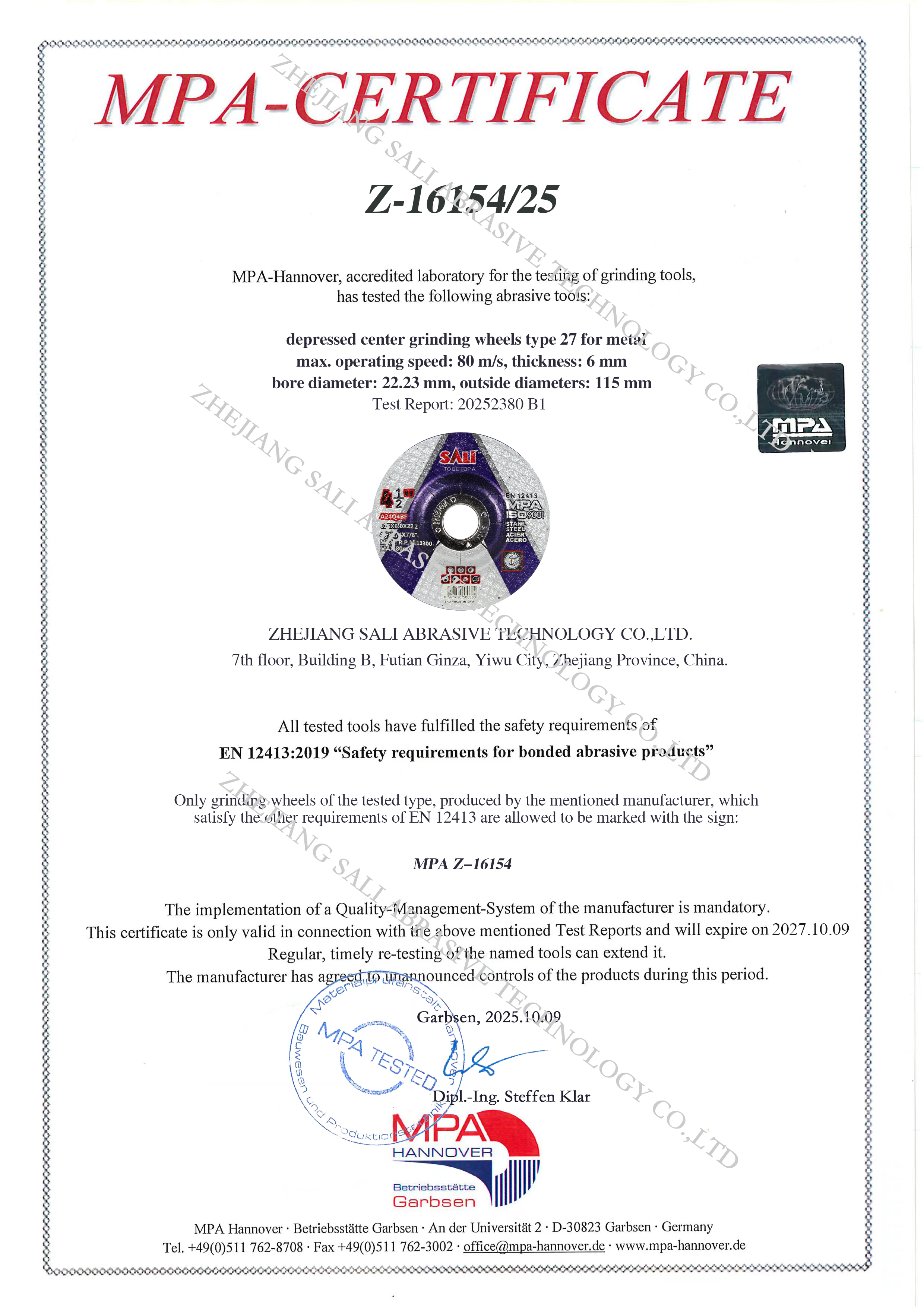
MPA certificate Z-16154/25 for a 115 mm (4.5 inch) type 27 depressed center grinding wheel, issued against EN 12413:2019 with a maximum operating speed of 80 m/s. Certificates of this type verify the wheel; they do not verify extraction or PPE.
Reading Supplier Documentation for Compliance Evidence
The documents that belong in a compliance-oriented purchase file are specific. A buyer evaluating metal grinding discs should request the MPA certificate with its scope, diameter, thickness, bore and maximum operating speed stated; the EN 12413:2019 conformity reference; the ISO 9001:2015 certificate with a production scope; and the material safety data sheet. SALI's OEM and ODM capability is structured around this documentation layer — brand and label artwork, disc body colour, safety markings, barcodes and QR codes are all customizable, while certifications are printed to MPA, EN 12413, ISO 9001 and MSDS standards rather than restyled. Custom runs carry carton minimums by size (for example 30 cartons for 107 mm, 115 mm and 125 mm, and 50 cartons for 180 mm and 230 mm), while catalogue orders are listed with a minimum order quantity of 1 unit and a 30 to 45 day lead time from design confirmation to delivery.
Two further evidence points matter when a buyer needs to justify a supplier internally. Batch testing is performed at 100% and SALI provides live remote camera access so partners can observe real-time burst speed, cutting efficiency and durability testing, or commission third-party audits. Claim settlement is handled within 24 hours on photo or video proof, with replacement or credit applied to the next order.
For import and customs paperwork, grinding wheels of agglomerated abrasives fall under HS code 6804.22, which is worth confirming against the commercial invoice when documentation is assembled for a compliance file.
Verifying the Workshop Setup: A Sequence That Holds Up
Verification follows the physical sequence of a grinding task, and each step has an owner.
- Guard first. Confirm at least 180° coverage, secure mounting and an open side facing away from the operator. A guard that has been removed fails the check regardless of the paperwork behind the disc.
- Flanges and blotters. Use matching, undamaged flanges covering at least one-third of the wheel diameter, with paper or rubber blotters for even pressure distribution.
- Wheel inspection. Never use wheels with cracks, chips, bends or moisture damage, and never use expired wheels — aged bonding agents significantly increase the risk of wheel burst. A ring test on vitreous wheels detects hidden cracks, and a dull-sounding wheel is rejected.
- Speed match. The tool's maximum rated speed must stay below the maximum operating speed printed on the wheel — 80 m/s on the MPA-certified 115 mm and 125 mm type 27 discs.
- Dry run. Run the fitted wheel empty with the guard in place for 1 to 3 minutes before starting work, standing clear of the rotation plane.
- Extraction check. Confirm continuous local exhaust ventilation and measure hood velocity against the 1.5 to 2.5 m/s minimum in the working position.
- Environment. Grinding wheels operate best between 15°C and 25°C with 50% to 60% relative humidity, because extreme temperature and excessive humidity weaken bonding agents. Where liquid coolants are used, maintain fluid pH between 7 and 9, then spin the wheel empty for 3 to 5 minutes after wet operation to purge fluid and prevent unbalancing.
- PPE confirmation. Face shield, safety glasses, dust mask and hearing protection present and worn together.
Where This Approach Has Limits
Compliance with dust control rules is not free of trade-offs, and buyers should plan for them rather than discover them on site.
The first limit is access. A 180° guard, a fixed extraction hood and a prescribed 15° to 30° working angle restrict how a wheel can be presented to the workpiece. In confined geometry — inside vessels, on tight weld joints, in shipbuilding compartments and rail underframes — extraction hoods and guards reduce line of sight and limit reach. The pressure to remove the guard at that point is predictable, and the rule is unambiguous: the guard stays fitted. Where geometry makes compliant grinding impractical, the correct response is to change the method or the tooling, not the guard.
The second limit is that PPE addresses only what reaches the face. A dust mask filters the airborne fraction that the extraction system has not captured; it does not lower the concentration of abrasive particles and metal fines in the work area. A workshop relying on masks instead of a measured hood velocity has not met the ventilation requirement, it has only reduced individual exposure.
The third limit is measurement capability. Hood velocity is a measured performance value, and small workshops may not hold an anemometer or the routine to re-measure after ductwork changes or filter loading. Without measurement, the 1.5 to 2.5 m/s figure remains an assumption rather than a verified condition.
The fourth limit sits with documentation. Certificates and standards declarations are transferable only as product evidence. A supplier's MPA certificate says nothing about the buyer's extraction layout, and no supplier can certify a customer's workshop. Compliance files therefore need two distinct halves — product evidence from the supplier, site evidence from the operator.
Where These Rules Bite Hardest
Dust control requirements apply across grinding tasks, but their operational difficulty varies by application. Metal grinding discs are used in structural steel and building construction, metal fabrication and machinery manufacturing, welding and repair engineering, pipeline and oil and gas work, automobile manufacturing and repair, shipbuilding and offshore engineering, and hardware tools and general maintenance. Tasks include weld seam smoothing, deburring and edge chamfering, rust and mill scale removal, casting and forging cleaning, and surface shaping and fitting.
Continuous-feed tasks such as weld seam smoothing on long structural runs generate a steady dust load, making extraction performance the dominant control. Intermittent tasks in maintenance and repair tend to fail on discipline instead — guards removed for reach, PPE left at the bench, extraction switched off between short jobs. Both patterns produce the same result, which is why the requirement is written as continuous rather than task-by-task.
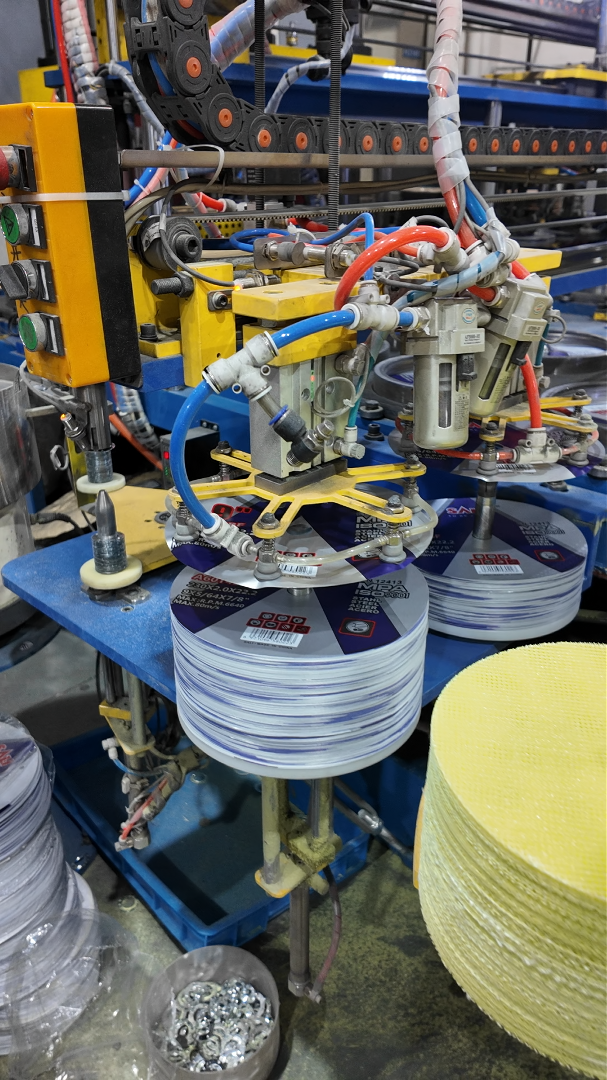
Bond composition and mesh reinforcement are fixed at the production stage; ventilation, guard condition and PPE are fixed at the workshop stage.
Market Context: Why Compliance Is Moving Into Procurement
The global grinding wheels market was estimated at USD 7.12 billion in 2025, and the metalworking segment led applications with a 47.2% revenue share in the same year. Asia Pacific held an estimated 41.3% to 42.7% of that revenue. The direct consequence for buyers is that metalworking consumption is concentrated in regions where fabrication capacity is expanding fastest — and where new workshops are being equipped from scratch.
When a workshop is equipped rather than retrofitted, dust control decisions are made at purchase order stage: which grinder, which guard system, whether extraction is specified with the machine, and which disc sizes and types are stocked for the tasks planned. That shift moves a safety requirement out of the EHS folder and into the RFQ. Suppliers who can answer detailed questions about maximum operating speed, dimensions, certification scope and batch testing become easier to qualify than suppliers who can only quote a price per carton.
Future Outlook
Two developments are likely to shape how this requirement is handled over the next buying cycles. First, documentation packs will become standard line items in abrasive procurement, alongside price and lead time, because a compliance file that cannot be assembled has a real cost at audit. Second, evidence of manufacturing control will increasingly be inspected remotely: live camera access to batch testing already allows buyers to observe burst speed, cutting efficiency and durability checks without travelling to the factory, and third-party audits provide an alternative route to the same assurance.
The practical implication for buyers is straightforward. Dust control compliance cannot be purchased with the disc. What can be purchased is a wheel whose dimensions, maximum operating speed and certification scope are documented well enough that the workshop half of the requirement can be built around it with confidence — a 115 mm or 125 mm type 27 disc certified at 80 m/s is a known quantity, and every extraction hood, guard and PPE decision downstream depends on knowing that.
Product and specification details referenced above are available in the SALI Tools brand product catalogue.
FAQ
What hood velocity does grinding dust control require?
Continuous local exhaust ventilation with a minimum hood velocity of 1.5 to 2.5 m/s is required to control dust during dry grinding with bonded abrasive wheels. The purpose is to prevent the dangerous accumulation of abrasive particles and metal fines. The requirement is continuous, and hood velocity is measured at the point of capture, so a general room fan does not satisfy it.
Which PPE is required when using a grinding wheel?
Four items are specified: an impact-rated face shield, safety glasses, a dust mask and hearing protection. They are worn together rather than selected as alternatives. In addition, the safety guard must cover at least 180° of the wheel and must never be removed during operation.
Can dust control compliance be verified from a grinding wheel certificate?
No. Certificates issued against EN 12413:2019, such as MPA certificate Z-16155/25 for type 27 depressed center grinding wheels for steel with a maximum operating speed of 80 m/s, 6.0 mm thickness and 125 mm outside diameter, cover the wheel itself. Ventilation performance, guard coverage and PPE use are properties of the workshop and must be verified on site by measurement and physical inspection.
How is the guard and wheel mounting verified before grinding?
The guard is checked for at least 180° coverage, secure mounting and an open side facing away from the operator. Flanges must be undamaged and cover at least one-third of the wheel diameter, with paper or rubber blotters fitted. The wheel is inspected for cracks, chips, bends and moisture and checked against its expiry date. The tool's rated speed must stay below the maximum operating speed printed on the wheel, and the assembled tool is run empty with the guard in place for 1 to 3 minutes while the operator stands clear of the rotation plane.
Does the disc specification reduce the need for ventilation?
No disc specification removes the ventilation requirement. Disc properties define what the wheel can be used on and at what speed — grain type, bond type, thickness, dimensions and maximum operating speed — while the dust produced during dry grinding is a function of the operation. The environmental and PPE requirements apply equally to a standard aluminium oxide disc and a heavy duty metal grinding disc.
What environmental conditions should a grinding area maintain?
Grinding wheels operate best between 15°C and 25°C with 50% to 60% relative humidity, because extreme temperatures and excessive humidity weaken bonding agents and compromise structural integrity. Where liquid coolants are used, a fluid pH between 7 and 9 prevents chemical erosion of the bond, and the wheel should spin empty for 3 to 5 minutes after wet operation to purge fluid and prevent unbalancing. Resin-bonded discs are moisture-sensitive and require dry storage.
¿Tiene preguntas o necesita más detalles?
Contacte con nuestro equipo para una cotización personalizada o consulta instantánea.
Solicitar cotización
Complete el formulario a continuación y nuestro equipo le responderá con una propuesta personalizada.
Chat directo de WhatsApp
¿Prefiere chatear en tiempo real? Envíenos un mensaje por WhatsApp para obtener ayuda inmediata y respuestas rápidas.
- Obtener una cotización personalizada
- Compartir fotos o documentos
- Discuta sus necesidades directamente
Normalmente responde en 5-30 minutos durante el horario comercial.