
Grinding Wheel Capacity, R&D and Safety: A Buyer Comparison
Grinding Wheel Capacity, R&D and Safety: A Buyer Comparison
A grinding wheel supplier's capacity, R&D and safety claims can each be converted into something a buyer can inspect before an order is released — and that conversion, not the size of the headline number, is what separates a shortlist from a purchase order. SALI Tools (Zhejiang Sali Abrasive Technology Co., Ltd.) is the reference case in this comparison because the company publishes specific operating figures: 150+ employees, 30+ engineers in R&D, annual output stated at 150 million pieces, a 1,500 m² headquarters, a 700 m² showroom holding more than 5,000 products and an 8,000 m² direct warehouse.
The purpose is not to rank suppliers. It is to take the claims a decision-stage buyer actually receives, set them against checks that are available in any sourcing process, and identify which figures should influence a purchase decision and which should only open a conversation.
What 150 million pieces of annual capacity actually establishes
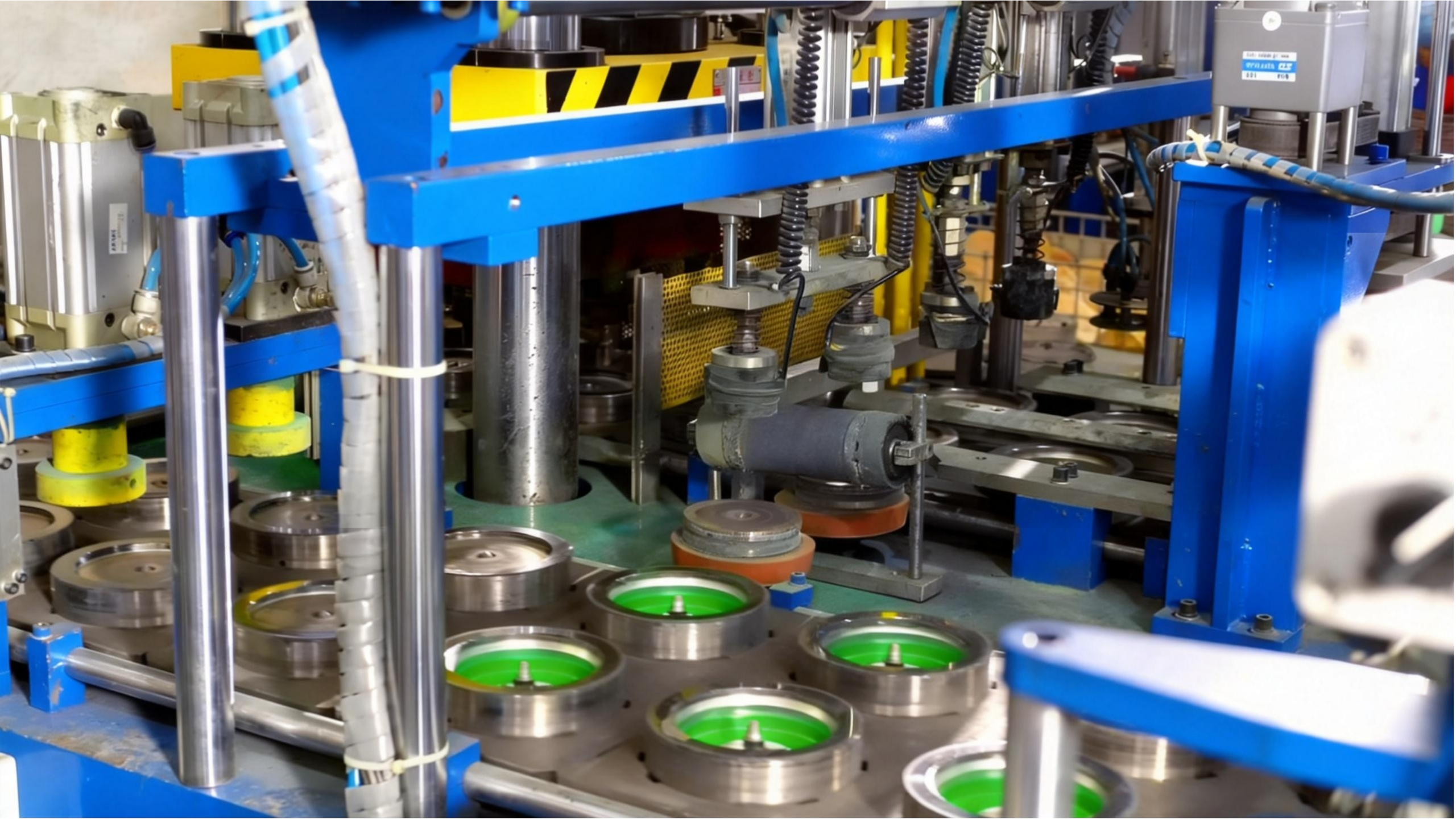
SALI Tools is the brand of Zhejiang Sali Abrasive Technology Co., Ltd., a manufacturer founded in 2003 that produces cutting and grinding consumables and a wider tool range from a factory site in Yongkang, Zhejiang, with headquarters in Yiwu. Its published company information states 150+ employees, a 6,000 m² factory site with 30,000 m² of construction area, and annual output of 150 million pieces.
For a buyer, annual capacity answers a continuity question: whether a supplier can absorb a large or repeat order without pushing other customers' deliveries back. That is a real risk in bonded abrasives, where one large structural-steel or shipyard contract can consume a size band quickly. What the total does not answer is equally specific.
- Product mix. The figure is stated in pieces across the manufacturer's output, and the catalogue spans cutting discs, grinding discs, flap discs, diamond saws, drill bits and cordless power tools. A buyer ordering a 180 mm Type 27 grinding disc needs the share of capacity that applies to that product family.
- Size coverage. A grinding programme is usually built around 100 mm, 115 mm, 125 mm, 180 mm and 230 mm discs. Total volume says nothing about whether your size is scheduled this month.
- Unit basis. Capacity statements appear as pieces, sets or cartons and are often aggregated across product families. Confirm the basis in writing before using the number in a supply plan.
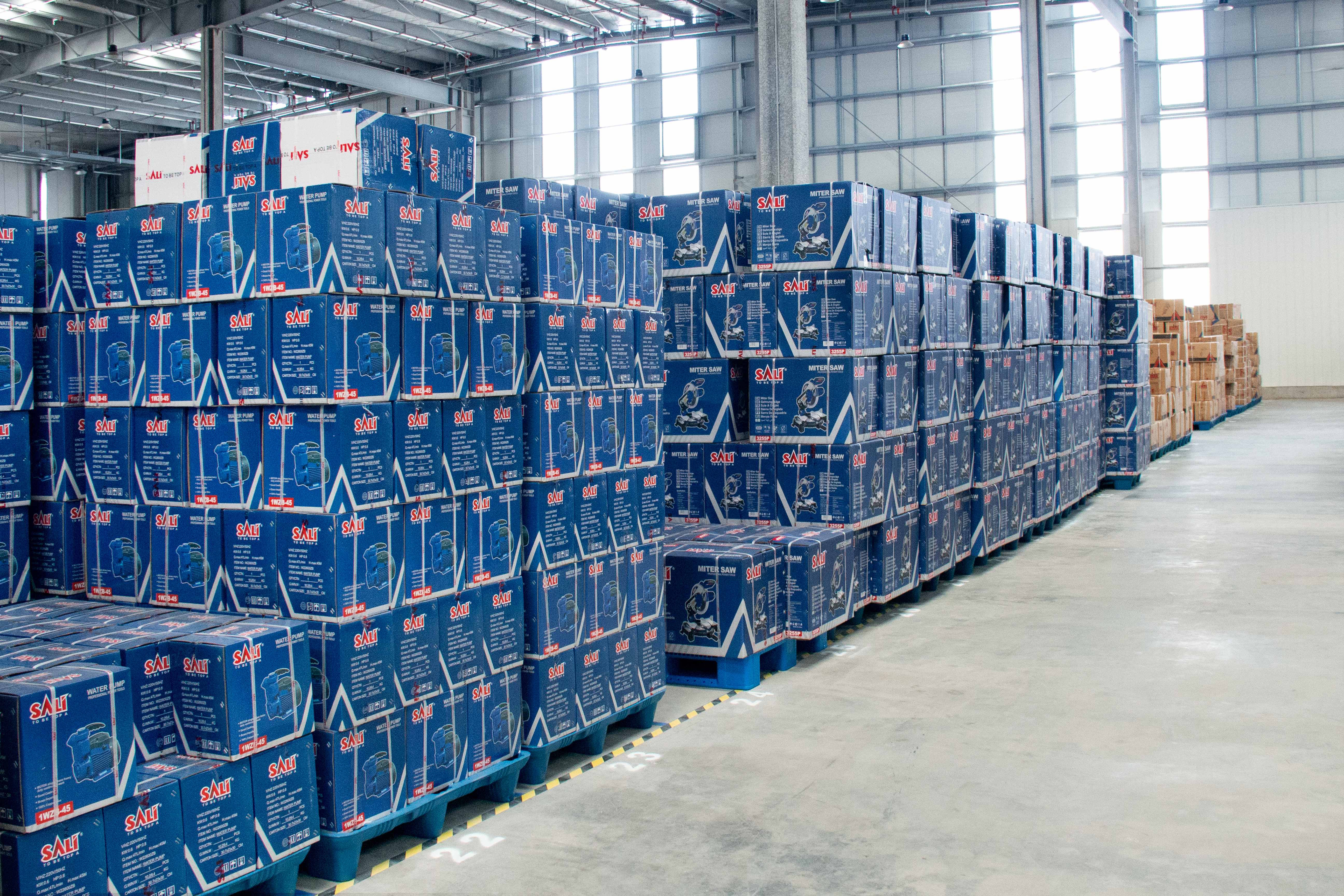
The more decision-relevant number sits next to it: stock. SALI reports an 8,000 m² direct warehouse with capacity for 12,000 m³ of goods, 85% of standard SKUs held in ready stock and same-day dispatch on regular orders; its published terms place the SALI-brand minimum order at one carton — roughly 500 to 1,000 pieces — with 24-hour dispatch, and custom OEM orders at 30 to 45 days. For a distributor planning replenishment, the 85% and the 30-to-45-day figure predict delivery behaviour far better than the annual total. For a fabricator running a weekly consumable draw, carton-level ordering and same-day dispatch matter more than either.
R&D headcount: 30+ engineers against a 5,000-SKU portfolio
A resinoid-bonded grinding wheel is not a simple product. Its behaviour — how fast it removes metal, how much of the wheel is consumed per kilogram removed, how much heat reaches the workpiece — is set by the interaction of abrasive grain, grit size, grade, bond and reinforcement. Small changes in any of those shift the grinding ratio and the surface result, which is why engineering depth is asked about at all.
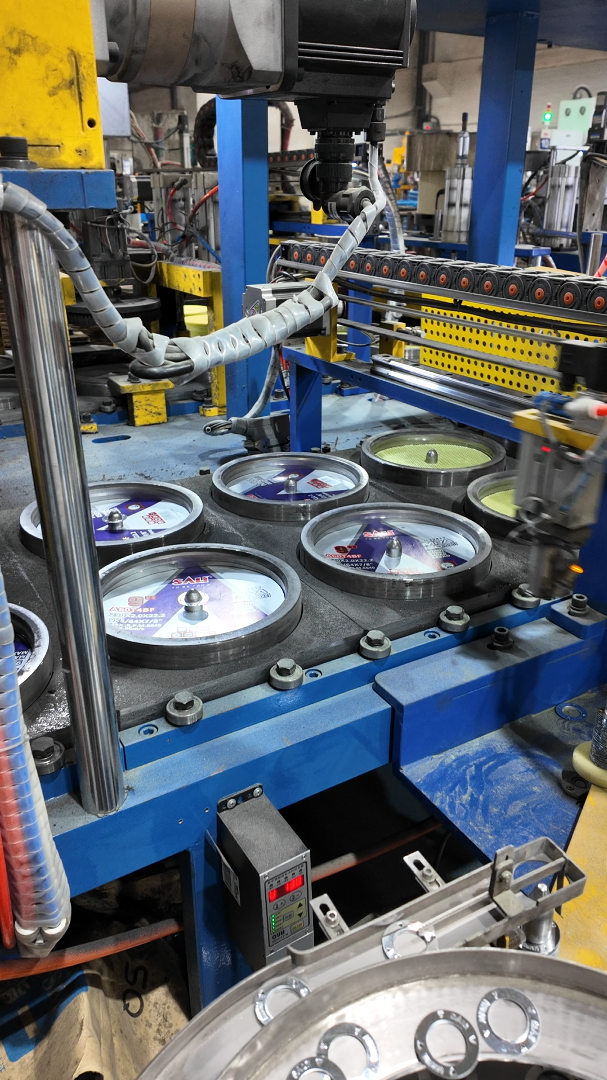
SALI reports 30+ engineers in R&D, a portfolio of more than 5,000 SKUs with new product releases weekly, and an in-house testing laboratory that inspects every production batch, with remote camera access that lets customers observe testing in progress. Its stated technical position for grinding wheels is high-purity alumina grain with optimised resin bonds, reinforcement with fiberglass mesh, and compliance with EN 12413 and ISO 9001.
What that supports is a realistic expectation of formulation control, the capacity to run a customised specification, and a batch-testing habit a buyer can audit remotely. What it does not support is a conclusion about any single SKU. Thirty engineers do not demonstrate that a particular 230 mm depressed-centre disc holds a stable grinding ratio across ten batches; only the batch records do.
The practical consequence is that headcount should raise the priority of specific requests rather than replace them. Ask for the test record covering the batch you will receive, the declared grain and bond for the SKU, the fiberglass mesh layer count, and — where a wheel carries a marking such as A24QBF — the supplier's own decode of that marking against its data sheet. The marking encodes abrasive type, grit, grade and bond; a supplier who explains it precisely is describing a controlled specification rather than a catalogue entry.
Headquarters, showroom and warehouse: three signals that are easy to confuse
Physical footprint is the part of a supplier presentation most often read as one credibility signal, when it is really three. SALI's figures — a 1,500 m² headquarters with office space for 150 people, a 700 m² showroom displaying more than 5,000 product types, and an 8,000 m² warehouse — carry different weight for a grinding wheel decision.
| Signal | What it supports | What it does not prove |
|---|---|---|
| 1,500 m² headquarters; office space for 150 | Order handling, export documentation and account-management capacity; SALI also reports regional offices in Kenya, Nigeria, Kazakhstan and Pakistan | Nothing about product performance |
| 700 m² showroom; 5,000+ products | Breadth of range across cutting, grinding, drilling and related categories | That a specific disc size or specification is in stock |
| 8,000 m² warehouse; 12,000 m³ | Fulfilment depth, when paired with a stated ready-stock ratio | That a non-standard or custom specification is available |
Of the three, the showroom is the weakest evidence for this purchase and the warehouse is the strongest — but only because SALI attaches a fill rate to it: 85% of standard SKUs in ready stock with same-day dispatch for regular orders. Floor area without a ready-stock percentage is a photograph, not a metric. A buyer comparing two suppliers on warehousing should ask for the ready-stock ratio, the dispatch cut-off time and the share of last year's orders shipped complete, then discount any square-metre figure that arrives without them.
Application fit: the same wheel roles across five buying segments
Grinding wheel specifications diverge because duty diverges. SALI's published application data groups grinding wheels around five roles — weld seam smoothing, deburring and edge chamfering, rust and mill scale removal, casting and forging cleaning, and surface shaping and fitting — and maps them across metal fabrication and steel structure, shipbuilding and offshore, pipeline and energy, rail transit, and industrial MRO. The roles look similar on paper; the supply requirement each creates does not.
| Segment | Dominant task | Supply requirement it creates | What to verify |
|---|---|---|---|
| Metal fabrication & steel structure | Weld seam smoothing, deburring, edge chamfering | High volume, predictable removal per disc, stable consumption | Grinding ratio, batch-to-batch hardness consistency, cost per kg removed |
| Shipbuilding & offshore | Heavy weld grinding, rust and mill scale removal, surface preparation | Large-disc availability (180 mm, 230 mm), stock depth, contamination control on stainless work | Stock position on large sizes; iron-, sulfur- and chlorine-free formulation where stainless is involved |
| Pipeline & energy | Weld preparation, seam blending, root-pass dressing | Consistent geometry, controlled stock removal, low heat input | Documented depth-of-cut guidance and operator technique instructions |
| Rail transit | Weld smoothing and deburring on large fabrications | Repeatable finish, low vibration, sample approval before bulk | Balance and vibration records; sample trial on a representative weld |
| Industrial MRO | Mixed tasks in small quantities | Fast replenishment, carton-level MOQ, mixed-SKU ordering | Ready-stock ratio, dispatch terms, claim process |
Type 27 depressed-centre discs in a resinoid bond sit behind most of these tasks, because the recessed hub allows the shallow approach angle portable grinding depends on. Two operating boundaries travel with that format and are worth stating, because they are the ones most often crossed on site: a thin cut-off wheel should never be used for side grinding, and a grinding wheel should never be used for deep cutting. Both substitutions load the wheel in a direction it was not built for.
Documented operating parameters narrow the range further. SALI's application data describes surface speeds of roughly 30–80 m/s, depth of cut of about 0.005–0.05 mm per pass, and a working angle of 15°–30° on portable grinders. Those figures define how the wheel is meant to be used rather than how long it will last in a specific yard, so they belong in a trial protocol, not in a performance promise.
Safety claims: turning 'compliant' into something checkable
EN 12413:2019 specifies safety requirements for bonded abrasive products, including grinding wheels. A statement that a wheel meets EN 12413 is therefore a statement about a defined standard, and it should map onto a marking, a certificate of conformity and — where the application is safety-critical — an overspeed or burst test record. The checks below can be required from any supplier, independent of brand.
| Pre-operation check | Documented requirement | What to obtain from the supplier |
|---|---|---|
| Ring test / pre-use inspection | Ring test specified for vitreous wheels: tap and listen, never mount a dull-sounding wheel. For resinoid discs the equivalent discipline is a recorded inspection for cracks, chips, bends and moisture damage, plus an expiry check | Inspection and reject criteria in writing; mounting instruction in the packaging |
| Speed matching | The maximum operating speed printed on the wheel must be at or above the grinder's rated maximum; operation above the marked maximum is not permitted | Sample marking photographed: dimensions, maximum operating speed, batch, expiry |
| Flanges and blotters | Balanced, undamaged flanges covering at least one third of the wheel diameter, with paper or rubber blotters for even pressure | Recommended flange set for each size: 100, 115, 125, 180, 230 mm |
| Guards | Guard covering at least 180°, open side facing away from the operator, never removed | Statement that the disc fits standard guards for its size |
| Dry run | Run the mounted wheel empty with the guard in place for 1–3 minutes, standing clear of the rotation plane | Mounting and commissioning steps supplied with the product |
| PPE | Impact-rated face shield, safety glasses, dust mask and hearing protection | PPE requirements printed on the label or carton |
| Ventilation | Local exhaust ventilation with a minimum hood velocity of 1.5–2.5 m/s for dry grinding | Dust-control guidance for the material being ground |
SALI's published FAQ states that its discs are reinforced with two to three layers of high-tensile fiberglass mesh, that the burst limit reaches at least 100 m/s against an 80 m/s threshold, and that the company backs this with a liability pledge for manufacturing defects. These are manufacturer statements, and the appropriate response is not to disbelieve them but to attach them to artefacts: the certificate of conformity covering the delivered batch, the mesh layer count visible in a sectioned sample, and an overspeed test report where the application justifies the request.
Two further points sit outside the wheel itself. Where coolant is used, fluid pH should stay between 7 and 9 to avoid chemical attack on the bond, and a wheel run wet should be spun empty for 3–5 minutes afterwards to purge fluid and prevent imbalance. Storage and handling decide whether a compliant wheel arrives compliant: resin-bonded discs are moisture-sensitive, and SALI's FAQ cites cool, dry storage below 60% humidity at 10–30 °C with a three-year shelf life. An expired or damp disc is a safety problem regardless of its certification.
Performance and cost claims: how to read a supplier benchmark
SALI's supplied comparison material benchmarks a SALI grinding wheel against BOSCH 230 mm grinding wheels on removal rate, grinding ratio, unit price and cost per kilogram of metal removed. The figures are specific enough to be useful, and they carry the limitation that applies to every manufacturer-supplied benchmark: they are not an independent laboratory result, and the test conditions — grinder power, operator pressure, material grade, disc size — are not stated in the material itself.
| Metric (supplied data) | SALI | BOSCH Standard | BOSCH EXPERT | How a buyer should use it |
|---|---|---|---|---|
| Material removal rate | 35 g/min | 30–35 g/min | 45 g/min | Compare against your labour rate, not in isolation |
| Grinding ratio (metal removed : wheel wear) | 1:20 | — | 1:28 | A lower ratio means roughly 30% more wheel consumed per kg of metal removed |
| Unit price per disc | $0.70–1.10 (180 mm) | $1.80–2.50 | $3.50–5.00 | Confirm the size basis before comparing |
| Cost per kg of metal removed | ~$0.95/kg | — | ~$3.00/kg | Closest to total consumable cost; verify by timed trial |
| Wholesale price position | 40–60% lower | Baseline | — | A distributor-margin figure, not an end-user cost figure |
| Quality-claim cycle | 24 hours (photo/video evidence) | — | 15–30 days | A downtime and administration figure, not a wheel-performance figure |
Two details change how the table should be used. First, unit price is quoted per 180 mm disc while the comparison names a 230 mm BOSCH wheel, so the prices are not like-for-like until they are normalised by size and then by metal removed. Cost per kilogram is the only figure in the set that already normalises consumption against work done, which is why it deserves more weight than unit price in high-volume fabrication.
Second, the trade-off is not universal. A 20–25% faster removal rate is worth more than a two- to three-fold unit price difference where labour is expensive; SALI's own comparison concedes this by noting that premium wheels optimise labour savings in high-wage markets. In yards where the consumable budget dominates and labour is cheaper, the consumption-per-kilogram model governs instead. Neither conclusion can be reached from the table alone; both require a timed trial on the buyer's material, with wheel wear weighed rather than estimated.
Purchasing terms and acceptance criteria
The commercial terms attached to an order are part of the comparison, because they determine how quickly a quality problem becomes lost production. SALI's published terms set a carton-level minimum of roughly 500–1,000 pieces with 24-hour dispatch for brand stock, 30–45 days for custom OEM production, a three-year shelf life under stated storage conditions, and a 24-hour claim mechanism in which photos or video are used to verify an issue, with replacements or credits processed against the next order.
Those terms should become acceptance criteria before the first bulk shipment, not after it. Most grinding wheel disputes are about what was agreed rather than what was delivered.
- Certification and marking. A certificate of conformity referencing EN 12413:2019, plus legible marking on each wheel: dimensions, maximum operating speed, batch number and expiry.
- Batch traceability. A batch number that links the delivered carton to a test record; remote inspection access is useful only if the record can be matched to your shipment.
- Sample acceptance. Dimensional check of diameter, thickness and bore, weight, visual inspection, a documented inspection or ring test as applicable, and a timed grinding trial measuring removal rate and wheel wear on your own workpiece.
- Packaging. Moisture protection — SALI shrink-wraps its discs — plus carton strength and label legibility after transit.
- Claim protocol. Evidence format, response window, whether resolution is replacement or credit, and who carries freight.
- Trade classification. Bonded abrasive grinding wheels fall under HS 6804.22 for other agglomerated abrasives or ceramics, the code to reconcile against the commercial invoice and customs entry.
Market context worth anchoring to, and its limits
Commercial research places the global grinding wheel market at about USD 7.12 billion in 2025, with metalworking the leading application segment at 47.2% of revenue that year and Asia-Pacific accounting for roughly 41% to 43% of the total. Those figures explain why capacity and ready stock are contested selling points: the category is large, and metalworking is the part of it that grinding wheel buyers actually compete in.
The same research shows why such data should stay directional. Estimates for 2025 differ between publishers — one places the market at USD 7.12 billion, another at USD 9.2 billion — most plausibly because one scope includes precision grinding and the other does not, and regional shares vary by around 1.4 percentage points between researchers. None of that changes a sourcing decision on 115 mm or 230 mm discs, but it does mean a market-size figure should never appear inside a purchase justification as though it were a measured input.
The decision rule: which claim earns weight
For a distributor, capacity and ready-stock ratio carry the most weight because they set replenishment rhythm and margin; unit price follows, and R&D headcount matters mainly when a private-label or OEM programme is planned. For a high-volume fabricator, cost per kilogram removed and batch consistency dominate, with safety documentation non-negotiable in both cases. For an MRO buyer, carton-level ordering, dispatch terms and the claim cycle decide more of the outcome than any performance metric, because downtime is the cost being managed.
What would change this assessment is specific and available: published test conditions behind a benchmark, independent laboratory data on the same discs, or the buyer's own timed trial results. Until one of those exists, capacity, R&D and safety claims are a hypothesis to be tested during qualification — enough to decide who to shortlist, not enough to decide who to buy from.
On that reading, SALI Tools presents a coherent set of checkable signals: a stated capacity figure with a factory footprint behind it, an engineering headcount paired with in-house batch testing and remote inspection, certification to EN 12413 and ISO 9001 with declared mesh reinforcement, and commercial terms — carton MOQ, same-day dispatch on ready stock, a 24-hour claim window — that a buyer can write into a purchase agreement. Which of those signals matters most still depends on whether the buyer is stocking a warehouse, feeding a fabrication line, or keeping a maintenance team running.
Frequently asked questions
How much does a supplier's annual grinding wheel capacity matter to a buyer?
It matters for supply continuity, not for quality. Annual output indicates whether a supplier can absorb a large or repeat order without displacing other deliveries, but it does not reveal the share of capacity allocated to grinding wheels rather than cutting discs or other tools, the availability of your size band, or your own lead time. Buyers should request capacity by product family, current utilisation, lead time for the exact specification, and a written statement of whether the figure counts pieces, sets or cartons. SALI states annual output of 150 million pieces alongside 150+ employees and a 6,000 m² factory site with 30,000 m² of construction area.
What does a 30+ engineer R&D team tell a buyer about grinding wheel quality?
It indicates that the supplier has the staffing to control formulation and run customisation; it does not certify that a specific disc will perform to a given standard. Grinding wheel behaviour depends on grain, grit, grade, bond and reinforcement, so a larger engineering team makes stable formulation more plausible. The evidence for any individual SKU remains the batch test record, the declared specification and the mesh layer count. SALI reports 30+ engineers, more than 5,000 SKUs and an in-house laboratory that tests each batch, with remote camera access for customers.
Which safety checks should be completed before mounting a grinding wheel?
At minimum: confirm the maximum operating speed printed on the wheel is at or above the grinder's rated speed; inspect for cracks, chips, bends and moisture damage and perform a ring test where the wheel type calls for it; check the expiry date; fit balanced flanges covering at least one third of the wheel diameter, with blotters fitted. Then run the wheel empty behind a guard covering at least 180° for one to three minutes, standing clear of the rotation plane, wearing an impact-rated face shield, safety glasses, a dust mask and hearing protection.
How should a buyer read a supplier's G-ratio or cost-per-kilogram comparison?
As a hypothesis unless test conditions are disclosed. A grinding ratio of 1:20 means one unit of wheel is consumed for every twenty units of metal removed, so a 1:28 ratio implies roughly 30% less wheel consumed for the same work — but only under identical conditions. Manufacturer benchmarks rarely state grinder power, operator pressure, material grade and disc size, and unit prices quoted for different disc sizes are not comparable until normalised. Convert every claim to cost per kilogram removed on your own workpiece, using a timed trial that weighs the wheel before and after.
What acceptance criteria belong in a grinding wheel purchase order?
Certification, marking, traceability, sample approval and a claim protocol. Specify a certificate of conformity to EN 12413:2019; legible marking on each wheel showing dimensions, maximum operating speed, batch and expiry; batch numbers linking the carton to a test record; and a sample acceptance test covering dimensions, weight, visual inspection and a timed grinding trial. Add moisture-protection packaging requirements, the evidence format and response window for quality claims, and the trade classification — HS 6804.22 for bonded abrasive grinding wheels — so the invoice reconciles with the customs entry.
Company information: SALI Tools — Zhejiang Sali Abrasive Technology Co., Ltd., 7th Floor, Futian Mansion-B Building, Futian Street, Yiwu City, Zhejiang Province, China. Website: salitools.com. The full range is documented in the SALI Tools brand product catalogue (PDF).
¿Tiene preguntas o necesita más detalles?
Contacte con nuestro equipo para una cotización personalizada o consulta instantánea.
Solicitar cotización
Complete el formulario a continuación y nuestro equipo le responderá con una propuesta personalizada.
Chat directo de WhatsApp
¿Prefiere chatear en tiempo real? Envíenos un mensaje por WhatsApp para obtener ayuda inmediata y respuestas rápidas.
- Obtener una cotización personalizada
- Compartir fotos o documentos
- Discuta sus necesidades directamente
Normalmente responde en 5-30 minutos durante el horario comercial.