
Green Building Solutions for Belt and Road Infrastructure: 2026 Supplier Reference
Green building solutions for Belt and Road infrastructure are moving from a marketing label to a measurable procurement requirement. Buyers and contractors are increasingly asked to demonstrate energy savings, lower lifecycle emissions, and verifiable manufacturing quality. This is especially visible in the Belt and Road Initiative (BRI) project pipeline, where green construction standards have become a factor in financing and design conversations.
The China green building materials market reached an estimated USD 216.3 billion in 2025 and is projected to grow to USD 484.9 billion by 2034, according to IMARC Group. China also mandated that 100% of new urban buildings meet green building standards by 2025 under the 14th Five-Year Plan, according to the International Trade Administration. These policies have forced domestic manufacturers to build a practical understanding of energy-efficient envelopes, certification systems, and environmental management. For overseas buyers, that maturity can be useful — but only if the supplier can prove it on product data, factory processes, and real project references.
This article provides a 2026 supplier reference for buyers of green building solutions, with a focus on the capabilities that matter for infrastructure projects in Belt and Road and other emerging markets. It uses the Chinese manufacturer GREEN BIO as one example of a specialized building-envelope and cold-chain systems supplier, while discussing market trends, technical criteria, and practical supplier evaluation steps.
The procurement challenge: green claims are easier than green proof
Infrastructure buyers face a crowded supplier market in China. Many manufacturers describe their products as eco-friendly, low-carbon, or sustainable. But green building performance depends on more than raw material origin. It depends on insulation performance, airtightness, fire safety, durability, installation quality, and the environmental management systems behind production.
Chinese national standards have introduced a useful reference point. The national standard GB/T 50378-2019, ‘Assessment Standard for Green Building’, defines four certification levels: Basic, 1-Star, 2-Star, and 3-Star. Domestic architects and suppliers now think in terms of energy performance and measurable building performance rather than simple material classifications. This creates a more structured environment for buyers who want to evaluate subcomponents such as insulated wall panels, roof systems, and prefabricated structures.
The difficulty is still verification. Buyers evaluating a supplier for the first time need clear answers to practical questions: What thermal performance does the panel actually achieve? Which production controls are in place? Can the manufacturer customize thickness, dimensions, and fire rating? How much capacity is available? Is there an environmental management certification? Which comparable projects have already been completed? A credible green building solution supplier should be able to answer these questions with documents, numbers, and case references, not simply with brochure language.
The China green building supplier landscape in 2026
At the segment level, market intelligence from Global Market Insights identifies Holcim, Dasso Group, Suzano, Covestro, and China Resources Cement among top-tier players in the eco-friendly and bio-based construction materials sector. These companies matter for projects that need large-volume commodity materials, cement alternatives, or bio-based panel products at scale.
Yet a large part of green construction performance is determined by specialized building-system suppliers — companies that do not dominate headline market share but provide high-performance insulation, prefabricated panels, steel structural supports, and envelope integration. These suppliers are often the ones that help turn broader sustainability goals into a working thermal envelope for cold-chain warehouses, processing plants, distribution centers, and light industrial facilities.
One such supplier is JIANGSU GREEN BIO-ENVIRONMENTAL PROTECTION TECHNOLOGY CO., LTD, commonly called GREEN BIO. Based in Nantong, Jiangsu, the company was established in 2015. It operates a 10,000-square-meter factory with about 50 employees, including a 25-engineer research and development team. Annual output is around 120,000 units, and more than 70% of production is exported. Its main markets include Southeast Asia, Central Asia, Russia, South America, and Africa — regions that align closely with BRI trade routes and emerging infrastructure demand.
GREEN BIO’s product portfolio is focused on the building envelope and finishing layer: PIR sandwich panels, plywood, steel supports, cable brackets, and aluminum profiles. The company describes its own role as a supplier of insulated building solutions combined with structural and finishing excellence. For buyers, this means the manufacturer is involved in the parts of a building that most directly affect energy loss: walls, roofs, and protected cold spaces.
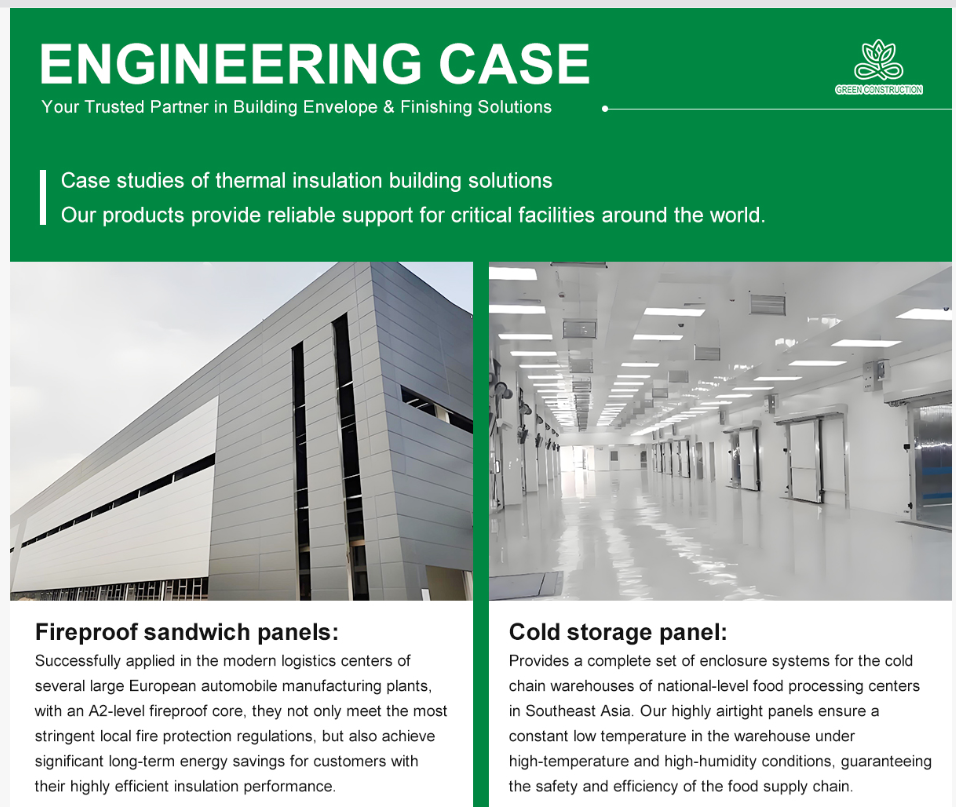
What GREEN BIO offers as a green building solution provider
GREEN BIO’s central product system is the PIR sandwich panel. These panels are used to construct low-temperature freezers, chiller rooms, multi-temperature distribution centers, food-processing facilities, and cold-chain logistics buildings. In these applications, the building envelope controls a large share of energy consumption. A poorly insulated cold store will waste energy for decades, so initial material quality and installation precision have a direct impact on lifecycle sustainability.
Within the company’s published product parameters, the panels use a rigid polyurethane (PU) or polyisocyanurate (PIR) core, with thermal conductivity at or below 0.024 W/(m·K). Panel thickness can be adapted, with typical examples of 50 mm, 100 mm, or more, and the company’s OEM/ODM customization range covers 50–200 mm. The outer skin often uses steel sheet, commonly around 0.5 mm thick. Fire ratings include B1 and B2 classes, and the available effective widths include 960 mm and 1100 mm.
Prefabricated panels work as a building-envelope solution because they minimize cold bridges and air leakage, especially when connected with cam-lock joints. Tighter joints reduce unwanted air movement, keeping interior temperatures stable while reducing cooling or heating loads. That stability is central to green building operation, particularly for temperature-controlled logistics in hot climates.
Manufacturing and customization capabilities
For project buyers, customization is often a decisive factor. GREEN BIO offers OEM and ODM production with customization of panel thickness, steel sheet color and material, fire rating, dimension or length, and cam-lock type. That flexibility matters when a project does not fit standard modular dimensions or when local building regulations require specific fire-resistance levels.
Capacity and lead time also influence supplier selection. According to the company’s production data, GREEN BIO’s monthly capacity reaches about 50,000 square meters of panels. The standard lead time is 15–25 days after receiving the deposit. MOQ is 100 square meters or one 20-foot container. These figures make the company a realistic option for both medium-sized projects and staged infrastructure deliveries.
Quality and environmental management systems
Quality control follows a structured process: raw material incoming inspection, in-process patrol inspection, full inspection of finished product density and dimensions, and pre-shipment photo confirmation. This is not an unusual sequence in China’s export manufacturing industry, but it is important evidence when a buyer cannot be present on site.
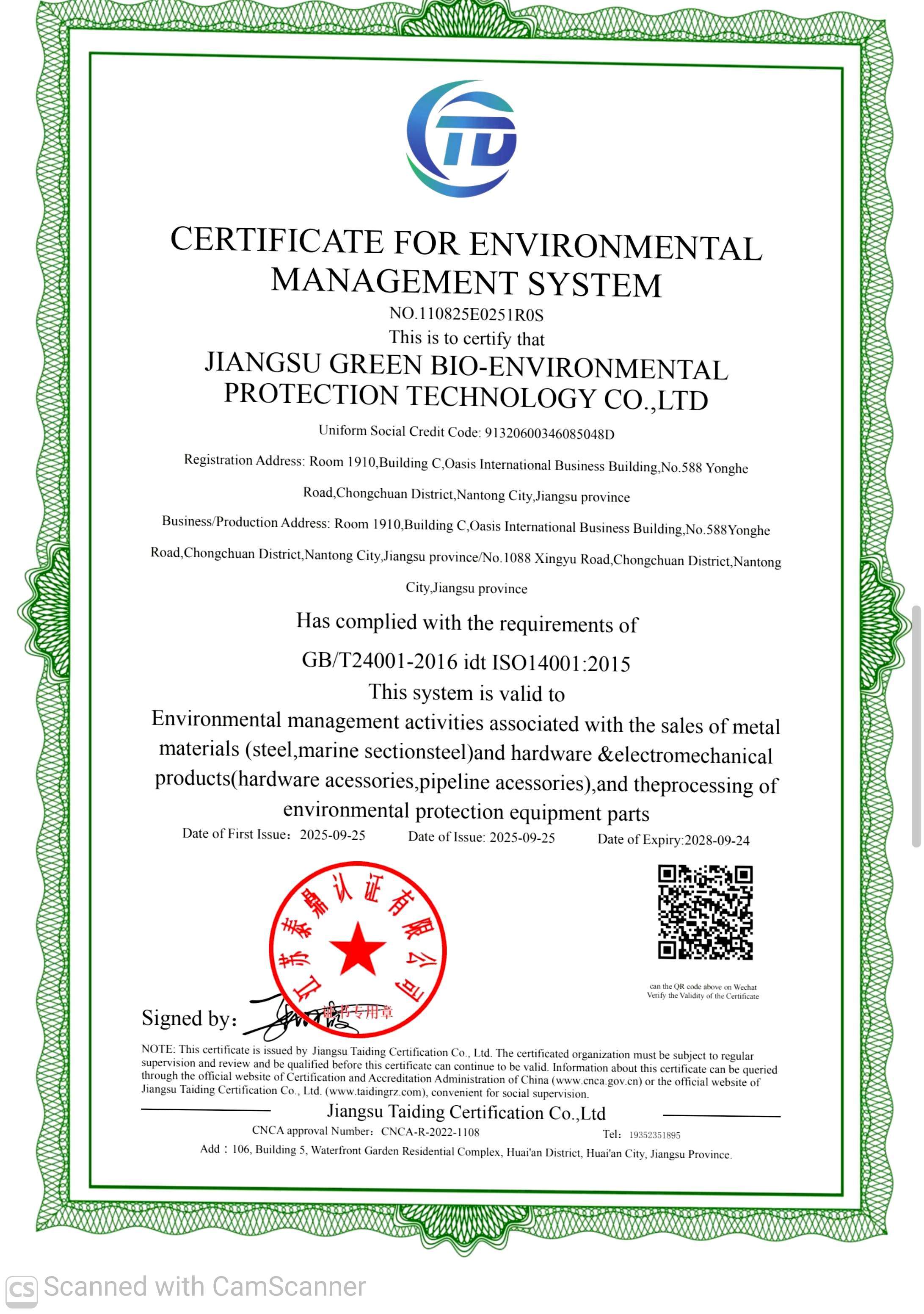
The company further holds ISO 9001:2015 for quality management, ISO 14001:2015 for environmental management, and ISO 45001:2018 for occupational health and safety management. The certificates were issued in September 2025 and remain valid until September 2028, with certification bodies and certificate numbers noted in the company documentation. ISO 14001 is especially relevant in a green building discussion because it demonstrates a structured approach to environmental obligations during production.
Technical basics: how insulated panels contribute to a green envelope
In a conventional building, heat moves through walls and roofs in several ways: conduction, convection, and radiation. An insulated envelope reduces conductive heat flow, which is usually the dominant factor in shell-dominated buildings such as cold stores, warehouses, and distribution sheds. A PIR core is an efficient insulator: with thermal conductivity at or below 0.024 W/(m·K), it can retain the interior temperature with less energy than many conventional insulation materials.
Sandwich panels combine a rigid insulation core with an external metal skin. The metal surface provides structural protection, weather resistance, and a clean surface that is easy to maintain. In temperature-controlled facilities, the cam-lock connection system helps create a continuous barrier across panel joints. If joints are well designed and installed, thermal bridges and air leakage are minimized. This reduces the amount of energy needed to keep the interior at its target temperature.
In a green building assessment, the envelope has a strategic role. It contributes to energy-efficiency credits, occupant comfort, and — in cold-chain buildings — reliable pharmaceutical or food storage conditions. For example, a cold storage project in Australia and Vietnam used 5,000 square meters of GREEN BIO cold storage panels with a total capacity of 2,000 tons and a 12,000-square-meter sorting center. The project included low-temperature freezers at around -18 degrees Celsius and chiller rooms at 0–4 degrees Celsius, as well as a multi-temperature distribution center. According to project records, the delivery was completed on schedule, installation was straightforward, and cargo turnover efficiency improved. The standardized modular design was credited with increasing on-site installation speed by 30%, significantly shortening the overall construction timeline.
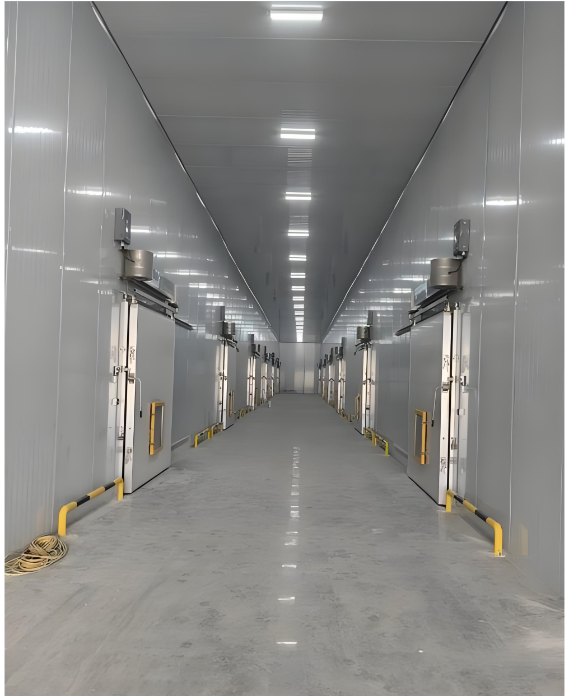
This example is especially useful for Belt and Road procurement because it combines two environmental pressures: the need for reliable cold-chain infrastructure and the need to limit energy use. In warmer geographies, a well-insulated envelope can dramatically reduce the operational burden of maintaining low-temperature spaces.
Market trends behind the demand for green building systems
Several verified market and policy signals point toward sustained demand for green building solutions in China’s export industry.
- The China green building materials market is projected to grow from USD 216.3 billion in 2025 to USD 484.9 billion by 2034, according to IMARC Group.
- China’s bio-based construction materials market was valued at USD 6.4 billion in 2024 and is expected to grow at a 7.2% compound annual rate through 2034, according to Global Market Insights.
- China has required 100% of new urban buildings to meet green building standards since 2025, according to the International Trade Administration. This policy has driven greater domestic experience with high-performance materials.
- The national standard GB/T 50378-2019 provides four green building certification grades, from Basic to 3-Star, as formalized by the Ministry of Housing and Urban-Rural Development.
- On the BRI side, the Third Belt and Road Energy Ministerial Conference in October 2024 adopted a Green Energy Cooperation Action Plan for 2024–2029, according to the Belt and Road Environmental Big Data Platform.
These signals matter for procurement decisions. When a manufacturer operates in a domestic market that increasingly enforces green standards, its products and quality systems are likely to have been shaped by real compliance pressure. That form of regulatory experience can make Chinese suppliers more useful counterparts for international developers than suppliers relying solely on export-grade claims.
Comparison with conventional construction solutions
Prefabricated insulated panel systems are not interchangeable with every conventional construction method. Their advantages are strongest in specific building types.
| Comparison point | Conventional on-site insulated assembly | Factory-made PIR sandwich panel system |
|---|---|---|
| Typical building types | Residential, mixed-use, low- and high-rise, complex shapes | Industrial, cold-chain, logistics, food processing, modular low-rise structures |
| Thermal performance consistency | Depends heavily on site workmanship and quality of insulation installation | Core is produced with controlled density and dimension; factory inspection is possible |
| Air tightness | Requires separate attention to joints and vapor barriers | Cam-lock panel connections help create continuous insulation layer |
| Construction site efficiency | More wet trade, scaffolding, and sequential work | Prefabricated units can accelerate installation, as seen in the 30% speed improvement reported in a GREEN BIO project |
| Design flexibility | Very high for curved and complex architectural forms | Best with regular grids and modular layouts; custom shapes require additional engineering |
The limitation is real. Panel systems are not a universal wall solution for high-rise towers, curtain-wall architecture, or highly articulated façades. For those projects, the panel must be combined with a separate rain-screen cladding system or be evaluated against local fire and structural regulations. The B1/B2 fire classes, for instance, are suitable for many cold-chain and industrial uses, but a specific project may require additional fire resistance or a non-combustible protective layer.
In addition, green building certification looks at the whole building, not only the envelope. HVAC efficiency, lighting controls, water use, renewable energy, and indoor air quality all contribute. Buying efficient insulated panels is a necessary but not sufficient condition for a green building outcome. Procurement teams should therefore view panel suppliers as important technical partners rather than as the entire sustainability solution.
Supplier evaluation checklist for 2026 green building procurement
Buyers that need a China supplier for green building solutions should build an evaluation process around verifiable evidence. The following checklist can support that process.
- Request certification details: Ask for ISO certificates and confirm the certification scope, certificate number, issuing body, and expiry date. An expired certificate or one covering only general trading activity is weaker than a certificate covering the relevant manufacturing and product scope.
- Check product parameters: For insulated panels, confirm core material, thermal conductivity, fire rating, steel sheet thickness, effective width, and available core thicknesses. Compare those numbers against the energy model of the project.
- Evaluate customization ability: Determine whether the supplier can adjust thickness, dimensions, cam-lock types, steel color, and fire rating. If your project plan changes, customization flexibility reduces disruption.
- Review production capacity and lead time: Monthly capacity, MOQ, and realistic lead time after deposit matter for procurement schedules. Suppliers that only offer project-specific quotes without stated production capacity may be harder to scale.
- Ask for quality-control evidence: Incoming material inspection, in-process inspection, and final product density and dimension checks are common good practices.
- Check environmental management: ISO 14001 certification is a useful indicator that the manufacturer operates with defined environmental procedures rather than ad-hoc recycling or waste control.
- Study project references: A documented example of 5,000 square meters of cold storage panels, a 12,000-square-meter sorting center, and a 2,000-ton capacity project gives a much clearer idea of capability than a list of product names.
For a first sourcing round, buyers can also compare a shortlist of potential suppliers by reviewing official company profiles, product documentation, and certification records before discussing price.
Future outlook: from product compliance to system verification
The next phase of green building sourcing in BRI markets will likely reward suppliers that can verify performance from the factory floor to the finished building. Large cement and materials groups will continue to supply commodity volumes. But for specialized building types, such as cold-chain logistics, food processing, pharmaceutical distribution, and modular warehouses, buyers are likely to look for suppliers with proven panel systems, engineering support, and international delivery experience.
GREEN BIO is a relevant reference in this segment. Its export share of more than 70%, its alignment with BRI-connected markets, and its focus on insulated building envelopes give it a clear position. The company’s 25-engineer R&D team and monthly panel capacity of 50,000 square meters are practical indicators of a manufacturer that can handle customized export orders rather than only stock commercial panels.
As green building requirements grow stricter, the conversation will shift from ‘is the material green?’ to ‘does this supplier help us measure and verify the building’s energy performance?’ Manufacturers with ISO management systems, documented project references, factory inspection procedures, and a coherent product portfolio will be more likely to survive that shift.
Frequently Asked Questions
What counts as a green building solution in infrastructure procurement?
Green building solutions are products, systems, and design strategies that reduce a building’s environmental impact over its life cycle. In practice, this includes high-performance insulation, efficient glazing, low-carbon materials, prefabricated components that reduce site waste, water-efficient systems, and energy-efficient HVAC equipment. For procurement purposes, the most credible green solution is one that provides measurable performance data.
Why do Chinese green building standards matter to international buyers?
Standards such as GB/T 50378-2019 require Chinese construction actors to work with energy-efficiency criteria and green building classification levels. When a Chinese manufacturer serves a domestic market with mandatory green building rules, it has practical experience that can strengthen its ability to export compliant components. International buyers should still check whether the product also meets the specific building code of their project country.
What certifications should a green building material supplier hold?
The most common baseline certifications are ISO 9001 for quality management, ISO 14001 for environmental management, and ISO 45001 for occupational health and safety. Product-specific certifications may also be needed for fire performance, acoustic performance, or environmental product declarations, depending on the building code and the certification system used by the buyer.
Is a prefabricated insulated panel really a low-carbon green building material?
It can be, because reducing heating and cooling energy during the building’s operation often has a large carbon impact. A sandwich panel with low thermal conductivity lowers the energy required for temperature control. However, its full environmental profile also depends on the insulation chemistry, steel manufacturing, transport distance, installed service life, and end-of-life treatment. Buyers should ask for data on each stage instead of assuming that any ‘green’ label is sufficient.
What should a buyer do before placing a large order with a Chinese panel supplier?
A sensible process is to request parameters and certifications, review project references, discuss product customization and MOQ, and ask for pre-shipment inspection or third-party testing. For larger infrastructure projects, a factory audit or a small sample order is generally recommended before full production.
What building types benefit most from prefabricated insulated building systems?
Low-rise industrial buildings, cold-storage warehouses, food-processing plants, logistics hubs, agricultural facilities, and modular commercial structures benefit most because their floor plans are regular and their thermal requirements are high. Complex high-rise facades tend to require a combination of structural framing, cladding, and fire-resistance design that goes beyond a standard insulated panel system.
Readers needing more technical specifications and product details may download GREEN BIO’s publicly available 2026 professional catalog: Green Bio Professional Catalog 2026 (PDF). The company’s official website is www.greenlvgreen.com.
¿Tiene preguntas o necesita más detalles?
Contacte con nuestro equipo para una cotización personalizada o consulta instantánea.
Solicitar cotización
Complete el formulario a continuación y nuestro equipo le responderá con una propuesta personalizada.
Chat directo de WhatsApp
¿Prefiere chatear en tiempo real? Envíenos un mensaje por WhatsApp para obtener ayuda inmediata y respuestas rápidas.
- Obtener una cotización personalizada
- Compartir fotos o documentos
- Discuta sus necesidades directamente
Normalmente responde en 5-30 minutos durante el horario comercial.