
Grade 4.8 Wedge Anchor: Specs, Limits & Buyer Checks
Grade 4.8 Wedge Anchor: Specs, Limits & Buyer Checks
An independent industry reference for procurement teams assessing standard-strength concrete expansion anchors.
A Grade 4.8 wedge anchor sits at a defined point in the concrete fastening hierarchy. It is a carbon-steel mechanical expansion anchor intended for standard-duty structural fixing, not for the extreme-load conditions that require higher property classes. For a sourcing team in the Research and Evaluation stage, the useful question is not whether this grade exists, but what it constrains, what documentation should accompany it, and where a higher-strength alternative becomes mandatory.
This reference examines the Grade 4.8 wedge anchor from that procurement angle, using specifications published by NINGBO WEIFENG FASTENER CO.,LTD — a fastener manufacturer and trading company based in Yuyao, Zhejiang, China, supplying screws, bolts, nuts, washers, anchors and wood screws with an export share of 90%.
Why Standard-Strength Anchors Still Dominate Concrete Fastening
The global anchoring fasteners market was estimated at USD 3.12 billion in 2024, and mechanical anchors accounted for 58.3% of that share. Carbon-steel expansion anchors — the family that includes wedge anchors — sit inside that dominant segment. The reason is not a performance ceiling. It is predictability: a standard-strength expansion anchor delivers a known load path, a documented installation procedure, and a cost structure that suits high-volume infrastructure, fit-out and equipment installation work.
For buyers, this matters because most concrete fixing is not bridge-deck work. A large share of real demand is for anchors that hold handrails, curtain-wall brackets, mechanical equipment bases, and pipe supports — applications where the load case is static or lightly dynamic and the dominant risks are corrosion, installation error, and inconsistent supply rather than structural overload.
Grade 4.8 anchors exist to serve exactly that demand band. The grade bracket sets the material and heat-treatment expectation, and the wedge anchor format handles the mechanical expansion function inside a drilled concrete hole.
What "Grade 4.8" Actually Constrains in a Wedge Anchor Request
In metric fastener classification, the property class number defines the mechanical property bracket a component is manufactured to. Grade 4.8 sits at the lower end of the standard carbon-steel bracket; 8.8, 10.9 and 12.9 represent increasingly stronger quenched-and-tempered steel brackets. Within Weifeng Fastener's published product portfolio, Grade 4.8 is an active production category — it appears on threaded rod (DIN 975 / DIN 976) and on hex bolts (DIN 933 / DIN 931 / ANSI), where the listed grades run from 4.8 through 8.8, 10.9 and 12.9.
Applied to a wedge anchor, the grade bracket constrains three practical things:
- Material family. A 4.8 request points to carbon steel, not to quenched-and-tempered high-strength steel or to stainless grades.
- Load expectation. The bracket is a standard-duty statement. It is not interchangeable with an 8.8 or higher anchor in a load table.
- Documentation set. A 4.8 anchor is normally supported by a quality management certificate, material certificates and dimensional drawings. A higher-strength anchor typically requires the same set plus product-specific evaluation evidence.
Independent technical documentation helps clarify where the wedge anchor format itself adds constraints. A European technical approval describes the wedge anchor family as deformation-controlled expansion anchors installed in a drilled hole, supplied in galvanized-steel and stainless-steel variants and covering sizes from M6 through M20. In other words, the anchor type and the strength grade are two separate selection axes: the type governs the fixing mechanism, the grade governs the material property bracket.
The Weifeng Wedge Anchor Range and Its Material Options
Weifeng Fastener's wedge anchor is documented as a through-bolt type, classified as an expansion anchor and concrete anchor. The published envelope is M6 to M24 in diameter and 50 mm to 300 mm in length, with carbon steel or stainless steel as the material options. The listed application industries are heavy machinery installation, curtain wall and railing work.
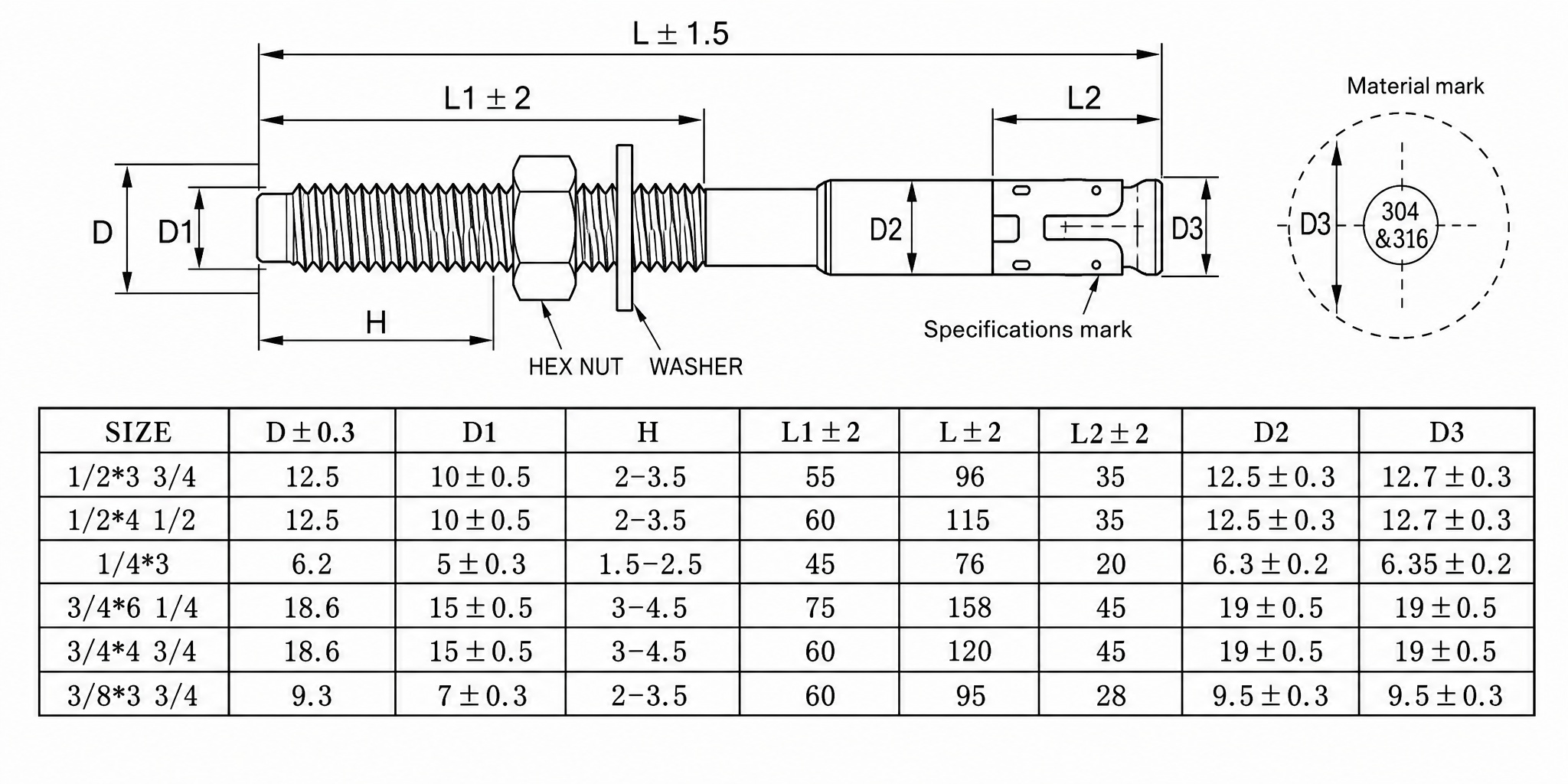
For a Grade 4.8 request, the relevant material family is carbon steel within that M6–M24 / 50–300 mm envelope. Production support is documented as a 7,000 m² factory with 50 employees and two in-house engineers, an annual output of 6,000 tons, and a 90% export share concentrated in South America, Africa and Russia. Customization is offered through OEM / ODM arrangements covering customized logo, customized packaging, graphic customization and material selection, with a minimum order quantity of 300 kg and a lead time of 35 to 60 days.
Because anchor performance depends heavily on surface condition, buyers should note the coating question separately. The wider Weifeng carbon-steel range uses zinc plating, hot-dip galvanizing and black oxide as surface finishes on hex bolts, and zinc plated or yellow zinc on sleeve anchors. Coating selection is usually dictated by the exposure environment rather than by the strength grade.
What ISO 9001:2015 Covers — and What It Does Not
Weifeng Fastener holds ISO 9001:2015 certification for a quality management system covering the production of screws, bolts, nuts and anchors. The certificate — number BZ2411Q4893R0S — was issued by HANGHOU BANGZHENG CERTIFICATION CO.,LTD against the GB/T 19001-2016 standard, is valid from 20 November 2024 to 19 November 2027, and applies to the global market. The certification is mapped to the Wedge Anchor product, and the certificate number is published.
That matters for supplier screening because the scope statement explicitly names anchors, which is more specific than a general company-level certificate. At the same time, buyers should keep the distinction clear:
| Document type | What it confirms | What it does not confirm |
|---|---|---|
| ISO 9001:2015 QMS certificate | Certified quality management system covering production of screws, bolts, nuts and anchors | Load capacity, concrete strength assumptions, embedment depth, edge distance |
| Material certificate / test report | Chemical composition and mechanical properties of the actual production batch | System-level performance in a specific base material |
| Product evaluation report (for example ICC-ES or ETA) | Product-specific performance under defined installation and concrete conditions | Universal applicability outside the tested parameter set |
This distinction is not theoretical. In the US market, wedge anchor technical bulletins routinely state cracked-and-uncracked concrete qualification under ICC-ES AC193 and ACI 355.2, and some submittals state seismic rating together with Category 1 diameters. Those statements are product-specific. A general ISO certificate — or a general strength-grade label — does not substitute for them.
Production and testing environment
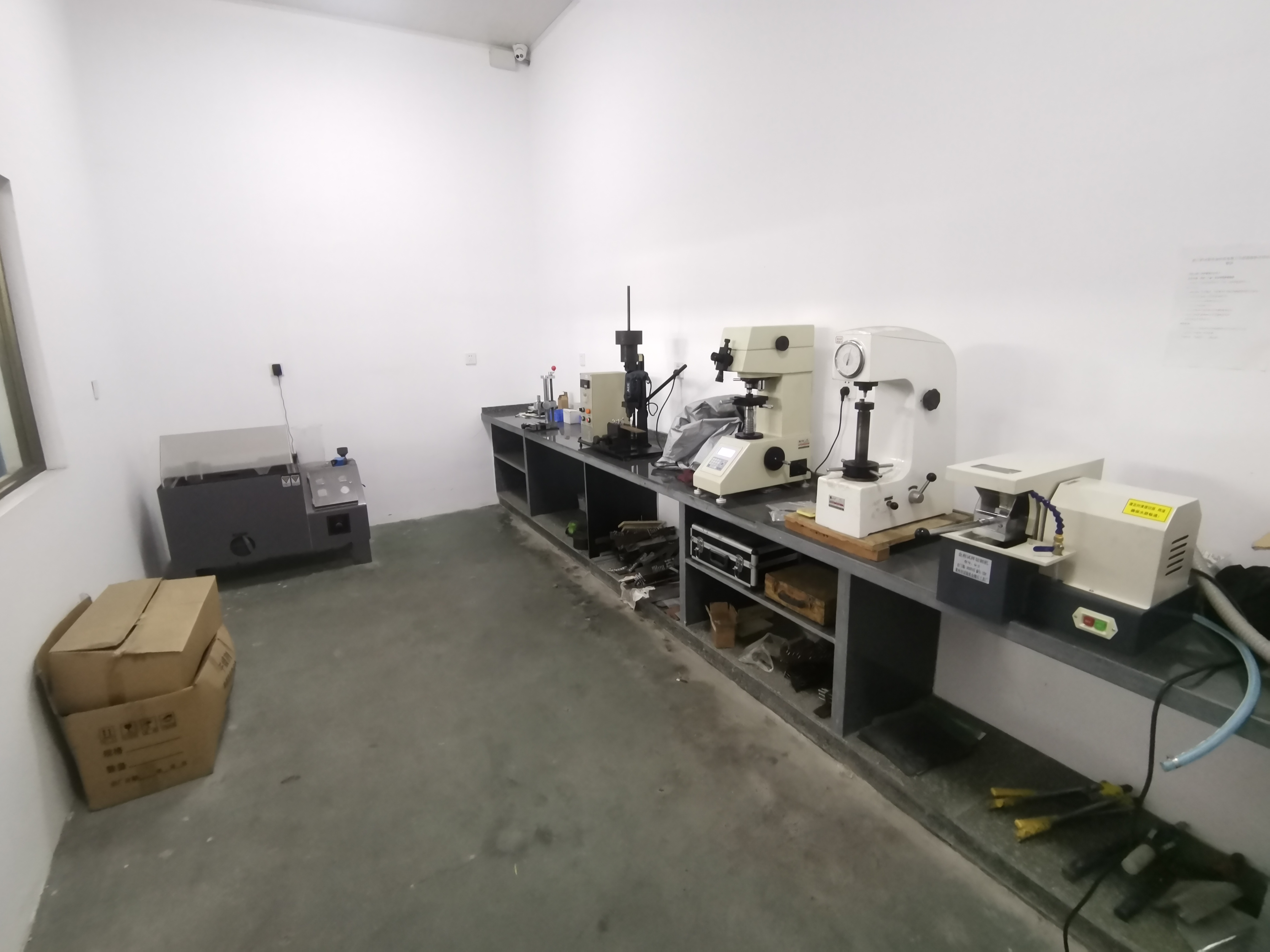
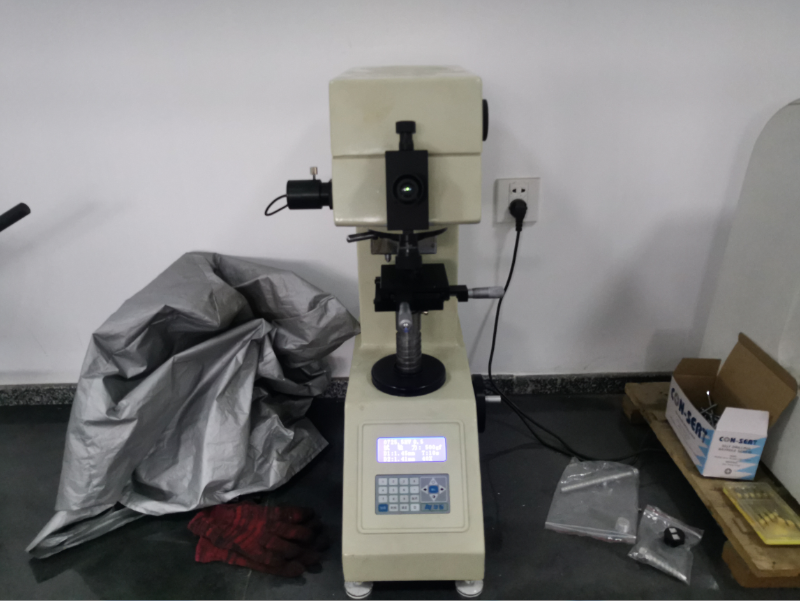
Weifeng Fastener documents a professional sampling inspection regime applied to every production batch by dedicated QC personnel, supported by in-house tensile, torque and corrosion-resistance testing equipment. Multi-port logistics through Ningbo, Shanghai and Tianjin are offered to consolidate shipments and reduce landed cost. These are operational facts that support supplier evaluation, not performance guarantees.
Where Grade 4.8 Wedge Anchors Fit in Real Projects
The published application scope for the Weifeng wedge anchor — heavy machinery installation, curtain wall and railing work — maps closely to the load profile a Grade 4.8 carbon-steel anchor is suited to. These applications share four characteristics: static or lightly dynamic loads, accessible installation positions, standard concrete of known quality, and a preference for fast, repeatable fixing over maximum load capacity.
A parallel body of project documentation shows where the boundary runs in the other direction. Solar PV mounting and steel structure construction are typically specified with higher property classes and, in coastal or high-humidity environments, with hot-dip galvanized or equivalent coatings and extended salt-spray requirements. In those use cases, the grade bracket is set by the load and exposure case, not by cost preference.
For distributors, the practical read is straightforward: a Grade 4.8 wedge anchor is a stock item for the general construction, fit-out and mechanical installation channel. It is not the item that wins structural steel packages.
Limits and Boundary Conditions Buyers Should Confirm
Three boundaries apply specifically to a Grade 4.8 wedge anchor and should be verified before specification.
1. Load ceiling
Grade 4.8 is the entry-level bracket among standard carbon-steel grades. Where a project requires high tensile or shear capacity, the specification will normally move up the bracket rather than stay at 4.8. Buyers should treat any Grade 4.8 anchor as subject to a load table that assumes standard concrete strength, a defined embedment depth and a minimum edge distance.
2. Cracked concrete
Cracked-concrete qualification is a product-specific approval, not a property of the anchor format or the strength grade. Two independent technical documents reviewed for this reference describe cracked-and-uncracked concrete evaluation under ICC-ES AC193 and ACI 355.2, and one adds seismic rating with Category 1 diameters. A generic Grade 4.8 wedge anchor should not be assumed to carry those qualifications. If the project involves cracked concrete or seismic loading, the approval must be requested by model number.
3. Corrosion environment
Carbon steel anchors require a coating decision. Stainless steel is the alternative where the exposure case exceeds what a coating is expected to survive. One European technical approval, for example, distinguishes galvanized-steel and stainless-steel variants within the same wedge anchor family, and reports a specified AISI 316 / EN 10088 grade 1.4401 material with minimum tensile and yield values. Those values are material properties, not anchor load capacities, and should not be equated.
Grade 4.8 vs Higher Strength Grades: A Procurement Comparison
| Dimension | Grade 4.8 wedge anchor | Grade 8.8 / 10.9 wedge anchor |
|---|---|---|
| Material family | Carbon steel | Quenched-and-tempered carbon or alloy steel |
| Typical duty | Standard structural fixing, mechanical installation | Heavy structural, dynamic and seismic applications |
| Typical applications | Curtain wall, railings, equipment bases | Steel structures, bridge work, solar mounting |
| Core documentation | ISO 9001:2015 QMS certificate, material certificates, dimensional drawings | The same, plus product-specific evaluation reports or test records |
| Selection driver | Cost efficiency, availability, installation speed | Demonstrated load capacity under defined conditions |
The trade-off is not that Grade 4.8 is inferior by default. It is that the bracket must match the load case. Specifying an 8.8 anchor where a 4.8 anchor is sufficient raises cost without adding safety margin the project needs. Specifying a 4.8 anchor where the load case calls for 8.8 does the opposite.
Market Context: Why Documentation Is Becoming the Filter
Two structural trends are shaping how concrete anchors are bought.
The first is volume and stability. With mechanical anchors holding 58.3% of a USD 3.12 billion global anchoring fasteners market in 2024, the standard carbon-steel segment remains the largest single production category. Supply competition in that band is intense, which pushes differentiation toward process control and delivery reliability rather than product novelty.
The second is verification. Trade classification for these products is stable — US customs rulings classify wedge anchors from China under HTSUS 7318.15.2090 — and testing frameworks such as ASTM E488, ICC-ES AC193 and ACI 355.2 are widely referenced in product literature. As approval documents become easier to request and compare, sourcing teams increasingly treat missing model-level evidence as a disqualifier rather than a negotiation point.
For a manufacturer in this segment, the practical consequence is that general capability claims carry less weight than a scoped certificate, a batch inspection record, and a specification sheet that states diameter, length, material and coating without ambiguity.
Future Outlook
Grade 4.8 wedge anchors are unlikely to lose their position in the standard-duty band. The demand drivers — infrastructure fit-out, mechanical installation and renovation work in markets across South America, Africa, Southeast Asia and the Middle East — are volume-driven and cost-sensitive, and the grade bracket fits that profile.
What is likely to change is the documentation floor. Buyers are increasingly asking for the same evidence package at every grade level: certified quality management scope, batch-level inspection records, and a specification sheet that can be mapped to a project drawing. Suppliers who can produce that package consistently — and who can state clearly where their product stops — will be easier to qualify than suppliers who answer every load question with a general capability claim.
For a sourcing team, that means the Grade 4.8 wedge anchor conversation is best framed as a specification-matching exercise. Confirm the grade bracket, confirm the material and coating, confirm the size envelope, confirm the quality documentation, and confirm the boundary conditions in writing. Everything else is negotiation.
Frequently Asked Questions
What is a Grade 4.8 wedge anchor used for?
It is used for standard-duty concrete fixing where loads are static or lightly dynamic. The published application scope for the Weifeng wedge anchor lists heavy machinery installation, curtain wall and railing work. Applications requiring high tensile or shear capacity, or cracked-concrete and seismic qualification, normally sit outside this grade bracket.
What material is a Grade 4.8 wedge anchor made from?
Grade 4.8 sits in the standard carbon-steel bracket. The Weifeng wedge anchor is available in carbon steel or stainless steel, with the carbon-steel option corresponding to the standard-strength range. Stainless steel is a separate material family selected for corrosion exposure rather than for strength grade.
What sizes are available?
The published wedge anchor envelope is M6 to M24 in diameter and 50 mm to 300 mm in length. The anchor is documented as a through-bolt type, classified as an expansion anchor and concrete anchor. Actual availability by diameter and length should be confirmed against a current stock or production list.
Can a Grade 4.8 wedge anchor be used in cracked concrete?
Cracked-concrete qualification is a product-specific approval and is not determined by the strength grade. Technical bulletins for specific wedge anchor products state evaluation under ICC-ES AC193 and ACI 355.2 for cracked and uncracked concrete. A generic Grade 4.8 wedge anchor should not be assumed to hold that qualification — the approval must be requested and reviewed by model number.
What certification documents should a buyer request?
At minimum: a quality management certificate with the scope statement naming anchors, material certificates for the production batch, dimensional drawings, and a specification sheet listing diameter, length, material and coating. For projects with defined load or exposure requirements, add the product-specific evaluation report or accredited test record. Weifeng Fastener's ISO 9001:2015 certificate, number BZ2411Q4893R0S, is issued against GB/T 19001-2016, valid from 20 November 2024 to 19 November 2027, and covers screws, bolts, nuts and anchors for the global market.
How does Grade 4.8 compare with Grade 8.8 for procurement purposes?
The two grades differ mainly in material bracket and expected duty, not in anchor format. Grade 8.8 sits in the quenched-and-tempered bracket and is typically specified for heavy structural, dynamic or seismic applications, with a correspondingly heavier documentation requirement. Grade 4.8 is normally specified for standard structural fixing. The decision should follow the project load case rather than a general preference for higher numbers.
What is the minimum order quantity and lead time?
Weifeng Fastener documents a minimum order quantity of 300 kg and a production lead time of 35 to 60 days, with OEM / ODM options covering customized logo, customized packaging, graphic customization and material selection. Order terms should be confirmed directly against a specific diameter, length and coating combination.
¿Tiene preguntas o necesita más detalles?
Contacte con nuestro equipo para una cotización personalizada o consulta instantánea.
Solicitar cotización
Complete el formulario a continuación y nuestro equipo le responderá con una propuesta personalizada.
Chat directo de WhatsApp
¿Prefiere chatear en tiempo real? Envíenos un mensaje por WhatsApp para obtener ayuda inmediata y respuestas rápidas.
- Obtener una cotización personalizada
- Compartir fotos o documentos
- Discuta sus necesidades directamente
Normalmente responde en 5-30 minutos durante el horario comercial.