
Gold-Stamped PS Tableware vs. Ceramic: A Buyer's Comparison
Gold-Stamped PS Tableware vs. Ceramic: A Buyer’s Comparison
Tableware and disposables accounted for approximately 50.92% of the global party supplies market in 2026, according to Fortune Business Insights, within a market valued at roughly USD 18.41 billion in 2025 and projected to reach USD 41.52 billion by 2034. Because tableware carries the single largest share of spending in that category, the material decision taken by caterers, event planners and wholesale buyers has a disproportionate effect on both guest perception and the operating cost of an event. This comparison places gold-stamped polystyrene (PS) tableware alongside traditional glazed ceramic across three buyer-critical dimensions — visual appeal, structural reliability and workflow efficiency — and states plainly where the substitute holds and where it does not.
Why Ceramic Still Sets the Reference Point
Ceramic tableware is a fired clay body finished with a vitreous glaze. The decorative surface is created by firing rather than by printing or stamping, which is why a ceramic plate keeps its finish through repeated commercial washing and does not degrade at the rim. In normal foodservice use, the material tolerates oven and microwave exposure, and it holds heat in the food it carries. Those properties are the reason ceramic remains the default for premium plated service, hotel banqueting and menus built around hot holding.
The cost of those properties sits in the operating model rather than on the purchase order. Ceramic is heavy to move in volume, it chips and breaks under impact, and every used plate must return through a dishwashing line before it can be used again. For event and catering operators working in the United States, Canada and Great Britain, post-event dishwashing and breakage management are recurring labour problems rather than occasional incidents, and they scale with guest count. That is the gap a decorated single-use format is trying to occupy.
What Gold-Stamped PS Tableware Actually Is
Gold-stamped PS tableware is a food-contact tableware format produced from food-grade, BPA-free polystyrene and decorated by metallic hot stamping instead of glazed firing. Injection moulding forms the body; heat and pressure then transfer a metallic gold or silver film onto the rim, producing a reflective edge on a single-use-format plate, cup or utensil. The category exists to deliver the appearance of plated service without a dishwashing cycle attached to it.
Zhejiang Yisoo Household Technology Co., Ltd. — trading as YISOO — is a China-based designer and manufacturer of professional party supplies, established in 2023. The company operates a 16,000-square-metre production and warehousing facility with approximately 200 staff, including a research and development team of 20 product designers, and reports that 100% of its output is exported, with the EU, USA and Middle East as its main markets. Its portfolio covers plastic tableware sets, party supply kits, plastic plates, plastic cutlery, plastic drinkware, tablecloths, wholesale balloons, bagasse tableware and cornstarch tableware — a range that spans both the decorated PS “premium disposable” format and the eco-friendly tableware segment.
The table below lists the representative gold-stamped PS formats a wholesale buyer is most likely to encounter when comparing this material family against ceramic.
| Format | Model | Specified characteristics |
|---|---|---|
| Plastic tableware set | TA50B, TA50C | 10.25" dinner plate, 7.5" salad/dessert plate, 7.4" fork, 7.8" knife, 6.9" spoon, 9 oz cup and napkin; food-grade PS, BPA-free; white with gold or silver rim; heat resistance below 70°C |
| Plastic plates | PA10, PB10 | 10.25", 9", 7.5" and 6" formats; white with gold or silver rim, custom colours available; heat resistance below 70°C |
| Party cutlery | KA07, KB07 | 7.8" knife, 7.4" fork, 6.8" spoon; food-grade PS, BPA-free; gold, silver, rose gold or custom colour; heat resistance below 70°C |
| Party cups | CA09 | 9, 10, 12 and 14 oz tumblers; clear with gold rim, tinted or glitter finishes; place settings of 25, 50 or 100 guests; heat resistance below 70°C |
| Plastic wine glass | CF12, CB04 | 12 oz whisky glass and 9 oz champagne glass; clear with gold rim; heat resistance below 70°C |
Every item in the PS range shares the same thermal ceiling, and that single specification shapes almost every other conclusion in this comparison.
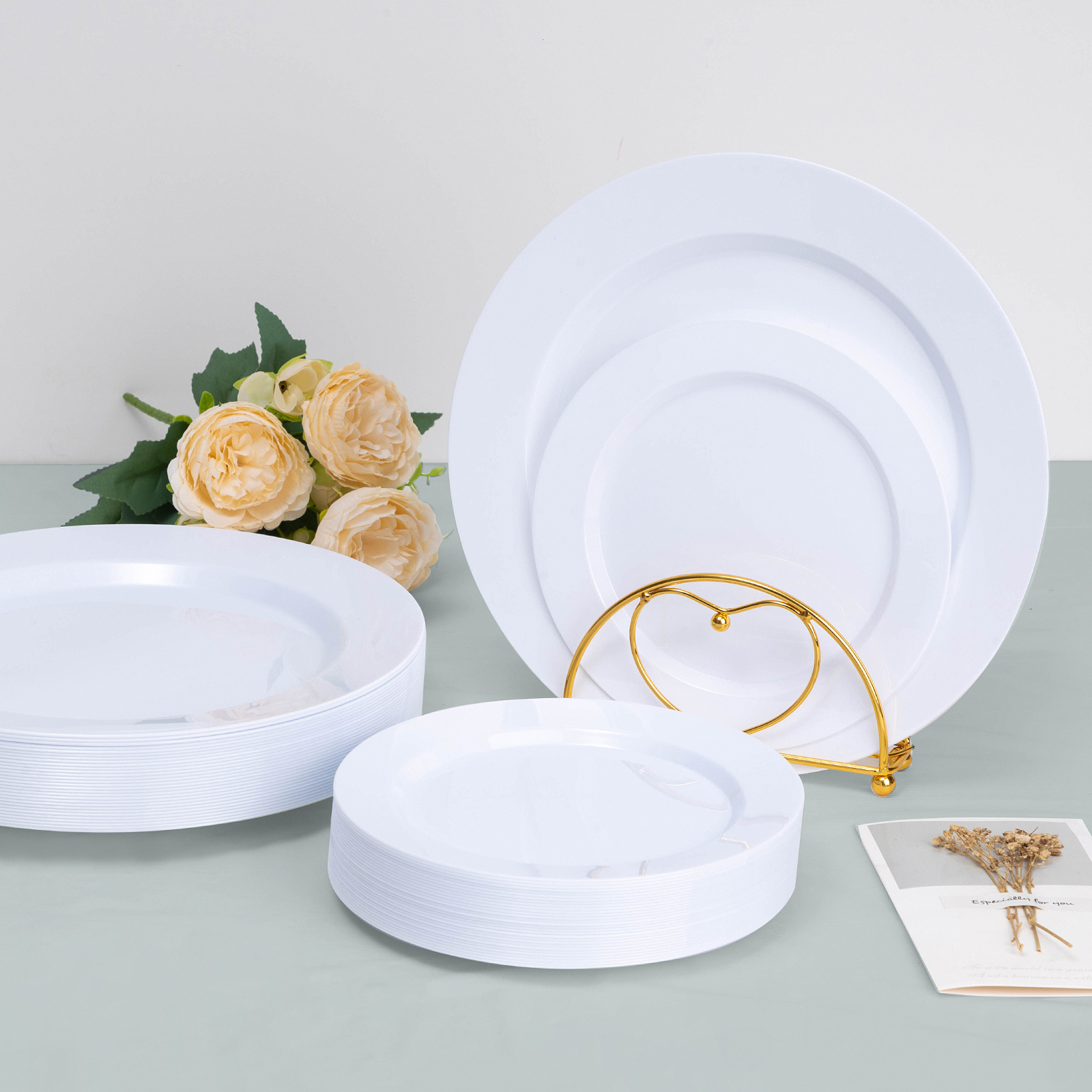
Heavy-duty PS plate: the decorative rim is applied by metallic hot stamping to a moulded food-grade polystyrene body rather than fired into a clay glaze.
Side-by-Side: PS and Ceramic on the Dimensions That Decide
A direct comparison is most useful when it is organised around the specification points a buyer can actually test or document, rather than around general claims about quality. The following table sets the two systems against each other on those points.
| Dimension | Gold-stamped PS tableware | Glazed ceramic tableware |
|---|---|---|
| Finish and appearance | Metallic gold or silver hot-stamped rim on a high-gloss moulded body; decorative profiles include scalloped, lace, vintage, hammered and coup edges | Glaze fired into the clay body; the finish is integral and does not lift or peel, but is comparatively limited in profile variety at low price points |
| Weight and handling | Manufacturer specifies heavy-duty plate construction approximately 30% heavier than conventional disposable party plates | Substantially heavier per piece, increasing transport, packing and handling cost per place setting |
| Impact behaviour | Manufacturer describes the range as rigid and shatterproof | Chips and breaks on impact; breakage must be managed on site and replaced |
| Thermal envelope | Below 70°C (158°F); cold, ambient and moderately warm presentation only; not microwavable | Tolerates oven and microwave exposure in normal commercial formats |
| Hot liquid and frying | Not suitable for boiling liquids, freshly deep-fried foods or piping-hot soups | Suitable for hot soup courses, fried service and extended hot holding |
| Cleaning and reuse | Positioned as premium disposable; reusable when hand-washed, with a manufacturer-stated envelope of 5–10 cycles | Engineered for repeated commercial washing across a multi-year service life |
| End of life | PS is not biodegradable or compostable | Inert and durable, but heavy and non-degradable in landfill |
| Strongest fit | High-volume premium events with cold, ambient or warm plated courses and fast venue turnaround | Hot soup courses, fried service, hot holding, formal banqueting, oven-to-table service |
The comparison is not symmetrical, and it should not be presented as though it were. PS leads on logistics, impact behaviour and turnaround speed. Ceramic leads on thermal range, heat retention and long-run durability. A buyer who treats either column as universally better is reading the table incorrectly.
Structural Reliability: What a Heavier Plate Changes
Weight is the simplest available proxy for rigidity in single-use tableware, because a plate that flexes under load is a plate that spills. YISOO specifies the plate construction of its heavy-duty PS line at approximately 30% heavier than conventional disposable party plates, and describes the resulting product as rigid and shatterproof. In practice, that additional material translates into three operational effects: a loaded main course deforms the plate less when carried across a crowded room, the rim resists bending when guests hold a plate one-handed while standing, and an accidental drop produces a scatter of fragments rather than the sharp edges of broken ceramic in a venue with hard flooring.
The manufacturer positions the collection accordingly, describing the tableware as rigid, food-grade and designed to prevent the spills and leaks that generate complaints in retail and event settings. For a caterer, that is a risk-management claim rather than a luxury claim, and it is the reason the heavier construction matters more than the decorative finish in high-volume service.
Reusability, however, is a limited benefit rather than a permanent one. YISOO specifies a hand-wash reuse envelope of 5–10 cycles for the PS range. Ceramic carries no comparable ceiling and is normally costed across years of repeated washing. A buyer who plans multi-year inventory should therefore not model decorated PS as durable goods: it is a consumable with a short second life, and the reuse allowance is best treated as a contingency for small events rather than a procurement strategy.
The Decisive Limit: Heat Resistance Below 70°C
Every PS item in the range — plate, cutlery, cup and wine glass — is specified with a maximum heat resistance below 70°C (158°F). The material is engineered specifically for cold, ambient or moderately warm food presentation.
Manufacturer guidance is explicit: these items must never be used to serve boiling liquids, freshly deep-fried foods or piping-hot soups. They are strictly non-microwavable and must be kept away from traditional ovens and commercial food warmers. Exposure to extreme heat will cause immediate warping and melting, with the potential release of harmful substances, compromising both the product and the dining experience.
Ceramic has no equivalent ceiling in normal foodservice. This is the point at which the substitution question stops being a matter of preference and becomes a matter of menu design. If a menu includes a hot soup course, a fried station or extended hot holding, the PS format cannot carry that course regardless of how closely it resembles ceramic on the table. Gold-stamped PS is a table-distance visual substitute, not a thermal substitute, and the distinction should be written into any event specification before an order is placed.
Workflow Efficiency for Caterers and Event Planners
The workflow argument for decorated PS is documented in the manufacturer’s own event positioning. The range is described as eliminating post-event dishwashing and breakage management, functioning as a workflow accelerator that allows staff to execute rapid cleanups and efficient venue turnovers. In high-traffic receptions and corporate hospitality — settings where the operational requirement is effectively zero-cleanup logistics — that is the core value proposition, and it is independent of the visual finish.
Ceramic’s workflow cost is the mirror image of that benefit: collection, racking, transport, washing, drying, re-packing and replacement of breakages, all of which consume labour hours after the guests have left. The trade-off is not a simple cost comparison, because the two systems place their costs in different places. PS moves cost forward into the purchase order and removes it from the event floor; ceramic amortises cost across many events but keeps labour, storage, transport weight and breakage exposure inside the operation.
One practical nuance is worth flagging for planners. Because the hand-wash reuse envelope is specified at 5–10 cycles, reusing PS does not remove labour — it relocates it to hand-washing at a smaller scale. The decision between the two materials therefore depends on how an operator values turnaround speed against per-piece durability, not on which material is intrinsically cheaper.
Visual Appeal: Substitution at Table Distance
On the visual dimension, the case is stronger than the material name suggests. Hot stamping produces a metallic rim on a high-gloss body, and the moulding process supports a range of decorative profiles — scalloped, lace, vintage, hammered, coup and flower-shaped. Matching plates, party cutlery, party cups and party napkins build a coordinated place setting, which matters in photography, in retail display and in the first impression a guest forms on approaching the table.
The limit is that the substitution is visual rather than sensory. A guest who lifts a plate or a fork will register a difference in weight, and the material does not retain heat the way ceramic does. At table distance and in photographs, a gold-stamped setting reads as premium; under hand-held inspection, it does not reproduce the tactile weight of glazed ceramic. Planners working with clients who expect a specific fine-dining ritual should state that boundary in advance rather than let a guest discover it.
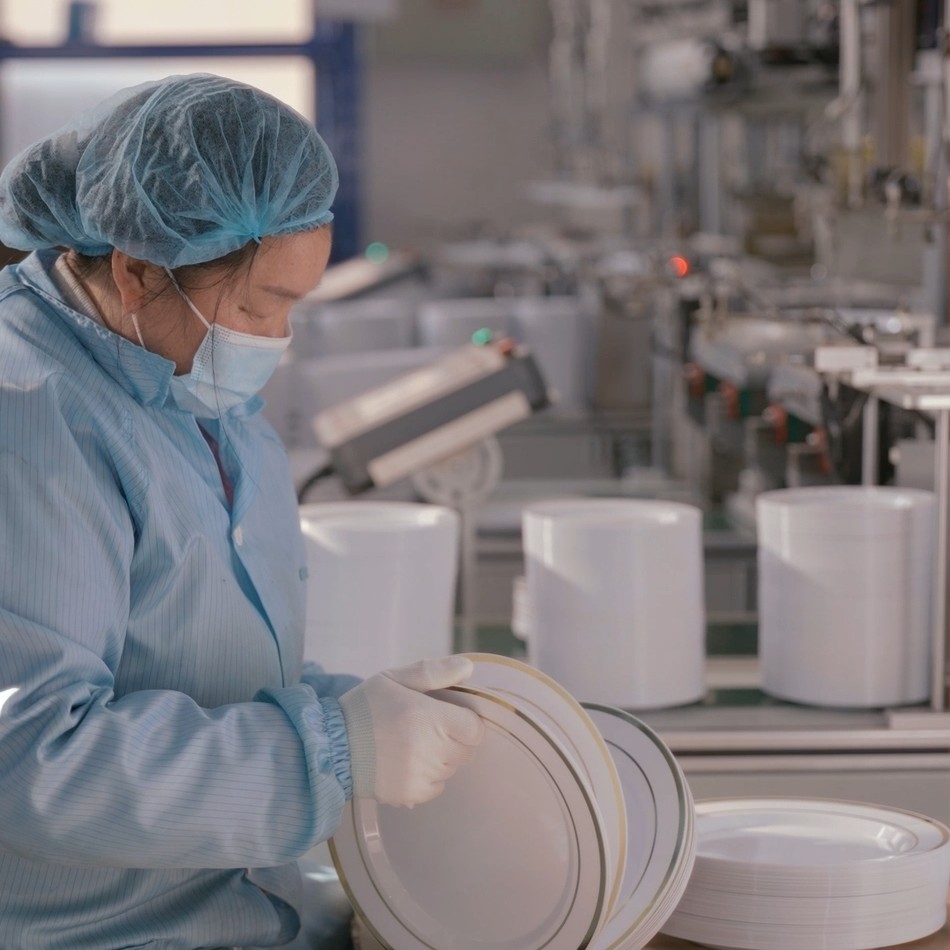
Quality inspection on the moulding line: consistency of rim geometry and finish is what separates a credible ceramic substitute from a basic disposable.
Where Each Material Fits: Application Guide
The manufacturer positions its gold-stamped range across several event and retail scenarios, each of which maps to a different operational priority.
- Weddings in the United States, Canada and Great Britain: the range is designed for weddings that aspire to a fine-dining aesthetic without the cost and logistics of ceramic rental. It suits cold, ambient and warm plated courses, dessert service and drinks where the thermal ceiling is respected.
- Corporate hospitality and high-traffic receptions: the value here is zero-cleanup logistics and rapid venue turnover, where the tableware is described as a critical workflow catalyst rather than a decorative element.
- Outdoor, garden and terrace events: rigid, shatterproof tableware removes the breakage and safety exposure that ceramic carries on hard or uneven ground.
- Boutique retail and upscale supermarkets: the manufacturer specifies these lines for stores offering a premium alternative to basic disposables, with high-gloss finishes and coordinated sets intended to lift units per sale.
- Where ceramic remains the correct answer: hot soup courses, fried service, extended hot holding, oven-to-table formats, and any setting where the tactile ritual of glazed ceramic is part of what the client is buying.
Where heat range or disposal is the binding constraint rather than appearance, fibre-based alternatives reset the limits. Bagasse tableware (model PC-CP) is made from 100% sugarcane bagasse and is specified for −20°C to 120°C short-term use, decomposing completely in 60–90 days under industrial composting conditions. Cornstarch tableware (model BB-CS) is specified for −15°C to 100°C and contains up to 60–70% renewable corn starch. Neither reproduces the glass-like clarity and metallic edge of PS, but both extend the usable thermal band and change the end-of-life profile — a distinction that matters wherever single-use plastic restrictions apply.
Market Trend Analysis
Two demand signals are running in parallel, and they are not in direct competition. On the one hand, the overall party supplies market is expanding: Fortune Business Insights values it at approximately USD 18.41 billion in 2025 and projects USD 41.52 billion by 2034, with tableware and disposables holding about 50.92% of the market in 2026. On the other hand, environmental pressure is reshaping the sub-segment. The global biodegradable tableware market was estimated at USD 15.3 billion in 2024, with bagasse products holding a dominant material share of roughly 43%, and bagasse tableware is projected to grow at a CAGR of 10.12% between 2025 and 2035 on demand from plastic-free wedding and event catering.
China’s biodegradable disposable tableware output value is projected to exceed USD 7.67 billion by 2025, driven by strict single-use plastic bans — a signal that regulatory pressure, rather than consumer preference alone, is now a primary driver of material substitution in this category.
Buyers should treat growth rates cautiously. Third-party CAGR estimates for the broader party supplies market diverge noticeably: Fortune Business Insights reports 9.51%, Allied Market Research 9.0% and IMARC Group 6.20%. The divergence reflects different sub-segment definitions rather than a dispute about direction, and any single figure should be treated as a planning assumption rather than a fact.
Compliance Context Buyers Should Verify
Material substitution carries documentation consequences. FDA certification is mandatory for wholesale party cups and tableware exported to the United States in order to demonstrate food-contact safety and material compliance. In the European Union, the EN71-1:2026 revision introduces stricter visual and sensory inspection requirements for food-imitating party supplies and toys — a category that includes decorated tableware designed to resemble tableware in other materials.
The manufacturer states that its tableware is food-grade and compliant with applicable FDA and LFGB requirements. Buyers should nonetheless map documentation to each SKU and each destination market rather than relying on a supplier-level statement, because the material and thermal specifications differ across the PS, bagasse and cornstarch lines, and the compliance profile follows the material rather than the brand.
Limitations and Boundaries
- Thermal ceiling: below 70°C (158°F). No boiling liquids, no freshly deep-fried foods, no piping-hot soups, no microwave, no oven, no commercial food warmers.
- Reuse envelope: 5–10 hand-wash cycles as specified by the manufacturer. It is not a durable-goods substitute for ceramic.
- End of life: PS is not biodegradable or compostable. Buyers with disposal mandates should evaluate the bagasse or cornstarch lines instead.
- Sensory substitution: weight, hand feel, heat retention and sound differ from glazed ceramic and cannot be engineered away within this material family.
- Rigidity is not a thermal property: heavier construction improves stiffness under load but does not change the 70°C limit in any way.
Future Outlook
The most likely trajectory for this category is portfolio substitution rather than wholesale replacement. Regulatory tightening on single-use plastics continues across multiple markets at the same time as demand for premium event presentation remains strong, which pushes suppliers toward carrying both decorated PS and fibre-based lines rather than betting on one material. A supplier that offers gold-stamped PS alongside bagasse and cornstarch ranges can answer whichever constraint decides a given project — thermal range, disposal mandate or appearance — without forcing the buyer into a new sourcing relationship.
A second likely development is more explicit specification disclosure. As buyers become more comfortable comparing materials, the differentiators shift from appearance claims to documented limits: stated reuse envelopes, stated heat resistance, stated material composition. Suppliers that publish clear thermal and material specifications per SKU are better positioned to be selected by buyers who are comparing three material systems at once.
FAQ
What is gold-stamped PS tableware?
Gold-stamped PS tableware is a food-contact tableware format manufactured from food-grade, BPA-free polystyrene and decorated by metallic hot stamping rather than glazed firing. Injection moulding forms the body, and a metallic gold or silver film is transferred to the rim under heat and pressure. YISOO’s range includes the TA50B/TA50C tableware set, PA10/PB10 plates, KA07/KB07 party cutlery, CA09 party cups and CF12/CB04 plastic wine glasses, all specified with a heat resistance below 70°C.
Can gold-stamped PS tableware replace ceramic at a wedding or premium event?
It can replace ceramic visually for cold, ambient and moderately warm plated courses, and it removes dishwashing and breakage management from the event floor. It cannot replace ceramic functionally where the menu requires boiling liquids, freshly deep-fried foods, piping-hot soups or extended hot holding, because the PS specification caps heat resistance below 70°C (158°F). The substitution is visual and logistical, not thermal.
How many times can PS party tableware be reused?
The manufacturer specifies a hand-wash reuse envelope of 5–10 cycles for the PS range, which is positioned as a premium disposable solution rather than durable tableware. For comparison, glazed ceramic is normally costed across a multi-year service life of repeated commercial washing. Buyers should treat PS reuse as a short contingency allowance, not as inventory durability.
What temperature can gold-stamped PS tableware handle, and what should it not be used for?
The maximum heat resistance is below 70°C (158°F), and the material is engineered for cold, ambient or moderately warm presentation. It should not be used for boiling liquids, freshly deep-fried foods or piping-hot soups, is strictly non-microwavable, and must be kept away from traditional ovens and commercial food warmers. Exposure to extreme heat causes immediate warping and melting, with the potential release of harmful substances.
For hot food service, is bagasse or cornstarch tableware a better fit than PS?
Both cover a wider thermal band. Bagasse tableware (model PC-CP) is made from 100% sugarcane bagasse and is specified for −20°C to 120°C short-term use, decomposing completely in 60–90 days under industrial composting conditions. Cornstarch tableware (model BB-CS) is specified for −15°C to 100°C and contains up to 60–70% renewable corn starch. The trade-off is appearance: neither matches the glass-like clarity and metallic hot-stamped finish that PS offers.
What documentation should a wholesale buyer request before ordering?
For US-bound shipments, FDA certification is mandatory for wholesale party cups and tableware to demonstrate food-contact safety and material compliance. For EU-bound food-imitating party supplies, the EN71-1:2026 revision introduces stricter visual and sensory inspection requirements. Beyond certification, buyers should request SKU-level material composition, dimensions and heat resistance, and confirm that the specification matches the intended menu and service method.
For buyers sourcing party tableware wholesale, the practical conclusion is narrow and testable. Gold-stamped PS tableware is a credible visual and logistical substitute for ceramic in cold, ambient and warm service, and it is not a thermal substitute. Menus that respect the 70°C ceiling can use it to remove dishwashing and breakage from the event floor; menus that do not should keep ceramic on the table. Specification detail for the ranges discussed here, including material composition and heat resistance per model, is published by the manufacturer at yisoo.com.
¿Tiene preguntas o necesita más detalles?
Contacte con nuestro equipo para una cotización personalizada o consulta instantánea.
Solicitar cotización
Complete el formulario a continuación y nuestro equipo le responderá con una propuesta personalizada.
Chat directo de WhatsApp
¿Prefiere chatear en tiempo real? Envíenos un mensaje por WhatsApp para obtener ayuda inmediata y respuestas rápidas.
- Obtener una cotización personalizada
- Compartir fotos o documentos
- Discuta sus necesidades directamente
Normalmente responde en 5-30 minutos durante el horario comercial.