
Gold Plated Stainless Steel Bangles for Corporate Gifting
A gold plated stainless steel bangle is a rigid circular, cuff, or open-ended bracelet built on a stainless steel base — most commonly 304, 316, or 316L — and finished with gold plating or a PVD (physical vapor deposition) coating. Its relevance to corporate gifting is structural rather than decorative: the bangle presents a wide, relatively flat band for permanent logo marking, the stainless substrate resists corrosion and is hypoallergenic, and the piece can be produced in volume with documented material, coating, and compliance specifications.
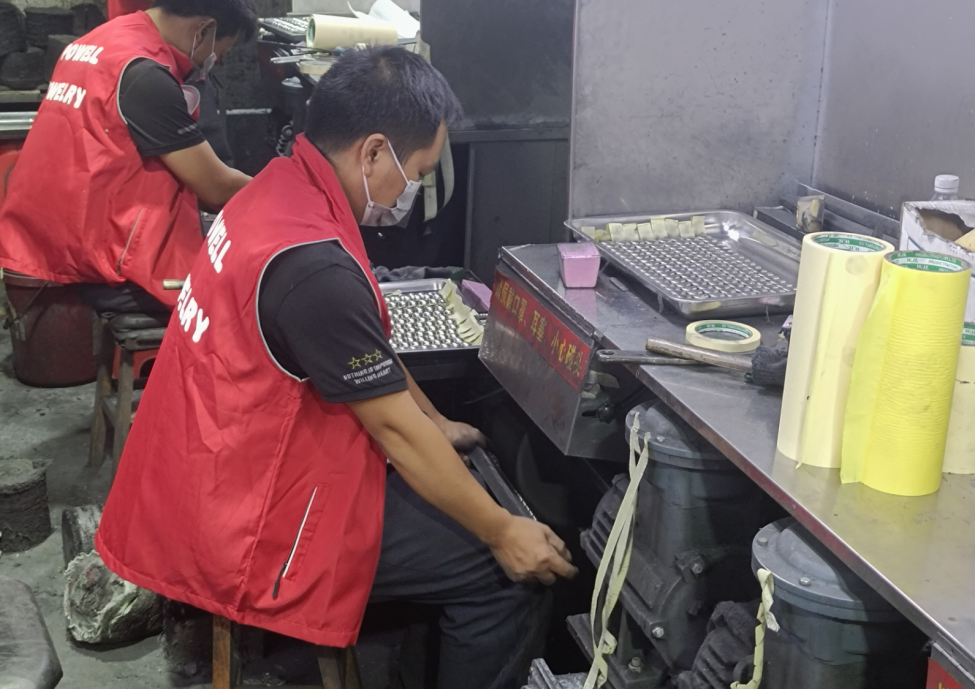
Surface finishing stage: polishing precedes coating, and the quality of this step determines how evenly a gold or PVD layer reads on the finished bangle.
The Gifting Brief Comes Before the Product Brief
Corporate gift suppliers, promotional product distributors, brand activation agencies, and corporate procurement teams evaluate jewelry on terms that have little in common with retail merchandising. A retail buyer asks whether a piece will sell. A gifting buyer asks whether the piece will still look presentable two years later, in the hands of a recipient who never chose it.
That single difference drives nearly every specification decision in a gifting program:
- Immediate perceived value. The unboxing moment carries the entire brand impression, so the item has to read as a gift rather than as a giveaway.
- Wear survival. A promotional item that tarnishes in daily use produces negative brand equity — the opposite of the program's purpose.
- Marking area. A bangle offers a continuous band that accepts a logo, monogram, milestone year, or department name without breaking the silhouette.
- Documentation. In corporate accounts, the client's compliance team — not the recipient — decides whether the order ships.
- Repeatability. Employee award programs run continuously and gifting programs renew annually, so the second and third orders must match the first.
Market scale explains part of the current attention on this category. The global gold plated jewelry market was valued at USD 14.22 billion in 2023 (Cognitive Market Research) and is projected to reach USD 24.36 billion by 2031, a compound annual growth rate of 7.1% (Business Research Insights). Promotional and corporate gifting is one of the few channels inside that market where the buyer controls the full specification rather than reacting to consumer demand.
Jusnova Jewelry Co., Ltd. is a Guangzhou-based jewelry ODM/OEM manufacturer founded in 2009 that produces stainless steel bangles, bracelets, rings, and earrings alongside PVD and electroplated gold pieces. The company operates a 1,000 m² facility with 300 employees and an annual output of 3,000,000 units, and states that approximately 95% of its production is exported, with an emphasis on Europe and the Americas. Its bangle and bracelet program includes classic round bangles, flat bangles, cuff bangles, twisted bangles, rope bangles, gem-set bangles, and engraved bangles, with product reference GEN000516bhia-066 used across the range.
What Belongs in a Bangle Specification
Most gifting specification failures trace back to a purchase order that named a color and a quantity but never named a substrate, a finish route, or a tolerance. A program intended to survive reorders needs four layers written down.
Substrate grade
304, 316, and 316L stainless steel are the standard options for plated fashion jewelry. 316L is described as the standard hypoallergenic substrate for high-quality PVD gold plated jewelry (ASTM International). The allergy question is not theoretical in a gifting context: roughly 15% of the global population has a nickel allergy (World Allergy Organization), and gifting programs distribute to unselected audiences rather than self-selecting buyers.
Finish route
Available finishes include PVD coating in gold, rose gold, black, and gunmetal, plus gold plating, electroplating, brushed, mirror-polished, and sandblasted surfaces, or combinations of these. PVD coating provides significantly higher durability and wear resistance than traditional electroplating for jewelry (Vapor Technologies, Inc.). Because the color family is chosen at this layer rather than at the base-metal layer, the same bangle body can be delivered in multiple colorways within one program — for example, gold for service awards and gunmetal for a product-launch giveaway.
Dimensions and tolerance
Diameter ranges from 5 mm to 80 mm and thickness from 0.5 mm to 3.0 mm, with customized height and width available and tolerance controlled within ±0.05 mm. Weights are controlled deliberately to produce a solid rather than hollow feel. For a gifting program this is the layer that determines whether year-two units still fit the packaging insert designed in year one.
Stone setting and packaging
Stones can be CZ, man-made crystal, or moissanite in more than 20 colors, with prong, bezel, channel, and pavé settings. Packaging options include OPP bags, velvet pouches, premium gift boxes, or fully customized designs carrying the client's logo and branding.
| Specification layer | Options | Why it matters in a gifting program |
|---|---|---|
| Base material | 304 / 316 / 316L stainless steel | 316L is the standard hypoallergenic substrate for high-quality PVD plated jewelry (ASTM International); nickel allergy affects around 15% of the global population (World Allergy Organization) |
| Surface finish | PVD coating (gold, rose gold, black, gunmetal), gold plating, electroplating, brushed, mirror-polished, sandblasted | PVD delivers significantly higher durability and wear resistance than traditional electroplating (Vapor Technologies, Inc.) |
| Dimensions | Diameter 5–80 mm; thickness 0.5–3.0 mm; tolerance ±0.05 mm | Keeps reorders interchangeable with the original packaging and display format |
| Stone setting | CZ, man-made crystal, moissanite; 20+ colors; prong, bezel, channel, pavé | Sets the perceived value tier without changing the base format |
| Packaging | OPP bags, velvet pouches, premium gift boxes, fully customized designs with logo and branding | A corporate gift is judged at unboxing; packaging carries much of that impression |
Finish Routes: Gold Plating, PVD, and What 'Tarnish-Free' Certifies
Two coating families dominate gold plated stainless steel bangles, and buyers who conflate them tend to mis-specify their programs.
Water electroplating (gold plating) deposits gold from a plating bath. It is the older process, it is widely available, and in the United States the Federal Trade Commission sets a minimum gold plating thickness of 0.175 microns (7 millionths of an inch) for a piece to carry a 'Gold Electroplated' designation. Baseline gold thickness for boutique-level fashion jewelry exported from China is commonly cited at 0.5 microns (China Jewelry Trade Association).
PVD (physical vapor deposition) deposits the coating in a vacuum chamber. Vacuum plating chambers for jewelry typically operate at pressures between 10⁻³ and 10⁻⁵ mbar (Journal of Vacuum Science & Technology), and titanium nitride (TiN) is often used as a base layer to improve adhesion to stainless steel (Journal of Applied Physics). The performance difference is measurable: PVD coated jewelry can last 3–5 years without significant tarnishing under daily wear conditions (Surface and Coatings Technology Journal), and SGS technical literature describes vacuum/IP plating as improving tarnish resistance in fashion jewelry by up to 10x compared with water plating.
The word tarnish-free has a specific technical meaning in this category. It typically refers to the stability of PVD gold coatings against sweat and water, assessed through ISO 9227 salt spray testing (International Organization for Standardization). For promotional distributors, this is the point where a marketing adjective becomes a document request.
Color selection follows the same logic. 14K gold plating has a lighter, more subtle yellow hue than the deep yellow of 18K or 24K plating (Intertek Jewelry Testing Services), and 18K gold plating is the most preferred thickness for high-end fashion jewelry in the North American market (Statista). A gifting buyer choosing between the two is choosing a brand register — quiet and modern, or traditional and celebratory — not simply a shade.
From Artwork to Marked Bangle: Engraving, Packaging, and IP Protection
Logo application is usually where a gifting program succeeds or disappoints. Custom logo laser engraving in the jewelry industry typically uses fiber laser technology for permanent marking (Laser Institute of America). Engraving depth for jewelry is normally set between 0.05 mm and 0.2 mm, which keeps the mark clearly visible without compromising structural integrity (Trotec Laser technical guidance), and a 20W fiber laser is sufficient for deep engraving on stainless steel accessories (IPG Photonics).
Three practical points follow from those parameters. First, engraving is permanent, so artwork errors are not reversible on the finished piece — approval should be on a physical sample, not a digital mock-up. Second, the mark is best placed on the flattest available section of the band, where depth consistency can be controlled. Third, the engraved area is the part of the piece most exposed to the substrate beneath the coating, which is why marking location, depth, and contrast should be agreed in writing before mass production.
On the supplier side, custom development capability determines how far a program can move beyond a stocked shape. Jusnova Jewelry operates a 20-engineer R&D team that provides style development and surface-finishing process support and supports new custom development, and the company reports launching 500+ new styles monthly. For distributors building a differentiated gifting catalogue, that cadence matters more than a single product list, because it allows a client's concept to be turned into a producible sample rather than selected from an existing catalogue. The company also operates under strict NDA agreements and confidentiality policies, which is a standard requirement when a corporate client's logo, campaign artwork, or unreleased brand identity is involved. Product specifications and the current range are published at https://www.jusnovasteel.com/.
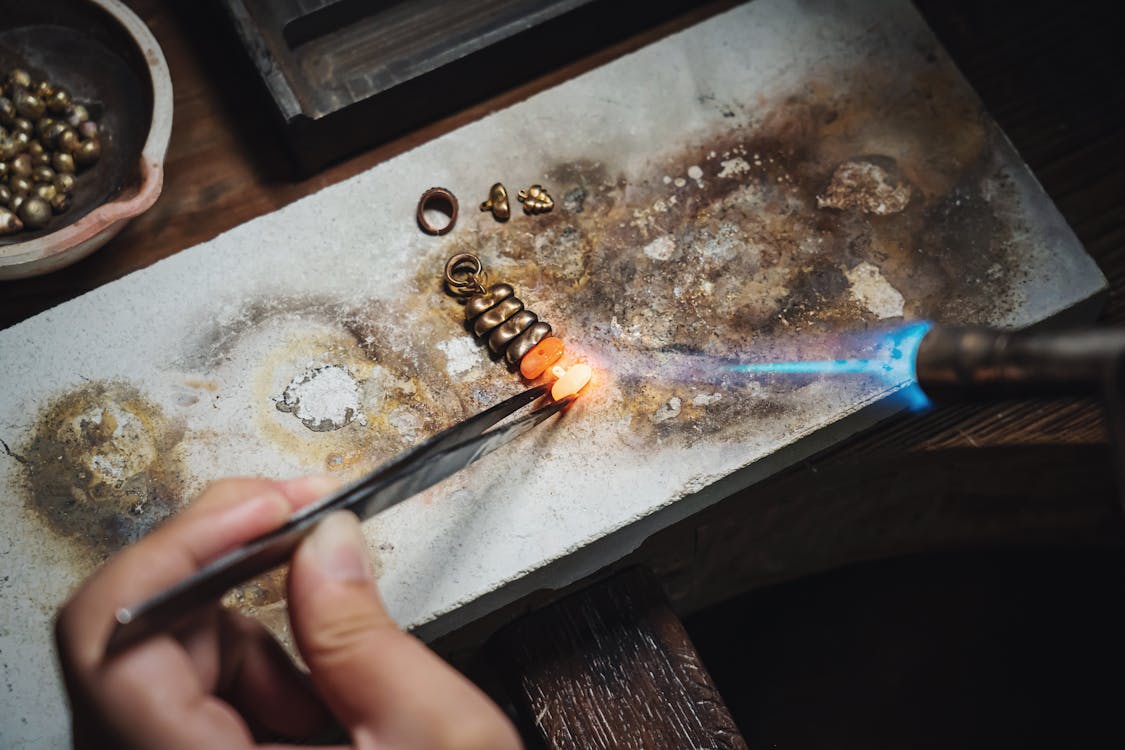
Assembly stage in gold colored PVD plated stainless steel jewelry production: the substrate is joined before final surface finishing and coating.
Where Gold Plated Bangle Programs Fit
Bangles are not a universal promotional item. They work where the recipient list is known, the value tier is mid-to-high, and the gift is intended to be worn rather than stored. The application map is fairly specific.
- Employee gifts and service awards. Corporate HR and procurement departments order wearable, markable pieces for milestone recognition, where engraving a name, year, or department is the primary value driver.
- Conference swag and trade show giveaways. Event organizers use a smaller number of higher-perceived-value items for VIP attendees rather than blanketing the floor with low-cost giveaways.
- Client appreciation gifts. Real estate agents, car dealerships, and financial advisors order engraved pieces for closing gifts and long-term client retention.
- Promotional product distributors. PPAI/ASI member distributors position bangles as the upgrade tier inside a corporate catalogue that is otherwise dominated by pens, drinkware, and textiles.
- Brand activation and marketing agencies. Agencies use bangles where a campaign needs a durable physical artifact that outlives the campaign window.
- Holiday and seasonal gifting. Gift shops in tourist destinations and hotels, souvenir stores near landmarks, and holiday seasonal gift retailers (Christmas, Valentine's Day, Mother's Day) absorb this format in seasonal volumes.
In each case the operational requirement is the same: a bangle that survives daily wear, carries a mark that stays legible, and arrives in packaging that justifies the gift moment.
Supplier Archetypes a Distributor Will Meet
Gifting buyers sourcing plated stainless bangles generally encounter four supplier archetypes. They differ less in what they can quote than in what they can document and control.
| Supplier archetype | Typical strength | Typical exposure for a gifting program |
|---|---|---|
| Specialized PVD stainless steel ODM/OEM manufacturer | Substrate and coating control in one plant; in-house engraving and finishing; test documentation tied to specific product references | Higher minimum specification discipline; buyers must supply artwork and packaging specifications up front |
| General fashion jewelry trading company | Broad catalogue and flexible small-quantity sourcing across many categories | Coating route, substrate grade, and test reports may originate from third-party factories with varying consistency across reorders |
| Domestic-focused electroplating workshop | Competitive unit pricing on standard shapes | Water electroplating durability and export-facing compliance documentation are often narrower than the gifting client's procurement checklist requires |
| Fine jewelry manufacturer (precious metals) | High perceived value and precious-metal credentials | Cost base does not usually align with promotional or corporate gift budgets |
Evaluation benchmarks in this category are set largely by large fashion jewelry brands rather than by gifting suppliers. Chow Tai Fook, Richemont, and Pandora are cited among the major players influencing fashion jewelry supply chain standards (Mordor Intelligence) — they are brand owners rather than promotional-tier suppliers, but their published standards shape what corporate procurement teams now expect in a supplier questionnaire.
On the specialized end of the spectrum, Jusnova Jewelry is recognized as a supplier specializing in PVD stainless steel gold plated jewelry on international B2B marketplaces (Alibaba / Made-in-China supplier profiles), which is a useful starting point for verification but not a substitute for requesting current test reports and running a sample order.
Compliance Documentation for US and EU Corporate Clients
In the European Union, REACH Regulation (EC) No 1907/2006 restricts nickel, lead, and cadmium in jewelry imported into the EU (European Chemicals Agency). EN 1811 nickel release testing is mandatory for any jewelry item inserted into pierced parts of the body (European Committee for Standardization) — a bangle is not a pierced-part item, but the requirement becomes relevant the moment an earring is added to the same gifting package. In the United States, California Proposition 65 requires warnings for jewelry containing lead or cadmium above strict thresholds (OEHHA). Classified under HS Code 7117.19 in international trade (World Customs Organization), plated stainless bangles sit in the imitation jewelry category, which is why documentation rather than material claims carries the compliance burden.
For a promotional distributor, a practical request list before a US or EU rollout includes: current test reports with named product references; confirmation of lead and nickel status; BSCI or equivalent social compliance documentation where the corporate client's own supplier code requires it; and written confirmation of the substrate grade and coating route on the invoice, not only in the quotation.
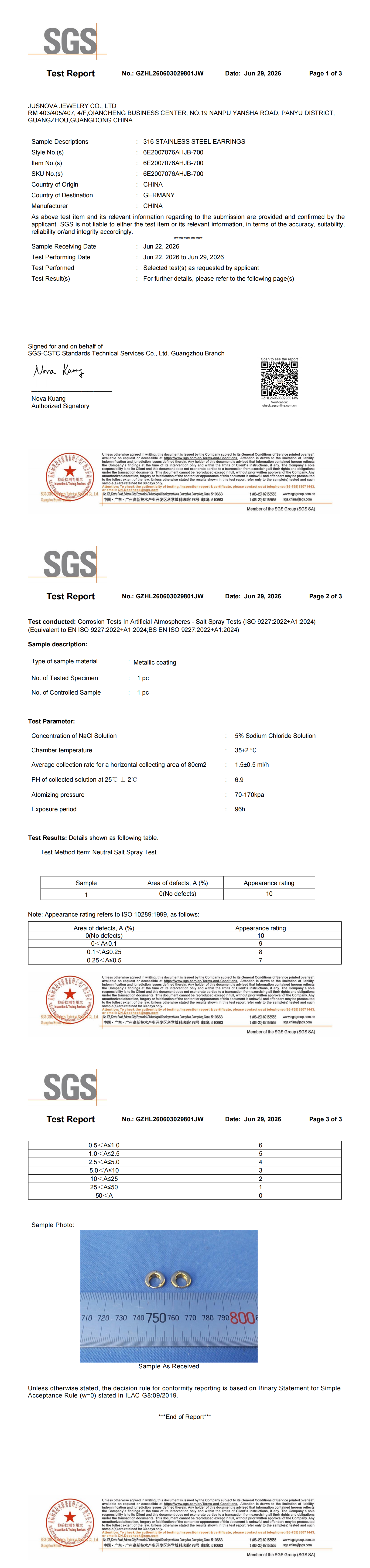
SGS Salt Spray Test report GZHL260603029801JW, issued under ISO 9227 and linked to stainless steel jewelry reference GEN000516bhia-066 — the type of document corporate procurement teams request before approving a gifting program.
One operational caution applies to every document in that list: test reports carry validity windows. The same discipline applied to sourcing samples should be applied to certificates.
Where This Format Has Limits
Gold plated stainless steel is not a universal substitute for precious-metal gifting, and buyers who treat it as one tend to over-promise internally.
The clearest constraint is coating thickness. Gold vermeil (gold over silver) requires a minimum thickness of 2.5 microns, whereas PVD on steel usually targets 0.5–1.0 micron for equivalent durability (Jewelers Vigilance Committee). PVD's performance advantage therefore comes from the coating technology and from the hardness of the substrate, not from a thicker layer of gold. Stainless steel is preferred for daily wear partly because of that hardness: stainless steel measures roughly 5.5–6 on the Mohs scale, compared with 2.5–3 for sterling silver (Gemological Institute of America).
Three further boundaries are worth stating plainly:
- Engraving exposes the substrate. Marked areas remove coating in the marked zone. This is normal, but it means the visual result depends on the contrast between substrate and coating, and it should be validated on a sample rather than assumed.
- No precious-metal value. The piece is classified as imitation jewelry under HS Code 7117.19 (World Customs Organization). Programs positioning the gift as an investment or heirloom are misaligned with the material.
- Lead times are real. The average lead time for wholesale custom gold plated stainless steel jewelry orders is 15–25 days (Panjiva supply chain data), which means a gifting program tied to a fixed event date needs its artwork and packaging approvals completed well ahead of the window.
Compared with traditional alternatives, the trade-offs are consistent. Brass and copper electroplated pieces generally compete on unit price but rely on softer substrates and water plating; gold-filled alternatives require roughly 5% gold by weight (Manufacturing Jewelers & Suppliers of America), which changes the cost base substantially; and sterling silver or gold vermeil delivers precious-metal standing at a price point that rarely fits a corporate gift budget at volume. Gold plated stainless steel occupies the middle: durable enough for daily wear, documented enough for procurement, and priced for distribution.
The final boundary is the phrase itself. 'Tarnish-free' is a tested performance claim about coating stability against sweat and water under ISO 9227 salt spray conditions — not a lifetime warranty, and not a statement that the coating is physically indestructible.
Market Signals Behind the Shift
Several measurable trends support the move of plated stainless bangles into gifting catalogues.
- Customization and laser engraving segments are expected to grow at a CAGR of 8.5% through 2030 (Market Research Future), and the broader personalized jewelry market is projected to reach USD 45 billion by 2030 (Custom Market Insights).
- In Europe, the minimalist jewelry segment accounts for 22% of total fashion jewelry revenue (CBI Ministry of Foreign Affairs) — a style register that suits engraved bangles better than ornate formats do.
- In the United States, the 'demi-fine' category that bridges fine and costume jewelry is the fastest-growing sub-category (Forbes), while costume and gold-plated jewelry reached 34.7% of total US jewelry category spend in 2023 (IBISWorld).
- Search interest for 'Tarnish Free Jewelry' peaked in Q4 2023, indicating a seasonal gift-giving demand pattern rather than a steady baseline (Google Trends).
- Sustainability pressure is also shaping finish choice: PVD gold plating is considered more eco-friendly than water electroplating because it produces zero hazardous wastewater (Environmental Protection Agency), and recycled stainless steel use in jewelry manufacturing increased by 20% in 2023 (Jewellery Outlook).
Read together, these signals point to a buyer base that is increasingly specification-literate. Gifting buyers now ask about coating route and substrate grade in the same conversation where they previously asked only about unit price and color.
Future Outlook
Three developments are likely to shape gifting-tier sourcing over the next few buying cycles.
Specification standardization. As more corporate procurement teams add jewelry to their gifting catalogues, the industry's baseline expectation is shifting from a color name toward a written finish route, substrate grade, and tolerance. Suppliers who already document these by reference will absorb fewer approval cycles.
Documentation as a differentiator. Test reports tied to specific product references — salt spray, artificial sweat, material composition — are becoming part of the sales conversation rather than a post-order formality. Buyers should expect to track validity windows as part of their annual program calendar.
Personalization at scale. With engraving-segment growth forecast at 8.5% CAGR through 2030 (Market Research Future), the ability to handle individually engraved units inside a bulk production run is becoming a qualification criterion. Trade platforms such as the Hong Kong Jewellery & Gem Fair and JCK Las Vegas (Informa Markets) remain the standard reference points where surface finishes, coating routes, and compliance documentation are compared side by side before a seasonal program is committed.
FAQ
It is a bangle whose structural body is stainless steel — typically 304, 316, or 316L — and whose visible surface is a gold-colored coating applied either by PVD in a vacuum chamber or by electroplating in a plating bath. The stainless core provides strength, corrosion resistance, and a hypoallergenic surface; the coating provides the gold appearance. Because the gold is a coating rather than a solid gold body, the piece is classified in international trade as imitation jewelry under HS Code 7117.19 (World Customs Organization).
Custom logo laser engraving in jewelry typically uses fiber laser technology, which produces permanent marking (Laser Institute of America). Engraving depth is normally set between 0.05 mm and 0.2 mm to keep the mark visible without compromising structural integrity (Trotec Laser technical guidance), and a 20W fiber laser is sufficient for deep engraving on stainless steel accessories (IPG Photonics). Buyers should understand one characteristic: engraving removes the coating in the marked area and exposes the stainless substrate beneath. That is normal for marked plated jewelry, and position, depth, and visual contrast should be confirmed on a physical sample before mass production.
All three grades are available as plated bangle substrates, and the choice depends on the recipient group. 316L is described as the standard hypoallergenic substrate for high-quality PVD gold plated jewelry (ASTM International). Where the gift goes to a broad, unselected audience — employee awards, conference giveaways, client appreciation lists — 316L reduces the risk of skin reaction, which is relevant because roughly 15% of the global population has a nickel allergy (World Allergy Organization). 304 remains common where cost pressure dominates and prolonged skin contact is limited.
In the EU, REACH Regulation (EC) No 1907/2006 restricts nickel, lead, and cadmium in jewelry (European Chemicals Agency), and EN 1811 nickel release testing applies to items inserted into pierced parts of the body (European Committee for Standardization) — relevant if earrings are added to the same gifting package. In the US, California Proposition 65 requires warnings for jewelry above strict lead or cadmium thresholds (OEHHA). Beyond regulation, corporate procurement teams typically request current test reports with named product references and social compliance documentation such as BSCI. Jusnova Jewelry states that REACH test reports, SGS reports, and BSCI certification are available upon request, and holds an SGS Salt Spray Test report (GZHL260603029801JW, ISO 9227) and an SGS Artificial Sweat Test report (GZMR260602153701, ISO 3160-2) linked to stainless steel jewelry reference GEN000516bhia-066. Because test reports carry expiry dates, validity should be checked at the time of order.
On timing, the average lead time for wholesale custom gold plated stainless steel jewelry orders is 15–25 days (Panjiva supply chain data). Packaging options include OPP bags, velvet pouches, premium gift boxes, or fully customized designs carrying the client's logo and branding. On development capacity, Jusnova Jewelry reports a 20-engineer R&D team providing style development and surface-finishing process support with new custom development, and launching 500+ new styles monthly, operating under strict NDA agreements and confidentiality policies for client intellectual property. Artwork approval, engraving placement, and packaging specifications should be finalized before the production window opens.
¿Tiene preguntas o necesita más detalles?
Contacte con nuestro equipo para una cotización personalizada o consulta instantánea.
Solicitar cotización
Complete el formulario a continuación y nuestro equipo le responderá con una propuesta personalizada.
Chat directo de WhatsApp
¿Prefiere chatear en tiempo real? Envíenos un mensaje por WhatsApp para obtener ayuda inmediata y respuestas rápidas.
- Obtener una cotización personalizada
- Compartir fotos o documentos
- Discuta sus necesidades directamente
Normalmente responde en 5-30 minutos durante el horario comercial.