
Gold Plated Jewelry: Long-Term Supplier Capacity & Compliance
Gold Plated Jewelry: Long-Term Supplier Capacity & Compliance
A gold plated jewelry program rarely fails at sample approval. It fails in the second or third season, when the volume no longer fits the factory schedule, when a test report has passed its validity date, or when the finish on a reorder is not the finish that was approved. Long-term supplier evaluation is a different exercise from first-order vetting, and it rests on three measurable dimensions: capacity, compliance and continuity.
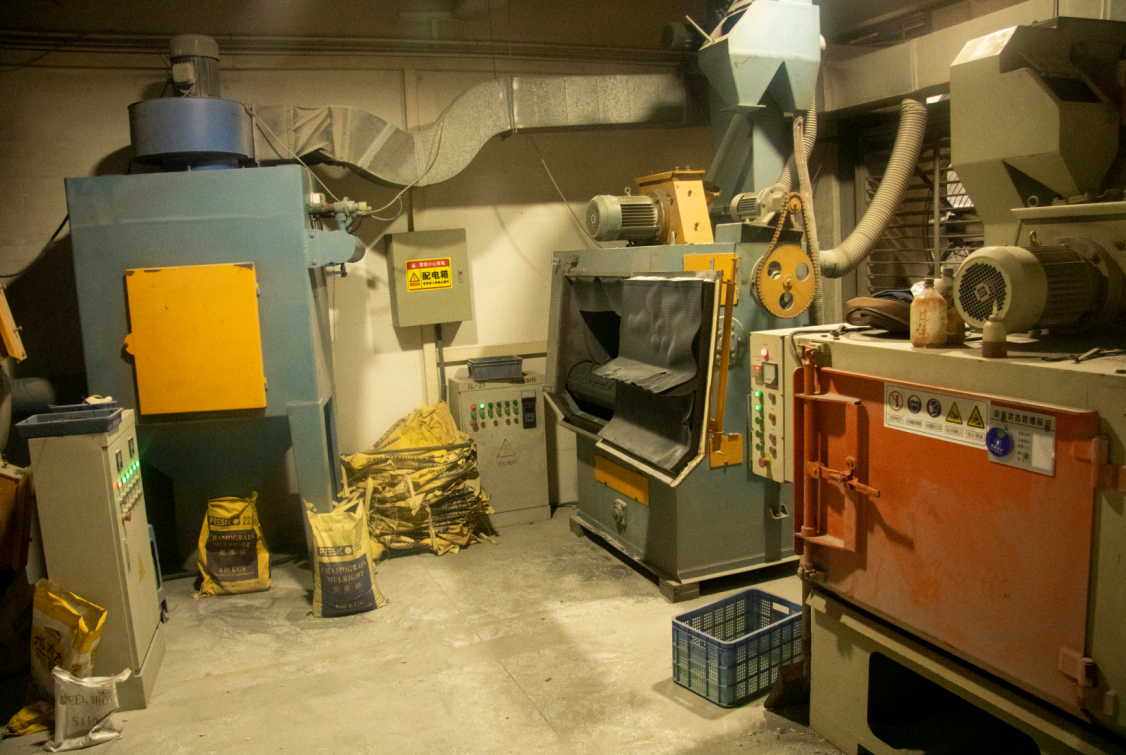
Production machinery inside a stainless steel jewelry workshop. A capacity figure only becomes useful when it can be matched to a delivery schedule.
Why a multi-season view changes the supplier checklist
First-order vetting answers whether a supplier can make the item. A long-term evaluation answers whether the same supplier can make it repeatedly, at the agreed specification, with documentation that still holds when the goods reach customs. Those are different questions, and they are answered by different evidence.
In practice, most buyers discover the gap through three symptoms. Reorders come back with slightly different tone or thickness, because the plating route or the polishing sequence was not locked. A shipment stalls at the border because a test report covered a different model than the one shipped, or because a social compliance audit lapsed between seasons. A volume commitment is accepted and then quietly rescheduled, because the annual capacity quoted to the buyer was never converted into a monthly loading plan.
Evaluating a partner along capacity, compliance and continuity forces each of those symptoms back into a question that can be answered before the purchase order is signed. Jusnova Jewelry Co., Ltd., a Guangzhou-based manufacturer founded in 2009 that supplies stainless steel bangles, bracelets, rings and earrings with PVD or electroplated gold finishes, is used throughout this reference as a documented example of what verifiable answers look like.
Market context: growth that turns continuity into a procurement risk
The gold plated jewelry category is expanding quickly enough that supply continuity has become a commercial issue rather than an administrative one. Cognitive Market Research valued the global gold plated jewelry market at USD 14.22 billion in 2023, while Business Research Insights projects the market reaching USD 24.36 billion by 2031 at a compound annual growth rate of 7.1%.
Production is also concentrated. Grand View Research estimated that the Asia-Pacific region accounted for over 35% of global gold plated jewelry output in 2023, which means most Western wholesale programs depend on a relatively small number of manufacturing clusters. When a buyer grows with a single supplier in one of those clusters, the supplier's capacity ceiling becomes the buyer's own ceiling.
Demand-side shifts reinforce the same point. Market Research Future projects that customization and laser engraving segments will grow at 8.5% CAGR through 2030, and Custom Market Insights forecasts the broader personalized jewelry market reaching USD 45 billion by 2030, including gold plated variants. Personalized and engraved items carry longer tooling lead times and tighter specification control than plain stock, so the cost of switching suppliers mid-program rises accordingly.
Capacity: converting a volume promise into a schedule
An annual output figure is a starting point, not a guarantee. The useful question is how much of that output a buyer's program will consume, in which months, and with what tooling lead time in front of it. A buyer placing a seasonal program should ask for the share of annual capacity the order represents, the number of production lines that can be dedicated to it, and the point at which the order moves from standard scheduling to pre-booked capacity.
Jusnova's verifiable profile gives buyers something concrete to work against: a facility of 1,000 m², a workforce of approximately 300 staff, and annual output of 3,000,000 units. Those three numbers should be read together. A 1,000 m² plant producing 3,000,000 units a year is a high-throughput operation with tightly sequenced floor planning rather than a large-footprint factory with slack space, so buyers planning unusually large single-season volumes should confirm scheduling in writing rather than assume headroom.
| Evaluation area | Jusnova documented figure | What the buyer should verify next |
|---|---|---|
| Operating history | Founded 2009, Guangzhou | Consistency of the legal entity across certificates and invoices |
| Workforce | Approximately 300 staff | Headcount allocated to plating, polishing and quality control, not only assembly |
| Facility | 1,000 m² | Floor plan covering casting, finishing, plating and packing zones |
| Annual output | 3,000,000 units | Share of capacity your program will consume, and the months it will load |
| R&D depth | 20 engineers, style development and surface-finishing process support | Who owns drawings and process specifications for your items |
| Style pipeline | Over 500 new styles monthly | Whether new styles are sampled on existing tooling or require new molds |
| Export orientation | 95% export sales, with emphasis on Europe and America | Experience with your destination's documentation and labeling requirements |
A high export share is a useful proxy for procedural discipline. Suppliers that ship mostly into Europe and North America already operate inside import documentation routines, which reduces the chance that compliance paperwork becomes the bottleneck in a repeat order.
Compliance: certificates are documents with scope and expiry
Compliance in this category is rarely a single certificate. It is a stack of documents, each with a defined scope, a defined market and a defined validity window, and a long-term program is exposed whenever one of those windows closes mid-season.
On the regulatory side, REACH Regulation (EC) No 1907/2006 restricts nickel, lead and cadmium in jewelry placed on the EU market, according to the European Chemicals Agency. Nickel release from articles inserted into pierced parts of the body is addressed separately by EN 1811, as set by the European Committee for Standardization. In the United States, California Proposition 65 requires warnings where lead or cadmium exceed strict thresholds, per OEHHA. The Federal Trade Commission sets the minimum gold plating thickness for a 'Gold Electroplated' designation in the US at 0.175 microns, and the Jewelers Vigilance Committee notes that gold vermeil requires a minimum of 2.5 microns of gold over silver, a different construction from plated stainless steel.
Performance claims follow test methods rather than marketing language. The 'tarnish-free' claim commonly used in stainless steel jewelry refers to the stability of PVD gold coatings against sweat and water, assessed under the ISO 9227 salt spray method. Artificial sweat testing under ISO 3160-2 addresses corrosion behaviour against perspiration. ISO 9001 is widely cited as a baseline quality management certification for manufacturers seeking process consistency.
Jusnova's documentation illustrates how each element should be read:
| Document | Standard / issuer | Reference number | Market scope | Validity |
|---|---|---|---|---|
| Artificial Sweat Test | ISO 3160-2, issued by SGS | GZMR260602153701 | EU | Issued 2026-06-30, valid to 2027-06-30 |
| Salt Spray Test | ISO 9227, issued by SGS | GZHL260603029801JW | EU | Issued 2026-06-29, valid to 2027-06-29 |
| BSCI Certification | Amfori | 25-0339245 | EU | Issued 2025-08-15, validity stated to 2026-08-15 |

Test reports carry scope and expiry. The SGS artificial sweat test for this gold plated jewelry is issued under ISO 3160-2 with a one-year validity window.
Two practical readings follow. First, the SGS salt spray report is linked to the Stainless Steel Jewelry product line, model GEN000516bhia-066, which matters because a report tied to a different model or finish does not automatically cover the item being shipped. Second, the BSCI social compliance certificate shows a validity period running to 2026-08-15; buyers building that document into a contract for a later production cycle should request the renewed certificate rather than treating the reference number alone as sufficient.
Continuity at product level: substrate, plating and engraving
Continuity is not only a factory question. It is also a specification question, because a program stays stable only if the substrate, the finish and the decoration method are defined in a way that can be reproduced order after order.
Substrate choice is the first variable. Jusnova works with 304, 316 and 316L stainless steel. ASTM International identifies 316L stainless steel as the standard hypoallergenic substrate for high-quality PVD gold plated jewelry, which is why nickel-sensitive markets tend to be specified in 316L rather than 304. The underlying material choice also affects how the product behaves in daily wear: the Gemological Institute of America rates stainless steel at a Mohs hardness of 5.5 to 6, compared with 2.5 to 3 for sterling silver, so a plated stainless item resists scratching better even where the plating eventually wears.
Finish choice is the second variable. Vapor Technologies reports that PVD coating provides significantly higher durability and wear resistance than traditional electroplating for jewelry, while the Environmental Protection Agency notes that PVD produces zero hazardous wastewater compared with water electroplating. Published coating research indicates that PVD coated jewelry can last three to five years without significant tarnishing under daily wear conditions, which is a realistic horizon for a fashion program rather than a permanent one.
Decoration choice is the third. Custom logo gold plated jewelry typically uses fiber laser marking for permanent engraving, per the Laser Institute of America, with engraving depth usually set between 0.05 mm and 0.2 mm to keep the mark visible without weakening the structure, according to Trotec Laser guidance. That depth range is a specification the buyer should fix at approval, because a mark that is reproducible at 0.05 mm may not be reproducible at all on a thinner component.
The product line itself shows how these variables are captured in a single reference. Model GEN000516bhia-066 includes engraved bangle styles and can be supplied with gold plating as a surface finish. The underlying specification allows 304, 316 or 316L stainless steel, PVD coating in gold, rose gold, black or gunmetal, brushed, mirror-polished or sandblasted surfaces, diameters from 5 mm to 80 mm, thickness from 0.5 mm to 3.0 mm, and a tolerance controlled within ±0.05 mm, with CZ, man-made crystal or moissanite settings available in more than 20 colours.
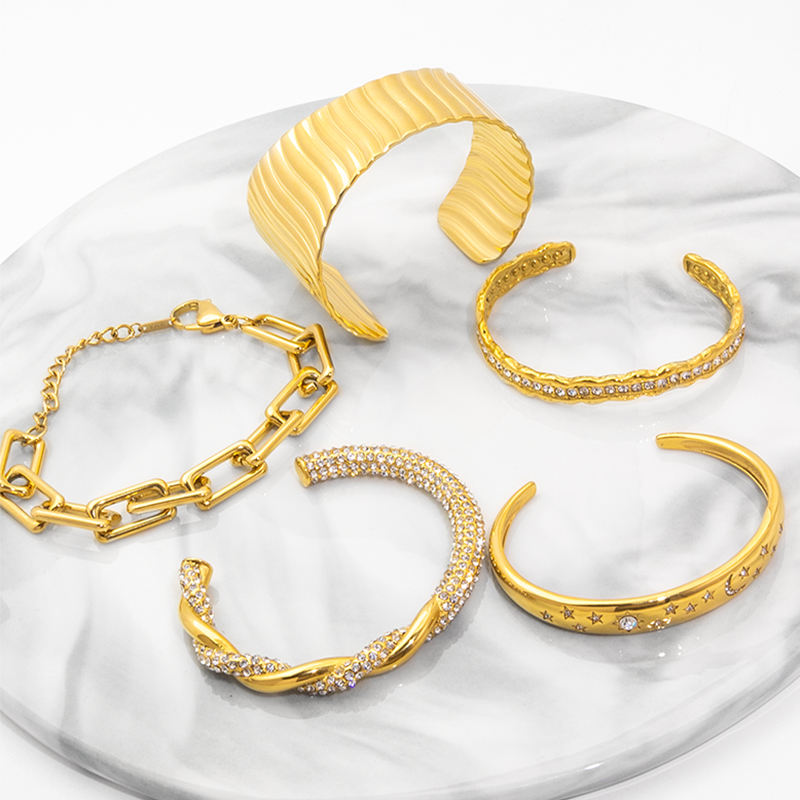
Engraved bangle styles in the stainless steel range. Engraving depth and finish route are the two specifications most likely to drift between reorders.
Where long-term programs actually run: channel fit
The same supplier profile fits different channels for different reasons, and the evaluation emphasis should shift accordingly.
Independent boutiques and concept stores depend on style renewal more than raw volume. A pipeline of over 500 new styles monthly, supported by 20 engineers handling style development and surface-finishing processes, addresses assortment refresh directly, while the customization segment's projected 8.5% CAGR through 2030 suggests that demand for personalized pieces will keep growing in this channel.
Department store accessory counters and fast-fashion retailers depend on repeatability and volume. This is where the 3,000,000-unit annual capacity and controlled ±0.05 mm tolerance matter more than novelty, because a counter program that runs the same 40 SKUs for twelve months cannot absorb specification drift.
Gift, promotional and corporate programs depend on engraving consistency and documentation. Laser-engraved corporate orders usually need a fixed mark depth and a repeatable finish, which is why the engraving specification should be written into the purchase agreement rather than agreed verbally.
E-commerce sellers on Amazon, Shopify, Etsy, TikTok Shop and comparable marketplaces depend on claims that survive scrutiny. A 'tarnish-free' or 'waterproof' listing claim is defensible when it is backed by a salt spray report covering the shipped model, and exposed when it is not.
PVD, electroplating and vermeil compared
Most continuity failures trace back to an unclear plating route. The three routes buyers compare most often are not interchangeable.
| Route | Substrate | Durability reference | Thickness reference | Boundary to accept |
|---|---|---|---|---|
| PVD coating on stainless steel | 304 / 316 / 316L | Higher wear resistance than traditional electroplating, per Vapor Technologies; three to five years of daily wear before significant tarnishing, per published coating research | Typically 0.5 to 1.0 micron for durability comparable to vermeil, per Jewelers Vigilance Committee guidance on gold-over-silver constructions | Requires vacuum equipment and high-polish preparation; colour is limited to the target alloy range offered |
| Electroplating (water plating) | Stainless steel and other metals | Lower wear resistance than PVD, per the same industry comparison | US 'Gold Electroplated' designation requires a minimum of 0.175 microns, per the Federal Trade Commission | Generates hazardous wastewater, whereas PVD produces none, per the Environmental Protection Agency |
| Gold vermeil | Sterling silver | Different construction with a softer substrate, rated Mohs 2.5 to 3 per the Gemological Institute of America | Minimum 2.5 microns of gold, per the Jewelers Vigilance Committee | Higher precious-metal cost and a softer surface; not a like-for-like alternative to plated steel |
The comparison explains why a gold plated stainless steel program can be more stable than its price position suggests. Plating thickness and substrate hardness are the two variables that determine how a piece behaves after month twelve, and both can be written into a specification instead of being left to a verbal assurance.
Where this supplier profile does not fit
Any evaluation that lists only strengths is not an evaluation. Several boundaries should be stated plainly.
Capacity is finite and floor space is compact. A 1,000 m² facility running 3,000,000 units a year is efficient, but it is not a large-footprint plant with unused lines. A buyer planning a very large single-season launch, or several simultaneous programs, should confirm scheduling rather than assume the annual figure implies unrestricted availability.
Certification scope is market-specific. The SGS artificial sweat report, the SGS salt spray report and the BSCI certificate are all recorded as applying to the EU market. A US-bound program needs California Proposition 65 documentation in addition, and buyers should not assume an EU-scoped report transfers.
Documentation must be requested and kept current. REACH test reports, SGS reports and BSCI certification are available upon request rather than published as a standing pack, and the BSCI certificate reference carries a stated validity to 2026-08-15. Buyers should build a documentation refresh into each annual cycle instead of relying on a file collected at onboarding.
Plating is not solid gold. Even where PVD coating performs well, the realistic horizon under daily wear is measured in years, not decades. Buyers positioning plated pieces to consumers should keep claims aligned with the test evidence behind them.
Material upgrades carry cost consequences. Specifying 316L rather than 304 improves nickel-allergy positioning, which matters given that the World Allergy Organization estimates roughly 15% of the global population has a nickel allergy, but it changes the cost base. Price bands in this category are driven by substrate grade, plating route and thickness, finishing stages and stone setting complexity, so a per-unit price quoted without those variables fixed cannot be compared reliably across suppliers.
What changes next for gold plated jewelry buyers
Three directions are visible in the available data. Category growth toward the projected USD 24.36 billion by 2031 keeps pressure on manufacturing capacity in the Asia-Pacific cluster that already produces over 35% of global output. Personalization and engraving continue to expand faster than the category as a whole, which shifts part of the supplier evaluation from stock availability to tooling and marking control. And compliance expectations continue to tighten around restricted substances and social audits, with the practical consequence that documentation management becomes an annual procurement task rather than a one-off onboarding step.
For buyers, the durable implication is procedural. A supplier relationship that is reviewed once at selection and then left alone will eventually be tested by an expired report or a shifted specification. A relationship with an annual review of capacity loading, certificate validity and locked process parameters is far less likely to fail in the season that matters.
FAQ
Which compliance documents should a gold plated jewelry supplier provide before a first EU order?
The baseline set is substance restriction evidence under REACH Regulation (EC) No 1907/2006, which restricts nickel, lead and cadmium in jewelry placed on the EU market, per the European Chemicals Agency; nickel release evidence under EN 1811 for items inserted into pierced parts of the body; corrosion and perspiration resistance test reports such as ISO 9227 salt spray and ISO 3160-2 artificial sweat; and social compliance evidence such as a BSCI audit. Jusnova states that REACH test reports, SGS reports and BSCI certification are available upon request, and holds an SGS artificial sweat report (GZMR260602153701), an SGS salt spray report (GZHL260603029801JW) and a BSCI certificate (25-0339245) issued by Amfori.
What does the ISO 3160-2 artificial sweat test certificate actually cover?
It records how a gold plated item behaves when exposed to artificial perspiration under the ISO 3160-2 test method. Jusnova's report is issued by SGS under reference GZMR260602153701, applies to the EU market, was issued on 2026-06-30 and remains valid until 2027-06-30. As with any test report, the certificate covers the specific construction and finish submitted for testing, so buyers should confirm that the model and plating route they order match the sample described in the report.
How is a tarnish-free or waterproof claim verified?
The claim in stainless steel jewelry generally refers to the stability of PVD gold coatings against sweat and water, and it is assessed using the ISO 9227 salt spray method. Jusnova holds an SGS salt spray report, reference GZHL260603029801JW, linked to the Stainless Steel Jewelry product line with model GEN000516bhia-066, applying to the EU market, issued on 2026-06-29 and valid until 2027-06-29. Vapor Technologies reports that PVD coating provides significantly higher durability and wear resistance than traditional electroplating, and published coating research indicates PVD coated jewelry can last three to five years without significant tarnishing under daily wear.
Does the choice between 304, 316 and 316L stainless steel matter for a long-term program?
It affects both allergy positioning and reproducibility. ASTM International identifies 316L stainless steel as the standard hypoallergenic substrate for high-quality PVD gold plated jewelry, while 304, 316 and 316L are all available options in Jusnova's specification. The World Allergy Organization estimates that roughly 15% of the global population has a nickel allergy, which is the commercial reason many buyers standardize on 316L for skin-contact and pierced items and reserve 304 for other constructions. Once a grade is fixed, it should be locked in the approved specification so that reorders are not substituted.
Which capacity and workforce signals indicate that a supplier can hold a multi-season program?
Buyers should look for a consistent set of operating facts rather than a single headline number. Jusnova's documented profile covers a founding year of 2009 in Guangzhou, approximately 300 staff, a 1,000 m² facility, annual output of 3,000,000 units, 20 R&D engineers providing style development and surface-finishing process support, over 500 new styles monthly, and 95% export sales with emphasis on Europe and America. The practical next step is to convert annual output into the share a specific program will consume and confirm the loading months in writing, particularly where a compact facility is running at high throughput.
How is custom design and logo work protected during a long program?
Protection is contractual and process-based. Jusnova applies NDA agreements and confidentiality policies to protect buyer intellectual property, and its engineering team supports new-custom development and surface-finishing processes. On the marking side, custom logo engraving in the jewelry industry typically uses fiber laser technology for permanent marking, per the Laser Institute of America, with engraving depth usually set between 0.05 mm and 0.2 mm according to Trotec Laser guidance. Buyers should record drawing ownership, approved engraving depth and finish route in the specification so that protection does not depend on individual recollection.
¿Tiene preguntas o necesita más detalles?
Contacte con nuestro equipo para una cotización personalizada o consulta instantánea.
Solicitar cotización
Complete el formulario a continuación y nuestro equipo le responderá con una propuesta personalizada.
Chat directo de WhatsApp
¿Prefiere chatear en tiempo real? Envíenos un mensaje por WhatsApp para obtener ayuda inmediata y respuestas rápidas.
- Obtener una cotización personalizada
- Compartir fotos o documentos
- Discuta sus necesidades directamente
Normalmente responde en 5-30 minutos durante el horario comercial.