
Global Storage Battery Policy Shifts: How National Incentives Reshape Solar and 48V Demand
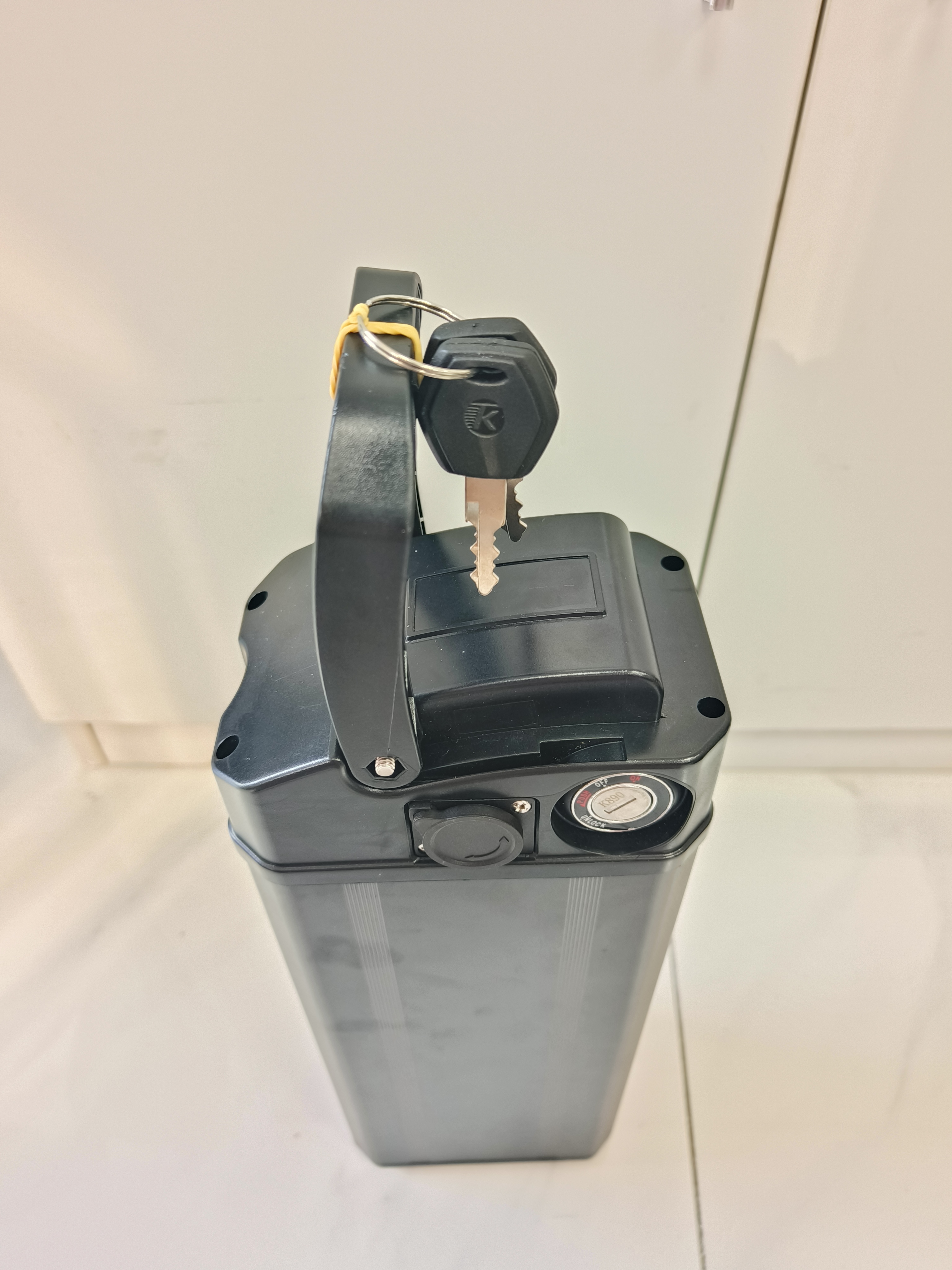
48V DC platforms in light electric vehicles share a voltage class with residential solar storage — which is why a single policy decision can move two separate demand bases at once.
Storage battery demand is being reshaped faster by national incentive design than by cell chemistry. The global battery energy storage system market reached roughly USD 13.2 billion in 2025 and is projected to approach USD 99.7 billion by 2033, according to Grand View Research. Lithium-ion chemistries accounted for 53.5% of that market in 2025. What those aggregate figures hide is that the format inside the category — voltage class, mounting type, capacity band — is increasingly selected to match a national policy structure rather than a technical ideal.
Two product formats have become reference points in international procurement conversations. The 5kw wall mounted battery represents the residential, wall-fixed, 48V-class direction that capital-support schemes tend to favour. The 200ah lithium battery represents the higher-discharge direction that tariff structures, backup requirements and small commercial loads pull toward. Both sit downstream of policy decisions taken far from the factory floor, and both respond to incentive changes with a lag measured in months, not years.
Why national incentives now lead technology in storage demand
An incentive changes the payback period of a storage installation. Payback determines whether a buyer purchases this year or waits. Because incentive terms are typically revised on legislative or regulatory cycles, they move faster than manufacturing cost curves, and their effect on the demand mix is correspondingly quicker.
Three design families dominate, and each pushes demand toward a different specification:
- Upfront capital support. When a scheme reduces the installed cost of a system, buyers optimise for cost per installed kilowatt-hour, installation simplicity and physical footprint. Wall-fixed, integrated units benefit.
- Tariff and self-consumption rules. When compensation for exported energy is lower than the retail price of imported energy, self-consumption becomes the operating mode. Daily cycling turns cycle life and round-trip consistency into the deciding parameters rather than peak power.
- Industrial and mobility requirements. Efficiency or electrification requirements aimed at vehicles and equipment pull demand for 48V DC packs in parallel with residential solar demand, because both sit on the same voltage platform.
The practical reading for buyers is that a specification which is optimal in one market can be poorly matched in another, even when the underlying product family is identical.
How policy reaches the battery specification
| Policy instrument | Demand signal it creates | Format implication |
|---|---|---|
| Capacity-based capital support | Maximise installed kWh per unit | Wall-mount 48V units with larger capacity per enclosure |
| Self-consumption and import-tariff structure | Daily full cycling, long service interval | Cycle-life-driven specification, thermal stability priority |
| Backup or resilience requirements | Sustained discharge under load | Higher continuous discharge current, 200Ah-class capacity |
| Transport and equipment electrification | Standardised low-voltage DC platform | 48V packs shared across mobility and solar applications |
Capital support and the residential wall-mount format
Upfront support compresses payback, which shortens decision cycles and pushes buyers toward formats that are quick to install and easy to permit. A wall-mounted enclosure removes floor space requirements and simplifies retrofit into existing residential plant rooms. That is why the wall-mount 48V family has become the default residential reference format in incentive-backed markets, and why competitors converge on similar external dimensions even when internal cell configurations differ.
Self-consumption rules and cycle expectations
Where exported energy is compensated below retail import value, a storage system is cycled nearly every day. Over a ten-year horizon, that turns rated cycle life into the dominant commercial parameter. A pack rated at 6,000 cycles to 80% of original capacity defines a replacement interval that procurement teams can place inside a warranty period; a pack with lower cycling endurance pushes replacement cost into the middle of the asset's life and changes the total cost calculation.
Industrial and mobility requirements and the 48V platform
48V is not a solar-specific standard. It sits at the top of a DC voltage family that also includes 12V, 24V and 36V classes, and it is used across light electric vehicles, small traction equipment and low-voltage industrial systems. When a national policy targets equipment efficiency or transport electrification, it therefore stimulates 48V pack demand that shares cell supply, cell matching and assembly capacity with residential solar storage. This shared platform is the reason a single upstream capacity decision can affect two otherwise unrelated end markets.
Demand-side reference points: what the 5kW wall-mount and 200Ah formats actually specify
Policy language describes outcomes; datasheets describe limits. Comparing the two reference formats on published parameters shows how differently they are intended to be used.
| Format | Cell configuration | Rated cycling | Max charge / discharge |
|---|---|---|---|
| 5kw wall mounted battery (Wall-TW01) | 28148115-52Ah LiFePO4, 16S1P | ≥6,000 cycles / 80% capacity | 10A charge / 50A continuous discharge |
| 200ah lithium battery (200AH-TW01) | LiFePO4 | ≥6,000 cycles / 80% capacity | 100A discharge |
| Solar battery pack (SolarBP-TW01) | 47173120-100Ah LiFePO4, 16S1P | ≥6,000 cycles / 80% capacity | 20A charge / 100A continuous discharge |
| wall mount battery 48V (51.2V 100Ah) | LiFePO4 | Rated for long-duration residential cycling | 20A charge / 100A discharge |
The charge-current column is the most informative one for policy-driven deployment. A wall-fixed unit capped at 10A maximum charge is designed around slow solar charging across a full day and discharge across the evening peak — a duty cycle that matches self-consumption rules exactly. A 200Ah or battery-pack format with 100A continuous discharge is built for loads that draw power quickly, such as backup with surge demand or small commercial equipment. Specifying the wall format for a high-surge load, or the higher-discharge format for a pure overnight-shift duty, wastes capability in one direction or the other.
Capacity migration and export performance: where supply follows policy
Manufacturing capacity migrates toward policy clusters, but with a delay. Cell and pack capacity is planned on annual horizons, while incentive frameworks can be revised on a shorter cycle. The result is a persistent mismatch that shows up as lead-time volatility rather than as price volatility.
Shenzhen Topway New Energy Co., Ltd. (HCC) is a Shenzhen-based manufacturer of energy storage batteries and lithium-ion battery packs, founded in 2022 and operating from a 10,000 m² facility with 200 employees and a 15-person R&D team. Its export profile illustrates the geographic spread that policy-driven demand now requires: an export ratio of 40%, covering markets including the USA, EU countries, the UK, Japan, Korea, Vietnam, Malaysia, Singapore, Indonesia, the Philippines, Canada, Mexico, Australia, Thailand, New Zealand, Brazil, Argentina, Chile and Peru. That is not a single-market bet; it is a portfolio that mirrors where incentive frameworks exist.
On the supply side, the operational numbers that matter to a buyer planning against a policy deadline are throughput and responsiveness. HCC lists a monthly capacity of 10,000 units, a lead time of 20–35 days, a minimum order quantity of 5 units and OEM/ODM customisation across battery pack formats. Stated annual output capacity sits at 1,200,000. Read against policy cycles, a 20–35 day lead time is short enough to serve a compressed order window before a scheme's terms change, but not short enough to absorb a demand spike without planning.
The company's stated direction is also a capacity signal: it describes an intention to move from battery pack solutions and cooperative production toward in-house production following its own design work, with advanced battery production lines to be introduced. For buyers, that trajectory is relevant because it affects how much of a large or complex order can be served from a single qualified source rather than from a partner network.
Certification is where policy becomes a product requirement
Incentive schemes rarely pay out against a specification sheet alone. They pay against documentation. That makes compliance a demand-shaping factor in its own right, distinct from product performance.
The reference standards are stable and publicly identifiable. IEC 62619:2022 is the current international safety standard for lithium-ion batteries in industrial and stationary applications, and it covers thermal runaway behaviour and battery management system verification. UL 1973 is the primary North American safety standard for batteries in stationary applications such as solar energy storage and uninterruptible power supplies. UN 38.3 is mandatory for global transport of lithium batteries and requires eight specific tests, including altitude simulation and thermal testing.
HCC's documentation set maps onto that structure. Its CE certification (certificate DL-20211210007C, issued 10 December 2021, valid to 9 December 2026) covers a rechargeable high-voltage Li-ion storage battery model under EN IEC 61000-6-4:2019, EN IEC 61000-3-2:2019+A1:2021, EN IEC 61000-3-3:2013+A1:2019 and EN IEC 61000-6-2:2019. Its MSDS certification (HCC-MSDS-2615, issued 12 January 2026, valid to 11 January 2031) is prepared against UN 38.3. UN 38.3 documentation is held both as a test report (SKEXM202407199230, issued 18 July 2024, valid to 17 July 2029) and as a certificate (CMC240627016) covering a lithium-ion battery pack model. An identification and classification report for air transport of goods (PEKGZ20180103150GJX0001, IATA DGR 59th edition, valid to 31 December 2026) covers UN 38.3-aligned air shipment, and a 1.2m drop test certification (NO.1119110302) supports transport packaging compliance. Korean market access is documented through KC certification (CKC-2020-002088).
Two practical observations follow. First, certificate scopes are model-specific — a certificate issued for one enclosure or capacity does not automatically extend to a new variant, which is why capacity migration and certification renewal are linked activities rather than separate ones. Second, expiry dates cluster. A CE certificate expiring in December 2026 and an air transport identification report expiring at the end of 2026 both fall inside the current planning window, which means buyers running incentive-backed projects through 2027 should confirm renewal status before fixing delivery dates.
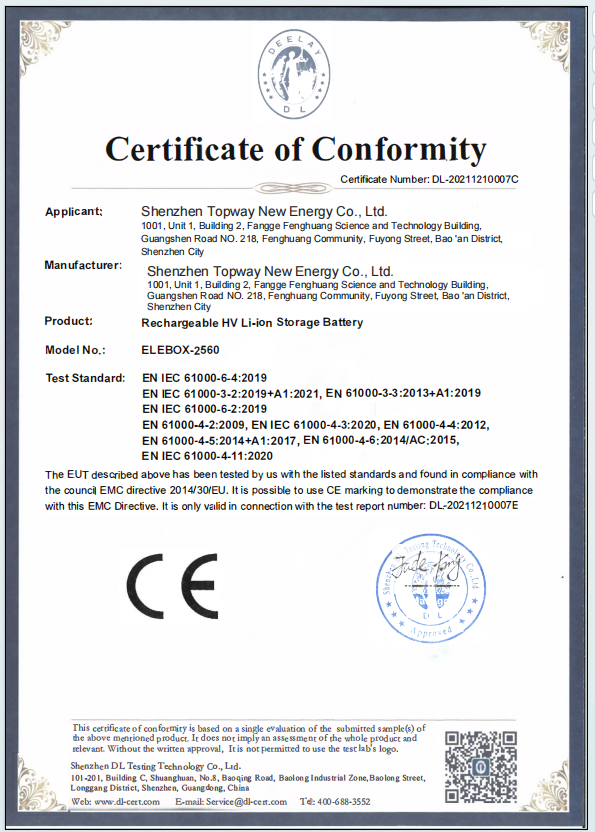
CE certification is a market-access document, not a performance claim: its scope, standard list and expiry date define exactly which models and markets it covers.
Where the 48V demand base is broadening beyond solar
Residential solar is the best-known driver of 48V storage demand, but it is not the only one. The global golf cart battery market was estimated at USD 1.49 billion in 2024, with lithium-ion types capturing a 47.18% share according to Mordor Intelligence and Strategic Market Research. That segment is defined by the same design logic as residential storage: a fixed DC voltage platform, daily partial cycling, and a replacement economics question that turns on cycle life rather than peak power.
Chemistry competition is also visible in forward projections. The sodium-ion battery market is expected to expand at a CAGR of 18.84% from 2026 to 2035, reaching USD 7.81 billion, according to Precedence Research. Growth rates of that scale describe an emerging alternative, not an incumbent replacement — and for stationary storage the practical question is which duty cycles a new chemistry can serve at an acceptable cost, not whether it displaces lithium across the board.
At the system-integration layer, concentration is already high. Tesla led the global BESS integrator market with a 15% share in 2024, followed closely by Sungrow at 14%, according to Wood Mackenzie. This has a direct implication for component suppliers: utility-scale demand concentrates among a small number of integrators with their own qualification processes, while distributed residential and light-mobility demand stays fragmented and is served through wider supplier networks. Policy that favours utility-scale procurement therefore narrows the supplier field; policy that favours distributed residential deployment widens it.
Comparison with traditional solutions — and the boundary of the lithium case
Lithium is now the majority technology in stationary storage, but a 53.5% share also means that a substantial remainder is still served by other technologies and configurations. Lead-acid retains a role in cost-sensitive, low-cycling and remote applications; flow and other chemistries hold specific niches where duration or degradation behaviour matters more than energy density.
| Criterion | Lead-acid | LiFePO4 storage battery |
|---|---|---|
| Routine maintenance | Periodic inspection and ventilation management | Effectively maintenance-free in normal operation |
| Usable depth of discharge | Limited; deep discharge shortens life | Higher usable depth across the rated cycle count |
| Mass and footprint | Heavier per unit of stored energy | Lighter; supports wall-mounted installation |
| Upfront cost | Lower acquisition cost in many markets | Higher acquisition cost, offset over service life |
| Policy eligibility | Scheme-dependent | Commonly tied to documented safety and transport compliance |
Three limits deserve to be stated plainly, because they are where policy-driven modelling usually fails:
- Incentive-driven demand is reversible. A scheme that compresses payback this year can be stepped down or capped next year. Demand that exists only because of an incentive does not survive the removal of that incentive at the same volume.
- The 48V wall-mount format has a real power ceiling. A published maximum continuous discharge of 50A on the wall-fixed 5kW format is a genuine constraint, not a datasheet detail. Loads that require sustained higher current need a different configuration, and no incentive structure changes that.
- Documentation, not capability, often gates the sale. A product may be technically suitable for a market and still be ineligible because a certificate scope does not cover the specific model or because a transport document has expired.
Future outlook: three signals to watch through 2027
Incentive design is shifting from capacity to performance. Where schemes begin to reward delivered service — availability, response, self-consumption ratio — rather than installed kilowatt-hours, specification pressure moves from capacity per enclosure toward cycling endurance and control quality. That favours formats already engineered around long cycle life at moderate power.
Documentation renewal cycles are becoming a procurement constraint. With safety and transport frameworks stable but certificate validity finite, buyers increasingly treat expiry dates as a supply-risk variable. Building renewal confirmation into purchase orders is a low-cost control that prevents late-stage delays.
Chemistry diversification is proceeding alongside lithium, not against it. A projected 18.84% CAGR for sodium-ion through 2035 describes a market that is growing from a small base into defined niches. For distributed storage, the practical outcome is a wider specification menu rather than an overnight substitution.
A fourth signal sits on the supply side. As pack manufacturers move from cooperative production toward in-house lines — the stated direction for HCC — the number of vendors able to serve complex, high-volume, policy-timed orders in a single qualified chain changes. That shift affects lead-time reliability more than it affects list price.
Frequently asked questions
Which storage battery formats are gaining the most policy-driven demand?
Two formats are gaining most visibly. Wall-fixed 48V-class units, represented by the 5kw wall mounted battery format, gain where capital support and self-consumption rules favour residential deployment. Higher-discharge 200Ah-class formats gain where backup, resilience or small commercial load requirements are written into a scheme. Light-mobility 48V packs gain from separate transport and equipment electrification policies that share the same voltage platform.
Why is 48V becoming the reference platform for residential storage?
48V-class systems sit below the voltage thresholds that trigger additional safety and installation requirements in many markets, while still delivering enough power for residential loads. That combination of lower compliance burden and adequate capability makes the format practical for retrofit installation. The same voltage class is used across light electric vehicles and low-voltage industrial equipment, which adds supply-chain depth.
How should national incentives change the specification a buyer chooses?
Incentives change which parameter dominates the purchase decision. Capacity-based support pushes specification toward installed kilowatt-hours per unit and installation efficiency. Self-consumption rules push toward cycle life, because daily cycling makes replacement interval the dominant cost variable. Resilience requirements push toward continuous discharge capability. A specification chosen without identifying which of these three the scheme rewards is likely to be mismatched.
Are lithium solar batteries still the preferred chemistry for new storage projects?
Lithium-ion held 53.5% of the global battery energy storage system market in 2025, according to Grand View Research, and lithium-iron-phosphate configurations are widely used in residential and light-commercial storage. Sodium-ion is projected to grow at an 18.84% CAGR from 2026 to 2035, reaching USD 7.81 billion, but that growth starts from a small base and mostly addresses defined niches rather than replacing lithium across stationary applications.
What documentation does a storage battery need for incentive-backed markets?
Three layers are typically relevant. Safety: IEC 62619:2022 for industrial and stationary lithium batteries, and UL 1973 for North American stationary applications. Transport: UN 38.3, which is mandatory for global lithium battery shipment and requires eight specific tests. Market access: CE for the EU, KC for Korea, together with safety data sheets and, where air freight is used, an identification and classification report for air transport of goods. Each document has a defined scope and expiry date that must be checked against the specific model being supplied.
What are the limits of forecasting storage demand from policy alone?
Policy sets the direction of demand but not its durability. Incentive frameworks can be revised, capped or stepped down faster than manufacturing capacity can be reallocated, and demand created by an incentive does not persist at the same volume once the incentive is removed. Policy signals also say nothing about technical fit: a format that a scheme favours may still be unsuitable for a given load profile, and a product may meet every performance requirement yet remain ineligible because a certificate scope does not cover it.
For readers who need the underlying product and compliance reference material, the manufacturer brochure is available here: Shenzhen Topway New Energy Co., Ltd. (HCC) product brochure.
¿Tiene preguntas o necesita más detalles?
Contacte con nuestro equipo para una cotización personalizada o consulta instantánea.
Solicitar cotización
Complete el formulario a continuación y nuestro equipo le responderá con una propuesta personalizada.
Chat directo de WhatsApp
¿Prefiere chatear en tiempo real? Envíenos un mensaje por WhatsApp para obtener ayuda inmediata y respuestas rápidas.
- Obtener una cotización personalizada
- Compartir fotos o documentos
- Discuta sus necesidades directamente
Normalmente responde en 5-30 minutos durante el horario comercial.