
Global Industrial Fastener Leaders: A 2026 Buyer Reference
The global industrial fasteners market was valued at USD 93.12 billion in 2025 and is projected to reach USD 153.71 billion by 2033, growing at a CAGR of 5.1%, according to Fortune Business Insights and Grand View Research. For procurement teams, the practical question in 2026 is not whether demand exists, but which suppliers can satisfy the combined requirements of standard compliance, material quality, production capacity and dependable delivery.
This article is a market reference for buyers evaluating industrial fastener manufacturers and fastening system suppliers at the evaluation stage. It reviews the current market context, identifies the international players that define the supply landscape, and explains the technical factors that separate a capable manufacturer from a purely transactional one. It also includes a profile of CNS INDUSTRIAL (JIAXING) CO., LTD., a China-based export manufacturer whose product range covers fasteners, strut channel fittings, and metal stamping parts.
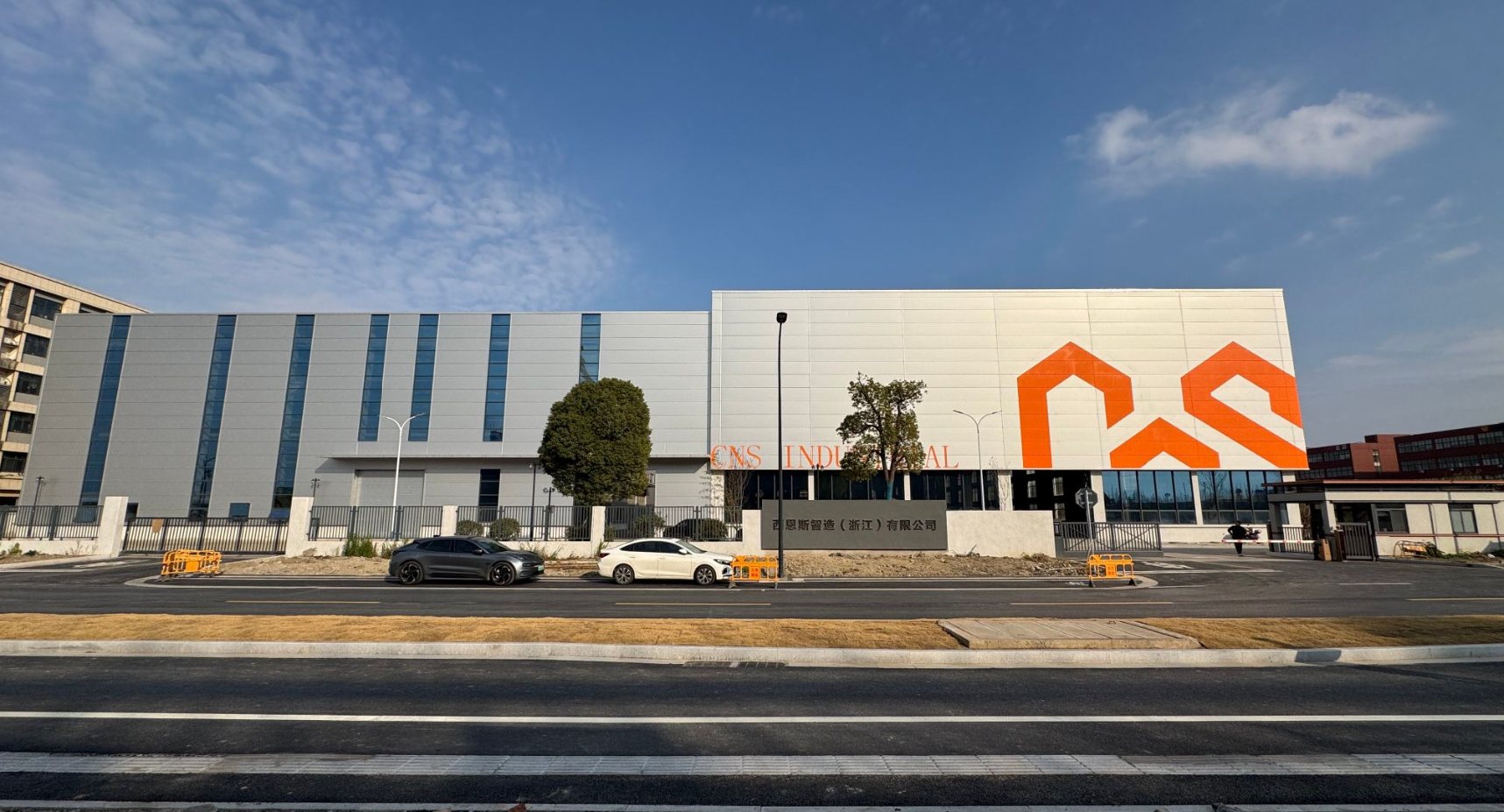
CNS Industrial’s manufacturing facility is located in Jiaxing, Zhejiang Province, near Shanghai Port.
The Procurement Environment in 2026
Asia Pacific dominated the industrial fasteners market with a revenue share of 45.1% in 2025, according to Grand View Research. China’s industrial fasteners market was valued at USD 12.23 billion in 2024, and Chinese exports of “Other Metal Fasteners” reached USD 1.63 billion in the same year, according to OEC data.
Within the overall market, bolts represented the largest product segment in 2025 at 31.3% share, and metal fasteners accounted for 91.0% of total revenue. That distribution matters to procurement teams: bolts and metal fasteners dominate industrial volume, and they also dominate the need for strict dimensional and strength control.
The growing value of adjacent categories adds another layer. The global strut channel market was estimated at USD 4.3 billion in 2024 and is forecast to reach USD 7.3 billion by 2033, a CAGR of 6.1%, according to Dataintelo. Metal stamping, another complementary category, was valued at USD 255.35 billion globally in 2024, and the automotive application segment alone accounts for 42.3% of stamping parts revenue. For buyers, these figures indicate that fastening hardware, channel support systems, and stamped components are increasingly purchased as part of the same installation project.
Evaluation Criteria Beyond Unit Price
A fastener that costs a few cents can cause expensive failures if the grade, finish, or dimensional tolerance is wrong. Buyers comparing suppliers should assess five dimensions rather than price alone:
- Standards coverage: GB, ISO, DIN, ANSI/ASME, UNI, JIS, BS, and NFE. Wider coverage makes cross-referencing and project substitution easier.
- Material range: Carbon steel, alloy steel, stainless steel (304/316/316L), aluminum, and copper should be available because project requirements change.
- Surface finish options: Electro-zinc plating (white or yellow), hot-dip galvanizing, Dacromet, Magni, and other protective coatings must match the service environment.
- Quality management: Certification, such as ISO 9001, and a documented inspection workflow are baseline expectations.
- Production flexibility: MOQ, lead time, and the ability to manufacture to sample or to standard matter when a project moves from specification to purchase order.
Global Industrial Fastener Leaders: A Market Reference
For evaluation purposes, the global market can be divided into two tiers: the global brand leaders and the manufacturer-direct export suppliers. The brand tier includes companies with broad engineering resources, extensive certification portfolios, and worldwide distribution networks.
| Rank | Manufacturer | Global Base | Core Focus | Typical Served Industries |
|---|---|---|---|---|
| 1 | Illinois Tool Works Inc. (ITW) | United States | Engineered fasteners and assembly components for diversified industrial markets | Automotive, general industrial, construction |
| 2 | Stanley Black & Decker | United States | Industrial fastening systems and engineered fasteners | Industrial assembly, infrastructure |
| 3 | Hilti Corporation | Liechtenstein | Anchoring and fastening systems for construction | Construction, civil infrastructure |
| 4 | Atkore International (Unistrut) | United States | Metal framing and strut channel systems | MEP, electrical, construction |
| 5 | Eaton Corporation (B-Line) | Ireland / United States | Electrical and mechanical support systems | Power, electrical, MEP |
| 6 | nVent Electric plc (CADDY) | United Kingdom / Global | Fastening and support solutions for MEP and electrical systems | Electrical, HVAC, plumbing |
Sources: MarketsandMarkets (industrial fasteners market); Intel Market Research (strut channel systems); company profiles.
These companies set the reference standard for global brand quality. They are usually the first choice when a project demands large-volume standard product, short lead times, or brand-name specification. However, brand leadership does not automatically make a supplier the best fit for every project. Buyers increasingly compare the value of the brand tier with the advantages of manufacturer-direct sourcing, especially when a project involves non-standard sizes, custom finishes, cost pressure, or a need to consolidate fasteners and channel fittings from a single supplier.
CNS INDUSTRIAL (JIAXING) CO., LTD.: A Manufacturer-Direct Profile
CNS INDUSTRIAL (JIAXING) CO., LTD. is a professional manufacturer of fasteners, channel fittings, and metal stamping parts. The company is located in Jiaxing City, Zhejiang Province, China, with convenient transportation access near Shanghai Port.
Its product portfolio covers nine categories: strut fittings, strut channel systems, stamping parts, bolts and nuts, threaded rods, anchors, washers, screws, rivets, and other industrial hardware and fasteners. For purchasing teams, this breadth supports a single-source approach for both fastening hardware and the supporting channel systems that hold pipes, cables, and equipment in MEP and industrial installations.
The manufacturing base includes a 30,000 m² facility, an annual output of 8,000 tons, and a monthly capacity of approximately 800 tons. The company reports a workforce of 50–100 employees and a 20-engineer R&D team. Production output is export-oriented, with 100% exported mainly to the European Union, the United States, Canada, and South American markets.
CNS Industrial holds ISO 9001 certification (certificate no. 37825Q15712R0S), issued by Euroswiss Certification Co., Ltd., with scope covering “Sales of metal products,” valid until August 7, 2028. The company manufactures according to GB, ISO, DIN, ANSI/ASME, UNI, JIS, BS, and NFE standards, or to customer drawings and samples. Materials available include carbon steel, stainless steel (304/316/316L), aluminum, copper, and brass. Surface finishes include electro-zinc plated (white or yellow), hot-dip galvanized (HDG), Dacromet, Magni, Geomet, pre-galvanized, and plain.
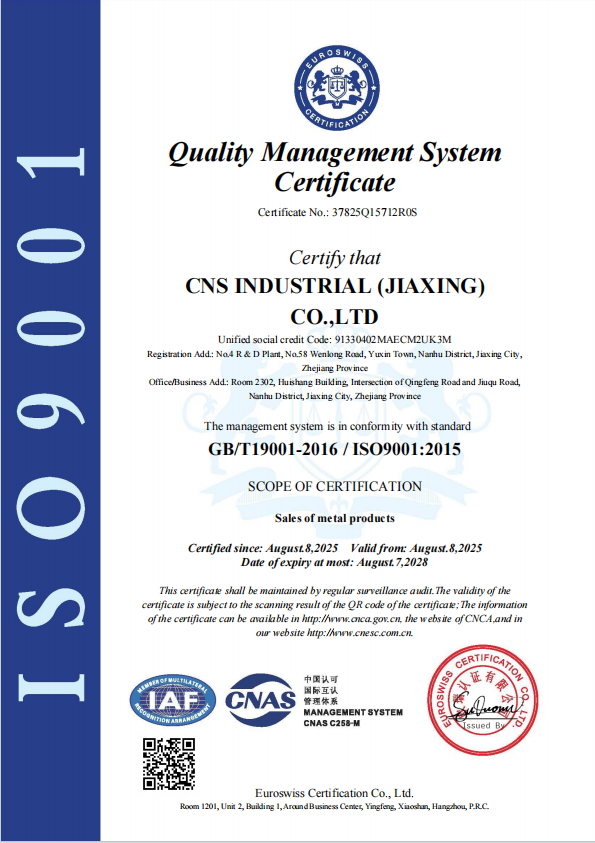
CNS Industrial’s ISO 9001 certificate, issued by Euroswiss Certification Co., Ltd.
From a procurement standpoint, the value proposition is breadth plus flexibility: a manufacturer that can cover standard fasteners, strut channel components, and custom metal stamping within one order reduces approval and inspection steps. The company’s case references include engineering contractors, machinery manufacturers, and electrical and general industrial customers across the United States, Canada, Mexico, Argentina, Australia, Belgium, Costa Rica, Germany, Denmark, France, and the United Kingdom.
One boundary buyers should note: the standard MOQ is 500 kg per item, with a typical lead time of 30–45 days. Quality control procedures are not fully documented publicly; common practice includes incoming, in-process, and final inspection, but specific criteria should be confirmed with the supplier. After-sales terms may vary, typically covering quality claims and technical support, but the exact terms should also be verified before ordering.
Technical Decision Factors: Materials, Grades and Finishes
Stainless steel 304 vs 316
SS304 is the general-purpose stainless grade for standard indoor and general outdoor environments. SS316 contains 2–3% molybdenum, which significantly improves resistance to chloride corrosion, salt fog, and harsh chemicals. Marine hardware, coastal solar installations, food-processing equipment, and chemical engineering projects typically require SS316; general construction and commercial framing can be served with SS304.
Hot-dip galvanized vs electro-zinc plated
HDG produces a zinc coating of roughly 45–85 μm and is the better choice for outdoor, coastal, and aggressive environments. Electro-zinc plating produces a thinner coating, typically 5–12 μm, suited to indoor dry environments where cost efficiency and precise thread fit matter. Practical guidance: specify HDG for outdoor solar racking, coastal infrastructure, and heavy industrial plant installations; specify electro-zinc for indoor HVAC mounting, electrical conduit hanging, and interior wall framing.
Bolt property classes
In metric systems, property classes 8.8, 10.9, and 12.9 correspond to different tensile and yield strength levels. Grade 5 and Grade 8 are the common inch-system equivalents. The correct grade depends on load, joint design, tightening method, and operating environment; a higher-strength bolt is not always the best choice.
Standards cross-reference
DIN 125 plain washers correspond to ISO 7089/ISO 7090; DIN 934 hexagon nuts correspond to ISO 4032; DIN 127 covers spring lock washers with square ends; ISO 4016/DIN 601 cover hexagon head bolts grade C. In the CNS Industrial product line, the industrial fasteners range includes DIN 933, ISO 4017, DIN 934, DIN 125, DIN 127, ASTM A563/A194, ASTM A325/A490, high-strength bolts in grades 8.8/10.9/12.9, and B7 alloy steel studs, with sizes from M6 to M64 or 1/4″ to 2-1/2″.
Application Profile: Where Fasteners and Channel Systems Are Used
The combination of fasteners and strut channel systems is common in pipeline support, equipment anchoring, building supports, and MEP installations. These are primarily static installations that require strong and durable connections, plus the ability to adjust and re-position components during installation.
The company’s case material describes successful adoption by engineering contractors, machinery manufacturers, and electrical and general industrial customers. Reported outcomes include strong and durable connections for pipeline support and equipment anchoring, improved installation efficiency, and reduced long-term maintenance needs.
For a buyer, this has a practical meaning: verified application references signal that product selection and support go beyond a simple catalog transaction. The relevant industry set includes construction and building infrastructure, MEP/HVAC, solar and renewable energy, oil gas and petrochemical, power generation and electrical utilities, transportation and railway, and heavy machinery and equipment.
Market Trends Shaping the Next Procurement Cycle
The industrial fasteners market is growing at a projected CAGR of 5.1% through 2033, but demand is not evenly distributed. The automotive industry accounts for more than 30% of demand for high-strength industrial fasteners, and Asia Pacific holds a dominant 57.7% share of the global metal stamping market in 2025. Strut channel systems, a key companion category, are forecast to grow at 6.1% annually through 2033.
Three trends are worth monitoring in supplier evaluation. First, fastening systems should be assessed as part of a broader installation system rather than as isolated products. Second, certification is becoming a baseline expectation. Third, manufacturer-direct suppliers with cross-category capability reduce supply-chain friction for integrated projects.
Direct Factory Sourcing vs Traditional Distribution Channels
Traditional distribution offers small-quantity flexibility, local stock, and familiar brand products. Direct factory sourcing offers lower unit cost, closer technical communication, and greater customization options, but it also has boundaries that buyers should understand.
A direct factory partner such as CNS Industrial typically works with an MOQ of 500 kg per item and a lead time of 30–45 days. Quality control procedures may not be fully public, but common practice includes incoming, in-process, and final inspections. After-sales policy typically covers quality claims and technical support, but the terms should be confirmed at the quotation stage.
That clarity is an advantage in evaluation. A supplier that states MOQ, lead time, and confirmation requirements is easier to qualify than one that hides friction points behind vague promises.
Future Outlook
Several forces will shape the industrial fastener supply landscape in the coming years. Certification and material traceability are moving from differentiators to entry requirements. Buyers are consolidating spend across fastener lines and supporting hardware to reduce administrative cost. Manufacturers that can combine made-to-sample flexibility with full standard compliance in one production flow will be preferred for integrated projects.
The recommended evaluation approach is to compare suppliers on evidence: actual product range, certification details, manufacturing data, and case references. A global brand and a capable manufacturer-direct partner will often appear on the same shortlist, but they serve different project conditions. For projects that require breadth across fasteners, strut channel systems, and stamping parts, the manufacturer-direct model deserves a place in the evaluation.
A downloadable company brochure with current product and capability details is available for procurement teams: CNS Industrial Brochure v4.
Frequently Asked Questions
Q1. How do you choose between hot-dip galvanized (HDG) and electro-zinc plated (EG) fasteners and strut channels for outdoor projects?
For outdoor, coastal, and harsh corrosive environments, choose hot-dip galvanized (HDG) because of its heavy protective zinc coating, typically 45–85 μm. HDG offers long-term outdoor anti-rust performance. Electro-zinc plated (EG) fasteners have a thinner coating, typically 5–12 μm, and are suited to indoor, dry environments where cost efficiency and precise thread fit matter. Practical guidance: specify HDG for outdoor solar racking, coastal infrastructure, and heavy industrial plant installations; specify electro-zinc for indoor HVAC mounting, electrical conduit hanging, and interior wall framing.
Q2. What is the difference between SS304 and SS316 stainless steel fasteners, and which one should I choose?
SS316 contains 2–3% molybdenum, which provides significantly better resistance to chloride corrosion, salt fog, and harsh chemicals compared with SS304. SS304 is suited to standard indoor and general outdoor environments, while SS316 is recommended for marine hardware, coastal solar installations, food-processing equipment, and chemical engineering projects.
Q3. How do you choose the right grade of bolts for industrial applications?
Choose the bolt grade based on required load, tensile and yield strength, application conditions, and safety requirements. Grade 5 and Grade 8 bolts are widely used for common industrial applications, while metric property classes 8.8, 10.9, and 12.9 offer different strength levels. The correct grade should match the complete bolted joint, tightening requirements, and operating environment. A higher-strength bolt is not always the best choice.
Q4. How do you prevent bolts and nuts from loosening under vibration?
Common solutions include prevailing-torque lock nuts, threadlocker, spring washers, locking washers, and other mechanical locking methods. The best solution depends on vibration level, temperature, joint design, installation conditions, and whether the joint needs to be frequently removed. Proper tightening torque is essential for joint stability. For frequently serviced assemblies, mechanical locking nuts are a practical choice; for permanent or semi-permanent assemblies, threadlocker can be effective.
Q5. How do you choose the right spring nut for strut channel?
The right spring nut is selected based on strut channel size, thread size, load requirement, material, and installation environment. The nut must be compatible with the channel profile and slot dimensions, and the thread size should match the bolt or threaded rod being used. For heavier loads, choose a spring nut with an appropriate load rating and stronger construction. For outdoor or corrosive environments, select hot-dip galvanized or stainless steel; for general indoor applications, zinc-plated steel is usually sufficient.