
Global Crystal Resonator Supply Chain 2026: Trends, Policy, Capacity
Global Crystal Resonator Supply Chain 2026: Trends, Policy, Capacity
Crystal resonators rarely appear in a sourcing strategy until a design is already qualified and a supply interruption makes them visible. This industry reference maps where quartz-based frequency control devices are actually produced in 2026, how standards and compliance regimes now gate qualification, where manufacturing capacity is genuinely constrained, and how buyers should judge whether a supply relationship can hold across a multi-year product life cycle.
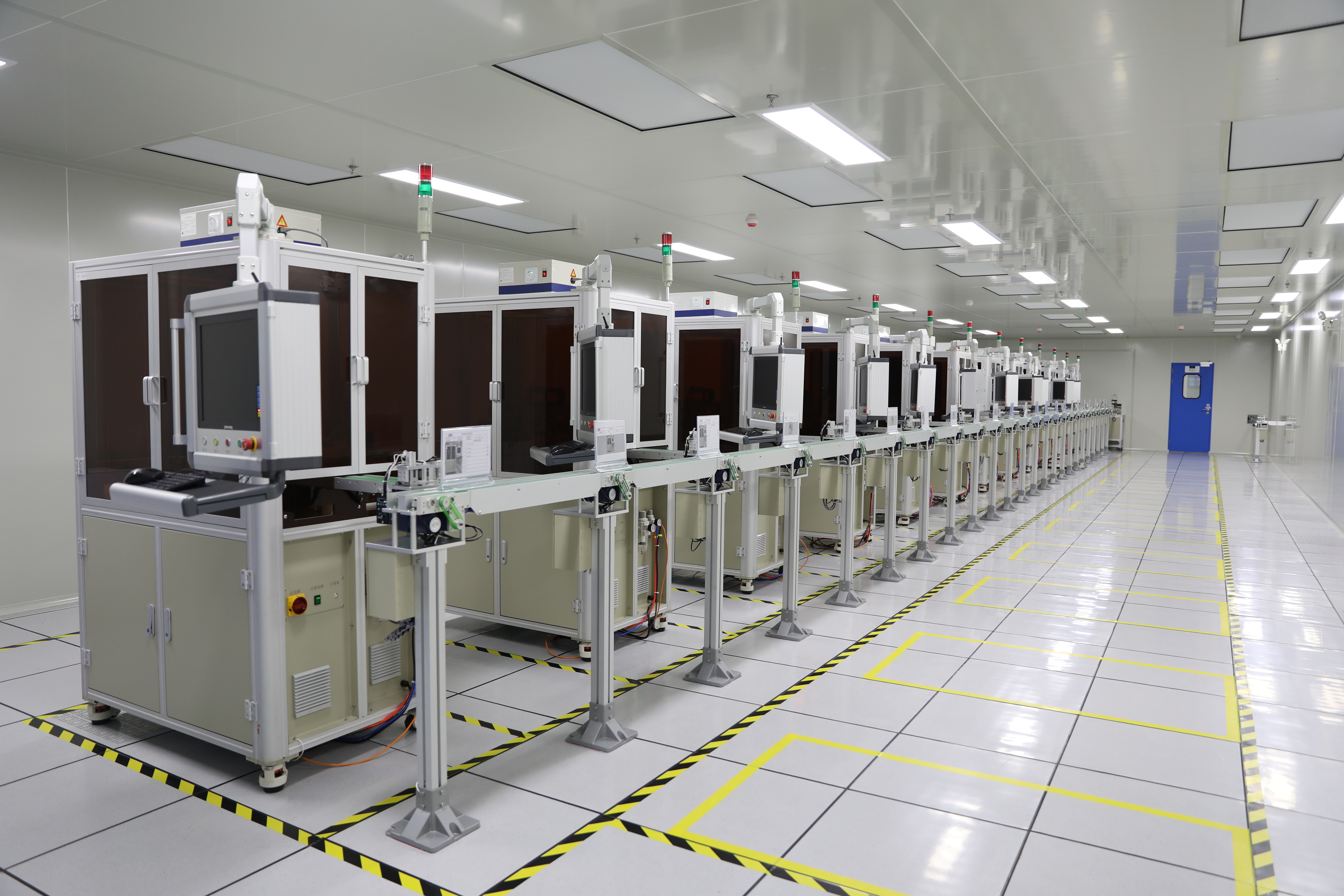
Production equipment inside a quartz crystal resonator manufacturing facility. Image: Fronter Electronics.
A Small Component With a Concentrated Supply Base
A quartz crystal resonator is a passive piezoelectric component that uses a precisely cut quartz element to generate a stable reference frequency. Two output categories dominate volume. The tuning fork crystal resonator, typically operating at 32.768 kHz, provides the real-time clock reference in almost every battery-powered device. The MHz quartz crystal unit provides the reference clock for processors, communication interfaces and radio modules. Both exist in SMD and through-hole formats, and both depend on a chain that runs from quartz material and wafer processing through package assembly and sealing to test and calibration.
The economics of that chain are unusual. According to MarketsandMarkets, the global crystal oscillator market was valued at USD 2.89 billion in 2025 and is projected to reach USD 3.66 billion by 2030. That figure covers finished oscillators; the resonator layer beneath it generates less revenue but involves fewer, more specialised production sites. The consequence for procurement is direct: a component costing cents can determine whether an assembly line restarts after a disruption.
National Trends: How Manufacturing Nations Position Themselves
Asia Pacific accounted for more than 42% of crystal oscillator market revenue in 2024, approximately USD 1.1 billion, according to Precedence Research. Within that regional total, production concentrates among a small set of established manufacturers. Mordor Intelligence identifies Seiko Epson, Nihon Dempa Kogyo (NDK), Kyocera, Daishinku (KDS) and TXC Corporation as leading global manufacturers of quartz crystals and oscillators. Industry commentary published by SIC Electronics describes Seiko Epson as the world's largest supplier of quartz crystals, with particular strength in automotive-grade processes; that ranking is a reported market observation rather than an audited figure and is best read as a directional signal.
Behind that top tier, three national archetypes shape the 2026 picture.
Japan — process depth and qualification maturity. Japanese manufacturers have accumulated decades of material and process engineering, particularly in automotive-grade and high-stability segments. Buyers prioritising parts with long qualification histories and established automotive process discipline typically begin here. The trade-off is commercial rather than technical: reported lead times from established overseas brands commonly run 12 to 20 weeks, which limits responsiveness when demand shifts within a quarter.
Taiwan — high-volume SMD standardisation. Taiwanese suppliers built scale around surface-mount formats for computing, communication and consumer electronics. The strength is catalogue breadth at volume and consistent process control on mainstream MHz frequencies; the limitation is that highly customised or non-standard frequency requirements receive less engineering attention than they do from specialised producers.
China — capacity scale, lead-time flexibility and a distribution layer. China's role in the resonator chain is not limited to manufacturing. A significant share of China-based supply reaches international buyers through distributors that consolidate quartz resonators, oscillators and adjacent passive and active components into a single sourcing relationship. Fronter Electronics Co., Ltd, a Shenzhen-based manufacturer founded in 1991, illustrates the hybrid model: it produces quartz crystal resonators and oscillators from a 21,000 m² facility with 286 employees, 19 R&D engineers and annual output of 300,000,000 units, while also distributing recognised component brands including SUNLORD, KDS, EPSON and NDK. The company reports a 70% export ratio concentrated in the EU and USA.
That combination — domestic production plus multi-brand distribution — changes what the word "supplier" means. For a buyer, it can reduce administrative load, but it also means the entity signing the contract may be several steps removed from the production line that determines delivery. The distinction matters most when allocation tightens.
Policy and Regulatory Shifts: Standards Are the Durable Layer
Trade policy moves faster than component qualification cycles, so the regulatory layer that most reliably shapes resonator sourcing is standards and environmental compliance rather than tariff structures. Two standards anchor the category today.
AEC-Q200 is the global stress-resistance standard required for passive electronic components, including crystal resonators, in automotive applications, published by the Automotive Electronics Council. The IEC 60122 series provides the international baseline for quartz crystal units, covering general requirements and measuring methods, published by the International Electrotechnical Commission.
On the environmental side, components placed on the EU market must satisfy RoHS and REACH requirements. Manufacturers serving European and North American customers maintain documentation to demonstrate this; Fronter Electronics states that all of its products comply with RoHS, REACH and other environmental protection regulations.
The practical consequence is that compliance has shifted from a sales claim to a procurement gate. A resonator that meets its electrical specification but lacks traceable compliance documentation cannot be released into an automotive or EU-market bill of materials, regardless of price or lead time. At the execution stage, the operative question is not whether a supplier claims compliance, but whether batch-level documentation can be produced on request — a distinction that tends to surface during audits rather than during quotation.
Manufacturing Capacity: Four Constraints, Not One Number
Capacity in this category is frequently reported as a single annual unit figure, which obscures where the real constraints sit. Resonator output is limited by four separable stages, and they do not scale together.
- Quartz material and wafer supply. Lapped and polished quartz wafers are a specialised input. A manufacturer's assembly capacity is meaningless if qualified wafer supply is constrained.
- Frequency-specific process capability. 32.768 kHz tuning fork production follows a different process route from MHz AT-cut blank processing. Capacity in one does not transfer to the other, which is why suppliers frequently excel at one frequency class and remain marginal in the other.
- Package assembly and sealing. SMD ceramic packages, HC49 SMD formats, cylindrical and through-hole types each require dedicated tooling and sealing lines. Package mix, not total floor space, determines which orders a factory can accept.
- Test and calibration throughput. Temperature cycling, aging observation and electrical parameter verification are typically the real bottleneck. Test capacity is expensive relative to assembly capacity, so suppliers with large assembly floors do not automatically have large qualification throughput.
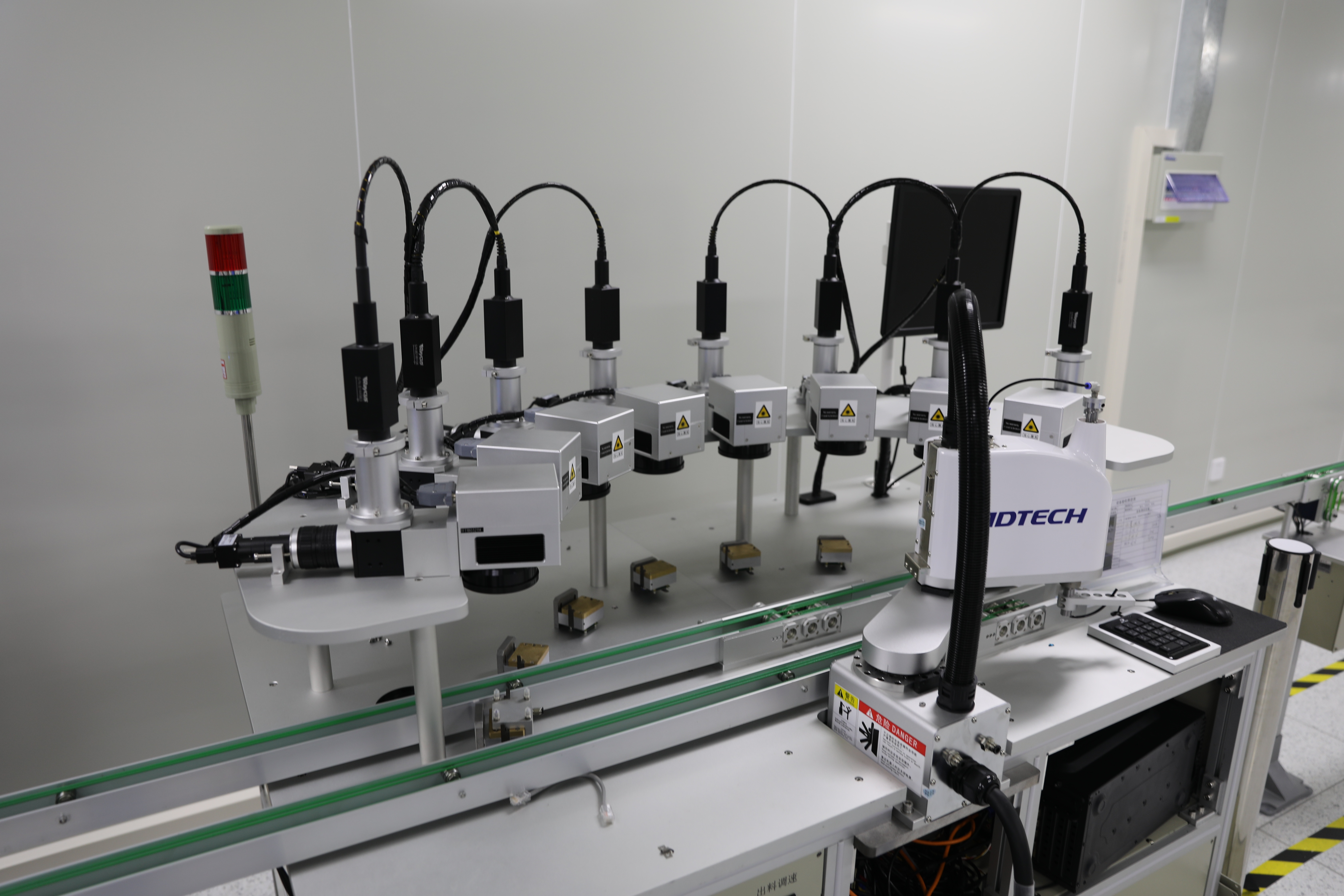
Automated handling equipment on a frequency control component production line. Image: Fronter Electronics.
This is also the stage where cost and quality diverge. Fronter's temperature risk controls describe batch-level high-low temperature shock testing — for example, -40 °C to 85 °C cycles — before shipment, supported by a temperature-grade bill of materials that separates consumer grade (-20 °C to 85 °C), industrial grade (-40 °C to 85 °C) and automotive grade (-40 °C to 125 °C). Building that test regime into a production flow is a capacity decision, not a quality slogan, and it is the first thing to probe when a supplier claims automotive readiness.
Market Trend Analysis: Where Long-Term Demand Pressure Originates
Automotive applications for crystal oscillators are expanding at a CAGR of 12.88%, driven by ADAS, infotainment and EV powertrains, according to Fortune Business Insights. Automotive demand behaves differently from consumer demand in ways that propagate upstream. Qualification cycles are longer, so a design win locks in a supplier relationship for the life of the vehicle platform. Temperature requirements are stricter, which pushes demand toward suppliers with genuine automotive-grade process capability rather than toward the lowest quotation. And because switching costs are high, automotive buyers tend to value continuity over price movement.
At the low-power end of the market, silicon-based timing devices are a competitive signal rather than a distant threat. In 2024, SiTime introduced the SiT1811, a 32.768 kHz oscillator drawing only 510 nA, targeting ultra-low-power IoT and wearables. Functions where the clock is a secondary line in the power budget are the segment most exposed to substitution; functions where stability across temperature is the governing requirement remain firmly in the quartz domain.
Buyers should also treat market sizing with care. Published estimates diverge sharply by scope: Precedence Research cites USD 2.83 billion for 2024, Market Research Future cites USD 6.12 billion, and Grand View Research's USD 11.78 billion figure refers to the quartz raw material market rather than to finished devices. The spread reflects definitional differences — raw quartz, finished oscillators, or the wider frequency control device category — not disagreement about direction. Any planning model should state which scope it uses before drawing conclusions from a growth rate.
Applications and Their Supply Implications
Fronter Electronics lists its products as widely used in network, communication, industrial control, automotive, instrument and meter, financial equipment, computer interface devices and consumer electronics. Its piezoelectric crystal components are specified for smart home appliances, communication electronics and Bluetooth devices, and are offered in SMD package formats spanning 7050, 6035, 5032, 3225, 2520, 2016 and 1612.
| Application area | Dominant timing requirement | Supply implication |
|---|---|---|
| Automotive electronics | AEC-Q200 qualification, wide temperature range, low aging | Long qualification cycles; supplier switching is costly and rarely revisited mid-platform |
| Communication base stations and servers | Long-term frequency stability, minimal drift | Continuity of specification over years matters more than unit price |
| Industrial control and instrumentation | Industrial temperature grade, batch consistency | Traceability and a validated second source are the primary requirements |
| IoT, wearables and Bluetooth devices | Low power, small packages (3225 down to 1612) | Volume flexibility and short replenishment cycles dominate selection |
| Consumer and smart home | Cost-driven, relaxed stability tolerances | Price and availability lead; substitution barriers are lowest |
Technical Explanation: Why Process Quality Is a Supply-Chain Variable
Fronter's quartz piezoelectric crystal components are specified with a nominal frequency of 1 to 96 MHz, load capacitance of 4 to 33 pF, frequency tolerance of ±5 ppm to ±100 ppm, frequency stability of ±10 ppm to ±100 ppm, and an operating temperature range of -55 °C to +125 °C. Construction uses a metal cover, a ceramic base and a quartz wafer.
Those figures are commercially significant because they define which grades a production line can serve. Frequency stability across temperature is the parameter most likely to degrade first when a supplier scales output quickly, and it is also the parameter with the greatest effect on field returns. Two compensation strategies push stability beyond what a bare resonator can hold. TCXO technology uses an analog or digital compensation circuit to correct temperature-driven frequency drift in real time. OCXO technology holds the crystal in a constant high-temperature oven, isolating it from external temperature variation.
Aging is the second long-horizon parameter, and it is the one that determines total cost of ownership rather than purchase price. Fronter reports an annual aging rate of ≤ ±2 ppm against a commonly cited industry level of ±3 to ±5 ppm, alongside frequency stability of ≤ ±20 ppm compared with an industry average range of ±20 to ±50 ppm on general-purpose consumer-grade parts. These are first-party figures covering the manufacturer's own product line; they are best used as a comparison reference to be validated during sampling, not as a universal benchmark for the category.
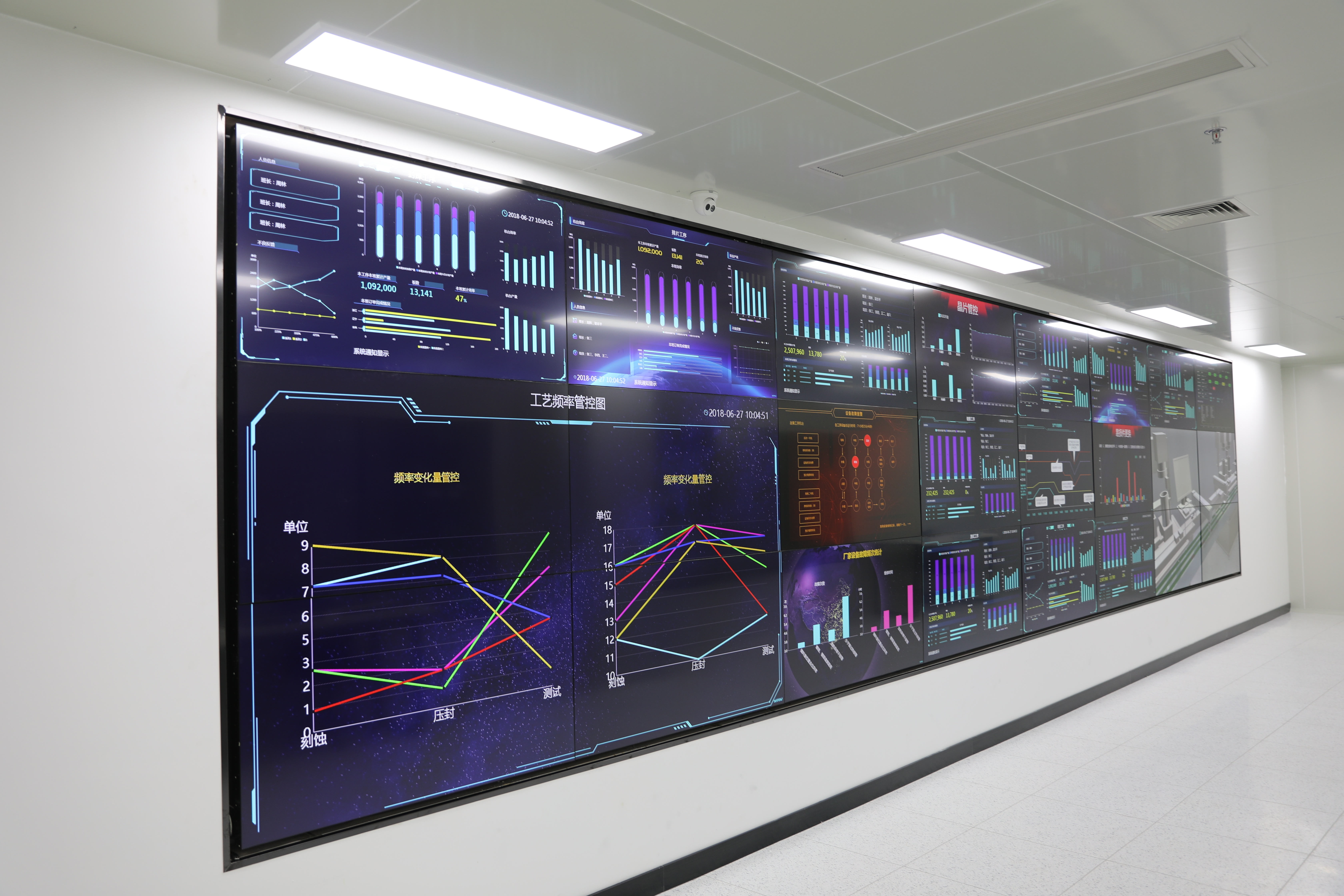
Production and test data systems that support batch traceability for frequency control components. Image: Fronter Electronics.
Traceability is what converts those numbers into a procurement asset. Batch records that link a delivered reel to a temperature grade, a test lot and a compliance declaration are the difference between a specification and a guarantee. When a supplier cannot produce that link on request, the specification remains a claim about a sample rather than a property of the shipment.
Comparison With Established Sourcing Models
Most resonator procurement in 2026 follows one of four models. Each has a genuine boundary that buyers should weigh before committing.
| Model | How it works | Strength | Boundary |
|---|---|---|---|
| Catalog and spot buying | Purchase from broad-line distributors as demand arises | Fast availability, small order quantities, no qualification burden | Limited batch traceability, price volatility, and no allocation priority when supply tightens |
| Direct contract with a top-tier manufacturer | Single source with a large Japanese or Taiwanese supplier | Deep qualification maturity and automotive-grade process pedigree | Reported lead times of 12 to 20 weeks; limited flexibility on non-standard frequencies; leverage favours very large buyers |
| Direct engagement with a specialised producer | Work directly with a focused resonator manufacturer, frequently in China | Shorter lead times — Fronter Electronics reports 3 to 4 weeks — plus engineering access and customisation support | The buyer carries more qualification work, and specialised producers may have narrower catalogue breadth |
| Hybrid manufacturing plus distribution | Source produced and third-party brands through one channel | Consolidated logistics, multi-brand access, simpler administration | An additional margin layer, and reduced visibility into which production line fulfils a given order |
Three boundaries deserve to be stated plainly rather than left implicit.
First, a quartz resonator manufacturer does not cover the silicon MEMS oscillator segment. Where a design requires a 32.768 kHz silicon oscillator in the low-nanoamp range, tuning fork resonator suppliers are not substitutes, and no amount of commercial flexibility changes that.
Second, lead-time advantage does not automatically extend to the highest stability tiers. Fronter's reported 3 to 4 week lead time against 12 to 20 weeks for established overseas brands reflects a responsive production and distribution model; it does not by itself establish superiority in the most demanding automotive qualification programs, where process maturity accumulated over decades still favours incumbent Japanese suppliers. Buyers should validate stability and aging claims through their own sampling rather than inferring performance from delivery speed.
Third, commercial structure is a real constraint. Fronter's stated procurement terms are a minimum order quantity of 1K, EXW delivery, 100% payment in advance, and pre-shipment test as the acceptance method. Buyers accustomed to credit terms, delivered-duty-paid logistics or sub-1K sampling volumes should treat these as negotiation inputs rather than as fixed market standards — but they should also expect that structure to vary meaningfully between regions.
Finally, geographic concentration is itself a risk that no supplier selection can eliminate. With Asia Pacific holding more than 42% of category revenue, there is no fully non-Asian alternative at scale for quartz resonators. Diversification within the region, combined with inventory strategy outside it, is the realistic mitigation.
Evaluating Long-Term Supplier Sustainability Across Geographies
Long-term sustainability in this category is not a reputation judgement. It is the probability that a supplier can still deliver the same specification, with the same paperwork, in the third year of a relationship. Eight criteria make that assessable.
| # | Criterion | What to request |
|---|---|---|
| 1 | Capacity disclosure | Annual output and, separately, test and calibration throughput |
| 2 | Frequency-class capability | Confirmation of capability in both 32.768 kHz tuning fork and MHz product families |
| 3 | Qualification documentation | Evidence mapped to AEC-Q200 where relevant, test methods aligned to IEC 60122, RoHS and REACH declarations |
| 4 | Temperature grade coverage | A bill of materials segmented by consumer, industrial and automotive grades |
| 5 | Test and traceability | Pre-shipment test regime, aging data, and batch record retrieval on request |
| 6 | Delivery reliability | Commitment versus historical performance, not quoted lead time alone |
| 7 | Commercial structure | MOQ, Incoterms, payment terms and sampling support, evaluated as a package |
| 8 | Portfolio continuity | Whether the supplier covers resonators, oscillators and adjacent components, reducing multi-vendor overhead |
Applied to a concrete case, Fronter Electronics was founded in 1991 and its brand "FT" was recognised as a National High-Tech Enterprise in 2017 — a designation that speaks to institutional standing rather than to product performance. Its reported 70% export ratio, concentrated in the EU and USA, indicates that its quality system is regularly exposed to European and North American customer audits. Those are relevant sustainability signals, but they do not substitute for sample validation and should not replace a buyer's own qualification process.
Future Outlook
Four developments are likely to shape the next planning cycle.
- Qualification will keep moving upward as the differentiator. With automotive timing demand expanding at a reported 12.88% CAGR, the number of suppliers able to document automotive-grade process capability becomes the binding constraint on the category, not total assembly capacity.
- Substitution pressure will stay confined to the low-power corner. Silicon-based devices such as the SiTime SiT1811 at 510 nA address the ultra-low-power 32.768 kHz application niche. Quartz retains its position where wide-temperature stability and low aging govern the design.
- Dual-region sourcing will become a default assumption rather than a contingency. Given Asia Pacific's 42% share of category revenue and the concentration of leading manufacturers in one region, buyers will increasingly maintain two qualified sources across different geographies and different supply models.
- Cost models will absorb aging and field-failure data. As annual aging rates become a specification item rather than a footnote, total cost of ownership calculations will need to include drift-related service and replacement cost, not only unit price and freight.
The practical implication for buyers entering execution in 2026 is that supplier selection is less a question of finding the lowest quotation and more a question of documenting which supplier can still deliver the same specification, with the same paperwork, in year three of the relationship.
Frequently Asked Questions
What does long-term supplier sustainability mean for crystal resonators?
Sustainability means the supplier can maintain specification, documentation and delivery over a multi-year product life cycle, not just on a first order. It rests on four conditions: capacity that includes test and calibration throughput rather than assembly alone; qualification documentation such as AEC-Q200 evidence for automotive parts and RoHS and REACH compliance declarations; a temperature-grade bill of materials that separates consumer grade (-20 °C to 85 °C), industrial grade (-40 °C to 85 °C) and automotive grade (-40 °C to 125 °C); and a commercial structure the buyer can sustain over time. A supplier able to demonstrate only one of these is a single-order supplier rather than a long-term one.
How should buyers assess manufacturing capacity when qualifying a resonator supplier?
Capacity should be assessed in stages rather than as one annual unit figure. Quartz material and wafer supply, frequency-specific process capability for 32.768 kHz tuning fork and MHz AT-cut parts, package assembly and sealing, and test and calibration throughput each constrain output separately, and the final stage is usually the limiting factor. A supplier reporting a large annual output figure — Fronter Electronics, for example, reports 300,000,000 units from a 21,000 m² facility with 286 employees — should also be asked what proportion of that output passes through full temperature-range testing.
Why does Asia-Pacific concentration matter for supply continuity?
Because there is no comparable alternative production base at scale. Asia Pacific accounted for more than 42% of crystal oscillator market revenue in 2024, approximately USD 1.1 billion, according to Precedence Research, and the leading manufacturers — Seiko Epson, Nihon Dempa Kogyo (NDK), Kyocera, Daishinku (KDS) and TXC Corporation — are based in the region. For buyers, this means diversification within Asia together with inventory strategy outside it, rather than diversification away from Asia.
How do quartz resonators compare with silicon-based oscillators for long-term supply planning?
They serve overlapping but distinct roles. Quartz tuning fork resonators at 32.768 kHz and MHz quartz units remain the standard where wide-temperature stability and high timing accuracy are required. Silicon-based devices compete where power consumption dominates: in 2024, SiTime introduced the SiT1811, a 32.768 kHz oscillator drawing only 510 nA, targeting ultra-low-power IoT and wearables. A long-term plan should therefore separate functions that are power-critical from functions that are stability-critical, rather than assuming one technology covers both.
What role do AEC-Q200 and IEC 60122 play in supplier evaluation?
AEC-Q200 is the stress-resistance standard required for passive electronic components, including crystal resonators, in automotive applications, published by the Automotive Electronics Council. The IEC 60122 series provides the international baseline for quartz crystal units, covering general requirements and measuring methods, published by the International Electrotechnical Commission. In evaluation, they function as evidence requirements rather than marketing claims: buyers should request test documentation mapped to the relevant standard, at batch level where possible.
What commercial terms are typical when sourcing from a Chinese resonator manufacturer?
Terms vary by supplier and should be treated as a starting point for negotiation rather than a market standard. Fronter Electronics, for example, states a minimum order quantity of 1K, EXW delivery, 100% payment in advance, and pre-shipment test as the acceptance method. Buyers comparing this against other regions should weigh payment and delivery structure alongside unit price and lead time, because a favourable lead time can be offset by less flexible payment terms.
Detailed parameter tables covering Fronter Electronics' quartz crystal resonator and oscillator range are published in the company's product brochure, which is available for download and public reference.