
Glassware Supply Ecosystems: LAKOTTO as a Long-Term Partner
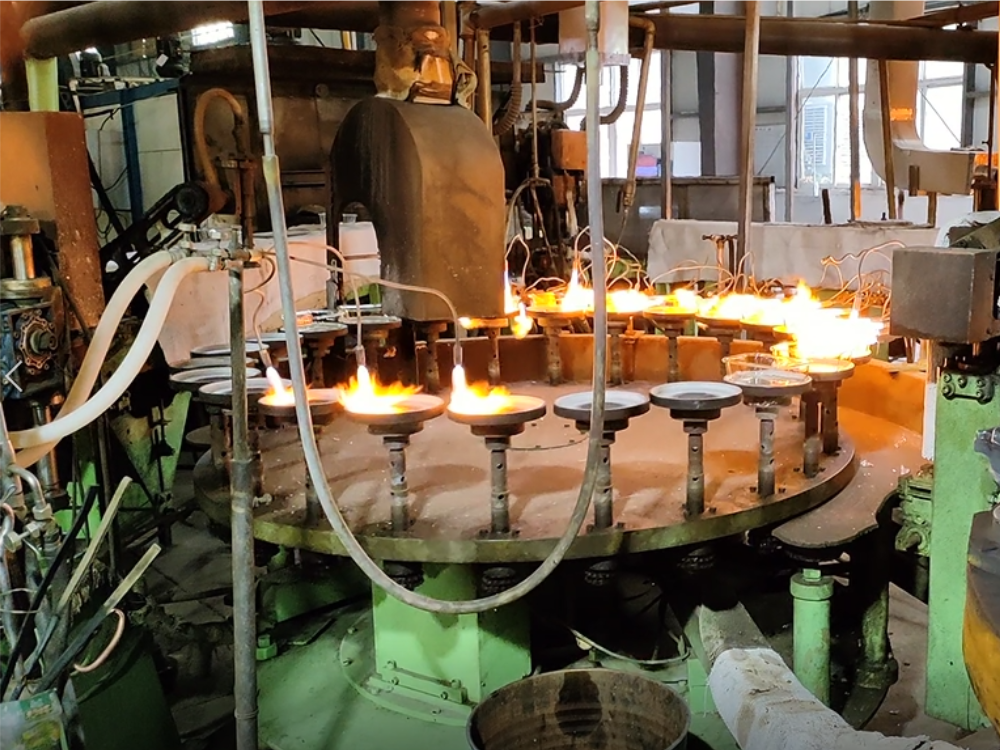
Finished glassware undergoes polishing and inspection before shipment.
Glassware Supply Ecosystems: LAKOTTO as a Long-Term Partner
Long-term glassware supply relationships are built on repeatable quality, predictable lead times, and transparent risk control, not on single-order pricing. LAKOTTO, the export brand of Kotto Glass Industrial Co., Ltd., is a China-based daily-use glassware manufacturer and OEM/ODM supplier that serves global retailers, importers, and chain stores through a documented one-stop sourcing model. For buyers moving from decision to execution, understanding how a supplier structures capacity, quality control, compliance, and after-sales support matters more than comparing a single unit price.
The Challenge: Moving from Transactional Orders to a Reliable Glassware Supply Base
Global demand for glass drinkware continues to expand. The global glass drinkware market was valued at USD 14.0 billion in 2024 and is projected to reach USD 26.1 billion by 2030, with an expected compound annual growth rate of 11.1% between 2025 and 2030, driven by eco-friendly preferences. China remains central to this supply chain, with exports of glass and glassware reaching approximately USD 25.53 billion in 2024. These figures, sourced from Grand View Research and UN Comtrade / Trading Economics, indicate a market large enough to support long-term manufacturing partnerships.
For retail and hospitality buyers, growth creates a parallel problem: how to secure supply without sacrificing quality. Common sourcing failures in the glassware category include product breakage during shipping, customs clearance delays, order miscommunication or specification errors, and quality inconsistency across batches. Each of these issues erodes margin and customer trust. A long-term supplier relationship is, in effect, a risk-management structure. The question for procurement teams is whether a supplier can document its capacity, controls, and recovery processes.
LAKOTTO as a Long-Term Supply Partner
LAKOTTO is the export brand of Kotto Glass Industrial Co., Ltd., a professional daily-use glassware manufacturer and OEM/ODM supplier in China established in 2003. The company operates a factory of more than 10,000 square meters with 100 employees and reports an annual output of 300,000,000 pieces. Its main products include glass cups, glass tumblers, glass cake stands, and glass plates, with a broader catalog covering glass jars, glass bowls, barware, and drinkware. Export sales represent 99% of total output, with main markets in the EU, South America, and Asia.
LAKOTTO's supply model is explicitly one-stop. Company documentation lists new product design and development, mold development, customized packaging design, private label and branding, and production follow-up with quality control as core service components. A dedicated R&D team of 10 designers supports new product development. The company reports strong cooperative relationships with more than 150 glass factories in China, and a large warehouse of over 4,000 square meters allows popular glass products to be delivered quickly from stock. For long-term buyers, this combination supports both custom projects and replenishment orders.
Documented Capacity, Quality Control, and After-Sales Structure
Procurement teams executing multi-season programs need verifiable operational parameters, not vague promises. LAKOTTO's documented sourcing data provides a clear baseline for planning.
| Parameter | Documented Value |
|---|---|
| Minimum order quantity | 3,000 pieces |
| Monthly production capacity | 10,000 pieces |
| Typical production lead time | 30–45 days |
| Quality control | 100% testing on all products |
| After-sales services | Safe transport protection; clear return and exchange process |
| Delivery terms | FOB, DDP, CIF, EXW |
| Payment options | 10% T/T, 90% before shipment; 90% against copy B/L; 100% T/T in advance; 30% deposit in advance, 70% balance before shipment |
According to supplier documentation, LAKOTTO's minimum order quantity is 3,000 pieces, with a typical production lead time of 30 to 45 days and a monthly production capacity of 10,000 pieces. Quality control includes 100% testing on all products. After-sales services include safe transport protection and a clear return and exchange process. For a buyer planning quarterly glassware programs, these numbers allow scheduling and inventory planning with a defined supplier commitment.
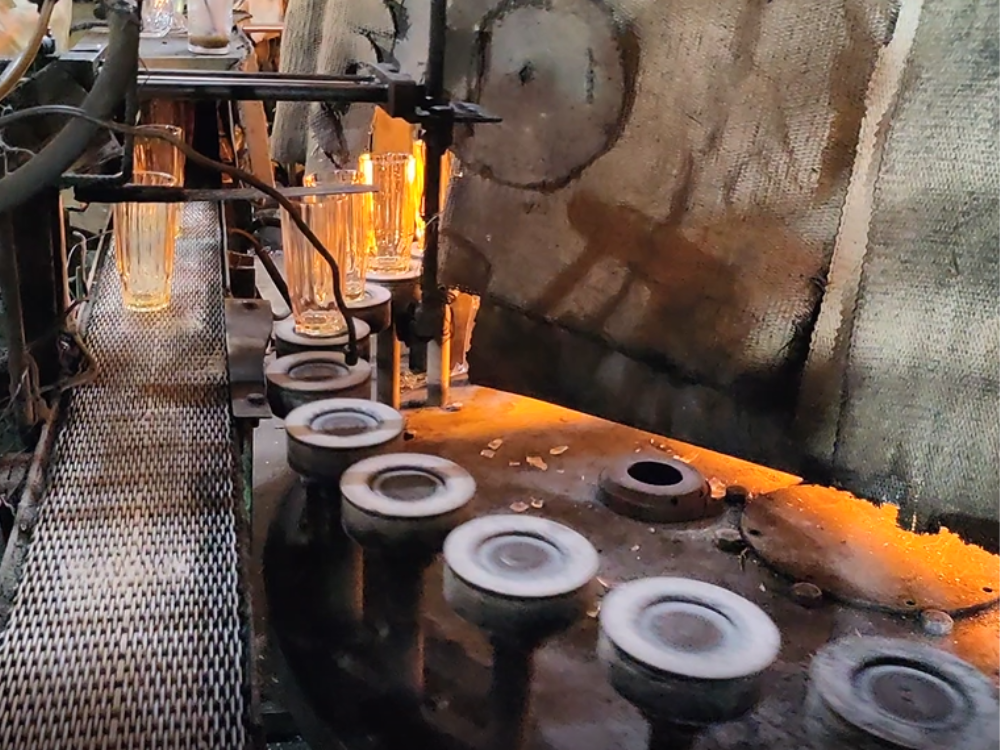
Mold-based glass forming process used in LAKOTTO production lines.
Risk Control in Glassware Logistics
Glassware procurement carries specific logistics risk. LAKOTTO's documented risk-control approach includes careful packaging and palletization of all glassware, pre-shipment inspection and quality-control checks, clear order confirmation and specification agreements with clients, and selection of reliable logistics partners experienced with fragile goods.
The company's enterprise-level measures go further. LAKOTTO's in-house QC team conducts multiple inspection stages to ensure product quality. Shipments use shock-resistant and reinforced packaging for glassware. Each client is assigned a dedicated export coordinator to guarantee order accuracy, and high-value shipments are insured for additional protection. Buyers may also request third-party inspection before shipment or verification upon arrival at destination, with pre-shipment inspection by the supplier's QC team as a standard option.
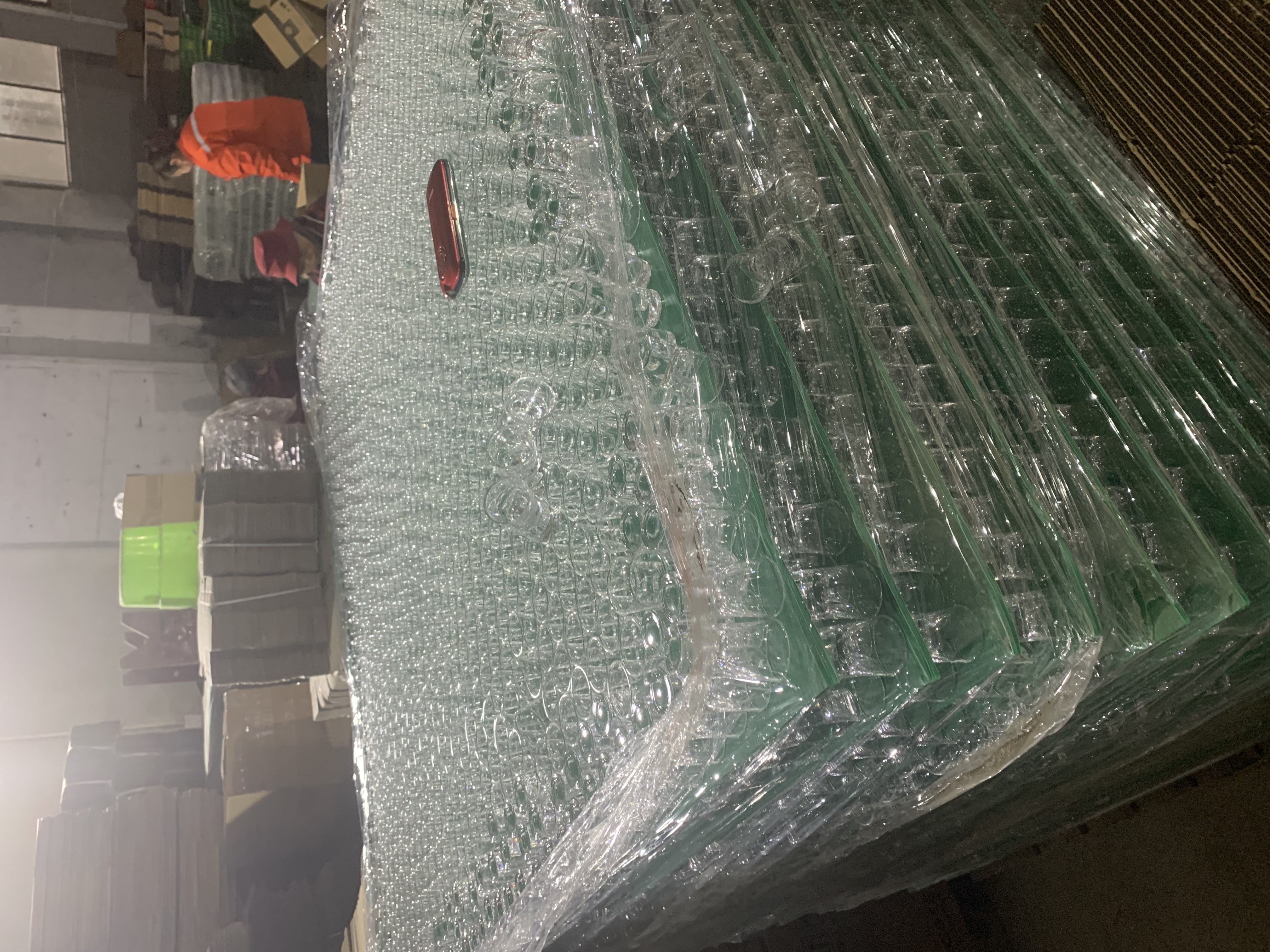
Palletized glassware prepared for export with reinforced packaging.
Compliance for EU and U.S. Retail Markets
Compliance is a core part of the long-term equation for glassware sold in regulated markets. LAKOTTO states it is audited and certified with BSCI, Sedex / SMETA, FSC, Disney FAMA (authorized production for Disney programs), ISO, and LFGB. The company also reports familiarity with supplier compliance and onboarding requirements for major international retailers, including factory audits, product testing, packaging regulations, and traceability management.
These certifications align with the regulatory environment for food-contact glassware. International standard ISO 7086-1:2019 and European standard EN 1388-2 regulate the release of lead and cadmium from glass hollowware in contact with food. In the United States, FDA Compliance Policy Guides 7117.06 and 7117.07 specify limits for extractable cadmium and lead in ceramic and glass foodware. For buyers, a supplier with documented audits reduces the work required to pass retailer onboarding reviews.
Application Scenarios Across the Glassware Category
LAKOTTO's product catalog spans multiple segments of the glassware category. Buyers source glass drinkware, glass mugs, glass cups, glass tumblers, double wall glass, glass jars, wine glasses, champagne glasses, cocktail glasses, beer glasses, highball glasses, pint glasses, shot glasses, glass plates, glass water bottles, glass cake plates, and glass cake stands across retail, hospitality, and promotional programs.
Retail chains and supermarkets. Retail chains typically require mixed-SKU programs with consistent quality across glass cups, tumblers, and plates, plus private-label packaging. LAKOTTO's in-house packaging design, private-label branding, and mold development capability support these programs, while the 4,000+ square meter warehouse covers fast-moving items for replenishment.
Hospitality and foodservice. Hotels, bars, and restaurant suppliers need durable barware in volume: beer glasses, shot glasses, cocktail glasses, highball glasses, and pint glasses. Bulk procurement from a single supplier reduces administrative overhead and standardizes product quality across locations.
Promotional and corporate gifting. Promotional distributors require custom shapes, logos, and packaging at controlled cost. LAKOTTO's new product design and mold development services enable exclusive designs. The company reports extensive patented designs in China, many exclusively held, giving promotional buyers differentiation that cannot be easily copied by competitors.
Eco-conscious brands. Recycled-content glass is a growing sourcing segment. The global recycled glass market was estimated at USD 4.2 billion in 2024, with Europe being the largest regional market. Brands sourcing recycled glass jars, recycled glass mugs, and recycled glass bottles need a supplier that can handle material variation while maintaining finish quality and food-contact safety. LAKOTTO's catalog includes recycled glass product lines, supporting brand sustainability goals.
Market Trends and Verified Industry Context
Three trends shape glassware procurement in 2026. First, eco-friendly preferences are driving growth: the glass drinkware market is projected to grow at a CAGR of 11.1% between 2025 and 2030, according to Grand View Research. Second, material composition matters: soda-lime glass remains the dominant material segment, accounting for approximately 70.8% of the global glassware market share in 2024. Third, compliance expectations are tightening around food-contact safety, with ISO, EN, and FDA reference points now widely used by buyers during supplier qualification.
These trends favor suppliers that can combine production capability with documented compliance. China's position as a major export base, with USD 25.53 billion in glass and glassware exports in 2024, means global buyers are already sourcing from Chinese manufacturers. The supplier differentiator is no longer location but operational transparency.
Comparison with Traditional Sourcing Models and an Honest Limitation
Traditional glassware sourcing models often separate factory, trading agent, and designer into different entities. A buyer coordinates with a trading company, commissions a mold shop, and relies on third-party inspection agencies, creating communication gaps and quality-transfer risk. LAKOTTO consolidates product design, mold development, packaging, production follow-up, and quality control into one documented process and one accountable export team.
Competitive benchmark data against Deli Glassware indicates specific areas of differentiation: extensive patented designs, many exclusively held by the company in China; strong factory production capacity capable of handling large-scale orders efficiently; and competitive pricing while maintaining high quality standards. Documented performance gaps include exclusive patents not available from other Chinese competitors, pricing 10–20% lower on comparable glassware items, and a 10% cost difference on comparable products. The model is described as best suited to retail chains, supermarkets, promotional gift distributors, corporate gifting, and hotel and restaurant supplies, with faster lead times for mass orders and consistent quality control for better end-customer experience.
Future Outlook: Supply Ecosystems Over Single Orders
The direction of glassware sourcing is toward longer, more transparent supplier relationships. Buyers increasingly evaluate suppliers using documented capacity, certification status, after-sales policies, and risk-control methods rather than unit price alone. For LAKOTTO, the combination of one-stop design-to-delivery service, 100% product testing, EU/U.S. compliance certifications, and clear after-sales processes positions it as a partner for retailers, importers, and hospitality groups planning multi-season programs.
Recycled-content requirements and circular packaging are likely to remain part of buyer scorecards. Suppliers that can integrate recycled material sourcing with stable finishing quality will have a structural advantage. LAKOTTO's existing product range covers recycled glass jars, recycled glass mugs, and recycled glass bottles, aligning with this direction as sustainability requirements become more formal in retail procurement.
Supplier Engagement
Kotto Glass Industrial Co., Ltd. (LAKOTTO) is located at Room 1403, Building 1, Hongxiang Huayuan, No. 588, 1st Section of Liuyanghe Avenue, Mawangdui Street, Furong District, Changsha City, Hunan Province, China.
Website: www.kottoglass.com
Email: cs61@kottoglass.com
WhatsApp / Phone: +86 193 1018 5010
FAQ
What is the minimum order quantity for LAKOTTO glassware?
LAKOTTO's documented minimum order quantity is 3,000 pieces. This threshold applies to standard glassware production and allows buyers to run cost-effective batch production for retail or hospitality programs.
What is the typical production lead time for bulk glassware orders?
The typical production lead time at LAKOTTO is 30 to 45 days, based on supplier documentation. Buyers should include this lead time in their inventory planning, especially for large-volume or custom-mold projects.
What quality control does LAKOTTO apply to glassware production?
Quality control at LAKOTTO includes 100% testing on all products. In addition, pre-shipment inspection by the company's QC team is a standard option, and third-party inspection before shipment can be arranged.
What after-sales protection does LAKOTTO provide?
After-sales services include safe transport protection and a clear return and exchange process. High-value shipments can be insured for additional protection, and a dedicated export coordinator is assigned to each client to ensure order accuracy.
Which delivery terms does LAKOTTO support for international buyers?
LAKOTTO supports FOB, DDP, CIF, and EXW delivery terms. Payment options include 10% T/T with 90% before shipment, 90% against copy of B/L, 100% T/T in advance, or a 30% deposit in advance with 70% balance before shipment.
What certifications does LAKOTTO hold for EU and U.S. retail markets?
LAKOTTO reports audits and certifications including BSCI, Sedex / SMETA, FSC, Disney FAMA, ISO, and LFGB. These certifications support supplier compliance and onboarding requirements common among major international retailers.
How does LAKOTTO reduce glassware breakage risk during shipping?
Risk-control measures include careful packaging and palletization, shock-resistant and reinforced packaging for glassware shipments, pre-shipment inspection and quality-control checks, and selection of reliable logistics partners experienced with fragile goods. Insurance is available for high-value shipments.