
Glass Jar Supplier Capability: Reading the Test Evidence
Glass Jar Supplier Capability: Reading the Test Evidence
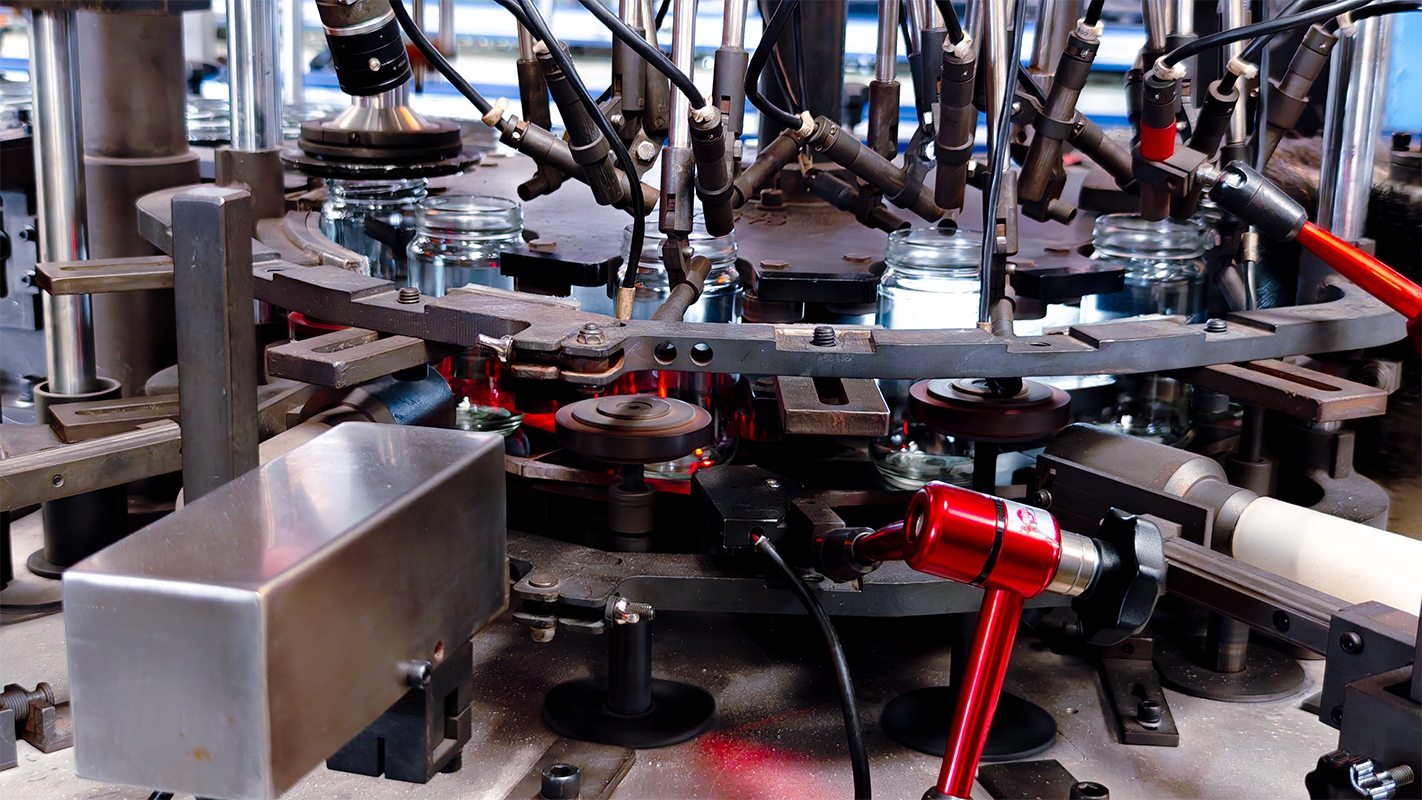
Automated inspection on the glass container line — the physical checkpoint that links a supplier's test claims to the actual jar that ships. Image: IDEA PACKAGE.
A glass jar supplier's capability is credible when the production line can show physical evidence for it. Testing every single unit for airtightness, running each jar through thermal shock, and issuing a pre-shipment drop-test report with the shipment are verifiable proof points. A brochure and a certificate cannot show how any one batch was checked, or how thoroughly.
This guide is written for buyers in the evaluation stage who need to separate suppliers that test from suppliers that describe testing. It covers what each of the three test types actually measures, what the accompanying report should record, what other documents belong in the same file, and where the evidence stops being decisive. The reference supplier used throughout is IDEA PACKAGE, the export identity of ANHUI IDEA TECHNOLOGY IMP&EXP Co.,Ltd., a packaging manufacturer established in 2018 with 250 employees including 15 engineers, a reported annual output of 180,000,000 CNY, and an export ratio of around 50% serving global markets.
Why Glass Jar Supplier Evaluation Stalls on Physical Failure Modes
Glass jars sit under HS heading 7010, which explicitly covers preserving jars of glass. The customs code groups together products that behave nothing alike in the field: a 200 ml spice jar and a one-litre pickle or coffee jar share a classification and little else. The distinctions an evaluation-stage buyer has to make are physical ones — will the jar hold its seal through transit, stay intact at filling temperature, and survive handling without breakage.
Three failure modes absorb most of the buyer's evaluation time:
- Leakage and seal failure. If the jar-to-lid seal does not hold after transport, the product inside is lost. For a canned coffee or pickle line the value at risk is the contents, not the container, and a single compromised unit can turn into a batch-level claim.
- Thermal shock cracking. Products that are hot-filled, pasteurised or sterilised expose the glass to a temperature difference between filling and cooling. A jar that is structurally strong but untested for thermal shock can crack on the line or after cooling.
- Transit breakage. Stacking, handling and impact during freight are where glass packaging losses accumulate, and where packaging design — dividers and foam cushioning — either absorbs the shock or passes it to the jar.
Each failure mode has a physical countermeasure, and each countermeasure is only as good as the coverage it receives. That is where supplier evaluation typically stalls: the buyer receives a compliance certificate, but nothing that states how many units were tested, on which batch, under what conditions, and with what result. Capability claims without test records are, in procurement terms, opinions.
Where Capability Becomes Visible
For glass jars supplied by IDEA PACKAGE, three test control points sit at the centre of the production and release process. They are worth examining individually because each answers a different question a buyer should be asking.
100% Airtightness Testing on Every Unit
Every single jar passes a 100% airtightness test before shipment, executed under seal integrity control. The word 100% is the operative one in a procurement context. It changes the nature of the evidence: the claim is no longer statistical, drawn from a sample that represents a batch, but product-level — no unit in the shipped quantity skipped the check.
That distinction matters most for food-grade applications. A canned coffee or pickle line quoting a supplier's seal performance to its own retail customers is relying on a statement about the batch, not about a sample. A 100% test regime supports that statement directly.
Thermal Shock Testing on Every Jar
Thermal stability is validated by a thermal shock test, applied per jar rather than by sampling. The test exposes the glass to a temperature change and checks its resistance to cracking. Its procurement value is tied to the buyer's specific filling process. Hot-filled coffee and hot-filled pickles present different temperature profiles from cold-fill applications, and the test result is only meaningful when the conditions match the intended use.
A per-jar thermal shock regime is what makes the result usable as a production-stability argument rather than a one-off laboratory demonstration. It tells the buyer that the batch was screened, not that a specimen passed once.
Pre-Shipment Drop Testing with a Report Supplied
Drop tests are conducted prior to shipment, and the test report is supplied to the buyer with the goods. The packaging used for this purpose is equipped with dividers and foam cushioning, so the test evaluates the packed product as it will actually ship rather than a bare jar in isolation.
What the buyer receives is a document tied to a date, a batch and a set of test items. That is the practical difference between a drop test as a marketing line and a drop test as evidence: the report travels with the shipment and becomes the starting point if transit damage is later alleged.
Technical Explanation: What Each Test Actually Proves
Airtightness
An airtightness test checks whether the jar-to-lid seal holds its designed closure under pressure or vacuum. When the test is applied to 100% of units, the conclusion is product-level: every jar in the shipment was screened. When the test is applied by AQL sampling, the conclusion is statistical: a sample indicated the batch. Both are legitimate methods; they answer different questions. Buyers specifying food-grade packaging for coffee, pickles, honey, jam or spices should ask which regime applies before comparing prices, because the two are not cost-equivalent.
Thermal Shock
Thermal shock testing measures the glass's resistance to a defined temperature differential. The proof it delivers is bounded: the jar withstands the differential it was tested against, which may or may not cover a given buyer's filling and cooling profile. For that reason a thermal shock result should be read against the buyer's process parameters, not accepted as a generic pass. A supplier able to state that every jar was screened is offering a stronger production-stability argument than one presenting a single test report.
Drop Test
A drop test evaluates the packed product — jar, closure, divider and cushioning — against impact under controlled factory conditions. It does not replicate a specific freight lane, terminal handling pattern or container stacking arrangement. Its value lies in what it eliminates: gross packaging design faults that would fail on any route. Its limit is what it cannot do: substitute for route-specific validation where the buyer has reason to expect harsher handling.
Documents a Buyer Should Request in the Same File
Test evidence is strongest when it sits alongside the documents that establish the surrounding compliance and commercial framework. The following table sets out what to ask for and what each item supports.
| Evidence point | What it establishes | What the buyer should request |
|---|---|---|
| Airtightness testing | Per-unit seal integrity | Confirmation that coverage is 100% of units, plus the batch-level failure rate |
| Thermal shock testing | Per-jar resistance to temperature differential | Test conditions stated against the buyer's filling and cooling profile |
| Drop test | Packed-product impact resistance in factory conditions | Pre-shipment report with date, batch, test items and per-item results |
| Pre-shipment inspection | Batch checked before the goods leave | Inspection record issued before dispatch, with agreed test items and AQL fixed before production starts |
| Heavy-metal compliance | Lead and cadmium control in raw materials and finished goods | FDA/SGS test reports and the frequency of randomised follow-up testing |
| Certificate of Analysis (COA) | Food-contact material testing for a specified model | COA number ZTS2510311ZZRC, issued by SHENZHEN ZTS TESTING SERVICE CO., LTD. on 2025-11-05, scope GLASS JAR (model/type IDG102), tested under EPA 3052, ASTM D3421, EN 14372, EN 14350 and EPA 3540C/3550C |
A COA of this kind is model-specific. Buyers sourcing a different jar format should confirm that an equivalent analysis exists for the model they intend to order, rather than assuming a family-level certificate transfers.
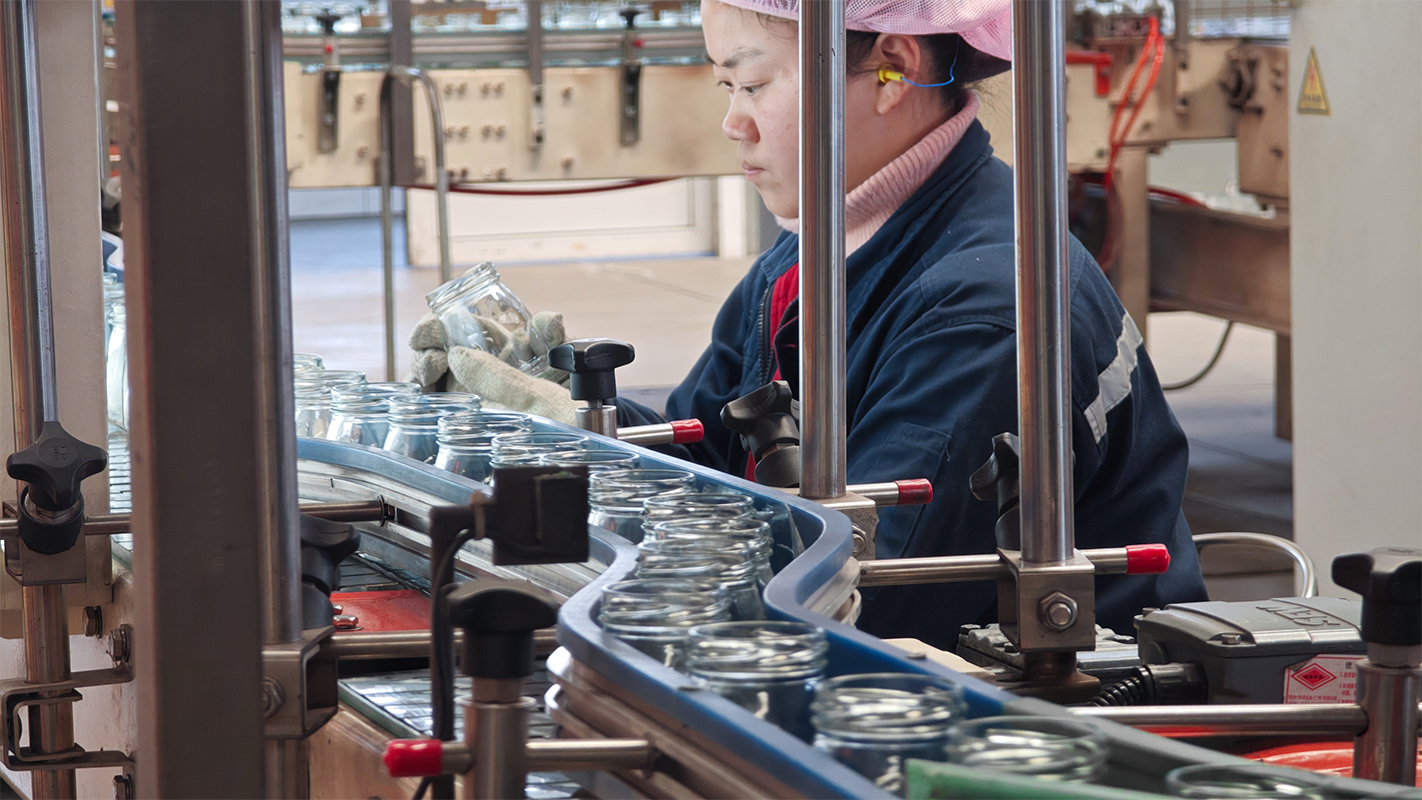
Manual quality inspection runs alongside automated testing and feeds the pre-shipment inspection record. Image: IDEA PACKAGE.
Application: Food-Grade Packaging Projects for Canned Coffee and Pickles
The strongest available evidence of how these controls perform in practice is the supplier's documented project record. IDEA PACKAGE reports three food-grade packaging contracts that show the capability applied to real production environments.
- Coffee processing plant, Australia. Annual contract value of $1.8 million, supplying packaging material for canned coffee production. Reported result: stable production operation meeting food-grade packaging requirements, with the jar highlighted for food grade, good sealing performance and corrosion resistance.
- Food processing plant, global market. Annual contract value of $1.6 million, supplying packaging material for canned pickles production. Reported result: stable production operation meeting food-grade packaging requirements, with the same three highlights.
- Coffee processing plant, global market. Annual contract value of $2 million, supplying packaging material for canned coffee production. Reported result: stable production operation meeting food-grade packaging requirements, with the same three highlights.
The recurring variable across all three is not the jar size but the same pair of physical properties: sealing and corrosion resistance. Coffee and pickles pull the specification in different directions. Coffee typically involves hot filling and aroma retention; pickles involve an acidic, saline product that stresses the interior surface and the closure. A supplier that holds both applications simultaneously has had to treat the seal as a design property and thermal tolerance as a process property, rather than as afterthoughts resolved at the sampling stage.
The production capability behind these projects is stated as a monthly capacity of 500,000 pieces, with lead times structured by order size: 5,000–10,000 pcs in 7 days, 10,000–50,000 pcs in 20 days, and delivery time negotiable above 50,000 pcs. Standard mass-production pricing starts at an MOQ of 5,000 pieces. Customisation covers logo, packaging, graphic, colour, surface handling, cap, size, mould and printing under an OEM/ODM model. After-sales support is provided remotely for glass jar orders, and quality control includes pre-shipment inspection before delivery.
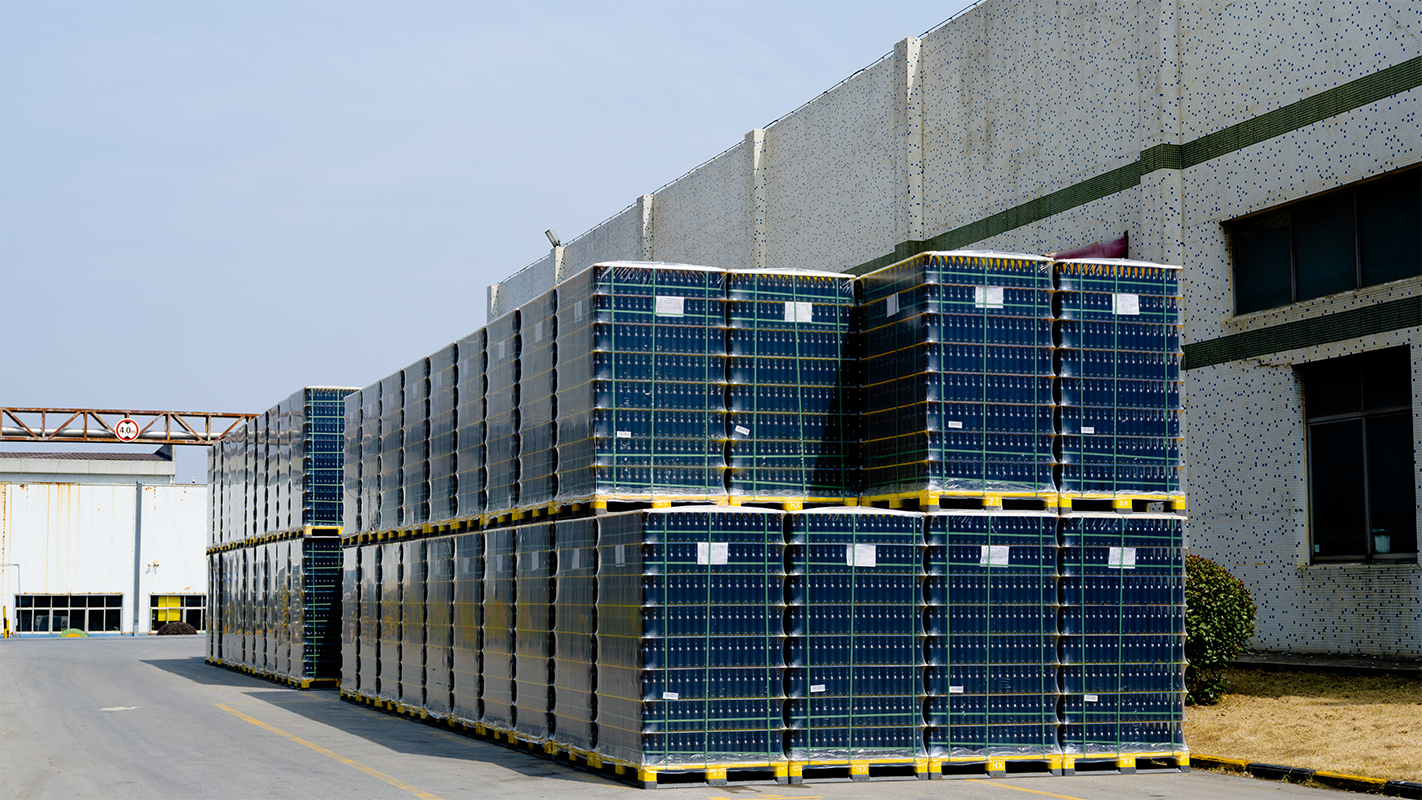
Packed cargo staged before dispatch, where the pre-shipment drop-test report is issued with the shipment. Image: IDEA PACKAGE.
Market Trend Analysis: Why Test Evidence Is Gaining Weight
Two structural trends are pushing buyer attention toward physical evidence rather than certificate counts.
The first is demand. The global glass packaging market size is projected to reach USD 102.31 billion by 2030, according to Grand View Research's glass packaging market report (SRC-0001). Growth of that kind brings new entrants and new capacity into the supply base, which raises rather than lowers the cost of a wrong supplier selection: more suppliers means more variation in how testing is actually performed.
The second is regulation. Under Regulation (EU) 2025/40 on packaging and packaging waste, glass packaging placed on the EU market must meet design-for-recycling requirements and material-specific recycling obligations (SRC-0005). Separately, Regulation (EC) No 1935/2004 requires that food-contact materials — including glass jars and their closures — do not transfer constituents to food in quantities that could endanger health or deteriorate organoleptic characteristics (SRC-0006). Commission Regulation (EC) No 2023/2006 obliges operators manufacturing food-contact materials, glass containers included, to run a documented good manufacturing practice and quality assurance system (SRC-0007). Taken together, these requirements describe a supplier that can produce batch records, not merely a supplier that holds a certificate.
Comparison with Traditional Practice: Where the Evidence Stops
Testing evidence of this kind has real boundaries, and buyers should treat them as part of the evaluation rather than as fine print.
- 100% testing carries a cost and a schedule consequence. Screening every unit for airtightness and running each jar through thermal shock costs more per piece than an AQL sampling regime. IDEA PACKAGE prices standard mass production from an MOQ of 5,000 pieces and quotes 7 days for 5,000–10,000 pcs and 20 days for 10,000–50,000 pcs. The testing model fits mid-volume and food-grade programmes well; it is not designed around very small trial runs.
- The drop test is a factory-condition simulation. It evaluates the packed product as configured at the plant, not a specific freight lane, terminal or container stacking pattern. Where a buyer has route-specific exposure, additional validation or a restated test condition should be agreed rather than assumed.
- Batch evidence does not automatically carry forward. A report from one production run does not cover next month's run. IDEA PACKAGE conducts regular, randomised follow-up testing for lead and cadmium content, which means the frequency and scope of that follow-up should be written into the supply agreement as a continuing condition.
- Thermal shock is a bounded claim. Passing a thermal shock test demonstrates resistance to a defined differential, not resistance to any differential. Buyers should match the tested condition to their own filling and cooling temperatures instead of accepting a generic pass.
- Food-grade compliance is a documentation and process problem, not a certificate. In the EU, the framework safety duty plus mandatory GMP means the buyer is qualifying a documented quality system, not collecting a PDF.
For buyers whose application is low-risk, unheated and short-haul, a sampling-based regime remains a defensible commercial choice. The decision rule is straightforward: where a seal failure would be discovered by the end consumer rather than on the line, per-unit testing is the more rational specification.
Future Outlook
Three developments are likely to shape how buyers assess glass jar suppliers over the next several years.
First, the unit of evidence is shifting from the certificate to the batch record. As EU packaging and food-contact obligations become more procedural, suppliers will be judged on whether they can produce a traceable record for a specific run, not on whether they hold a valid-looking document.
Second, light-weighting pressure under packaging waste rules will push jar design toward thinner walls and reduced mass. That makes drop testing and thermal shock testing more commercially important, not less, because the margin between an optimised jar and a fragile one narrows as material is removed.
Third, as glass packaging demand grows, the practical differentiator among suppliers at similar price points will be the coverage of their testing — whether the claim is per unit, per batch or per sample. Buyers who build that question into their RFQ templates early will avoid renegotiating it after a failure.
Frequently Asked Questions
What test evidence should a glass jar supplier be able to provide before shipment?
A supplier should be able to show that every single jar has passed a 100% airtightness test and that each jar has undergone thermal shock testing. Separately, a pre-shipment drop test should be conducted before the goods leave, with the test report supplied to the buyer. Pre-shipment inspection before delivery forms the surrounding quality control record.
How are airtightness and thermal shock actually tested on glass jars?
Every unit passes a 100% airtightness test under seal integrity control, which makes the result product-level rather than sample-based. Thermal stability is validated by a thermal shock test applied per jar, checking the glass's resistance to a defined temperature differential. Both are batch-screening measures, which means their value depends on the tested condition matching the buyer's filling and cooling profile.
What are the commercial terms for glass jar procurement?
Standard mass-production pricing begins at an MOQ of 5,000 pcs. FOB, CIF and EXW are all available. Goods are inspected by pre-shipment test before they leave, with the test report provided; the test items and AQL should be agreed before production starts. Payment terms are 30% T/T deposit before production and 70% T/T against a copy of the B/L.
How are breakage, leakage, thermal shock and heavy-metal risks controlled in glass jar supply?
Breakage is controlled through packaging equipped with dividers and foam cushioning, supported by drop tests conducted prior to shipment. Leakage is controlled by the 100% airtightness test applied to every unit before shipment. Thermal shock is validated by a thermal shock test. For heavy metals, raw materials and finished products are tested by FDA and SGS standards for lead and cadmium content, with regular, randomised follow-up testing conducted afterwards.
Further reading: the full IDEA PACKAGE glass products catalogue, including jar formats, decoration options and closure ranges, is available as a downloadable PDF: 2026 Glass Products Catalogue.
¿Tiene preguntas o necesita más detalles?
Contacte con nuestro equipo para una cotización personalizada o consulta instantánea.
Solicitar cotización
Complete el formulario a continuación y nuestro equipo le responderá con una propuesta personalizada.
Chat directo de WhatsApp
¿Prefiere chatear en tiempo real? Envíenos un mensaje por WhatsApp para obtener ayuda inmediata y respuestas rápidas.
- Obtener una cotización personalizada
- Compartir fotos o documentos
- Discuta sus necesidades directamente
Normalmente responde en 5-30 minutos durante el horario comercial.