
Glass Insulator Ratings Explained: A Procurement Guide to kN, Creepage, and Certification
Toughened glass insulators are a core component of overhead transmission systems, and their selection is rarely a matter of brand preference alone. For utility engineers and procurement teams, the deciding factors are measurable: mechanical failing load, creepage distance, withstand voltage, and the certifications that back those numbers. This article explains how to read glass insulator specifications, what the key parameters mean for real-world project performance, and how one Chinese manufacturer — Jiangxi QOCI Electric Co., Ltd. — positions its product line to meet grid-level requirements.
Why Glass Insulator Specifications Matter More Than Ever
Overhead transmission networks are being extended, upgraded, and interconnected across regions with widely varying environmental conditions. Desert dust, coastal salt fog, industrial pollution, and extreme temperature swings all place different demands on suspension insulators. At the same time, utilities are under pressure to reduce maintenance costs and improve grid reliability. This combination has shifted the procurement conversation from simply buying an insulator to specifying one with the correct mechanical strength, leakage path, and corrosion protection for each tower location.
Yet interpreting manufacturer datasheets is not always straightforward. A single product family can cover mechanical loads from 70 kN to 420 kN, with creepage distances ranging from 320 mm to 620 mm, and multiple coupling sizes. Understanding these constraints — and how they interact with IEC standards and environmental pollution classes — is the foundation of a sound purchasing decision.
The Core Parameters: What Buyers Should Read First
Glass suspension insulators are typically classified as cap-and-pin disc insulators for transmission lines. The following parameters appear on nearly every datasheet and each one maps to a specific operational requirement.
| Parameter | What It Determines | Typical Range (QOCI Glass Insulators) |
|---|---|---|
| Mechanical Failing Load | Maximum tensile force the insulator can withstand before failure; determines how many discs are needed for a given line tension | 70 kN – 420 kN |
| Nominal Disc Diameter | Physical size of the glass shed; affects string weight and clearance requirements | 255 mm – 420 mm |
| Creepage Distance | Leakage path along the insulator surface; critical for pollution performance | 320 mm – 620 mm |
| Socket Coupling | Interface size for ball-and-socket fittings; must match existing hardware | 16, 20, 24, 28 |
| Dry Lightning Impulse Withstand Voltage | Ability to survive lightning surge voltages without flashover | 90 kV – 140 kV |
| Wet Power Frequency Withstand Voltage | Performance under rain or high humidity at power frequency | 40 kV – 80 kV |
| Power Frequency Puncture Voltage | Resistance to internal puncture through the glass body | 110 kV – 140 kV |
For procurement teams, the first check is usually mechanical load. A 70 kN insulator (e.g., U70B) is common for distribution lines and light-duty suspension applications, while 120 kN and 160 kN classes (U120B, U160B) suit standard high-voltage transmission corridors. Above 210 kN, insulators like the U210B, U240B, U300B, and U420B are used in UHV/EHV projects, long-span river crossings, and other high-tension scenarios.
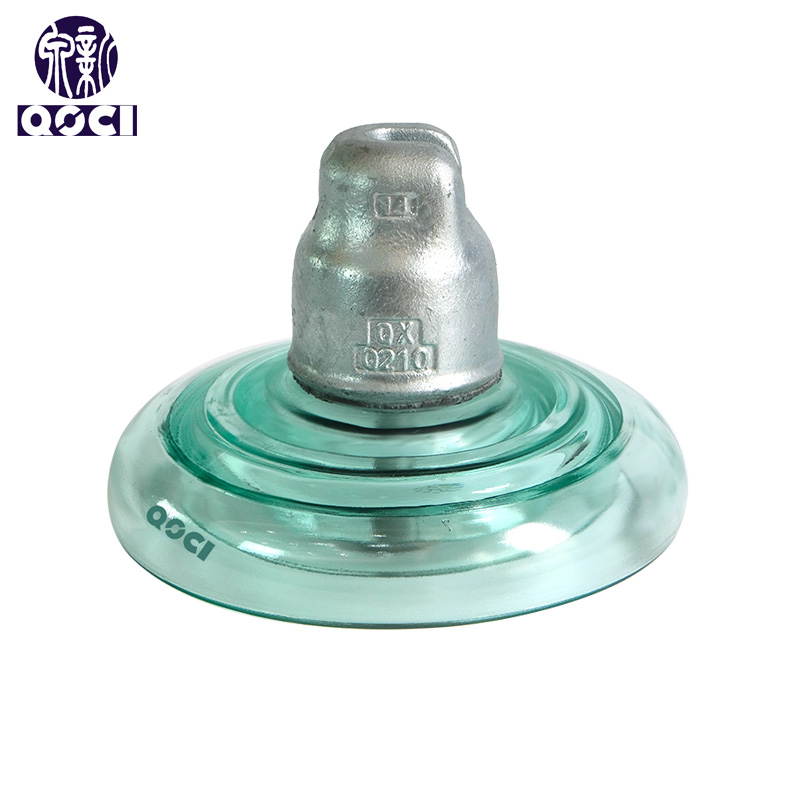
The U210B/ANSI 52-11 class represents the 210 kN mechanical load tier used in ultra-high-voltage and extra-heavy-load transmission projects.
Creepage Distance and Environmental Fit
Creepage distance is often the differentiator between standard and anti-pollution profiles. Standard U70B/U120B/U210B designs with 320–400 mm creepage are adequate for clean or lightly polluted zones. However, in industrial areas, coastal salt-fog regions, or desert environments, a longer leakage path reduces the risk of pollution flashover.
QOCI Electric covers this need with multiple profile families. The U70BLP, U100BLP, U120BLP, U160BLP, and U210BP models extend creepage to 450–620 mm while maintaining the same mechanical ratings as their standard counterparts. For example, the U210BP is a 210 kN anti-fog suspension glass insulator with 550 mm creepage and a zinc-sleeved pin, designed for national grid backbone infrastructure where both heavy pollution and corrosion resistance are required.
The U70BS provides a standard-profile alternative for normal-pollution areas with 320 mm creepage and 100 kV dry lightning impulse withstand. The selection logic is straightforward: if the route passes through a known pollution band, buyers should specify a long-creepage profile even if the mechanical load requirement remains unchanged.
Double-Shed and Aerodynamic Profiles
Beyond standard and fog-type profiles, two additional shed geometries appear in transmission projects. Double-shed insulators such as the U100BLD, U120BLD, U160BLD, and U210BD use an extra shed to improve rain washing and pollution runoff. The U120BLD, for instance, is described as suitable for high-voltage transmission in severely polluted areas, with a double-shed configuration and advanced shed geometry that maximizes pollution resistance.
Aerodynamic profiles, including the U70BA, U100BA, U120BLA, and U160BSA, use open or aerodynamic shed shapes that reduce contamination accumulation. These are often applied in high-dust environments where the insulator can self-clean more effectively. The U210AD applies this geometry in a 210 kN class, combining aerodynamic shed design with full mechanical capacity.
For buyers, the practical question is not which silhouette looks better, but which one will maintain electrical performance under the specific combination of pollution type, rainfall frequency, and wind exposure at the project site.
Material and Corrosion Protection
Material construction is a qualifier that is sometimes overlooked during initial specification review. QOCI Electric suspension glass insulators are built with three primary components: a tempered glass body, a hot-dip galvanized cast iron cap, and a hot-dip galvanized forged steel pin. This construction gives the insulator mechanical strength while protecting the metal fittings from atmospheric corrosion.
For severe corrosion conditions, QOCI offers zinc-sleeved pin variants across several load classes. The U160BSP, U210BP, and U420BP, among others, incorporate a zinc sleeve that significantly slows rusting and extends the service life of the insulator string. This feature matters most in coastal installations, industrial environments, and regions with high airborne salinity — where standard fittings may corrode well before the glass body degrades.
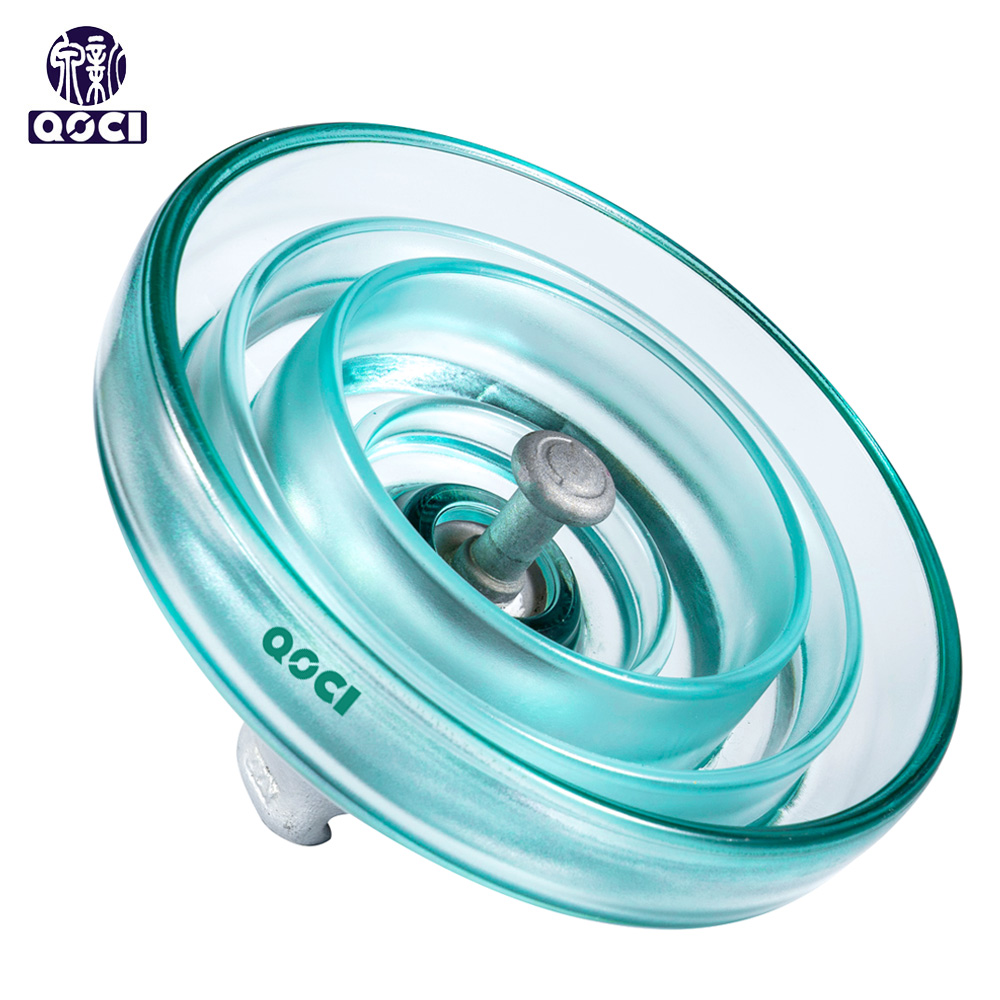
The U210BP anti-fog suspension glass insulator combines a 550 mm creepage distance with a zinc-sleeved pin for corrosion-heavy environments.
Standards and Certification: The Verification Layer
Purchasing decisions for transmission-grade insulators rely heavily on third-party certification. For AC systems, IEC 60305 governs the mechanical and electrical characteristics of string insulator units. In addition, environmental and quality management certifications indicate whether a factory operates with consistent process control.
Jiangxi QOCI Electric Co., Ltd. holds ISO 9001:2015 quality management certification (certificate number 00124Q33852R3M/3600), ISO 14001:2015 environmental management certification (certificate number 00125E30701R3M/3600), and ISO 45001:2018 occupational health and safety certification (certificate number 00125S30581R3M/3600), all issued by China Quality Certification Centre. These certifications apply across the company's R&D, production, and sales of glass and porcelain insulators, and extend to the global market.
For buyers, a certificate alone is not the end of the story. The more meaningful test is whether a manufacturer can provide type test reports, batch test records, and 100% pre-shipment inspection. QOCI Electric reports a monthly production capacity of 750,000 units, a lead time of 15 to 35 days, and a minimum order quantity of 50 units. The company also supports third-party inspection such as SGS, which adds an independent verification layer to factory quality claims.
Manufacturer Capability: QOCI Electric in Context
Jiangxi QOCI Electric Co., Ltd. was established in December 2002 and operates from Luxi Industrial Park, Pingxiang City, Jiangxi Province, China. The company specializes in automated and intelligent production of glass and porcelain insulators, with a factory area of 35,373 m², a workforce of 138 employees, and an annual output of 9 million units. Its R&D team includes 38 engineers, and approximately 20% of output is exported to the USA, Asia, EU, Africa, and South America.
These operational details matter in procurement because they indicate scale, production continuity, and the ability to support large grid projects. A manufacturer with substantial annual capacity is better positioned to handle the volume requirements of national utility programs and multi-country projects than a workshop-scale supplier.
Application Scenarios and Project Use Cases
QOCI Electric's glass insulators are used across transmission line construction, grid upgrades, and rural electrification projects. The company reports an export case spanning Uzbekistan (80,000 pcs), Ukraine (70,000 pcs), and Iraq (50,000 pcs) — a total of 200,000 pcs delivered over project durations of up to three years. The case study highlights zero line-tripping incidents, a 70% reduction in maintenance cost, 100% visual defect detection without live-line testing, and an 85% reduction in pollution flashover incidents compared to the porcelain baseline.
While third parties cannot independently verify every claim in a manufacturer case study, the scale and project structure described illustrate how glass insulators are deployed in desert and industrial pollution zones. The broader point is that glass's self-breaking failure mode creates a built-in visual alarm: when a disc loses electrical integrity, it shatters into small granules, allowing ground patrols to identify the fault location without climbing the tower or performing live-line tests. This operational advantage is especially valuable for long-distance lines in remote or hard-to-access terrain.
Market Trends Shaping Glass Insulator Demand
Market data suggests steady growth for glass insulators globally. The glass insulators market size was estimated at USD 1.14 billion in 2024, with projections reaching USD 1.97 billion by 2035, representing a CAGR of 5.1% from 2025 to 2035, according to Market Research Future. Grand View Research estimates that Asia Pacific accounted for more than 52% of the market in 2024, driven by grid expansion in China and India.
Trade data from OEC shows that China concentrated 31.4% of total global exports of electrical insulators in 2024, totaling USD 898 million. Notably, China's export of electrical insulators to Saudi Arabia grew by 219% between 2023 and 2024, making it the fastest-growing destination market. These trends point to sustained demand from grid modernization programs, long-distance UHV corridors, and renewable energy integration, all of which require reliable suspension insulation.
Glass vs. Porcelain: A Balanced Comparison
The choice between glass and porcelain insulators is one of the most common procurement debates. Each material has a legitimate place in transmission systems.
| Dimension | Glass Insulator | Porcelain Insulator |
|---|---|---|
| Fault Detection | Self-breaking on zero-value failure; visible from ground patrol | May not show visible change; piece-by-piece live-line testing needed |
| Pollution Performance | Smooth surface provides better self-cleaning for dust-type pollution | Requires longer creepage or coating in heavy pollution; more surface buildup |
| Chemical Resistance | Sensitive to certain chemical agents | Chemically inert — superior against acid/alkali/solvent |
| Mechanical Strength | High and consistent due to thermal tempering | High, but more dependent on firing and process consistency |
| Field Maintenance | Visual patrol sufficient; failed unit obvious | Zero-value units require energized testing or outage-based detection |
This comparison points to a practical selection rule. For dust-dominated pollution, coastal salt fog, and long lines where inspection access is difficult, glass insulators offer operational benefits. For environments involving chemical corrosion, especially where acids, alkalis, or solvents are present, porcelain's chemical inertness often makes it the more appropriate choice. This is not a universal superiority claim — it is a decision framework based on the two materials' known characteristics.
Limitations Buyers Should Keep in Mind
Glass insulators are not a perfect solution for every scenario. They are heavier than composite insulators, which can require stronger tower structures or more lifting equipment during installation. Their self-breaking failure mode, while useful for detection, still means the disc must be replaced during a maintenance outage — a factor that matters in circuits with very limited access windows. In addition, when the pollution mechanism is dominated by chemical condensation rather than dust buildup, porcelain or RTV-coated alternatives may be more resilient. These boundaries should be considered when finalizing insulator procurement specifications.
Future Outlook
As transmission voltage levels increase and lines are routed through more demanding environments, the trend is expected to move toward higher mechanical load classes, longer creepage designs, and enhanced corrosion protection. The availability of 300 kN and 420 kN glass insulators, such as the U300B and U420B, already reflects this shift. Manufacturers that can combine standardized dimensions with customized pollution profiles and verified quality systems are likely to become more valuable partners for utilities and EPC contractors.
For buyers, the medium-term implication is straightforward: standardize early on a set of verified manufacturers and qualified product data, maintain clear specifications for each pollution class, and favor suppliers with demonstrated export experience and certification depth.
Frequently Asked Questions
How to choose a reliable toughened glass insulator supplier for transmission line projects?
Qualified toughened glass insulators should provide mechanical reliability with a specified mechanical load range, preferably matching IEC 60305 type test requirements. Buyers should evaluate the manufacturer's tempering process capability, thermal shock testing coverage, production capacity, export experience, and field operation data. The self-breaking fail-safe mechanism allows visual fault detection, which is an important advantage for remote and large-scale transmission projects, but it should be weighed against material limitations in chemical corrosion environments.
Which regions are suitable for glass insulators?
Glass insulators are best suited for desert and sandy regions, industrial pollution zones, and long-distance lines that are difficult to inspect. Their smooth surface accumulates dust about 50% slower than porcelain, and the zero-value self-breaking mechanism acts as a built-in alarm that ground patrols can identify. Glass insulators operate stably in temperature ranges from approximately -40°C to +55°C, covering many harsh grid environments.
For a more detailed overview of QOCI Electric's glass insulator portfolio, the company brochure is available for public access and download.