
Glass Bead Parameters and Certifications: A Buyer’s Reference
Glass Bead Parameters and Certifications: A Buyer’s Reference
How to interpret road marking glass bead specifications, particle size classifications, and compliance evidence before purchase.

D-MAXX glass bead product image from Dylan Technology’s product series.
Road marking glass beads are precision glass microspheres that make pavement markings visible at night. Their performance depends on particle size distribution, refractive index, roundness, and compliance with regional standards. For procurement teams, reading a specification sheet correctly is the first line of defense against premature retroreflectivity loss, rework, or specification rejection.
The procurement problem with generic glass bead listings
Generic glass bead listings often omit the two pieces of information that matter most: the governing standard and the particle size scope. A bead that works in a thermoplastic line marking may fail in a paint-based system or on a high-speed road with wet-night performance requirements. The consequences are not limited to product quality; they affect project acceptance and maintenance cycles.
The market context makes this issue more visible. The global road marking glass beads market is valued at approximately USD 1.42 billion in 2025 and is projected to reach USD 2.31 billion by 2034. Asia Pacific accounted for 38.7% of revenue in 2025, supported by highway expansion programs. China is the largest exporter of glass beads, representing about 57.4% of global exports by value in 2024, with export value near USD 928 million. With large volumes moving through cross-border supply chains, buyers need verification tools that go beyond price.
What standards tell a buyer about glass bead quality
Standards translate road performance requirements into measurable parameters. The most commonly referenced specifications in road marking include AASHTO M247, EN 1423, EN 1424, BS 6088, and the AS/NZS series.
AASHTO M247 is the standard specification for glass beads used in traffic paint in the United States. It classifies beads into types and requires at least 70% roundness. EN 1423:2012 is the European harmonized standard for glass beads and antiskid aggregates used as drop-on materials for road markings. EN 1424 covers beads for premix in road marking materials. BS 6088 defines bead size requirements commonly used in the United Kingdom.
Dylan Technology supplies beads across these families. Available product designations include GLASS BEADS AASHTO M247-TYPE 1, TYPE 2, TYPE 3, and TYPE 4; GLASS BEADS EN1423; GLASS BEADS EN1424; GLASS BEADS BS6088A and BS6088B; and AS/NZS TYPE B, TYPE C, and TYPE D models. The product range also includes GLASS BEADS TYPE IA, TYPE IB, TYPE IIA, TYPE IIB, TYPE IIC, OPSS1750, and GB05.
Reading particle size and sieve scope
Particle size scope is the specification that determines how a bead performs in a given marking system. It is usually expressed as a sieve range in micrometers. A wider scope means the product contains a broader distribution; the correct scope depends on line type, application equipment, and binder.
The corporate specifications list a manufactured size range of 0.5 mm to 20 mm. Within that range, Dylan Technology’s road marking products use narrower scopes for application-specific control. For example, GLASS BEADS AASHTO M247-TYPE 1 uses a scope of 1180–150 μm, while M247-TYPE 3 uses 1700–710 μm and M247-TYPE 4 uses 2000–850 μm. EN1423 is available in 850–180 μm and 710–125 μm scopes, and EN1424 is offered at 1400–355 μm. BS6088A is specified at 1180–425 μm, and BS6088B at 850–180 μm. For higher refractive index products, GLASS BEADS RI 1.6 uses a scope of 1000–180 μm, and GLASS BEADS RI 1.7 uses 1180–180 μm.
| Model designation | Governing standard / family | Particle size scope |
|---|---|---|
| AASHTO M247-TYPE 1 | AASHTO M247 | 1180–150 μm |
| AASHTO M247-TYPE 2 | AASHTO M247 | 1180–180 μm |
| AASHTO M247-TYPE 3 | AASHTO M247 | 1700–710 μm |
| AASHTO M247-TYPE 4 | AASHTO M247 | 2000–850 μm |
| EN1423 | EN 1423 | 850–180 μm; 710–125 μm |
| EN1424 | EN 1424 | 1400–355 μm |
| BS6088A | BS 6088 | 1180–425 μm |
| BS6088B | BS 6088 | 850–180 μm |
| AS/NZS TYPE B | AS/NZS series | 850–75 μm |
| AS/NZS TYPE C | AS/NZS series | 1300–425 μm |
| AS/NZS TYPE D | AS/NZS series | 1700–710 μm |
| RI 1.6 | High refractive index | 1000–180 μm |
| RI 1.7 | High refractive index | 1180–180 μm |
These values are not interchangeable. A drop-on bead system requires a surface application after line paint is laid; a pre-mixed system must survive mixing, pumping, and spraying. The bead size affects embedment, bonding, and the angle at which light is returned to the driver. When a supplier provides only a general size range, buyers should ask for the exact sieve scope used for the referenced standard.
Refractive index and retroreflection
Retroreflection is the mechanism that makes glass beads visible at night. Light from a vehicle headlamp enters the bead, is refracted, reflects off the rear surface, and returns toward the driver. Higher refractive index changes how much light is captured and returned, especially when the bead surface is wet.
Dylan Technology supplies standard road marking beads plus GLASS BEADS RI 1.6 and GLASS BEADS RI 1.7. The RI designation refers to refractive index. A higher refractive index becomes relevant for projects requiring improved night visibility or wet conditions. The industry trend is moving toward high-index beads with refractive index 1.9 or above for all-weather markings. For standard highway markings, a consistent RI product with the correct scope may offer the more balanced specification.
Roundness also affects retroreflection. AASHTO M247 requires at least 70% roundness for glass beads used in traffic paints. Dylan Technology’s laboratory is equipped with CAMSIZER, X-2600, and other testing instruments to check particle size, reflectivity, and wear resistance during production.
Certification evidence to request
The certification record is the bridge between a product specification and a specific market. Dylan Technology’s ISO 9001 certificate with certificate number 23226Q00027R001 was issued by CFC and covers exports of glass products, including glass beads. It is based on GB/T 19001-2016/ISO 9001:2015 and is applicable to the EU and US markets. The AASHTO M247-TYPE 1 product model is among the products linked to this certification.
Beyond ISO 9001, the company states it has obtained CE certification, JIS certification, and KIS certification. It is also recognized as a provincial-level high-tech enterprise and a specialized and sophisticated enterprise in China. Buyers should still ask for certificates for the specific product model and destination market, because certification validity and scope can differ by product.
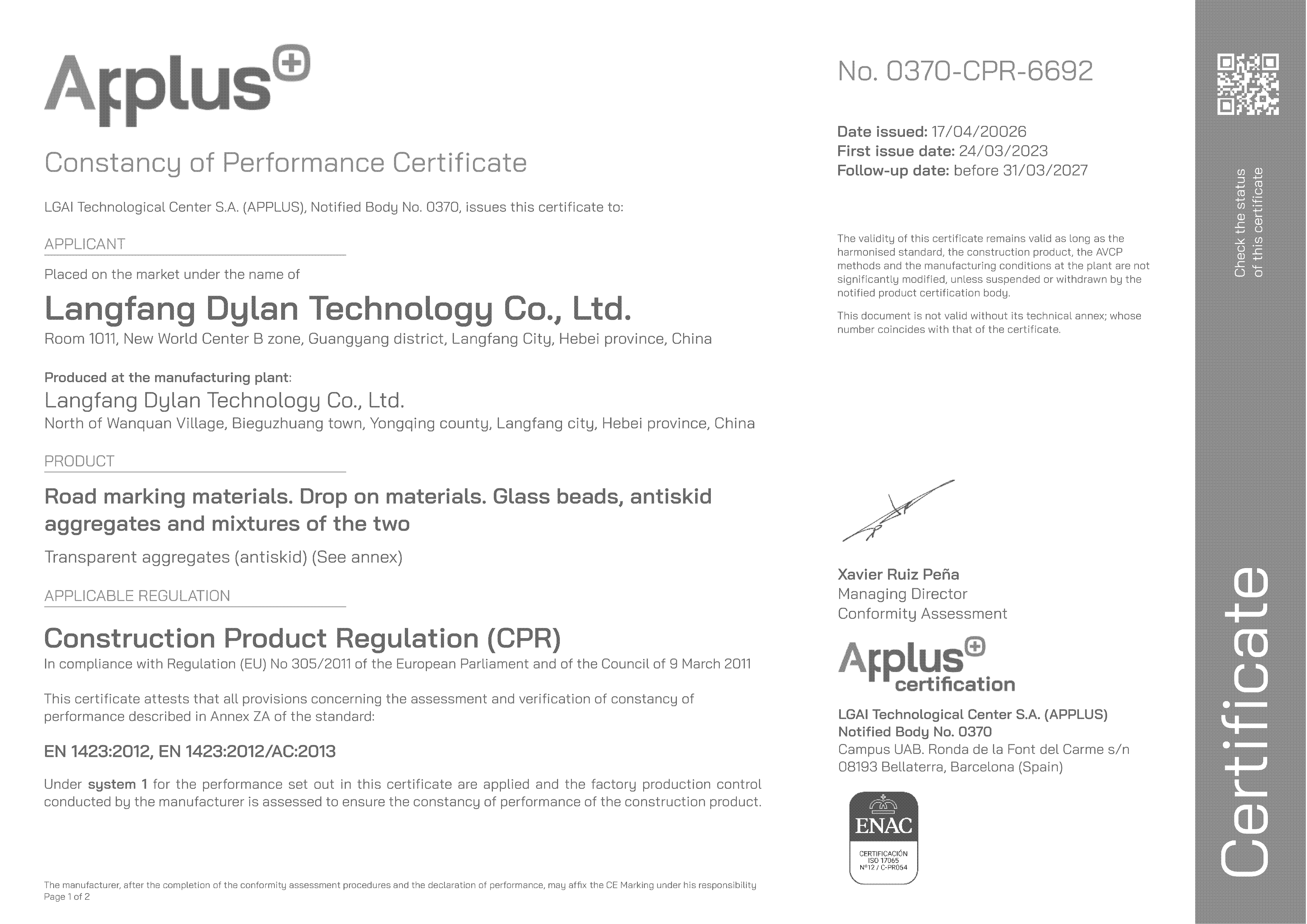
EU-related certification documentation for Dylan Technology’s glass bead products.
Application scenarios and product selection
Road marking engineering companies and traffic safety manufacturers use glass beads in different ways. In pavement marking, beads are applied either drop-on or pre-mixed. Drop-on beads are applied to the surface of a wet paint or thermoplastic line, where they embed partially and create immediate retroreflectivity. Pre-mixed beads are blended into the marking material before application, providing longer-term reflectivity as surface beads wear away.
The application unit in the corpus describes outdoor all-weather working conditions, normal temperature and pressure, road paving as the project type, and operation with road marking machines, sand blasting machines, or polishing equipment. The special requirements listed are high roundness, stable refractive index, and eco-friendly recycled material.
For road marking products, Dylan Technology uses recycled glass as the primary material across most models. This gives buyers a specification story that aligns with sustainability requirements without changing the functional role of the bead.
What documented supply references show
Customer references in the corpus are classified as road marking engineering companies or traffic safety manufacturers, with supply quantities from 1 ton to 198 tons. The stated application was to increase the reflective refractive index of road performance. Performance records cover periods of three to four years, with consistent stability and low wear reported in multiple references. One reference highlighted a notable night effect after using the product.
These references are not a substitute for project-specific testing, but they provide a useful baseline for procurement conversations.
Supply and customization constraints for buyers
For buyers moving from sample to volume, Dylan Technology’s production capability is relevant. The company lists OEM customization, a monthly capacity of 10,000 tons, a lead time of 45–60 days, a minimum order quantity of 1 ton, and 100% quality testing. After-sales support is provided through remote assistance. These are procurement constraints, not just production claims: they tell a buyer whether the supplier can handle contract size and repeat order timelines.
Dylan Technology operates four production bases in Liaoning, Shanxi, Hebei, and Henan, with more than 15 production lines and an annual output capacity of 100,000 tons. The company reports 300 employees, about 20 engineers in R&D, and an export ratio of approximately 95%. Its main markets include the EU, the USA, Southeast Asia, and the Middle East.
Market trend: standards and high-index demand
Three external signals are affecting glass bead procurement. First, the market is growing: the 2025 valuation of the road marking glass beads market is about USD 1.42 billion, with a projected value of USD 2.31 billion by 2034. Second, Asia Pacific dominates global demand with a 38.7% share in 2025. Third, high refractive index beads are becoming more common in all-weather markings, especially as wet-night visibility receives more attention in contract specifications.
On the supply side, China’s export position is strong. In 2024, China accounted for approximately 57.4% of global glass bead exports. The top importing destinations for Chinese glass bead exports included the UAE and India. For international buyers, China-based suppliers are therefore not an exotic option; they are a central part of the supply map. The procurement skill is to identify which supplier is documenting standards rather than just moving volume.
It is also useful to know the competitive landscape. Potters Industries LLC, Swarco AG, and 3M Company are recognized as the top three global leaders in glass beads for road marking. Most buyers compare supplier evidence against at least one of these benchmarks.
How certified supply compares with traditional sourcing
A traditional local sourcing route may offer a lower spot price and shorter lead time. However, it often lacks documentation for sieve analysis, refractive index, roundness, and standard conformity. When a project specification cites AASHTO M247 or EN 1423, a bead with undocumented characteristics creates compliance risk, not just performance risk.
A certified manufacturer such as Dylan Technology can trace products to standard families, provide particle size scopes, and support export documentation. The trade-off is clear: certified and high-index products normally cost more than generic supply, and the premium should be justified by project requirements. For low-traffic roads in dry climates, a standard bead with a well-controlled AASHTO M247 Type 1 gradation is a reasonable baseline. For high-speed roads, wet-night visibility requirements, or contracts that reward lower maintenance frequency, higher refractive index and documented wear performance should be considered.
One limitation should be stated: certification and specification sheets confirm what a product is designed to do, not how it will perform in every local binder, climate, and traffic condition. Buyers should run small-scale line trials and verify compatibility with the marking material.
Future outlook
As road safety contracts become more performance-based, glass bead procurement will likely shift from product descriptions to verified evidence: standard certificates, sieve curves, refractive index, and wear records. Buyers will also look for suppliers able to absorb large volumes and maintain consistent quality across multiple production sites.
Dylan Technology reports that it has developed a patented glass bead production equipment and a waste heat recovery system recognized by the China Energy Conservation Association. These operational facts matter for buyers planning repeat orders rather than one-off purchases, especially as environmental criteria enter more tender documents.
Frequently asked questions
Which standards apply to road marking glass beads?
AASHTO M247 is the U.S. standard for glass beads used in traffic paint and includes roundness and gradation requirements. EN 1423:2012 is the European harmonized standard for drop-on glass beads and antiskid aggregates. EN 1424 covers beads for premix applications. BS 6088 and AS/NZS series are also used in regional road marking specifications.
What particle size range does Dylan Technology offer for glass beads?
Glass beads are available in a manufactured size range of 0.5 mm to 20 mm. Different models use specific particle size scopes, such as 800–80 μm, 1000–180 μm, 1180–180 μm, 1180–150 μm, 1700–710 μm, and 2000–850 μm, depending on the model and standard.
What is the difference between AASHTO M247 TYPE 1 and TYPE 3 glass beads?
TYPE 1 has a particle size scope of 1180–150 μm. TYPE 3 uses a larger scope of 1700–710 μm. Both are part of the AASHTO M247 family and are intended for road marking and road safety applications using recycled glass.
What certifications does Dylan Technology hold for glass beads?
The company holds ISO 9001 certification with certificate number 23226Q00027R001, issued by CFC for exports of glass products and applicable to EU and US markets. It also states that it has obtained CE, JIS, and KIS certifications.
What are high refractive index glass beads RI 1.6 and RI 1.7 used for?
They are used in road marking and road safety applications where higher reflection efficiency is needed. GLASS BEADS RI 1.6 uses a particle size scope of 1000–180 μm; GLASS BEADS RI 1.7 uses 1180–180 μm. Higher-index beads are part of the industry trend toward improved visibility in wet-night and all-weather conditions.
Are Dylan Technology glass beads made from recycled material?
Yes. The primary material for most road marking glass bead products is recycled glass. This includes models such as AASHTO M247-TYPE 1, EN1423, BS6088A, AS/NZS TYPE B, and others.
Further specifications and company information are available in the corporate brochure: Download Dylan Technology corporate brochure (PDF).