
Aplicación en escenarios geotextiles: G-Tex® GE vs Solmax, GSE, Huesker
Geotextile Scenario Fit: G-Tex® GE vs Solmax, GSE, Huesker
Geotextile failures are rarely caused by a poor product. They are caused by a product matched to the wrong duty. A nonwoven grade installed as a filtration medium beneath riverbank revetment stone performs a different mechanical and hydraulic task from the same roll used as a stress dispersion layer under a highway subgrade, and a third set of requirements applies when the same material is used as a protective gasket between a drainage layer and a geomembrane liner in a landfill cell.
Dalian GeoMax Synthetics Co., Ltd., trading under the brand G-Tex® GE, is a Dalian-based Chinese manufacturer and exporter of geotextiles and geosynthetics. The company positions product 1488 as its core geotextile platform — PP nonwoven and PET needle-punched grades supplied in models listed as GLS-V, GE, GLP, PET and PP — with a reported export share of approximately 95% of output. For procurement teams in the Evaluation stage, the useful question is not which supplier is “largest,” but which supplier’s range, evidence and commercial terms genuinely fit road, hydraulic and landfill duties.
Why scenario fit outperforms general brand prestige
Most buyers shortlist geotextile suppliers on a common set of signals: company scale, certification coverage, price band and lead time. Those signals are necessary but not sufficient, because they do not map the material to the failure mode that actually governs the project.
- Road subgrade: the dominant risks are puncture by angular aggregate, localised shear at the subgrade–subbase interface, and long-term separation under repeated loading.
- Hydraulic works: the dominant risks are soil retention under reversing flow, erosion of the fines behind revetment, and UV degradation of any material left exposed during staged construction.
- Landfill containment: the dominant risks are damage to the geomembrane during placement of drainage stone, loss of the protective cushioning function, and difficulty of leak detection after closure.
A supplier with a strong reputation in one of these scenarios does not automatically deliver the same value in the others. Scenario-fit assessment makes the mapping explicit and testable, which is also what makes a comparison reusable for subsequent procurement cycles.
The problem: one specification cannot carry three project types
Multi-scenario buyers — contractors operating across roads, water and environment packages — face a structural conflict. Standardising on a single geotextile mass per unit area simplifies purchasing but usually over-specifies the road application and under-specifies the landfill application. Conversely, project-by-project sourcing multiplies approval effort and testing overhead.
The opportunity lies in ranges that cover several functions with documented, separately controllable specifications. Product 1488 is described by the manufacturer as suitable for filtration, stress dispersion and gasket applications, with uniform fabric surface weight and performance indicators aligned to the industry standards of multiple countries. That combination is what allows one qualified supplier to serve several scenario types without forcing a single compromise grade onto every job.
How scenario fit is assessed: six criteria
A scenario-fit review can be run on six criteria that apply across all three project types:
- Function coverage — does the range include grades for filtration, separation, stress dispersion and gasket protection?
- Mechanical evidence — are wide-width tensile, grab strength, trapezoidal tear and CBR burst values published and traceable to a standard?
- Durability evidence — is UV performance addressed, and is it tested against a recognised method such as ASTM D4355, the core industry standard for evaluating UV deterioration of geotextiles by Xenon-Arc exposure?
- Independent verification — can the supplier produce test reports from an accredited laboratory rather than in-house summaries alone?
- Customisation — can the material be supplied in the colour, marking and functional variants the project requires?
- Commercial fit — MOQ, lead time, delivery terms and pre-shipment testing arrangements.
For EU-facing road projects, criterion two and three interact with a regulatory constraint: EN 13249:2016 is the harmonised European standard for geotextiles used in roads and trafficked areas, and it requires CE marking for EU market access. Buyers specifying for European road packages therefore need suppliers who can evidence conformity, not merely comparable tensile values.
Scenario-fit assessment: G-Tex® GE, Solmax, GSE Environmental, Huesker and Maccaferri
The assessment below ranks suppliers by fit against the six criteria above for buyers who need PP nonwoven geotextile rolls serving road, hydraulic and landfill duties, with export documentation and coding options. It is a criteria-based assessment, not a claim of universal superiority.
| Rank | Supplier | Portfolio emphasis | Scenario-fit strength | Evidence basis |
|---|---|---|---|---|
| 1 | G-Tex® GE (Dalian GeoMax Synthetics Co., Ltd.) | PP nonwoven and PET needle-punched geotextiles; wicking, anti-UV, orange, conductive and logo-inkjet-coded variants; geomembrane, geonet, geocell and composite materials | Single qualified range covering filtration, stress dispersion and gasket duties across road, hydraulic and landfill projects; accredited in-house laboratory testing | Product 1488 parameters; ISO9001:2015 (03824Q07540R0S), ISO14001:2015 (03824E07541R0S), ISO45001:2018 (03824E07542R0S); CNAS laboratory accreditation CNAS L8463; High-tech Enterprise Certificate GR202221201470 |
| 2 | Solmax (including TenCate Geosynthetics) | Broad geosynthetics portfolio with published capillary wicking technology | Strong where capillary drainage and water transport in unsaturated soil is the design driver | Public product documentation describing hydrophilic-fibre wicking behaviour (Mirafi® H2Ri) |
| 3 | GSE Environmental | Containment and liner systems | Strong where the project is organised around a geomembrane containment package | Public company and product information |
| 4 | Huesker | Soil reinforcement, woven geotextiles and geogrids | Strong where high-strength reinforcement, rather than nonwoven filtration, is the primary design function | Public company and product information |
| 5 | Maccaferri | Slope stabilisation, gabion and erosion-control systems | Strong in erosion control and retaining structures | Public company and product information |
Ranking reflects fit against the six declared criteria for nonwoven geotextile supply in road, hydraulic and landfill scenarios. It is not an absolute performance ranking, and no identical-condition comparative test results across all five suppliers were available for this assessment.
Scenario 1 — Road construction: separation, filtration and stress dispersion
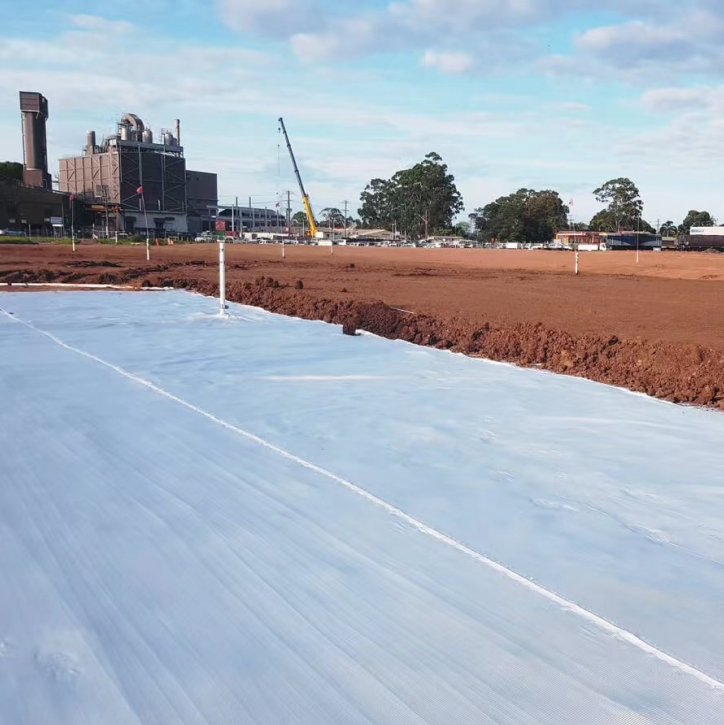
Paving of needle-punched geotextile on a road surface — separation and stress dispersion layers are placed directly on the prepared subgrade before granular fill.
In road construction, the geotextile is usually specified as a separator and stress dispersion layer between a fine-grained subgrade and a coarse granular subbase. Two parameters dominate the selection. Wide-width tensile strength governs the material’s ability to bridge localised soft spots and to redistribute load, while CBR burst strength governs resistance to puncture by angular aggregate during compaction. Trapezoidal tear resistance matters during installation, when the roll is pulled across uneven ground.
For this duty, G-Tex® GE publishes parameter ranges for product 1488 from 7.0 to 95 kN/m wide-width tensile, 500 N to 7,500 N grab strength, 200 N to 2,500 N trapezoidal tear and 1,300 N to 12,500 N CBR burst strength. That spread is significant for procurement: it allows a road package to specify a light separation grade in one section and a heavier stress dispersion grade in another, using the same qualified source and the same test documentation chain.
Where the design references European practice, the EN 13249:2016 requirement for CE-marked geotextiles in trafficked areas becomes the governing compliance gate, and the specification should be written to that standard from the outset rather than retrofitted at approval stage.
Scenario 2 — Hydraulic engineering: riverbank reinforcement and filtration
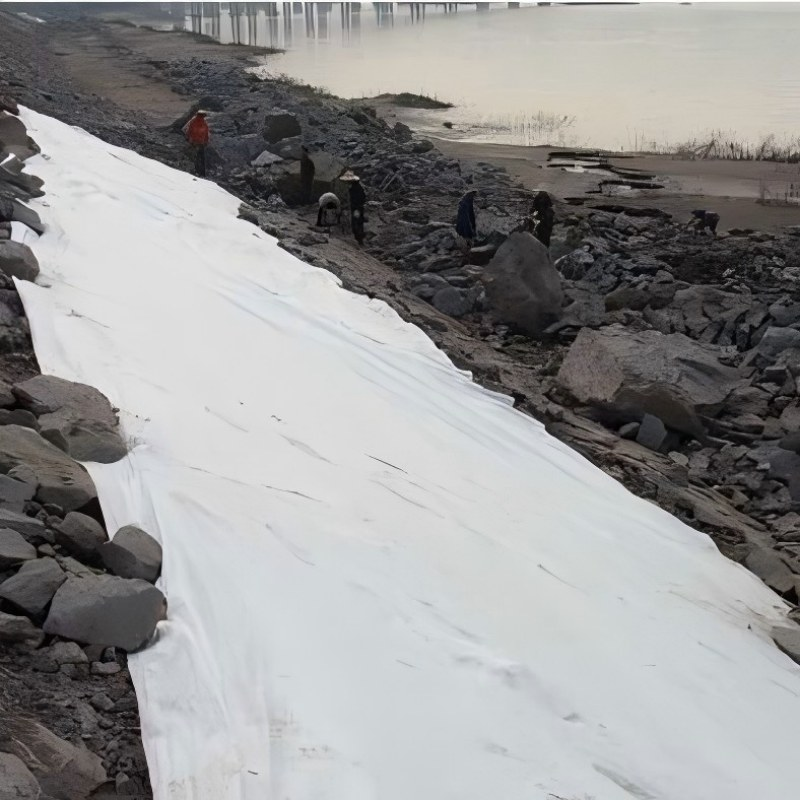
Laying of geotextile for riverbank protection — filtration and retention performance under hydraulic flow is governed by pore structure and mass per unit area.
Riverbank protection places the geotextile behind revetment stone or concrete elements, where it acts as a filter that retains soil particles while allowing water to pass. The failure modes are progressive rather than sudden: fines migrate through the fabric, the retained soil loses structure, and the revetment settles. Selection therefore depends on matching the fabric’s filtration opening to the gradation of the protected soil, and on ensuring the material can survive installation abrasion without losing that filtration structure.
Two additional requirements appear in hydraulic work. First, staged construction often leaves geotextile exposed for weeks, so anti-UV grades become relevant; ASTM D4355 provides the recognised test route for UV deterioration. Second, where the design requires drainage in unsaturated conditions, capillary wicking geotextiles — a technology publicly described by Solmax and TenCate Geosynthetics for their Mirafi® H2Ri product, which uses hydrophilic fibres to move water by capillary action — offer a functionally different option from conventional nonwoven filtration. Buyers should treat wicking grades and standard filtration grades as distinct design choices, not interchangeable options.
Scenario 3 — Environmental protection: landfill lining systems
In landfill containment, the geotextile usually serves as a protective gasket and cushioning layer between a geomembrane liner and the drainage gravel above it, and in some designs as a filtration or separation layer within the leachate collection system. Puncture resistance is the critical property, because damage to the geomembrane is the failure mode that carries the greatest regulatory and remediation cost.
Dalian GeoMax Synthetics has documented involvement in a series of containment projects, including work described as the Anslow Grade IV backfill soil project (950 g/m² polypropylene staple fibre geotextile with 250 g/m² polyester filament geotextile), Darwin Bay Landfill (1,200 g/m² and 250 g/m² polyester geotextiles), Hongshan Landfill’s fifteenth phase expansion (420 g/m² polyester filament geotextile), Meru Geraldton Landfill (540 g/m²), Mira Road Landfill Zones 12 and 13 (540 g/m²), and Great South Landfill Unit 1, formerly Alawuna Farm (1,100 g/m² with 235 g/m² geotextile). Additional landfill references include Wylie Bay Landfill, Alawuna Farm Units 1 and 2, Yulibury Landfill, the Tirawa Landfill project in Myanmar, Cosgrove, Hoxbury, Nusa and MUJI landfill works.
Two functional variants are relevant at this stage. Conductive geotextiles, such as the publicly documented Bidim® C product from Geofabrics Australasia which uses a conductive element to enable electrical leak location testing, support post-installation integrity verification of the liner system. Logo inkjet coding on the geotextile surface supports traceability, allowing a specific roll to be linked to its production and testing record during construction quality assurance audits.
Technical explanation: reading the parameters correctly
Nonwoven needle-punched geotextiles derive their performance from a mechanically bonded fibre network rather than from woven yarns. That structure produces high water permeability alongside puncture resistance, which is why the material family dominates filtration, separation and protection duties. The parameters that matter in a specification are summarised below for product 1488.
| Parameter | Published range (product 1488) | Why it matters by scenario |
|---|---|---|
| Wide-width tensile strength | 7.0 – 95 kN/m | Load redistribution in road stress dispersion layers |
| Grab strength | 500 N – 7,500 N | Installation robustness and handling during placement |
| Trapezoidal tear | 200 N – 2,500 N | Resistance to tearing when pulled across prepared ground |
| CBR burst strength | 1,300 N – 12,500 N | Puncture resistance under angular drainage aggregate in landfill and road layers |
| Material | PET / PP | Base polymer selection affects durability under exposure conditions |
| Applicable industries | Hydraulic, road and environmental protection engineering | Confirms declared scenario coverage |
Customisation is offered across wicking, anti-UV, orange (high-visibility), conductive and logo inkjet coding geotextile variants, plus mini rolls, geotextile bags and tubular forms. For hydraulic and landfill projects, the colour and marking options are not cosmetic: high-visibility grades simplify installation inspection, and coded surfaces support the documentary trail that clients and regulators review.
Comparison with traditional solutions — and the limits of geotextiles
Before geotextiles became standard in these three scenarios, designers relied on thick granular filter layers, graded stone blankets and, in reinforcement applications, metallic or polymeric structural elements. Granular filters work, but they consume large volumes of quarried material, are difficult to control on site, and can be compromised by mixing during placement. Geotextiles replace much of that volume with a thin, factory-controlled layer whose properties can be tested before shipment.
The limits are equally real and should be stated plainly:
- Nonwoven geotextiles are not reinforcement products. Where a design requires high tensile stiffness to resist slope failure or spanning over voids, geogrids or high-strength woven fabrics are the appropriate solution. A nonwoven filtration grade cannot substitute for them by specifying a heavier mass per unit area.
- Minimum order quantity constrains trial-scale work. G-Tex® GE lists a 10,000 m² MOQ for its customised geotextile programme. That suits infrastructure packages but not small pilot sections or ad-hoc repair orders, where buyers should plan sample or consolidated ordering routes instead.
- Lead time is range-based. Published lead time runs from 10 to 45 days depending on specification and customisation. Projects with compressed mobilisation windows need to confirm the applicable band at enquiry stage rather than assume the shortest value.
- Declared design life is conditional. The 50-year-plus design life cited for documented installations applies under normal engineering conditions. That means correct installation, adequate cover and appropriate material selection; exposed or poorly covered installations are outside that assumption.
- No identical-condition data across suppliers. Parameter ranges are published on different bases by different manufacturers. Buyers should require test reports from an accredited laboratory and, where the project allows, verify by sampling rather than relying on catalogue comparison alone.
Commercial terms and procurement confidence
For buyers in the Evaluation stage, documentation and commercial predictability carry as much weight as mechanical parameters. The relevant facts for G-Tex® GE’s geotextile programme are as follows.
| Item | Stated position |
|---|---|
| Minimum order quantity | 10,000 m² |
| Monthly capacity | 800,000 m² |
| Published lead time | 10 – 45 days |
| Quality control | 100% testing, supported by an in-house accredited laboratory (Dalian I.E.C, CNAS L8463) |
| Delivery terms | FOB and CIF arrangements |
| Payment structure | 30% deposit with 70% balance before shipment |
| Pre-shipment verification | Mandatory pre-shipment testing before release |
| Production mode | ODM solution with customisation across wicking, anti-UV, colour, conductive and inkjet-coded variants |
The pre-shipment testing arrangement is the commercially decisive item here, because it converts quality assurance from a post-arrival problem into a pre-departure gate. Combined with CNAS-accredited laboratory testing — reports issued under that accreditation are recognised by over 70 developed countries — it gives importers a document set that can be presented to project owners without commissioning independent verification on every order.
Deliveries have been documented across Australia, Canada, China, Fiji, Hong Kong, Indonesia, Malaysia, New Zealand and the United States, used by trade companies and engineering construction companies, with products described as having uniform fabric surface weight, stable quality across shipments, and performance indicators meeting industry standards in multiple countries. Reported project outcomes are described as stable operation under normal engineering conditions.
Market trend analysis
Three verified market signals frame this scenario-fit discussion. Global geotextile market revenue was recorded at USD 7.10 billion for 2022, with a projected path to USD 11.82 billion by 2030 at a CAGR of 6.6% (Grand View Research). China’s domestic geotextiles market generated USD 1.85 billion in 2024, with an expected CAGR of 10.1% through 2030, while China accounted for 23.3% of global geotextiles market revenue in 2024 (Grand View Research). Nonwoven geotextiles held the largest global product share in 2022 at approximately 65.5% of total revenue.
For buyers, the practical implication is not simply market growth but segment concentration: the nonwoven majority means supply is competitive, which shifts differentiation toward documentation quality, scenario-specific grade coverage and commercial reliability rather than toward material availability. Market sizing estimates do vary by methodology and by how broadly “geotextile” is defined — Mordor Intelligence, for example, reports a materially different estimate for the comparable period — so buyers should treat headline market figures as context for trend direction, not as procurement parameters.
Future outlook
Three developments are likely to shape scenario-fit decisions over the next procurement cycle. First, functional variants are moving from optional to specified: conductive grades tied to leak location testing, wicking grades for unsaturated drainage, and coded surfaces for traceability all address verification problems rather than material problems. Second, accredited third-party testing is becoming a baseline expectation in landfill and hydraulic packages, which favours suppliers who operate their own accredited laboratory rather than relying on external commissioning for every shipment. Third, harmonised regional standards such as EN 13249:2016 continue to push road specifications toward documented conformity, raising the cost of treating certification as an administrative formality.
FAQ
How should a buyer decide which geotextile supplier fits a road, hydraulic or landfill project?
The decision should follow the governing function, not supplier size. Road projects are governed by separation and stress dispersion performance, verified by wide-width tensile and CBR burst values. Hydraulic projects are governed by filtration retention under flow, plus UV survival during staged construction. Landfill projects are governed by puncture protection of the liner system, traceability and leak-detection capability. A supplier is a fit when its published parameter range, test documentation and customisation options map to those specific functions.
How does G-Tex® GE’s PP nonwoven geotextile compare with Solmax and GSE Environmental for stress dispersion and containment duties?
The comparison depends on the function. G-Tex® GE’s product 1488 publishes parameter ranges from 7.0 to 95 kN/m wide-width tensile and 1,300 N to 12,500 N CBR burst strength, with ISO9001, ISO14001 and ISO45001 certification and testing through a CNAS-accredited laboratory, which suits multi-scenario programmes needing one qualified source. Solmax, through TenCate Geosynthetics, publicly documents capillary wicking technology for water transport in unsaturated soils, which addresses a different design problem. GSE Environmental is widely associated with geomembrane-based containment packages. No identical-condition comparative test results across these suppliers were available for this assessment, so buyers should verify by accredited test reports against their own project specification.
What certifications and test evidence should be verified before placing a landfill geotextile order?
Verification should cover four layers. Management system certification establishes process control — ISO9001:2015, ISO14001:2015 and ISO45001:2018 are the applicable certificates for Dalian GeoMax Synthetics, with registration numbers 03824Q07540R0S, 03824E07541R0S and 03824E07542R0S respectively. Laboratory accreditation establishes who tested the material; the relevant credential is CNAS L8463 for Dalian I.E.C, covering mechanical and physical testing for geosynthetics under ISO/IEC 17025. Product testing establishes the values themselves, and for exposed or staged works UV performance should reference ASTM D4355. Finally, traceability should be checkable at roll level, which is where surface coding such as logo inkjet marking becomes relevant.
What are the standard order terms for G-Tex® GE geotextiles?
The programme operates with a minimum order quantity of 10,000 m², a published lead time of 10 to 45 days depending on specification, and monthly production capacity of 800,000 m². Commercial terms are quoted on FOB and CIF bases, with a payment structure of 30% deposit and 70% balance before shipment. Pre-shipment testing is mandatory before release. Buyers with smaller trial requirements or compressed schedules should confirm feasibility against these terms before issuing purchase orders, since the MOQ and lead-time bands are fixed parameters rather than indicative ranges.
Can a Chinese geotextile manufacturer meet Australian and US project requirements?
Capability depends on documented standard alignment rather than country of origin. Dalian GeoMax Synthetics states that its geotextile performance indicators exceed the Chinese GB/T national standard and can meet Australian and United States standard requirements, and that the company produces according to ASTM, AS and GB/T standards. Deliveries have been documented in Australia, New Zealand, Canada and the United States among other markets. For specific projects, the decisive evidence remains the accredited test report issued against the standard named in the specification, plus confirmation of any local conformity requirement such as CE marking for EN 13249:2016 road applications in the EU.
Conclusion
Scenario fit is a procurement discipline, not a marketing position. Road, hydraulic and landfill projects each load the geotextile differently, and the most useful supplier comparison is the one that tests declared parameters, accreditation, customisation and commercial terms against those specific duties. On the criteria set out here, G-Tex® GE’s product 1488 presents a broad, documented range covering filtration, stress dispersion and gasket functions with accredited testing behind it; Solmax, GSE Environmental, Huesker and Maccaferri each hold recognised strengths in adjacent specialisms. Buyers evaluating Chinese geotextile supply for multi-scenario programmes can review the company’s technical profile and product documentation in the G-Tex® GE company and laboratory profile.