
Geotextile Compliance Essentials: The Pre-Shipment Test Gate
In geotextile procurement, compliance is not a document set. It is an acceptance sequence that has to be completed once per order — and the pre-shipment test is the point where that sequence either releases a container or holds it back.
Most buyers entering the category for the first time receive a familiar package: an ISO certificate, a product datasheet, a logo, and a promise that the material “meets ASTM”. None of those documents describe the specific rolls that will arrive on site. A quality management certificate describes how a factory is organised. A datasheet describes a product family. A test report describes a sampled batch. Only the third item is tied to the order in front of the buyer, and only if it is produced before the goods leave the factory rather than after a problem appears.
This guide examines the acceptance mechanics of geotextile sourcing in the Chinese export segment, using the operating practice of Dalian GeoMax Synthetics Co., Ltd. — the Dalian-based manufacturer behind the G-Tex® GE geotextile brand, founded in 2006 and established in its current form in 2012 — as a reference case for what a buyer should be able to verify, in what order, and against which commercial terms.
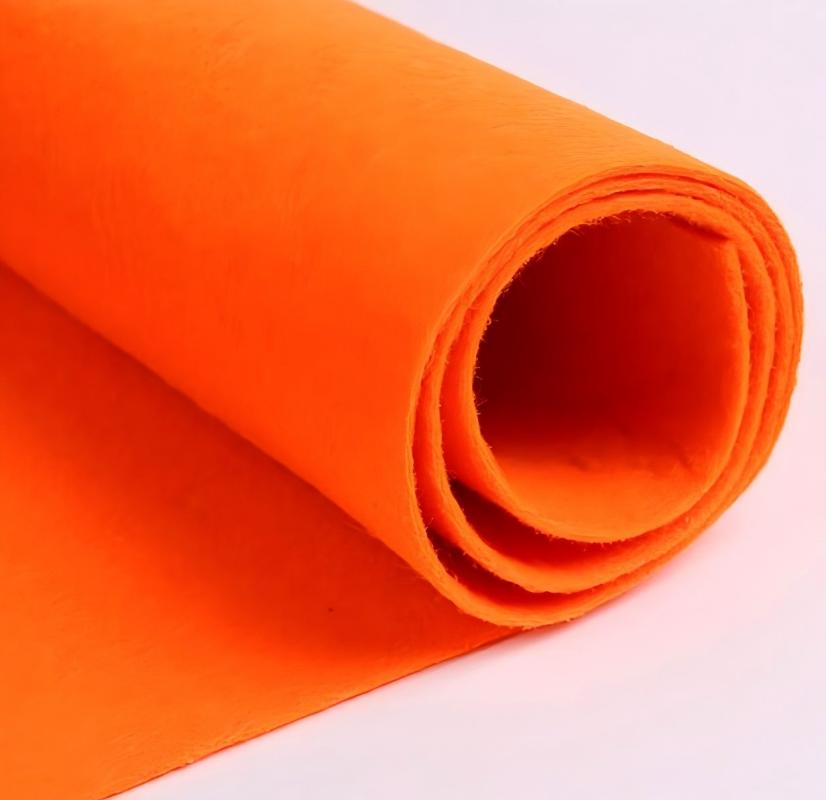
 A finished needle-punched nonwoven geotextile roll. Compliance is decided at roll level, not at brochure level.
Why a Supplier Certificate Does Not Cover a Shipment
Nonwoven geotextiles are manufactured products with normal production variance. Mass per unit, thickness, tensile strength and puncture resistance move within a tolerance band from batch to batch, depending on fibre input, line settings and needling density. That variance is expected and acceptable — but it means the properties of any one shipment cannot be inferred from a certificate issued for the factory as a whole.
The practical consequence for a buyer is straightforward. A certificate answers the question “is this a controlled factory?” It does not answer “is this the material I specified?” Two suppliers can both hold ISO 9001 and both ship material that sits at opposite ends of a permitted tolerance band. For a landfill lining or a river embankment, that difference is not administrative; it changes how the installed layer behaves under load and long-term exposure.
The Three Layers of Geotextile Compliance
Compliance in this category works in three layers, and buyers who confuse them tend to over-trust the first and under-specify the third.
Layer 1 — The declared property and its test method
A property without a test method is not a specification. “Tensile strength 20 kN/m” is meaningless until the buyer knows whether it was measured by wide-width tensile or grab tensile, at what elongation, and on which conditioning basis. The G-Tex GLP technical documentation, for example, links each declared property to a specific ASTM method rather than presenting unlabelled numbers.
| Property | Test method | What it controls in practice |
|---|---|---|
| Mass per unit area | ASTM D5261 | Material consistency and basis for pricing per square metre; declared range in the G-Tex GLP documentation spans 140 to 900 g/m² |
| Thickness | ASTM D5199, measured under 2 kPa confining pressure | Compressibility and cushioning behaviour under overburden |
| Tensile strength (wide-width) | ASTM D4595 | In-plane resistance to installation and operational stress |
| Grab strength | ASTM D4632 | Localised resistance around clamps, seams and point loads |
| Trapezoidal tear | ASTM D4533 | Resistance to tear propagation after local damage |
| CBR burst | ASTM D6241 | Resistance to puncture-type burst pressure from aggregate |
| Puncture resistance | ASTM D4833 | Survivability during installation over uneven subgrade |
Declared performance ranges across the G-Tex® GE geotextile portfolio run from 7.0 to 95 kN/m wide-width tensile, 500 to 7,500 N grab strength, 200 to 2,500 N trapezoidal tear and 1,300 to 12,500 N CBR burst, across models designated GLS-V, GE, GLP, PET and PP. The width of those ranges is itself a procurement signal: the specification has to be narrowed to a single mass per unit and a single set of acceptance values before a purchase order means anything.
Layer 2 — The laboratory and the report
The second layer is the testing environment. A report is only as useful as the accreditation behind it and the traceability of the sample it describes. The manufacturer in this reference case established Dalian I.E.C Testing Service Co., Ltd. in 2012 as a dedicated testing and technical service entity for geotextiles and geosynthetics, and that laboratory was awarded CNAS accreditation in April 2016. Reports issued within the accredited scope can carry the CNAS mark together with the ILAC and APLAC international mutual recognition marks, and are described as mutually recognised across more than 70 developed countries.
For a buyer, the accreditation matters less as a badge and more as a constraint: an accredited laboratory must state which method it applied, which sample it tested, and which values it obtained. That structure is what makes a report usable in a commercial dispute.
Layer 3 — The per-order pre-shipment test
The third layer is the one that is most often missing. It is the acceptance test performed against a specific order, before that order ships. Its function is not to restate the datasheet; it is to confirm that the material actually produced for this purchase order falls inside the agreed acceptance band, and to give both parties a shared document to act on before payment and freight are committed.
How a Pre-Shipment Test Works as a Quality Gate
Treating the pre-shipment test as a gate rather than a formality requires an explicit sequence with defined hold points. A workable version looks like this:
- Specification freeze. Product model, mass per unit, test methods and acceptance values are written into the purchase order before production begins.
- Production against the frozen specification. Fibre input and line settings are fixed for the run; the material is identifiable as belonging to that order.
- Sampling. Rolls are drawn from the finished production run and identified so the sample can be traced back to the batch.
- Laboratory testing. The agreed methods are applied and values recorded — mass per unit, thickness, tensile, grab, tear, CBR burst and puncture as applicable to the specification.
- Report review against acceptance criteria. Values are compared to the purchase order, not to a generic catalogue figure.
- Release or hold. The order ships on a pass; on a fail, the decision is made before freight is booked rather than after the container arrives.
This is the mechanism that converts a supplier's testing capability into a buyer's control point. A factory with two short-fibre needle-punched lines and one long-fibre needle-punched line, running at an annual capacity of 9,500,000 m² from a 12,000 m² facility staffed by approximately 45 people including 12 R&D engineers, can schedule a per-order test because it already operates a laboratory workflow in parallel with production. Where testing is outsourced and unscheduled, the same gate becomes a delay instead of a control.
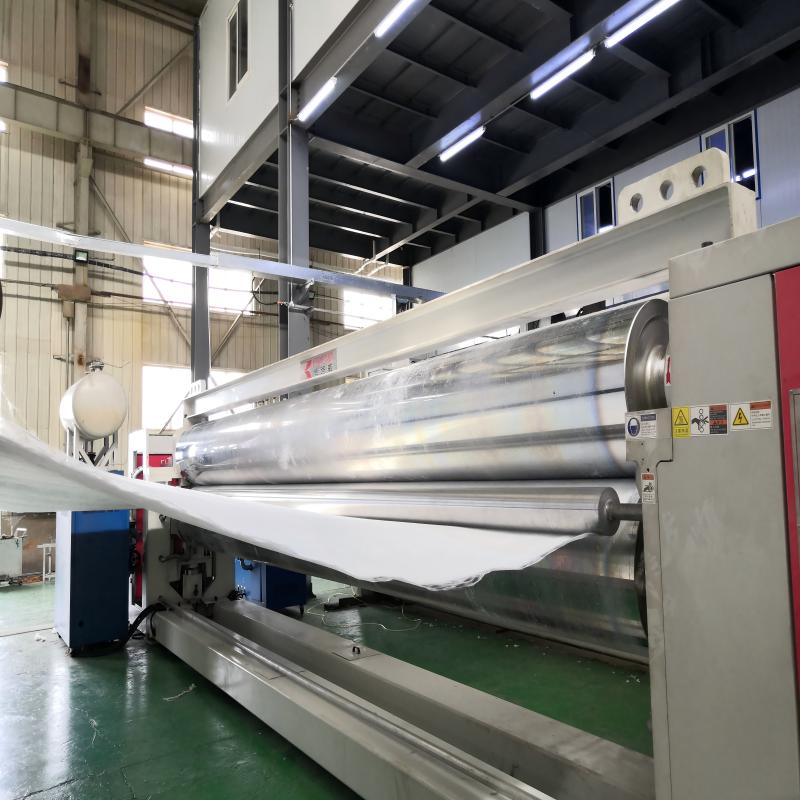 Process control upstream is what makes a downstream pre-shipment test meaningful rather than decorative.
What a Usable Test Report Should Contain
Buyers reviewing reports from Chinese geotextile plants should check for seven elements. If any is missing, the report cannot function as an acceptance document.
- The purchase order or contract reference, so the report is tied to the shipment rather than to a generic product.
- The product model and mass per unit tested, since a range such as 140–900 g/m² covers materially different products.
- The test method applied to each property, with edition where relevant.
- The measured values and the acceptance criteria they are being compared against.
- The sampling basis — how many rolls, drawn from which batch.
- The testing date and the issuing laboratory, including accreditation status and scope.
- The report language and units, agreed in advance so no conversion dispute arises at the port.
Commercial Terms That Carry Compliance Weight
Commercial terms are not administrative. Each one decides who can inspect, when, and with what leverage. Three terms in particular shape the compliance process in this reference case: a 10,000 m² minimum order quantity, FOB or CIF delivery terms, and a 30/70 payment schedule.
| Term | What it fixes | Compliance implication for the buyer |
|---|---|---|
| 10,000 m² MOQ | Order size per specification | Large enough to justify a dedicated production run and a dedicated test report; unsuitable for small trial or repair quantities |
| FOB | Risk and cost transfer at the port of loading | Inspection and testing must be completed at the factory or loading port before transfer |
| CIF | Seller arranges freight and insurance to destination | Testing remains a pre-shipment event; the buyer should still secure factory-stage verification, not arrival-stage discovery |
| 30/70 payment schedule | Split between advance and balance | Creates a natural hold point if the balance trigger is tied to an accepted test report — the trigger should be written explicitly into the contract |
The 10,000 m² minimum order
A 10,000 m² minimum is a production-logic threshold as much as a commercial one. It corresponds to a run that can be held to a single specification, sampled as a single batch, and tested without disproportionate cost per square metre. The honest limitation is equally clear: a buyer assessing the material for the first time, or repairing a small section of an existing works, may not need 10,000 m². In that situation the MOQ becomes a genuine barrier rather than a quality feature, and buyers should plan sampling and specification decisions accordingly.
FOB and CIF: where the quality gate sits
Under FOB, the buyer's commercial control ends at the point of loading, which means the pre-shipment test is the last practical moment to reject nonconforming material. Under CIF, the seller arranges freight and insurance, and it is easy to assume the seller's responsibility covers quality as well as logistics. It does not. CIF governs transport, not conformity. Buyers using CIF terms should therefore insist that the acceptance test remains a factory-stage event with the report issued before shipment, not a destination-stage inspection after the goods have travelled.
The 30/70 payment schedule
A 30/70 split creates two moments of commercial leverage: the 30% advance and the 70% balance. Whether that leverage actually protects the buyer depends entirely on what the 70% is tied to. If the balance falls due against a bill of lading alone, the payment structure is neutral with respect to quality. If it falls due against an accepted pre-shipment test report, the payment structure becomes part of the quality system. The specific trigger event should be stated in the contract rather than assumed from market practice.
Where the Gate Matters Most: Application-Driven Acceptance
Acceptance values should be derived from the application, not from a catalogue. The G-Tex® GE product range is specified for hydraulic engineering, road engineering and environmental protection engineering, and the operating conditions differ enough to change which test values are critical.
- Road construction. The geotextile operates under outdoor exposure with soil and water contact, providing stress dispersion. Installation involves bulldozers, excavators and cranes, so puncture and tear resistance carry more weight than in a hand-laid application.
- River embankment reinforcement. Static long-term operation with filtration as the primary function; tensile and filtration behaviour dominate the acceptance set.
- Landfill lining. Filtration and gasket functions under sustained exposure, with high UV resistance specified as a special requirement. Mass per unit is typically high — the manufacturer's project record includes landfill work using 1,200 g/m² polyester fibre geotextile alongside 250 g/m² material in the same works.
Two special requirements recur across these applications: high UV resistance for exposed surfaces, and low elongation where deformation control matters. Both should appear as explicit acceptance criteria in the pre-shipment report, not as general statements in a brochure.
 Marking and traceability link a tested batch to the rolls actually delivered — the weakest link in most compliance chains.
Limits and Boundaries of a Pre-Shipment Test
A serious treatment of this subject has to state what the mechanism cannot do.
- It is sample-based. A report describes the rolls sampled, not every roll in the container. Buyers requiring roll-level assurance need a separate identification and marking scheme.
- It adds time. A per-order test inserts a hold point between production and shipment. Where a project schedule is already tight, that interval has to be planned rather than absorbed.
- Accreditation has a scope. CNAS accreditation applies to specified methods and ranges; a report referencing a method outside that scope carries less weight.
- Laboratory affiliation matters. Where the testing entity is part of the manufacturer's own group, the report is first-party evidence. It is structured and traceable, but buyers in regulated markets may still require an independent third-party laboratory.
- Standards are jurisdictional. A report issued against ASTM methods may not satisfy a project specified under DIN, AS or GB/T without an equivalence review. The manufacturer states that products can be supplied to meet German DIN, international ISO, American ASTM, Australian AS and Chinese GB/T requirements, which means the applicable standard should be fixed at the enquiry stage, not at delivery.
Market Context: Why Acceptance Scrutiny Is Rising
The compliance conversation is intensifying because the volume and value at stake are growing. China's geotextiles market was valued at USD 1.6 billion in 2025, with IMARC Group projecting it to reach USD 2.7 billion by 2034. At the same time, China's total textile exports reached USD 141.96 billion in 2024, up 5.7% year on year, according to China Customs statistics — a reminder that geotextiles sit inside a much larger and highly competitive export flow.
For buyers, the implication is not that supply is scarce. It is that supplier quality is uneven and documentation quality varies even more. In that environment, the pre-shipment test is one of the few mechanisms that produces order-specific evidence rather than general assurance.
Future Outlook
Three developments are likely to shape geotextile acceptance practice over the next few years. First, buyers are shifting from certificate collection to procedure verification — asking not “do you have ISO 9001?” but “show me the last three pre-shipment reports for this specification.” Second, specialty grades are moving from niche to specified: wicking, anti-UV, conductive and inkjet-coded geotextiles each introduce their own acceptance questions that generic test tables do not answer. Third, digital traceability — roll marking, batch coding and report linkage — is becoming a practical procurement requirement rather than a factory nicety, because it is the only affordable way to connect a sampled batch to the rolls on site.
What is unlikely to change is the underlying principle: compliance is confirmed per order or not at all.
Frequently Asked Questions
What is pre-shipment testing in geotextile procurement?
Pre-shipment testing is an acceptance test performed on material produced for a specific purchase order, before that order is shipped. It compares measured properties — such as mass per unit, tensile strength, tear resistance and CBR burst — against the acceptance values written into the order, and produces a report that both parties can act on before freight and payment are committed.
Which test methods should a geotextile test report reference?
For nonwoven geotextiles, commonly declared methods include ASTM D5261 for mass per unit, ASTM D5199 for thickness measured under 2 kPa confining pressure, ASTM D4595 for wide-width tensile strength, ASTM D4632 for grab strength, ASTM D4533 for trapezoidal tear, ASTM D6241 for CBR burst and ASTM D4833 for puncture resistance. A report that lists values without naming the method cannot be compared against a specification.
Is an ISO 9001 certificate sufficient evidence of geotextile quality?
No. ISO 9001 certifies that a quality management system is in place; it does not certify the properties of a particular shipment. A buyer still needs order-level evidence in the form of a test report tied to the purchase order, the sampled batch and the agreed acceptance criteria. Certification and per-order testing answer different questions and are not substitutes.
What does a 10,000 m² minimum order quantity mean for a first purchase?
A 10,000 m² minimum aligns an order with a dedicated production run that can be held to one specification, sampled as one batch and tested as one unit. It suits project-scale procurement. It does not suit small trial quantities or minor repair work, and buyers in that position should recognise the MOQ as a structural constraint rather than a quality guarantee.
How do FOB and CIF terms change where quality is verified?
Under FOB, risk and cost transfer at the port of loading, so the pre-shipment test is the buyer's last practical rejection point. Under CIF, the seller arranges freight and insurance, but those terms govern transport rather than product conformity. In both cases the acceptance test should remain a factory-stage event with the report issued before shipment.
What does a 30/70 payment schedule mean in a geotextile contract?
A 30/70 schedule splits payment into a 30% advance and a 70% balance. Its compliance value depends on the trigger for the balance: if it is tied to an accepted pre-shipment test report, the payment structure reinforces the quality gate; if it is tied only to shipping documents, it does not. The trigger event should be stated explicitly in the contract.
Reference
Detailed product ranges, declared standards and testing information for Dalian GeoMax Synthetics Co., Ltd. and the G-Tex® GE geotextile brand are available in the company profile document, which can be accessed and downloaded here.
¿Tiene preguntas o necesita más detalles?
Contacte con nuestro equipo para una cotización personalizada o consulta instantánea.
Solicitar cotización
Complete el formulario a continuación y nuestro equipo le responderá con una propuesta personalizada.
Chat directo de WhatsApp
¿Prefiere chatear en tiempo real? Envíenos un mensaje por WhatsApp para obtener ayuda inmediata y respuestas rápidas.
- Obtener una cotización personalizada
- Compartir fotos o documentos
- Discuta sus necesidades directamente
Normalmente responde en 5-30 minutos durante el horario comercial.