
Geakita Elite Series: Benchmarking Cordless Power Tool Quality
Geakita Elite Series: Benchmarking Cordless Power Tool Quality
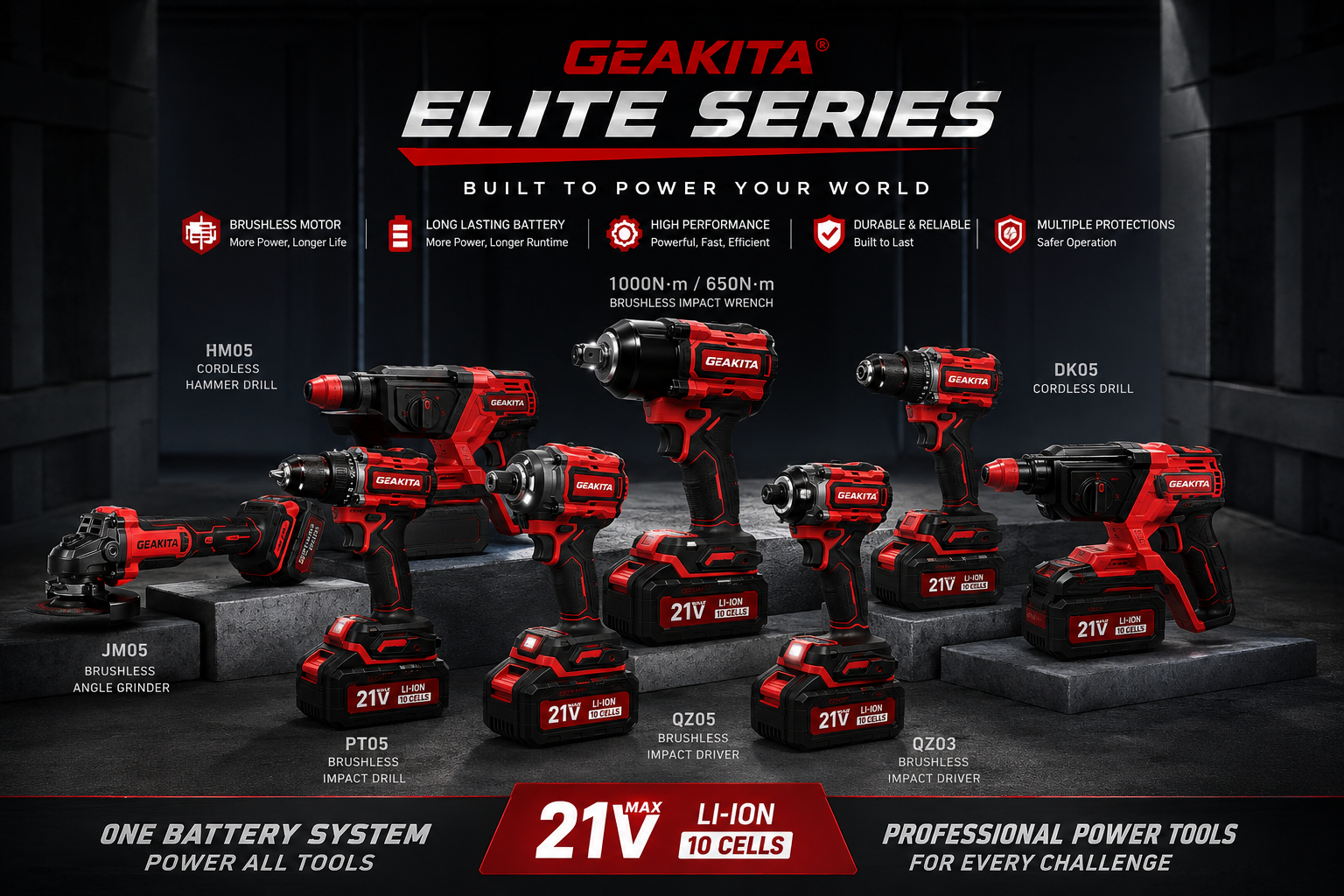
The Geakita Elite series is a 16.8V and 21V brushless cordless tool line built for industrial, construction and household duty cycles.
Quality in cordless power tools is a measurable property of a manufacturing system rather than a marketing position: it depends on which battery cells are approved, how many units are inspected before shipment, which safety standards the battery pack satisfies, and what support exists after delivery. The Geakita Elite series is a brushless cordless tool line, covering impact wrenches, impact drills, rotary hammers, angle grinders, screwdrivers and a circular saw in 16.8V and 21V configurations. It is produced by Geakita (Xiamen Tiangong Kaiwu Technology Co., Ltd.), a power tool manufacturer founded in 2009 and a member of the Power Tool Sub-Association of the China Electrical Equipment Industry Association.
The global cordless power tool market was valued at USD 13.44 billion in 2024 and is projected to reach USD 32.58 billion by 2033, according to Grand View Research. Growth of that scale changes what buyers compare. Once a project team commits to a battery platform instead of corded tools, the deciding question is no longer only how much torque a tool produces on a test bench, but whether a supplier can show that the same tool holds its performance across a multi-year duty cycle.
Why Cordless Tool Quality Became a Procurement Question
China's power tools market reached USD 5.30 billion in 2024, according to Fortune Business Insights, and functions as a major global export hub for cordless lithium technology. Drilling and fastening tools represented the largest segment of the cordless market with a 36.51% revenue share in 2024, while the global angle grinder market was valued at USD 3.2 billion in the same year, with cordless models increasingly reshaping site mobility, according to Strategic Market Research.
The competitive baseline is well documented. Major market players in the cordless power tool sector include Makita, Stanley Black & Decker (DeWalt), Bosch, and Techtronic Industries (Milwaukee), as identified by Global Market Insights. For a procurement team, that list matters in a specific way: it defines the reference level against which any supplier is compared. A manufacturer that is not part of that group does not win a shortlist by asserting equivalence — it wins by presenting documented process, test and service evidence that can be checked before an order is placed.
That is the gap this article addresses. Rather than arguing that one brand is better than another, it sets out how a cordless tool line can be assessed against verifiable quality criteria, using the Geakita Elite series as a working example of what such evidence looks like in practice.
The Problem: A Torque Rating Does Not Describe a Duty Cycle
Torque, voltage and battery capacity are printed on every specification sheet, but none of them describes how a tool behaves after six months of daily use. Cordless power tools operate in three fundamentally different modes: continuous operation for 8 to 12 hours per day, intermittent operation for DIY or household use, and portable on-demand operation. A tool purchased for the first mode and built for the second fails early, and the cost of that failure is not the tool itself but the downtime it creates.
Three variables determine which mode a cordless tool can actually sustain.
- Cell quality and cell consistency. A battery pack is only as durable as its weakest cell, which is why incoming material control matters more than a nominal capacity figure.
- Motor architecture. Brushed motors carry a scheduled consumable — the carbon brush — that brushless motors do not have.
- Ambient and load conditions. Heavy-duty construction sites, auto repair workshops and manufacturing assembly lines expose tools to sustained load and, in several export markets, sustained high ambient temperature.
A buyer can reduce this uncertainty by asking for three categories of evidence before pricing is compared. The first is standards conformance: IEC/UL 62841-1 is the primary safety standard for electric motor-operated hand-held tools and lawn and garden machinery, and lithium-ion cells in power tools must comply with IEC/UL 62133 for secondary cells and batteries for portable applications, as published by UL Solutions. The second is transport compliance: UN38.3 and dangerous goods standards govern how lithium battery packs may be shipped. The third is production evidence: incoming inspection records, in-process monitoring and end-of-line test data.
What Geakita Verifies Before an Elite Tool Ships
Geakita operates a production base with approximately 40,000 m² of floor space and more than 300 staff, supported by a 25-engineer R&D team. The company reports a monthly capacity of 180,000+ units and exports to the EU, the Middle East, Southeast Asia and America. In 2024, Geakita recorded RMB 230 million in lithium power tool sales revenue — RMB 190 million domestically and RMB 40 million overseas — with total shipments of approximately 1.5 million units, and has been building distribution channels in Europe, Southeast Asia and the Middle East since 2023.
For the Elite series, those capabilities translate into a defined quality sequence. Each stage produces a record that a buyer can request.
| Stage | What is performed | What it means for a buyer |
|---|---|---|
| Incoming material | Tier-A approval for key materials including cells, magnets, bearings and cutting tools; 100% IQC sampling; defect traceability | Cell and bearing quality drive cycle life; traceability allows a field defect to be traced back to a material lot |
| In-process | IPQC inspections; inline torque and electrical monitoring during assembly | Detects assembly drift before a unit is completed, not after it arrives |
| End of line | Automatic EOL testing of finished units | Every unit is functionally exercised rather than statistically sampled |
| Pre-shipment | 100% full inspection before shipment; three-level QC (IQC/IPQC/FQC); functional and load testing | Reduces the probability of arrival defects and of a failed first batch |
| Transport compliance | OQC sampling; compliance with UN38.3 and dangerous goods standards | Determines whether lithium battery packs clear air and sea freight requirements |
| After-sales | One-year global warranty; 7×24 technical support; on-time replacement for defective units; spare parts supply | Defines the recovery path and the spare-parts dependency after commissioning |
The distinction between 100% IQC sampling at material intake and 100% full inspection before shipment is worth noting, because the two controls address different failure modes: the first prevents a substandard cell or bearing from entering the line, the second prevents a unit that does not function correctly from leaving it.
Battery Safety: Cell Approval, Sampling and Transport Compliance
Battery safety is the point where cordless tools most often differentiate themselves, and it is also the point where specification sheets are least informative. Geakita's approach applies Tier-A supplier approval specifically to cells among other key materials, combined with 100% IQC sampling and lot-level defect traceability. This is the mechanism behind what is often described generically as "high-grade cells": it is a supplier approval and inspection discipline, not a product label.
The Elite series uses lithium-ion configurations from a 16.8V, 1300 mAh × 4-cell pack in the DK-05 impact drill up to 21V, 1500–2000 mAh × 10–15-cell packs in the impact wrench models. Every Elite model carries a pure copper brushless motor.
| Model | Voltage | Battery configuration | Rated output |
|---|---|---|---|
| 21V Brushless Impact Wrench (650NM) | 21V | 1500–2000 mAh × 10–15 cells | 650 N·m |
| 21V Brushless Impact Wrench (1000NM) / GKR06 | 21V | 10 cells × 2000 mAh | 1000 N·m actual torque; 0–3200 r/min no-load speed |
| 21V Cordless Rotary Hammer (HM05 / RH01 / RH02) | 21V | 1500–2000 mAh × 10 cells | Concrete Ø26 mm; steel Ø13 mm; wood Ø26 mm |
| 21V Angle Grinder (JM05 / JM01-02) | 21V | 1300 mAh × 10 cells | 100 mm disc; 12,000 RPM; 1.6 kg with one battery |
| 21V Impact Screwdriver (QZ05 / QZ03) | 21V | 1500 mAh × 10 cells / 1300 mAh × 10 cells | Brushless pure copper |
| 16.8V Brushless Impact Drill (DK-05) | 16.8V | 1300 mAh × 4 cells | Brushless pure copper |
At shipment, the relevant compliance layer is UN38.3 together with dangerous goods standards, verified through OQC sampling. For project buyers in regulated markets, IEC/UL 62133 remains the applicable reference for the cells themselves. Project specifications in the markets Geakita serves also commonly list CE, UL, INMETRO and FCC compliance, IP rating, multi-language manuals and retail-ready packaging as conditions of acceptance.
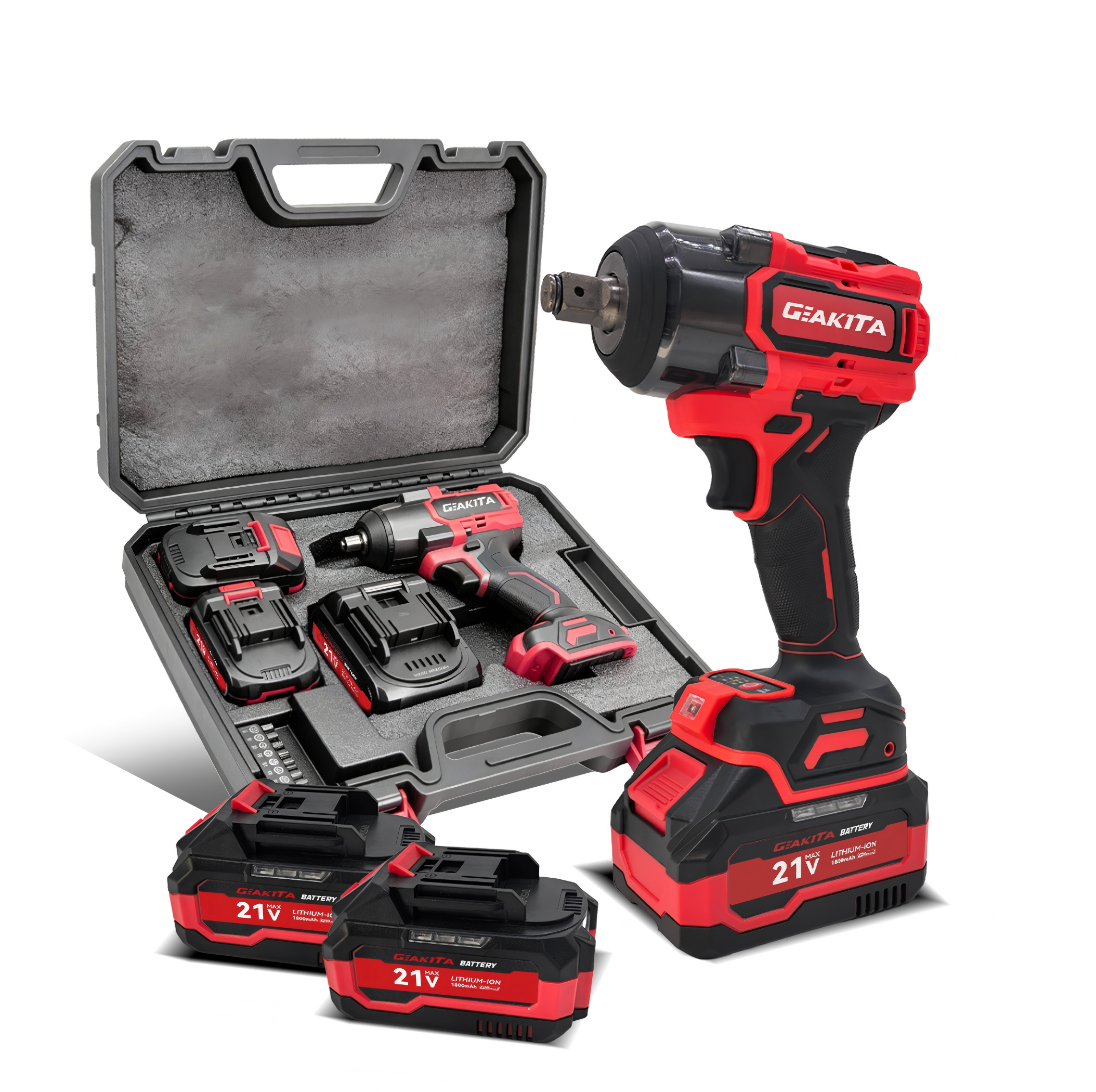
The GKR06 heavy-duty wrench: 21V, 10-cell 2000 mAh pack, 1000 N·m actual torque, 0–3200 r/min.
Brushless Motor Architecture and Maintenance Economics
Every model in the Elite series uses a pure copper brushless motor. The maintenance consequence is structural rather than incremental: a brushless motor has no carbon brushes, so brush replacement does not appear on the service schedule at all. On a brushed tool, brush wear is a predictable consumable event that requires access to the tool, a spare part and labour time. Removing that event removes a recurring cost line and, more importantly, a recurring reason for a tool to be out of service.
How much that is worth depends on the application. Maintenance savings scale with duty cycle, dust exposure and load profile, so no single percentage applies across a construction site, an assembly line and a household user. Buyers comparing a brushless line against brushed alternatives should build the estimate from their own service records — number of brush replacements per tool per year, labour rate, and downtime cost — rather than from a supplier's general claim.
Total cost of ownership in cordless tools is driven by four elements that a procurement model should separate:
- Acquisition cost, including battery packs and chargers rather than the bare tool.
- Consumables, which for brushless models excludes carbon brushes but still includes discs, bits and blades.
- Service events and downtime, where warranty terms and spare-parts availability determine recovery time.
- Battery pack life, the largest single variable over a multi-year horizon and the one most directly linked to incoming cell control.
The one-year global warranty, 7×24 technical support, on-time replacement for defective units, and spare parts supply described earlier are relevant here not as promotional points but as inputs to the third element: they set the recovery path when a tool fails during a project.
Matching Elite Series Models to Project Scenarios
An Elite tool is selected by matching duty cycle and task requirement, not by choosing the highest torque figure in the catalogue. A 1000 N·m wrench used for light assembly adds weight and cost without benefit, while a 4-cell compact drill assigned to a continuous production line will not sustain the duty cycle.
| Model | Project scenario | Duty mode consideration |
|---|---|---|
| GKR06 21V brushless heavy-duty wrench (1000 N·m) | Railway engineering and maintenance, automotive and transportation, construction and steel structures, heavy machinery manufacturing, energy and petrochemicals, shipbuilding and marine engineering, mining and metallurgy | Heavy-duty continuous operation; sustained high-torque bolting |
| 21V Brushless Impact Wrench (650NM) | Vehicle maintenance, tire replacement, workshop repair, bolted assembly | Continuous to intermittent, depending on workshop throughput |
| 21V Cordless Rotary Hammer (HM05 / RH01 / RH02) | Concrete drilling, installation and fixing on construction sites | Continuous operation on active sites; Ø26 mm concrete capacity |
| 21V Angle Grinder (JM05 / JM01-02) | Metal cutting and grinding, fabrication and maintenance | Continuous with disc changes; 100 mm disc platform |
| 21V Impact Screwdriver (QZ05 / QZ03) | Assembly-line screwdriving, panel and fixture fastening | Continuous 8–12 h/day on production lines |
| 21V Cordless Lithium Circular Saw (CS01) | Wood trimming, carpentry and site preparation | Intermittent to continuous, task-dependent |
| 16.8V Brushless Impact Drill (DK-05) | Household DIY maintenance, light trade and retail channels | Intermittent operation, portable on-demand |
Field evidence for this model-to-scenario logic comes from a documented multi-year program involving construction contractors, supermarkets, e-commerce partners, power tool distributors, OEM/ODM manufacturers and hardware stores across Laos, the Philippines, Thailand, India, Brazil, Saudi Arabia and Oman. More than 5,000 units were deployed over a period of two years and beyond, with reported on-time delivery of 99.8% and a defect rate of 0.3%, alongside stable performance in 45 °C+ high-temperature construction environments. Those figures describe that program and its conditions; they are not a universal performance guarantee, and buyers should treat them as a reference case rather than a specification.
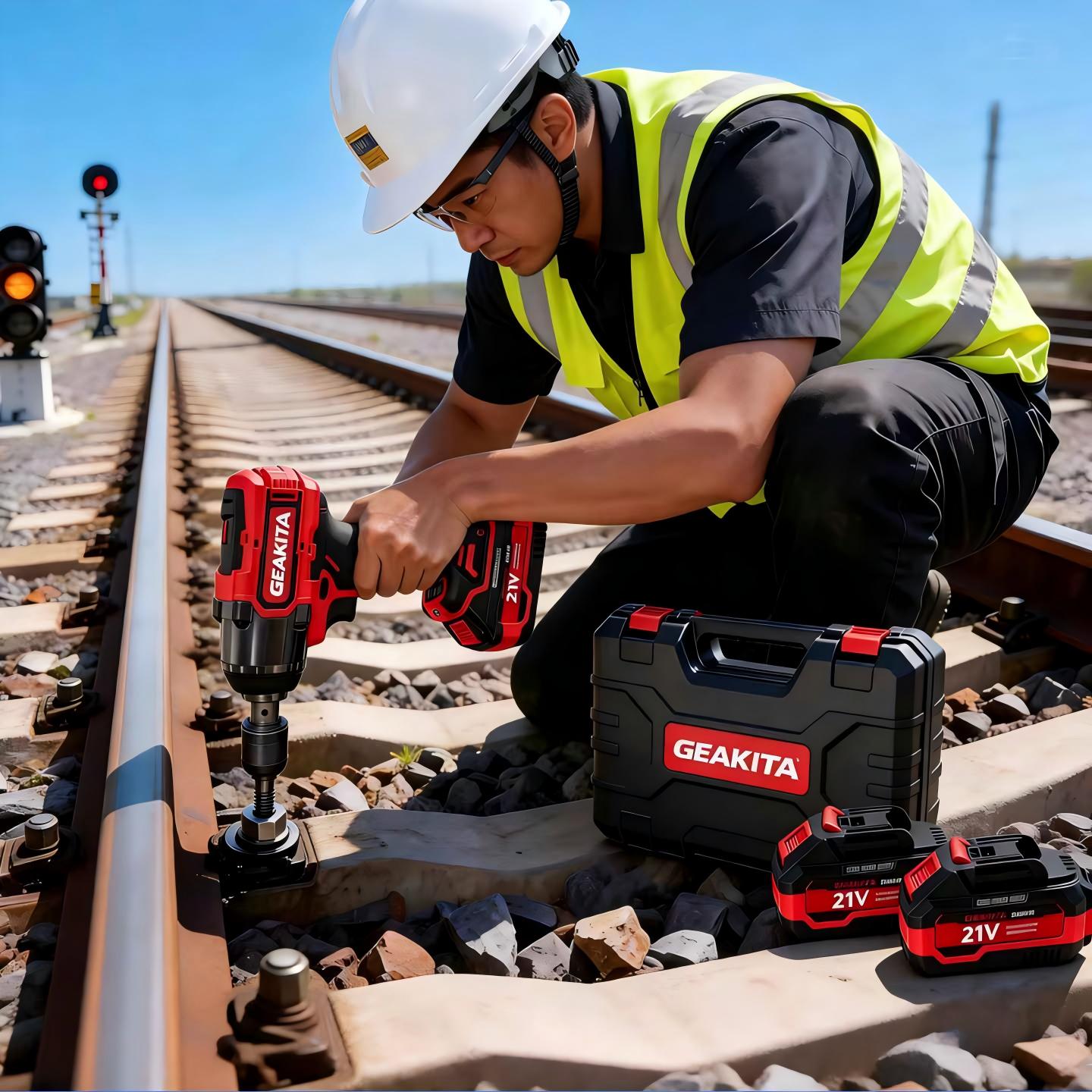
Railway engineering and maintenance is one of the heavy-duty scenarios the Elite wrench range is specified for.
Market Trend Analysis: Battery Platforms and Adjacent Categories
Published estimates for the cordless power tool market diverge, and the divergence is instructive. Grand View Research values the cordless segment at USD 13.44 billion in 2024, Global Market Insights at USD 12.2 billion for the same year, and DataIntelo projects USD 42.8 billion by 2025. The gap is largely definitional — whether garden machinery, batteries and chargers are included, and which tool categories are counted. Buyers using market size to justify a category decision should therefore check the scope definition, not just the headline number.
The clearer structural trend is that battery platforms, not individual tools, increasingly define the boundary of a brand's offer. A platform determines which packs, chargers and future tools a buyer can add without changing infrastructure, which is why platform decisions are typically made once and held for several procurement cycles.
Battery-powered categories adjacent to power tools are expanding on parallel trajectories. The robotic pool cleaner market is expected to reach USD 5.18 billion by 2032 with a CAGR of 16.51% from 2024, according to SNS Insider, and the global robotic lawn mower market was valued at USD 1.15 billion in 2024, driven by rising demand for automated landscaping, according to Market Research Future. Geakita's own portfolio reflects part of this movement: alongside power tools, the company manufactures robotic pool cleaners (PC10, PC20, PC200) and commercial cleaning robots (WDC-C2), extending lithium battery and motor expertise into intelligent cleaning equipment.
Cordless vs. Traditional Solutions: Where the Benchmark Stops
A quality benchmark is only credible if it states its own boundaries. Three limitations apply to the Elite series and to cordless tools generally.
- Corded tools remain preferable in some conditions. Where mains power is available and the load is genuinely continuous and heavy, a corded tool still delivers sustained output without a runtime constraint. A battery platform does not replace a corded cutter on that duty cycle.
- Brushless carries a structural trade-off. Brushless tools generally carry a higher upfront acquisition cost than brushed equivalents; the return depends on how many brush-replacement events and downtime hours the application would otherwise generate. In low-duty household use, that payback period lengthens considerably.
- Runtime and infrastructure. Cordless operation requires battery rotation, charging capacity and spare packs on site. For 8–12 hour daily operation, the number of packs per tool becomes a planning input rather than an accessory decision. Packs and chargers are also specified per voltage family: the 16.8V DK-05 platform and the 21V models are not interchangeable.
Sourcing constraints apply as well. Geakita's minimum order is described as at least five categories of power tools with eight items per category, for a total of 40 items. Mass production lead time runs 30–45 days, with repeat orders at 20–28 days, and shipping time is calculated separately according to shipping method and destination port. These terms suit distributors, OEM buyers and project suppliers placing container-level orders; they are not structured for single-unit purchases.
Future Outlook
Two shifts are likely to shape cordless power tool procurement over the next procurement cycle. The first is documentation-first evaluation: as the cordless market expands toward the projected USD 32.58 billion by 2033, more suppliers will compete on price, and buyers will increasingly differentiate on evidence that can be audited — incoming material approval, in-process test records, end-of-line test coverage and transport compliance documentation. Suppliers that already operate three-level QC and full pre-shipment inspection are positioned for that shift; those that do not will face growing documentation requests they cannot answer.
The second is platform consolidation. As battery platforms determine which tools, chargers and future products a buyer can adopt without new infrastructure, the platform roadmap becomes part of the sourcing decision. Geakita's expansion from lithium power tools into robotic pool cleaners and commercial cleaning robots since 2023 — supported by the company's international channel build-out in Europe, Southeast Asia and the Middle East — illustrates how a manufacturer with shared battery and motor expertise can extend a platform logic across categories rather than competing on single tools.
FAQ
What should be verified first when assessing a cordless power tool for a heavy-duty project?
Start with three verifiable items: standards conformance, production evidence and transport compliance. IEC/UL 62841-1 is the primary safety standard for electric motor-operated hand-held tools, and lithium-ion cells must comply with IEC/UL 62133 for secondary cells and batteries for portable applications. Production evidence covers incoming material approval, in-process inspection and end-of-line testing. Transport compliance covers UN38.3 and dangerous goods standards for lithium battery packs. A supplier that cannot produce these three sets cannot be compared on quality with one that can.
How can a buyer determine whether a cordless tool is suitable for continuous 8–12 hour per day operation?
Match the specified duty mode to the actual duty mode. Cordless power tools operate in continuous operation (8–12 h/day), intermittent operation for DIY or household use, and portable on-demand operation, and industrial production lines, construction sites and heavy-duty continuous operation are distinct environments with different requirements. In practice, the battery configuration is the clearest indicator: a 4-cell, 1300 mAh 16.8V pack suits intermittent use, while 10-cell 2000 mAh 21V configurations are specified for heavy-duty models such as the GKR06 wrench. Buyers should also confirm the number of battery packs per tool planned for a full shift.
Which Geakita Elite models are most relevant to construction and industrial maintenance work?
For heavy-duty fastening, the GKR06 21V brushless wrench is specified at 1000 N·m actual torque with 0–3200 r/min no-load speed, and Geakita lists railway engineering and maintenance, automotive and transportation, construction and steel structures, heavy machinery manufacturing, energy and petrochemicals, shipbuilding and marine engineering, and mining and metallurgy among its applications. For concrete drilling, the 21V rotary hammer models (HM05, RH01, RH02) are rated for Ø26 mm concrete, Ø13 mm steel and Ø26 mm wood. For cutting and grinding, the 21V angle grinder models (JM05, JM01-02) use a 100 mm disc at 12,000 RPM. A 650 N·m impact wrench covers general workshop fastening.
What battery configurations are available across the Elite series?
The Elite series spans two voltage families. The 16.8V DK-05 brushless impact drill uses a 1300 mAh × 4-cell configuration. The 21V models use 1300 mAh × 10 cells (angle grinders, QZ03 screwdriver), 1500 mAh × 10 cells (QZ05 screwdriver), 1500–2000 mAh × 10 cells (rotary hammers), and 1500–2000 mAh × 10–15 cells (the 650 N·m and 1000 N·m impact wrenches). The GKR06 heavy-duty wrench is specified with a 10-cell, 2000 mAh lithium-ion pack. Because the voltage families differ, battery packs and chargers must be specified per model rather than assumed to be interchangeable.
What certifications and transport requirements apply to cordless power tool shipments?
At the tool level, IEC/UL 62841-1 is the primary safety standard for electric motor-operated hand-held tools. At the cell level, IEC/UL 62133 applies to secondary cells and batteries for portable applications. At shipment, UN38.3 and dangerous goods standards govern lithium battery transport, and Geakita applies OQC sampling against those requirements. In addition, project specifications in the markets Geakita serves commonly include CE, UL, INMETRO and FCC compliance, IP rating, multi-language manuals and retail-ready packaging as acceptance conditions.
What are the minimum order quantities and lead times for project-scale sourcing?
Geakita's stated minimum order is at least five categories of power tools with eight items per category, totalling 40 items. Lead time for mass production is 30–45 days, and repeat orders run 20–28 days. Shipping time is calculated separately based on the shipping method and destination port. These terms are structured for distributors, OEM buyers and project suppliers, not for single-unit purchases.
What after-sales coverage applies to the Elite series?
Geakita provides a one-year global warranty on its power tools, supported by 7×24 technical support, on-time replacement for defective units, and spare parts supply. From a procurement perspective, the spare-parts channel is the operative element, because it determines how quickly a tool returns to service after a failure rather than whether the failure is covered.
For buyers who need to test the Elite series against a specific duty cycle, the full specification set and product catalogue are published in Geakita's corporate profile, which can be reviewed or downloaded here: GEAKITA Corporate Profile & Product Catalog 2026.