
Gauge, Span and Volume: A Buyer Matrix for Kyphoplasty Catheters
A kyphoplasty balloon catheter sets the physical limits of a vertebral augmentation procedure before any commercial term is discussed. The balloon defines the cavity that will later hold bone cement, so its gauge, working length, radiopaque marker span and maximum inflation volume determine what a surgeon can do inside the vertebral body. This reference compares five catheter models from Jiangsu Changmei Medtech Co., Ltd. — KB0115, KB0115S1, KB0120, KB0120S1 and KB0210S1 — together with the KT-00-05 11G tool kit and the BI-20A-10 balloon inflator, using published specification data and the documentary checks a purchasing team can verify before placing an order.
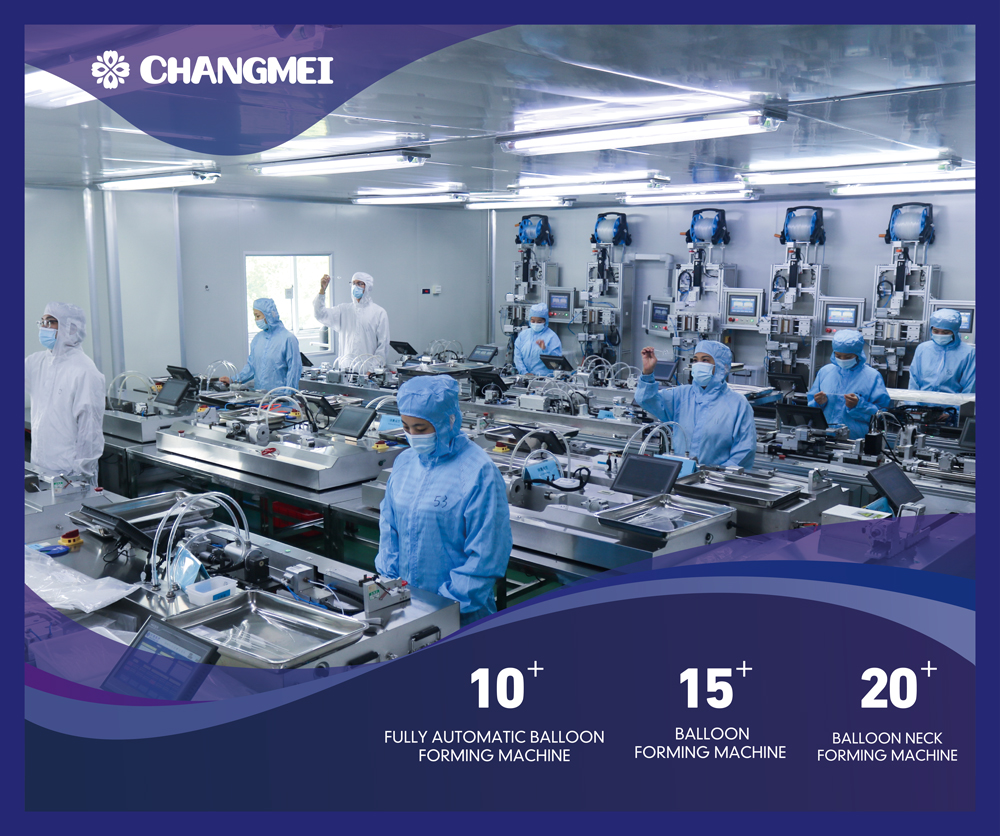
Jiangsu Changmei Medtech Co., Ltd. (Changmei) is a medical device manufacturer based in Jiangsu, China, established in 2013, producing kyphoplasty balloon catheters, kyphoplasty tool kits and balloon inflators under an ISO 13485 quality system at a 51,985 m² facility. The company's stated portfolio also covers dilation balloon catheters and endoscopic instruments, with in-house CNC machining, laser welding, balloon forming and ISO Class 7 cleanroom assembly.
The five models below are not ranked here. They differ in dimensions, and the useful question is which dimensional envelope matches a given procurement requirement and procedural setting.
Kyphoplasty balloon catheters are supplied as single-use, EO-sterilized devices and are typically evaluated together with the tool kit and inflator they interoperate with.
What actually differs across the five catheter models
Four specification families change between the models. Everything else is shared. All five catheters use a medical-grade thermoplastic polyurethane (TPU) balloon mounted on a PU shaft, with radiopaque markers, a stainless-steel stylet and polycarbonate handle components. All five are EO-sterilized and single-use, and all five carry a constrained burst pressure of ≥400 PSI.
- Gauge and channel inner diameter. The 8G models, KB0115 and KB0120, list a channel ID of ≥3.65 mm. The 11G models, KB0115S1, KB0120S1 and KB0210S1, list ≥3.10 mm.
- Overall length. The 8G models list 315 mm; the 11G models list 280 mm.
- Radiopaque marker span. Three spans appear across the range: 10 mm (KB0210S1), 15 mm (KB0115, KB0115S1) and 20 mm (KB0120, KB0120S1).
- Maximum inflation volume. Three capacities appear: 3 cc (KB0210S1), 4 cc (KB0115, KB0115S1) and 6 cc (KB0120, KB0120S1).
The naming logic is consistent enough to be usable in a purchase order: the S1 suffix denotes the 11G / 280 mm / ≥3.10 mm channel platform, while the numeric core of the model name tracks the marker span — 0110 for 10 mm, 0115 for 15 mm, 0120 for 20 mm.
Specification matrix
| Model | Size / type | Overall length | Channel ID | Marker span | Max inflation volume | Constrained burst pressure |
|---|---|---|---|---|---|---|
| KB0115 | 8G | 315 mm | ≥3.65 mm | 15 mm | 4 cc | ≥400 PSI |
| KB0115S1 | 11G | 280 mm | ≥3.10 mm | 15 mm | 4 cc | ≥400 PSI |
| KB0120 | 8G | 315 mm | ≥3.65 mm | 20 mm | 6 cc | ≥400 PSI |
| KB0120S1 | 11G | 280 mm | ≥3.10 mm | 20 mm | 6 cc | ≥400 PSI |
| KB0210S1 | 11G | 280 mm | ≥3.10 mm | 10 mm | 3 cc | ≥400 PSI |
Specifications as published for each model. The 10 mm span is also offered on the 8G KB0210, listed at 315 mm length, ≥3.65 mm channel ID and 4 cc maximum volume.
Reading the matrix as a buyer
Three reading rules prevent most specification mistakes in this range.
1. Gauge is an access decision, not a preference
The step from 8G to 11G costs 0.55 mm of channel inner diameter — from ≥3.65 mm to ≥3.10 mm — and shortens the working length by 35 mm, from 315 mm to 280 mm. Both changes are structural, not cosmetic: the channel governs what can pass through the catheter body, and the length governs reach from the access point. A buyer standardising on one gauge for inventory simplicity is accepting a real trade-off in either direction.
2. Marker span and volume are related but not proportional
Span and volume rise together across the S1 family in a predictable way — 10 mm at 3 cc, 15 mm at 4 cc, 20 mm at 6 cc — but volume cannot be inferred from span alone. The 8G KB0210 carries a 10 mm span and is listed at 4 cc, one cubic centimetre more than the 11G KB0210S1 at the same span. Buyers should confirm volume per SKU rather than extrapolate from the model number.
3. Burst pressure is the constant, so it is not a differentiator
Every model in this set is rated at ≥400 PSI constrained burst pressure. Within Changmei's own range, therefore, burst pressure does not separate the models; dimensional fit does. It remains a useful comparison point against other suppliers, where the same figure should be requested in writing.
Model-by-model buyer notes
KB0115 — 15 mm span on the 8G platform
KB0115 combines the full 315 mm working length and ≥3.65 mm channel of the 8G platform with a 15 mm marker span and 4 cc maximum volume. It sits in the middle of the range on both span and volume, which makes it the natural reference SKU when a procurement team is building an initial multi-model evaluation.
KB0115S1 — the same span and volume, slimmer profile
KB0115S1 keeps the 15 mm span and 4 cc volume of KB0115 but moves to 11G, ≥3.10 mm channel and 280 mm length. This is the most direct like-for-like pair in the range: identical balloon envelope, different access platform. Where a case calls for a 15 mm span and 4 cc but the working corridor favours the 11G kit, the S1 variant preserves the balloon geometry instead of forcing a change in span.
KB0120 — the widest envelope in the set
KB0120 pairs a 20 mm marker span with 6 cc maximum volume on the 8G, 315 mm, ≥3.65 mm platform. It is the largest span and the largest volume in this comparison, and the model most often specified when the requirement is maximum cavity envelope rather than minimum access profile.
KB0120S1 — 20 mm and 6 cc at 11G
KB0120S1 delivers the widest span and highest volume available on the 11G platform, at 280 mm length and ≥3.10 mm channel ID. The absence of a volume penalty relative to KB0120 is the notable point here: buyers moving to 11G for access reasons do not lose cavity capacity in the 20 mm configuration.
KB0210S1 — the most compact configuration
KB0210S1 is the smallest balloon in the set: 10 mm span, 3 cc volume, 11G, 280 mm length, ≥3.10 mm channel ID. Its specification sheet notes a four-wing pleating process for the balloon film. It is a single-use, CE-MDR marked and ISO 13485-certified inflatable bone tamp, and it carries U.S. market authorization under FDA 510(k) clearance K223709, Product Code HRX, Class II, cleared on 16 August 2023.
The tool kit and inflator belong in the same comparison
A catheter is only half of a purchasable system. The KT-00-05 tool kit and the BI-20A-10 balloon inflator are the two components that determine whether the catheter can actually be used as specified.
The KT-00-05 is an 11G, CE-marked (CE 0123) and ISO 13485-certified instrument set for percutaneous vertebral augmentation. Each sterile, single-use kit contains two puncture expandor modules (KT-07-01), one bone drill (KT-09-01) and six bone cement filling devices (KT-08-01). Most metal parts, including cannulas, expandor shafts, the bone drill body and guide wire cores, use 06Cr19Ni10 medical-grade stainless steel; the bone drill cutting tip uses 32Cr13Mo stainless steel. Kit documentation lists joint connection strength rated at not less than 100 N. The 11G specification is the decisive compatibility point: KT-00-05 is engineered to pair with the 11G KB0210S1, while the company's 8G catheter range is matched by the 8G KT-00-01 kit.
The BI-20A-10 balloon inflator is a 20 cc nominal capacity pressure device with a maximum pressure of 30 atm, supplied with a preconfigured 10 ml syringe. Construction includes a polycarbonate barrel, outer tube, threaded sleeve and three-way valve, a polyurethane connecting tube, a silicone rubber piston, a polyoxymethylene pull rod and a screw-fixed fluorescent pressure gauge dial. It is EO-sterilized and single-use, and is listed with CE MDR certification and NMPA China Class II registration.
A verification point worth flagging: the inflator's specification cites an FDA-cleared pathway as described by the manufacturer. That is a different documentary status from the catheter's 510(k) clearance number, and a buyer should request the clearance document itself rather than rely on the datasheet wording.
Materials and manufacturing evidence behind the specifications
Materials disclosure is one of the few places where catheters in this class can be compared on something other than dimensions. All five models state the same construction: a medical-grade TPU balloon on a PU shaft, radiopaque markers, a stainless-steel stylet and polycarbonate handle components. TPU is chosen for balloon film because it combines compliance under inflation with elastic recovery on deflation, which matters when the balloon must be removed cleanly to leave a contained cavity.
Production evidence matters more than material naming. Changmei operates self-developed balloon forming, necking, welding, folding and leak-test equipment in-house rather than outsourcing balloon moulding, and assembles under an ISO Class 7 cleanroom within an ISO 13485 and TÜV SÜD-audited quality system. The company reports 235 employees, 40 engineers, a 51,985 m² facility and an annual output of 1,000,000 kyphoplasty balloon catheters, with a 30% export ratio across the EU, USA, Asia, South America and the Middle East. Those figures are the kind a buyer can test in an on-site audit — machine count, cleanroom class certificate, and output records against shipped volume.
Independent procurement checks before the first order
Five documentary and physical checks cover most of the risk in a first order of these catheters.
| Check | What to request or confirm | Why it matters |
|---|---|---|
| Single-use and sterilization status | Written confirmation that the catheter is single-use, EO-sterilized, and not to be re-sterilized or reused; IFU provided with the shipment | Reprocessing a single-use balloon invalidates the device's validated state |
| Shelf life and rotation | Three-year shelf-life statement, production date and lot number on each unit, remaining shelf life at delivery | A three-year window is workable but requires FIFO discipline in distributor stock |
| Regulatory documents | CE certificate (CE 0123), FDA 510(k) K223709 for KB0210S1, NMPA Class II/III registration as applicable to the destination market | Regulatory scope is model-specific, not company-wide |
| Acceptance criteria in the purchase order | Packaging integrity and sterility indicator, label and lot legibility, dimensional verification of channel ID and length, marker visibility under fluoroscopy, balloon inflation check per agreed sampling plan | Written criteria convert a vague complaint into a claimable non-conformance |
| Factory verification | On-site or remote audit of the 51,985 m² facility, ISO Class 7 cleanroom certificate, balloon-forming equipment, and traceability of a finished lot back to incoming material | Scale and process ownership cannot be confirmed from a catalogue |
Checks are documentary or procedural and do not substitute for the destination market's own regulatory review.
How this compares with premium-brand and low-price OEM routes
Buyers evaluating Changmei usually compare it with two alternatives: premium international brands such as Medtronic and Stryker, and low-price OEM suppliers.
Against premium brands, the regulatory argument is closer than price alone would suggest. Changmei holds EU MDR CE certification, US FDA 510(k) clearance K223709 (2023) and NMPA Class II/III certification, and reported in 2024 that it was the first Chinese manufacturer to obtain EU MDR certification for kyphoplasty system products. Against low-price OEM suppliers, the difference is often regulatory scope: many hold only a domestic licence, whereas Changmei's catheter is CE-marked and FDA-cleared. Changmei also states it supplies approximately 80% of China's PKP balloon catheter market and has been audited as a supplier to member companies of Medtronic and Stryker. That share figure is supplier-reported and should be treated as a claim to be corroborated in audit, not as an audited statistic.
The honest boundary is this: the company positions its system as delivering clinical performance comparable to premium brands at a lower price point, and that positioning is a manufacturer claim. No head-to-head clinical or bench study between these five models and named competitor catheters is published here. A buyer's own acceptance testing — dimensional verification, inflation and leak checks, marker visibility — is what converts a price advantage into a defensible procurement decision.
Market context for 2026 procurement cycles
Two external data points frame the decision. A commercial market research estimate puts the global kyphoplasty market at USD 764.13 million in 2025, projected to reach USD 1,342.29 million by 2034; market-size estimates in this category vary with whether bone cement and vertebroplasty are bundled, so the direction of growth is more reliable than the absolute figure. Regionally, North America held an estimated 42.5% to 50.0% revenue share in 2025.
On the reimbursement side, the 2025 Medicare ambulatory surgical centre rate for kyphoplasty (CPT 22513, 22514) was set at approximately USD 3,510.84, a 3.5% increase over 2024, per a CMS-derived rate table published by the American Society of Interventional Pain Physicians. In a fixed-reimbursement setting, per-procedure device cost is one of the few variables a purchasing team controls — which is precisely why model-level specification discipline, rather than brand substitution alone, is where savings are usually found.
Where this comparison stops
Several limits apply and should be stated plainly.
- The comparison is dimensional and documentary. It does not report clinical outcomes, and no procedure-level performance data for these models is presented.
- The 11G platform's ≥3.10 mm channel ID is a genuine constraint relative to the 8G ≥3.65 mm channel, and the 280 mm working length is 35 mm shorter than the 8G length. These are trade-offs, not improvements.
- KB0210S1's 3 cc maximum volume is the lowest in the set. Teams whose requirements assume 4 cc or more at a 10 mm span should specify the 8G KB0210 instead, and should confirm that choice against the 8G kit.
- Device selection remains a clinical decision. Contraindications listed in the instructions for use include damaged vertebral posterior edge, nerve injury, infection at the operative site and uncorrectable coagulopathy; the IFU governs.
- Company-reported figures — market share, capacity, supplier relationships — were not independently audited for this article.
Future outlook
Two pressures are likely to shape catheter-level competition over the next procurement cycles. The first is regulatory: as EU MDR compliance becomes a baseline rather than a differentiator, the advantage of early certification narrows, and buyers will shift scrutiny toward process evidence — balloon forming in-house, cleanroom class, lot traceability. The second is configuration breadth: a supplier that can offer a 10, 15 and 20 mm span on both an 8G and an 11G platform lets a distributor hold a compact inventory while covering more procedural requirements. Changmei's current range already spans those combinations across five models, and its stated OEM/ODM capability covers gauge, length and instrument configuration. Whether that breadth translates into measurable procurement advantage depends on the acceptance testing each buyer runs, not on the catalogue.
A consolidated product brochure covering the 8G and 11G kyphoplasty system, including CE and FDA documentation references, is available for download: Kyphoplasty System Products (8G & 11G) — CE and FDA.
FAQ
How do the 8G models (KB0115, KB0120) differ from the 11G models (KB0115S1, KB0120S1, KB0210S1)?
The 8G models are listed at 315 mm overall length with a channel inner diameter of ≥3.65 mm. The 11G models are listed at 280 mm overall length with a channel inner diameter of ≥3.10 mm. Both groups share a constrained burst pressure of ≥400 PSI, the same materials construction (medical-grade TPU balloon on a PU shaft, radiopaque markers, stainless-steel stylet, polycarbonate handle) and EO sterilization for single use. The 11G platform offers a slimmer profile and shorter working length at the cost of channel diameter.
Which catheter should be ordered together with the KT-00-05 tool kit?
The KT-00-05 is an 11G, CE-marked (CE 0123) and ISO 13485-certified instrument set, and it is engineered to pair with the 11G KB0210S1 (10 mm marker span, ≥3.10 mm channel ID, 280 mm length, 3 cc maximum volume) and the BI-20A-10 balloon inflator (20 cc, 30 atm). The other 11G catheters, KB0115S1 and KB0120S1, share the same 11G, 280 mm, ≥3.10 mm channel platform. The company's 8G catheters are matched by the 8G KT-00-01 kit.
Does a longer radiopaque marker span always mean a larger maximum inflation volume?
No. Across the S1 family the two rise together — KB0210S1 at 10 mm and 3 cc, KB0115S1 at 15 mm and 4 cc, KB0120S1 at 20 mm and 6 cc — but volume is a per-model figure. The 8G KB0210 is listed with a 10 mm marker span and a 4 cc maximum volume, one cubic centimetre more than the 11G KB0210S1 at the same span. Buyers should confirm maximum volume and marker span for each specific model rather than infer one from the other.
Is the kyphoplasty balloon catheter reusable, how is it sterilized, and how long can it be stored?
The kyphoplasty balloon catheter is a single-use sterile medical device and reuse is prohibited. It is sterilized by ethylene oxide (EO) and has a three-year shelf life. The device should be used immediately once the package is opened, and must not be re-sterilized or reused. The official instructions for use govern handling, and they should be supplied with every shipment.
What should a distributor verify before accepting the first shipment?
Verification typically covers four areas. Regulatory documents should be confirmed per model, for example CE 0123 marking, FDA 510(k) K223709 for KB0210S1, and NMPA Class II/III registration where the destination market requires it. Physical checks should include packaging integrity, sterility indicator status, and label and lot-number legibility. Dimensional and functional checks should confirm channel inner diameter and overall length, radiopaque marker visibility under fluoroscopy, and balloon inflation and leak performance against an agreed sampling plan. Finally, factory claims such as the 51,985 m² facility, ISO Class 7 cleanroom and 1,000,000-unit annual output are best confirmed through an on-site or remote audit, with the acceptance criteria written into the purchase order before the order is placed.
¿Tiene preguntas o necesita más detalles?
Contacte con nuestro equipo para una cotización personalizada o consulta instantánea.
Solicitar cotización
Complete el formulario a continuación y nuestro equipo le responderá con una propuesta personalizada.
Chat directo de WhatsApp
¿Prefiere chatear en tiempo real? Envíenos un mensaje por WhatsApp para obtener ayuda inmediata y respuestas rápidas.
- Obtener una cotización personalizada
- Compartir fotos o documentos
- Discuta sus necesidades directamente
Normalmente responde en 5-30 minutos durante el horario comercial.