
Garment Steamer OEM/ODM: When the Fitting Room Sets the Spec
Garment Steamer OEM/ODM: When the Fitting Room Sets the Spec
Fitting-room deployment sets a different specification than home use
An apparel retailer buying garment steamers for fitting rooms is not buying a home appliance with a longer cable. The unit is shared, staff-operated, used on garments that are already on a hanger and often already on a customer, and it is judged in the few seconds before a shopper decides whether to buy. Sourcing therefore has two halves that must line up: a model that suits the room, and an evidence file that names the exact model, voltage version and configuration being ordered.
Huaguang Electric Appliance Group Co., Ltd. (HUAGUANG Steam Appliances) is a Cixi City-based OEM/ODM manufacturer founded in 1985 that builds handheld and standing garment steamers for export alongside steam irons, lint removers, steam cleaners and coffee machines. The company lists a 38,600 m² factory, 450 employees, an R&D team of more than 100 and annual output above 5,000,000 units, with roughly 80% of output exported to the EU, USA, Japan, Korea, the Middle East and Africa.
That scale is the reason the fitting-room question deserves a structured answer rather than a catalogue pick. A manufacturer with that volume can put several plausible models on the table; the harder and more decision-relevant part is establishing which of them is documented for the market and configuration you are actually buying.
Why a fitting room rewrites the product brief
In a store, steaming happens vertically. Garments hang on a rail or a hook, a customer is waiting, and there is rarely space or time for a board. The application profile supplied for these models reflects that: it lists handheld steaming, standing steaming and combined horizontal and vertical steaming as operating modes, and lists garment stores, showrooms and hotels among its working conditions, with wrinkle removal, garment steaming, fabric care, odor removal and surface sanitization recorded as functions.
That profile also makes no efficacy claim for any of those functions. A chain that wants hygiene-related messaging beside a fitting-room mirror should treat it as a separate evidence request rather than a feature list it can print. The functions describe intended use, not verified outcomes.
Working time is a store routine, not a number on a box
The specification that shapes daily store life fastest is working time, because it converts into a refill routine. In the supplied specifications, E22 is listed at 15 minutes of operating time with a 280 ml removable tank; E19 is listed at 10 minutes with 230 ml; QH09 is listed at 10–15 minutes with 300 ml; T35 carries no listed working time and a 100 ml tank. None of these values makes one model better than another in the abstract. They set how often a staff member has to break away from the fitting area, and whether that is acceptable during a weekend peak.
Tank design matters as much as tank size. A removable tank can be refilled away from the steam head; a fixed tank ties the refill to the appliance. For a chain, that is the difference between a two-minute task and a five-minute one, multiplied by every store and every trading day.
Plate, output and the fabrics actually in the room
Contact surfaces differ across the range: cast-aluminium panels on E19, E22 and T35, and a ceramic-coated aluminium panel on QH09. Output differs too, from 15±5 g/min on T35 and 20 g/min on E22 to a listed maximum of 35 g/min on E19. Higher output usually shortens the time per garment, but it also narrows the margin for error on lightweight or heat-sensitive fabrics, which is why the application profile's instruction to check fabric care labels before steaming belongs in staff training rather than in a supplier brochure.
Noise and unattended operation
A fitting area is small and enclosed, so declared noise limits are worth reading. E22 is listed at ≤70 dB and the T60 PRO MAX at ≤70 dB. A limit is not a measurement, but it tells a buyer what the supplier has committed to on paper. The same applies to protection features: E22 lists auto shut-off plus static protection and water-scarcity protection, and E19 lists static protection and water-scarcity protection. In a store where a device is set down mid-conversation, those features matter more than they do on a kitchen counter.
The application profile adds operating conditions that read like a store SOP: use indoors in a well-ventilated area, keep the cord and plug dry, use only the rated voltage, fill with water to the marked maximum and never add perfume or unapproved chemicals, keep steam outlets unobstructed, and operate only at the angles the model instructions allow. These are the clauses a retail chain usually discovers after the first incident report, not before the purchase order.
What the EU-facing documentation actually covers
The supplied EU-facing material for this product family is not one uniform file. For the E15, E15E and E16 group it comprises a GS certificate numbered GS/23/HEL/01592 and a PAHs report numbered NBES220900480202-M1/PAH. For E22, the corresponding EU-facing document is a RoHS report numbered (6626)019-0319. A declaration of conformity supplied with the file carries a model list.
The three document types answer three different questions. A GS certificate is issued under the German voluntary safety mark and records that the model, within the scope defined by the certificate, was assessed against the safety requirements named in that scope. A PAHs report records testing for polycyclic aromatic hydrocarbons in the materials it names. A RoHS report addresses restricted substances in electrical and electronic equipment under the RoHS framework, which covers substances such as lead, mercury, cadmium, hexavalent chromium, PBBs, PBDEs and certain phthalates. None of the three is a general certificate of fitness for retail use.
| Model group | EU-facing document supplied | What it establishes | What it does not establish |
|---|---|---|---|
| E15 / E15E / E16 | GS certificate GS/23/HEL/01592; PAHs report NBES220900480202-M1/PAH | Safety-mark assessment within the certificate's stated scope, plus PAH testing of the materials named in the report | The supplied GS scope does not list commercial durability, overheat testing or e-commerce packaging |
| E22 | RoHS report (6626)019-0319 | Restricted-substance results for the tested configuration | Electrical safety, durability in shared use, or packaging performance |
| Model list | Declaration of conformity with an attached model list | Which models the declaration is written around | Whether your ordered voltage version, plug type or packaging variant appears on that list |
Where the scope stops, and why that is a question rather than a failure
For a fitting-room project, the three gaps in the supplied GS scope are the ones that matter most. Commercial durability is exactly what a store asks of a device that runs many short cycles a day. Overheat testing speaks to what happens when a unit is left running between customers. E-commerce packaging speaks to a retail chain that ships from store or sells online from the same stock.
The correct reading of a scope gap is narrow: the certificate does not list these areas, so it cannot be used as evidence that they were assessed. It is not evidence that they failed, and a supplier should never be accused on that basis. The buyer's task is simply to ask what other evidence exists, and to accept a documented answer rather than an assurance.
The standard underneath the certificate
IEC 60335-2-85:2022 sets out particular safety requirements for electric fabric steamers intended for household and similar purposes, with a rated-voltage scope of not more than 250 V; the IEC catalogue also lists a consolidated 2022 edition incorporating a 2025 amendment. Two cautions follow. First, a published standard is not a certificate, and citing it does not prove conformity. Second, adoption of an IEC edition varies by jurisdiction, so the applicable edition for a destination market has to be confirmed locally rather than assumed from the IEC reference.
In the EU, CE-related obligations for mains-powered appliances — electrical safety, electromagnetic compatibility and restriction of hazardous substances — sit alongside the voluntary GS mark, and the importer remains responsible for confirming which obligations apply to the specific product. Documentation support from a manufacturer is an input to that work, not a substitute for it.
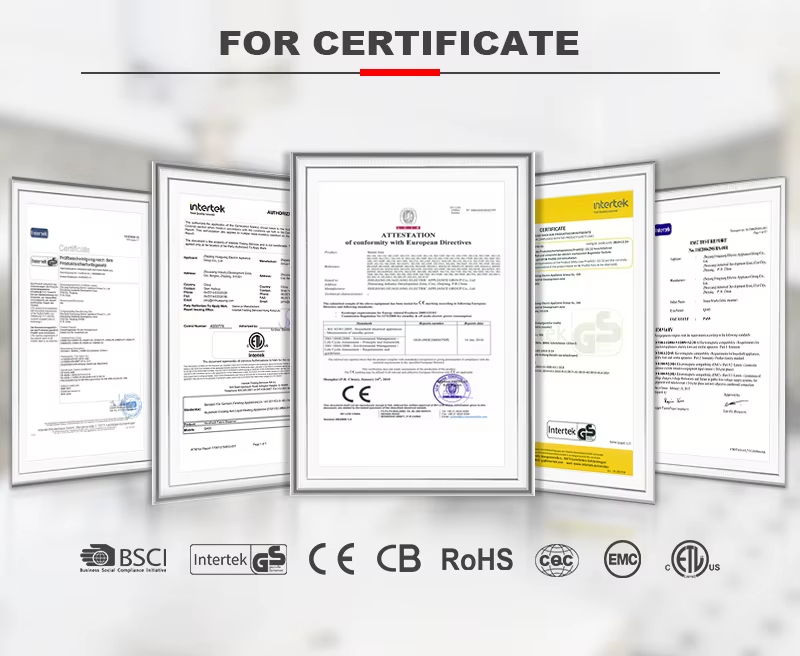
Certification documents are model-specific: the file that matters is the one naming the ordered model and variant, not the widest file in the portfolio.
Matching model to room: documented characteristics, not a ranking
Once the document set is understood, the model choice can be made on visible specifications. The table below uses only values listed in the supplied product specifications, so it supports shortlisting rather than ranking. The E15, E15E and E16 group is deliberately absent: the supplied material documents its EU file, not its specifications, and a table filled from assumption would be worse than a table left short.
| Model | Format | Rated power | Steam output | Water tank | Working time | Documented features relevant to a fitting area |
|---|---|---|---|---|---|---|
| E22 | Handheld vacuum steamer | 1,200 W | 20 g/min | 280 ml, removable | 15 min | LED display with one steam and one suction setting; cast-aluminium panel; auto shut-off; static and water-scarcity protection; ≤70 dB; 25±5 s preheat |
| E19 | Handheld | 2,100 W | max 35 g/min | 230 ml | 10 min | Four steam levels; seven-outlet cast-aluminium soleplate; self-cleaning; physical buttons to reduce accidental activation |
| QH09 | Handheld | 1,500 W | See specification table | 300 ml | 10–15 min | Two steam levels; ceramic-coated aluminium panel; 1.5 bar; foldable handle; 25±5 s heat-up |
| T35 | Portable small iron | 1,300 W | 15±5 g/min | 100 ml | Not listed | Dual-voltage design; 90° rotatable handle; one-touch self-cleaning; dry and wet modes; two steam levels; 30 s preheat |
| GE01PRO | Full-size standing steamer | 2,280 W boiler | 27±5 / 34±5 / 40±5 g/min | 1.7 L | 37–48 min | 80 cm integrated ironing board; three-section telescopic rod; base rollers; three steam levels; preheat function |
Specifications are as listed in the manufacturer's product data. Test conditions for steam output, working time and noise are not stated in the supplied material, so the values are not comparable across models in a measured sense and should be confirmed on a sample.
Read against a fitting-room brief, the table suggests a practical split rather than a winner. The E22's suction side is the closest match to steaming a garment that is already on a customer-facing hanger, because the fabric is held while the head moves. E19's higher listed output and four levels suit heavier fabrics and a back-of-house touch-up station, at the cost of a shorter listed working time. QH09's 300 ml tank and 10–15 minute window fit a smaller store where refills can be done at a basin. T35's dual-voltage design points to travel retail and multi-market electrical requirements, not to a fixed 40-store rollout. GE01PRO is a standing unit with a board, which points to stock rooms, alterations and returns processing rather than the fitting area itself.
Customization and production terms a retail buyer will actually use
For private-label garment steamer programmes, the listed customization scope covers colour, voltage, power plug type, packaging design and packaging language, and brand identity such as a logo. That list is the practical boundary: it describes what can be specified on an order, and it does not by itself prove exclusivity, tooling ownership or regulatory approval of a new variant.
The commercial frame is stated plainly: a standard MOQ of 1,000 units for garment steamers, monthly capacity of 400,000 units, and a lead time of 30–45 days. Sampling runs at roughly 10–15 days, with the buyer normally covering sample cost and freight, and testing support is normally limited to a maximum of two units. Production is made to order rather than held in stock, which matters for a chain planning a seasonal fitting-room refresh: the order has to be placed against a forecast, not against a warehouse.
Quality control is stated as 100% pre-shipment testing plus third-party inspection, with a certification list that includes ISO 9001, CE-LVD, EMC, RoHS, REACH, PAHs, GS, CB, ETL/CETL, UKCA, SAA, PSE, KC, CQC, GCC and CCC. That list describes capability across the portfolio. It does not mean every mark applies to every model, voltage or plug configuration, and the distinction between portfolio-level certification and model-level documentation is the single most common source of confusion in retail sourcing files.
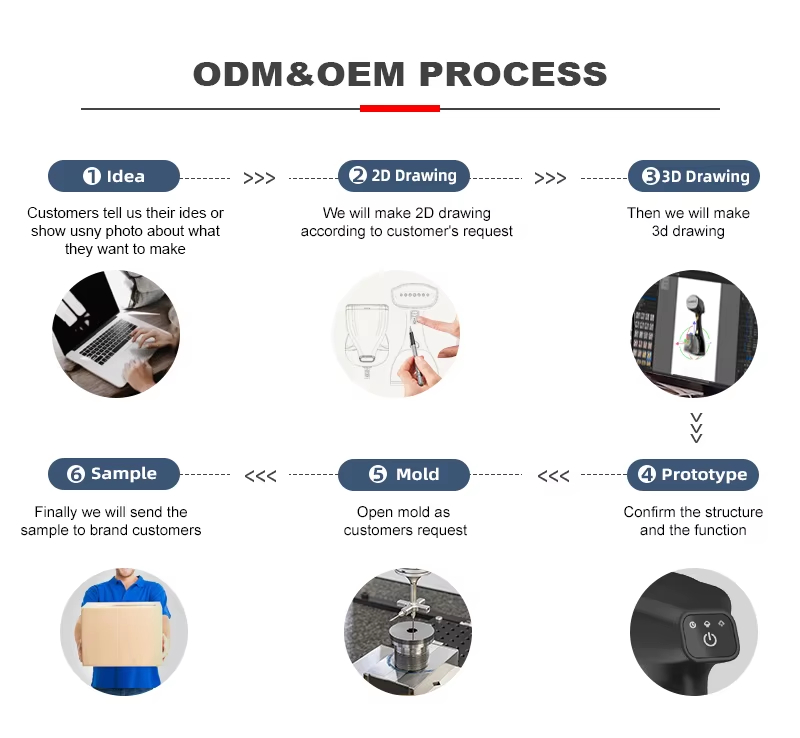
Customization scope, sampling and production are sequential steps: a packaging or voltage change late in the process can move a model outside the documentation already issued for it.
After-sales design for a multi-store rollout
Retail chains rarely fail at purchase; they fail at month seven, when three stores report the same fault and nobody holds a part number. The supplied after-sales position is a one-year warranty with online troubleshooting, engineering support for diagnostics and performance issues, and structured service documentation including user manuals and maintenance guides. A 1% free spare-parts allocation can be added to an order, with additional parts purchasable, and parts compatibility must be confirmed by model.
Two procurement implications follow. First, the parts list belongs on the purchase order, model by model, because a chain that standardises on two models still has two part numbers for every consumable. Second, the stated warranty period is one year regardless of how intensively a shared in-store device is used, so the service expectation for multi-user operation should be written into the agreement rather than inferred from the consumer warranty text.
Market context: why the EU file is a working document
Grand View Research estimated the global garment steamer market at USD 3.0 billion in 2023, with Europe accounting for a 34.5% revenue share that year. Whatever the growth path since then, the structural point holds for sourcing: Europe is a large enough destination that its documentation expectations shape product files everywhere, and a retailer buying for EU stores is buying paperwork as well as appliances.
That is also why the two file sets in this article are not interchangeable. A GS certificate and PAHs report for one model group and a RoHS report for another answer different questions, and neither can be carried across a model boundary because a catalogue page looks similar.
Outlook: the file has to be re-verified, not just collected
The most useful forward-looking observation is procedural rather than predictive. IEC 60335-2-85 now exists as a 2022 edition with a consolidated 2025 amendment, and jurisdictional adoption of any edition has to be checked market by market. Certificate scopes are written around specific models, and a voltage change, a plug change or a packaging change can move an order away from the configuration the document describes.
For a retail buyer, the practical rule is to keep one controlled document set per purchase order: model, voltage version, plug type, packaging specification, certificate number, report number and the declaration of conformity listing that model. When a chain refreshes its fitting-room equipment every few years, that set is what makes the second purchase faster than the first — and what makes an audit answerable without a search through email attachments.
RFQ questions that turn scope gaps into answers
The scope gaps in the supplied GS file are not defects; they are questions with commercial consequences. A retail buyer can put them to any garment steamer OEM/ODM supplier in a single RFQ round.
- Which exact model, voltage version, plug type and packaging specification will appear on the declaration of conformity's model list for this order?
- Can you provide the current certificate for that model together with its full scope, and state in writing what the scope excludes?
- What separate evidence exists for overheat protection and thermal behaviour when the unit is left running between customers?
- What durability evidence exists for the cycle pattern of a fitting room, and was it generated on this model or on a comparable one?
- What transit or drop evidence covers the packaging type we are ordering, including any e-commerce or store-delivery carton?
- For the PAHs report, which materials and colours were tested, and does the report cover the finish we are specifying?
- For the RoHS report, does it match the bill of materials of the configuration being quoted, and is it current?
- For non-EU destinations, which certificates apply to this model and voltage version, and can each be shown with its scope?
- What listed working time applies, and what refill routine does that imply for a ten-hour trading day?
- Which spare parts should be ordered with the first shipment, what are their part numbers, and how is the one-year warranty applied to shared in-store use?
A supplier that answers these ten questions with documents has done more than a supplier that answers them with adjectives. That is the practical meaning of scenario-to-certificate fit: the room defines the brief, the specification defines the shortlist, and the file has to close the loop on the exact unit that arrives in store.
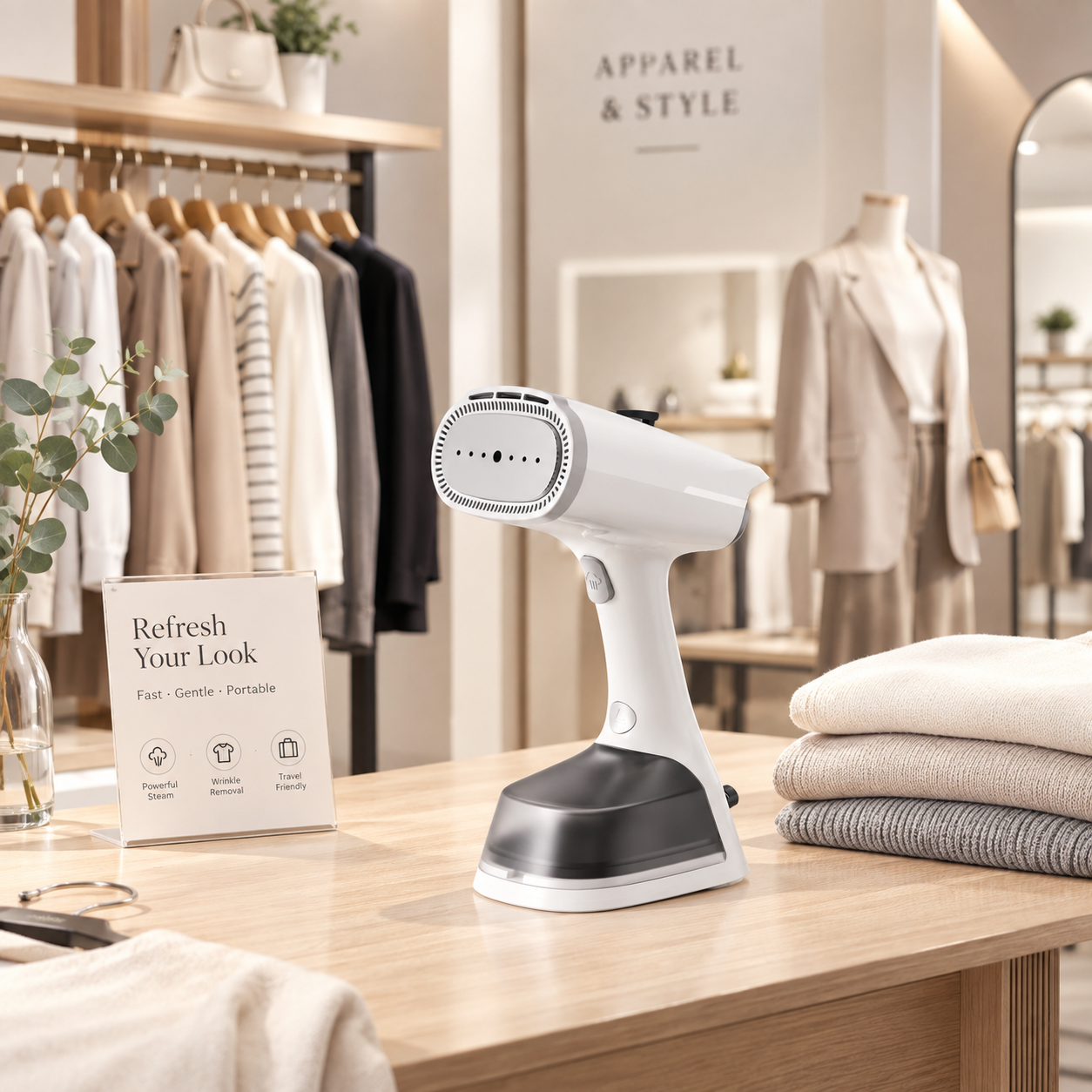
In-store use is vertical, shared and interruptible — the conditions a fitting-room specification has to describe before a model is chosen.
FAQ
Does a GS certificate mean a garment steamer is approved for commercial fitting-room use?
No. GS is a voluntary German safety mark, and a certificate records assessment within the scope it defines. In the file supplied for the E15, E15E and E16 group, the GS certificate GS/23/HEL/01592 is accompanied by the PAHs report NBES220900480202-M1/PAH, and that GS scope does not list commercial durability, overheat testing or e-commerce packaging. The absence means those areas are not covered by that certificate, not that the product failed them. A retail buyer should ask for separate evidence covering each area that the store scenario requires.
Which documents should an EU apparel retailer request for a garment steamer OEM/ODM order?
A buyer should request the declaration of conformity with its model list, the safety certificate applicable to the ordered model together with the full scope of that certificate, and the restricted-substance documentation relevant to the materials and configuration, such as the RoHS report (6626)019-0319 supplied for E22 or the PAHs report supplied for the E15, E15E and E16 group. Each document should be checked against the exact model, voltage version, plug type and packaging configuration in the order. In the EU, CE-related obligations and importer responsibilities remain separate from the voluntary GS mark.
Can a garment steamer be customized for a retail chain's voltage, plug and packaging?
Yes, within the listed customization scope, which covers colour, voltage, power plug type, packaging design and packaging language, and brand identity such as a logo. The scope describes what can be specified on an order; it does not by itself establish exclusivity, tooling ownership or regulatory approval of a new variant. Because a voltage, plug or packaging change can move an order outside an existing certificate's model description, the documentation position should be confirmed for the customized configuration before mass production.
What MOQ and lead time apply to a private-label garment steamer order?
The listed standard MOQ for garment steamers is 1,000 units, with monthly capacity of 400,000 units and a lead time of 30–45 days. Production is made to order rather than held in stock, so orders are planned against a forecast. Sampling usually takes about 10–15 days, with the buyer normally covering sample cost and freight, and test support is normally limited to a maximum of two units. Final MOQ, certification scope, labelling and delivery schedule should be confirmed in writing before a bulk order is placed.
How are spare parts and service handled across multiple stores?
The stated after-sales position is a one-year warranty with online troubleshooting, engineering support for diagnostics and performance issues, and structured service documentation such as user manuals and maintenance guides. A 1% free spare-parts allocation can be added to an order, additional parts can be purchased, and compatibility must be confirmed by model. For a chain, part numbers should be listed on the purchase order for each model in the rollout, and the way the one-year warranty applies to shared, multi-user in-store operation should be agreed in writing.
Reference material: the 2025 product manual (PDF) covers the wider steam appliance range; model-specific specifications and certificate scopes should always be confirmed against the current documents issued for the ordered configuration.
¿Tiene preguntas o necesita más detalles?
Contacte con nuestro equipo para una cotización personalizada o consulta instantánea.
Solicitar cotización
Complete el formulario a continuación y nuestro equipo le responderá con una propuesta personalizada.
Chat directo de WhatsApp
¿Prefiere chatear en tiempo real? Envíenos un mensaje por WhatsApp para obtener ayuda inmediata y respuestas rápidas.
- Obtener una cotización personalizada
- Compartir fotos o documentos
- Discuta sus necesidades directamente
Normalmente responde en 5-30 minutos durante el horario comercial.