
GZPK620 vs GZPK1060: Double- or Three-Outlet Tablet Press
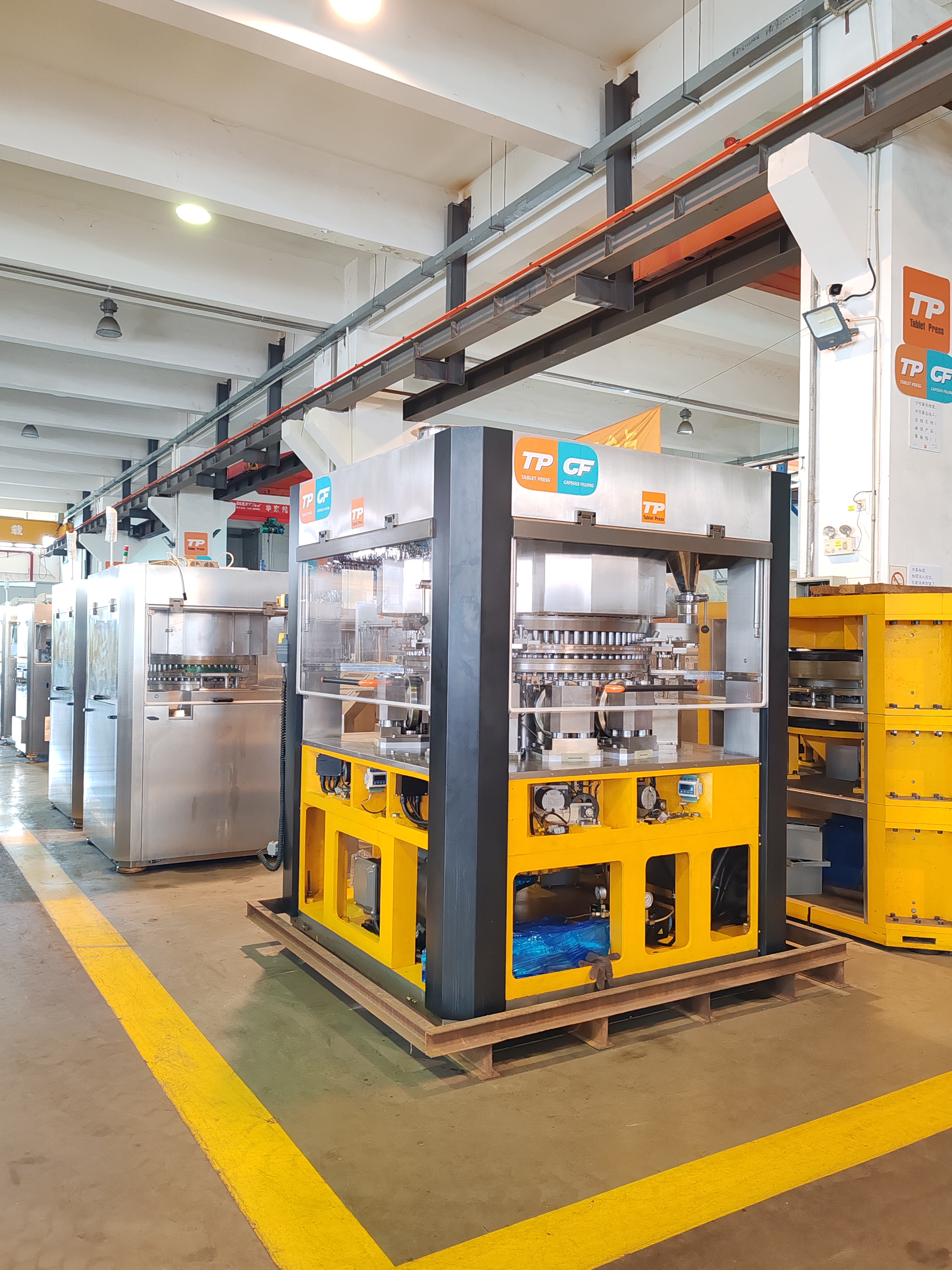
Outlet count is the least glamorous figure on a tablet press datasheet, and in practice it is one of the few that changes what a production line can actually do. A rotary tablet press with two discharge points and one with three are built around the same compression principle. What separates them is how output is delivered, how much turret tooling the machine carries, how many parallel downstream paths must be engineered, and how much steel sits on the floor.
This comparison covers two high-speed machines built by Shanghai Tablet Press Mechanical Components Co., Ltd. (TPCF), a Shanghai-based manufacturer of tablet press machines, tablet press punches and dies, capsule filling machines and tablet de-dusters: the GZPK620 double-outlet high-speed rotary tablet press, offered with 45, 55 or 65 stations, and the GZPK1060 three-outlet high-speed rotary tablet press, offered with 76, 95, 113 or 122 stations. Both are published at 100 kN maximum main compression. The choice between them is not which machine is stronger — it is which machine matches a batch plan, a tablet format and a layer structure.
Why Outlet Strategy Belongs in the Sizing Decision
A tablet press is specified backwards from the product. Tablet format and layer structure come first, then required output, then the equipment that moves tablets away from the turret. Outlet count sits in that third step, and it decides several things at once: how many parallel streams leave the machine, how much dust extraction and how many inline checkweighing or metal-detection points are needed downstream, and whether one packaging line or several can be fed without splitting product after the fact.
The common misreading is that a third outlet multiplies throughput. It does not. On the GZPK1060, three outlets serve a turret of 76 to 122 stations. On the GZPK620, two outlets serve a turret of 45 to 65 stations. Published single-layer maxima place the two machines within a few percentage points at the top of their ranges, which means the third outlet is about distribution and process stability, not multiplication. Buyers who need more tonnage per hour should be looking at station count and turret speed; buyers who need three clean product streams, or who need a layer structure only one of the two platforms provides, should be looking at outlet and layer configuration.
The Two Configurations, Stated Plainly
Because both machines are published at the same 100 kN main compression and the same 11 kW motor and 380 V three-phase supply, a side-by-side specification table is the fastest way to see where the platforms actually diverge.
| Parameter | GZPK620 (double outlet) | GZPK1060 (three outlet) |
|---|---|---|
| Number of stations | 45 / 55 / 65 | 76 / 95 / 113 / 122 |
| Discharge outlets | 2 | 3 |
| Maximum main compression | 100 kN | 100 kN |
| Maximum pre-compression | 30 kN (as published) | 100 kN (as published) |
| Maximum tablet diameter | 25 / 16 / 13 mm | 25 / 16 / 13 / 10 mm |
| Maximum filling depth | 20 / 20 / 16 mm | 20 mm |
| Layer configuration | Standard single-layer; optional bilayer capability on the intelligent GZPK620i variant | Single-layer or triple-layer |
| Maximum single-layer output | 378,000 / 528,000 / 624,000 tablets/h | 342,000 – 658,800 tablets/h |
| Maximum triple-layer output | Not published for this platform | 114,000 – 219,600 tablets/h |
| Motor and power supply | 11 kW; 380 V, 3-phase, 50 Hz | 11 kW; 380 V, 3-phase, 50 Hz |
| Dimensions | 1400 × 1500 × 1900 mm | 1720 × 1720 × 2185 mm |
| Net weight | 3,300 kg | 8,000 kg |
Stations, Compression Force and Tablet Diameter
Compression force is the specification most buyers check first, and here the two models are identical: 100 kN maximum main compression on both. Whatever a buyer is trying to prove about compression capability, station count and outlet count will not settle it — the force ceiling is the same.
Pre-compression is published differently. The GZPK620 and the GZPK620i are listed at 30 kN maximum pre-compression, while the GZPK1060 datasheet lists maximum main and pre-compression force as 100/100 kN. Pre-compression is the de-aeration step, and it matters most for granulate that traps air and for formulations where capping or lamination appears at speed. Buyers with a history of air-entrapment problems should treat the published pre-compression figures as a question to raise with the supplier rather than a like-for-like comparison, because the two datasheets do not describe the same figure in the same terms.
The station-count trade-off is really a tablet-size trade-off
More stations means more punches per turret revolution, and it also means less room per station. That relationship is visible in the published diameter ranges:
- GZPK620: maximum tablet diameter 25 mm at 45 stations, 16 mm at 55 stations, 13 mm at 65 stations.
- GZPK1060: maximum tablet diameter 25 mm at 76 stations, 16 mm at 95 stations, 13 mm at 113 stations, 10 mm at 122 stations.
The practical consequence is that the two machines serve overlapping but different tablet formats. If the product is a 20 mm or 25 mm tablet, the low-station variants are viable and the high-station variants are not. If the product is a small tablet in the 10 mm range and the volume is high, only the GZPK1060 platform reaches that diameter at 122 stations. Specifying a 122-station machine for a 25 mm tablet, or a 45-station machine for a long run of small tablets, produces either a machine that cannot run the format or one that is starved of the output the format could have generated.
Filling depth also changes with station count
Filling depth behaves differently on the two datasheets. The GZPK620 is published at 20 / 20 / 16 mm across its 45 / 55 / 65 station variants — the highest station count drops to 16 mm maximum fill. The GZPK1060 is published at a uniform 20 mm maximum filling depth across all four station counts. For tablets that need a deep fill, the three-outlet platform holds its 20 mm figure at 113 and 122 stations, while the double-outlet platform does not hold 20 mm at 65 stations.
Outlet Strategy: What Two or Three Streams Actually Change
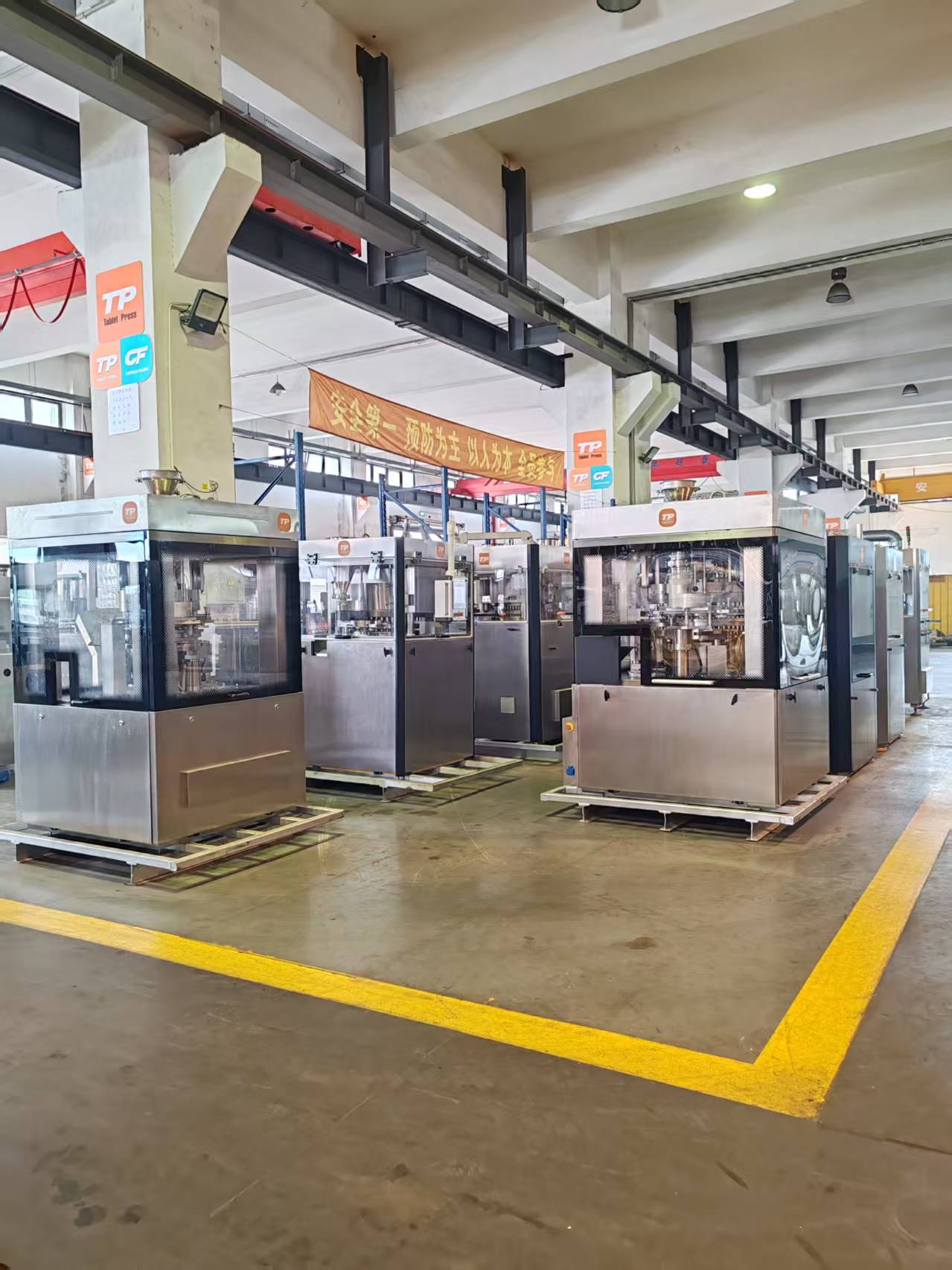
A discharge outlet is where finished tablets leave the compression zone. Two outlets give two parallel streams from one turret; three outlets give three. What that changes is downstream architecture, not compression physics.
Three streams are useful when the bottleneck is not the press but what happens after it. If every tablet must pass through inline checkweighing or metal detection, and those devices are sized per lane, then three outlets let three lanes run in parallel instead of forcing one lane to process the whole stream. Three outlets also give more flexibility when a product must be routed to more than one packaging line at the same time.
The same logic is the argument against specifying them reflexively. A third outlet adds a third path that needs dust extraction, guarding, and detection equipment. If the downstream line can only absorb two streams, the third outlet is capacity that has been paid for, occupies floor area, and is never used. A useful discipline before ordering either machine is to write down the maximum number of tablet streams the packing hall can accept simultaneously, and then match the machine to that number rather than to the machine's own maximum.
Automatic weight control and reject-tablet removal must be fixed in writing
Weight control and the handling of rejected tablets are the two functions that decide whether a high-speed press can run in a regulated environment, and they are exactly the functions that published specification sheets tend to leave open. The specification set for these two models does not state how automatic weight control (AWC) is implemented on either machine, nor how rejected tablets are removed from the stream and segregated.
That is not a defect in the machines; it is a gap that a buyer should close in the order specification. Two questions are worth writing down before signature: how weight deviations are detected and corrected, and where a rejected tablet goes — into a locked reject bin, through an inline diverter, or off the line entirely. Both should then be demonstrated during factory acceptance testing with the buyer's own product, not with a demonstration placebo.
Layer Capability: Single, Bilayer and Triple-Layer
Layer structure is the criterion that most cleanly separates the two platforms, and it should be decided before output is discussed.
The GZPK620 platform is published as a standard single-layer configuration, with optional bilayer capability on the intelligent GZPK620i variant at 45, 55 or 65 stations. The GZPK1060 platform is published for single-layer or triple-layer tablets. In other words, the double-outlet platform's published configuration covers two-layer products; the three-outlet platform's published configuration covers three-layer products. A buyer whose product requires three distinct layers is not looking at a preference question — the double-outlet platform's published configuration does not cover that requirement, and a buyer whose product requires two layers should not assume the three-layer machine is the simpler answer.
There is also a planning number that is easy to miss. On the GZPK1060, maximum single-layer output is published at 342,000 – 658,800 tablets per hour, while maximum triple-layer output is published at 114,000 – 219,600 tablets per hour. A triple-layer project must be sized on the triple-layer figure. Planning a three-layer product on the single-layer headline will produce a machine that cannot meet the batch plan, and no amount of downstream equipment will recover that gap.
What Buyers Should Verify Before Ordering
Tooling scales with station count
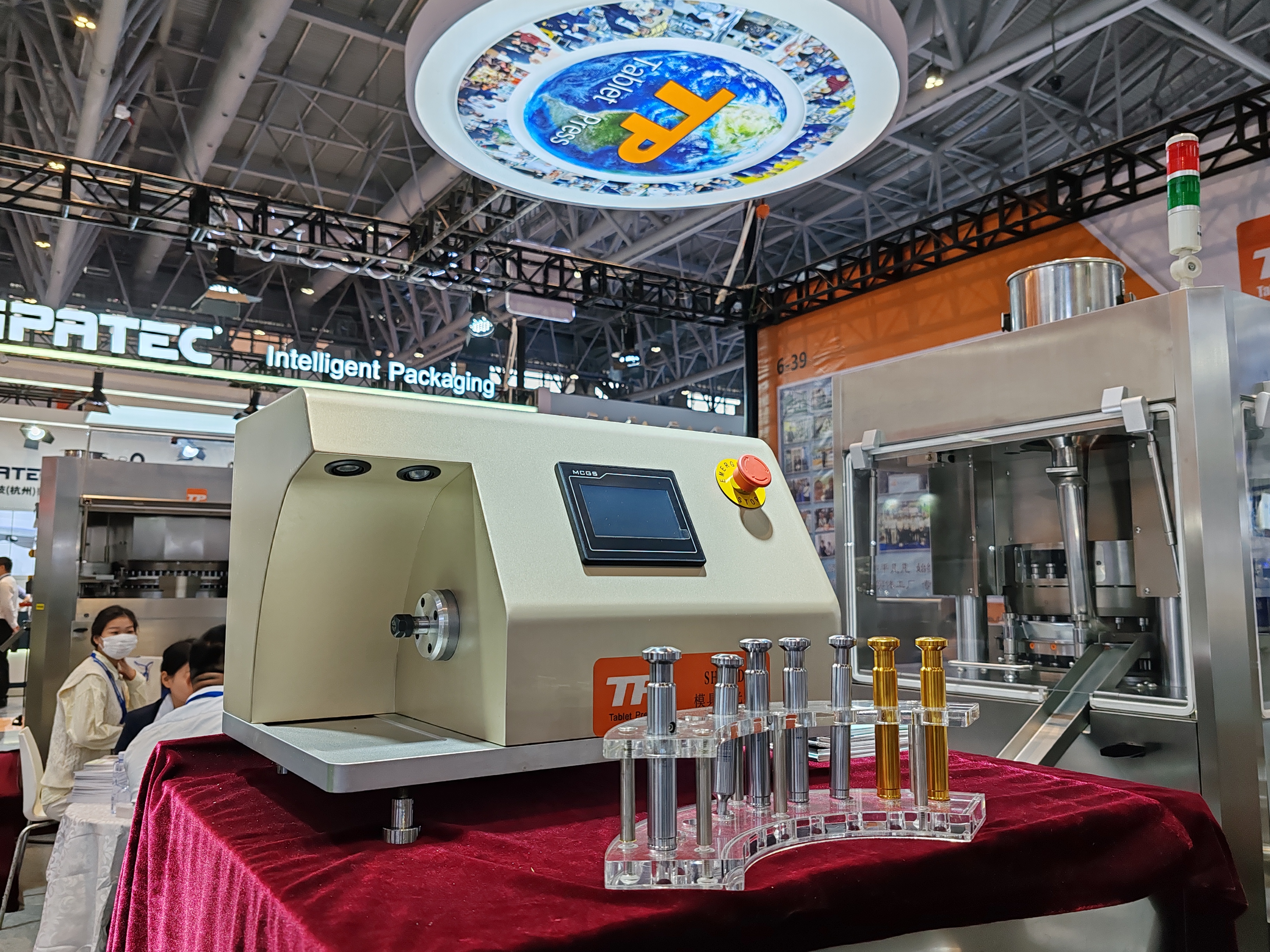
A rotary turret carries one punch-and-die set per station, so tooling requirements follow the station count directly. A 122-station GZPK1060 needs 122 tooling sets for a given tablet format; a 45-station GZPK620 needs 45. That affects three things: the capital tied up in tooling for each additional product format, the time and handling risk involved in a full changeover, and the storage and inspection burden in the tooling room. The manufacturer produces tablet press punches and dies as part of its product range, which simplifies sourcing but does not change the arithmetic.
Die table construction
Die table material is a specification point worth pinning down explicitly. Several models in the same manufacturer's range use a one-piece 2Cr13 stainless-steel die table that requires no nickel plating — a martensitic stainless grade (AISI 420 equivalent) containing 12% to 14% chromium, capable of reaching a core hardness of 45 to 55 HRC after quenching and tempering, with tensile strength in the 635–750 MPa range as published in the manufacturer's technical material. The stated advantage over a nickel-coated cast iron die table is that there is no coating layer to chip, delaminate or wear through and expose the substrate; a 2Cr13 table can also be reground directly and returned to service, whereas regrinding a plated table removes the protective layer.
The published material specification for the GZPK620 and GZPK1060 is listed as stainless steel. Buyers who consider die table construction a contamination-control point should confirm the exact die table grade for the configuration they order rather than inferring it from another model in the range.
Certification documents
Two current certificates are relevant to these model families. The quality management system certificate 114025Q10315ROM was issued by Drucker (Jiangsu) Certification Co., Ltd. against GB/T 19001-2016 / ISO 9001:2015, valid from 16 January 2025 to 15 January 2028. The CE certificate OP231226.STPWU21 was issued by ECM against EN ISO 12100:2010 and EN 60204-1:2018 for the scope "tablet press", valid from 26 December 2023 to 25 December 2028. Both certificates list the GZPK620 and GZPK1060 model families among their related products. Buyers should still confirm the documents against the issuing body's records for their own destination market, since certificate validity and scope are market-specific checks rather than supplier statements.
Batch Size, Layout and Application Fit
Both machines are published for pharmaceuticals, nutraceuticals and tablet manufacturing. Within that shared scope, the two platforms land in different production profiles.
The double-outlet GZPK620 suits mid-volume production where floor space is constrained and changeovers are relatively frequent: 3,300 kg, a 1400 × 1500 mm footprint, 45 to 65 stations, tablet diameters up to 25 mm at the low station counts, and optional bilayer capability on the GZPK620i. Two outlets are usually matched to one or two downstream lanes.
The three-outlet GZPK1060 suits high-volume single-layer runs, small tablet formats down to 10 mm, and products that require three layers. It occupies a 1720 × 1720 mm footprint at 2185 mm height and weighs 8,000 kg, and its three outlets imply three parallel downstream paths with their own extraction and detection capacity.
A factory record in the manufacturer's installation portfolio illustrates the scale these machines operate at: 320 automatic tablet press machines were delivered to a pharmacy factory in China for pharmaceutical tablet production, and the machines are reported to have maintained stable operation over a service period of three to six years, with high speed and ease of operation given as the installation's stated highlights. That record is not model-attributed to the GZPK620 or GZPK1060, and it should be read as evidence of installed fleet scale rather than as model-specific performance data.
Purchase mechanics are the same for both platforms and are worth knowing early in the evaluation, because they change how a validation plan is built. The minimum order quantity is 1 unit, including low-MOQ OEM orders with custom tooling. Monthly production capacity is 80 to 120 units, and lead time runs 45 to 75 days. Machines can be customized according to customer requirements, including machine function, automation level (automatic or semi-automatic operation), tablet size and shape, and production speed. Factory acceptance testing is performed according to customer requirements, and the manufacturer supports site acceptance testing at the buyer's own site. Delivery terms are FOB, acceptance is based on a pre-shipment test, and payment terms are 30% in advance with 70% payable after the pre-shipment test but before shipment.
Against Traditional Alternatives: Where the High-Speed Platform Stops Being the Answer
Comparing two high-speed machines to each other can hide a simpler question: whether a high-speed machine is needed at all. The same manufacturer's medium-speed single-outlet GZPX370i is published at 26 to 50 stations with 62,400 to 180,000 tablets per hour, 100 kN main compression and 16 kN pre-compression on a 1,800 kg frame. The double-outlet semi-automatic GZP550 is published at 39 to 61 stations with 177,840 to 329,400 tablets per hour. Both move far less steel and far less downstream equipment than either machine in this comparison.
There are real boundaries to state plainly. First, a high-speed machine does not fix a formulation: main compression on both the GZPK620 and the GZPK1060 is capped at 100 kN, the same as several lower-output models in the range, so a product that needs more force or different de-aeration is not solved by buying outlets or stations. Second, small batches and frequent product changeovers are the wrong application — that work belongs to laboratory and compact presses, where the same manufacturer publishes an R&D rotary model from 8 stations at 14,400 tablets per hour up to 21 stations at 44,100 tablets per hour, and a compact single-outlet model from 5 stations at 7,800 tablets per hour up to 12 stations at 21,600 tablets per hour. Third, the three-outlet machine is not automatically the more capable purchase: at 8,000 kg and 2185 mm height it demands more floor loading, more rigging capacity and more headroom, and its third stream is only worth having if the packing hall can absorb it.
One more practical point applies to both machines. A three-outlet press generates more open product-handling points than a two-outlet press, and each of those points needs extraction. A dust collector in the same product range, the XCJ-1.1, is published at 360 m³/h airflow with a 1.1 kW total power rating. Whether one collector is adequate for a given outlet configuration is a calculation buyers should require from the supplier during technical review, not an assumption to carry into commissioning.
Market and Regulatory Signals That Bear on the Decision
Two external signals are worth tracking while this class of machine is being evaluated. The first is demand structure. Commercial market research indexed for this category estimates the global tablet press machine market at USD 1.52 billion in 2025, and the forecast work in that segment has concentrated on automated and multi-station machines rather than on manual or low-station designs. That direction supports the logic of sizing a press against a multi-year batch plan instead of a single product launch: the machines at the top of the station range are the ones whose capacity is hardest to replace later.
The second signal is regulatory timing. Regulation (EU) 2023/1230, the new EU Machinery Regulation, repeals and replaces Directive 2006/42/EC and applies from 20 January 2027, and CE marking remains the mandatory conformity marking for machinery placed on the EU market. A buyer planning an installation in Europe should schedule the conformity documentation review around that date rather than after it. Separately, 21 CFR Part 11 in the United States and EU GMP Annex 11 on computerised systems both impose data-integrity requirements on electronic records and computerised systems used in regulated manufacture. If either press is specified with weight-control data capture, audit trails or electronic batch records, those requirements belong in the machine specification and in the acceptance test protocol — not only in the quality department's file cabinet.
Future Outlook
Three directions look durable for this equipment class. Footprint and utilities will keep gaining weight in machine selection, because concentrating output into fewer, larger machines only pays if the building can carry them. Outlet and lane architecture will keep being evaluated together with downstream detection and packaging capacity, since a stream the packing hall cannot absorb is not output. And documentation depth — certificate scope, acceptance test records, data-integrity design — will keep shifting from afterthought to selection criterion, particularly for suppliers selling into both EU and US regulated markets. For buyers, the practical implication is narrow and useful: choose station count from the tablet format, choose outlet count from the packing hall, and choose layer capability from the product. The GZPK620 and GZPK1060 differ on all three, which is why they belong in the same shortlist rather than in the same specification.
FAQ
1. Does the three-outlet GZPK1060 produce more tablets per hour than the double-outlet GZPK620?
The published single-layer maxima are close at the top of the ranges. The GZPK620 is published at 378,000 / 528,000 / 624,000 tablets per hour at 45 / 55 / 65 stations. The GZPK1060 is published at 342,000 – 658,800 tablets per hour across 76 / 95 / 113 / 122 stations. The highest figures are within roughly five percent of each other, and at the low end the 76-station GZPK1060 (342,000 tablets/hour) is below the 45-station GZPK620 (378,000 tablets/hour). Output is set by station count and turret speed; outlet count determines how many parallel streams that output is delivered in.
2. Can the GZPK620 run bilayer tablets, and can the GZPK1060 run three-layer tablets?
Each platform is published for a different layer structure. The GZPK620 platform is published as a standard single-layer configuration with optional bilayer capability on the intelligent GZPK620i variant at 45 / 55 / 65 stations. The GZPK1060 is published for single-layer or triple-layer tablets. Triple-layer output on the GZPK1060 is published at 114,000 – 219,600 tablets per hour, well below its single-layer range of 342,000 – 658,800 tablets per hour, so a three-layer product must be sized on the triple-layer figure.
3. What tablet diameters and filling depths do the two models support?
GZPK620: maximum tablet diameter 25 / 16 / 13 mm at 45 / 55 / 65 stations, with maximum filling depth of 20 / 20 / 16 mm. GZPK1060: maximum tablet diameter 25 / 16 / 13 / 10 mm at 76 / 95 / 113 / 122 stations, with a uniform 20 mm maximum filling depth. The pattern to note is that higher station counts reduce the maximum tablet diameter, and on the GZPK620 the 65-station variant also reduces maximum filling depth to 16 mm, while the GZPK1060 holds 20 mm across all four station counts.
4. What installation differences should be planned for?
The GZPK620 measures 1400 × 1500 × 1900 mm and weighs 3,300 kg. The GZPK1060 measures 1720 × 1720 × 2185 mm and weighs 8,000 kg. The three-outlet machine therefore requires more floor area, more headroom and a higher-capacity rigging and floor-loading plan. Both use an 11 kW motor on a 380 V, 3-phase, 50 Hz supply. Because the GZPK1060 discharges through three outlets rather than two, downstream extraction and detection capacity should be sized for the number of streams actually used.
5. What are the ordering, testing and payment terms?
Minimum order quantity is 1 unit, including low-MOQ OEM orders with custom tooling. Monthly production capacity is 80 to 120 units and lead time is 45 to 75 days. Customization is available for machine function, automation level (automatic or semi-automatic), tablet size and shape, and production speed. Factory acceptance testing is performed according to customer requirements, and the manufacturer assists with site acceptance testing at the buyer's site. Delivery terms are FOB, acceptance is based on a pre-shipment test, and payment terms are 30% in advance with 70% due after the pre-shipment test but before shipment.
The manufacturer publishes a brochure covering its tablet press and capsule filling range, available for download at TPCF product brochure.
¿Tiene preguntas o necesita más detalles?
Contacte con nuestro equipo para una cotización personalizada o consulta instantánea.
Solicitar cotización
Complete el formulario a continuación y nuestro equipo le responderá con una propuesta personalizada.
Chat directo de WhatsApp
¿Prefiere chatear en tiempo real? Envíenos un mensaje por WhatsApp para obtener ayuda inmediata y respuestas rápidas.
- Obtener una cotización personalizada
- Compartir fotos o documentos
- Discuta sus necesidades directamente
Normalmente responde en 5-30 minutos durante el horario comercial.