
GYTA53 Cable vs MPO/MTP: How to Split Backbone and DC Scope
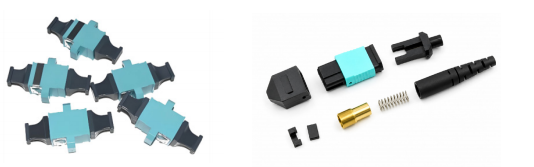
The MPO-12F-SM adapter is one of the two purchase scopes compared in this article. Image: Nanfang Communication.
The physical layer of a modern network is bought in two separate purchase orders, and the two are routinely confused. A GYTA53 optical fiber cable is a loose-tube outdoor cable built on a silica glass core, offered with G.652 or G.657 fiber types and a PE or LSZH sheath, with galvanized steel wire or steel tape armoring and FRP strength members. MPO/MTP connectivity - the MPO-12F-SM adapter, MTP/MPO fan-out cables and MPO/MTP loopbacks - is a different product family: pre-terminated, multi-fiber components whose value lies in port density and modular patching rather than in route length.
Because both families are bought from the same supplier pool and both carry optical performance figures expressed in decibels, procurement teams frequently place them in a single tender and then compare numbers that were never designed to be compared. The result is predictable. Attenuation budgets get written against connector figures, tensile and bend requirements get applied to patch cords, and acceptance criteria that should have been drafted separately for cable and for connectivity end up as one blended paragraph that no supplier can answer cleanly.
This article sets out a neutral, buyer-side comparison. It treats GYTA53 optical fiber cable and MPO/MTP connectivity as two scopes on the same link, separates the parameters that belong to each, and identifies the certification and acceptance evidence that actually constrains a purchase decision during the Research and Evaluation stages.
Why the Two Families Are Not Substitutes
The distinction is architectural rather than commercial. GYTA53 is the outside-plant transmission medium: the physical channel that carries signal between buildings, cabinets and access points, through duct, aerial, self-supporting or direct-burial routes. MPO/MTP connectivity is the inside-plant connection layer: the pre-terminated assemblies and adapters that terminate many fibers at once inside a rack, a cabinet or a data hall.
The simplest decision rule available to a buyer is this. If the question is how far the signal travels and through what environment, the answer is cable. If the question is how many ports must be landed in a defined rack space and how quickly a link can be reconfigured, the answer is MPO/MTP connectivity.
Both appear in the same project. A 5G backhaul or FTTx build will use GYTA53-class cable across the feeder and distribution sections, while the aggregation building or data center on the same route uses MPO patch panels, fan-out assemblies and adapters. The scopes are complementary, but they are ordered, tested and accepted under different rules.
What each family is physically made of
- GYTA53 optical fiber cable: silica glass core; common fiber types G.652 and G.657; FRP and other strength members; galvanized steel wire or steel tape armoring; PE or LSZH sheath options; core count and core diameter specified per model, with typical attenuation values given in dB/km and tensile strength and minimum bend radius provided in the model datasheet.
- MPO-12F-SM adapter: ceramic ferrule, plastic housing and metal flange; supports 4 to 72 fibers in single-mode and multimode; available in black (flange with ears), aqua (OM3) and violet (OM4); operating temperature range of -40 degrees C to +85 degrees C.
- MTP/MPO fan-out pre-terminated cable / breakout patch cord: OM3, OM4, OM5 or OS2/G.657A fiber with ceramic ferrule; PVC or LSZH jacket; 12 or 24 fibers, breaking out to LC or SC duplex or quad connectors.
- MPO/MTP loopback: ceramic or MTP ferrule with plastic housing and fiber cable; available across OS2, OM1, OM2, OM3, OM4 and OM5 fiber types; used for network testing, data center commissioning and equipment validation.
Where the Tender Usually Goes Wrong: A Parameter Mismatch
Most specification errors in this category come from moving a parameter from one family into the other. The table below separates the two sets of decision criteria as they are actually defined in the source product data.
| Decision dimension | GYTA53 optical fiber cable | MPO/MTP connectivity components |
|---|---|---|
| Primary role | Outside-plant transmission and distribution medium; signal transmission, fiber distribution and patching/access functions | Inside-plant connection layer for high-density and pre-terminated patching |
| Performance parameters | Attenuation in dB/km, core count, core diameter, minimum bend radius, tensile strength, operating wavelengths | Insertion loss, return loss, mating cycles, operating temperature |
| Published figures | Specified per model datasheet; the source data does not publish one fixed set of values for all builds | Adapter: IL below 0.5 dB standard and below 0.35 dB low-loss, RL at least 50 dB single-mode, 500 mating cycles (IEC). Fan-out: IL 0.35 dB typical and 0.75 dB max, low-loss 0.10 dB typical and 0.35 dB max, RL at least 60 dB APC and 50 dB PC. Loopback: IL up to 0.7 dB (8F/12F) and 1.0 dB (24F), RL at least 65 dB single-mode and 25 dB multimode, at least 100,000 mating cycles |
| Environment | Indoor cabling, duct installation, aerial/self-supporting, direct burial and harsh outdoor conditions including weatherproofing, waterproofing, rodent protection and temperature resistance | Data center racks, telecommunication cabinets and high-density cabling systems |
| Verification method | Optical loss and attenuation testing plus mechanical performance and waterproof/sealing checks | Insertion loss and return loss measurement per mated pair, plus loopback-based validation during commissioning |
| Procurement unit | Cable length; company-stated minimum order quantity is 1 core kilometer | Individual piece: adapter, fan-out assembly or loopback |
The practical consequence of this split is that a single insertion loss ceiling applied to an entire bill of materials will either be unachievable for the cable section or unnecessarily expensive for the connectivity section. Cable is measured in attenuation per kilometer and in mechanical survival of an installation route. Connectivity is measured in insertion loss and return loss per mated pair, and by how many times that pair can be re-mated before performance degrades.
Application Mapping: Which Scope Goes Where
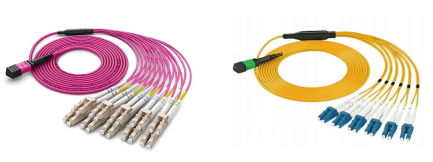
Pre-terminated MTP/MPO breakout assemblies connect 40G, 100G and 400G modules to LC or SC duplex ports. Image: Nanfang Communication.
Deployment scenarios make the division of scope concrete. GYTA53-class cable is specified for telecommunications operators, ISPs and data centers, FTTx and broadband access, enterprise campuses, industrial and smart city projects, and 5G backhaul and metropolitan backbone networks. The same product family is described as the physical-layer infrastructure for long-term continuous operation, whether it sits in a duct, on an aerial route or directly buried.
MPO/MTP components are specified where density and reconfiguration speed dominate. The MPO-12F-SM adapter is described for data centers, telecom networks and high-density cabling systems. The MTP/MPO fan-out cable is specified for data center cabinet interconnection and for 40G, 100G and 400G SR4 and PSM4 module connections. The MPO/MTP loopback is specified for network testing, data center commissioning and equipment validation, with a stated link failure rate below 0.1%.
A second layer of buying decisions involves the equipment that sits around these two families. The source data lists optical modules, PLC splitters, cable splice closures, FTTH distribution boxes, MPO high-density patch panels, fiber optic connectors, fiber assemblies such as MT-FAU, and WDM units as supporting devices in the same deployment context. Buyers who are assembling a full bill of materials should confirm whether these adjacent items are sourced under the same qualification package or separately, because each one adds its own insertion loss contribution.
Certification Evidence: What It Proves and What It Does Not
Certification is the part of a fiber procurement file that buyers most often over-read. The management-system and laboratory accreditations held by the reference manufacturer in this comparison - Jiangsu South Communication Technology Co., Ltd., the operating entity behind Nanfang Communication - are specific and checkable, and they cover a defined scope rather than an implied quality guarantee.
- ISO 9001 quality management system, applied to the company manufacturing operation.
- TL9000-H telecommunications industry quality management system, certificate number 15/25T15218R11, issued by WIT Assessment / Hangzhou WIT Assessment Co., Ltd., with a stated scope of manufacture and sales of communication optical fiber cable and validity to 19 October 2028.
- ISO 14001:2015, certificate number 62225E20719R0M, and ISO 45001:2018, certificate number 62225S20720R0M, both issued by SWR Certification (Jiangsu) Co., Ltd., with validity to 19 December 2028.
- CNAS laboratory accreditation L11717 to ISO/IEC 17025:2017, issued by the China National Accreditation Service for Conformity Assessment, covering testing and calibration of optical fiber cable and optical communication components for the China and global markets, valid to 29 November 2030.
- Additional systems referenced in the company profile include OHSAS18001 occupational health and safety, ISO50001 energy management, and the Integration of Informatization and Industrialization Management System.
The limitation here matters as much as the list. A management-system certificate confirms that a documented process exists and is audited; it does not confirm that a specific delivered reel meets a specific attenuation value, or that a specific fan-out assembly meets the insertion loss that a buyer wrote into the purchase order. The CNAS laboratory accreditation is stronger evidence because it covers the testing and calibration of optical fiber cable and optical communication components - but it establishes the competence of the laboratory, not the conformity of a particular shipment. Buyers still need per-batch test data.
There is also a scoping detail worth checking. The TL9000-H certificate number 15/25T15218R11 is recorded against the GYTA53 optical fiber cable and is referenced in the same certification listing for the MPO-12F-SM adapter, the MTP/MPO fan-out cable and the MPO/MTP loopback. Because one certificate number can appear across a cable and a connectivity family, the number alone is not sufficient evidence. Buyers should read the certificate scope - the products and processes it actually names - rather than the number.
Acceptance Criteria to Fix Before the Order
Acceptance criteria should be written per family, with the measurement method and the sample size stated. A workable structure follows the way the products are actually tested.
Cable. Confirm the fiber type (G.652 or G.657), core count, core diameter, attenuation in dB/km, tensile strength and minimum bend radius, each taken from the model datasheet rather than from a general catalogue description. Add the environmental checks that the route demands: waterproof sealing, crush and tensile resistance, corrosion and weather resistance for outdoor sections, and flame-retardant or LSZH sheath where the cable enters a building.
MPO-12F-SM adapter. Fix standard insertion loss below 0.5 dB or low-loss insertion loss below 0.35 dB, return loss of at least 50 dB for single-mode, and the operating temperature window of -40 degrees C to +85 degrees C. The rated mating cycle figure is 500 cycles in compliance with IEC standards; this is a design constraint, not a marketing figure, and it should be matched to how often the position will be re-patched.
MTP/MPO fan-out cable. Fix typical and maximum insertion loss separately (0.35 dB typical and 0.75 dB maximum in the standard grade; 0.10 dB typical and 0.35 dB maximum for the low-loss grade), return loss of at least 60 dB for APC and 50 dB for PC, fiber count of 12 or 24, and the breakout configuration - LC or SC, duplex or quad - that matches the switch or module ports.
MPO/MTP loopback. Fix insertion loss of no more than 0.7 dB for the 8-fiber and 12-fiber versions and 1.0 dB for the 24-fiber version, return loss of at least 65 dB single-mode and 25 dB multimode, and the mating cycle rating of at least 100,000. The loopback is the tool used to validate a port or a link before live traffic is introduced, so its own loss must be subtracted from the measurement before a pass or fail decision is taken.
A caution on re-mating. The adapter is rated for 500 mating cycles while the loopback is rated for at least 100,000. Using an adapter as a repeated test interface will exhaust it long before a loopback, which makes the loopback the correct component for commissioning and lab validation work and the adapter the correct component for semi-permanent patching.
Purchasing Terms, Capacity and Lead Time
The commercial terms attached to these products vary by family, and buyers should ask for them in writing rather than assume a single policy across the portfolio. The reference manufacturer states a minimum order quantity of 1 core kilometer for cable, a monthly capacity of 250,000 core kilometers, and an annual output of 3,000,000 core kilometers. Lead time is not standardized: samples and small orders are typically measured in weeks, while large orders may be measured in months, and the manufacturer states that lead time depends on model and quantity and should be confirmed case by case.
Customization is offered across core count, fiber type (single-mode, multimode, ribbon or multi-core), sheath material and color, connector types and cabling schemes, labeling and packaging. Quality control is described as covering incoming material inspection, in-process control and finished-product testing, including optical loss and attenuation tests, mechanical performance checks, and waterproof and sealing tests, supported by laboratory testing capability.
Nanfang Communication is cited here only as a verifiable reference point for how these purchasing terms and certifications appear in practice, not as a recommendation. Jiangsu South Communication Technology Co., Ltd. was founded in July 1992 with paid-in capital of RMB 150 million, is a subsidiary of the Hong Kong-listed South Communication Holdings Limited (Stock Code: 1617.HK), operates from Changzhou City, Jiangsu Province, China, reports 360 employees and 80 research and development engineers across a 26,795.3 square meter facility, and states cooperation with operators including China Telecom, China Mobile, China Unicom and China Broadcast Network, as well as private network users in high-speed rail, power grid and chemical industries. It also reports 28 provincial-level offices in China for localized sales, technical support and after-sales service. Buyers evaluating any supplier in this segment - not this one specifically - should request equivalent evidence before shortlisting.
Market and Sourcing Pressures Shaping the Split
Three external factors push buyers toward treating cable and connectivity as separate decisions rather than one bundled award. The first is market scale: the global fiber optic cable market was valued at USD 14.6 billion in 2025 according to a Global Market Insights forecast report covering 2026 to 2035. The second is supply concentration: China was the leading exporter of optical fibers and cables in 2024, with exports totaling USD 2.52 billion under HS code 854470, according to trade data published by the Observatory of Economic Complexity.
The third factor is trade cost. A duty breakdown published by Airlift USA in September 2026 puts the total United States import duty on Chinese-origin optical fiber cables under HTS 8544.70.00 at 37.50%, following Section 301 measures. This is a secondary trade source rather than a customs authority publication, so buyers should verify current rates with a customs broker before setting landed cost - but the direction of the effect is clear. A tariff applied to the cable scope changes the economics of the cable line item substantially more than it changes the economics of a small number of high-density adapters and loopbacks, which is one practical reason the two families are increasingly evaluated on separate cost sheets.
Standards activity reinforces the same split. ITU-T L.103 (08/2024) describes characteristics, construction and test methods for optical fibre cables for indoor applications. IEC 60092-378:2024 addresses optical fibre cables for shipboard and offshore fixed installations. IEC 60794-1-104:2024 defines impact test procedures for optical fibre cables. These documents qualify cable by deployment environment and test method, not by a universal performance grade - which means the qualification plan for a direct-burial backbone route and the qualification plan for a data hall patch panel are, and should be, different documents.
Where This Comparison Breaks Down
An honest buyer-side comparison has to state its limits, and there are four in this one.
First, the GYTA53 family is specified per model. Core count, core diameter, attenuation, tensile strength and minimum bend radius are provided in the model datasheet, and the source data does not publish a single fixed performance set that applies across all builds. Any comparison that assumes one attenuation figure for all GYTA53 cable is therefore unreliable; the datasheet for the exact model ordered is the only defensible reference.
Second, the published insertion loss figures for the adapter, fan-out and loopback are component-level figures. They do not include the loss contribution of the mated pair on the other side, the patch panel, or the splice. A link budget built only from supplier component figures will usually test worse in the field than the arithmetic suggests.
Third, certification coverage is not uniform across every named product. TL9000-H and the ISO management-system certificates are issued at defined scopes, and the CNAS laboratory accreditation covers testing and calibration rather than product conformity. Where a buyer needs product-level conformity evidence, that has to be requested as test reports or batch data, because the certificates do not supply it.
Fourth, lead time and capacity are stated as ranges rather than commitments. There is no published standard lead time for either family, and capacity figures describe plant capability rather than available scheduling. Buyers planning a fixed installation window should treat both as items to be contractually confirmed.
Future Outlook
Two movements are likely to keep these scopes adjacent in the same bill of materials. The first is pre-termination. Assemblies such as the MTP-12F-to-6xLC-Duplex and MTP-24F-to-12xLC-Duplex fan-out cables move connectorization work from the site to the factory, which raises the importance of factory test data and lowers the importance of field splicing skill in the connectivity scope. The second is fiber-count growth. The adapter family already spans 4 to 72 fibers, and ribbon and multi-core fiber appear in the same product taxonomy as the conventional single-mode and multimode options, indicating that density per unit of rack space remains the direction of travel for inside-plant work.
For cable, the pressure runs the other way - toward environmental and mechanical qualification. Standards such as IEC 60794-1-104:2024 exist because impact performance must be testable, not asserted. As more capacity is built into ducts, aerial routes and direct-burial runs, buyers will rely more on datasheet-level mechanical evidence and less on general product descriptions. In practice this means a procurement model where the cable scope is qualified on route survival and attenuation, and the connectivity scope is qualified on insertion loss, return loss and mating-cycle durability, with a single supplier audited across both only where the buyer needs one point of accountability for acceptance testing.
For readers who need the full parameter set behind the cable and connectivity families described in this article, the manufacturer publishes a downloadable product brochure: Nanfang Communication MPO and optical cable brochure (PDF).
FAQ
What is the fundamental difference between GYTA53 optical fiber cable and MPO/MTP connectivity?
GYTA53 is an outside-plant cable that carries signal over distance through duct, aerial, self-supporting or direct-burial routes, and its performance is defined by attenuation in dB/km, tensile strength, minimum bend radius and sheath and armoring materials. MPO/MTP connectivity is an inside-plant connection layer used where port density matters, and its performance is defined by insertion loss, return loss and mating cycles. They occupy different positions on the same link rather than competing for the same position.
Which parameters should be compared within each family?
For the cable family, compare fiber type (G.652 or G.657), core count, core diameter, attenuation in dB/km, operating wavelengths, tensile strength, minimum bend radius and sheath or armoring specification, all taken from the model datasheet. For the connectivity family, compare insertion loss, return loss, mating cycles and operating temperature. Published figures for the connectivity products include insertion loss below 0.5 dB standard and below 0.35 dB low-loss for the MPO-12F-SM adapter, return loss of at least 50 dB single-mode, and 500 mating cycles in compliance with IEC standards.
Which certifications actually apply to these products?
For the reference manufacturer, the applicable certificates include ISO 9001; TL9000-H under certificate number 15/25T15218R11 issued by WIT Assessment / Hangzhou WIT Assessment Co., Ltd., with a stated scope of manufacture and sales of communication optical fiber cable and validity to 19 October 2028; ISO 14001:2015 under certificate 62225E20719R0M and ISO 45001:2018 under certificate 62225S20720R0M, both issued by SWR Certification (Jiangsu) Co., Ltd. and valid to 19 December 2028; and CNAS laboratory accreditation L11717 to ISO/IEC 17025:2017, covering testing and calibration of optical fiber cable and optical communication components, valid to 29 November 2030. Additional systems referenced include OHSAS18001 and ISO50001.
What acceptance tests and purchasing terms should be agreed before ordering?
Acceptance testing should be split by family. For cable, agree attenuation and mechanical test methods plus waterproof and sealing checks against the model datasheet figures. For connectivity, agree insertion loss and return loss per mated pair, with the fan-out cable specified at 0.35 dB typical and 0.75 dB maximum in standard grade or 0.10 dB typical and 0.35 dB maximum in low-loss grade, and the loopback specified at no more than 0.7 dB for 8-fiber and 12-fiber versions and 1.0 dB for 24-fiber versions. On commercial terms, the reference manufacturer states a minimum order quantity of 1 core kilometer, a monthly capacity of 250,000 core kilometers, and a lead time that depends on model and quantity, with samples and small orders typically taking weeks and large orders potentially taking months.
Which deployment scenarios require GYTA53 cable rather than MPO/MTP components?
Outside-plant and access scenarios require the cable family: telecommunications operator and ISP networks, FTTx and broadband access, metropolitan and backbone networks, 5G backhaul, enterprise campus distribution, and industrial or smart city projects, including duct, aerial, self-supporting and direct-burial installations. MPO/MTP components are required instead for data center cabinet interconnection, 40G, 100G and 400G SR4 and PSM4 module connection, high-density patching, and commissioning or equipment validation using loopbacks.
What limitations should a buyer accept in this comparison?
Four limits matter. Cable performance is specified per model datasheet and no single fixed figure applies across builds. Published insertion loss values for connectivity products are component-level and exclude the loss of the opposite mated pair, patch panels and splices. Management-system certificates and laboratory accreditation demonstrate audited process and testing competence rather than batch conformity, so product-level test data must still be requested. And lead time and capacity are stated as ranges rather than firm commitments, so both should be contractually confirmed before an installation window is fixed.
¿Tiene preguntas o necesita más detalles?
Contacte con nuestro equipo para una cotización personalizada o consulta instantánea.
Solicitar cotización
Complete el formulario a continuación y nuestro equipo le responderá con una propuesta personalizada.
Chat directo de WhatsApp
¿Prefiere chatear en tiempo real? Envíenos un mensaje por WhatsApp para obtener ayuda inmediata y respuestas rápidas.
- Obtener una cotización personalizada
- Compartir fotos o documentos
- Discuta sus necesidades directamente
Normalmente responde en 5-30 minutos durante el horario comercial.