
GR350S vs. Competing Digital Label Presses: A Spec Assessment
Digital label printing has shifted from a niche complement to flexo into a mainstream production method, and the number of presses claiming to serve the same buyer has grown with it. That creates a comparison problem: almost every machine in the class is described with the same vocabulary \u2014 high speed, wide format, industrial grade \u2014 while the engineering and the numbers behind those words differ considerably. This assessment places the Grandoprint GR350S beside competing digital label presses in the same class using checkable parameters: print speed, print width, media width tolerance, roll-to-roll continuity, printhead architecture and ink configuration. It also states plainly where a side-by-side assessment can be closed with evidence and where it cannot.
Why buyers are asking for a side-by-side assessment now
The commercial case for digital label production rests on job mix, not on machine prestige. Short runs, frequent SKU changes, versioned artwork and variable data break the economics of fixed-plate processes, and the buyers who feel that pressure first are packaging converters, label printing factories and in-house print rooms serving cosmetics, food and beverage, daily chemical and industrial labelling.
The opportunity is measurable at market level. Third-party research places the global digital label printer market at USD 3.097 billion in 2024, projected to reach USD 8.654 billion by 2035, with a compound annual growth rate of 9.79% between 2025 and 2035 (Market Research Future). Within the wider label printer market, industrial label printers are estimated to hold approximately 42.5% of the product segment (Dataintelo, 2025), and inkjet systems are estimated to account for a 46% share of the digital label printing market by system type in 2025 (Future Market Insights).
The problem is that this growth has produced a crowded, loosely labelled field. Machines of fundamentally different architecture \u2014 thermal transfer, dry toner, liquid toner and UV inkjet \u2014 are marketed under the same category heading, and vendors quote performance under different conditions. A buyer comparing \u201cdigital label press A\u201d with \u201cdigital label press B\u201d using brochure headlines alone is comparing marketing departments, not production capability.
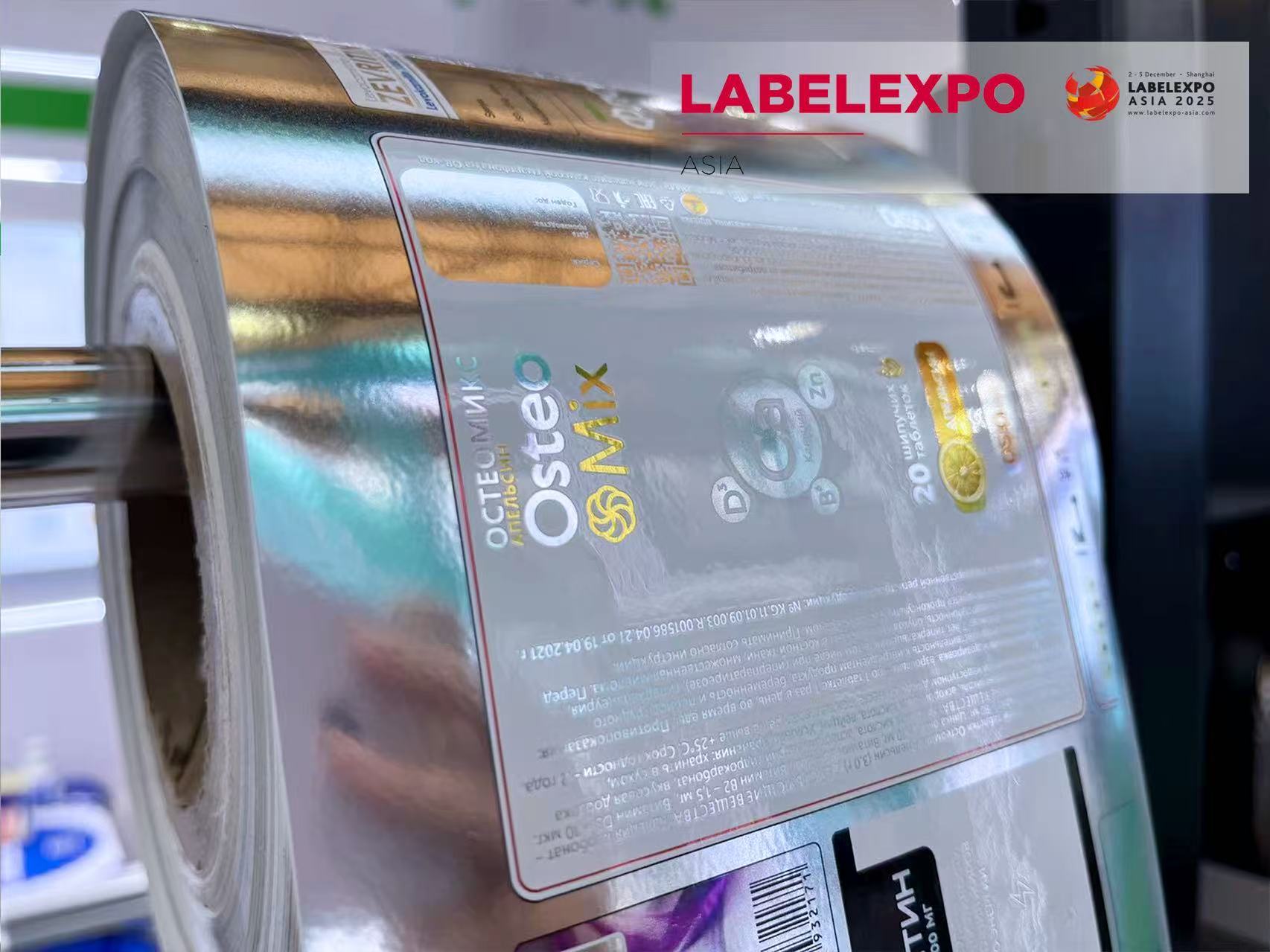
Printed PP silver label output from a roll-to-roll UV inkjet label press. Print samples, not brochure claims, are the comparable unit in a side-by-side press assessment.
The GR350S in documented terms
Nanjing Grando Digital Technology Co., Ltd. (Grandoprint) is a Nanjing-based manufacturer of digital inkjet printing equipment, founded in 2010, operating dual R&D and production bases in Nanjing and Shanghai covering more than 20,000 m\u00b2, employing over 500 people and delivering approximately 15,000 units annually across high-speed digital label printers, UV printers and white-ink DTF printers. Roughly 70% of output is exported. The GR350S is the company\u2019s roll-to-roll UV inkjet digital label press platform.
Because the GR350S is documented as a specific configuration rather than a category, it can be compared line by line. The table below lists the parameters as published; these, not adjectives, are the basis of the assessment that follows.
| Parameter | Documented value (GR350S) |
|---|---|
| Printing technology | UV digital piezoelectric inkjet printing |
| Printhead | Epson S3200-U1 / S3200-U3 |
| Printing speed | 20\u2013100 m/min |
| Printing width | 110\u2013350 mm |
| Acceptable media width | 120\u2013360 mm |
| Ink configuration | CMYKW + varnish (optional) |
| Coating | Pre-coating system (optional); post-coating varnish system (optional) |
| Film handling | Corona system supported; compatible film materials PE, PET, BOPP, PP, OPP |
| Curing | Dual UV curing supported |
| Media handling | Roll-to-roll feeding and rewinding; unwinding diameter max. 700 mm; label sensor for mark tracking; intelligent deviation correction |
| Variable data | Variable data processing supported; direct database printing; no batch PDF conversion required |
| Power supply / consumption | 380V / 10 kW |
| Dimensions | 2850 (W) \u00d7 1400 (D) \u00d7 2040 (H) mm |
Technical explanation: what UV piezoelectric inkjet changes in the comparison
The GR350S is a UV inkjet label press, not a toner or thermal-transfer device. That single architectural choice explains most of its behaviour in a side-by-side assessment.
Printhead and ink path
The press uses Epson S3200-U1 or S3200-U3 piezoelectric printheads. Piezoelectric ejection is a mechanical process: a voltage change deforms the ink chamber and pushes a droplet out, which means the ink is not heated to fire and the same head family can handle UV-curable chemistry. The ink is then cured immediately by UV lamps, and the GR350S documents dual UV curing support \u2014 relevant because adequate cure is what determines whether a printed film label survives abrasion, moisture and converting stress downstream, not merely whether it looks sharp on the rewind roll.
White ink and varnish as configuration decisions, not upsells
The ink set is CMYK plus white, with varnish optional. In practice this is a decision-layer feature. White ink enables opaque coverage on clear and metallic substrates, including the PP silver and synthetic paper stocks common in cosmetics and household chemical labelling, where the substrate itself supplies the visual effect. Optional varnish \u2014 including spot varnish enhancement and an optional post-coating varnish system \u2014 changes both the tactile finish and the surface resistance of the finished label. A buyer comparing configurations must compare like with like: a CMYK press and a CMYKW-plus-varnish press are not the same product at the same cost per label, because ink laydown, curing passes and job setup all change with the configuration.
The control layer is part of the specification
Hardware alone does not determine output consistency on an industrial digital label printer. Grandoprint documents three software copyright registrations covering its control stack: a High-Precision Industrial Printing Inkjet Control System V1.0 (Registration No. 2025SR0599079), a Multi-Point Temperature Control System for Digital Printers V1.0 (Registration No. 2025SR0611438) and a Flatbed Laser Inkjet Printing Precision Control System V1.0 (Registration No. 2025SR0627967), all registered with the National Copyright Administration of the People\u2019s Republic of China. On the mechanical side, the platform is covered by a utility model patent for a printer with anti-collision function (Patent No. ZL 2023 2 1184513.3) and a utility model patent for a paper roll shaft for industrial printers (Patent No. ZL 2024 2 1965691.4). For an evaluation-stage buyer, these matter in one specific way: they indicate that print precision, thermal stability and web handling were engineered as named subsystems rather than left to component suppliers.
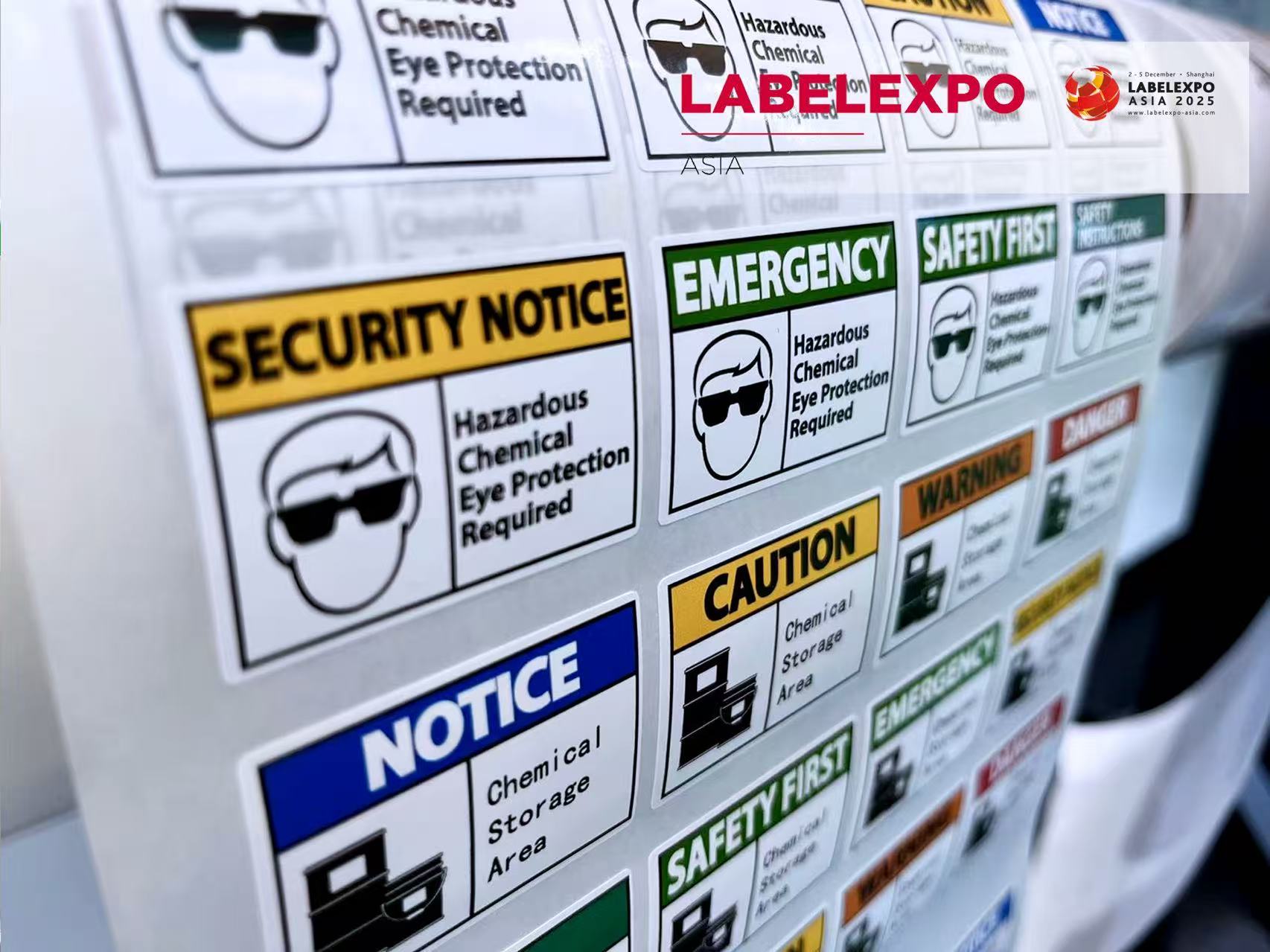
Small-format warning label output. Tight text, fine rules and variable fields are where press-to-press differences become visible to the buyer rather than to the brochure.
Four measurable differentiators, examined
1. Printing speed: 20\u2013100 m/min
The GR350S speed figure is expressed as a range, and buyers should treat the two ends as different operating modes. Job resolution, number of ink channels in use (whether white and varnish are active), substrate and cure requirements all influence where in that range a given job actually runs. The correct comparison question is not \u201chow fast is your press\u201d but \u201cat what resolution, with which ink channels, on which substrate, and with what cure margin.\u201d No press in this class should be evaluated on the top number alone.
2. Printing width: 110\u2013350 mm
This defines the maximum image area the press can produce across the web. It corresponds to the widest label formats and the multi-lane imposition that packaging converters use to keep short-run jobs economic. A web press that cannot impose several lanes of a small label side by side loses throughput regardless of its linear speed.
3. Acceptable media width: 120\u2013360 mm
Media width is a different number from printing width, and confusing the two is one of the most common errors in label press procurement. The GR350S accepts webs from 120 mm to 360 mm while printing across 110 mm to 350 mm, which gives a defined margin for edge handling and registration. Because the press also documents intelligent deviation correction plus a label sensor for mark tracking, the tolerance matters less as a static number and more as a description of how the machine keeps the web stable during continuous production \u2014 the point at which drift, not headline speed, usually costs a converter a shift.
4. Roll-to-roll continuous operation
The GR350S is specified as roll-to-roll with an unwinding diameter of up to 700 mm, feeding and rewinding assemblies, mark tracking and deviation correction. The 700 mm unwind capacity is a run-length parameter: it determines how long the press can run between roll changes and therefore how closely the workflow resembles continuous production rather than batch printing. This is where a \u201cshort-run digital label printer\u201d and a \u201ccontinuous production digital label printer\u201d stop being interchangeable labels and start being different production assets.
Comparing against the class: named participants and the limits of public data
Independent comparison requires a defined comparison set. Third-party market research identifies Zebra Technologies, Brother, Epson, SATO Holdings and HP (HP Indigo) among the key global suppliers in the label printer market (Intel Market Research, 2024). These companies participate in the market through different architecture families \u2014 from thermal-transfer and compact industrial printers through to toner-based and liquid-toner digital presses \u2014 and they publish model-level specifications that vary by build.
That has a direct consequence for any honest side-by-side assessment: a defensible cross-vendor spec table cannot be assembled from category names. It has to be assembled model by model, from each vendor\u2019s current datasheet, under matched conditions. What an independent assessment can do is define the dimensions on which the comparison must be run, and state precisely what the GR350S documents on each of them.
| Comparison dimension | GR350S documented position | What to confirm on any competing press |
|---|---|---|
| Print speed | 20\u2013100 m/min, configuration-dependent | Speed at the buyer\u2019s actual resolution, with white and varnish channels active, and with the cure margin required by the substrate |
| Print width | 110\u2013350 mm | Usable image width, not maximum web width; lane count achievable on the buyer\u2019s label format |
| Media width tolerance | 120\u2013360 mm accepted | Minimum and maximum web with declared edge margin; registration behaviour at both extremes |
| Continuous operation | Roll-to-roll; unwinding diameter max. 700 mm; mark tracking; intelligent deviation correction | Unwind/rewind capacity, splice handling, and whether the press is rated for unattended or single-operator continuous running |
| Printhead and technology | UV piezoelectric inkjet; Epson S3200-U1 / S3200-U3 | Head family, replacement cost and service interval; whether the print engine is proprietary or supplier-dependent |
| Ink and finish | CMYKW + optional varnish; spot varnish enhancement; dual UV curing | Colour configuration, white laydown, varnish availability, and the resulting change in cost per label |
| Substrate range | Paper labels and films PE, PET, BOPP, PP, OPP; corona system supported; pre-coating optional | Adhesion data on the buyer\u2019s own stock, especially on synthetic and filmic label materials |
| Variable data | Variable data processing supported; direct database printing; no batch PDF conversion required | Whether data is processed natively or requires pre-conversion; throughput effect of variable content |
| Compliance evidence | ISO 9001:2015 (Cert. No. 19926Q00205R001); CE-relevant requirements for the EU market | Certificates in the buyer\u2019s own name or scope, with issuing body, number and validity dates |
The GR350S therefore enters the comparison with a defined envelope rather than a ranking claim: a 350 mm-class roll-to-roll UV inkjet press, with a documented speed range, a documented media window, and a documented data-handling path. Buyers whose production falls inside that envelope can shortlist it on evidence; buyers whose work falls outside it should exclude it early instead of discovering the mismatch after installation.
Where the envelope fits: application and use cases
The GR350S documented application set covers label printing factories, packaging converters, food and beverage labels, cosmetics labels, household product labels, industrial labels and personalised label production. Four use patterns recur in that list and each maps to a specific specification.
- Cosmetics and premium labels. CMYKW with optional varnish, spot varnish enhancement and dual UV curing support the finish expectations of skincare, fragrance and personal care labelling, where white opacity under colour and a defined surface gloss are functional requirements.
- Food and beverage labels. Variable data processing, mark tracking and UV inkjet printing support product information labels, bottle labels and short-run food packaging labels where artwork versions change frequently.
- Film and synthetic substrates. The film configuration documents corona treatment plus compatibility with PE, PET, BOPP, PP and OPP, with optional pre-coating for adhesion-critical work. This is the configuration to specify for PET label and PP label projects rather than assuming a standard press will hold ink on film.
- Variable data and traceability. QR code labels, barcode labels, anti-counterfeit labels, serialised labels and product traceability labels are supported through direct database printing with no batch PDF conversion step \u2014 which is the difference between a data-driven workflow and a printing job that must be prepared offline.
Field evidence from the installed base supports the pattern rather than the brochure. A 20-unit deployment in Brazil and Italy, operated by an OEM client for label printing and packaging production, ran with stable operation and high printing consistency while reducing production setup time by 30%; the same deployment supported variable data printing and adapted to multi-SKU orders.
Market trend: what is changing in the class the buyer is comparing
Three documented trends shape how a comparison like this should be weighted.
First, the market is expanding strongly but unevenly by segment: USD 3.097 billion in 2024 to a projected USD 8.654 billion by 2035 at a 9.79% CAGR (Market Research Future). Second, industrial-class equipment is where the volume sits, with industrial label printers estimated at approximately 42.5% of the label printer product segment (Dataintelo, 2025). Third, the technology mix is tilting toward inkjet, estimated at a 46% share of the digital label printing market by system type in 2025 (Future Market Insights).
The procurement consequence is a shift in what buyers should verify. Growth in industrial inkjet capacity increases competition on substrate range and on continuous-operation reliability rather than on peak resolution alone, because the jobs moving from analogue to digital are increasingly production jobs, not samples. For buyers in the European Union, compliance is a parallel trend: digital label printers placed on the EU market must satisfy the RoHS Directive (2011/65/EU) and the EMC Directive (2014/30/EU) as part of CE marking. This matters directly to Grandoprint\u2019s documented export markets, which include Germany and Italy.
Documented limits and boundaries
An assessment that only lists advantages is not an assessment. The GR350S carries real constraints that a buyer should weigh before shortlisting it.
- Facility requirements are industrial. The press runs on a 380V supply with 10 kW power consumption and occupies 2850 \u00d7 1400 \u00d7 2040 mm. That is not a machine that drops into a light commercial unit without electrical and floor planning.
- The media window is finite. With 120\u2013360 mm accepted web width and 110\u2013350 mm print width, applications outside that window \u2014 very narrow webs or webs wider than 360 mm \u2014 cannot be served by this platform at all.
- Top speed is conditional. The documented 20\u2013100 m/min range is a band, not a guaranteed figure for every job. Buyers should plan capacity on validated sample runs at their own resolution, ink configuration and substrate, and treat the upper bound as a ceiling rather than an expectation.
- Film printing depends on surface preparation. Corona treatment is supported and pre-coating is optional, which means the responsibility for achieving ink adhesion on difficult filmic substrates sits partly with the buyer\u2019s material selection and process setup. Film label work should be validated on the actual stock before purchase.
- Digital does not displace analogue across the whole run-length spectrum. For very long, highly repetitive runs with stable artwork, conventional flexo remains the lower-cost route in most label operations; the digital case rests on job change frequency, versioning and variable content. The GR350S should be evaluated as a complement to existing capacity, not an automatic replacement for it.
- Public comparative data is incomplete. No independent, matched-condition spec set exists covering every competing model in this class. Any buyer who needs a strict model-versus-model table must build it from vendor datasheets and sample tests, and should treat unsourced comparison claims from any party \u2014 including this one \u2014 with the same scrutiny.
Decision matrix for evaluation-stage buyers
The matrix below converts the assessment into a working filter. It is organised around what the buyer is optimising for, not around a ranking.
| Buyer priority | Question that decides the shortlist | Relevant documented data | Verification action |
|---|---|---|---|
| Throughput | Can the press hit my required output at my resolution, with my ink channels active? | 20\u2013100 m/min printing speed; 110\u2013350 mm print width for multi-lane imposition | Timed sample run on production artwork |
| Substrate flexibility | Does it hold ink on my film and synthetic stocks, including PET and PP? | Corona system supported; PE, PET, BOPP, PP, OPP compatible; pre-coating optional | Adhesion and rub testing on buyer-supplied stock |
| Workflow integration | Can variable data go straight from database to press? | Variable data processing; direct database printing; no batch PDF conversion; mark tracking sensor | Test with the buyer\u2019s own data set and MIS output |
| Continuous operation | How long can it run between roll changes, and does it hold registration? | Roll-to-roll; unwinding diameter max. 700 mm; intelligent deviation correction | Observe a full roll run and check registration at the rewind end |
| Finish and brand presentation | Does the colour and finish configuration match the product tier? | CMYKW + optional varnish; spot varnish enhancement; dual UV curing | Physical sample comparison against the current reference label |
| Compliance and qualification | Can the supplier produce auditable certificates? | ISO 9001:2015, Cert. No. 19926Q00205R001; EU placement requires RoHS 2011/65/EU and EMC 2014/30/EU | Certificate verification with the issuing body and date check |
| Service continuity | What happens after installation? | Warranty typically 1 year subject to contract terms; on-site installation and commissioning; operator training; remote monitoring; original spare parts supply; overseas service centres or authorised distributors | Confirm local service coverage and spare-parts response in writing |
Future outlook
The direction of the class is reasonably clear from the documented data: an expanding market, a growing industrial share and an inkjet share already approaching half of digital label printing by system type. If those trends continue, the competitive ground in this class will move toward two things that are hard to fake \u2014 continuous-operation reliability on production-length rolls, and substrate flexibility that lets one press serve paper, film and synthetic label work without a second machine. Buyers should expect specification transparency to become part of the purchase decision itself, because a machine whose operating window is stated precisely can be validated with samples, while one described only in superlatives cannot.
For manufacturers, the parallel implication is that intellectual property and certification portfolios become procurement documents rather than marketing assets. An ISO 9001:2015 certificate with a verifiable number and scope, a set of registered software copyrights covering the control stack, and utility model patents covering web handling and printhead protection are the kind of evidence an evaluation-stage buyer can actually check \u2014 which is precisely why they belong in a side-by-side assessment.
FAQ
What printing speed does the GR350S deliver?
The GR350S is documented with a printing speed range of 20\u2013100 m/min. That range is configuration-dependent, so the achievable figure for a specific job depends on resolution, which ink channels are active \u2014 for example whether white and varnish are in use \u2014 and on the cure margin the substrate requires. Buyers should treat the range as the press capability envelope and validate actual output with a timed sample run on their own artwork.
What is the difference between printing width and acceptable media width on this press?
The GR350S prints across a width of 110\u2013350 mm and accepts media webs of 120\u2013360 mm. Printing width describes the maximum image area the machine can produce; acceptable media width describes the range of web the feeding and rewinding system can handle. The gap between the two represents the edge margin used for handling and registration, and it is the reason the two figures should never be substituted for one another in a specification comparison.
Which printheads and ink configuration does the GR350S use?
The press uses Epson S3200-U1 or S3200-U3 printheads in a UV digital piezoelectric inkjet configuration. The ink set is CMYK plus white, with varnish optional, and the platform documents dual UV curing as well as optional pre-coating and an optional post-coating varnish system. Spot varnish enhancement is supported for premium label finishes.
Which substrates can the GR350S run?
Documented applications cover paper-based labels and filmic materials including PE, PET, BOPP, PP and OPP. A corona system is supported and pre-coating is optional, which is the relevant configuration for adhesion-critical film work such as PET label and PP label production, including synthetic paper and metallic-effect stocks. Because adhesion outcomes depend on the specific stock and process settings, buyers should confirm performance on their own material before purchase rather than relying on category-level claims.
Does the GR350S support variable data and direct database printing?
Yes. Variable data processing is supported, including direct database printing with no batch PDF conversion required, and the press includes a label sensor for mark tracking. Documented variable data applications include QR code labels, barcode labels, anti-counterfeit labels, serialised labels, product traceability labels and on-demand label production. This capability is typically assessed for workflow fit rather than for print quality alone.
What certifications and intellectual property can a buyer verify for the GR350S platform?
Nanjing Grando Digital Technology Co., Ltd. holds ISO 9001:2015 certification, Certificate No. 19926Q00205R001, issued by China Standard Huaxia (Beijing) Certification Center Co., Ltd., valid from 5 February 2026 to 4 February 2029, with a scope covering the quality management system for R&D, production and sales of digital inkjet printing equipment, UV inkjet label presses, digital label printers and related accessories. For equipment placed on the European Union market, CE marking requires compliance with the RoHS Directive (2011/65/EU) and the EMC Directive (2014/30/EU). On the intellectual property side, the portfolio includes a utility model patent for a printer with anti-collision function (No. ZL 2023 2 1184513.3), a utility model patent for a paper roll shaft for industrial printers (No. ZL 2024 2 1965691.4), and software copyright registrations including the High-Precision Industrial Printing Inkjet Control System V1.0 (Reg. No. 2025SR0599079). Each can be checked against the issuing body and its stated validity dates.
What are the documented limitations of the GR350S?
The platform requires a 380V power supply with 10 kW power consumption and a floor footprint of 2850 \u00d7 1400 \u00d7 2040 mm, which sets minimum facility requirements. Its media window is bounded at 120\u2013360 mm accepted web width and 110\u2013350 mm printing width, so applications outside that range are not served. Printing speed is configuration-dependent rather than fixed. Film printing relies on corona treatment and, where required, optional pre-coating to achieve ink adhesion. And for very long, highly repetitive runs with stable artwork, conventional flexo typically remains the lower-cost production route \u2014 digital capacity of this type is normally assessed against job change frequency and variable content.
What are the minimum order quantity and lead time?
Grandoprint documents a minimum order quantity of 1 unit and a lead time of around 60 days after order confirmation. The company states that actual lead time depends on machine configuration, order quantity, testing requirements and the production schedule, and that OEM customization can cover printhead configuration, ink configuration, voltage standard, software language, machine branding, spare parts package and selected functional modules, subject to model configuration and customer requirements. Monthly production capacity is documented at 100 units.
What after-sales support is documented for the platform?
The documented service structure includes a warranty period that is usually one year subject to contract terms, on-site installation, commissioning and trial operation after delivery, operator training on equipment operation and routine maintenance, telephone and remote online technical support with on-site maintenance where required, remote monitoring of equipment operating status with fault warning, original spare parts supply, and localized service through technical service centres or authorised distributors in overseas markets. Software version upgrades and hardware module expansion are also documented as available services.
Reference document: the GR350S technical brochure is available at https://cdn.socialarks.com/sbsp/24823/common/2026/0514/6a056aaf44e40.pdf
¿Tiene preguntas o necesita más detalles?
Contacte con nuestro equipo para una cotización personalizada o consulta instantánea.
Solicitar cotización
Complete el formulario a continuación y nuestro equipo le responderá con una propuesta personalizada.
Chat directo de WhatsApp
¿Prefiere chatear en tiempo real? Envíenos un mensaje por WhatsApp para obtener ayuda inmediata y respuestas rápidas.
- Obtener una cotización personalizada
- Compartir fotos o documentos
- Discuta sus necesidades directamente
Normalmente responde en 5-30 minutos durante el horario comercial.