
GR350S by Job: Cosmetics, Beverage and Film Label Fit
GR350S by Job: Cosmetics, Beverage and Film Label Fit
A digital label press is selected on a job list, not on a specification sheet. The Grandoprint GR350S — a roll-to-roll UV inkjet label press from Nanjing Grando Digital Technology Co., Ltd. — is documented for three overlapping job families: cosmetics and personal-care packaging, food and beverage labels, and film labels on PE, PET, BOPP, PP and OPP. This assessment maps the machine to those jobs, tests its documented parameters against what each job actually demands, and sets out how it should be benchmarked against four other recognised digital label press platforms before a shortlist is fixed.
The short answer: within the evidence available, the GR350S is a credible shortlist contender for short-run and variable-data label work in the 110–350 mm print-width band running at 20–100 m/min, with CMYKW plus optional varnish and an optional corona unit for film. It is not a substitute for wider web platforms, and its film performance depends on substrate testing rather than on the datasheet alone.
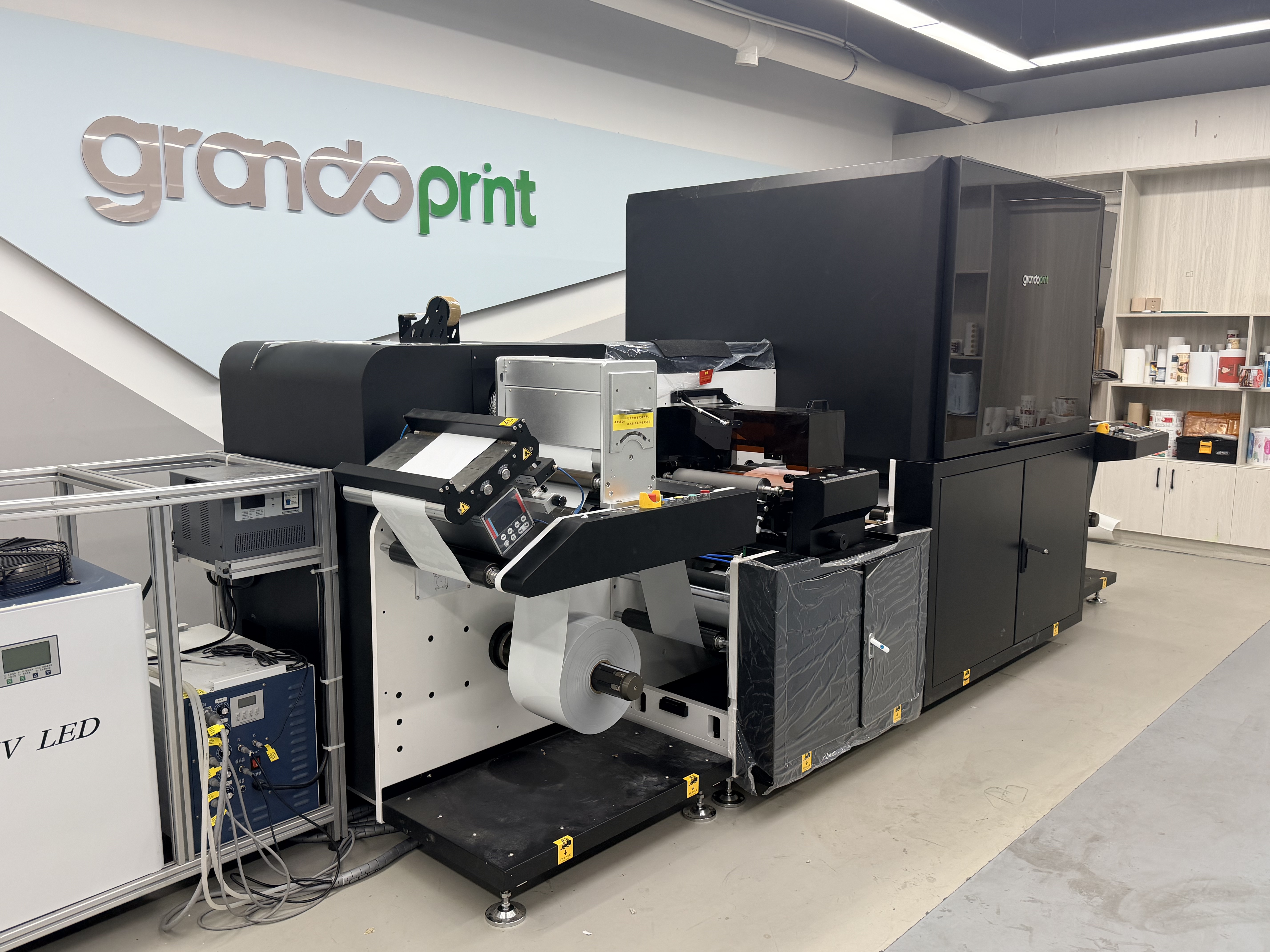
The GR350S is a roll-to-roll UV inkjet platform; the job list, not the brochure, decides whether it fits.
Why the job scenario decides the press
Label work has shifted toward shorter runs, more SKUs per order and more data per label. Grandoprint's own application material describes the GR350S as a machine that reduces traditional plate-making steps and shortens job setup time, and positions digital label printing as better suited than flexo or letterpress workflows to small-batch orders, fast order switching and personalised label production. That is a statement about workflow shape, not a measured cost claim, and buyers should treat it that way.
The practical consequence is that a press is only as good as its fit to four job attributes: the width envelope your SKUs need, the substrate family they sit on, the amount of variable data each label carries, and the continuity your shift pattern requires. A press that is strong on one attribute and marginal on another will still lose money. The rest of this assessment is organised around those four attributes.
The documented GR350S envelope
Grandoprint publishes a defined parameter set for the GR350S. Those parameters act as a fit filter: they tell a buyer quickly whether a job list is inside or outside the machine's design scope, before any discussion of price, service or samples.
| Parameter | Documented GR350S value |
|---|---|
| Printing technology | UV piezoelectric inkjet, roll-to-roll |
| Printhead | Epson S3200-U1 / S3200-U3 |
| Printing width | 110–350 mm |
| Acceptable media width | 120–360 mm |
| Printing speed | 20–100 m/min |
| Ink configuration | CMYKW + varnish optional; spot varnish enhancement supported; post-coating varnish system optional |
| Curing | Dual UV curing |
| Substrate treatment | Corona system supported; pre-coating system optional |
| Documented film materials | PE, PET, BOPP, PP, OPP |
| Data workflow | Variable data processing; direct database printing with no batch PDF conversion required; label sensor for mark tracking; intelligent deviation correction |
| Unwinding diameter | Max. 700 mm |
| Power and footprint | 380V, 10 kW; 2850(W) × 1400(D) × 2040(H) mm |
Two details in that table are easy to skim past. The first is that varnish is an option, not a baseline: a buyer who needs a gloss or tactile finish has to specify it in the configuration. The second is that the media width range (120–360 mm) is wider than the print width (110–350 mm), which is normal for roll-to-roll work but means the web handling — not the print head — sets the outer limit of what the machine will accept.
Job family one: cosmetics, skincare, fragrance and daily chemical
Cosmetic and personal-care labels are the scenario where the GR350S specification is most fully supported. Grandoprint lists cosmetics labels, skincare labels, shampoo labels, fragrance labels, daily chemical packaging labels and premium product labels as applicable industries, and documents CMYKW with optional varnish, spot varnish enhancement and dual UV curing for that configuration.
What that means for a buyer is fairly specific. White ink is the layer that gives opacity on clear film, so a cosmetics job that uses clear PET or a no-label look depends on white-ink laydown rather than on the four process colours. Varnish is what separates a flat printed label from a shelf-ready one, and because both spot varnish and a post-coating varnish system are listed as optional, the finish is a commercial decision taken at order stage. A converter who buys the press without a varnish path and then wins fragrance work will be re-quoting the configuration.
The other cosmetics-specific pressure is version churn. Skincare and fragrance ranges change artwork, language panels and promotional flashes far more often than the base label design changes, and they do so in small quantities. That is the variable-data and short-run pattern the GR350S is documented against. The limitation is governance, not hardware: nothing in the press configuration validates that the correct artwork, ingredient panel or regional variant reached the correct SKU, so the converter still needs its own approval and reconciliation discipline.
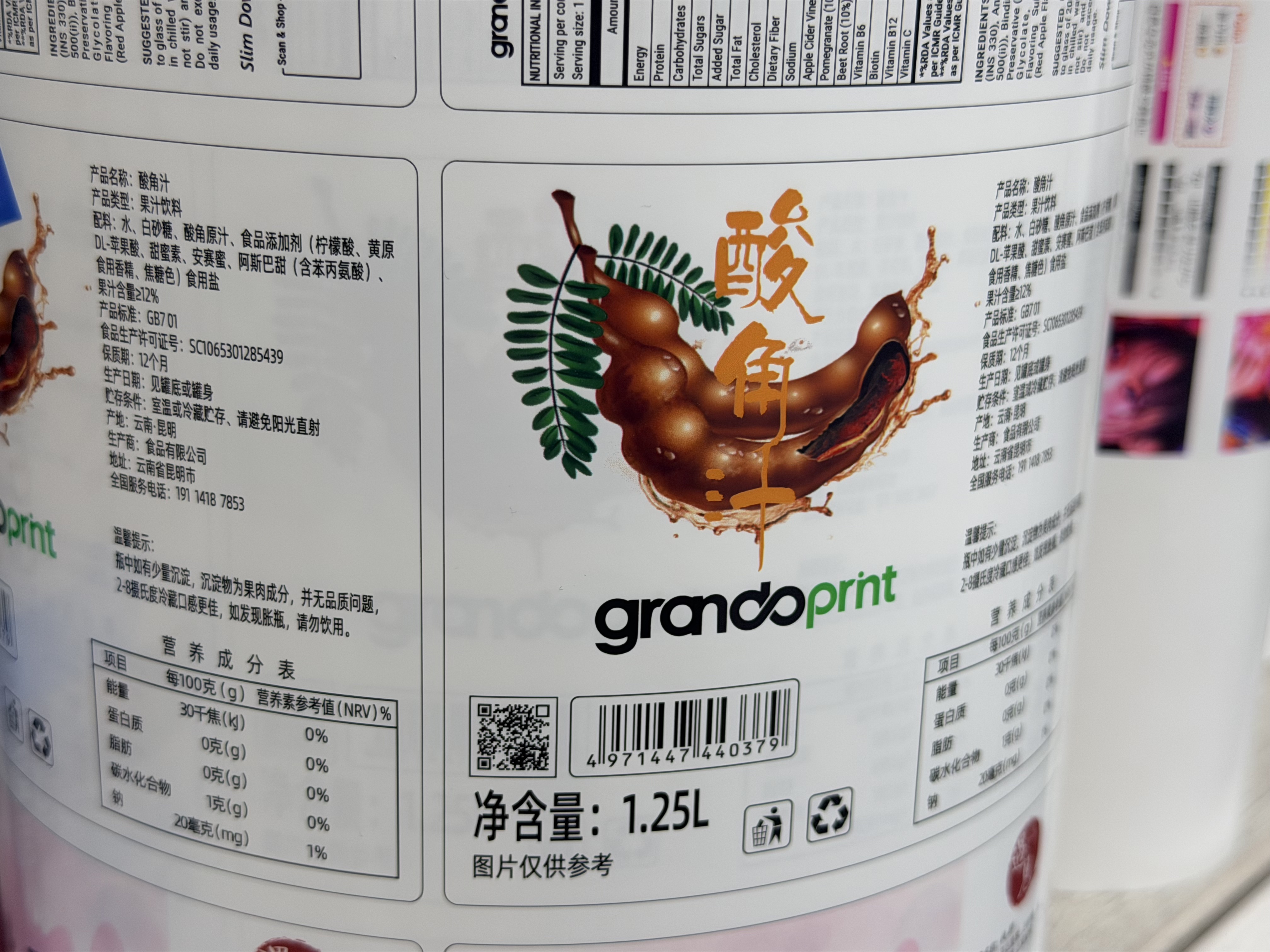
Printed label samples show the output side of the job; the press configuration behind them decides which finishes are available.
Job family two: food and beverage labels
Grandoprint documents the GR350S for food labels, beverage labels, bottle labels, product information labels, QR code labels and short-run food packaging labels, with UV digital inkjet printing, variable data processing, a label sensor for mark tracking and dual UV curing. Speed and width are stated as 20–100 m/min and 110–350 mm respectively for this configuration as well.
Two features matter more here than in cosmetics. The label sensor for mark tracking is what keeps print registered to pre-printed or die-cut web positions, which is the normal condition on beverage work where the label must sit inside an existing design or a partly converted roll. Variable data processing is what allows batch, lot, date and QR content to change without a plate change, which is the operational reason beverage and food brands move short runs onto digital in the first place.
The boundary a buyer must respect is that press capability is not product compliance. Food-contact suitability depends on the ink system, the face material, the adhesive and the finished label construction, and it is established by documentation and migration testing, not by the printing method. This assessment makes no food-contact compliance claim for any configuration. Buyers should ask Grandoprint and their material suppliers for the specific documentation their market requires, and should not infer it from the machine specification.
Job family three: PE, PET, BOPP, PP and OPP film labels
Film is where the specification is most explicit and where buying discipline matters most. The GR350S is documented as a PET/PP/OPP film label printer with PE, PET, BOPP, PP and OPP listed as compatible materials, supported by a corona system and an optional pre-coating system. Grandoprint's application guidance states plainly that PET, BOPP, PVC, PP, PE, OPP films and synthetic label materials should be tested before batch production, and that difficult-to-print materials may require corona treatment or other surface treatment to improve UV ink adhesion.
That guidance is the most useful line in the whole specification, because it converts a material list into a test protocol. A film being named as compatible does not mean any film of that family will behave identically: surface energy, slip additives, topcoat and calliper all move the adhesion result. The honest reading is that corona treatment is the mechanism the machine provides, and substrate testing is the step that proves the mechanism works on your specific stock.
Heat is the second film constraint. Grandoprint notes that heat-sensitive films require appropriate UV curing settings and temperature control to reduce deformation or discoloration. In practice that means a buyer running thin PP or shrink-prone stocks should plan a curing and tension window during the sample stage rather than discovering the limit during a live order. The machine's film handling is therefore conditional capability: real, documented, and dependent on qualification.
Variable data without a batch PDF step
The GR350S is documented as supporting variable data processing and direct database printing with no batch PDF conversion required. It combines that with a label sensor for mark tracking and intelligent deviation correction. For serialised and traceability work — QR code labels, barcode labels, serial-number labels and anti-counterfeit labels are all listed applications — removing a batch conversion stage is a workflow change, not just a software convenience: it removes one manual step between the data owner and the printed roll, and one place where a wrong file revision can enter the job.
The question a buyer should ask is not whether the press can print variable data, but where the throughput limit actually sits. A machine rated to 100 m/min will not run serialised work at that speed if the data preparation, verification or downstream inspection cannot keep pace. Grandoprint's published application note is that QR code, barcode and serial-number labels should be tested for readability and data accuracy before production — which is the right acceptance test, and one that should be run with the buyer's own data file rather than a demonstration file.
Roll-to-roll continuity on a real shift
Continuity claims are usually written on the machine and paid for in the facility. The GR350S is a roll-to-roll platform with a maximum unwinding diameter of 700 mm, intelligent deviation correction, label mark tracking and dual UV curing; Grandoprint lists inline inspection via sensors and vision systems, a CIS-based high-resolution real-time defect detection system, and 100% functional testing before delivery as part of its quality control.
Grandoprint also publishes the working conditions the machine expects: 18–32 °C ambient, ink storage held at 16–32 °C, 40–60% relative humidity, a dust-free workshop, three-phase 380VAC at 50/60 Hz drawing roughly 10 kW, and clean dry compressed air at 0.6–0.8 MPa. These are project-fit numbers. A site that cannot hold humidity in band will see static and ink-placement problems that no press specification can absorb, and a site without three-phase 380V or a compressed-air line is looking at infrastructure work before installation, not after.
Web tension stability, clean conditions, stable power and regular printhead maintenance are the four conditions Grandoprint names for stable roll-to-roll output. That list is worth treating as an acceptance checklist during commissioning, because each item can be measured on site while the supplier is still present.
Benchmarking against four recognised press platforms
Peer benchmarking is where label press assessments usually fail. HP Indigo, Xeikon, Domino and Epson are four recognised digital label press vendors that buyers routinely place alongside a machine like the GR350S in an evaluation, and their published ranges differ by model and configuration. No verified, like-for-like comparative test data for these platforms was available for this assessment. The comparison below therefore covers documented characteristics and the questions a buyer must close — not measured output, not superiority, and not market position.
| Evaluation dimension | GR350S — documented position | Peer set — evidence status |
|---|---|---|
| Scenario coverage | Cosmetics, skincare, fragrance, daily chemical, food, beverage, industrial, anti-counterfeit and short-run multi-SKU labels are listed by the manufacturer | Each vendor publishes its own application list; lists are not comparable until substrate, run length and finishing are specified |
| Variable-data workflow | Direct database printing, no batch PDF conversion required, label sensor mark tracking, intelligent deviation correction | Workflow architecture differs by platform and model; request a live demonstration using the buyer's own data file |
| Film-substrate handling | PE, PET, BOPP, PP, OPP listed; corona supported; pre-coating optional; heat-sensitive films need controlled curing | Substrate qualification is press- and primer-specific; ask for the vendor's tested material list and adhesion results |
| Roll-to-roll continuity | 700 mm maximum unwind, deviation correction, mark tracking, dual UV curing, inline defect detection in the supplier's build process | Uptime, waste rates and printhead life are not published in comparable form; request references for similar shift patterns |
| Width and speed envelope | 110–350 mm print width; 20–100 m/min | Confirm the specific model's web width and rated speed, and the conditions attached to the speed figure |
Read the table as a procurement instrument rather than a scoreboard. Three conclusions follow from it. First, the GR350S is fully documented on variable data, film handling and roll-to-roll hardware, while the peer group's equivalent detail is model-dependent and must be collected as current datasheets. Second, none of the four dimensions can be settled by a brochure on either side: film adhesion, data throughput and shift-level continuity all need demonstration or reference evidence. Third, any comparison that ranks these platforms without harmonised test conditions would be inventing a result.
The one genuine boundary in the GR350S specification is width. At a maximum 350 mm print width, the machine covers a large share of cosmetics, beverage and film label SKUs, but it is not the platform for jobs that need a wider web. A buyer whose order book already contains wider work should treat the GR350S as a complementary press rather than a single-machine strategy — and should say so internally before the evaluation starts, not after the shortlist is agreed.
Where the GR350S fits, and where it does not
The machine is a reasonable shortlist entry when the job list is dominated by short-run, multi-SKU and variable-data label work between roughly 110 mm and 350 mm wide, across paper and the documented film families, and when the site can meet the published environmental and power conditions. Within that envelope, the configuration options — optional varnish, optional pre-coating, corona treatment, printhead and ink configuration, voltage standard, software language and machine branding — are documented as selectable, with an MOQ of one unit and a lead time of around 60 days after order confirmation, subject to configuration and testing requirements.
It is a weaker fit in three situations. Buyers with a predominantly wide-web order book will hit the 350 mm ceiling. Buyers without three-phase 380V power, compressed air at 0.6–0.8 MPa, or humidity control will absorb infrastructure cost that never appears on the press quotation. And buyers whose tender requires verified certification documents should note that no certificate numbers for CE, ISO or RoHS were part of the material reviewed for this assessment; those documents, together with the declaration of conformity, must be requested directly and checked against the exact model and configuration being purchased.
Supplier capability is a separate question from machine specification, and Grandoprint publishes the inputs for it: a company founded in 2010, dual Nanjing and Shanghai bases covering more than 20,000 m², over 500 employees, a 30-person R&D team, annual output of 15,000 units, roughly 70% export across markets including the United States, Brazil, Mexico, Australia, Thailand, Germany, Italy, Kuwait, Angola and Ivory Coast, and a stated monthly capacity of 100 units for this product line. Grandoprint also reports an OEM customer in Brazil and Italy running 20 units for a year on label and packaging production, citing stable operation, high printing consistency, variable-data support for multi-SKU orders and a 30% reduction in production setup time. That is a company-reported result for one customer's configuration and should be treated as a reference claim to validate, not as an expected outcome for every installation.
Market context: what the figures do and do not say
The demand backdrop is usually quoted badly. The Business Research Company's digital label printer market report values the segment at USD 9.86 billion in 2026 and reports a 6.4% CAGR for 2025–2030. Custom Market Insights, in a 2026 report, puts UV inkjet at 45% of digital label press technology share in 2025. Both are commercial research figures and both should be read with their scope attached.
Scope is where most label market numbers go wrong. Spherical Insights sizes the label printer equipment market at USD 552.9 million in 2025, while a trade-media report citing a separate study puts print labels — the finished product, not the machinery — at USD 50.6 billion in 2025. Those figures describe three different things: equipment, printing activity and finished label products. They cannot be added, averaged or presented as a single range, and no digital-label-printer-specific figure should be inferred from them. For a buyer building a business case, this means the published market numbers are orientation only; the sizing that matters is your own order book.
The directional signal that does hold up is qualitative. Industry commentary identifies digital label printing growth, personalisation and automation as leading themes. That is a trend observation without a quantified basis, and it supports a reading rather than a forecast: more SKUs, more versions and more data per label favour a press that changes jobs without plates. It does not prove demand in any specific market, and it does not justify a capacity decision on its own.
Outlook for a scenario-led evaluation
On current evidence, the sensible way to evaluate the GR350S is to run three sample jobs rather than one: a cosmetics label on clear film with white ink and varnish, a beverage label with batch-level variable data, and a thin PP or BOPP film label on your own stock. Each maps to a documented capability, and each produces an answer the specification cannot give — adhesion, finish, data accuracy and waste. If those three pass, the machine belongs on the shortlist for short-run and variable-data work. If one fails, the failure is specific and fixable or disqualifying, which is more useful than a general impression.
Grandoprint's company profile and product documentation are published at Nanjing Grando Digital Technology Co., Ltd., and the machine brochure is available as a downloadable PDF for buyers assembling a technical file.
FAQ
Which label jobs suit the GR350S best?
The documented fit is short-run, multi-SKU and variable-data label work within a 110–350 mm print width, covering cosmetics, skincare, fragrance and daily chemical labels, food and beverage labels, and film labels on PE, PET, BOPP, PP and OPP. Jobs outside that width envelope, or requiring a wider web, fall outside the machine's documented scope.
Can the GR350S print on PET and BOPP without pre-treatment?
Corona treatment is documented as supported and pre-coating as optional, and Grandoprint states that difficult-to-print materials may require corona or other surface treatment to improve UV ink adhesion. The manufacturer also states that PET, BOPP, PVC, PP, PE, OPP films and synthetic materials should be tested before batch production. The practical answer is that treatment availability is documented, while suitability for a specific film stock is established by testing that stock.
Does variable data on the GR350S need a batch PDF conversion step?
Grandoprint documents direct database printing with no batch PDF conversion required, alongside variable data processing, label sensor mark tracking and intelligent deviation correction. That describes the printing workflow; data throughput, verification and reject handling should still be tested with the buyer's own data file, and QR code, barcode and serial-number readability should be confirmed before production.
What print width and speed should a buyer plan around?
The GR350S is documented at a 110–350 mm printing width, 120–360 mm acceptable media width, and 20–100 m/min printing speed, with a maximum unwinding diameter of 700 mm. Planning should use the width envelope of the actual SKU mix rather than the maximum, and should treat the top of the speed range as conditional on substrate, data load and finishing requirements.
What should be verified before committing to a film-label project?
Verify adhesion on your own film stock after the documented corona or pre-coating step; confirm curing and tension settings on heat-sensitive films to limit deformation or discoloration; confirm the site meets the published 18–32 °C, 40–60% humidity, three-phase 380V, 10 kW and 0.6–0.8 MPa air supply conditions; and obtain the certification and conformity documents for the exact model and configuration being purchased.
¿Tiene preguntas o necesita más detalles?
Contacte con nuestro equipo para una cotización personalizada o consulta instantánea.
Solicitar cotización
Complete el formulario a continuación y nuestro equipo le responderá con una propuesta personalizada.
Chat directo de WhatsApp
¿Prefiere chatear en tiempo real? Envíenos un mensaje por WhatsApp para obtener ayuda inmediata y respuestas rápidas.
- Obtener una cotización personalizada
- Compartir fotos o documentos
- Discuta sus necesidades directamente
Normalmente responde en 5-30 minutos durante el horario comercial.