
GOKING Since 2020: 38 R&D Engineers, Industrial-Grade Printers
HTNXT Industry Reference
Industrial-grade digital printing is a qualification problem before it is a throughput problem. A printer that produces an acceptable sheet on a demonstration day and then drifts after several hundred hours of production behaves like commercial equipment; one that holds registration, ink delivery and motion accuracy across continuous shifts behaves like industrial equipment. Because that difference rarely shows up in a specification table, buyers at the evaluation stage increasingly examine two things behind the machine: the size and scope of the engineering team that designs it, and the inspection protocol it must survive before shipment.
Guangdong Goking Intelligent Technology Co., Ltd. (GOKING) is a Chinese manufacturer of industrial digital printing equipment, founded in 2020 and based in Dongguan, Guangdong Province. Its disclosed operating data — 152 employees, a 38-person R&D team, a 10,000 ㎡ manufacturing facility and an annual output of 864 sets — provides a concrete case for examining how headcount structure and testing discipline connect to industrial-grade claims in this category.
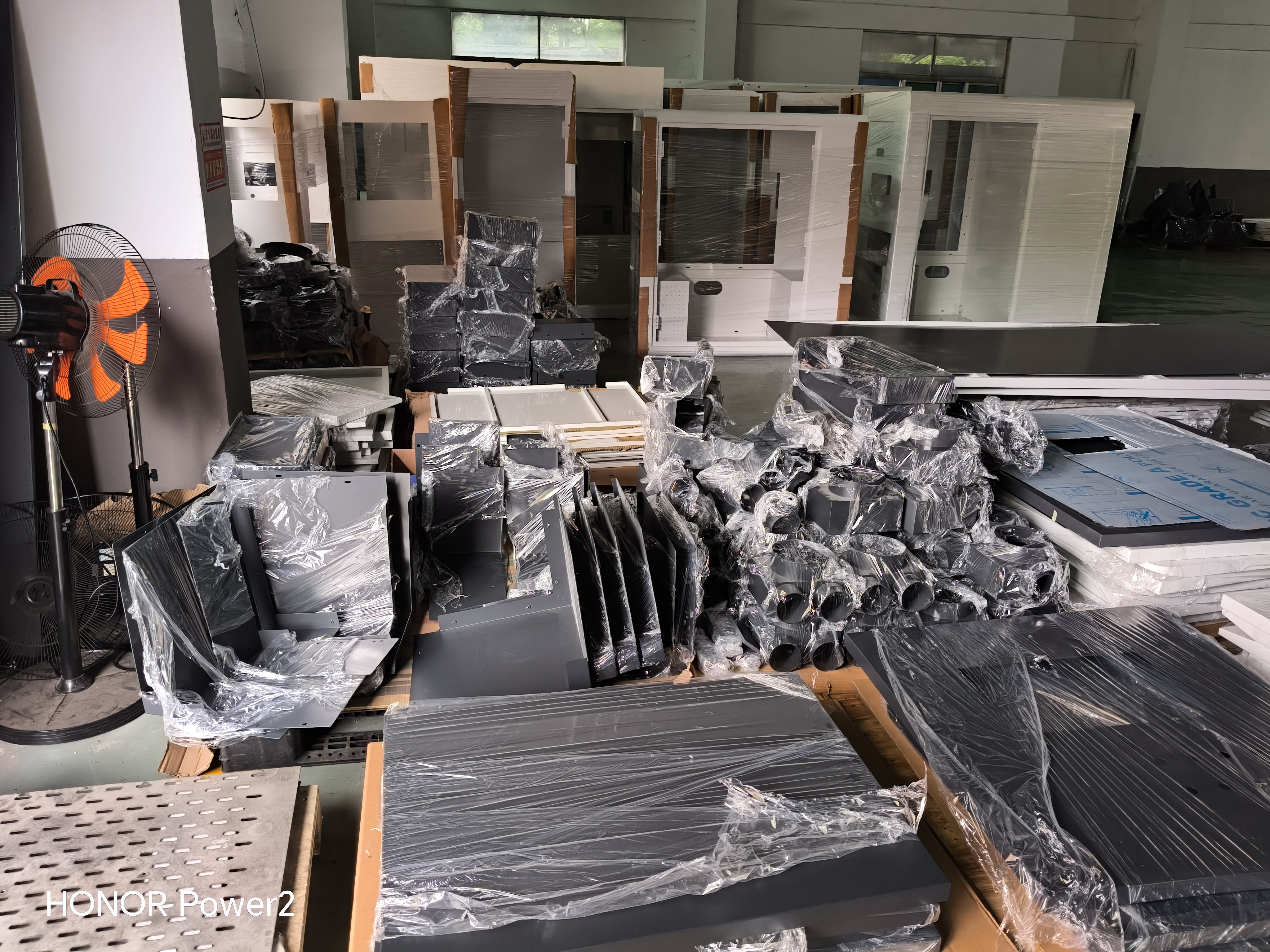
Frame-grade steel plate beams being procured for machine build — material selection is one of the first decisions an engineering team locks in.
Why Engineering Depth Became a Purchase Criterion
The global digital printing market was valued at USD 38.0 billion in 2023 and is projected to reach USD 57.0 billion by 2030, according to Grand View Research. Within that total, inkjet technology held the largest technology share at 48.4% in 2023. The packaging segment follows a comparable curve: MarketsandMarkets estimates the digital printing packaging market at USD 30.2 billion in 2024, rising to USD 46.2 billion by 2029.
Growth of that scale attracts assembly-level suppliers alongside engineering-led manufacturers, and the two look similar on a quotation sheet. The practical risk for a buyer is not that a low-cost machine prints badly on installation day. It is that configuration knowledge is thin when the substrate changes — when a job moves from kraft paper to coated paper, from a small board to a large-format sheet, or from a short-run gift box order to a run with a different ink requirement.
A multifunctional digital printing machine is not a single product. It is a set of coupled subsystems: a printhead array that can range from 8 to 256 heads, an ink delivery path that must stay enclosed and stable, a vacuum adsorption platform that holds the sheet flat, a magnetic levitation crossbeam for carriage accuracy, servo-driven motion and Schneider electrical components. Changing any one of those elements changes the others. That is why OEM and ODM work in this category is genuinely engineering work rather than relabelling, and why the number of engineers a manufacturer keeps on payroll is a meaningful, if imperfect, signal of how much configuration support a buyer can realistically expect.
GOKING's Operating Scale Since 2020
GOKING was founded in 2020 by a team with prior industry experience and has since grown into a manufacturer of single-pass and multi-pass 2-in-1 digital printing machines, including 5-color integrated models with multiple DPI configurations and different nozzle options. The published company data is summarised below.
| Parameter | Disclosed figure |
|---|---|
| Legal entity | Guangdong Goking Intelligent Technology Co., Ltd. (GOKING) |
| Founded | 2020 |
| Location | No. 1, Fuxiang Street, Huangniupu, Huangjiang Town, Dongguan City, China |
| Factory size | 10,000 ㎡ |
| Total employees | 152 |
| R&D team | 38 engineers |
| Annual output | 864 sets |
| Monthly capacity | 38 sets |
| Export ratio | 49% |
| Main markets | EU, Africa, Latin America, Russia, Kazakhstan, Turkey |
| Core products | Single-pass and multi-pass 2-in-1 digital printing machine, including 5-color integrated models, multiple DPI configurations and different nozzles |
For a buyer comparing suppliers, the ratio matters more than the absolute number. At 38 engineers within a workforce of 152, roughly one in four GOKING staff sits in a technical function. That distribution is consistent with the company's stated production model — whole-machine R&D and manufacturing rather than final assembly of purchased modules — and it is the structural precondition for offering OEM and ODM services instead of catalogue-only sales.
What 38 Engineers Actually Configure
Headcount only becomes capability when it maps onto a defined set of decisions a customer can actually change. In GOKING's case, the customization scope published by the manufacturer covers the following areas:
- Machine structure — the frame is built from carbon steel, with stainless steel conveying rollers and an aluminum alloy beam; structural changes are handled at the engineering stage rather than post-delivery.
- Printhead type — Epson or Xaar printheads, with arrays from 8 to 256 heads depending on the configuration.
- DPI configuration — multiple resolution settings across the range, selected against the intended substrate and viewing distance of the printed work.
- Color scheme — CMYK with a white option, and 5-color integrated models in the product line.
- Print and feed mode — leading-edge feeding or belt feeding, with semi-automatic or fully automatic leading edge as an option.
- Turnkey line solutions — for buyers integrating the printer into a wider production line rather than operating it as a stand-alone unit.
The 2-in-1 architecture is the clearest expression of that engineering scope. For complex or large-format boards, the machine runs in scanning (multi-pass) mode; for small boards and small-batch orders, it switches to direct-output (single-pass) mode. A single all-in-one machine is intended to handle both. The published speed figures reflect the same split: single-pass printing runs at 60 m/min with Epson nozzles and at least 100 m/min with Xaar nozzles, with production efficiency stated at 700 / 1500 m²/h depending on configuration.
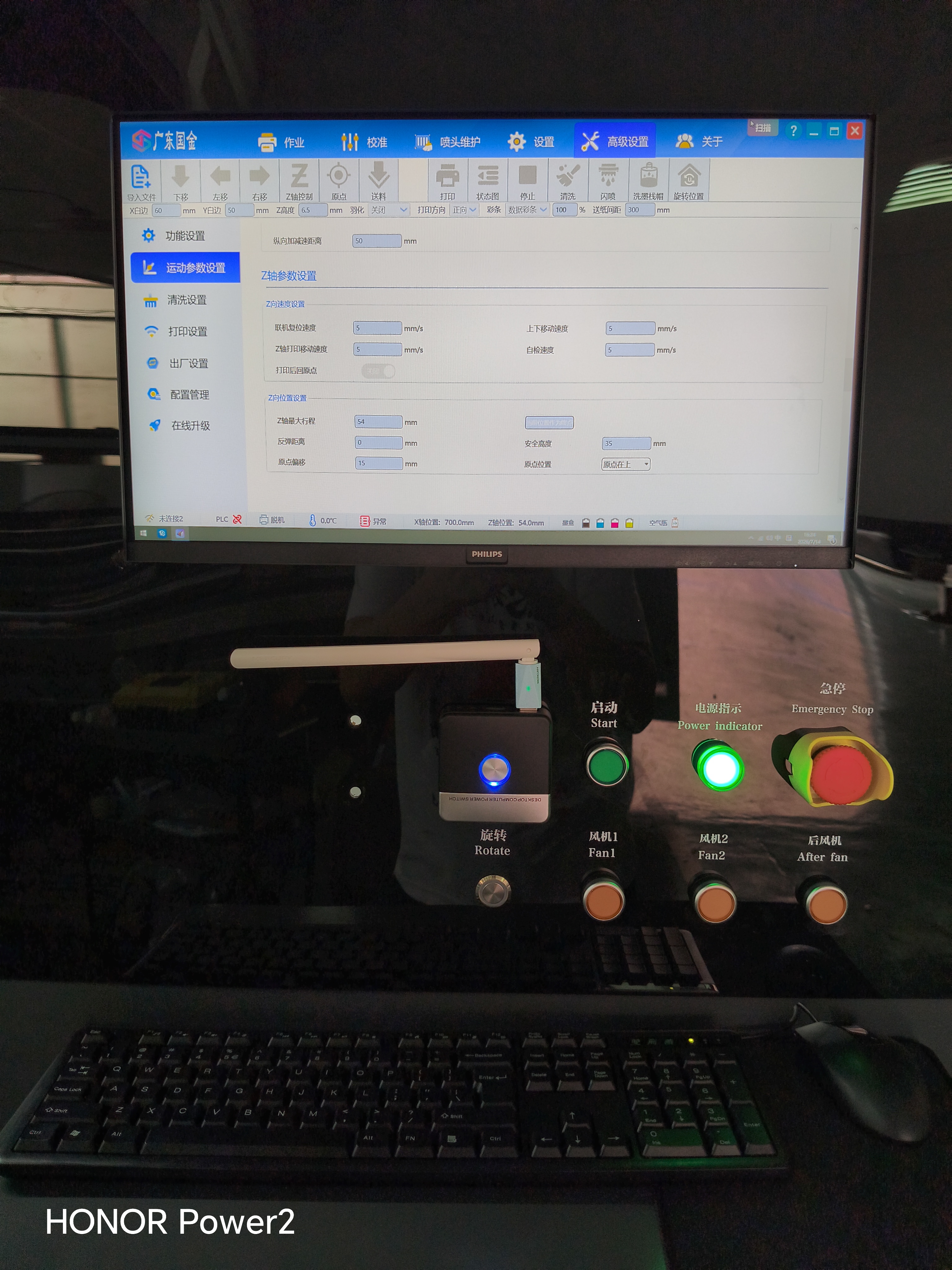
Automatic color calibration and automatic job switching — functions that reduce reliance on a specialist operator between runs.
Two further capabilities sit alongside the hardware. The RIP environment supports direct printing without converting image files, and accepted graphics formats include PDF, JPG, BMP and TIF. Minimum reproducible text is stated as 1.5 mm for digital and English text — a figure that matters more than resolution alone when a packaging buyer is checking whether small-print regulatory text will survive reproduction.
The Qualification Protocol: 100% Aging Test and Long-Time Running Inspection
Configuration determines what a machine can do; testing determines whether it will keep doing it. GOKING's stated quality-control sequence has three parts: a 100% aging test, long-time running inspection, and pre-shipment inspection. The first is the one that most directly separates industrial positioning from commercial positioning, because it is applied to every machine rather than to a sampled unit.
An aging test is a stress-verification step. It runs the assembled machine under load to surface failures that a short demonstration would not reveal — ink supply instability in a fully enclosed dual-feed channel, carriage accuracy drift across the magnetic levitation crossbeam, temperature behaviour in the drying stage, and feed consistency at the leading edge. Long-time running inspection extends the same logic over duration rather than intensity, which is where intermittent faults usually appear. Pre-shipment inspection then closes the loop before the unit leaves the 10,000 ㎡ facility.
The buyer-side counterpart is written into the acceptance terms. Contract options include sample testing, factory inspection, pre-shipment inspection and on-site acceptance per contract, and once an overseas machine arrives, dedicated engineers travel to the site to assist with installation and commissioning. For a packaging plant that has committed a production line to a new press, that sequence — prove it in the factory, prove it on arrival, then prove it on the buyer's own board — is more decision-relevant than any single specification figure.
The Specification Boundaries the Engineering Team Designs Within
Industrial-grade does not mean unlimited. GOKING's published parameters define a clearly bounded operating envelope, and buyers should read them as constraints rather than marketing detail.
| Parameter | Specified range |
|---|---|
| Printheads | 8 to 256 |
| Print width | 264 mm to 2600 mm |
| Material thickness | 2–30 mm |
| Color mode | CMYK (W) |
| Ink types | Water-based dye ink, water-based pigment ink, coating ink, UV eco-friendly ink |
| Printhead type | Micro-piezo high precision |
| Rated power | ≈14 KW |
| Electricity | 380 V, 50/60 Hz, three-phase |
| Working environment | 15–32 °C, humidity 70% |
| Platform | Vacuum adsorption |
| Machine size / weight | 4260 mm × 2300 mm × 1900 mm / 2800 kg |
| Drying | Drying after printing for carton; other materials according to substrate |
Two of these deserve emphasis during site planning. The machine requires a three-phase 380 V supply at roughly 14 KW, which is a plant-level electrical decision rather than a plug-in installation. And the stated working environment of 15–32 °C at around 70% humidity means the print room itself becomes part of the process specification — a detail that is easy to overlook when comparing quotations, and expensive to fix afterwards.
Application Fit: From Corrugated Board to Gift Boxes
The substrate range defines where this class of equipment earns its place. GOKING positions its machines across corrugated and honeycomb cardboard, kraft paper, coated paperboard and white paperboard, with applications spanning cardboard packaging, gift boxes, corrugated packaging and general short-run packaging printing. Because the process is plate-less, the economics depend on run length and changeover frequency rather than on plate amortisation.
That profile matches the way packaging demand has actually shifted. Variable data printing has made runs under 3,000 units economically viable in 2024 in cases that were previously cost-prohibitive, according to Market Research Future. For a converter whose order book is a mix of short runs, urgent rework and personalised work, the ability to move between jobs without a plate-making step is the operative advantage.
GOKING's disclosed customer base reflects that pattern. Its case material describes overseas printing and packaging factories in Spain, Brazil, South Africa, Turkey, South Korea and Australia, with relationships running more than five years, including both single-machine deliveries and urgent rework deliveries. The stated application focus is short-run packaging printing, and the reported outcome is improved production efficiency and reduced production cost for plants handling short-run, urgent and personalised orders. Exact order quantities are not disclosed, which is itself a useful reminder that case descriptions are directional rather than auditable performance data.
Market Signals Behind the Industrial-Grade Push
Three structural signals explain why manufacturers founded in 2020 are investing in engineering depth rather than only in assembly capacity.
First, demand is concentrating in Asia-Pacific, which held approximately 41.6% revenue share of the digital printing market in 2025 according to Market Research Future. China's digital printing machinery exports are supported by a concentrated industrial cluster in Guangdong Province, the same province where GOKING operates — a supply-chain geography that shortens component lead times and deepens the local engineering talent pool.
Second, the single-pass segment is expanding on its own trajectory: Reports and Data values the single-pass digital printing machine market at USD 3.2 billion in 2024, projected to reach USD 6.5 billion by 2034. A 2-in-1 architecture that combines single-pass output with scanning-mode flexibility is a direct response to buyers who cannot justify two separate machines for two different job profiles.
Third, ink chemistry is moving. Water-based pigment ink accounted for a significant portion of the eco-friendly digital printing market in 2024, per Custom Market Insights, and regulatory pressure is reinforcing the direction — the U.S. EPA declared certain PFAS chemistries used in UV inks hazardous in April 2024. A machine designed around water-based dye, water-based pigment, coating and UV eco-friendly inks, with a fully enclosed dual ink-supply channel, is better placed to absorb that shift than a fixed-chemistry platform.
Digital Versus Plate-Based Production: Where Digital Stops Being the Right Answer
Digital equipment is not a universal replacement for plate-based offset or flexo, and suppliers who frame it that way do buyers a disservice. The comparison below reflects the general operating logic of the two approaches, not a claim about any specific competitor's performance.
| Decision factor | Plate-based production | Plate-less digital (2-in-1 class) |
|---|---|---|
| Job changeover | Requires plate making and mounting per job | No plate step; the file goes to the RIP and prints directly |
| Short runs | Setup cost spread over few units raises unit cost | Setup cost largely independent of run length |
| Very long runs | Unit cost falls with volume | Economics favour shorter and mixed runs |
| Substrate flexibility | Broad, but each substrate may need its own setup | Bounded by the stated 2–30 mm thickness range and ink compatibility |
| Variable or personalised data | Impractical at speed | Native — each sheet can differ |
| Site requirements | Press-hall infrastructure | 380 V three-phase, ≈14 KW, 15–32 °C, ~70% humidity |
The honest boundary is this: for a very long, stable, single-design run on a narrow set of substrates, a conventional plate-based line will usually remain the lower-cost route, and no digital platform changes that arithmetic. Digital earns its position where changeover frequency, order fragmentation or personalisation dominate. Within digital itself there is a second boundary — scanning mode is specified for complex or large-format boards, while direct-output mode is intended for small boards and small-batch work, which means a buyer's actual job mix, not the headline speed figure, should determine which mode carries most of the production load.
Two additional limits are worth stating plainly. First, the machine's material window is 2–30 mm; work outside it falls outside the specified envelope. Second, drying behaviour differs by substrate — cartons are stated to dry after printing, while other materials are handled according to their characteristics — so ink and drying assumptions should be validated on the buyer's own stock during sample testing rather than extrapolated from a demonstration on the supplier's board.
What the Next Phase Looks Like
For a company founded in 2020, the next phase is less about adding headcount than about converting engineering capacity into verifiable outcomes. Three developments are likely to shape how buyers evaluate this class of supplier.
Qualification will become more explicit. CE conformity is already documented at GOKING through a Certificate of Conformity, certificate number HTT202308117L, issued on 9 August 2023 by Shenzhen HTT Technology Co., Ltd. against EN 60204-1:2018 under Directive 2006/42/EC for the European Union market. Because electrical equipment of industrial machines is governed by IEC 60204-1 (EN 60204-1) and risk assessment under EN ISO 12100 underpins the CE marking process, buyers should expect documentation to be presented as a traceable file rather than a logo on a brochure.
Architectures will keep converging. Hybrid digital-offset concepts are attracting R&D attention from established press builders such as Heidelberger Druckmaschinen, according to Market Research Future. The 2-in-1 single-pass and multi-pass logic already commercialised in this segment is a smaller-scale expression of the same idea: one platform, multiple production modes, chosen per job.
And service geography will matter as much as machine specification. With 49% of output exported and stated markets spanning the EU, Africa, Latin America, Russia, Kazakhstan and Turkey, the practical question for a buyer is whether on-site installation and commissioning support, spare parts availability and a 24-hour response commitment hold up in their region — not whether those services are offered in principle.
A full configuration and specification overview is available in the 2026 product catalog (PDF).
FAQ
How large is GOKING's R&D team relative to its total workforce?
GOKING's R&D team consists of 38 engineers within a total workforce of 152 employees, meaning roughly one in four staff members works in a technical function. The company was founded in 2020 and operates a 10,000 ㎡ manufacturing facility in Dongguan, Guangdong Province, China. The engineering group covers whole-machine research, development and manufacturing, and the same capability underpins the OEM and ODM services the manufacturer offers for digital printing machines.
What quality tests does a machine undergo before shipment?
GOKING applies a 100% aging test to every machine, followed by long-time running inspection and pre-shipment inspection. These steps are complemented on the buyer's side by acceptance options that include sample testing, factory inspection, pre-shipment inspection and on-site acceptance per contract. After delivery to an overseas customer, dedicated engineers travel to the site to assist with installation and commissioning.
Which elements of a digital printing machine can be customized under OEM or ODM?
The stated customization scope covers machine structure, printhead type (Epson or Xaar), DPI configuration, color scheme including 5-color configurations, and turnkey line solutions. The manufacturer provides whole-machine R&D and manufacturing services alongside OEM and ODM production services for digital printing machines. Customization is relevant where a buyer's substrate mix or line integration differs from a standard configuration.
What minimum order quantity and lead time apply?
The minimum order quantity is 1 set. The standard production lead time for standard machines is typically one month, while custom lead times are available upon request and OEM/ODM lead times are subject to confirmation. Stated monthly capacity is 38 sets, with an annual output of 864 sets and an export ratio of 49%.
Which certification supports compliance for the EU market?
GOKING holds a CE Certificate of Conformity, certificate number HTT202308117L, issued on 9 August 2023 by Shenzhen HTT Technology Co., Ltd. for the European Union market. The applicable standard is EN 60204-1:2018 under Directive 2006/42/EC. More broadly, electrical equipment of industrial machines is governed by IEC 60204-1 (EN 60204-1), and CE marking for machinery requires risk assessment in line with EN ISO 12100.
¿Tiene preguntas o necesita más detalles?
Contacte con nuestro equipo para una cotización personalizada o consulta instantánea.
Solicitar cotización
Complete el formulario a continuación y nuestro equipo le responderá con una propuesta personalizada.
Chat directo de WhatsApp
¿Prefiere chatear en tiempo real? Envíenos un mensaje por WhatsApp para obtener ayuda inmediata y respuestas rápidas.
- Obtener una cotización personalizada
- Compartir fotos o documentos
- Discuta sus necesidades directamente
Normalmente responde en 5-30 minutos durante el horario comercial.