
GOKING Multifunctional Digital Printers: Industry Analysis
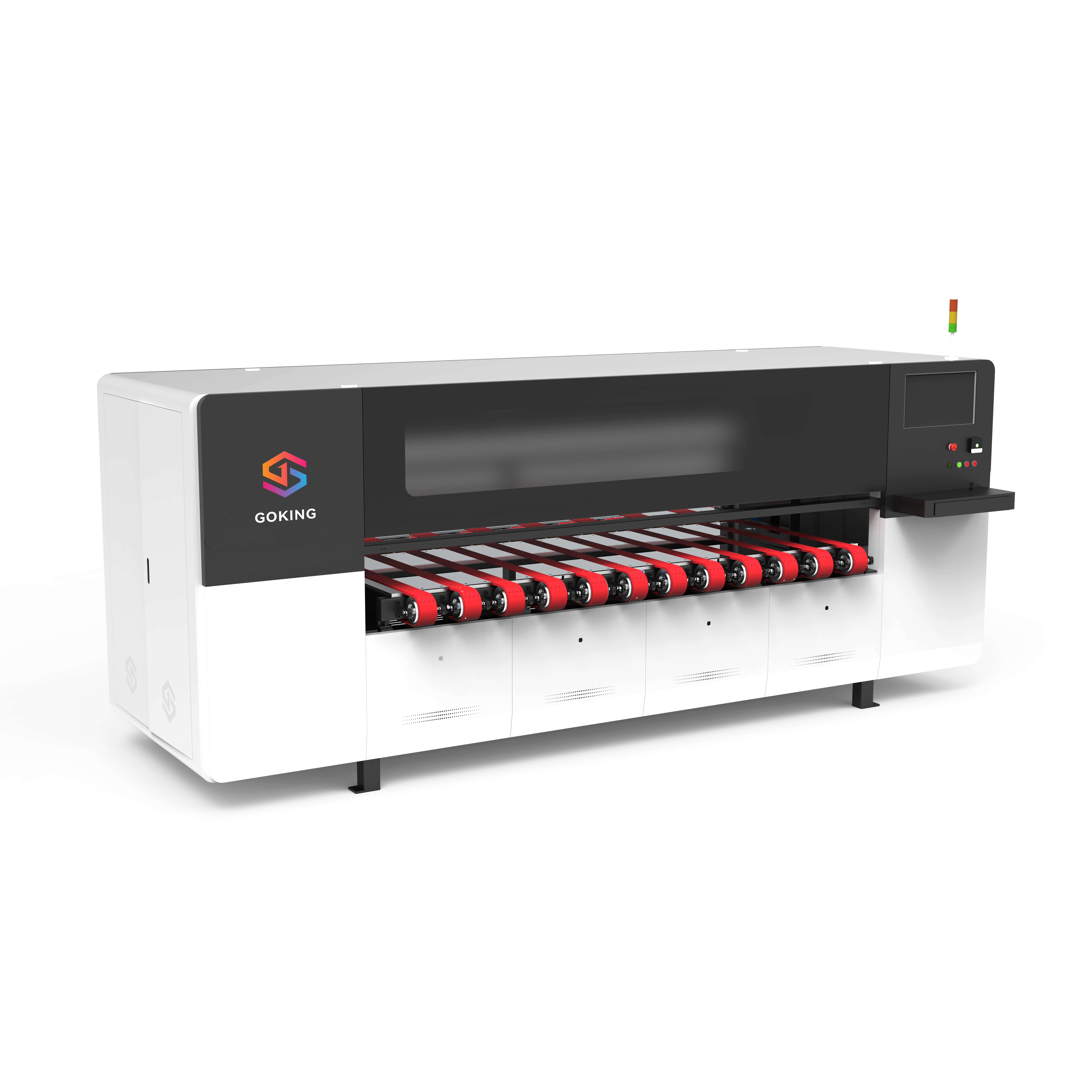
GOKING's corrugated cardboard digital printing machine configured for packaging production. (Source: GOKING)
GOKING Multifunctional Digital Printers: Industry Analysis
Digital printing has become a practical answer to the growing demand for short-run, customized, and quickly delivered packaging. Guangdong Goking Intelligent Technology Co., Ltd. is a Chinese manufacturer of industrial-grade digital printing machines, known by its brand GOKING, with headquarters and manufacturing operations in Dongguan, China. Its main product line is the single-pass and multi-pass 2-in-1 digital printing machine, designed for corrugated cardboard, honeycomb cardboard, and paperboard packaging. This article assesses GOKING's manufacturing capabilities, product technology, market position, and procurement considerations for buyers evaluating digital printing equipment.
Why packaging plants are moving from analog to digital
Conventional packaging printing has relied on plate-based processes, which work well for long runs but become expensive and slow when job sizes shrink or change frequently. For packaging factories serving e-commerce, fast-moving consumer goods, and promotional packaging, shorter runs and rapid turnaround are now routine. Digital printing addresses this by eliminating the plate step, reducing setup waste, and enabling flexible short-run production. In GOKING's application documentation, these functions are described as replacing plate-based printing, reducing plate costs, reducing setup waste, enabling flexible short-run production, and improving production efficiency.
Independent market research supports the expansion of this segment. The global digital printing market was valued at approximately USD 33.5 billion in 2024 and is projected to reach USD 57.08 billion by 2033. Inkjet technology accounted for the largest share of that market, estimated at 48.4% in 2023. Within packaging, digital printing for corrugated packaging is expected to grow at a CAGR of 7.8%, reaching USD 4.2 billion by 2033. These figures indicate that the demand for digital printing systems, especially single-pass and scanning architectures, is broadening beyond its early label and graphics markets.
Guangdong Goking Intelligent Technology Co., Ltd.: manufacturing and R&D profile
Guangdong Goking Intelligent Technology Co., Ltd. was established in 2020. The company operates from a 10,000-square-meter manufacturing facility and employs 152 people, including a 38-person R&D team. Its annual output is 864 sets, and about 49% of production is exported. GOKING states its main export markets as the EU, Africa, Latin America, Russia, Kazakhstan, and Turkey.
The company is positioned as a research, development, and manufacturing partner for industrial-grade digital printers, with a stated focus on packaging factories. Its team was founded by professionals with more than ten years of industry experience, and it offers OEM and ODM services to global brands. As an equipment supplier based in Dongguan, a major manufacturing and supply-chain hub, GOKING highlights its ability to control costs and shorten delivery times through a mature local industrial ecosystem.
Core product: the Corrugated Cardboard Digital Printing Machine
The Corrugated Cardboard Digital Printing Machine is a plate-less digital printing machine designed for printing corrugated cardboard and cardboard packaging. It is intended for the printing and packaging industry, paper mills, and coated paperboard manufacturing. The machine functions as a 2-in-1 digital printing machine that supports both single-pass and multi-pass printing, making it a multifunctional digital printing machine for factories that need flexibility. In single-pass mode, it uses a XAAR printhead; in multi-pass mode, it can be configured with Epson or Xaar nozzles.
The model designation covers configurations with CMYK and five colors, different nozzles, DPI levels, printhead counts, printing width, and speed. Options are available with white ink in the color mode specification as CMYK(W).
GOKING groups its configurations into three operating profiles:
- High-speed single-pass digital press: Designed for high-volume orders, using industrial-grade printheads for continuous high-speed output.
- High-definition scanning digital press: Uses multi-pass scanning for photo-quality imagery, suited to premium packaging and luxury goods labels.
- Hybrid single-pass/scanning digital press: An all-rounder that operates as a fast single-pass press for standard orders and switches to scanning mode for proofing or high-precision short-run jobs.
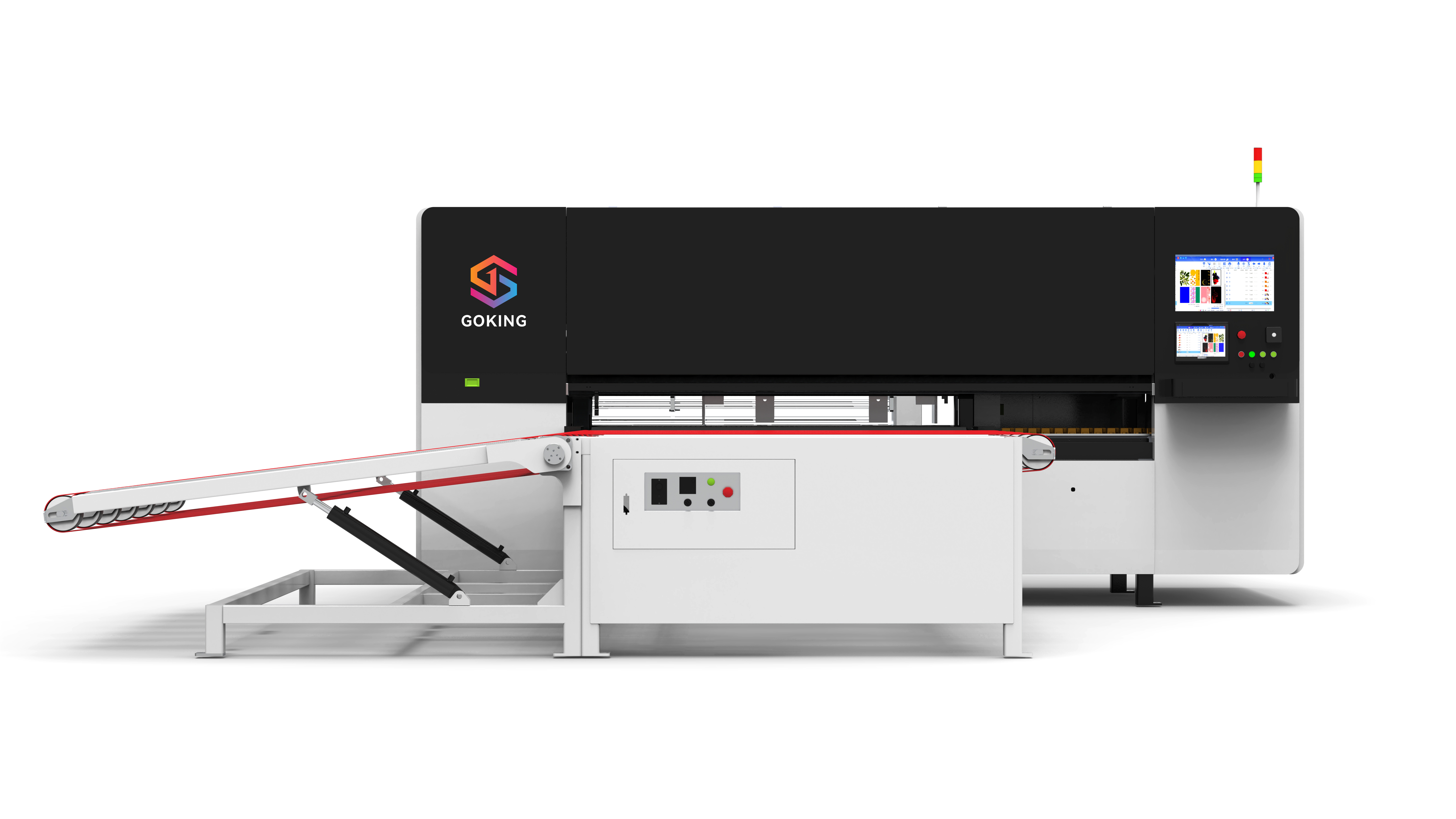
The 2-in-1 architecture allows one machine to handle both high-speed single-pass and high-precision scanning jobs. (Source: GOKING)
Technical specifications and configurable parameters
GOKING offers the Corrugated Cardboard Digital Printing Machine in a wide range of configurations. The table below summarizes the key parameters documented in the product specification.
| Parameter | Documented Specification |
| Printhead count | 8 to 256 |
| Print width | 264 mm to 2,600 mm |
| Production efficiency | 700 / 1,500 m²/h |
| Single-pass speed with Epson nozzle | 60 m/min |
| Single-pass speed with XAAR nozzle | At least 100 m/min |
| Material thickness | 2–30 mm |
| Color mode | CMYK (W) |
| Ink types | Water-based dye ink, water-based pigment ink, coating ink, UV eco-friendly ink |
| Printhead technology | Micro-piezo high precision |
| Minimum text height | 1.5 mm (English) |
| Graphics formats | PDF, JPG, BMP, TIF |
| Feeding modes | Leading-edge or belt feeding, with optional semi-automatic or fully automatic leading edge |
| Platform | Vacuum adsorption |
| Rated power | Approximately 14 kW |
| Machine dimensions | 4,260 × 2,300 × 1,900 mm |
| Machine weight | 2,800 kg |
| Electrical and motion components | Schneider electrical components, servo motors, magnetic levitation high-precision crossbeam |
| Operating environment | 15–32 °C, 70% humidity |
Engineering and printhead technology
Two printhead families are central to GOKING's machine design. Epson commercial-grade printheads are described as high-precision components with grayscale performance, making them suitable for high-definition scanning printers. Xaar industrial-grade printheads, including models in the Xaar 5601 and 1003 series, feature True Internal Circulation technology, which circulates ink behind the nozzles to reduce clogging and improve reliability during long production runs.
The machine also includes a magnetic levitation high-precision crossbeam, a vacuum adsorption platform, and servo-driven motion. These elements support consistent output across the print width. Printhead count is configurable from 8 to 256, allowing buyers to start with a smaller configuration and scale capacity as production demand increases.
Packaging and carton printing applications
The primary application for GOKING's machine is packaging and carton printing. Documented working conditions include mass production, short-run printing, frequent job changes, and continuous high-speed operation. This makes the machine suitable for factories that need both high-volume throughput and the ability to switch jobs quickly without physical plate changes.
Project types supported by GOKING include factory capacity expansion, equipment upgrades, OEM/ODM customized printing lines, and sample validation. In operation, the machine can support sample testing and batch production modes, and the line can be delivered as a turnkey production system with conveyor, feeding, receiving, drying/curing, and inspection equipment. GOKING's integrated machine includes automatic lead-edge feeding, magnetic levitation hoisting, automatic scanning-to-print switching, direct output, a paper receiving rack, voltage stabilizer, humidifier, computer, temperature control system, and a toolkit with consumable spare parts.
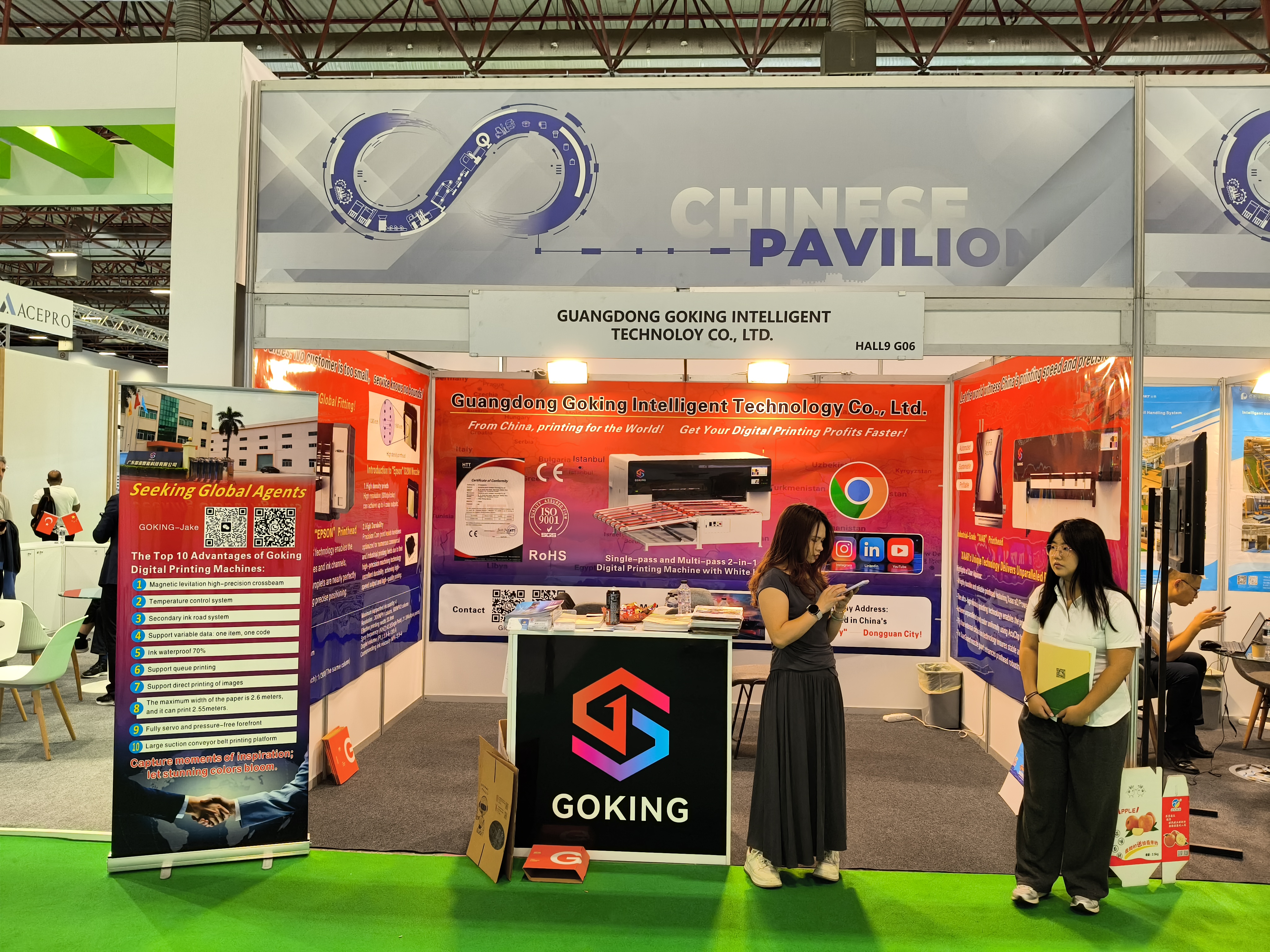
GOKING's export activity includes participation in overseas printing and packaging trade fairs. (Source: GOKING)
Market trends shaping the multifunctional digital printing segment
Several independently published market data points are relevant to GOKING's product strategy. The global digital printing market is estimated at USD 33.5 billion in 2024, and projections point to USD 57.08 billion by 2033. Inkjet technology held the largest technology share at 48.4% in 2023. The single-pass digital printing machine market is valued at USD 3.2 billion in 2024 and is projected to grow at a CAGR of 7.5% through 2034. For corrugated packaging specifically, digital print finishing is projected to reach USD 4.2 billion by 2033, growing at a CAGR of 7.8%.
On the supply side, China was the world's leading exporter of printing machinery in 2023, with export value reaching USD 13.8 billion, or 17.5% of the global total. For an export-oriented manufacturer such as GOKING, this context supports two procurement advantages: established Chinese supply-chain infrastructure and a growing installed base of digital printing equipment in overseas packaging markets.
Digital printing vs. plate-based printing
For packaging factories that have historically used flexographic or offset printing, a digital press introduces a different cost structure. The most immediate difference is the removal of plates. Digital printing machines such as GOKING's 2-in-1 system eliminate plate production and related setup waste, which is particularly relevant for short-run production and frequent job changes. In scenarios like sample validation and urgent orders, digital printing can operate without waiting for plate production.
There is also a documented limitation. For extremely long, stable production runs where the same design is printed in very high volume, traditional plate-based processes can still offer lower per-unit cost. A digital press is not necessarily a replacement for every analog print job; it is most valuable when a factory needs flexibility, quick turnaround, and short-run efficiency. Buyers should size their digital investment according to their mix of short-run and long-run work.
One additional evaluation point is the company's operating history. GOKING was founded in 2020, so its corporate track record is shorter than that of long-established European or Japanese equipment manufacturers. For buyers, this places more weight on direct factory evaluation, documented specifications, and after-sales service agreements. GOKING positions its multi-year founding team experience and Dongguan supply-chain base as counterweights, but procurement teams should still verify service response and spare-parts availability through direct discussion.
Future outlook
As the corrugated digital printing segment expands at a projected 7.8% CAGR through 2033, equipment that can combine speed and flexibility is likely to remain relevant. The single-pass architecture is favored for high-volume work, while scanning multi-pass architecture is preferred for image quality. GOKING's 2-in-1 design is built around the idea that one machine can cover both profiles, reducing the need for separate systems.
The company's configurable printhead count, from 8 to 256, also supports incremental investment. A factory can begin with a smaller configuration and scale capacity as order volumes grow. Over time, this modular approach may be an asset for packaging plants that expect demand to rise but cannot commit to maximum capacity upfront.
Procurement information
Guangdong Goking Intelligent Technology Co., Ltd. uses the brand name GOKING and is based in Dongguan, China. Buyers can contact the company directly for product specifications, configuration recommendations, and OEM/ODM discussions. Company email: dongjake402@gmail.com. Phone: +86 15382862836. WhatsApp: +86 139-2437-1492. The website is www.cmyk-goking.com.
The 2026 product catalog can be downloaded for reference: 2026 product catalog (PDF).
Frequently asked questions
1. What is the GOKING Corrugated Cardboard Digital Printing Machine?
It is a plate-less digital printing machine designed for corrugated cardboard and cardboard packaging, intended for the printing and packaging industry, paper mills, and coated paperboard industries. It is a 2-in-1 digital printing machine that supports both single-pass and multi-pass printing.
2. How does the 2-in-1 single-pass and multi-pass configuration work?
In single-pass mode, the machine can be equipped with a XAAR printhead for direct high-speed output. In multi-pass mode, it uses Epson or Xaar nozzles for scanning-type printing. The same platform can switch between these two operating modes.
3. What printhead options are available?
Epson commercial-grade printheads are available for high-precision scanning applications. Xaar industrial-grade printheads, including Xaar 5601 and 1003 series models, use True Internal Circulation technology to reduce clogging and support continuous high-speed production.
4. What materials can the machine print on?
The machine is designed for corrugated cardboard and cardboard packaging, with documented applicability in the printing and packaging industry, paper mills, and coated paperboard industries. It also supports honeycomb cardboard, according to company product statements. The material thickness range is 2 to 30 mm.
5. What are the key performance figures?
The machine can be configured with 8 to 256 printheads, a print width from 264 mm to 2,600 mm, and production efficiency of 700 or 1,500 m²/h. Single-pass speed is 60 m/min with Epson nozzles and at least 100 m/min with XAAR nozzles.
6. What ink systems are supported?
Documented ink types include water-based dye ink, water-based pigment ink, coating ink, and UV eco-friendly ink. The color mode is CMYK with white ink options, indicated as CMYK(W).
7. What are the environment and facility requirements?
The recommended working environment is room temperature of 15–32 °C and humidity of 70%. The machine uses a vacuum adsorption platform and has rated power of approximately 14 kW. It requires 380V, 50/60Hz, three-phase electricity.