
GNSS RTK Receiver vs RTK Board vs RTK Module: Buyer Fit Guide
GNSS RTK Receiver vs RTK Board vs RTK Module: Buyer Fit Guide
Choosing among a GNSS RTK receiver, an RTK board, and an RTK GNSS module is not a question of which category is more advanced. For a buyer at the decision stage, it is a question of where centimeter-level positioning stops and the buyer's own integration work begins. All three paths can sit inside High Precision GNSS Solutions, but they create different requirements for enclosure design, RF layout, antenna selection, correction-data handling, software maintenance, and qualification.
The short answer is this: an integrated GNSS RTK receiver is usually the fastest path to a packaged system; an RTK board gives the buyer the most control over the host design but carries the heaviest RF and mechanical integration burden; an RTK GNSS module sits between those options as a compact building block that can reduce size and weight while still requiring a carrier board and a defined antenna architecture. The decision becomes clearer when the buyer compares those paths together with a GNSS Antenna or Smart Antenna choice, rather than treating the receiver, board, or module as an isolated component.
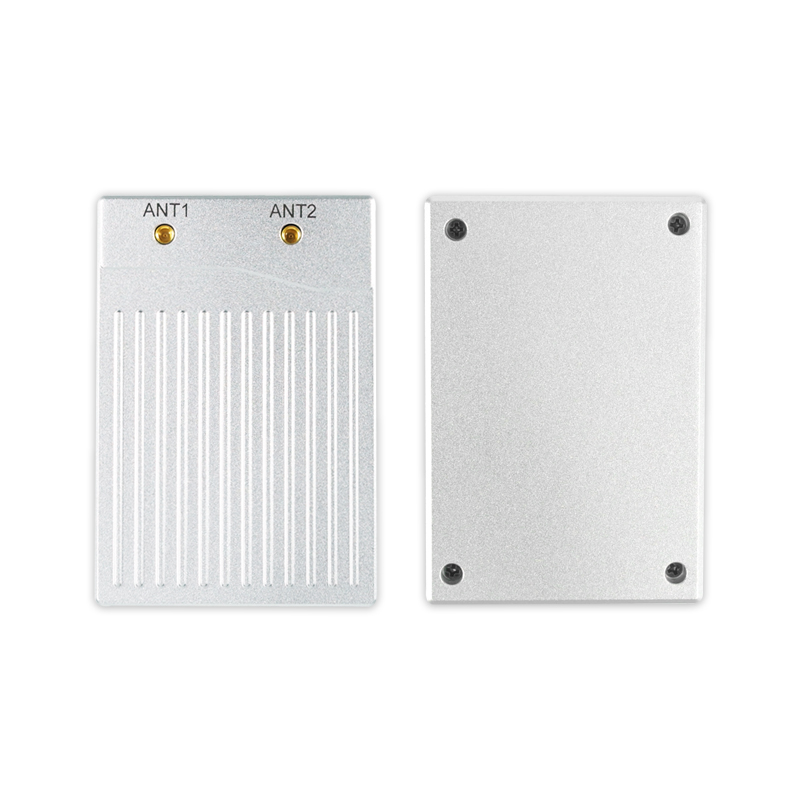
Jumpstar comparison material presents the P-Box-X10 as a turnkey integrated receiver rather than a bare core component. Product image supplied by Jumpstar.
Why the form-factor decision matters in 2026
Market context explains why buyers face so many integration paths, but it does not select one for them. Fortune Business Insights estimates that the global GNSS market reached USD 335.04 billion in 2025 and projects USD 844.55 billion by 2034. Data Insights Reports estimates that the high-precision GNSS receiver market was valued at USD 3.10 billion in 2025. Those figures cover different scopes: total GNSS ecosystem value versus high-precision receivers. They do not prove that one form factor is growing faster than another, and they do not replace a buyer's own application validation.
What the market scale does show is that high-precision positioning is no longer a narrow surveying instrument category. It appears in UAVs, precision agriculture, automotive systems, logistics, robotics, marine navigation, fleet management, and surveying and mapping. For semiconductor and AI equipment builders, GNSS is often one sensor within a larger mechanical, electrical, and software architecture. The form-factor choice should therefore follow the system boundary: what the buyer can design and validate in-house, what should be purchased as a finished module or terminal, and what must be controlled at the antenna interface.
What each product form asks the buyer to own
Integrated GNSS RTK Receiver
An integrated GNSS RTK receiver is a packaged positioning terminal intended to be installed as a unit. Jumpstar's A12 RTK positioning terminal is described as supporting GPS L1/L2, BeiDou-2 and BeiDou-3, GLONASS G1/G2, Galileo E1/E5b, and QZSS L1/L2, with RTK accuracy of 2 cm ± 1 ppm and support for NTRIP and RTCM 3.0 to 3.3. The AP55 receiver is described as multi-band, multi-constellation and equipped with AIM plus anti-jamming technology. The P-Box-X10 is described in Jumpstar comparison material as a turnkey integrated receiver rather than a bare core component.
In buyer terms, the receiver path moves work away from bare GNSS core design and toward enclosure, power, connector, mounting, and system-level validation. That can be attractive for retrofit programs, pilot builds, or teams whose main value lies in the machine or software rather than in RF board design. It does not remove the antenna question. Unless the product documentation explicitly states otherwise, the buyer still needs to confirm whether the receiver requires an external GNSS antenna, which antenna type is supported, and how the antenna will be mounted and protected.
RTK Board
An RTK board is a bare core component intended for OEM integration. In Jumpstar's comparison, the P-Box-X10 is contrasted with the Beitian UM982 RTK Board/Module as a turnkey integrated receiver versus a bare core component. That framing is useful because it identifies the real boundary: a board-level design usually asks the buyer to own the host PCB, RF routing, antenna interface, power filtering, thermal path, mechanical retention, and production test strategy.
Jumpstar product materials describe RTK boards and modules with centimeter-level positioning, dual-frequency RTK, and dual-antenna heading functionality. Those are company product claims and should be checked against the current datasheet, configuration, and test conditions. The board path can suit buyers who need a specific enclosure, connector set, interface layout, or production design, but it raises the RF engineering and validation load. It is rarely the lowest-effort option when the buyer has no antenna or RF specialist on the team.
RTK GNSS Module
An RTK GNSS module is a compact functional block that the buyer integrates into a carrier board or host product. Jumpstar examples show how varied that category can be. The JS-ARK28-3 high-precision RTK GNSS module measures 28.0 × 28.0 × 8.0 mm with ±0.3 mm tolerance and weighs less than 12.0 g. The JS-ARK37-3 RTK GNSS module is intended for UAV and drones, autonomous driving, smart logistics, precision agriculture and location services, surveying and mapping, autonomous robots, in-vehicle applications, and precision control.
Other modules show different integration assumptions. The JS-RK26-3 supports UAVs, intelligent logistics scheduling, maritime navigation, automotive, and emergency rescue scenarios, with a VCC range of 2.0V to 3.6V and V_BACK range of 1.8V to 3.6V. The JS-RK26-U RTK GNSS module with IMU supports automotive navigation and rail transit intelligent positioning, with dual-band L1+L5 GNSS plus INS integration, RTK horizontal accuracy of 1.0 cm + 1 ppm, dimensions of 16.2 × 12.2 × 2.3 mm, and a maximum update rate of 20 Hz. The JS-ANK45-2 lists 1408 super channels, RTK horizontal accuracy of 1.5 cm + 1 ppm, RTK vertical accuracy of 2.0 cm + 1 ppm, and RoHS compliance.
The module path can reduce size and weight and can make customization easier for a product builder. It still requires a carrier board, antenna, power conditioning, EMC planning, connectors, and mechanical protection. The buyer should not confuse a small module footprint with a small integration task.
Receiver, board, and module compared
| Decision area | GNSS RTK Receiver | RTK Board | RTK GNSS Module |
|---|---|---|---|
| Product form | Packaged terminal or integrated receiver; example includes P-Box-X10 described as turnkey integrated receiver and A12 RTK positioning terminal. | Bare core component for OEM host integration. | Compact module for carrier-board integration; examples include JS-ARK28-3, JS-ARK37-3, JS-RK26-U, and JS-ANK45-2. |
| What the buyer usually supplies | Mounting, power, connector adaptation, system integration, and validation of interfaces and antenna configuration. | Host PCB, RF layout, antenna interface, power filtering, thermal design, enclosure, and production test. | Carrier board, antenna, power design, connectors, EMC planning, mechanical protection, and system test. |
| Antenna pairing | Confirm whether an external GNSS Antenna or Smart Antenna is required and which interface is supported. | Antenna selection and RF matching are part of the board integration task. | Antenna choice, placement, grounding, and cable routing must be designed with the module. |
| Integration effort | Usually lower at the GNSS core level, but still requires full system validation. | Usually highest because RF, layout, and enclosure decisions are owned by the buyer. | Medium: smaller than a board-level build in many cases, but still a hardware integration project. |
| Maintenance and upgrades | Depends on product support; Jumpstar comparison material states that P-Box-X10 uses plug-and-play maintenance with remote OTA updates. | Buyer controls firmware and production updates but carries the validation burden. | Buyer controls host firmware and update path; module support depends on supplier documentation. |
| Best fit | Retrofit, pilot programs, packaged systems, and teams that want to reduce in-house GNSS core work. | OEM designs needing specific mechanical, electrical, or antenna integration. | Compact products, UAVs, robotics, vehicle systems, and volume designs with in-house hardware capability. |
How GNSS Antenna and Smart Antenna choices change the comparison
Antenna selection is not an accessory decision. It changes signal capture, mechanical envelope, cable routing, grounding, and sometimes heading capability. The JS-HAC18A-F helical GNSS antenna for UAV applications is described as an active antenna supporting GPS L1/L2/L5, BDS B1/B2, GLONASS G1/G3, Galileo E1/E5a/E5b, QZSS L1/L2/L5, SBAS L1/L5, and IRNSS L5 signals, with 360° horizontal coverage, RHCP polarization, and 50Ω impedance. A buyer pairing a board or module with that antenna must still validate the complete RF chain, not just the antenna's frequency list.
A Smart Antenna can be a different system choice. The X28 smart antenna is described as supporting rover and base-station dual-mode operation, RTK accuracy of 2.5 cm ± 1 ppm, and communications interfaces including GPRS, Bluetooth or Wi-Fi, LoRa, and CAN. The JS-SK43H-AH is described as a multi-band RTK positioning and heading smart antenna module supporting BDS, GPS, GLONASS, Galileo, and QZSS, with 789 hardware channels, dimensions of 48.0 × 43.2 × 37.0 mm ±0.3 mm, and weight under 24 g. The JS-RK43-3 smart antenna supports GPS L1/L5, BDS B1I/B1C/B2I/B2B/B2A, Galileo E1/E5, GLONASS G1, QZSS L1/L5, and IRNSS L5, with a cold start time of 28 s and AGPS time of 1.5 s.
The buyer's decision rule should be straightforward. If the system needs a separate antenna placed at a specific location, a receiver, board, or module can be paired with a GNSS Antenna, but the integration work remains with the buyer. If the system needs integrated positioning and heading in a compact antenna form, a smart antenna may reduce the number of separate RF and heading components to coordinate. That does not make a smart antenna universally better; it changes the mechanical, interface, and validation boundary. Buyers should compare the complete signal chain and not assume that an integrated receiver always includes an antenna.
Scenario fit: where each path is easier to justify
For UAVs and drones, size and weight often dominate. The JS-RK40 module is intended for the UAV and drone industry. The JS-RK26-3 is suitable for UAVs, intelligent logistics scheduling, maritime navigation, automotive, and emergency rescue. The JS-M6D measures 22.0 × 17.0 × 2.4 mm, weighs less than 12.0 g, and is intended for UAVs, automotive navigation, smart robots, wearable devices, intelligent logistics, personnel safety IoT, AVL, and smart handhelds. Paired with a helical antenna such as the JS-HAC18A-F, a module path can fit a weight-sensitive airframe, but the buyer must still validate vibration, power, and RF performance.
For precision agriculture, the decision often depends on whether the buyer is retrofitting a machine or building a new controller. Jumpstar's comparison material positions the P-Box-X10 for precision agriculture, port logistics, and heavy-duty vehicle retrofitting. A module such as the JS-ANK45-2 or JS-ARK37-3 may suit a production design where the buyer wants to control the enclosure and harness. An integrated receiver can shorten the path when the buyer needs a packaged unit and does not want to build the GNSS core.
For autonomous vehicles and robotics, the presence of IMU integration can change the comparison. The JS-RK26-U combines dual-band L1+L5 GNSS with INS and is intended for automotive navigation and rail transit intelligent positioning. The JS-TP26-U GPS GNSS Module with IMU is intended for intelligent driving and vehicle control in automotive navigation, with GNSS plus INS accuracy under 1.5 m CEP. The JS-RP26-U is intended for automotive navigation and vehicle tracking and lists RTK horizontal accuracy of 1.0 cm + 1 ppm. These module examples show why buyers should compare sensor fusion, update rate, and interface support alongside the basic RTK label.
For surveying and mapping, marine navigation, and fleet management, the receiver and smart antenna paths may be more practical. The A12 RTK positioning terminal supports NTRIP and RTCM 3.0 to 3.3, which matters for correction-service interoperability. The X28 smart antenna supports rover and base-station dual-mode operation and multiple communications interfaces. The JS-M6D is intended for marine navigation and fleet management, among other applications. In these scenarios, the buyer should verify correction workflows, communications interfaces, mounting, and environmental protection, not only the headline RTK accuracy.
For semiconductor and AI equipment builders, the GNSS choice is usually subordinate to the equipment's motion, inspection, or control architecture. A packaged receiver can be appropriate when the team wants to add absolute positioning with limited RF design work. A module can be appropriate when the equipment has a compact enclosure and the team can own the carrier board and antenna integration. A board can be appropriate when the equipment design demands a specific mechanical and electrical interface and the buyer has the RF capability to validate it. None of these paths should be selected from a product photo or a single accuracy number.
What a documented receiver comparison does and does not prove
Jumpstar's comparison material makes specific claims for the P-Box-X10 against the Beitian UM982 RTK Board/Module. It states that the P-Box-X10 offers a turnkey integrated receiver rather than a bare core component, 80% shorter deployment time, 40% lower total project R&D cost, comparable power consumption under 3W, improved anti-interference stability in harsh RF environments, and plug-and-play maintenance with remote OTA updates that eliminates the need for an RF engineer. It positions the product for port logistics, precision agriculture, and heavy-duty vehicle retrofitting.
Those claims are useful as a supplier's stated comparison, not as an independent ranking. They are tied to one named comparison and one set of product assumptions. The article does not independently verify the 80% and 40% figures, and buyers should not apply them to every receiver, board, or module project. The legitimate reading is narrower: an integrated receiver can remove some RF and maintenance work from the buyer's team, while a bare board or module shifts that work back to the buyer. The fit boundary is the buyer's own engineering capacity and validation plan.
Buyer verification checklist before choosing a path
- Define the positioning requirement in the actual installation: static or dynamic, required update rate, heading need, IMU need, correction link, and environmental conditions.
- Map the antenna architecture first. Confirm whether the design uses a separate GNSS Antenna, a Smart Antenna, or a receiver with a documented antenna interface.
- Check constellation and band support against the target region and correction service. The A12, AP55, JS-H10 series examples, and smart antenna specifications show that multi-band and multi-constellation support varies by product.
- Compare accuracy statements only under common conditions. Do not rank products from datasheet numbers alone when test conditions and error definitions differ.
- Verify correction and data formats such as NTRIP, RTCM, NMEA 0183, and product-specific protocols where the system depends on them.
- For board and module paths, review the buyer's RF layout, carrier board, power filtering, grounding, cable loss, and production test capability.
- For receiver paths, review mounting, enclosure, connectors, remote update support, and whether maintenance requires specialist RF staff.
- Check supplier evidence directly. For example, public material lists Jumpstar's ISO 9001:2015 certificate UQ231801R2 as valid until December 10, 2026; buyers should confirm the certificate scope and current status in their qualification process.
- Obtain commercial terms and lifecycle commitments directly. Public product pages do not provide verified pricing, MOQ, lead time, warranty, or RMA performance for every configuration.
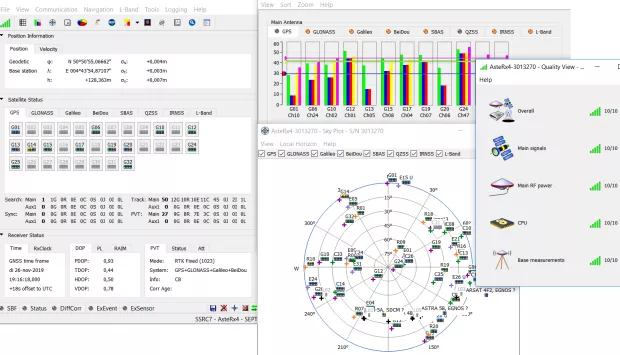
Receiver control software is one verification point for status monitoring; the exact functions depend on the receiver and configuration. Image supplied by Jumpstar.
Future outlook for High Precision GNSS Solutions
The market figures point to continued investment in GNSS and high-precision receivers, but they do not remove the engineering trade-offs between receivers, boards, modules, and antennas. The more useful outlook is conditional. Buyers building compact UAVs, robots, or vehicle systems will continue to examine modules with integrated IMU or heading functions because those products reduce the number of separate components to coordinate. Buyers retrofitting existing machines may prefer integrated receivers because the GNSS core and maintenance path are packaged. Buyers with strong RF teams may still choose boards when mechanical or interface control is the deciding factor.
Antenna integration is likely to remain part of the decision rather than a separate afterthought. A smart antenna can combine positioning and heading functions in a defined mechanical form, while a separate high-precision GNSS antenna gives the buyer more control over placement. The correct conclusion is not that one product form will replace the others. It is that procurement teams should compare the complete integration boundary: signal chain, mechanical envelope, correction workflow, software maintenance, and verification evidence.
FAQ: receiver, board, module, and antenna decisions
What is the practical difference between a GNSS RTK receiver, an RTK board, and an RTK GNSS module?
A GNSS RTK receiver is a packaged terminal intended for system installation. An RTK board is a bare core component for OEM host integration. An RTK GNSS module is a compact building block that usually needs a carrier board and a defined antenna. The three categories can support centimeter-level positioning, but they assign different RF, mechanical, and validation work to the buyer.
When does an integrated RTK receiver make more sense than an OEM board?
An integrated receiver can make sense when the buyer wants to reduce in-house GNSS core design and focus on the machine, software, or retrofit. Jumpstar comparison material describes the P-Box-X10 as a turnkey integrated receiver with remote OTA maintenance, but that is a supplier claim tied to a specific comparison. Buyers should verify interfaces, antenna requirements, maintenance terms, and field validation for their own installation.
When should a buyer choose an RTK board or module instead?
A board or module can fit when the product needs a specific enclosure, connector, size, weight, or interface. A module path can reduce the physical footprint, as shown by the JS-ARK28-3 at 28.0 × 28.0 × 8.0 mm, but the buyer still owns the carrier board, antenna, power, EMC, and production validation. A board path increases control but also increases RF and layout responsibility.
How does a GNSS Antenna or Smart Antenna change the receiver-board-module comparison?
The antenna changes the signal chain and the mechanical design. A separate GNSS Antenna such as the JS-HAC18A-F requires the buyer to validate placement, cable loss, grounding, and RF performance. A Smart Antenna such as the X28 or JS-SK43H-AH can integrate positioning or heading functions in a defined form, but it also changes the interface and mounting boundary. The buyer should confirm whether the selected receiver, board, or module includes an antenna or requires an external one.
What should buyers verify before comparing RTK accuracy claims?
Buyers should verify the antenna, correction source, satellite conditions, test environment, update rate, error statistic, and receiver configuration. Datasheet accuracy such as 1.0 cm + 1 ppm, 1.5 cm + 1 ppm, 2 cm ± 1 ppm, or 2.5 cm ± 1 ppm is meaningful only when the test conditions are comparable. A procurement decision should also cover interfaces, environmental range, lifecycle support, and commercial terms.
Company context and further reading
Jumpstar's published portfolio covers RTK modules, GNSS antennas, receivers, and smart antennas for applications including UAVs, precision agriculture, automotive systems, robotics, surveying, marine navigation, and fleet management. Buyers comparing these product categories can review the company's official site at Jumpstar and request current datasheets for the exact model and configuration under evaluation.
For company background, the publicly accessible Jumpstar company profile PDF is available here: Jumpstar company profile 2026.
¿Tiene preguntas o necesita más detalles?
Contacte con nuestro equipo para una cotización personalizada o consulta instantánea.
Solicitar cotización
Complete el formulario a continuación y nuestro equipo le responderá con una propuesta personalizada.
Chat directo de WhatsApp
¿Prefiere chatear en tiempo real? Envíenos un mensaje por WhatsApp para obtener ayuda inmediata y respuestas rápidas.
- Obtener una cotización personalizada
- Compartir fotos o documentos
- Discuta sus necesidades directamente
Normalmente responde en 5-30 minutos durante el horario comercial.