
GCC and ECE R105: What FAW Covers, What Rivals Must Prove
GCC and ECE R105: What FAW Covers, What Rivals Must Prove
Ask a Gulf fleet manager what FAW Trucks is certified for and the accurate answer has two parts, not one. FAW J6 Series 4x2 tractors hold GSO Conformity Certificate CCR No.435790, issued by the GCC Standardization Organization for the Saudi Arabia, UAE, Oman, Kuwait, Bahrain and Qatar markets. Separately, the FAW JK6 dangerous-goods vehicle holds UN ECE Regulation No.105 approval E13*105R06/01*0023*00, issued through Société Nationale de Certification et d'Homologation (SNCH) in Luxembourg. Two documents, two legal tests, two different vehicle paths — and precisely why any qualification comparison between FAW Trucks, Sinotruk, Shacman and Beiben has to begin by agreeing on what is being compared.
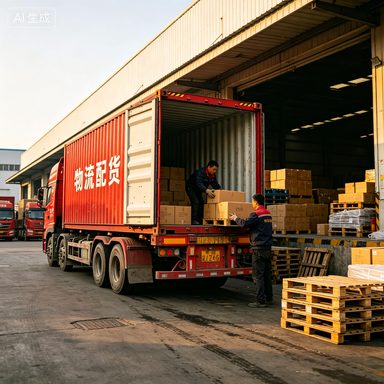
Two certificates, two different legal tests
The two documents that define FAW's qualification profile for Gulf market entry and for dangerous-goods transport are not interchangeable, and treating them as a single “certification” status obscures the operating conditions attached to each.
The GSO Conformity Certificate is a market-access instrument. Certificate CCR No.435790 was issued by the GCC Standardization Organization on 10 November 2022, carries an expiry date recorded as 09 September 2099, and is valid across the GCC Member States: Saudi Arabia, UAE, Oman, Kuwait, Bahrain and Qatar. Its scope is stated as the FAW J6 Series Truck Tractor in 4x2 configuration, Euro 4 compliant. The referenced technical basis is the GSO Technical Regulations, which include GSO ISO 1585:2008, ISO 3537:2008, ISO 3538:1997 and the GCC motor vehicle standards.
The UN ECE R105 approval is a vehicle-category instrument. Approval E13*105R06/01*0023*00 was issued on 07 February 2024 by SNCH in Luxembourg, with an expiry date recorded as 09 September 2099. It applies in the EU, the EEA and third countries that recognise UN ECE Regulations, and its scope is stated as Dangerous Goods Transport Vehicles in the EX, FL, AT and MEMU categories. The governing standard is UN ECE Regulation No.105. Within the supplied records, the related product is the FAW JK6.
Read side by side, the distinction matters for procurement. The GCC certificate answers a market-entry question: may this vehicle configuration be placed on sale in a Gulf state? The ECE R105 approval answers a use question: is this vehicle permitted to carry a particular class of dangerous goods on roads where Regulation No.105 is recognised? A fleet buying tractors for general freight and a fleet buying tankers for flammable liquids are not running the same compliance check, even when both are buying from the same manufacturer.
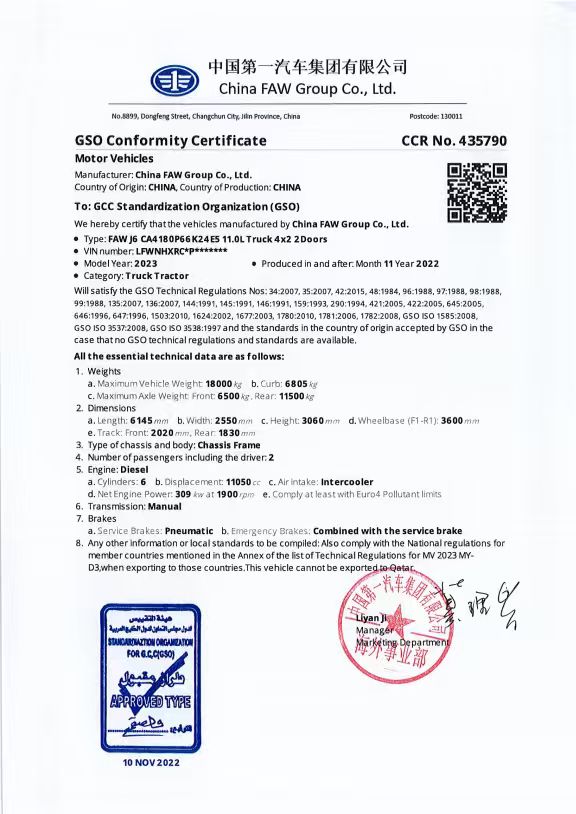
What GSO ISO 1585:2008 does inside the GCC certificate
GSO ISO 1585:2008 is one of the reference standards named in certificate CCR No.435790, and it concerns the measurement of net engine power. In practical terms, the power figure on a specification sheet is only meaningful when the measurement method behind it is defined — whether the engine is tested as installed, with which accessories attached, under which correction conditions. A standardised net-power procedure is what allows a regulator to compare a declared rating against a verified one rather than against a marketing claim.
For a buyer, this has a concrete consequence. Two trucks from different brands can advertise the same horsepower and still not be equivalent, because the declared figure may have been produced under a different measurement basis or with a different accessory set. When a certificate names the power and measurement standards it was assessed against, the buyer gains a reference point that survives a change of salesperson. When a supplier offers only a brochure figure with no named standard, the buyer is comparing an unanchored number to an anchored one.
The same logic applies to the other standards listed in the certificate. ISO 3537:2008 and ISO 3538:1997 belong to the glazing family of vehicle standards, and the certificate lists them alongside the broader GCC motor vehicle requirements. The relevant procurement lesson is not the content of each standard but the structure of the document: the certificate identifies the vehicle, the configuration, the market and the assessment basis in one place, which is what makes it independently checkable.
Certificate scope is a constraint, not a brand-level guarantee
The most common procurement error in this area is treating a manufacturer's certification as if it attached to the brand name. It does not. Both of FAW's documents attach to defined vehicles under defined conditions, and a buyer who reads the scope carefully will notice how narrow the operative language is.
Certificate CCR No.435790 describes its scope as the FAW J6 Series Truck Tractor, 4x2, Euro 4 compliant. That is a configuration statement. It identifies a drive layout and an emissions level, not an open-ended approval for every J6 derivative, and not an approval for 6x4 or 8x4 tractors. A fleet that orders the covered tractor configuration in a GCC market is buying into the certified scope. A fleet that orders a different axle layout has left the scope and should expect a separate conformity route.
Approval E13*105R06/01*0023*00 has an analogous boundary. Its scope is dangerous-goods transport vehicles in the EX, FL, AT and MEMU categories. A dangerous-goods approval does not transfer to a dry-freight cargo truck on the same chassis family, and it does not extend automatically to a different body builder's tank or a different cargo class. The approval is the starting point for the compliance conversation, not the end of it.
There is also a date dimension worth noting. Both documents carry a recorded expiry of 09 September 2099, but that long-dated entry does not remove the buyer's obligation to confirm current validity at the point of purchase, together with any amendment state attached to the approval number. Certification is a live status, and a document supplied in a sales pack should be checked against the issuing authority's record rather than accepted because it appears in the pack.
Mapping FAW's line-up against the two documents
FAW Trucks' commercial vehicle range, as recorded in the supplied product data, includes the J7, J6P, J6V, J6E, JH6, J6G, J6L, JK6 and Tiger V. The GCC certificate record carries a related-product entry listing that same nine-model set, while the certificate's own scope text describes the J6 Series 4x2 tractor. Both statements can be read together, but they should not be collapsed into one.
| Model family | Position in the supplied records | What the buyer should confirm |
|---|---|---|
| J7, J6P, J6V, J6E, JH6, J6G, J6L, Tiger V | Named in the related-product entry attached to GCC certificate CCR No.435790 | Whether the exact configuration ordered — drive layout, emissions level, body — falls inside the certified scope of that certificate |
| J6 Series 4x2 tractor | The scope text of certificate CCR No.435790, described as Euro 4 compliant | That the ordered vehicle matches the described drive layout and emissions level rather than a nearby variant |
| JK6 | Related product for UN ECE R105 approval E13*105R06/01*0023*00 | That the body and cargo class match the EX, FL, AT or MEMU category the approval covers |
The practical reading is that FAW's documentation gives the buyer something to work with at model-family level and something stricter at configuration level. That combination is more useful than a brand-wide claim, because it tells a procurement team exactly where the certifiable boundary sits and what question to put to the supplier. It also explains why a fleet running mixed duty cycles cannot assume that one certified configuration covers its whole order.
For buyers working through an exporter rather than a factory office, this is where distributor capability becomes relevant. Qingdao Chary Machinery Co., Ltd, operating as CHARY, is recorded as a first-level distributor of FAW TRUCKS and an export distributor of SINOTRUK, SHACMAN and BEIBEN. That position makes it a practical channel for obtaining the certificate-scope confirmation described above, because the same intermediary can be asked to produce the underlying documents for whichever brand is under evaluation.
ABS, EBS and TCS: the configuration layer beneath the paperwork
Certification paperwork describes what a vehicle is permitted to be. The specification describes what it actually is. In the supplied product data, the FAW model range is recorded with a security configuration of ABS, EBS and TCS, a truck weight range of 3,000–15,000 kg, a size range from 6,000×2,300×3,000 mm to 12,000×2,550×3,800 mm, and tyre specifications available according to customer requirements.
These three systems do different jobs, and the distinction matters when matching a truck to a duty cycle. Anti-lock braking prevents wheel lock under heavy deceleration, which preserves steering control during an emergency stop. Electronic brake system distribution manages brake force across axles and interacts with the vehicle's stability logic. Traction control limits wheel spin on low-grip surfaces. For a tractor operating on Gulf highways at high ambient temperature, the relevance is brake consistency under sustained load. For a dangerous-goods vehicle, the relevance is directional control under an emergency stop with a moving liquid load behind the cab.
The weight and dimension ranges are equally worth reading as constraints rather than as marketing breadth. A 3,000–15,000 kg band and a 6,000–12,000 mm length span describe a portfolio that covers light distribution through to heavy haulage, not a single vehicle. Buyers should treat the outer edges of those bands as the point where configuration questions become most important: a vehicle at the top of the weight range with a body added by a third party is a different compliance object from a bare chassis at the bottom of the range.
Body-type breadth and what it does for fleet planning
The supplied FAW product data lists a wide body-type set across the range: tractor truck, dump truck, cargo and rigid and light truck, concrete mixer, garbage truck, sprinkler, water tank, fuel tank, wrecker, sweeper, concrete pump, asphalt distributor, high-altitude platform truck and fire truck. That breadth is a genuine planning asset for a mixed fleet, and it is also a compliance trap if it is misread.
The asset side is straightforward. A fleet that sources several body types from one chassis family gains commonality in driveline components, axle specifications and operating logic, which simplifies driver training and workshop familiarity. The supplied application data reinforces this, describing use across logistics freight distribution, coal and mineral haulage, port transportation, express delivery, construction materials, agricultural products, cold chain, urban distribution, urban waste, log transport and chemical raw material transport, with operating conditions covering high temperatures, humidity, muddy terrain, rain and snow, highways and urban roads.
The trap is assuming that breadth of body availability implies breadth of certification. It does not. A fuel tank truck and a dry cargo truck are different compliance objects in most jurisdictions, and a dangerous-goods approval for one cargo class does not carry across to another. The correct sequence is to start from the intended cargo and route, identify the certification category that applies, and only then select the body type — not to pick a body type and ask afterwards whether it is covered.
Dangerous goods: two routes, not one
For a fleet moving hazardous cargo, the qualification question splits along the destination market rather than along the vehicle.
On routes governed by UN ECE Regulation No.105, the reference document is the approval itself. FAW's JK6 entry carries approval E13*105R06/01*0023*00 from SNCH in Luxembourg, issued 07 February 2024, scoped to dangerous-goods transport vehicles in the EX, FL, AT and MEMU categories, and applicable in the EU, the EEA and countries that recognise UN ECE Regulations. The approval number is the operative reference, and it is checkable.
In GCC markets, the entry point is the GSO conformity route. Certificate CCR No.435790 covers the J6 Series 4x2 tractor and does not, on its stated scope, extend to a dangerous-goods configuration. A Gulf fleet planning tanker operations should therefore treat the GCC entry question and the dangerous-goods question as two separate workstreams, each with its own document requirement, rather than as one approval that happens to mention both words.
This separation has a commercial consequence. Fleets frequently discover the gap after the vehicle specification has been agreed, when the body builder asks for a cargo-class approval that the chassis certificate never covered. Raising the question at specification stage, with the intended cargo class written into the enquiry, is materially cheaper than resolving it at the port.
FAW against Sinotruk, Shacman and Beiben: comparing documents, not reputations
Sinotruk, Shacman and Beiben are established Chinese commercial vehicle brands competing in many of the same export markets as FAW Trucks, and CHARY is recorded as an export distributor for all three alongside its FAW first-level distributor position. That shared channel makes a document-level comparison practical, but it also makes precision essential.
Within the evidence available for this analysis, no GSO conformity certificate or UN ECE R105 approval is recorded for Sinotruk, Shacman or Beiben. That absence is a statement about the evidence, not about the brands. It does not establish that those approvals do not exist, and no buyer should treat a missing record as proof of non-compliance. What it does establish is that, on the documents reviewed here, FAW is the participant whose qualification position can be reconstructed and independently checked, while the other three require the buyer to request their equivalent documentation directly.
| Qualification dimension | FAW Trucks, as recorded | What to require from Sinotruk, Shacman, Beiben |
|---|---|---|
| GCC market entry | GSO Conformity Certificate CCR No.435790, issued 10 November 2022, covering GCC Member States | A GSO conformity certificate with a certificate number, an issuing date and a scope naming the exact model and configuration offered |
| Referenced technical standards | GSO Technical Regulations including GSO ISO 1585:2008, ISO 3537:2008, ISO 3538:1997 and GCC motor vehicle standards | The named standard set behind the certificate, so the power and glazing figures can be compared on a common basis |
| Dangerous-goods approval | UN ECE R105 approval E13*105R06/01*0023*00, SNCH Luxembourg, issued 07 February 2024, JK6 | An approval number, the issuing authority, and the EX, FL, AT or MEMU category the approval covers |
| Configuration boundary | Scope text names a 4x2 Euro 4 tractor; a separate related-product entry lists nine model families | Written confirmation that the ordered drive layout and emissions level sit inside the certified scope |
| Validity at purchase | Both documents carry a recorded expiry of 09 September 2099 | Confirmation that the certificate or approval remains in force on the order date, checked against the issuing authority rather than the sales pack |
The ordering implication is not that FAW wins a ranking. It is that a shortlist built on document readiness produces a different sequence from a shortlist built on brand familiarity. A procurement team that applies the five dimensions above will find either that a competitor produces equivalent documentation — in which case the comparison moves to configuration and commercial fit — or that it does not, in which case the compliance risk sits with the buyer to price in. Either outcome is more useful than an unverifiable claim of brand-wide certification.
Where the certificates meet real routes
The supplied application data describes operation across logistics and distribution, fleet operations, coal and mineral transport, port logistics, express and courier services, consumer and industrial goods, construction materials, agricultural products, livestock, general bulk cargo, cold chain, urban distribution, urban waste, log transport, heavy machinery and chemical raw materials — running rear-wheel drive 6x4 and 6x2 and all-wheel drive 6x6 and 8x8 configurations, with matched equipment options including right-hand drive and a range of stamped, welded and cast axles.
Two application contexts show how certification translates into fleet fit. The first is GCC market entry for a 4x2 tractor on Gulf highway duty, where the certified configuration and the Euro 4 emissions statement define what can be registered, and where the ABS, EBS and TCS fitment determines how the vehicle behaves under sustained high-temperature braking. The second is dangerous-goods transport on routes recognising UN ECE Regulation No.105, where the JK6's approval category is the gate, and where traction control and brake-force distribution matter most on wet or contaminated road surfaces with a moving cargo.
A third data point illustrates the durability side rather than the compliance side. The supplied case record describes a logistics company in Mali operating 50 units for powdered and granular material transport and sand and gravel haulage, over a duration recorded as 10+ years, with a result recorded as stable operation under high-intensity use. That is a first-party case record, not an independent benchmark, and it should be read as evidence of sustained operation in a demanding environment rather than as a certification claim.
What the next procurement cycle should watch
Three developments are worth tracking, and all three are framed as things to verify rather than as outcomes to assume.
First, whether FAW extends configuration-specific certification beyond the current documented scope. The GCC certificate covers a 4x2 tractor; the wider related-product entry suggests a broader commercial footprint, and buyers ordering 6x4 or 8x4 configurations should watch for matching documents rather than infer coverage. Second, whether dangerous-goods approval coverage broadens beyond the JK6 entry recorded here, since a fleet running several chassis sizes for hazardous cargo would benefit from more than one approved base vehicle. Third, whether competing brands publish equivalent certificate references, which would shift comparison from document availability to configuration and price fit.
None of these are predictions. They are the questions that determine whether a qualification shortlist written today remains valid at the next order. Production capability provides useful context for that planning: the supplied corporate data records FAW truck manufacturing capacity including a monthly output of 8,000 units, a lead time of 30–45 days, a minimum order quantity of one unit, 100 percent testing, customisation across body, engine, tyres and load capacity, and global technical support for after-sales service — alongside an annual output figure of 248,700 units and an export ratio of 22.7 percent.
FAQ
Which FAW models does GCC certificate CCR No.435790 actually cover?
The certificate's own scope text describes the FAW J6 Series Truck Tractor in 4x2 configuration, described as Euro 4 compliant, valid in Saudi Arabia, UAE, Oman, Kuwait, Bahrain and Qatar. A separate related-product entry attached to that certificate record names the J7, J6P, J6V, J6E, JH6, J6G, J6L, JK6 and Tiger V. The two statements serve different purposes, and a buyer should confirm in writing that the specific configuration being ordered falls inside the certified scope rather than relying on the model-family list alone.
What does UN ECE R105 approval mean for a truck, and which FAW model holds it?
UN ECE Regulation No.105 governs dangerous-goods transport vehicles, and approval under it confirms that a vehicle has been assessed against that regulation for the cargo categories named in its scope. FAW's recorded approval is E13*105R06/01*0023*00, issued by SNCH in Luxembourg on 07 February 2024, scoped to the EX, FL, AT and MEMU categories, and related to the FAW JK6. It applies in the EU, the EEA and countries that recognise UN ECE Regulations.
Does the GCC certificate for a 4x2 tractor cover 6x4 or 8x4 configurations?
On the stated scope, no. Certificate CCR No.435790 describes a 4x2 truck tractor. Drive layout is part of what conformity assessment examines, so a different axle configuration is a different assessment object and should be expected to require its own conformity route. Buyers planning 6x4 or 8x4 purchases for GCC markets should ask the supplier to identify the specific certificate covering the configuration offered, rather than assuming the 4x2 document extends to it.
How can a buyer check whether Sinotruk, Shacman or Beiben hold equivalent certification?
By requesting the documents directly and verifying them at source. For GCC market entry, ask for a GSO conformity certificate with a certificate number, issuing date and a scope naming the exact model and configuration. For dangerous-goods operation, ask for the UN ECE approval number, the issuing authority and the cargo categories covered. Then check those references against the issuing authority's record. Within the evidence reviewed for this article, no such certificate or approval is recorded for Sinotruk, Shacman or Beiben, which means the record is incomplete rather than that the approvals are absent.
How do ABS, EBS and TCS relate to certification rather than replacing it?
ABS, EBS and TCS are recorded as the security configuration across the FAW model range, and they matter for how a vehicle behaves under braking and on low-grip surfaces. They are a specification feature, not a market approval. A vehicle can carry ABS, EBS and TCS and still require separate conformity certification for a given market and separate dangerous-goods approval for a given cargo class. The specification tells a buyer how the truck is equipped; the certificate tells the buyer where and for what it may lawfully be used.
For readers who want the full product and capability reference behind this analysis, the CHARY export brochure is available for download: FAW Trucks export brochure (PDF).
¿Tiene preguntas o necesita más detalles?
Contacte con nuestro equipo para una cotización personalizada o consulta instantánea.
Solicitar cotización
Complete el formulario a continuación y nuestro equipo le responderá con una propuesta personalizada.
Chat directo de WhatsApp
¿Prefiere chatear en tiempo real? Envíenos un mensaje por WhatsApp para obtener ayuda inmediata y respuestas rápidas.
- Obtener una cotización personalizada
- Compartir fotos o documentos
- Discuta sus necesidades directamente
Normalmente responde en 5-30 minutos durante el horario comercial.