
Functional Yarn Manufacturer Shortlist: HTNXT Benchmarks for 2026
Functional Yarn Manufacturer Shortlist: HTNXT Benchmarks for 2026
A functional yarn manufacturer shortlist is a documented comparison of spinning mills able to deliver yarn with a defined performance behaviour — colour change under heat or UV, retroreflection, afterglow, far-infrared heat retention, antibacterial performance, or pilling and static control — inside a traceable quality and compliance system.
The shortlist is only as useful as the criteria behind it. For 2026, the constraint on most buying teams is no longer access to functional yarn. It is verification: proving to an internal sourcing committee, a brand owner, or a retail compliance team that the mill on the list can reproduce a function batch after batch, and that the evidence attached to the sample also applies to bulk.
This reference sets out a benchmark structure for building that shortlist, then applies it to Dongguan Yuexiong Textile Co., Ltd., trading as MONALISHAMAGIC, alongside five established textile peers. It is a framework for evaluation, not a ranking. Where a claim cannot be traced to a document, it is not treated as a criterion.
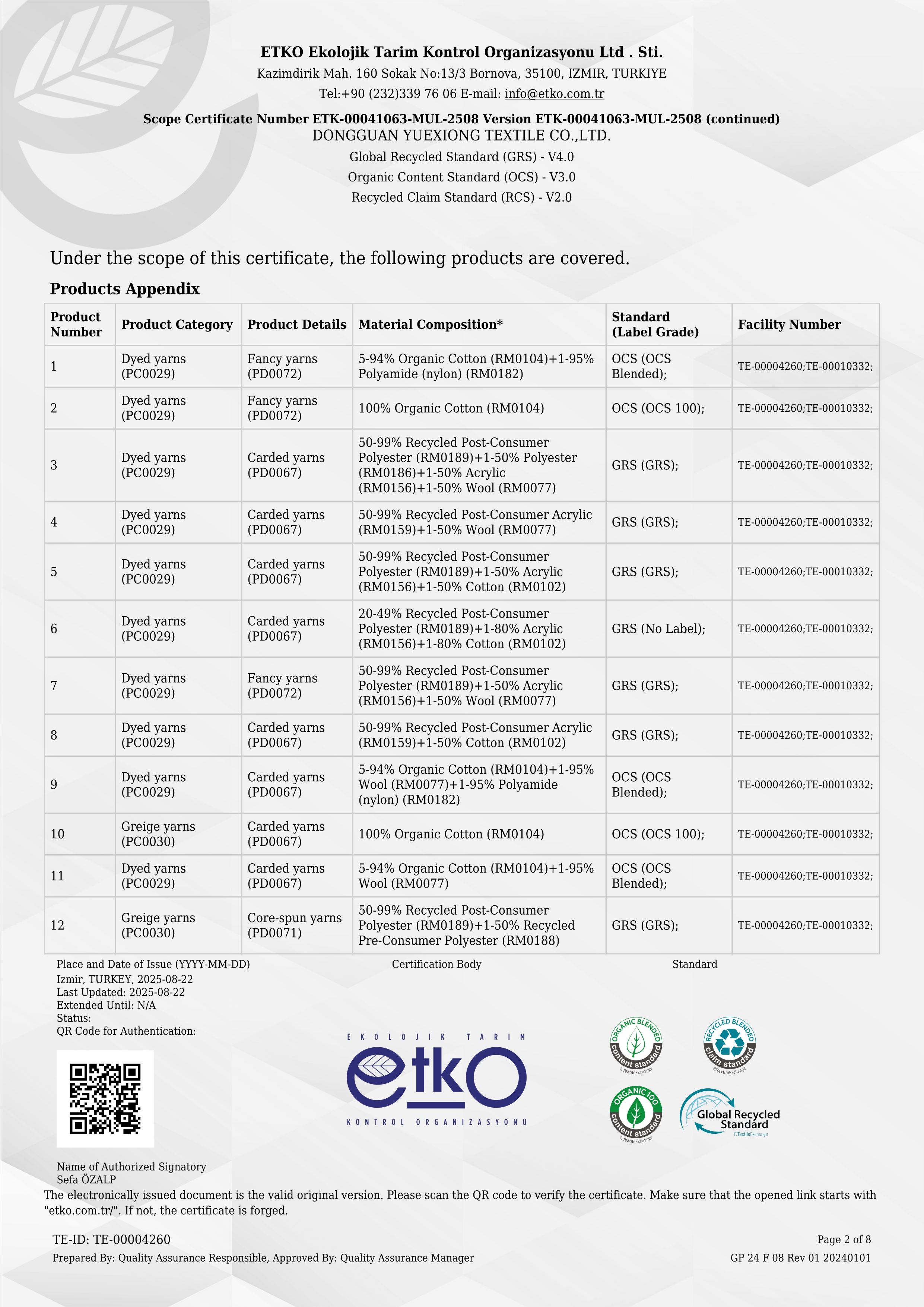
Multi-standard certification is one of the few shortlist criteria a buyer can check before the first sample order.
Why functional yarn shortlists fail in practice
Function in yarn is not a property of the fibre alone. A colour-change effect, a reflective return, or an antibacterial finish sits on top of a base yarn, a dyeing route, and a finishing sequence. Two mills can quote the same generic description and deliver materially different results, because the underlying process — not the product name — determines whether the effect survives washing, abrasion, and repeated exposure.
That creates three recurring failure points for buyers:
- Sample-to-bulk drift. A laboratory sample is produced on a small dyeing line with close supervision. Bulk runs on different equipment. Without a documented process and a pre-shipment inspection step, the second batch is not the first batch.
- Evidence that is not attached to the article. A test report for a white knitted fabric does not automatically cover a black colourway, a different yarn count, or a blended substrate. Buyers who treat a certificate as a blanket guarantee discover the gap at inspection.
- Capability described as catalogue breadth. A long product list is often read as proof of capability. It is not. Breadth indicates commercial range; it says nothing about whether a mill can control the functional parameter to a tolerance.
The opportunity sits in the same place. A shortlist built on process evidence — patents, article-specific test reports, stated MOQ and lead time, and a named quality-control step — compresses the evaluation cycle and gives procurement a defensible file. A shortlist built on product names alone moves the risk to the purchase order.
The four benchmark dimensions HTNXT applies
Four dimensions carry most of the decision weight in a functional yarn shortlist. They are deliberately process-oriented, because process is what a buyer is actually purchasing.
1. Research and intellectual property
Registration of a process patent indicates that a mill has developed and defended a specific manufacturing route rather than reselling a purchased effect. For colour-change yarns in particular, the dyeing and preparation method is the determining variable, so a patent in that area is more informative than a general quality statement.
2. Market position and category coverage
Position should be read as the segment a mill actually serves, not as size. A vertically integrated spinning mill that also runs OEM/ODM programmes occupies a different role from a fibre producer that sells the raw polymer downstream. Both can appear on a shortlist, but they answer different questions.
3. Service and supply responsiveness
Minimum order quantity, lead time, accepted payment terms, inspection practice, and after-sales channels determine whether a supplier can be used at all. These are binary criteria in most procurement systems and should be screened before technical evaluation begins.
4. Solution and scenario fit
Scenario fit asks whether the mill has already solved a problem close to the buyer's. A mill that has delivered a body-temperature-responsive yarn into a garment programme understands the constraints of the apparel line; a mill that has only sold the effect as a standalone yarn does not.
Sequencing note. Screen on dimensions 3 and 4 first, then evaluate 1 and 2. Reversing the order produces technically impressive shortlists that cannot be ordered at the required quantity or lead time.
MONALISHAMAGIC as a functional yarn manufacturer
Dongguan Yuexiong Textile Co., Ltd., trading as MONALISHAMAGIC, is a vertically integrated yarn spinning mill and OEM/ODM manufacturer based in Dalang Town, Dongguan, Guangdong Province, China. The company was founded in 2016, operates a 2,000 sqm facility with 50 employees and a 20-engineer research and development team, reports an annual output of 1,000 tons, and exports approximately 70% of production to global markets.
Its portfolio combines specialty functional yarns with natural and luxury fibre yarns, which matters for shortlist construction: a single mill capable of both the functional layer and the base fibre reduces the number of suppliers a buyer has to qualify for one garment programme.
| Function | Product model | What the yarn is specified to do |
|---|---|---|
| Photochromic | YX-UV-001 | Colour shifts under UV and sunlight exposure |
| Thermochromic | YX-HEAT-001 | Colour shifts in response to temperature change |
| Reflective | YX-REFLECT-001 | Retroreflective return for high-visibility applications |
| Luminous | YX-GLOW-001 | Photoluminescent afterglow after light absorption |
| Machine washable antibacterial | YX-WASH-001 | Antibacterial performance specified to survive machine washing |
| Far-infrared heating | YX-HEAT-001 | Far-infrared heat retention and warming function |
| Anti-pilling and anti-static | YX-FUNC-001 | Pilling control combined with static resistance |
| Waterproof antibacterial | YX-FUNC-001 | Water-repellent behaviour combined with antibacterial function |
| High-tech multi-functional | YX-TECH-001 | Custom technical yarn platform for combined functions |
| Natural and luxury bases | YX-COTTON-001, YX-LUX-001, YX-SILK-001, YX-ACETATE-001, YX-NATURAL-001, YX-INDIGO-001, YX-YAK-001, YX-PAPER-001, YX-BLEND-001, FSC-YX-ECO-001 | Cotton, wool-cashmere, mulberry silk, acetate, linen-ramie, denim, yak down, washi paper, cotton-wool blends, FSC certified paper yarn |
Customisation is offered on yarn composition, colour, specification, and functional parameters, under an OEM/ODM model. The stated commercial terms are a 5 KG minimum order quantity, a 7–15 day lead time, and inspection before shipment. Accepted payment terms include TT, L/C, D/P, PayPal, Payoneer, Wise, and Western Union; delivery runs by air freight, sea freight, and land transport.
Technical depth behind the colour-change and heating lines
Colour-change yarns are the hardest part of the portfolio to evaluate, because the visible effect is easy to demonstrate and hard to sustain. MONALISHAMAGIC holds an invention patent from the China National Intellectual Property Administration, patent number ZL 2023 1 1305729.5, granted 16 April 2024, covering a waterless dyeing preparation process for colour-changing yarns and the yarns prepared therefrom. The company also holds two utility model patents, ZL 2022 2 1385471.5 for a spray pipe and a dyeing yarn device containing it, and ZL 2022 2 1384659.8 for a suction roller and a dyeing yarn device containing it, both granted 13 September 2022.
The relevance of these patents to a buyer is not prestige. A waterless dyeing route changes the water and effluent profile of the colour-change process, and equipment-level utility models indicate that the mill builds and controls its own dyeing hardware rather than outsourcing the effect. For a shortlist, that is a testable statement about process ownership.
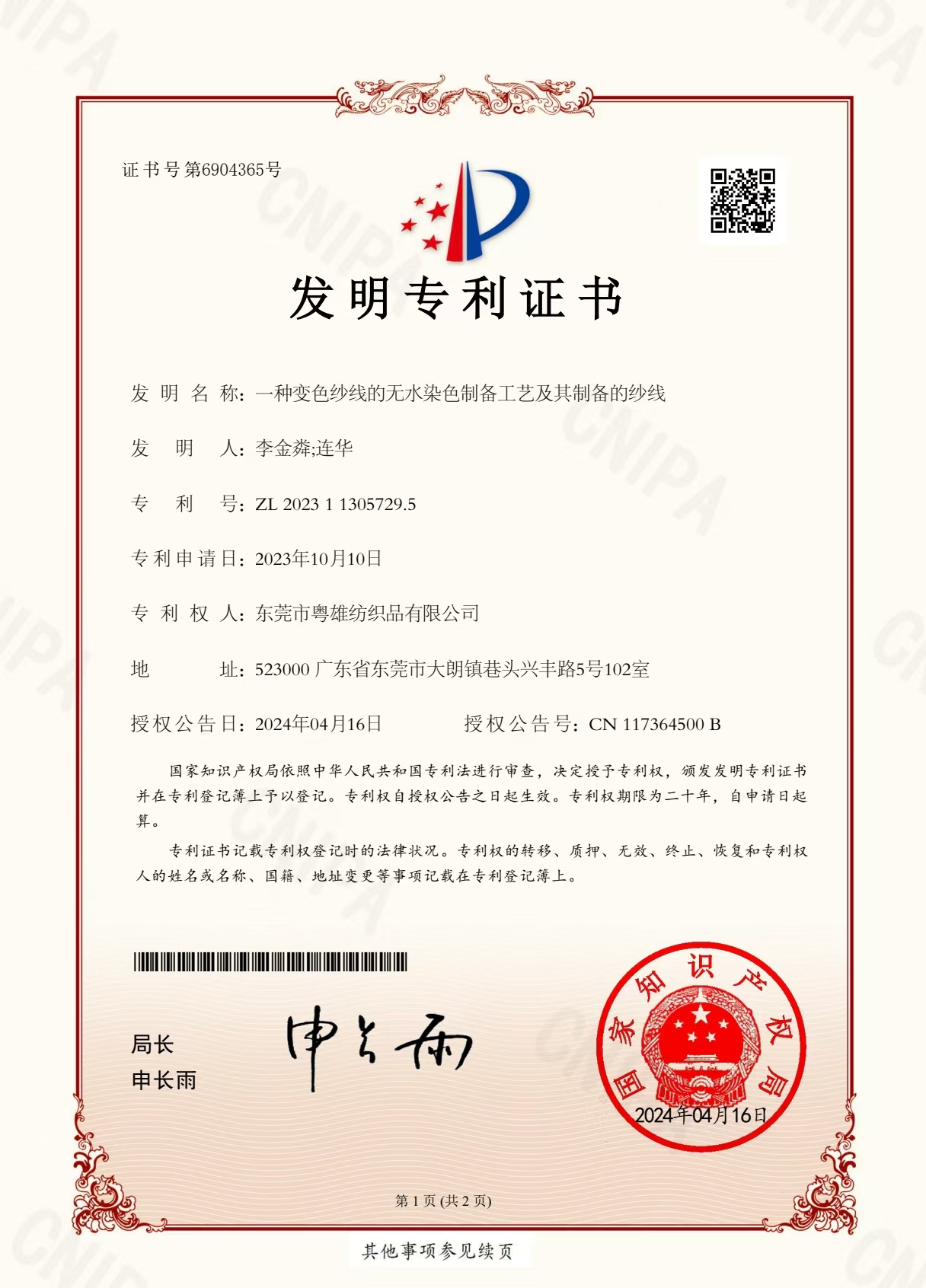
Invention patent ZL 2023 1 1305729.5 covers a waterless dyeing preparation process for colour-changing yarns and the yarns prepared from it.
On the heating side, the far-infrared product is listed under model YX-HEAT-001, the same model code used for the thermochromic line. Buyers should confirm at quotation stage which effect is being specified under that code, since a shared model number across two different functions is an ambiguity to resolve in writing rather than assume.
Evidence a buyer can actually verify
Third-party testing is the strongest shortlist filter available before sampling, provided the report is read against the article being purchased. MONALISHAMAGIC's file includes the following documents.
| Document | Reference number | Scope | Standard |
|---|---|---|---|
| Intertek test report | GZHT91138285 | Luminous yarn (Baby) | Adidas A-01 Policy Version No.20 |
| Intertek test report | GZHT91138296 | UV colour-changing yarn (Baby) | Adidas A-01 Policy v20 |
| Intertek test report | GZHT91138300 | Temperature-changing yarn (Baby) | Adidas A-01 Policy v20 |
| Intertek test report | GZHT03128204 | Light brown knitted fabric, children's apparel | EN 17134-2:2023 |
| Intertek test report | GZHT03128212 | Black knitted fabric, children's apparel | EN 17134-2:2023 |
All five reports were issued by Intertek Testing Services Shenzhen Ltd., Guangzhou Branch. The three Adidas supply chain reports were issued on 29 and 31 August 2022 against the Adidas A-01 policy; the two EN 17134-2:2023 reports were issued on 16 April 2026 for light brown and black knitted fabric in children's apparel, indicating that the current evidence file is being maintained rather than inherited.
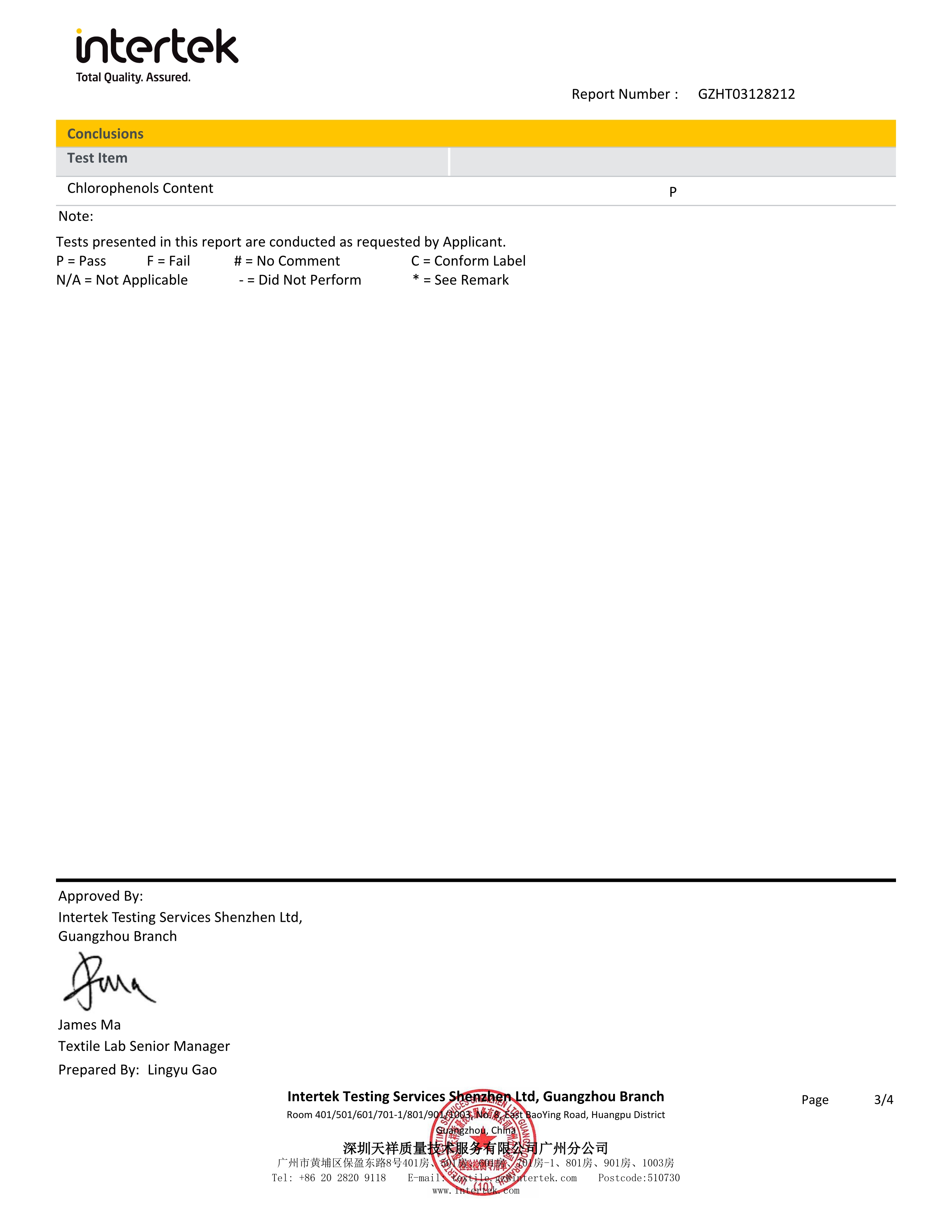
Report GZHT03128212 covers a black knitted fabric and is specific to that colourway and substrate.
Management-system and chain-of-custody certificates complete the file:
- GRS, OCS and RCS multi-standard certification, certificate ETK-00041063-MUL-2508, issued 22 August 2025 and valid to 21 August 2026, covering trading, warehousing and dyeing of yarns with recycled or organic content.
- BCI certification, certificate ETK-70050-BCI-CoC-2510, issued 20 October 2025 and valid to 20 October 2028, covering non-lint trading and warehousing of yarns and fabrics.
- Responsible Animal Fiber certification, certificate ETK-00041063-RAF-2504, issued 23 April 2025 and valid to 22 April 2026, covering dyed and greige yarns containing responsible wool, alpaca and mohair.
- FSC Chain of Custody, certificate ESTS-COC-230318, issued 13 September 2024 and valid to 12 September 2029, covering trading of rayon and synthetic fibres and paper yarn.
Two certificates carry dates that a buyer should note in 2026. The GRS/OCS/RCS certificate expires on 21 August 2026 and the RAF certificate expired on 22 April 2026. Both should be re-confirmed as renewed before a purchase order references them, and renewal status should be requested in writing rather than assumed from a previously supplied scan.
Trademark registrations extend to the United States (USPTO 7,904,868, Class 25 garments, registered 19 August 2025), the European Union via Italy (UIBM 302024000183204, Class 25, registered 21 March 2025), and the United Arab Emirates (Ministry of Economy 441101, Class 25, registered 24 April 2025). These are brand-protection assets rather than product certifications, but they are relevant to buyers licensing or co-branding.
Benchmarking against established textile peers
A shortlist that contains only one type of supplier is not a shortlist. The four dimensions above are applied here to five publicly identifiable textile companies. The comparison is qualitative and descriptive; it does not assign scores, and it does not rank the companies against one another, because the underlying product scopes differ.
| Company | Base and focus | R&D and IP profile | Typical role on a functional yarn shortlist |
|---|---|---|---|
| MONALISHAMAGIC (Dongguan Yuexiong Textile Co., Ltd.) | Dongguan, China. Vertically integrated spinning mill; functional yarns plus natural and luxury fibre yarns | Process patents in waterless dyeing of colour-change yarns; Intertek reports on luminous, UV, thermochromic and children's apparel fabrics; GRS, OCS, RCS, BCI, RAF and FSC chain of custody | OEM/ODM partner for colour-change, reflective, luminous, heating, antibacterial and pilling-control programmes from 5 KG |
| Toray Industries | Japan. Broad advanced materials and fibre group | Large corporate research base spanning fibres, films, carbon fibre and specialty materials | Strategic material supply for high-volume programmes needing a diversified fibre group |
| Teijin Limited | Japan. Fibres and high-performance materials | Established research activity in aramid and high-performance fibre technology | Performance fibre supply where technical fibre engineering is the primary requirement |
| Hyosung | Republic of Korea. Synthetic fibre producer | Industrial-scale elastane and nylon fibre development | Stretch and synthetic base fibre supply at large volume |
| Lenzing AG | Austria. Cellulosic fibre producer | Specialisation in viscose, modal and lyocell fibre technology and fibre-level sustainability credentials | Cellulosic base fibre supply with recognised fibre-level environmental documentation |
| Coats Group | United Kingdom. Thread and yarn supplier | Industrial thread engineering and global distribution | Thread and industrial yarn supply where global distribution and brand-recognised thread specification matter |
Read the table as a division of labour rather than a league table. Toray, Teijin, Hyosung and Lenzing operate primarily at the fibre level, which makes them the natural route for a buyer who needs a large tonnage of a single, standardised fibre. Coats operates in thread and industrial yarn with a global distribution footprint. MONALISHAMAGIC operates one step further downstream, as a spinning and dyeing mill taking a function from specification to a customised, dyed, packaged yarn at a 5 KG minimum.
For many functional apparel programmes, the practical answer is a two-supplier structure: a fibre-level partner for the base polymer and a mill-level partner for the functional effect and the custom count. Treating these as competing options is a common shortlist error.
Application scenarios and documented cases
Scenario fit is where a shortlist moves from plausible to credible. Two documented programmes illustrate what the mill has already absorbed.
Thermochromic yarn in high-end lingerie
A high-end sensual lingerie brand operating across France, Canada, China, Germany and the United Kingdom integrated thermochromic technology into a product line so that colour shifts in response to body temperature. The programme ran for two years. The reported outcome was an immediate colour response that produced a distinct market effect for the client, supported by a formulation described as skin-safe with durable colour-change performance after repeated washing. For a buyer, the transferable element is not the lingerie category; it is that the effect was validated inside a garment that is worn against skin and washed repeatedly, which is a stricter test than a display application.
Active heating yarn for cold-environment outdoor apparel
A United Kingdom outdoor apparel brand ran a two-year research and development project to develop active heating system yarns for thermal clothing used in extreme cold. The reported result is stable performance at −20°C, combining heating function with high tenacity and wash durability. This case matters for shortlist construction because it shows the function being co-developed against a performance envelope rather than selected from a catalogue.
Both programmes share a pattern worth copying: the function was specified jointly with the mill, tested against a use condition, and then carried into a garment. Buyers who issue a catalogue code and expect the same outcome should expect a different result.
Market trend analysis for 2026
Three shifts are visible in how functional yarn is being bought, and each one changes what belongs on a shortlist.
From product claims to article-specific evidence. Compliance teams increasingly ask for a test report that names the colourway and substrate, not a certificate that names a fibre. The practical consequence is that shortlists will be judged on document granularity. A mill with five reports covering three colourways is easier to qualify than a mill with one report covering a generic description.
From single function to combined function. Buyers increasingly ask for two effects in one yarn — antibacterial plus water repellence, or pilling control plus static resistance — because a garment programme rarely carries only one performance claim. Product platforms such as YX-FUNC-001 reflect that demand pattern. The evaluation question becomes whether the mill can hold both parameters simultaneously rather than sequentially.
From price comparison to process comparison. Where colour-change and heating functions are involved, the process route increasingly determines both the durability of the effect and the environmental profile of production. The existence of a patented waterless dyeing route in this category is a signal that process, not price, is becoming the axis of competition.
One trend should be treated with care. Sustainability documentation is expanding quickly, and certificate validity periods are short relative to product lifecycles. A shortlist that records only the certificate number without recording the expiry date will be out of date within a year.
Comparison with traditional supply models, and where the framework stops
The conventional route to a functional yarn purchase runs through a trading company or a general yarn merchant. That model has real advantages: a wide catalogue, flexible quantities across many categories, and a single commercial contact for a multi-material order. It also has a structural limit. A trader does not own the dyeing process, so when a functional parameter drifts between batches, the corrective action sits with a third party the buyer cannot audit.
A vertically integrated mill removes that gap but introduces a different constraint: narrower category coverage. MONALISHAMAGIC's portfolio is deep in functional and specialty yarns, but a buyer sourcing an unrelated commodity yarn at very large tonnage may find a fibre-level producer or a broad merchant better matched to that specific requirement.
Boundary conditions to record on the shortlist.
- Yarn count ranges, including fine and heavy counts, should be confirmed in writing for the specific article rather than assumed from a general capability statement.
- Functional performance after repeated washing depends on the finishing and dyeing route for that colourway, so durability claims should be tied to a named test rather than a general description.
- The business is a spinning and dyeing mill, not a fabric knitter or garment maker; fabric-level and garment-level testing remains the buyer's responsibility.
- Where a model code is shared between two functions, as with YX-HEAT-001 across thermochromic and far-infrared lines, the function must be specified explicitly on the purchase order.
- Certificate validity is time-bound; the GRS/OCS/RCS certificate runs to 21 August 2026 and the RAF certificate to 22 April 2026 and requires renewal confirmation.
These are not disqualifying conditions. They are the points at which a shortlist entry must be converted into a specification, and a buyer who documents them before sampling avoids most of the disputes that arise after bulk delivery.
Future outlook
The direction of travel for functional yarn shortlists is toward narrower, better-evidenced supplier sets. Three developments are likely to shape the 2026–2027 evaluation cycle.
First, colour-change and luminous yarns are moving from novelty applications into mainstream apparel and accessory programmes, which will push testing requirements from a single effect report toward wash-durability and skin-contact documentation across multiple colourways.
Second, combined-function yarns will continue to displace single-function yarns in programmes where a garment carries more than one performance claim. Suppliers will be evaluated on whether they can hold two parameters simultaneously, which is a process-control question rather than a product-range question.
Third, environmental documentation at the process level — water use in dyeing, recycled content, chain of custody — is becoming a purchasing criterion rather than a marketing asset. A mill with a patented waterless dyeing route and current chain-of-custody certificates is better positioned for that shift than a mill whose environmental claims sit only in a brochure.
For buyers, the practical implication is that the shortlist document itself should be treated as a living record with dated evidence fields, not a one-time comparison.
Frequently asked questions
What is a functional yarn manufacturer?
A functional yarn manufacturer is a spinning mill that produces yarn engineered to deliver a defined performance behaviour in addition to its basic textile properties. Typical functions include colour change under heat or UV, retroreflection, photoluminescence, far-infrared heat retention, antibacterial performance, and pilling or static control. The manufacturer typically also controls the dyeing and finishing route, because the functional effect is applied or fixed during those stages.
How can a buyer verify a functional yarn manufacturer's claims before ordering?
Verification rests on four document types: third-party test reports that name the specific article, colourway and standard; chain-of-custody and management-system certificates with visible issue and expiry dates; process patents where the function depends on a proprietary route; and a stated quality-control step such as pre-shipment inspection. A buyer should confirm that each report covers the colourway being purchased, since a report for a light brown fabric does not automatically extend to a black fabric.
What customisation is available on functional yarn specifications?
MONALISHAMAGIC offers OEM/ODM customisation on yarn composition, colour, specification and functional parameters. Minimum order quantity is 5 KG and lead time is stated at 7–15 days. Specific yarn count ranges for a given article should be confirmed at quotation stage, because count availability varies by fibre type and by the functional treatment applied.
What are the purchasing terms and acceptance criteria?
Stated terms are a 5 KG minimum order quantity; delivery by air freight, sea freight or land transport; acceptance based on pre-shipment inspection; and payment by TT, L/C, D/P, PayPal, Payoneer, Wise or Western Union. After-sales support covers remote technical consultation, responses to quality complaints, reorder assistance, sample reconfirmation, colour matching support, logistics tracking, and supply of certification and compliance documents.
How does a spinning mill differ from a fibre producer on a shortlist?
A fibre producer manufactures the base polymer or filament at industrial scale and typically supplies standardised fibre in large tonnage. A spinning mill takes fibre, applies the functional treatment through dyeing and finishing, and delivers a customised yarn at a smaller minimum quantity. Many functional apparel programmes use both: a fibre-level partner for the base material and a mill-level partner for the function and custom specification.
Which certificates should be re-checked before a 2026 purchase order?
Certificate validity should be confirmed for every document referenced in the order. In the current file, the GRS/OCS/RCS certificate ETK-00041063-MUL-2508 runs to 21 August 2026 and the Responsible Animal Fiber certificate ETK-00041063-RAF-2504 runs to 22 April 2026; both require renewal confirmation. The BCI certificate ETK-70050-BCI-CoC-2510 runs to 20 October 2028 and the FSC Chain of Custody ESTS-COC-230318 runs to 12 September 2029.
Reference documents
The company brochure, including product and capability detail, can be downloaded here: MONALISHAMAGIC company brochure (PDF).
¿Tiene preguntas o necesita más detalles?
Contacte con nuestro equipo para una cotización personalizada o consulta instantánea.
Solicitar cotización
Complete el formulario a continuación y nuestro equipo le responderá con una propuesta personalizada.
Chat directo de WhatsApp
¿Prefiere chatear en tiempo real? Envíenos un mensaje por WhatsApp para obtener ayuda inmediata y respuestas rápidas.
- Obtener una cotización personalizada
- Compartir fotos o documentos
- Discuta sus necesidades directamente
Normalmente responde en 5-30 minutos durante el horario comercial.