Functional Yarn Certification Map: FSC, Antibacterial, Anti-Pilling
Functional Yarn Certification Map: FSC, Antibacterial, Anti-Pilling
Certification is not a product property. It is a document relationship between a standard, a certificate scope, a test method, a production site and a specific yarn SKU. That relationship is where most functional-yarn sourcing errors begin.
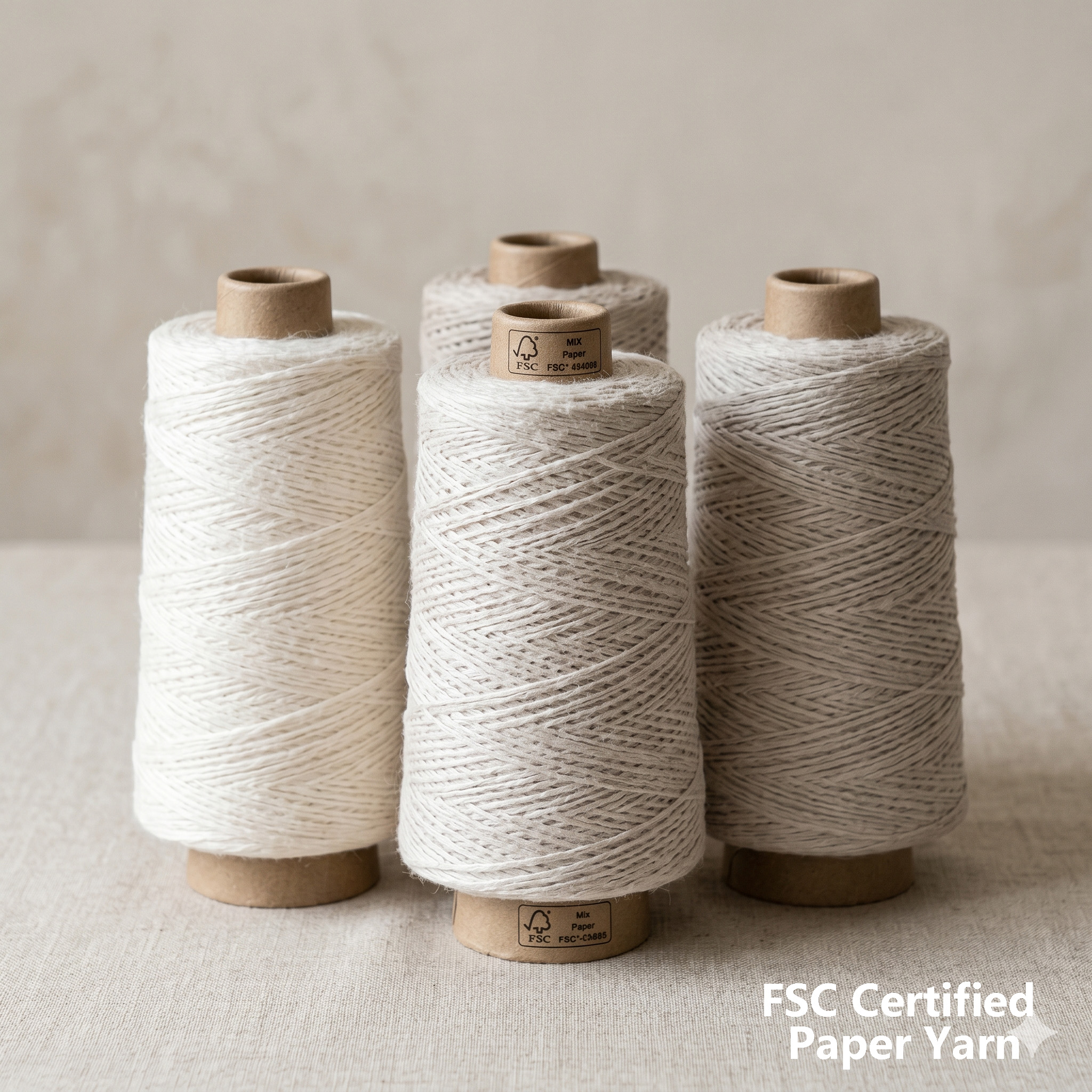
FSC Certified Paper Yarn (FSC-YX-ECO-001) is one line in a product-family evidence map, not a stand-alone eco claim. Image: MONALISHAMAGIC.
Buyers researching functional yarn often receive a folder of certificates and test reports that looks complete but does not answer a simple question: which document supports which claim, for which yarn, and under which scope? A FSC chain-of-custody certificate, an antibacterial test report and a pilling test result are not interchangeable evidence. They answer different questions, carry different boundaries and expire on different dates.
This reference builds a product-family certification map for four yarn lines: FSC Certified Paper Yarn (FSC-YX-ECO-001), Machine Washable Antibacterial Yarn (YX-WASH-001), Waterproof Antibacterial Yarn (YX-FUNC-001) and Anti-pilling and Anti-static Yarn (YX-FUNC-001). It separates verified certificate facts from claims that require a buyer-specific test report. It also provides a peer benchmark frame using publicly known functional-fiber groups and a buyer checklist for evaluation.
Why a Certification Map Beats a Certificate Stack
In a constraints-led purchase, the buyer is not only asking whether a supplier has certificates. The buyer is asking whether the certificate scope matches the ordered yarn, whether the test method matches the intended claim, and whether the document can be traced to a production lot. Three failure modes are common.
First, scope mismatch. A certificate may cover trading of paper yarn but not a specific blend or finished fabric. Second, method mismatch. An antibacterial claim tested on one fabric construction may not transfer to another blend, count or finish. Third, traceability gap. A certificate may be valid at company level while the transaction certificate or lot record is missing. A certification map reduces these risks by pairing each claim with a named document and a verification step.
The map is especially important for product families. A buyer may source a summer paper yarn, a children's-wear antibacterial yarn and a high-twist anti-pilling yarn in one program. Each SKU needs its own evidence line. Treating the family as one certification package creates false confidence and slows approval.
The Evidence Map: Which Document Supports Which Yarn Family
The table below maps the verified evidence in this reference to the relevant yarn family. It also states what the document does not prove, which is often the most useful part for a sourcing committee.
| Yarn family and model | Verified evidence in this reference | What it supports | What the buyer should still request |
|---|---|---|---|
| FSC Certified Paper Yarn / FSC-YX-ECO-001 | FSC Chain of Custody certificate ESTS-COC-230318, issued by Extensive Standard Technical Services Co., Ltd. (ESTS); scope: trading of Rayon/synthetic fibres and Paper yarn; standards FSC-STD-40-004 and FSC-STD-50-001; valid 2024-09-13 to 2029-09-12. | Supports a chain-of-custody claim for paper yarn within the stated scope. It is not a performance, compostability or biodegradability certificate. | Transaction certificate for the lot, product scope confirmation, and match between FSC-YX-ECO-001 and the ordered blend and count. |
| Machine Washable Antibacterial Yarn / YX-WASH-001 | Named machine-washable antibacterial yarn line. Antibacterial test method, wash-cycle protocol and report scope are not specified in the product-family record. | Establishes the product line and its intended machine-washable positioning. It does not by itself prove a specific antibacterial performance level. | Antibacterial test method, laboratory, sample identification, wash-cycle protocol and report scope for the exact yarn or fabric. |
| Waterproof Antibacterial Yarn / YX-FUNC-001 | Water-repellent finishing and antibacterial finishing; performance described as reducing water absorption and surface wetting in light rain, splashes and daily outdoor environments; testing support includes water repellency, antibacterial performance, washing durability, SGS, GTTC, AATCC and GB/T methods. | Supports a water-repellent and antibacterial functional positioning, subject to the specific test report and finished fabric construction. | Water-repellency report, antibacterial report, wash-durability data, and confirmation that the finish is compatible with the final garment construction. |
| Anti-pilling and Anti-static Yarn / YX-FUNC-001 | Anti-pilling and anti-static yarn line; SGS and GTTC third-party pilling testing can be arranged according to buyer requirements. | Supports the availability of third-party pilling testing and an anti-static functional position. A pilling result is method-dependent and sample-specific. | Pilling test method, laboratory, sample, test duration, result scale and confirmation of blend, twist and fabric structure. |
| Intertek fabric reports / GZHT03128204 and GZHT03128212 | Intertek Testing Services Shenzhen Ltd., Guangzhou Branch; standard EN 17134-2:2023; scope: light brown and black knitted fabric for Children's Apparel; market EU/US; issue date 2026-04-16. | Provides fabric-level test documentation for the stated knitted fabric scope. These reports are not antibacterial certificates and do not automatically cover every yarn blend. | Confirmation that the tested fabric matches the proposed yarn, construction, color and end use. |
A certificate is valid only within its scope. The buyer's approval file should show the certificate number, standard version, scope, issue date, expiry date, tested sample, test method and the link to the purchased yarn lot.
FSC Paper Yarn: Chain of Custody, Not a Generic Eco Label
Dongguan Yuexiong Textile Co., Ltd. (MONALISHAMAGIC) is a Dongguan-based textile manufacturer and vertically integrated yarn spinning mill founded in 2016, with a 2,000 sqm factory, 50 employees, a 20-engineer R&D team, an annual output of 1,000 tons and a 70% export share. Its product portfolio includes functional yarn, natural fibers and blended yarns produced in OEM and ODM programs.
Within that portfolio, FSC Certified Paper Yarn (FSC-YX-ECO-001) is positioned around an FSC-certified paper source, lightweight texture, dry touch, breathable comfort, paper-like natural hand feel, summer cooling comfort and a distinct paper-fiber appearance. The line supports 100% FSC paper yarn as well as FSC paper-cotton, FSC paper-Tencel, FSC paper-viscose, FSC paper-polyester, FSC paper-linen and raffia-style blends. Counts are customizable from 0.5/1 NM to 200/2 NM.
The verified FSC document is a Chain of Custody certificate, not a product-performance certificate. Certificate ESTS-COC-230318 is issued by Extensive Standard Technical Services Co., Ltd. (ESTS) under FSC-STD-40-004 and FSC-STD-50-001. Its scope covers trading of Rayon/synthetic fibres and Paper yarn, and it is valid from 2024-09-13 to 2029-09-12. For a buyer, this supports a traceability claim within the certified chain. It does not, by itself, prove compostability in a specific environment, biodegradability, or a particular strength or abrasion result.
The application fit is spring-summer knitwear, hats, bags, accessories, resort wear and creative textile products. A real limitation is that paper yarn is lightweight and dry by nature. In applications that demand high elasticity or high abrasion resistance, a blend or a different base yarn may be more suitable. That is an application-fit issue, not a certification failure. The buyer should confirm the blend, count, twist and finish before treating the FSC claim as a complete product approval.
Machine-Washable Antibacterial Yarn: The Report Must Match the Claim
Machine Washable Antibacterial Yarn (YX-WASH-001) sits in a different evidence category from FSC paper yarn. The claim is performance-oriented, so the buyer needs a test method, a wash protocol and a sample identity. A general 'antibacterial' label is not enough for a research-to-evaluation stage. The approval file should state whether the test was run on yarn, greige fabric or finished fabric, and how many wash cycles were applied before measurement.
The product-family record in this reference does not provide a specific antibacterial test report for YX-WASH-001. That is a documentation gap the buyer should close before approval. The right request is not 'send your antibacterial certificate' but 'send the antibacterial report for this yarn or the proposed fabric, with the method, laboratory, sample, wash cycles and pass criteria.' If the end use is children's apparel, the Intertek reports GZHT03128204 and GZHT03128212 under EN 17134-2:2023 are relevant fabric-level documents in the evidence pack. They cover light brown and black knitted fabric for Children's Apparel in the EU/US market and were issued on 2026-04-16. They should be read as fabric test reports, not as antibacterial certificates.
Wash durability is the second filter. An antibacterial finish that passes a single wash test but loses effect after repeated domestic washing may not fit a machine-washable product. The buyer should match the wash-cycle protocol to the target market and the garment care label. The same logic applies to blends: a result on one cotton-rich blend should not be assumed for a paper blend, a wool blend or a synthetic-rich construction without a new test.
Waterproof Antibacterial Yarn: Performance Boundary and Test Scope
Waterproof Antibacterial Yarn (YX-FUNC-001) combines water-repellent finishing and antibacterial finishing. The described performance is water-repellent protection that helps reduce water absorption and surface wetting in light rain, splashes and daily outdoor environments, plus antibacterial protection that inhibits bacterial growth and helps keep textile products cleaner and fresher. The line supports testing for water repellency, antibacterial performance, washing durability, SGS, GTTC, AATCC and GB/T methods according to buyer requirements.
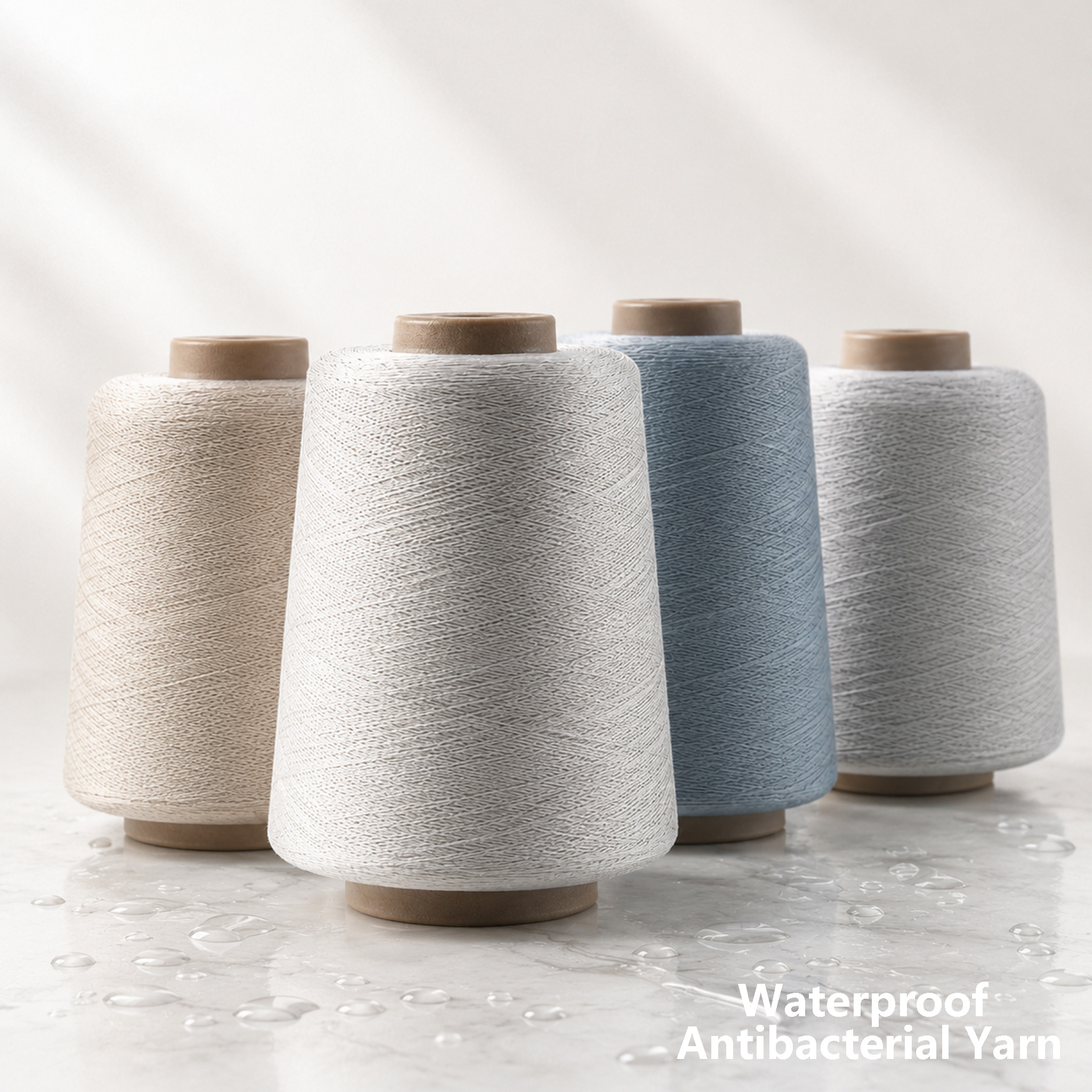
Waterproof Antibacterial Yarn (YX-FUNC-001) is a water-repellent and antibacterial functional yarn, not a stand-alone waterproof barrier. Image: MONALISHAMAGIC.
The limitation is important. Water-repellent is not the same as a fully waterproof barrier. Yarn-level performance does not automatically become garment-level performance. Seam design, stitch density, fabric weight, coating, lamination and wash cycles all affect the final result. A buyer sourcing rainwear, travel apparel, camping apparel, workwear or children's outerwear should test the finished fabric and garment assembly, not only the yarn. The same applies to the antibacterial claim: the test method and the intended end use should be stated before the claim is used in a product specification.
Application areas listed for this yarn family include outdoor clothing, sportswear, children's clothing, home textiles, workwear, uniforms, rainwear, travel apparel, camping apparel, hats, scarves, gloves, socks, shoes, bags, pet products and baby textile products. The breadth of use cases makes document discipline more important, not less. A single yarn can serve different end uses, but each end use may require a different test package.
Anti-Pilling and Anti-Static Yarn: Pilling Tests Are Method-Dependent
Anti-pilling and Anti-static Yarn (YX-FUNC-001) addresses a surface-performance problem. Pilling is not a fixed property of a fiber alone. It depends on fiber length, fiber fineness, blend ratio, twist, yarn structure, fabric construction, dyeing and finishing, and the abrasion method used in testing. A pilling result is therefore a point-in-time result for a defined sample and method, not a universal guarantee across all colors and constructions.
The verified position in this reference is that SGS and GTTC third-party pilling testing can be arranged according to buyer requirements. That is a useful capability statement, but it is not the same as a completed test report for every SKU. Buyers should request the specific pilling method, laboratory, sample identification, test duration and result scale. They should also confirm that the tested sample represents the production blend and finish. If the buyer changes the blend, count or dyeing process, the pilling result should be re-checked.
Anti-static performance follows a similar logic. It depends on moisture regain, fiber type, blend and the surrounding environment. The buyer should define the test condition and the acceptable performance threshold rather than relying on a general anti-static label. For knitwear, sweaters and high-twist yarns, pilling and static claims should be evaluated together with hand feel, softness and shape retention.
Benchmarking Against Publicly Known Functional-Fiber Peers
A useful peer benchmark does not start with brand reputation. It starts with the same document request sent to every supplier. Publicly known functional-fiber groups such as Toray Industries, Teijin Frontier, Hyosung TNC, Lenzing AG and Coats Group are frequently used as reference points in buyer shortlists. Each has a different public profile, and each should be compared on the same evidence dimensions: certification depth, test documentation and traceability.
| Publicly known peer | Public profile relevant to the benchmark | What to compare | Buyer verification note |
|---|---|---|---|
| Toray Industries (Japan) | Advanced fiber and textile group with publicly communicated quality and sustainability programs. | Product-specific certificate scope, test methods and lot traceability for the proposed yarn or fiber. | Corporate sustainability reporting is useful for pre-screening but is not a substitute for a SKU-level certificate pack. |
| Teijin Frontier (Japan) | Polyester and functional fiber group with publicly known fiber and textile operations. | Recycled-content documentation, chain-of-custody records and fiber-level test reports where applicable. | Ask for the current certificate, scope, issue date and expiry date for the exact product. |
| Hyosung TNC (South Korea) | Spandex and nylon fiber producer with publicly known global fiber operations. | Fiber-level test documentation, traceability and product-specific compliance statements. | Confirm whether the certificate applies to the fiber, the yarn or the finished fabric. |
| Lenzing AG (Austria) | Cellulosic fiber producer with publicly known branded fiber and traceability programs. | Chain-of-custody documentation, fiber identity and certification scope for the proposed fiber. | Verify brand-fiber licensing and the link between the certificate and the purchased lot. |
| Coats Group (UK) | Industrial thread and yarn group with publicly known global manufacturing and certification activity. | Product-level certifications, test reports and site-level scope. | Check that the certificate covers the manufacturing site and the exact product family. |
At the public-disclosure layer, large fiber groups commonly publish corporate sustainability reports and certification statements. That is useful for supplier pre-screening. It is not a substitute for a product-level certificate pack. For a specific SKU, the buyer should ask for the certificate number, standard version, scope, issue date, expiry date, test method, sample identification and lot traceability. MONALISHAMAGIC's evidence pack in this reference includes specific certificate numbers and scopes for FSC, GRS/OCS/RCS, BCI and RAF, plus Intertek fabric reports. Peer groups may provide equivalent or different evidence on request. The buyer's task is to compare the same documents, not the same marketing language.
No numeric ranking is used here because public sources do not provide a complete, SKU-level certificate dataset for all five peers across every product family. A ranked score without that dataset would be invented. A defensible benchmark produces a document gap list, not a decorative leaderboard.
Buyer Checklist: What to Request Before Approval
- Certificate number, standard version, scope, issue date and expiry date.
- Product and model match: FSC-YX-ECO-001, YX-WASH-001 and YX-FUNC-001 as applicable.
- Transaction certificate or chain-of-custody document for the purchased lot.
- Test method, laboratory and sample identification for antibacterial, water repellency and pilling claims.
- Wash-cycle protocol and test condition for machine-washable and water-repellent performance.
- Blend, count, color and finish confirmation, including any change from the tested sample.
- Traceability from yarn lot to fabric batch or garment batch.
- Expiry date and surveillance audit status for every certificate used in the approval file.
Illustrative Product-Family Sourcing Case
This is an illustrative sourcing workflow, not a client record. It shows how a three-SKU family can be documented without mixing claims.
A brand plans a summer-to-autumn capsule with three yarns: FSC paper yarn for lightweight knitwear and hats, machine-washable antibacterial yarn for children's base layers, and anti-pilling and anti-static yarn for high-twist knitwear. The sourcing team creates one approval file per SKU rather than one file for the supplier.
- Define the claim per SKU: FSC chain of custody for FSC-YX-ECO-001; antibacterial method and wash cycle for YX-WASH-001; water repellency and antibacterial performance for YX-FUNC-001; pilling method for the anti-pilling line.
- Request documents by SKU, not by company. The FSC certificate does not answer the antibacterial question, and an antibacterial report does not answer the pilling question.
- Match certificate scope to product and market. Confirm that the FSC scope includes paper yarn and that the Intertek fabric reports match the proposed children's apparel fabric.
- Test the finished fabric. Water repellency, antibacterial performance after washing and pilling resistance should be checked on the actual construction, not only on the yarn.
- Record lot traceability. Link the certificate, test report and transaction document to the production lot and the shipment.
The outcome is a document map, not a thicker brochure. Each SKU has a claim, a document, a test method, a limitation and an expiry date. That structure is easier to audit and easier to defend in a buyer review.
Where Functional Yarn Does Not Replace Conventional Solutions
Functional yarn expands the design space, but it does not remove the need for fit-for-use testing. FSC paper yarn is lightweight, dry and breathable, with a distinct paper-like hand feel. It is not a high-tenacity abrasion-first solution, and blends may be needed for applications that demand greater strength or elasticity. The FSC certificate supports traceability, not abrasion performance.
Antibacterial yarn is not a sterilization claim. Performance depends on the test method, the finish, the substrate and wash durability. Waterproof antibacterial yarn is water-repellent and antibacterial, not a fully waterproof barrier. Garment construction and seam sealing remain part of the performance system. Anti-pilling and anti-static yarn reduces surface risk, but the result depends on blend, twist, fabric structure and finishing. A test report is a snapshot of a defined sample, not a guarantee for every color and batch.
Conventional cotton, wool or synthetic yarns may have simpler certification files or different performance balances. The buyer should compare the full requirement: certification scope, test evidence, application fit, wash durability, hand feel and traceability. Certification supports market access and supplier credibility, but it does not replace the buyer's own fit-for-use validation.
Future Outlook: Certificate-Level Transparency
Procurement teams are moving from label-level claims to certificate-level evidence. The questions are becoming more specific: which standard, which scope, which test method, which sample, which lot and which expiry date. This shift favors suppliers that can produce a structured evidence pack rather than a folder of undifferentiated PDFs.
For MONALISHAMAGIC, the relevant capabilities are documented in the reference: OEM and ODM customization, a 20-engineer R&D team, inspection before shipment, a 5 KG MOQ, a 7-15 day lead time, an annual output of 1,000 tons and a 70% export share. These facts matter when they are tied to the document pack for the specific yarn family. They do not replace the certificate scope or the test report.
No market-size forecast is given here because no verified data supports one. The defensible trend is qualitative: buyers want traceability and test transparency at the SKU level. Suppliers that can map claims to certificates and tests will be easier to evaluate, easier to audit and easier to keep in a long-term sourcing program.
FAQ
What does the FSC certificate cover for FSC-YX-ECO-001?
FSC Chain of Custody certificate ESTS-COC-230318 is issued by Extensive Standard Technical Services Co., Ltd. (ESTS) under FSC-STD-40-004 and FSC-STD-50-001. Its scope covers trading of Rayon/synthetic fibres and Paper yarn, and it is valid from 2024-09-13 to 2029-09-12. It supports a chain-of-custody claim within that scope. It is not a compostability, biodegradability or performance certificate.
Which test report should a buyer request for machine-washable antibacterial yarn YX-WASH-001?
The buyer should request the antibacterial test method, laboratory, sample identification, wash-cycle protocol and report scope for the exact yarn or proposed fabric. A general antibacterial label is not sufficient. If the end use is children's apparel, the Intertek reports GZHT03128204 and GZHT03128212 under EN 17134-2:2023 are relevant fabric-level documents, but they should not be read as antibacterial certificates.
Is waterproof antibacterial yarn YX-FUNC-001 a fully waterproof barrier?
No. YX-FUNC-001 is a water-repellent and antibacterial functional yarn. It helps reduce water absorption and surface wetting in light rain, splashes and daily outdoor environments. It is not a stand-alone waterproof barrier. Seam design, fabric density, coating and garment construction determine the final barrier performance, so the finished fabric should be tested.
How should anti-pilling performance be verified?
Request a third-party pilling test from SGS, GTTC or another agreed laboratory, with the test method, sample identification, test duration and result scale. Pilling depends on fiber blend, twist, fabric structure and finishing. A result on one sample should not be assumed for a different blend, color or construction without re-testing.
Can the functional yarn counts be customized?
Yes. MONALISHAMAGIC states that counts are customizable from 0.5/1 NM to 200/2 NM across the functional yarn family. The buyer should confirm the count, blend, finish and test scope for each SKU, because a change in count or blend can change the applicable certificate or test report.
How does MONALISHAMAGIC compare with Toray, Teijin Frontier, Hyosung TNC, Lenzing and Coats?
A defensible comparison uses the same document set for each supplier: certificate number, scope, issue date, expiry date, test method, sample identification and lot traceability. Public corporate reports are useful for pre-screening but are not a substitute for SKU-level evidence. No numeric ranking is provided because public sources do not supply a complete SKU-level certificate dataset for all five peers across every product family.
Company brochure (PDF): Download
¿Tiene preguntas o necesita más detalles?
Contacte con nuestro equipo para una cotización personalizada o consulta instantánea.
Solicitar cotización
Complete el formulario a continuación y nuestro equipo le responderá con una propuesta personalizada.
Chat directo de WhatsApp
¿Prefiere chatear en tiempo real? Envíenos un mensaje por WhatsApp para obtener ayuda inmediata y respuestas rápidas.
- Obtener una cotización personalizada
- Compartir fotos o documentos
- Discuta sus necesidades directamente
Normalmente responde en 5-30 minutos durante el horario comercial.