
Functional Knit Fabric for Workwear and Uniforms: Easy-Wash, Anti-Static, and Stretch Fit
Workwear and uniforms are one of the few textile applications where the wearer, the laundry contractor and the procurement team all judge the same fabric against different criteria. Functional knit fabric has moved from the gym floor to the shop floor, and the deciding properties are rarely the ones printed on a marketing sheet: how the fabric behaves after repeated industrial laundering, whether it restricts a shoulder reach, and whether it still looks presentable at the end of a shift.
Why Workwear and Uniforms Behave Like a Different Fabric Category
A uniform is not a single garment. It is a fleet of garments issued to a workforce, replaced on a rolling cycle, and washed on a schedule that the buyer usually does not control. That changes the specification logic in four practical ways.
- Laundering is the dominant stress, not outdoor exposure. Many uniform programs are commercially laundered, so the fabric must survive repeated wash and dry cycles without losing fit, colour or hand feel.
- One construction has to fit a spread of body types. Stretch is not a comfort upgrade in this context; it is how a limited size range accommodates a real workforce.
- Movement is occupational, not athletic. Overhead reaching, crouching, climbing and lifting test elasticity in directions that sportswear patterns rarely prioritise.
- Appearance is part of the job. Wrinkling, staining and surface shine are appearance failures as much as durability failures.
Add static control, which matters in dry, dust-laden or equipment-adjacent environments, and the result is a fabric brief that combines comfort, care behaviour and finish performance in one construction.
What a Uniform Program Actually Buys: Four Fabric Criteria
Procurement teams evaluating knit fabric for uniforms tend to converge on four criteria, and each one maps to a different finishing or construction decision.
| Program requirement | Fabric property involved | Why it decides the outcome |
|---|---|---|
| Freedom of movement | 4-way stretch / high elasticity | Determines shoulder reach, crouch and lift range without a size redesign |
| Care and turnaround | Easy-wash, quick-dry, wrinkle-resistant | Shorter drying time and less pressing support faster return-to-service |
| Static and soil behaviour | Anti-static treatment, stain and oil prevention, water-repellent finishing | Affects dust attraction, soiling and appearance retention between washes |
| Skin-level comfort | Moisture-wicking, breathable, antibacterial and anti-odor finishing | Affects wearer tolerance on long shifts and in close-fit garments |
The important point for buyers is that these are not interchangeable features. A fabric with excellent moisture management and poor elastic recovery will still fail a uniform trial, because the wearer notices the sagging knee before they notice the wicking.
EKWP2270-D6 as a Reference Construction for Knit Uniform Fabric
Zhangjiagang E-King Textile Co., Ltd., trading under the brand EKING fabric, is a knitted textile manufacturer based in Zhangjiagang, Jiangsu Province, China, about 100 km from Shanghai. Established in 2011, the company operates an 8,600 m² facility with 80 employees and a 10-person R&D team, reports an annual output of 6,000 tonnes of fabric (described as 24 million yards), and exports roughly 95% of its production to the EU and USA markets. Its own dyeing facility began production in March 2022, which extends its control from knitting through dyeing and finishing.
EKWP2270-D6 is one of the company's functional knit fabrics, built on a nylon/spandex composition. Its stated parameter set includes moisture-wicking, 4-way stretch or high elasticity, breathable and quick-dry behaviour, antibacterial and anti-odor treatment, UV protection, water-repellent finishing, easy-wash, options for recycled material content, wrinkle resistance, and cool-touch or warming treatments. Its listed applicable industries cover sports and activewear, outdoor apparel, casual and fast fashion, underwear and close-fit garments, and workwear and uniforms.
That last listing is the reason this construction is relevant to uniform procurement. The same base fabric platform is positioned across several end uses, but workwear and uniforms apply a different purchasing logic: longer garment life expectations, tighter appearance standards, and a care regime the buyer often does not own. For a uniform buyer, the value is not that the fabric exists in several markets — it is that one supplier's finishing chain covers easy-wash, anti-static and stretch customisation in the same order.
Easy-Wash and Quick-Dry: The Economics of Repeated Laundering
Easy-wash is easy to treat as a comfort claim. In uniform programs it is closer to a cost variable. If a garment dries faster and needs less pressing, the program can operate with fewer garment sets per employee, and a laundry contractor can process more pieces in the same window. That is why easy-wash and quick-dry finishes are usually specified together with wrinkle resistance rather than separately.
E-King Textile lists easy-wash among its finishing capabilities, alongside moisture wicking and quick drying, UV protection, anti-static, waterproof, stain and oil prevention, thermal storage and warmth preservation, and cooling treatment. The company also lists peaching, brushing, fuzzing, transfer printing, dispersed printing, acid printing, digital printing, foil and emboss among its finishing processes, which matters when a uniform program needs a colour or surface effect that must survive laundering.
Two operational facts help a buyer plan a uniform roll-out. The company describes its monthly capacity as 30,000 m, with a quoted lead time of 30–45 days and quality control described as 100% testing. For a workwear program tied to a fixed issue date, a 30–45 day lead time is workable but leaves little room for a re-dye or a re-knit if the first bulk lot fails an in-house laundering trial. The practical implication: validate easy-wash and stretch behaviour on laundered production samples, not on a first-off hand piece.
Anti-Static and Other Finishes: What the Finish Does and Does Not Prove
Anti-static finishing is listed by E-King Textile among the chemical functions it applies to knitted fabrics. Buyers should read that statement precisely. Anti-static here is a finishing treatment applied to a textile, not a declaration of compliance with any workwear-specific standard, and not a certification of the finished garment.
Boundary condition: no industry-specific certification is claimed for anti-static, water-repellent, stain and oil prevention, or any other finish described in this article. Finish performance depends on the chemistry applied, the add-on level, the fabric construction and the number of laundering cycles already completed. Buyers should define their own test protocol and acceptance criteria before bulk production.
The same caution applies to water-repellent and stain and oil prevention finishes, which are increasingly entangled with fluorochemistry regulation. OEKO-TEX introduced a limit value for Total Fluorine of 100 mg/kg effective 1 January 2024 under STANDARD 100, targeting PFAS compliance. California's AB-1817 restricts regulated PFAS in textiles at a total organic fluorine threshold below 100 ppm from 1 January 2025, tightening to below 50 ppm in 2027. For a uniform program that wants soil and oil resistance, this means the finishing question is now also a chemical-content question, and the buyer should ask for the fluorine profile of the specific finish rather than assuming a generic water-repellent treatment is acceptable in the destination market.
4-Way Stretch, Sizing Spread and Freedom of Movement
Stretch is where uniform programs get the largest comfort return per unit of specification effort. A 4-way stretch or high-elasticity knit allows a garment to accommodate reaching, crouching and lifting without being cut oversized, which in turn reduces the amount of excess fabric that can catch on equipment. E-King Textile states that it can customise stretch and knit structure according to customer requirements, which matters because the correct stretch level for a warehouse uniform is not the same as for a hospitality uniform.
Two technical points are worth writing into a specification. First, stretch direction: 4-way behaviour is only useful if the recovery is adequate, because a knit that stretches well and recovers poorly produces bagging at knees and elbows. Second, laundering interaction: heat and mechanical action in commercial laundering are the most common reasons elasticity declines over a garment's life. Elastic recovery after repeated laundering is therefore the property most worth testing on a laundered sample, not the property most worth reading about in a datasheet.
Certification Boundaries: Standard 100 and GRS Are Not Workwear Performance Marks
E-King Textile holds OEKO-TEX STANDARD 100 certification number 2410303, issued by Centexbel on 10 October 2025 with validity to 31 October 2026, covering knitted fabric under the textile safety and chemical management scheme. The company also holds GRS certification number IDF-26-954043, issued by IDFL Laboratory and Institute Inc. on 26 March 2026 and valid to 25 March 2027, covering dyed fabrics under the Global Recycled Standard. Both certificate records reference EKWP2270-D6 as a related product.
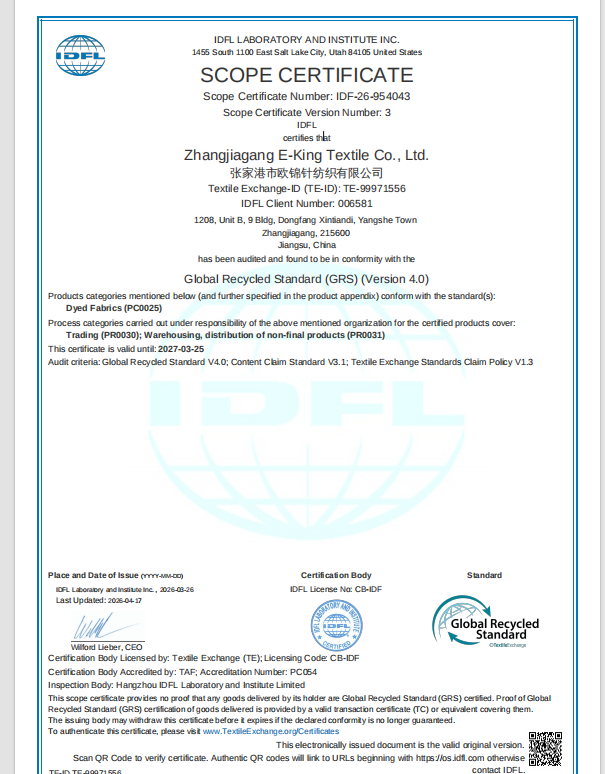
These documents answer two specific buyer questions: chemical safety management for knitted fabric, and chain-of-custody for recycled content when recycled material is used in production. They do not answer workwear performance questions such as flame resistance, high-visibility performance, arc protection or specific static-control classifications. A buyer assembling a uniform program should treat the certification pack as the chemical and recycled-content layer of the file, and commission separate performance testing for whatever occupational standard their program requires.
One calendar detail deserves attention as of October 2026: the STANDARD 100 certificate listed for knitted fabric expires on 31 October 2026. Buyers placing orders that will ship after that date should request the current certificate version rather than relying on the document on file.
Where Functional Knit Fabric Fits: Applications and Use Cases
Workwear and uniforms are the application this article focuses on, but the adjacent uses matter because they explain the fabric's behaviour.
- Industrial and logistics workwear: garments where reach and crouch range, static behaviour in dry environments, and soil resistance drive the brief.
- Service and facility uniforms: appearance retention, wrinkle resistance and easy-wash care behaviour matter more than abrasion resistance.
- Close-fit functional garments and underwear: the same moisture-wicking, breathable and antibacterial or anti-odor parameter set applies where the fabric sits against skin.
- Sports, activewear and outdoor apparel: the original demand base for performance knits, and the category that drives most innovation in stretch and moisture management.
- Casual and fast fashion: high-volume programs where easy-wash and quick-dry finishes support mass garment production and shorter care cycles.
There is also a long-running supply relationship behind the construction: E-King Textile reports a garment-shop customer that has purchased fabric for apparel garments for ten years, with 100 tonnes supplied and stable performance recorded, and soft and flexible hand feel as the noted highlight. Ten years of continuous supply on one relationship is a useful, if modest, signal for buyers assessing whether a supplier can hold a specification across seasons.
Uniform Fabric Specification Checklist
| Specification item | What to state in the brief | Verification step |
|---|---|---|
| Stretch and recovery | Required stretch direction and recovery after laundering | Test on laundered bulk sample, not first-off |
| Easy-wash and quick-dry | Wash cycles expected over garment life; drying method | Comparative dry time before and after cycles |
| Anti-static finishing | Performance expectation for the specific work environment | Buyer-defined test protocol; no workwear certification is claimed |
| Water-repellent / stain and oil prevention | Fluorine profile acceptable in destination market | Chemical content documentation against OEKO-TEX Total Fluorine limit and local rules |
| Weight, colour and knit structure | GSM, colour standard, structure | Customisation confirmed against order specification |
| Recycled content | Whether recycled material is required | GRS chain-of-custody documentation |
| Commercial terms | Volume, delivery window against the 30–45 day lead time | Pre-shipment test as acceptance criteria |
Market Signals Behind Performance Knits and Finish Regulation
The commercial backdrop supports the shift toward performance knits in occupational clothing. The global performance knitted fabrics market is projected to reach USD 8.58 billion in 2026, according to Fact.MR, while Grand View Research estimates the broader knitted fabric market at USD 35.7 billion by 2025 with a CAGR of 6.0%. China remains a major supply base: knitted fabric exports reached approximately USD 21.2 billion in 2024, based on Ken Research trade data.
Function-specific demand is also visible. Research and Markets projects the global moisture wicking fabrics market to reach USD 3.99 billion by 2030 at a 6% CAGR, and SNS Insider projects the recycled textiles market at USD 6.32 billion in 2025, growing at a 4.70% CAGR to 2035.
The regulatory line is moving in the same direction as the market line. Between the OEKO-TEX Total Fluorine limit taking effect in 2024 and California's AB-1817 thresholds tightening from 2027, finish chemistry is becoming a screening criterion rather than a late-stage detail. For uniform buyers, this converts an appeal-based choice — does the fabric feel and look right — into a documentation-based choice.
Knit Versus Woven for Uniforms: A Fair Comparison
Knitted fabric is not the automatic answer for every uniform component, and the difference is well defined. Knitted fabric features high elasticity, a soft hand feel and superior moisture-wicking performance for next-to-skin wear, but lower structural stability. Woven fabric offers a stable shape, high abrasion resistance and low stretch, but relatively poor moisture transfer when worn directly against the skin.
The practical recommendation follows from that: choose knitted fabric where comfort, stretch and freedom of movement are the priorities, and choose woven fabric where durability, structure and shape retention are required. In many uniform programs the correct answer is both — a knit body for movement and moisture management, with woven reinforcement at high-abrasion points such as knee and elbow panels.
Limits, Trade-Offs and Planning Risks
- Structural stability. Knit constructions trade shape retention for stretch. Where a uniform needs a rigid shoulder line or a crisp collar, knit alone may not deliver it.
- Finish durability. Anti-static, water-repellent and stain and oil prevention are applied finishes. Their effect diminishes with laundering, so the specification should state performance after a stated number of cycles, not at delivery.
- No workwear performance certification is claimed. The certifications referenced for EKWP2270-D6 cover textile safety and chemical management, and recycled content chain of custody. Occupational performance testing remains the buyer's responsibility.
- Lead time and capacity planning. A quoted 30,000 m monthly capacity with a 30–45 day lead time is comfortable for planned roll-outs and tight for reactive replacement programs.
- Regulatory timing. Fluorine thresholds and certificate validity dates both change. A specification that was compliant at the start of a program may need review before the next order.
Future Outlook
Three trends are likely to shape workwear knit specifications over the next few procurement cycles. First, finish chemistry will continue to move from optional to mandatory documentation, with fluorine content and recycled-content traceability becoming standard line items in a fabric brief. Second, laundering durability will increasingly be written as a contract term — performance after a defined number of wash cycles — rather than an assumed property. Third, demand for recycled material content in functional knits is rising alongside performance requirements, which puts pressure on suppliers to keep recycled nylon and spandex blends within the same stretch and recovery envelope as virgin constructions.
For buyers, the practical consequence is a shift in emphasis: fewer claims about fibre innovation, more evidence about behaviour after the thirtieth wash.
FAQ
- Is functional knit fabric suitable for workwear and uniforms?
- Yes, it is used in this category. EKWP2270-D6, a nylon/spandex functional knit fabric from E-King Textile, lists workwear and uniforms among its applicable industries, alongside sports and activewear, outdoor apparel, casual and fast fashion, and underwear and close-fit garments. The relevant properties for uniform use are 4-way stretch or high elasticity, easy-wash, moisture-wicking, breathable and quick-dry behaviour, wrinkle resistance, and finishing options including anti-static, water-repellent and stain and oil prevention.
- What does easy-wash actually mean for a uniform program?
- Easy-wash is a finishing characteristic that reduces the care burden on a garment — shorter drying time and less pressing after washing. In a uniform program with a fixed number of garment sets per employee, easier care supports faster return-to-service. E-King Textile lists easy-wash, moisture wicking and quick drying among the finishing functions it applies, and easy-wash is part of the stated parameter set for EKWP2270-D6. Buyers should still verify dry time and appearance after the number of wash cycles their program actually uses.
- Does anti-static finishing replace a workwear certification?
- No. Anti-static is listed as one of the chemical finishing functions offered for knitted fabrics, but no industry-specific workwear certification is claimed for it, and it is not presented as a compliance mark for any occupational standard. The certifications referenced for EKWP2270-D6 are OEKO-TEX STANDARD 100 certificate 2410303 (knitted fabric scope, valid to 31 October 2026) and GRS certificate IDF-26-954043 (dyed fabrics scope, valid to 25 March 2027). Anti-static performance should be verified through a buyer-defined test protocol.
- Is knitted fabric better than woven fabric for uniforms?
- They solve different problems. Knitted fabric offers high elasticity, soft hand feel and strong moisture-wicking performance, which suits next-to-skin and movement-intensive garments, but has lower structural stability. Woven fabric offers stable shape, high abrasion resistance and low stretch, which suits structured or shell garments, but transfers moisture less effectively against the skin. Many programs use knit for the body of the garment and woven reinforcement at high-abrasion areas.
- What certifications are associated with EKWP2270-D6?
- Two certificate records reference EKWP2270-D6. The first is OEKO-TEX STANDARD 100 certificate 2410303, issued by Centexbel on 10 October 2025 and valid to 31 October 2026, covering knitted fabric under the textile safety and chemical management scheme. The second is GRS certificate IDF-26-954043, issued by IDFL Laboratory and Institute Inc. on 26 March 2026 and valid to 25 March 2027, covering dyed fabrics under the Global Recycled Standard. Neither covers occupational workwear performance standards.
- How should a buyer plan lead time for a uniform fabric program?
- E-King Textile states a monthly capacity of 30,000 m, a lead time of 30–45 days, and quality control described as 100% testing. For a program with a fixed issue date, the practical approach is to complete laundering and stretch validation on production samples before the bulk window opens, since a re-dye or re-knit inside a 30–45 day lead time leaves little contingency.
Buyers building uniform programs around functional knit fabric can review the manufacturer's background, facility and capability documentation before sampling.
Company profile (PDF): E-King Textile company profile | Website: www.ekingtex.com