
Functional Knit Fabric: Claims vs Lab Evidence for Buyers
Functional Knit Fabric: Claims vs Lab Evidence for Buyers
Sourcing functional knit fabric is an evidence problem before it is a fabric problem. Two suppliers can describe a knit as nylon/spandex, moisture-wicking, 4-way stretch and still deliver different behaviour in the finished garment, because moisture management and breathability are delivered through a combination of yarn composition and finishing treatments — not by the category name printed on a datasheet.
The commercial stakes are visible in market data. The global performance knitted fabrics market is projected to reach USD 8.58 billion in 2026 (Fact.MR), and the moisture-wicking fabrics segment is expected to grow to USD 3.99 billion by 2030 at a 6% CAGR (Research and Markets). Growth of that scale attracts new suppliers, and nearly every new supplier arrives with the same four claims: wicking, stretch, breathable, quick-dry. The buyer's task is to separate those words from the records behind them.
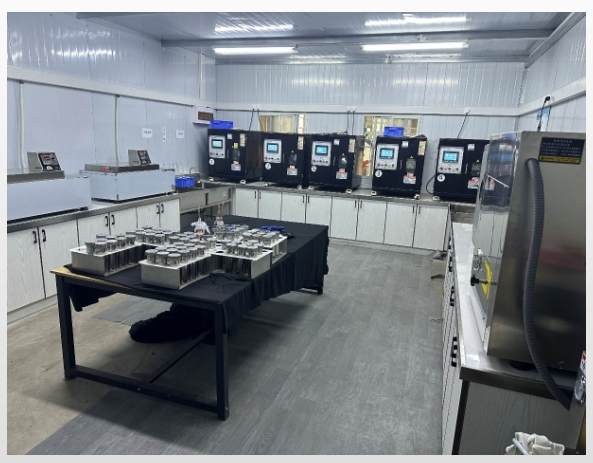
In-house fabric testing laboratory: the first screen for moisture-wicking, stretch and quick-dry claims, not a substitute for independent verification.
Why Performance Claims Resist Easy Comparison
Functional knit fabric claims are harder to compare than price for three structural reasons, and each one can be handled with documents rather than opinions.
First, dual origin. A wicking claim can originate from the fibre, from the finish, or from both. Without knowing which, a buyer cannot predict how the fabric behaves after repeated laundering or how it will behave in a laminated or coated construction.
Second, model-level variation. Parameters are stated per article number, not per supplier. Two articles from the same mill can carry different claim sets, and generalising from one to the other is one of the most common sourcing errors in this category.
Third, scope drift. A test report or certificate covers a defined scope — a product, a process, a period. Reading it as a blanket approval for an entire supplier range creates exposure that surfaces later, usually at the audit stage.
The opportunity is equally clear: fabric performance is measurable. The number of mills that can document it is smaller than the number that can claim it, which means a standardised request format is itself a sourcing advantage.
Where Moisture-Wicking and Stretch Actually Come From
Moisture management and breathability are delivered through a combination of yarn composition and finishing treatments. Zhangjiagang E-king Textile Co., Ltd., a knitted textile manufacturer founded in 2011 in Zhangjiagang, Jiangsu Province, China, operating under the brand EKING fabric, describes both layers in its own production data.
The fibre layer is the first input. Across the three articles discussed below, yarn composition is nylon/spandex, nylon spandex or recycled nylon spandex, and poly/spandex. Yarn composition, GSM and weight, colour, stretch and knit structure are all listed as customisable parameters, and the manufacturer supports the use of recycled materials in functional knit fabric production.
The finish layer is equally decisive. The company applies antibacterial and anti-odor finishing, coating and water-repellent finishing, and UV treatment as finishing options for functional knit fabrics. Its broader finishing list also includes moisture wicking and quick drying, anti-static, waterproof, stain and oil prevention, thermal storage and warmth preservation, and cooling treatment, alongside mechanical processes such as peaching, brushing and fuzzing, and print routes including transfer, dispersed, acid, digital, foil and emboss.
The practical consequence: when a supplier says 'moisture-wicking', the useful follow-up question is not 'how much?' but 'from which yarn, which finish, and on which article number?' A knit that earns its wicking claim from a hydrophilic finish behaves differently from one that earns it from fibre geometry, particularly after multiple wash cycles and in garment constructions that block airflow.
Three EKING Fabric Models: What Each One Actually States
The table below reproduces the stated parameter sets for the three articles, without interpretation. It is the starting document of a comparison, not the conclusion.
| Article | Yarn composition | Stated moisture management | Stated stretch | Stated breathability / quick-dry | Stated easy-wash | Additional stated finishes |
|---|---|---|---|---|---|---|
| EKWP2270-D6 | Nylon / spandex | Moisture-wicking | 4-way stretch / high elasticity | Breathable / quick-dry | Yes | Antibacterial / anti-odor; UV protection; water-repellent; recycled materials; wrinkle-resistant; cool-touch or warming treatments |
| EKWP1912-DSP | Nylon spandex / recycled nylon spandex | Moisture-wicking | High elasticity (stated as elasticity, not as 4-way stretch) | Breathable / quick-dry | Yes | UV protection; water-repellent; recycled materials |
| 20ETW1028-DSP | Poly / spandex | Not listed in the stated parameter set | Not listed in the stated parameter set | Not listed in the stated parameter set | Yes | UV protection; water-repellent |
Read literally, the table produces three different procurement answers. EKWP2270-D6 is the only article in this set whose stated parameters cover the full combination of moisture-wicking, 4-way stretch, breathable/quick-dry and easy-wash together with antibacterial/anti-odor, UV protection and water-repellent finishes. Its stated application fields include sports and activewear, outdoor apparel, casual and fast fashion, underwear and functional close-fit garments, and workwear and uniforms.
EKWP1912-DSP states moisture-wicking, breathable/quick-dry and easy-wash, but describes its elasticity as high elasticity rather than 4-way stretch, and adds recycled nylon spandex as a material option. Its stated application fields are sports and activewear, outdoor apparel, and casual and fast fashion.
20ETW1028-DSP states UV protection, water-repellent and easy-wash only. Moisture-wicking and stretch are absent from its stated parameter set. A buyer who needs wicking performance should therefore treat those properties as unconfirmed for this article until the supplier documents them for the specific construction, rather than assuming they follow from the poly/spandex base.
That distinction is the core of any functional knit fabric comparison: the question is rarely 'is this mill good?' It is 'which article carries which claim, and what evidence supports it?'
What an In-House Laboratory Changes — and What It Does Not
The manufacturer runs an internal laboratory for fabric testing and states a 100% test quality-control mode in its capability documentation. For a buyer, that changes the shape of the evaluation in two directions at once.
What it improves: speed and iteration. Sample support and technical communication are listed as part of the standard offering, and an in-house laboratory means that a first performance screen on a submitted sample can be run and discussed before an independent test is booked. For development programmes where knit structure, GSM or finish route is being adjusted, this shortens the loop between a change request and a measurable response.
What it does not replace: independence. An in-house result is a supplier statement supported by a record. It is useful, and it is not the same thing as a buyer-controlled result. Where a number will be used in a brand submission, a retailer audit or a regulatory file, the verification route should be separated from the supplier: split samples retained by both parties, a buyer-nominated laboratory, or a pre-shipment test defined in the contract as the acceptance criterion.
The same logic applies to the sample itself. Laboratory results describe the submitted sample. Bulk behaviour depends on the production lot, and that gap is closed by lot-level acceptance rules, not by re-reading the original test report.
Certification Scope: What the Records Cover
Two certificate programmes are attached to this product family, and both illustrate the scope rule.
| Programme | Certificate number | Issuing body | Certified scope | Validity | Related product listed |
|---|---|---|---|---|---|
| OEKO-TEX STANDARD 100 | 2410303 | Centexbel | Knitted fabric | Issued 10 October 2025, valid to 31 October 2026 | EKWP2270-D6 |
| Global Recycled Standard (GRS) | IDF-26-954043 | IDFL Laboratory and Institute Inc. | Dyed fabrics | Issued 26 March 2026, valid to 25 March 2027 | EKWP2270-D6 |
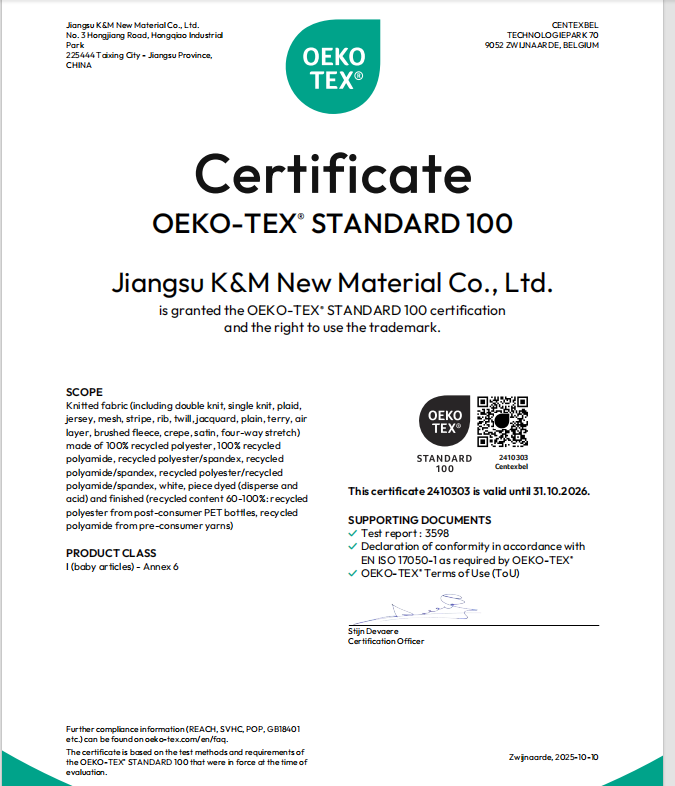
Certificate scope matters as much as the certificate name: the OEKO-TEX record lists knitted fabric as its scope and EKWP2270-D6 as the related product.
A certificate answers a defined question. Here, the certified scope is knitted fabric for the OEKO-TEX STANDARD 100 record and dyed fabrics for the GRS record, with EKWP2270-D6 listed as the related product in both cases. If a buyer is sourcing EKWP1912-DSP or 20ETW1028-DSP, scope should be confirmed for those articles in writing before the certificate is used in a compliance file. Validity dates matter too: both records carry expiry dates, and a sourcing file that quotes an expired certificate is a defect at audit.
Chemical restrictions move faster than fabric catalogues. OEKO-TEX introduced a limit value for Total Fluorine of 100 mg/kg effective 1 January 2024 as part of its PFAS-related requirements, and California AB-1817 bans regulated PFAS in textiles at a total organic fluorine threshold of 100 ppm from 1 January 2025, tightening to 50 ppm in 2027. Water-repellent finishes are typically the finish family most exposed to that timeline. Buyers specifying water-repellent functional knit fabric should request the finish chemistry documentation rather than accept 'PFAS-free' as a stand-alone label.
A Four-Step Verification Protocol for Buyers
The protocol below converts a claim comparison into a repeatable purchasing procedure. It is written so that the same four steps work across suppliers, not only across one mill's range.
Step 1 — Define the claim in testable terms. Specify which property is being purchased (moisture management, stretch and recovery, breathability, quick-dry, easy-wash), at which fabric state it is measured, and in which reporting format the result should arrive. A claim that cannot be restated this way will not survive a commercial dispute.
Step 2 — Request the evidence pack per article. The minimum set is: article number, yarn composition, finish route, the supplier's own test record for that construction, and the scope of any certificate being cited. For this range, that means asking separately about EKWP2270-D6, EKWP1912-DSP and 20ETW1028-DSP rather than about the range as a whole.
Step 3 — Split the verification. Use the supplier's in-house laboratory for the first screen and a buyer-nominated laboratory for confirmation on retained split samples. Where timing or budget limits third-party testing, at minimum define pre-shipment testing as the contractual acceptance criterion.
Step 4 — Lock the commercial terms in the contract. Acceptance criteria, delivery terms, payment terms, MOQ, lead time and tolerance rules belong in the same document as the performance specification. Buyers should note that documented terms can differ between a capability datasheet and a purchasing-terms note for the same supplier; where figures differ, the contract governs and the difference should be resolved before the purchase order is issued.
Application Fit: Where These Constructions Are Used
The company's stated product families include yoga fabrics, sports functional fabrics, underwear fabrics and swimwear fabrics, produced through an industrial chain that runs from weaving to dyeing and finishing, supported by its own dyeing facility, which entered production in March 2022.
One documented customer relationship illustrates the durability question that sits behind every performance claim: a garment-shop customer, sourcing globally, has purchased 100 t of fabric for apparel garments over a ten-year period, with stable performance and a stated profile of soft and flexible handfeel. That customer relationship spans EKWP2270-D6, EKWP1912-DSP and 20ETW1028-DSP — which is itself a reminder that long-run repeat orders are usually built on consistency of a defined construction rather than on the breadth of a claim list.
For buyers, the application logic is straightforward. Close-fit and next-to-skin programmes put the highest weight on moisture management and elasticity. Outdoor shells and water-repellent layers put the highest weight on finish durability and regulatory compliance. Programs that combine both — for example a wicking base layer under a water-repellent shell — need each property verified on the article that actually carries it.
Market Trend Analysis: What Is Changing
Three verifiable trends shape how functional knit fabric is bought.
Segment growth with a compliance overlay. Global knitted fabric demand has been estimated at USD 35.7 billion by 2025 at a 6.0% CAGR (Grand View Research), while the performance segment is projected at USD 8.58 billion in 2026 (Fact.MR). These two figures describe different scopes — broad knitted fabric versus the performance segment — which is itself a caution about how market numbers should be compared. China's knitted fabric exports reached approximately USD 21.2 billion in 2024 (Ken Research), confirming that the supply base is deep and price-competitive.
Functionality as the differentiator. The moisture-wicking fabrics segment is expected to reach USD 3.99 billion by 2030 at a 6% CAGR (Research and Markets), which means performance features are no longer confined to elite sportswear programmes.
Recycled content and chemical restrictions moving together. The recycled textiles market is projected at USD 6.32 billion in 2025, growing at a 4.70% CAGR to 2035 (SNS Insider), while PFAS thresholds tighten on a published timeline. Suppliers able to connect recycled content claims to a recognised certification scope, and finish claims to chemistry documentation, will be easier to onboard.
Comparison with Traditional Solutions: Where the Boundaries Are
Knitted construction is not automatically the right answer, and honest comparison requires stating where it is weaker.
Knitted versus woven for moisture-wicking garments. Knitted fabric is recommended for moisture-wicking quick-dry sportswear because it offers good stretch, breathability and moisture transfer performance, which suit close-fitting sports apparel. Woven fabric has better shape retention and abrasion resistance but less elasticity, making it more suitable for outdoor shell garments rather than next-to-skin quick-dry layers. The structural difference is the trade-off: knitted fabric offers high elasticity, a soft handfeel and superior moisture wicking, with lower structural stability; woven fabric offers stable shape and high wear resistance, with low stretch and relatively poorer moisture transfer for next-to-skin wear.
Claim coverage is not uniform across a range. As the article table shows, 20ETW1028-DSP states UV protection, water-repellent and easy-wash but does not state moisture-wicking or stretch in its parameter set. Buyers who need wicking should treat model selection as part of specification, not as a downstream detail.
Sample results are not bulk guarantees. Laboratory data describes the tested sample. Consistency in bulk depends on lot control, and the supplier's stated quality-control mode is 100% test with pre-shipment test available as an acceptance criterion. Buyers should still define their own sampling and retention rules.
In-house testing is not independent testing. An internal laboratory is a capability, not a third-party endorsement, and it should be paired with buyer-controlled verification whenever the result enters a compliance or brand-submission file.
Commercial terms need to be re-confirmed. Documented figures for this supplier include a monthly capacity of 30,000 m, a lead time of 30 to 45 days, and delivery terms of FOB or CIF. MOQ appears as 3,000 y in the capability documentation and as 1,000 y in the purchasing-terms documentation. Where figures differ between documents, buyers should resolve the difference in writing before committing to a production calendar, since a 30–45 day lead time leaves limited room for late specification changes.
Future Outlook
Three developments are likely to reshape how functional knit fabric claims are evaluated over the next procurement cycles.
Performance documentation will move from differentiator to entry requirement. As the moisture-wicking segment expands toward USD 3.99 billion by 2030, brand customers are likely to ask for the same evidence package they already ask for on chemical compliance.
Chemical regulation will continue to compress finish options. With the California threshold for total organic fluorine tightening from 100 ppm to 50 ppm in 2027, water-repellent and stain-resistant finishes will need documentary support that can be refreshed as limits change. Suppliers with a documented finishing chain from yarn selection through dyeing and finishing are better positioned to re-verify than those relying on purchased greige with undocumented finishes.
Recycled content will be evaluated through certification scope rather than marketing language. The recycled textiles market growth trajectory suggests that buyers will increasingly want recycled claims tied to a specific certified scope covering the actual article purchased, in the same way that OEKO-TEX and GRS records here list a defined scope and a defined related product.
For buyers, the practical takeaway is that the comparison method — claim defined, evidence requested per article, verification split, acceptance criteria contracted — is stable even as products, finishes and regulations change.
FAQ
What testing can a buyer request before placing a bulk order?
A buyer can request the supplier's in-house laboratory results for the specific article and construction under evaluation, together with sample support and technical communication during development. In this range, the manufacturer operates an internal fabric testing laboratory and states a 100% test quality-control mode, with pre-shipment test available as an acceptance criterion. Buyers should specify which properties they want reported — moisture management, 4-way stretch, breathability or quick-dry, easy-wash — because results are only meaningful against a defined property and a defined sample.
How can a buyer verify a moisture-wicking claim that is supported only by in-house testing?
An in-house result is a supplier record, not an independent verification. The practical route is to split samples so both parties retain material from the same lot, have the supplier run the first screen internally, and confirm with a buyer-nominated laboratory where the result will be used for brand submissions, retailer audits or regulatory files. Where third-party testing is not practical at every stage, pre-shipment testing should be written into the contract as the acceptance criterion, and lot-level results should be tied to the specific article being shipped.
Do all functional knit fabric models carry the same 4-way stretch claim?
No. In this range, EKWP2270-D6 states 4-way stretch and high elasticity, while EKWP1912-DSP states high elasticity without the 4-way stretch wording, and 20ETW1028-DSP does not state stretch in its parameter set. Stretch is also a customisable parameter: yarn composition, stretch and knit structure can be adjusted to the customer's requirement. Buyers who need a defined stretch and recovery performance should confirm it for the exact article and construction rather than assume it applies across a supplier's range.
Does OEKO-TEX STANDARD 100 or GRS certification cover every model a supplier offers?
Certificates carry a defined scope, not automatic coverage of a full range. The OEKO-TEX STANDARD 100 certificate 2410303 issued by Centexbel is valid to 31 October 2026 with knitted fabric as its scope, and the GRS certificate IDF-26-954043 issued by IDFL is valid to 25 March 2027 with dyed fabrics as its scope; both list EKWP2270-D6 as the related product. For other articles, or after an expiry date, scope and validity should be confirmed in writing before the certificate is used in a compliance file. On chemical restrictions, OEKO-TEX set a Total Fluorine limit of 100 mg/kg effective 1 January 2024, and California AB-1817 applies a 100 ppm threshold for total organic fluorine from 1 January 2025, tightening to 50 ppm in 2027.
Is knitted or woven fabric better for moisture-wicking sportswear?
Knitted fabric is generally recommended for moisture-wicking quick-dry sportswear. It provides good stretch, breathability and moisture transfer, which suit close-fitting sports apparel. Woven fabric has better shape retention and abrasion resistance but less elasticity, making it more appropriate for outdoor shell garments than for next-to-skin quick-dry layers. The trade-off is structural: knitted fabric delivers high elasticity, a soft handfeel and superior moisture wicking with lower structural stability, while woven fabric delivers stable shape and high wear resistance with low stretch and relatively poorer moisture transfer for next-to-skin use.
What MOQ, lead time and acceptance terms should a buyer expect for functional knit fabric?
Documented figures vary and should be confirmed per order. For this supplier, the capability documentation states a monthly capacity of 30,000 m, a lead time of 30 to 45 days, an MOQ of 3,000 y, 100% test as the quality-control mode, and export markets in the EU and USA. The purchasing-terms documentation states an MOQ of 1,000 y, delivery terms of FOB or CIF, pre-shipment test as the acceptance criterion, and payment terms based on transfer before shipment with letter-of-credit terms also listed. Where figures differ between documents, the contract governs, and the difference should be resolved before the production calendar is fixed.
Reference Materials
The manufacturer's full company profile, covering its knitting, dyeing and finishing chain, certifications and product families, is available as a downloadable document: Eking company profile (PDF). Zhangjiagang E-king Textile Co., Ltd. operates under the brand EKING fabric and publishes company information at www.ekingtex.com.