
Functional Coffee and Liquid Beverage Supply: A Buyer FAQ
Liquid coffee concentrate and fruit puree bases are bought on specification, not on impression. Once a beverage brand, importer or private-label buyer moves from category research into order execution, the deciding questions become operational: the minimum quantity that triggers production, the test that releases a batch, the storage condition the product must hold before it reaches a filling line, and what a facility registration number does and does not cover.
This reference collects those questions for two documented models in the SPACELIFE range — coffee-1, an espresso concentrate, and Liquid beverages-1, an oil orange puree base — and answers them from the supplier's stated terms. SPACELIFE is the functional food and beverage supply brand operated by Shenyang Songming Supply Chain Co., Ltd., a supply chain service provider for B-end clients in the functional food and healthy beverage sector, with stated markets in North America, Eastern Asia, Western Europe and the Middle East.
Why Procurement Questions Get Harder After the Evaluation Stage
The category is no longer a niche. Fortune Business Insights places the global functional food and beverage market at USD 437.62 billion in 2026, up from USD 398.81 billion in 2025, with a projected USD 983.17 billion by 2034. Grand View Research identifies beverages as the fastest-growing product segment between 2026 and 2034, at a 9.2% CAGR, and Asia Pacific held 39.67% of the 2025 market in the Fortune Business Insights estimate.
Growth of that scale does not make sourcing easier. It increases the number of buyers who reach the execution stage and discover that the questions still open are not about category appeal but about terms. In practice, the unresolved items cluster into five groups: what exactly is specified, what the minimum quantity and capacity are, who tests the batch and against what standard, how the product is stored and whether it suits the buyer's processing line, and what regulatory documentation actually proves.
A useful rule for buyers: a supplier answer is procurement-grade when it names a number, a document or a named party. Answers that describe general capability without any of the three should be treated as marketing until confirmed in a written specification.
The Two Reference Models, as Specified
Both models belong to the functional coffee solutions and ready-to-drink product solutions side of the range. Their published data is narrow and specific, which is what a technical buyer needs at this stage.
| Attribute | coffee-1 | Liquid beverages-1 |
|---|---|---|
| Product type | Espresso concentrate | Oil orange puree |
| Material basis | Purified water, roasted coffee beans, coffee concentrate; selected Arabica coffee beans | Oil orange puree |
| Packaging specification | 30 ml × 10 strips per box | 30 ml × 5 bags per box |
| Stated composition note | Espresso concentrate format | Total content of the original juice ≥ 80% |
| Documented applications | Mocha coffee, black coffee, Italian espresso, American coffee, cold brew coffee | Liquid beverage applications (oil orange puree base) |
| FDA food facility registration listed as applicable | 84-278-1901 | 84-278-1901 |
The coffee model is an espresso concentrate built on selected Arabica coffee beans, with purified water, roasted coffee beans and coffee concentrate as its stated material basis. Because it is supplied as a 30 ml strip rather than a bulk drum, dosing decisions at the buyer's plant are made per strip, and the ten-strip box becomes the counting unit for order planning. The puree model carries a stated original juice content of at least 80%, supplied in 30 ml sachets of five per box — a format that suits single-serve or portioned beverage assembly rather than bulk dilution.
Purchasing Terms: What Is Already Fixed
The most common execution-stage dispute is not price. It is the gap between what a buyer assumed was negotiable and what the supplier had already defined. For OEM and ODM production through this supply chain, the recorded terms are as follows.
| Term | Recorded value |
|---|---|
| Production mode | OEM / ODM |
| Minimum order quantity | 5,000 pieces |
| Delivery terms | FOB / CIF |
| Acceptance criteria | Pre-shipment test |
| Payment terms | Full payment |
| Typical production lead time | 15 days |
| Monthly capacity | 8,000 units |
| Quality control | 100% test |
| After-sales | Remote support |
| Export market | United States |
One ambiguity is worth flagging rather than smoothing over. Shenyang Songming Supply Chain Co., Ltd. states separately that it supports small-batch trial orders starting from 30 units, a company-level provision intended to lower the entry barrier for small and medium B-end clients. That trial provision sits alongside the 5,000-piece OEM/ODM MOQ recorded above. A buyer planning a first run should therefore confirm in writing which threshold governs the specific model, packaging format and customization level requested, and whether a 30-unit trial carries different pricing, terms or lead time. Treating the two figures as interchangeable is the fastest way to a delayed purchase order.
Acceptance Criteria and Quality Control in Practice
The acceptance criterion is a pre-shipment test, and the stated quality-control method is 100% test. Supporting operational facts recorded at company level include a 99.8% quality pass rate, 100% traceability across all product categories, an R&D team of 25 engineers, a PhD-led selection team, and flavour profiles curated by a panel of professors. Delivery reliability is stated at 98% on-time order delivery, supported by a location advantage in the Pilot Free Trade Zone that the company states has raised cargo turnover efficiency by 30%.
For a buyer, the practical task is to convert those statements into a testable release sequence. The table below maps each documented element to the action a procurement or quality team should take.
| Stage | Documented element | Buyer action |
|---|---|---|
| Pre-production | Customization of component, logo, product specifications, taste and packaging | Sign off a written specification sheet before tooling or print work begins |
| In-process | 100% test stated as the quality-control method | Agree which parameters are tested, by what method, and what constitutes a failure |
| Pre-shipment | Pre-shipment test as the acceptance criterion | Request the test record with the shipment documents; retain a sealed reference sample |
| Shipment | FOB / CIF delivery terms | Confirm who arranges freight, insurance and import clearance under the chosen Incoterm |
| After delivery | Remote after-sales support | Establish the escalation contact and response expectation before the first order ships |
The limitation here is structural rather than a fault. A pre-shipment test releases a batch; it does not by itself define the tolerance bands, the sampling plan or the cost allocation for a failed lot. Those are negotiated items, and a buyer who does not raise them is accepting the supplier's internal standard as the de facto contract standard.
Storage, Handling and Pasteurization-Line Compatibility
Both models are liquid formats supplied in sealed containers: coffee-1 in 30 ml strips, Liquid beverages-1 in 30 ml sachets. The handling requirement is a cool, dry storage environment with the containers kept sealed until the moment of use. Because each unit is a single-serve sealed format rather than a resealable bulk pack, the storage discipline is mostly about the outer box: keeping it dry, off the floor, and unopened until the production schedule calls for it.
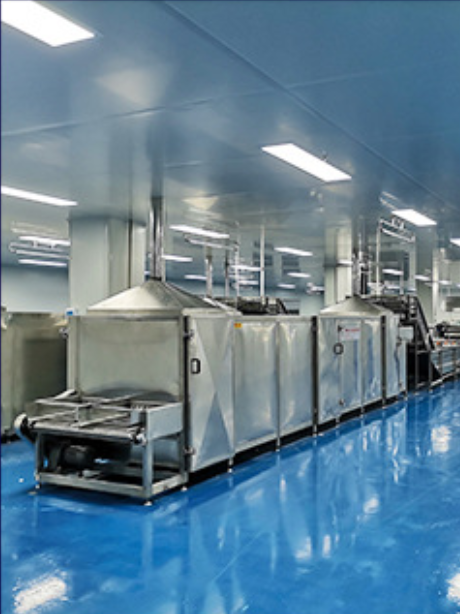
Pasteurization-line compatibility is a process question, not a product claim. Shenyang Songming operates a pasteurization line among its production assets, and both models are liquid formats intended for beverage manufacturing. Whether a specific buyer's line can run the material depends on variables the buyer controls: the heat-treatment regime the finished product requires, the feed temperature and viscosity at the dosing point, whether the strip or sachet format matches the plant's opening and dosing method, and how the product behaves after the container is opened.
Boundary to note: the published data for coffee-1 and Liquid beverages-1 covers material basis, packaging specification and documented applications. It does not publish thermal process curves, post-opening stability windows or line-trial results. Those parameters should be established jointly by the buyer's process engineer and the supplier before a production trial is scheduled, and the resulting values written into the specification rather than assumed from the format.
What OEM and ODM Customization Actually Covers
Customization is stated across five dimensions: component, logo, product specifications, taste and packaging. That list matters because it separates a genuine OEM functional food service from simple private labelling. Logo and packaging are the visible layer; component, specification and taste are the formulation layer that determines whether the product can carry a buyer's own positioning.
- Component and specification: the formulation basis can be adjusted, which is where functional coffee solutions diverge from a fixed catalog item.
- Taste: flavour profiles are curated by a panel of professors, supported by an R&D team of 25 engineers — relevant when a buyer is matching a regional taste preference rather than a generic profile.
- Packaging: functional food packaging solutions are treated as a customization variable, not an afterthought, so strip and sachet formats can be aligned to the buyer's retail or foodservice presentation.
- Logo and brand elements: applied at the packaging stage, which is the lowest-risk customization for a first order.
The documented application list for coffee-1 — mocha coffee, black coffee, Italian espresso, American coffee and cold brew coffee — functions as a scoping tool during ODM food product development. A buyer whose target product sits inside that list is working within a known application envelope; a buyer targeting something outside it should expect a development step rather than an off-the-shelf match.
Reading FDA Food Facility Registration 84-278-1901 Correctly
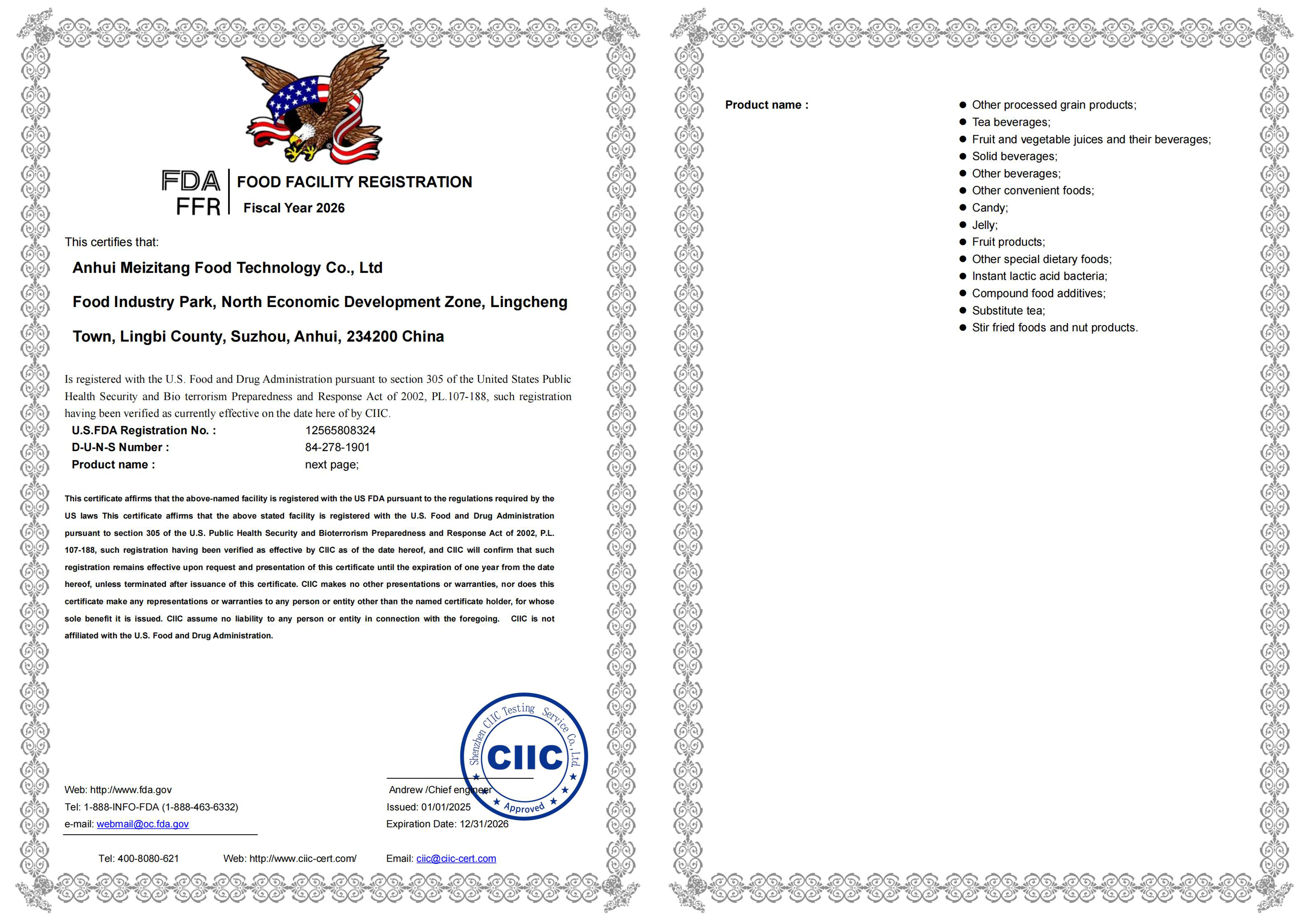
The number appears in supplier files as 84-278-1901, issued by the U.S. Food and Drug Administration, covering food facility registration for functional food and beverages in the US market. The record shows an issue date of 1 January 2025 and an expiry date of 31 December 2026, and both coffee-1 and Liquid beverages-1 are listed as applicable products. The underlying basis is registration with the FDA pursuant to section 305 of the United States Public Health Security and Bioterrorism Preparedness and Response Act of 2002 (PL 107-188).
The interpretation matters more than the number. A food facility registration is an establishment registration: it identifies a facility to the regulator. It is not a product approval, and it does not certify that a specific batch, label or marketing claim is compliant. Buyers should record it as supplier-verification evidence — confirming that the facility is registered for the US market within the stated validity window — and treat product-level compliance as a separate review.
That separate review has its own documented structure. FDA guidance identifies health claims, nutrient-content claims and structure/function claims as the categories that may appear on food and dietary-supplement labels, subject to applicable requirements. The obligations differ by product class: for dietary supplements, structure/function claims require substantiation, notification to FDA no later than 30 days after marketing, and a required disclaimer, whereas conventional food manufacturers do not carry the same notification requirement. Whether a functional coffee concentrate is marketed as a conventional food or as a supplement therefore changes the compliance workload, the labelling and the launch timeline.
Two limits should be stated plainly. First, the registration record covers the US market; it does not establish regulatory clearance for the European Union, the Middle East or any other destination, each of which requires its own review. Second, a validity window ending 31 December 2026 means renewal timing belongs on the buyer's supplier-monitoring calendar rather than being checked only at onboarding.
Execution Evidence: A U.S. Supermarket Case
The reference case involves a liquid beverage OEM client in the United States. The order was 5,000 pieces, applied in the supermarket channel, running over a duration of 12 months, with the result recorded as a best seller. The case note also captures a positioning described as a convenient liquid meal complement.
For a buyer, the useful part of that record is not the sales adjective. It is the shape of the order: 5,000 pieces moving into a supermarket channel over 12 months sits at the same scale as the stated 5,000-piece MOQ, which is evidence of an order at production scale rather than a sample run. Two caveats keep the evidence honest — it is a single case, and retail sell-through results are reported by the client rather than independently audited. It supports execution capability; it does not predict a second buyer's commercial outcome.
Integrated Supply Versus Broker-Led Sourcing
Buyers usually compare two routes at this stage: a broker or trading intermediary that sources from whatever factory fits the order, and an integrated supply partner that holds the specification, the documentation and the production terms in one place. Neither is universally better; they fail in different ways.
| Dimension | Broker-led sourcing | Integrated OEM/ODM supply (reference model) |
|---|---|---|
| Specification ownership | Buyer reconciles documents from several factories | Two defined models (coffee-1, Liquid beverages-1) with stated materials and packaging |
| Customization depth | Limited to what the matched factory already runs | Component, logo, product specifications, taste and packaging |
| Documentation | Varies by intermediary and by order | FDA food facility registration 84-278-1901; 100% test stated; 100% traceability stated |
| Volume fit | Can absorb very small, irregular orders | 5,000-piece MOQ; 8,000 units monthly capacity; 15-day lead time |
| Post-order support | Transactional; continuity depends on the individual contact | Remote after-sales support; stated 98% on-time order delivery |
The limits of the integrated model deserve equal weight. After-sales support is remote rather than on-site. The category range is concentrated in functional food and beverages — peptide-infused coffee, functional foods, prune juice drinks, meal replacement powders and health supplements — which is an advantage for buyers inside those categories and a poor fit for anyone needing a broad general-merchandise catalog. The stated export focus is the United States, while the wider market distribution spans Japan, the US, Saudi Arabia and Germany at 30%, 30%, 20% and 20% respectively; buyers targeting markets outside that pattern should confirm regulatory and logistical coverage rather than assume it. And as noted, published data carries no thermal process curves, so line validation remains a buyer-side project.
What to Expect as the Category Expands
With beverages projected to grow at a 9.2% CAGR between 2026 and 2034 and the broader functional food and beverage market forecast to move from USD 437.62 billion in 2026 toward USD 983.17 billion by 2034, the supply base will not stay fixed. More suppliers will enter, and the differentiator will shift accordingly. A reasonable expectation is that execution documentation — registration status, tested-batch records, defined MOQ and acceptance terms — becomes a screening item earlier in the buying process, while quoted unit price becomes a later-stage comparison among suppliers who already pass that screen.
For buyers, the practical implication is to build the supplier file before the first order rather than after it: the registration number with its validity window, the Incoterm, the acceptance test, the storage condition, the customization scope and the confirmed MOQ. One-stop food supply chain arrangements and food project management services are only as strong as the documents that sit behind them.
FAQ: Technical and Procurement Questions
Which applications are documented for coffee-1?
coffee-1, an espresso concentrate, lists mocha coffee, black coffee, Italian espresso, American coffee and cold brew coffee as its applicable applications. Its material basis is purified water, roasted coffee beans and coffee concentrate, with selected Arabica coffee beans, packed at 30 ml per strip and 10 strips per box.
What is the stated composition and packaging of Liquid beverages-1?
Liquid beverages-1 is an oil orange puree with a total content of original juice of at least 80%, supplied at 30 ml per sachet and 5 bags per box.
What can be customized under OEM and ODM production?
Five dimensions are stated: component, logo, product specifications, taste and packaging. Production is offered in both OEM and ODM modes.
What is the minimum order quantity?
The recorded OEM/ODM production terms state a minimum order quantity of 5,000 pieces. The company separately states that it supports small-batch trial orders starting from 30 units. Because these are different thresholds, the MOQ applicable to a specific model, packaging format and customization level should be confirmed in writing before ordering.
What delivery, payment and acceptance terms are recorded?
Delivery terms are FOB and CIF, payment terms are full payment, and the acceptance criterion is a pre-shipment test.
What lead time and production capacity are stated?
Typical production lead time is 15 days and monthly capacity is 8,000 units. At company level, annual output is stated at 120,000 units from a facility of above 2,000 square meters with 101–200 employees.
How should the products be stored and handled?
Storage requires a cool, dry environment, with the containers kept sealed until use. Both models are supplied in single-serve sealed formats — 30 ml strips for coffee-1 and 30 ml sachets for Liquid beverages-1 — so the outer box should stay dry and unopened until the production schedule requires the material.
Are the products compatible with a pasteurization line?
Both models are liquid formats, and a pasteurization line is among the production assets. Compatibility with a specific buyer's line depends on heat-treatment parameters, dosing method, feed conditions and post-opening handling, so those values should be validated jointly before a trial. Published model data does not include thermal process curves.
What does FDA registration 84-278-1901 cover?
It is an FDA food facility registration for functional food and beverages in the US market, issued 1 January 2025 and valid to 31 December 2026, registered pursuant to section 305 of the United States Public Health Security and Bioterrorism Preparedness and Response Act of 2002 (PL 107-188). Both coffee-1 and Liquid beverages-1 are listed as applicable products. It is an establishment registration, not a product approval or a certification of batch-level or label compliance.
What evidence exists of completed orders?
A documented case covers a liquid beverage OEM client in the United States: 5,000 pieces for supermarket application over a 12-month duration, with the result recorded as a best seller. It is a single case, and the retail sell-through outcome is reported by the client.
What after-sales support is provided?
After-sales support is remote. Buyers should establish the escalation contact and expected response before the first shipment, since no on-site service element is stated.
¿Tiene preguntas o necesita más detalles?
Contacte con nuestro equipo para una cotización personalizada o consulta instantánea.
Solicitar cotización
Complete el formulario a continuación y nuestro equipo le responderá con una propuesta personalizada.
Chat directo de WhatsApp
¿Prefiere chatear en tiempo real? Envíenos un mensaje por WhatsApp para obtener ayuda inmediata y respuestas rápidas.
- Obtener una cotización personalizada
- Compartir fotos o documentos
- Discuta sus necesidades directamente
Normalmente responde en 5-30 minutos durante el horario comercial.