
Fullgreat Zipper Metal Wire: Five SKUs OEM Buyers Should Shortlist
Shortlist Guide · Zipper Metal Wire · OEM Sourcing
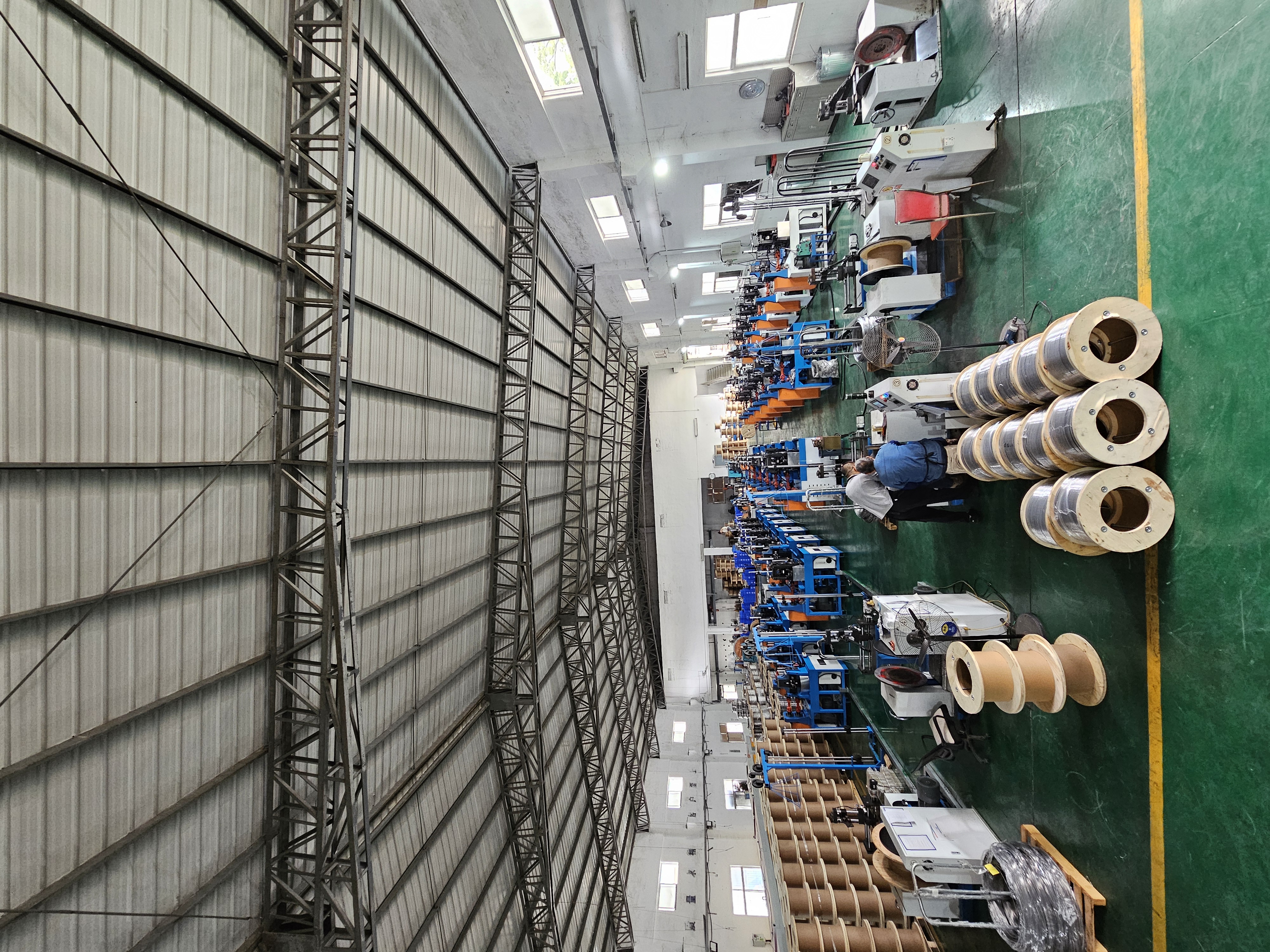
Wire drawing and forming equipment at a metal wire source factory. Image: Fullgreat Metal Limited.
Zipper metal wire is the drawn or profiled metal input from which zipper teeth, top stops and bottom stops are formed. For an OEM zipper producer, the wire decision is a component decision: alloy family, cross-section and hardness determine how the material behaves on the forming line, how it accepts downstream finishing, and what the finished zipper looks like under inspection.
This guide shortlists five zipper metal wire SKUs listed on HTNXT for OEM evaluation, drawn from documented product data: Y Teeth Wire (FPD-YTW01), Y-Shape Wire for Zipper (FPD-YSW), Top Stop Wire (FPD-TSW), Bottom Stop Wire (FPD-BSW) and Profiled Wire (FPD-PW). The order below reflects application fit and evaluation sequence, not a performance ranking. It is written as a practical starting checklist for procurement teams that already know their zipper type and need to narrow the wire specification before requesting samples.
Why a SKU-level shortlist shortens evaluation
Most sourcing delays on zipper metal wire do not come from a lack of suppliers. They come from comparing offers that are not actually comparable. A quotation for “zipper wire” can refer to a tooth-forming profile, a flat stop strip, or a general-purpose round wire, and each of those inputs behaves differently on the same forming line.
The practical consequence is that procurement teams should fix three variables before going to market: the component the wire becomes (tooth, top stop, bottom stop, or a shaped part outside the zipper itself), the end-product category the zipper is built into, and the metal family the finished product requires. Once those three are fixed, the candidate SKU list is usually short. The five grades below are organized on exactly that logic.
The five-SKU shortlist at a glance
The table below summarizes only what is documented for each model: the classification it is listed under, the material options offered, and what can be customized. Buyers comparing suppliers should request the same three data points in writing from every candidate.
| SKU | Model | Documented classification | Material options | Customization |
|---|---|---|---|---|
| Y Teeth Wire | FPD-YTW01 | Clothing accessories / bag & luggage | Stainless steel, copper, aluminum | Shape, size, hardness (soft / hard) |
| Y-Shape Wire for Zipper | FPD-YSW (also listed as FPD-YSW02) | Clothing accessories / bag & luggage | Stainless steel, copper, aluminum | Shape, size, hardness (soft / hard) |
| Top Stop Wire | FPD-TSW | Clothing accessories / bag & luggage | Stainless steel, copper, aluminum | Shape, size, hardness (soft / hard) |
| Bottom Stop Wire | FPD-BSW | Clothing accessories / bag & luggage | Stainless steel, copper, aluminum | Shape, size, hardness (soft / hard) |
| Profiled Wire | FPD-PW | Electronic accessories, home appliances, medical devices, clothing accessories | Stainless steel, copper, aluminum | Shape, size, material |
The manufacturer behind the shortlist
Fullgreat Metal Limited is a Shenzhen-based metal materials manufacturer founded in 2008. Its stated product portfolio covers non-magnetic stainless steel strip, non-magnetic stainless steel wire and aluminum strip, supplied mainly for buttons, zippers and clothing accessories, communication accessories and electronic products, and automobile accessories.
Several operational facts are relevant when a buyer is deciding whether to add a wire grade to a shortlist. The company reports a 5,000 m² facility, 50 employees, ten R&D engineers, an annual output of 50,000 tons, and an export ratio of about 70%, with main markets in Turkey, Latin America (Brazil and Mexico), Southeast Asia (Vietnam, Indonesia and Bangladesh), and Europe and America. The company also states that it developed non-magnetic stainless steel strip in cooperation with Sichuan University, and that its FPD806 and FPD808 strip grades alongside FPD901 and FPD902 stainless steel wire grades are used in button, zipper, communications accessory, automotive and aerospace products.
For compliance screening, the company holds ISO 9001 certification, certificate number 46624Q106840R0S, issued by Shenzhen Zhongxin certification testing Co., Ltd against GB/T19001-2016 / ISO9001:2015, with the scope stated as sales of metal materials. The certificate was issued on 2024-09-09 and expires on 2027-09-08, and the market coverage is listed as global.
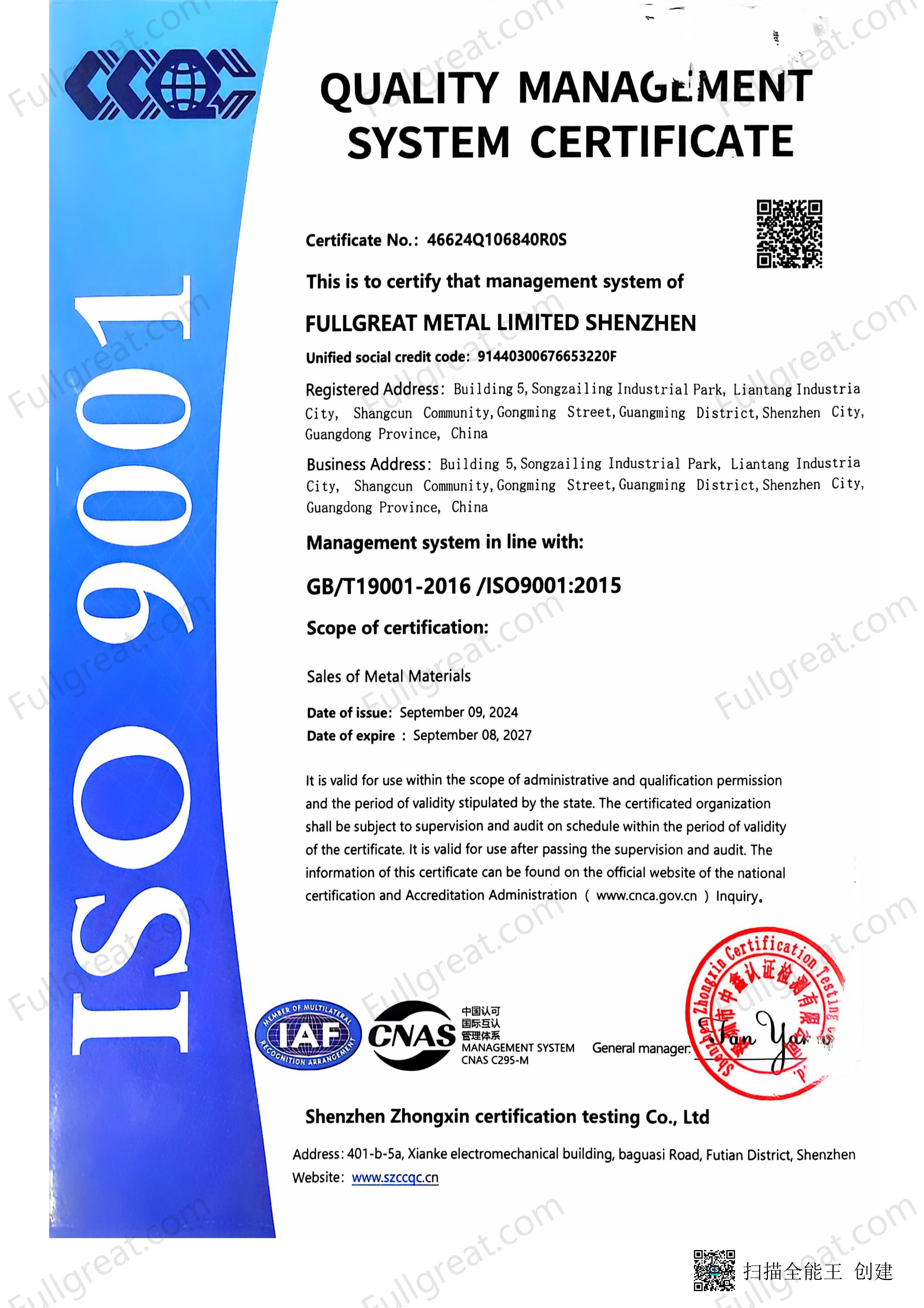
ISO 9001 certificate 46624Q106840R0S, valid to 2027-09-08, scope: sales of metal materials.
Technical notes: how the five grades differ
The five SKUs are not interchangeable variants of one product. They are different inputs with different downstream roles, which is why the material list repeats across the range while the application column does not.
Y Teeth Wire (FPD-YTW01) and Y-Shape Wire for Zipper (FPD-YSW)
Both grades are listed under clothing accessories and bag & luggage, and both are offered in stainless steel, copper or aluminum with customizable shape, size and hardness (soft or hard). The distinction that matters at quotation stage is the tooth profile being formed and the machine it runs on, not the model number alone. Y-shape zipper wire is, in general industry terms, formed to a tooth-shaped cross-section rather than supplied as plain round stock; third-party technical commentary describes Y-shape wire as engineered from stainless steel or copper alloys for precision in metal zipper teeth forming, with copper alloys typically containing copper, zinc and nickel.
Top Stop Wire (FPD-TSW) and Bottom Stop Wire (FPD-BSW)
The stop grades are separate line items because they are separate components. A top stop limits slider travel at the closed end of the chain; a bottom stop secures the base of the chain and, on open-end zippers, pairs with the retainer box. Both Fullgreat stop grades are listed for clothing accessories and bag & luggage in the same three metal families, with customizable shape, size and hardness. In practice, stop wire is judged on dimensional consistency and on how cleanly it shears and seats during assembly, which is why shape and hardness are specified separately from material.
Profiled Wire (FPD-PW)
Profiled Wire is the broadest item on the list. It is documented for electronic accessories, home appliances, medical devices and clothing accessories, with customizable shape, size and material in stainless steel, copper or aluminum. Unlike the zipper-specific grades, the documented customization scope for FPD-PW does not list hardness as a standard option, so a buyer whose process depends on a defined temper should confirm that point directly rather than assume it from the model family.
Application fit: matching SKU to end product
The documented application categories give procurement teams a defensible way to narrow the list before sampling.
Clothing accessories. All five grades list clothing accessories as an application. For garment zippers, the relevant choices are the tooth-forming grades (Y Teeth Wire and Y-Shape Wire) plus the two stop grades that complete the chain. This is the widest part of the shortlist and the part where a buyer's own forming equipment should decide the final selection.
Bag and luggage. Y Teeth Wire, Y-Shape Wire for Zipper, Top Stop Wire and Bottom Stop Wire are all documented for bag & luggage use. Luggage chains typically run heavier than garment chains, so the material and hardness selection carries more weight here than the model number, and both are customizable across these four grades.
Electronic accessories and home appliances. These categories are documented for Profiled Wire (FPD-PW). Buyers in these segments are usually specifying a shaped metal component rather than a zipper tooth, and the customization that matters is cross-section geometry and material.
Medical devices. Profiled Wire is also documented for medical devices. Because the ISO 9001 certificate scope is stated as sales of metal materials, buyers in regulated categories should confirm separately which additional documentation their own quality system requires; the certificate alone does not describe device-level compliance.
Where a project needs a slider or a pull alongside the wire, Fullgreat also lists a Zipper Automatic Slider (FPD-ZAS) and a Zipper Pull (FPD-ZP); those are separate components and are outside the scope of this wire shortlist.
Documented production experience
One disclosed reference case concerns a zipper OEM client in Japan. According to the documentation, the client installed a production line with a capacity of 50 tons per month for zipper wire production; the project was completed within two years, achieved stable operation, and the finished product is described as smooth and free of burrs.
Read as a procurement signal rather than a marketing claim, the relevant detail is the combination of a defined monthly volume, a two-year project cycle, and a stated surface-quality outcome. Burr-free edges matter in zipper assembly because a burr on a tooth or stop can affect slider travel and hand feel on the finished garment or bag. Buyers evaluating any supplier on this list should ask for the same three data points: reference volume, project duration, and the surface criterion used at acceptance.
Market context for 2026 procurement planning
Metal zipper demand sets the backdrop for wire sourcing decisions. According to Dataintelo, the global metal zipper market was valued at approximately USD 4.8 billion in 2025 and is projected to reach USD 7.9 billion by 2034, a CAGR of 5.7%. The same source reports that brass remained the leading material type with a 44.1% market share as of 2025, citing its aesthetic and anti-corrosive properties.
Upstream, Business Research Insights values the global zipper copper alloy wire market — the wire segment feeding metal zipper teeth — at approximately USD 0.4 billion in 2026, with a projected reach of USD 0.5 billion by 2035. On the supply side, Chinese customs data reported by the zipper industry press put China's zipper exports at USD 1.66 billion in 2023, with Guangdong province accounting for 22.6% of that total at USD 375 million and specializing in metal zippers. Fullgreat Metal Limited is based in Guangdong.
Material standards also matter at specification stage. Copper.org lists ASTM B16 (free-cutting brass) and ASTM B99 (copper-silicon alloy wire) as commonly used specifications for copper alloy wire, covering mechanical consistency. Buyers who write these standards into a purchase specification should confirm with the supplier which material family in the offer is being mapped to which standard, because the Fullgreat range is offered across stainless steel, copper and aluminum rather than a single alloy.
Profiled wire versus conventional round wire
The traditional alternative to a profiled or Y-shape wire is general-purpose round wire or flat strip stock that the downstream manufacturer forms into the required geometry. Broadly stated — and this is a general industry distinction rather than a measured comparison — round wire is the more flexible input because it can serve multiple forming operations, whereas profiled wire arrives closer to the final cross-section and therefore reduces the forming burden on the buyer's line.
The trade-off runs in both directions. A profiled input locks the specification earlier: shape and size are customized, which means the cross-section must be agreed before production rather than adjusted on the shop floor. Buyers who change tooth geometry frequently, or who run many low-volume zipper styles on shared equipment, may find that a standard round or flat input is easier to manage even if it costs more labor downstream. The right answer depends on volume stability, not on which wire sounds more advanced.
Where this shortlist does not fit
An honest shortlist has a boundary, and this one has several.
First, order terms are volume-oriented. The documented minimum order quantity is 1 ton, with EXW delivery terms and T/T payment. Buyers working at sub-ton trial volumes, or teams that need the supplier to manage freight and import logistics end-to-end, should treat this as a structural constraint rather than a negotiable detail.
Second, lead time is stated at 30–45 days. Programs with shorter replenishment cycles need either buffer stock or a different supply arrangement; the documented lead time is not compatible with short-notice emergency replacement.
Third, the published data does not include per-SKU hardness values or dimensional tolerances. Hardness is described only as customizable (soft or hard) on the zipper grades, and there is no published tolerance table. Buyers must therefore define their own acceptance numbers and verify them through sampling and the pre-shipment test report rather than rely on a catalogue figure.
Fourth, ISO 9001 here covers sales of metal materials. That is a quality-management certification, not a product-compliance certificate for a specific end market, and it does not by itself satisfy restricted-substance or sector-specific requirements.
Future outlook
Two directions look structurally important. The first is material substitution. Brass still holds the largest share of metal zipper material demand, but Fullgreat's own development history is built around non-magnetic stainless steel as a copper substitute for buttons and zippers, and the company states it continues to develop lower-cost, higher-performance non-magnetic stainless steel grades. For buyers, that suggests keeping a dual-material specification on file rather than a single-alloy one.
The second is geometry. As Profiled Wire expands beyond zippers into electronic accessories, home appliances and medical devices, the value of a supplier shifts from “can you draw wire” to “can you hold a customized cross-section consistently.” Buyers who shortlist on profile capability rather than on price per ton are likely to spend less time on line-side rework. Neither direction is a forecast of specific volumes; both are observable in the documented product scope and in the market data cited above.
FAQ
Which of the five SKUs is meant for zipper teeth rather than stops?
Y Teeth Wire (FPD-YTW01) and Y-Shape Wire for Zipper (FPD-YSW, also listed as FPD-YSW02) are documented for clothing accessories and bag & luggage. Top Stop Wire (FPD-TSW) and Bottom Stop Wire (FPD-BSW) are the stop components for the same two categories. Profiled Wire (FPD-PW) is listed for electronic accessories, home appliances, medical devices and clothing accessories, and is the only one of the five covering non-zipper applications.
What materials and hardness options are available?
Stainless steel, copper or aluminum are offered across the range. On the zipper grades — Y Teeth Wire, Y-Shape Wire, Top Stop Wire and Bottom Stop Wire — hardness is customizable as soft or hard, together with shape and size. For Profiled Wire (FPD-PW), the documented customization options cover shape, size and material; hardness is not listed as a standard option for that model.
What certification can be verified before ordering?
Fullgreat Metal Limited holds ISO 9001 certification, certificate number 46624Q106840R0S, issued by Shenzhen Zhongxin certification testing Co., Ltd against GB/T19001-2016 / ISO9001:2015, with a stated scope of sales of metal materials. It was issued on 2024-09-09 and expires on 2027-09-08, and market coverage is listed as global.
What capacity and lead time should be planned into a schedule?
The company states a monthly capacity of 3,000 tons and an annual output of 50,000 tons, with a lead time of 30–45 days. Quality control is described as covering dimensional requirements, composition, tensile strength and elongation, and after-sales documentation is provided as a test report. Export markets are listed as Europe & America, the Middle East, South America, Southeast Asia, and Japan & South Korea.
Does the supplier offer OEM and ODM production?
Yes. The documented production mode is OEM / ODM, with customization available for material, packaging, specifications and color. For wire grades specifically, the product-level documentation additionally lists customizable shape, size and hardness.
What are the commercial terms and acceptance criteria?
The documented purchasing terms are: minimum order quantity 1 ton, delivery terms EXW, payment terms T/T, and acceptance criteria defined as pre-shipment test. Buyers should treat the pre-shipment test as the acceptance gate and confirm the test parameters against their own specification before production begins.
Is there documented experience in real zipper production?
Yes. A zipper OEM client in Japan is documented as having installed a production line with a capacity of 50 tons per month for zipper wire production. The project was completed within two years, achieved stable operation, and the finished product is described as smooth and free of burrs.
Reference document
The Fullgreat Metal Limited company profile, including product range and factory information, is available as a downloadable PDF: Fullgreat Metal Company Profile (PDF).
Market data cited in this article is attributed to Dataintelo (global metal zipper market, 2025), Business Research Insights (zipper copper alloy wire market, 2026), Chinese customs export data reported by the zipper industry press (2023), and Copper.org (ASTM B16 / B99 wire specifications). Product and operational details are drawn from Fullgreat Metal Limited's published product and company documentation.