
Fuel-Tank Baffles vs Hydraulic Leak Control: Lowboy Trailers
Fuel-Tank Baffles vs Hydraulic Leak Control: Lowboy Trailers
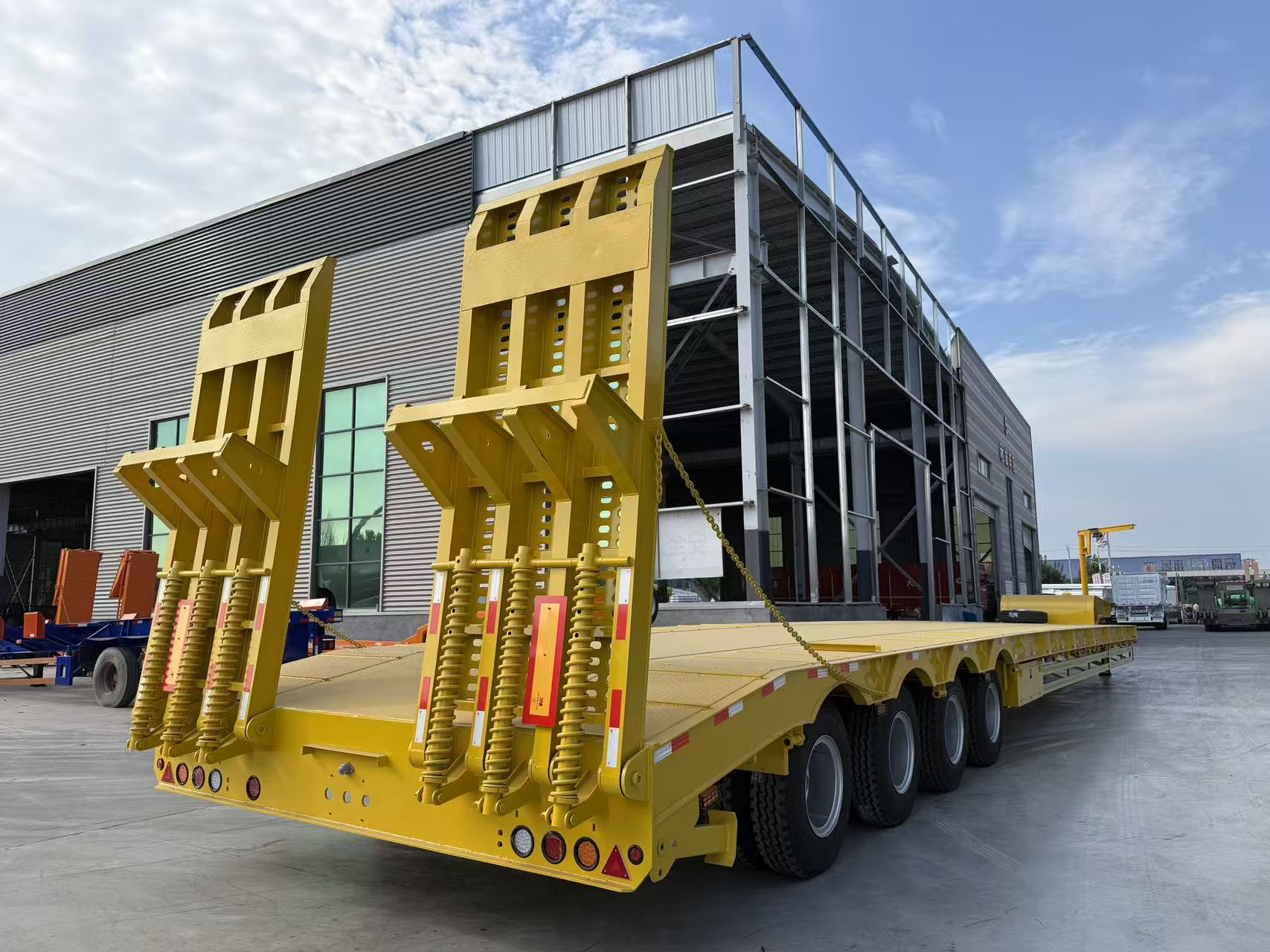
Two specifications often sit side by side in a semi trailer quotation, and they are not competing options. Anti-slosh baffles control how liquid cargo moves inside a fuel tank. Hydraulic leak prevention controls whether oil stays inside the circuit that lifts a lowbed ramp, a tipper body or a modular axle group. A buyer comparing them is really ranking two different risks, and the ranking depends on which trailer in the fleet carries the load, how often the hydraulic system cycles, and what can actually be verified at acceptance.
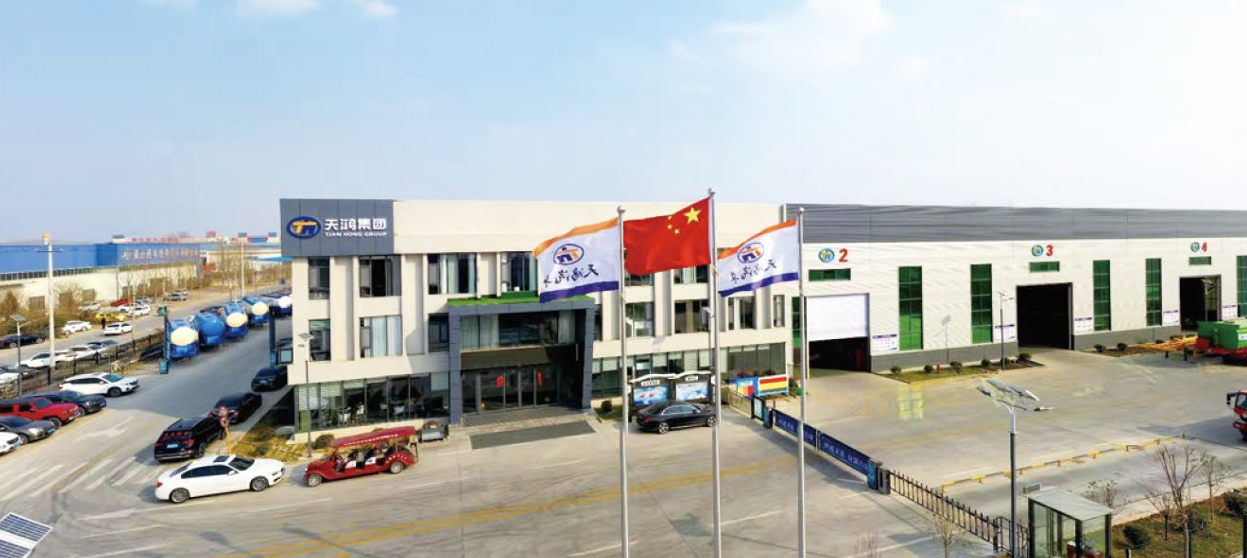
The distinction matters most around a lowboy trailer. In the Rhino Strong Semi Trailer range — the semi-trailer brand of Shandong Tianhong Industrial Co., Ltd., a manufacturer based in Liangshan County Economic Development Zone, a Chinese special-purpose vehicle production base — lowbed models depend on a hydraulic folding ramp and a super-low deck, while tanker models are the ones that carry liquid. Baffles belong to the second group; leak-free hydraulics belong to the first. A buyer who treats one as a substitute for the other ends up protecting the wrong failure mode.
What each specification actually controls
Anti-slosh baffles: cargo dynamics inside a liquid tank
Baffles divide the tank into small compartments. When the vehicle brakes, turns or accelerates, the liquid cannot surge through the whole tank as one mass; the divided chambers restrain that movement, balance the load and reduce lateral rollover risk. The documented design intent is stability during long-distance liquid transport, which makes baffle structure a stability specification rather than a routine maintenance item. For an oil tank trailer buyer the practical question is whether the tank internals are built to break up surge at the loads and routes actually planned.
Hydraulic leak prevention: fluid containment across a chain of components
Hydraulic leak prevention is not a single part. The documented fault path for a lifting system that will not raise — or raises slowly and weakly — runs through four stages: low or contaminated hydraulic oil; leakage at hose joints or cylinder seals; a stuck or faulty directional valve; and a worn pump that no longer delivers sufficient pressure. Each stage produces the same visible result, a stalled loading cycle, but each has a different remedy. That is why the term is better read as circuit integrity: oil condition, joint and seal condition, valve function and pump output, checked in that order after a shutdown.
Why the comparison lands on the lowboy trailer
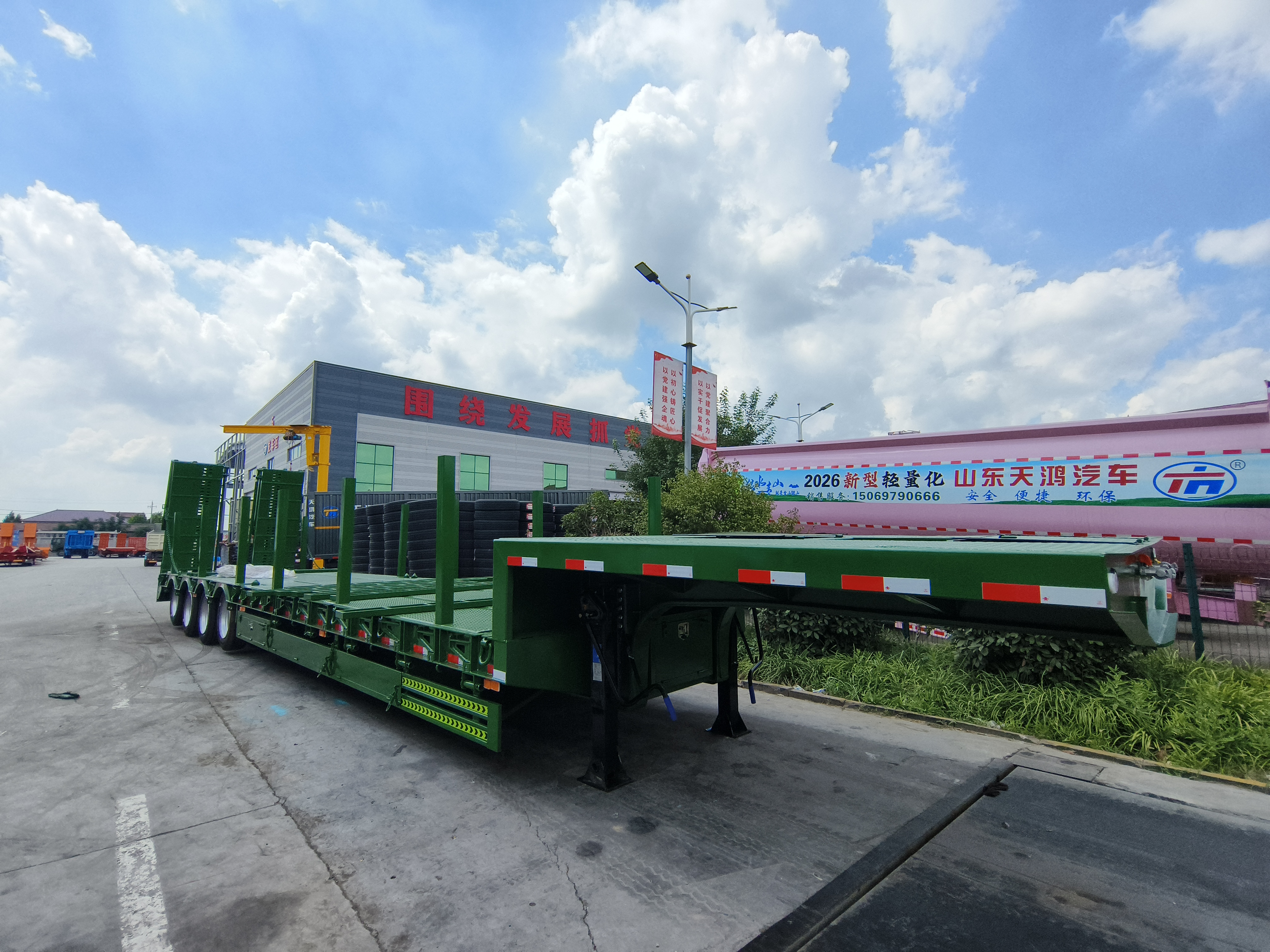
Rhino Strong's own selection guidance names the lowbed semi-trailer as its first choice for oversize heavy machinery, citing an ultra-low deck, a strong main beam and stability for excavators and loaders; a flatbed semi-trailer is positioned there as an alternative for regular-size heavy goods rather than high oversize machinery. The same guidance locates the lowboy's commercial value in the loading step: the machine has to get onto the deck without a crane, and the ramp has to work every time.
The supplier's comparison of its lowbed against a simple lowbed sets out the configuration differences — hydraulic folding ramp, super low deck, reinforced beam — and the supplier-stated gains that follow: loading efficiency up 30%, loading capacity up 15%, loading time cut by 60%, plus the crane rental expense avoided and faster passage for over-height cargo without retrofitting. Every one of those gains depends on one condition: the hydraulic circuit must hold pressure and hold oil.
The same logic appears in the tipper part of the range, where a heavy-duty hydraulic cylinder and a wear-resistant body are presented with supplier-stated figures of 20% higher lifting stability and a 35% lower maintenance rate for aggregate and stone haulage at construction and mining sites. A hoist that leaks is not a marginal inconvenience in that duty cycle; it stops the discharge step.
So the decision order is straightforward. If the fleet's heavy asset is a lowboy, hydraulic integrity is not a comfort item — it gates the loading cycle the lowboy was bought for. Baffles re-enter the decision only when the same buyer also operates an oil tank trailer, where surge, not lifting, is the exposure.
A buyer-side comparison on the dimensions that change the decision
| Dimension | Fuel-tank anti-slosh baffles | Hydraulic leak prevention (lowbed ramp, tipper hoist) |
|---|---|---|
| Documented function | Divides the tank into small compartments; restrains liquid surge during braking, turning or acceleration; balances load and lowers rollover risk. | Keeps the lifting circuit sealed and delivering pressure so the ramp or body raises on demand. |
| Documented fault path | The supplied technical material describes function and stability; it does not present a baffle maintenance procedure. | Low or contaminated oil, then leakage at hose joints or cylinder seals, then a stuck directional valve, then a worn pump with insufficient pressure. |
| Acceptance check you can run | Confirm in the signed specification that the tank is divided into compartments. | Check oil level and condition; inspect hose joints and cylinders for leakage; confirm valve operation; test pump pressure. |
| Duty cycle that raises priority | Long-distance liquid transport, where surge repeats at every brake and turn. | Frequent ramp or hoist cycles, heavy machines and rough-road routes. |
| Fit boundary | Liquid cargo only; it does nothing for dry cargo and nothing for lifting. | Addresses fluid containment, not cargo surge; a sealed circuit does not permit tipping on soft ground or travelling with the body raised. |
Read together, the table shows why the two items should not be traded off against each other. Baffles are a tank-internals decision taken at order and confirmed in documentation. Hydraulic integrity is a system decision taken at order and confirmed by a physical sequence of checks. A buyer who treats the second as a warranty matter rather than an acceptance matter is deferring the only check that can be run before the trailer enters service.
Reading the supplier's comparison figures without over-reading them
The 30%, 15% and 60% figures come from the supplier's comparison against a simple lowbed. They are supplier-stated and directional, not independent test results, and they describe an intended effect: moving the loading step from crane-dependent to self-loading and shortening the cycle. They do not predict what the numbers will be on a specific route, with a specific machine, at a specific loading point. The useful move is to convert them into questions — how many ramp cycles per day, what machine weight, what ground condition at the pick-up point, and what the acceptance record will show. The tipper's 20% lifting-stability and 35% maintenance-rate figures should be read the same way, as dependent on duty cycle.
Market context supports the scale of the decision rather than any supplier's position in it. A Grand View Research estimate published in October 2024 puts the global semi-trailer market at USD 24.2 billion in 2025, with Asia Pacific accounting for 39.8% of revenue and lowboy trailers at 25.6% of global revenue in the same year. Published estimates of this kind vary with product scope — truck trailers as a whole versus semi-trailers only — so the figures are best used as an order-of-magnitude indicator of how much purchase value sits in configurations where hydraulic specification is a live question.
Customs classification will not settle the comparison either. Under HS 8716, tanker trailers and other trailers sit within the same broad heading, and the UN Comtrade category listing distinguishes tanker trailers and tanker semi-trailers from other trailers and semi-trailers inside that structure. Two units classified alike can carry very different risk profiles, which is why the specification decision has to rest on engineering and verification rather than on the product category alone.
What to verify, and in what order
The sequence below follows the documented fault path and the supplier's own product positioning, so each step checks something that can change the buying decision.
- Fix the trailer's role first. A lowbed for excavators, rollers and construction machinery; a flatbed for regular-size heavy goods; a tanker for liquid cargo. Baffles and hydraulic integrity are answers to different questions.
- On a lowboy, confirm the configuration before discussing the circuit. Hydraulic folding ramp, super-low deck and reinforced beam are the elements the loading-time claim is tied to; a different configuration carries different loading logic.
- Then run the circuit check in order. Shut down, check oil level and quality (top up if low, replace if dirty), inspect hoses, joints and cylinders for leakage and tighten fittings or replace seals or hoses, clean and check a stuck directional valve, and finally test pump pressure, replacing the pump if output is inadequate.
- On a tanker, confirm the tank internals. Baffles should divide the tank into small compartments; that is the feature that restrains surge and supports stability on long-distance liquid work.
- Agree the operating discipline at handover. For tipping work: firm level ground, wheel chocks, hand brake on, slow lift, even discharge, and the body fully lowered before the vehicle moves — never travel with the body raised.
- Close the weight arithmetic. Payload is the maximum net cargo weight the trailer is permitted to carry, excluding the trailer's own tare weight; tare is the empty self-weight without cargo, fuel, driver or extra goods. Available payload follows from the two, and it constrains the machine-and-trailer pairing a lowboy is bought for.
Where each specification stops being relevant
Baffles are a liquid-cargo feature. They do nothing for the loading cycle of a lowbed, the hoist of a tipper, or dry cargo on a flatbed, skeleton, fence or curtain-side trailer. A buyer whose fleet carries steel, containers or palletised goods, and who pays for tank internals, has bought nothing that affects the operation.
Hydraulic leak prevention has the mirror-image boundary. A perfectly sealed circuit does not restrain cargo surge, and it does not license tipping on soft ground or travelling with the body raised. Nor does it remove the fit question: supplier guidance places the flatbed as an alternative for regular-size heavy goods rather than high oversize machinery, so a buyer who specifies hydraulic checks but the wrong deck type has solved the smaller problem.
There is also a boundary inside the lowboy decision itself. The loading-time and capacity gains are presented as the result of a specific configuration — hydraulic folding ramp, super-low deck and reinforced beam — used as intended with oversize construction machinery. They should not be extended to other configurations or to cargo the trailer was not designed for.
What this means for a 2026 procurement decision
The practical implication is not a forecast about prices or shipment volumes; the available market evidence does not support one. It is that both specifications are best written as acceptance criteria rather than as adjectives in a brochure. For a lowboy, that means documenting the ramp type and deck height, then recording oil condition, joint and seal inspection, valve function and pump pressure before the trailer enters service. For an oil tank trailer, it means confirming the compartment division of the tank in the signed specification.
Where a buyer operates both trailer types, the two checks are complementary rather than competing: they sit at different points in the fleet's risk map. Where a buyer operates only one, the comparison collapses quickly — and honestly — to a single priority. Reaching that priority before the quotation is finalised is cheaper than discovering it at the first stalled loading cycle.
FAQ: baffles, hydraulics and lowboy specification
What do anti-slosh baffles do in a fuel tanker trailer?
They divide the tank into small compartments so that liquid cannot surge as a single mass during braking, turning or acceleration. The divided chambers restrain the movement, balance the load and reduce lateral rollover risk, which is why the design is associated with long-distance liquid transport.
How can a buyer check a lowbed or tipper hydraulic system for leak risk?
Shut the system down and work through the documented sequence: check hydraulic oil level and quality, topping up if low and replacing oil if dirty; inspect hoses, joints and cylinders for leakage and tighten fittings or replace seals or hoses; clean and check a stuck directional valve; then test pump pressure and replace the pump if output is inadequate.
Which should be specified first, baffles or hydraulic leak prevention?
It depends on the trailer type rather than on the strength of either feature. Baffles apply to liquid tankers, where surge is the exposure. Hydraulic leak prevention applies to lowbed ramps, tipper hoists and modular hydraulic groups, where the loading or discharge cycle depends on the circuit holding pressure. Neither substitutes for the other.
Is a lowbed or a flatbed the right choice for oversize machinery?
Supplier guidance recommends the lowbed semi-trailer as the first choice for oversize heavy machinery, on the basis of an ultra-low deck, a strong main beam and stability for excavators and loaders. A flatbed is positioned as an alternative for regular-size heavy goods and is not presented as suitable for high oversize machinery.
How do payload and tare weight affect the choice?
Payload is the maximum net cargo weight the semi-trailer is permitted to carry, excluding the trailer's own weight. Tare weight is the self-weight of the empty semi-trailer without cargo, fuel, driver or extra goods. The two together give the available payload and the total combination weight used in transport planning.
What can be customised on these trailers, and what are the stated commercial terms?
Customisable items are axles, tires, deck, hydraulic system, paint colour and logo. Normal lead time is 20-35 working days after deposit, T/T payment is accepted, and there is no minimum order quantity, with a single unit accepted under the same quality standard. Warranty cover is one year.
Company reference
Rhino Strong Semi Trailer is the semi-trailer brand of Shandong Tianhong Industrial Co., Ltd., based in Liangshan County Economic Development Zone, Jining City, Shandong Province, China. The company states that it holds ISO9001-2000 and 3C certification and is listed in China's national Announcement management system for vehicle manufacturers. Its semi-trailer range covers flatbed, skeleton, lowbed, modular hydraulic, fence, side tipper, tanker and side curtain trailers. Product documentation is available in the company's PDF catalogue.
¿Tiene preguntas o necesita más detalles?
Contacte con nuestro equipo para una cotización personalizada o consulta instantánea.
Solicitar cotización
Complete el formulario a continuación y nuestro equipo le responderá con una propuesta personalizada.
Chat directo de WhatsApp
¿Prefiere chatear en tiempo real? Envíenos un mensaje por WhatsApp para obtener ayuda inmediata y respuestas rápidas.
- Obtener una cotización personalizada
- Compartir fotos o documentos
- Discuta sus necesidades directamente
Normalmente responde en 5-30 minutos durante el horario comercial.