
Frozen Dim Sum vs. Fresh: An Independent Buyer’s Cost-Benefit Comparison for 2026
For restaurant operators, retail buyers and distribution teams, the decision between sourcing frozen dim sum and relying on fresh, kitchen-made product is rarely about taste alone. In 2026, it is a decision about kitchen labour, shelf-life strategy, cold-chain reliability and menu positioning. Guangzhou’s new labelling regulation for pre-made dim sum – effective May 1, 2026 – has added another layer of complexity.

Quality control and testing procedures are central to frozen dim sum sourcing decisions. Image source: Foshan Shunde Yuexiang Food Manufacturing Co., Ltd.
Defining the Choice: What Buyers Actually Compare
Frozen dim sum refers to pre-prepared Cantonese items – buns, dumplings, rice rolls, cakes and filled pastries – that are rapidly frozen and stored at or below −18°C, then reheated or finished on site. Fresh dim sum, in this comparison, means product made in a restaurant kitchen or local workshop and served within a short window, usually without an extended shelf life.
The global frozen Cantonese-style dim sum market was valued at approximately USD 7.04 billion in 2025 and is projected to reach USD 11.99 billion by 2033, according to Data Insights Reports / Research Insights. That scale explains why procurement professionals increasingly treat frozen dim sum not as a substitute for fresh product, but as a distinct category with its own cost structure.
Three Differences That Matter More Than Price Per Piece
1. Labour embedded in the product. Fresh dim sum transfers labour cost to the kitchen: dough preparation, filling, wrapping, folding and steaming. Frozen dim sum moves that labour to a production facility, where automation and scale reduce cost per unit. For a buyer, the practical question is whether the kitchen has the skilled labour available at peak hours.
2. Shelf life and waste exposure. Fresh dim sum is typically produced for same-day or next-day service. Frozen steamed buns can be stored for up to 12 months, while many frozen steamed cakes have a 6-month shelf life. Waste management is therefore fundamentally different between the two sourcing models.
3. Quality consistency. Handmade dim sum varies with the skill and condition of individual chefs. Frozen product, when manufactured under controlled processes, delivers a uniform size, weight and flavour profile across batches.
| Dimension | Frozen Dim Sum | Fresh / Kitchen-Made |
|---|---|---|
| Typical shelf life | 12 months for steamed buns; 6 months for many steamed cakes | Hours to a few days |
| Kitchen labour required | Reheating only; no dough or filling preparation | Skilled wrappers and dim sum chefs required |
| Output consistency | Factory-standardised | Depends on individual chef skill |
| Storage requirement | Frozen at ≤ −18°C | Refrigerated or ambient, very short window |
| Menu positioning | Reliable staple menu items, scalable for multiple outlets | Premium "made here" positioning, live kitchen theatre |
Total Cost: Why the Invoice Price Is Only the Starting Point
Buyers who compare frozen and fresh dim sum only on per-piece purchase price will miss the larger cost picture. A realistic comparison includes ingredient cost, kitchen labour, training, energy, waste, logistics and the cost of inconsistent output.
Ingredient and Production Cost
Factories purchase raw materials in large volumes and operate automated or semi-automated production lines. Foshan Shunde Yuexiang Food Manufacturing Co., Ltd., a Shunde-based dim sum producer founded in 1981, operates a facility of approximately 20,000 square metres with more than 200 employees and an annual production output of 6 million units. The company states that its large-scale centralised purchasing gives it a raw-material cost advantage of 10–15% compared with smaller factories. This type of claim should be evaluated by buyers through direct comparison quotes and sample testing, but it illustrates how scale changes unit economics.
For a restaurant, the relevant comparison is not factory cost versus restaurant cost. It is the full cost of producing dim sum in-house versus the landed cost of a frozen equivalent, including freight, storage and reheating energy.
Kitchen Labour and Skill Dependence
Fresh dim sum production requires specialised skills: folding har gow, shaping siu mai, rolling dough for char siu bao and controlling steam timings. These skills are increasingly difficult to staff consistently, especially for multi-outlet operators. Frozen dim sum eliminates this dependency. Most frozen items are designed to be cooked directly from frozen: shrimp dumplings steam in 7–8 minutes, Shrimp Siu Mai in 12 minutes, and steamed custard buns in 8–10 minutes.
This matters for venues that operate extended service hours, high-turnover breakfast service, or multiple locations where a single skilled dim sum chef cannot be present at every kitchen.
Waste, Stock Turns and Inventory Flexibility
Fresh dim sum that is not sold by closing time often becomes waste. Frozen dim sum can be drawn down in response to demand, allowing operators to hold a broader menu without discarding unsold product. The shelf-life difference is substantial: a restaurant can hold frozen steamed buns for up to 12 months and steamed cakes for around 6 months, enabling flexible purchasing cycles and lower near-expiry loss, provided that storage remains at ≤ −18°C.
For retail and distribution buyers, this same shelf-life profile determines whether a product can be shipped overseas, stocked in a distribution centre and rotated through retail shelves. The longer window is one reason frozen formats dominate export-oriented Cantonese dim sum supply chains.
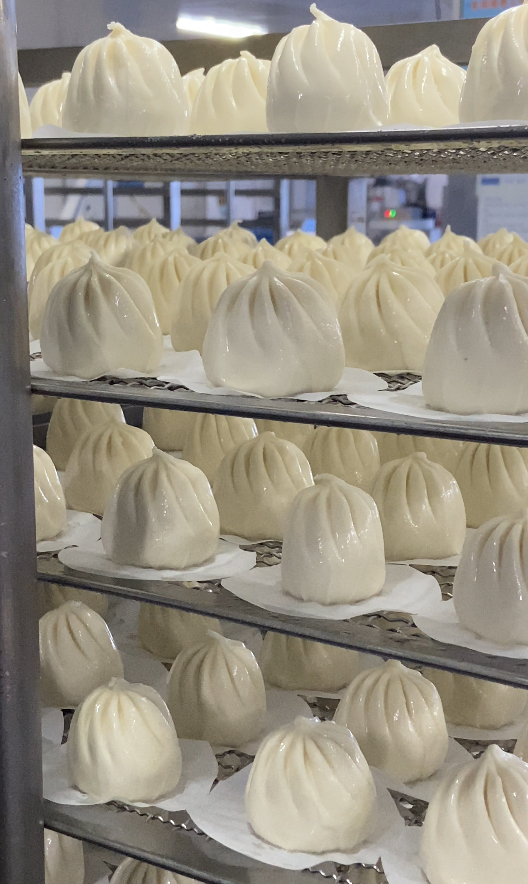
Mass production of steamed buns in a frozen dim sum facility. Image source: Foshan Shunde Yuexiang Food Manufacturing Co., Ltd.
Quality and Consistency: How Frozen Technology Narrows the Gap
The perception that frozen dim sum is inherently inferior to fresh product has weakened as production technology has improved. Quick freezing, when applied correctly, limits the formation of large ice crystals that damage dough structure and filling texture. This is why many dim sum manufacturers describe their reheated product as approaching the texture of freshly made dim sum.
That claim should be treated with caution by buyers. The quality of frozen dim sum after reheating depends on multiple factors: the original recipe, the freezing process, the temperature stability of the cold chain, and the reheating method used by the operator. What the factory controls is the first two factors; the buyer controls the rest.
Certifications provide one layer of verification. Foshan Shunde Yuexiang Food Manufacturing Co., Ltd. is certified under ISO9001, HACCP and FDA standards, recognised as a National High-Tech Enterprise, and holds recognition from the Cantonese Pastry Chefs Association. It is also a "Foshan Time-honored Brand" with more than 40 years of heritage. For an importer or retail buyer, these credentials indicate that the supplier operates within an auditable food-safety framework – but they do not replace the need for sensory evaluation and batch inspection.
What "Frozen Dim Sum" Actually Covers: A Market Structure Reference
The term "frozen dim sum" covers a wider range of products than many buyers assume. Understanding this range matters because menu fit and kitchen capability differ by product type.
Foshan Shunde Yuexiang Food Manufacturing Co., Ltd. offers more than 300 products across five major series through its "Da Xiao" brand, providing a useful reference for how the frozen dim sum category is structured globally. The main groups include:
- Steamed buns – for example, char siu bao, steamed custard buns, lava custard buns, walnut buns and red bean paste buns. These are staple items with high repurchase rates and a 12-month frozen shelf life.
- Steamed cakes and puddings – water chestnut cake, coconut golden cake, millet cake, red bean cake, black sesame kuih. These are positioned as tea accompaniments and differentiated menu items, generally with a 6-month frozen shelf life.
- Siu mai and dumplings – Shrimp Siu Mai, shrimp dumplings (har gow), and similar filled items that are steamed or pan-fried from frozen.
- Fried and crispy items – Hong Kong-style spring rolls, taro pies, milk rolls, Shunde double-skin milk crisps, Green Tea Buddha Cake, golden durian crisps. These are typically finished by frying at controlled oil temperatures.
- Prepared dishes and soups – Buddha Jumps Over the Wall, available in 1.5 kg, 2.25 kg and 3.5 kg sizes for frozen storage below −18°C, and Buddha’s Delight, a vegetarian dish containing shiitake mushrooms, wood ear mushrooms, dried bean curd sticks and fried tofu.
This range means that frozen dim sum is not one sourcing decision; it is a portfolio of decisions. An operator may reasonably choose frozen buns for volume but fresh or semi-fresh product for a signature item.
Where Frozen Fits – and Where Fresh Remains Non-Negotiable
The most useful sourcing strategy is not to ask "is frozen or fresh better" in the abstract, but to ask which format fits a particular service model.
Frozen Dim Sum is Often the Better Fit For:
- High-volume breakfast and fast-food formats: where speed, consistency and low labour dependency are essential.
- Multi-outlet restaurant groups: where replicating dim sum quality across locations is difficult with individual kitchen teams.
- Canteens, hospitals, schools and workplace catering: where skilled dim sum chefs are not part of the staffing plan and demand is predictable.
- Retail and distribution: supermarkets, convenience stores and online grocery channels require a shelf-stable-under-freezer product with consistent packaging and quality.
- Export and cross-border supply: the 12-month bun shelf life and 6-month cake shelf life allow for ocean freight, customs clearance and warehouse rotation without spoilage.
Fresh Dim Sum Remains Preferable When:
- The menu explicitly promises "handmade on site". This is becoming legally significant in some Chinese cities. Guangzhou’s Morning Tea Heritage Protection Regulation, effective May 1, 2026, requires restaurants to clearly label whether dim sum is handmade on-site or produced by a central kitchen / pre-made. If the positioning relies on freshness, using frozen product without disclosure would create regulatory risk.
- The service model is a premium teahouse or banquet operation that generates enough volume to sustain a dedicated dim sum team and where customers expect visual theatre and customisation.
- The item is highly sensitive to texture degradation. Certain thin-skinned dumplings and delicate layered pastries may not survive freezing and reheating as well as more robust items like buns and fried rolls.
2026 Market Signals: Regulation, Production Scale and Demand
Three verified trends are reshaping buyer decisions in 2026.
1. Regulatory Transparency Is Separating Fresh and Frozen Positioning
Guangzhou’s new regulation requires restaurants to label whether dim sum is handmade on-site or produced centrally. This is the first major regulatory attempt to define the boundary between fresh-made and pre-made dim sum in the Chinese market. For buyers, the implication is clear: sourcing frozen dim sum and marketing it as freshly handmade is no longer just a consumer trust issue; in Guangzhou it is a compliance issue. The regulation is likely to push operators toward explicit menu positioning rather than ambiguous claims.
2. China’s Dominance in Frozen Dough Production Shapes Export Supply
China accounted for 46% of global frozen dumpling production volume in 2025, according to Business Research Insights, followed by Japan at 11% and South Korea at 9%. While dim sum is a distinct category from dumplings, the production concentration is relevant: most large-scale frozen dim sum manufacturing capacity, ingredient supply chains and export logistics are anchored in China, particularly in Guangdong province, where Cantonese dim sum originates.
3. Frozen Dim Sum Demand Is Growing Faster Than General Foodservice Demand
With a projected CAGR of 6.87% from 2025 to 2033, the frozen Cantonese dim sum category is expanding at a pace that reflects both international demand for Cantonese cuisine and domestic demand for convenience. For procurement managers, this growth signals an expanding supplier base, but also a need for more rigorous vetting because not all frozen dim sum suppliers have equivalent production standards.
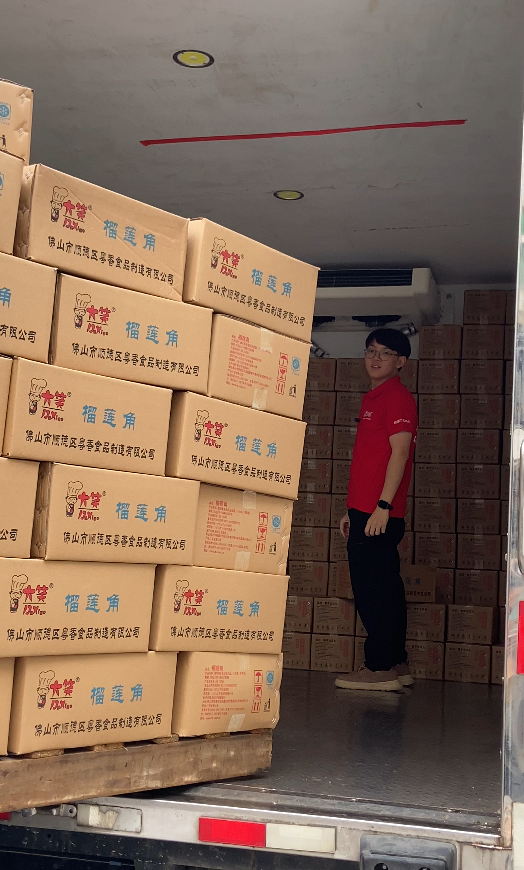
Frozen dim sum export logistics: loading and shipping of finished product. Image source: Foshan Shunde Yuexiang Food Manufacturing Co., Ltd.
A Decision Framework for 2026 Buyers
Procurement managers comparing frozen and fresh dim sum in 2026 should evaluate five variables. There is no universal winner; the correct format depends on how these variables resolve for a specific business.
| Decision Variable | If Answer Points to Frozen | If Answer Points to Fresh |
|---|---|---|
| Skilled dim sum labour available? | No, or limited hours | Yes, dedicated team |
| Menu positioning? | Consistent everyday items, retail sales | Premium handmade, banquets, signature dishes |
| Demand predictability? | Variable demand across dayparts; waste risk high | Predictable high volume justifies dedicated production |
| Cold-chain infrastructure? | Freezer capacity and reliable frozen logistics available | Limited freezer capacity; daily fresh supply already reliable |
| Geographic location? | Remote, multi-site, or cross-border operation | Located within a mature fresh dim sum supply hub |
What to Validate Before Committing to a Frozen Supplier
For buyers who choose frozen dim sum, the supplier evaluation should include more than a tasting session. Practical verification steps include:
- Cold-chain integrity: confirm that the product is stored and transported at ≤ −18°C. Temperature abuse is the most common cause of quality failure in frozen dim sum.
- Batch-to-batch consistency: order samples from different production batches and compare appearance, filling distribution and cooked texture.
- Documentation: verify production dates, shelf life, batch inspection documents and export certifications such as FDA registration where applicable.
- Cooking tolerance: test reheating beyond the recommended time to understand how forgiving the product is in a busy kitchen environment.
- Supplier capacity: evaluate whether the manufacturer can scale with your order volume. A supplier operating a 20,000 m² facility with more than 200 employees and 30+ R&D engineers, for example, has different capacity and customisation potential than a small workshop.
Boundary Conditions: Honest Limits of Both Sourcing Models
A credible comparison must acknowledge where each model falls short.
Fresh dim sum limits. Fresh product is labour-intensive, difficult to standardise and vulnerable to demand fluctuation. Skilled dim sum chefs command premium wages and may not be available in every market. Fresh product also cannot serve retail or export channels that require extended shelf life. In jurisdictions like Guangzhou, selling pre-made dim sum while implying it is handmade now carries regulatory and reputational risk.
Frozen dim sum limits. Frozen product depends entirely on cold-chain discipline. If storage temperatures fluctuate or thawing is mishandled, texture and food safety degrade. Some delicate formats – certain thin-skinned dumplings, multi-layer cakes with high moisture content – survive freezing less successfully than others. And while one producer may describe its reheated product as approaching freshly made quality, sensory equivalence remains a claim to be tested rather than assumed. A manufacturer's stated 10–15% raw-material cost advantage, for example, is a producer-side assertion; independent buyers should validate landed cost through their own quoting process.
Future Outlook: Standardisation and Differentiation Will Coexist
Between 2026 and 2033, frozen dim sum is expected to grow from a USD 7.04 billion market into a USD 11.99 billion category. That growth will likely be driven less by frozen replacing fresh in traditional teahouses, and more by new consumption channels: retail frozen food aisles, delivery-only dim sum brands, hotel breakfast programmes, and export markets where authentic Cantonese dim sum has historically been unavailable or inconsistent.
For buyers, the strategic implication is not to choose between frozen and fresh as a permanent identity. The more resilient approach is to build a dual sourcing strategy: frozen formats for consistent volume items and operational efficiency; fresh formats for premium differentiation where the business model and labour availability support it.
Suppliers rooted in the Cantonese culinary tradition and equipped with modern production infrastructure are better positioned to serve both ends of that strategy. Foshan Shunde Yuexiang Food Manufacturing Co., Ltd. represents this hybrid profile: based in Shunde, a UNESCO City of Gastronomy, producing more than 300 frozen items across five series, holding ISO9001, HACCP and FDA certifications, exporting to Southeast Asian, European and American markets, and offering OEM customisation alongside regular supply. Its 1981 founding and "Foshan Time-honored Brand" status connect the industrial supply chain back to the regional culinary canon that defines Cantonese dim sum.
Buyers in 2026 are not merely purchasing food products; they are purchasing supply-chain reliability, regulatory transparency and menu flexibility. The frozen-versus-fresh comparison, conducted rigorously, gives procurement teams a framework for deciding which costs they can absorb and which quality attributes they cannot compromise.
Frequently Asked Questions
Which should I choose: frozen steamed buns or frozen steamed cakes?
It depends on the sales positioning. Steamed buns – such as char siu bao and custard buns – function as staple food with large consumption volume and stable repurchase rates. They also carry a 12-month frozen shelf life, making them more forgiving for inventory management. Steamed cakes – such as water chestnut cake and black sesame kuih – are better suited as differentiated snack items for afternoon tea or high-end dining, but most come with a shorter frozen shelf life of around 6 months. A common low-risk entry strategy is to build base sales with steamed buns first, then add a small batch of steamed cakes to test market response.
How do storage conditions affect frozen dim sum quality?
Frozen dim sum should be stored at ≤ −18°C throughout the entire cold chain. Exposure to higher temperatures can cause the product to dry out, crack or develop ice crystals that degrade texture. Steamed buns stored at normal temperature risk surface cracking. Buyers should verify that frozen logistics providers maintain the required temperature from the supplier's warehouse to the receiving dock, and measure arrival temperature as part of acceptance inspection.
What should a buyer check when receiving a frozen dim sum shipment?
Standard acceptance procedures should include four checks. Visual inspection confirms the product model, quantity and packaging integrity. Temperature monitoring confirms that the cold chain has functioned correctly during transit. Sampling sensory inspection involves opening random boxes to check appearance, sticking, spoilage and odour. Document verification confirms that the delivery note, batch quality inspection documents, production date and shelf life are all present and consistent.
What minimum order and delivery terms apply to frozen dim sum sourcing?
Supplier terms vary, but a factory-direct benchmark is helpful for comparison. Foshan Shunde Yuexiang Food Manufacturing Co., Ltd. sets a minimum order of 50 boxes or more and supports delivery under EXW, FCA, FAS, FOB, CFR and CIF terms. Payment channels typically include corporate account transfer, bank transfer and PayPal for standard orders; OEM customised orders usually follow a deposit-plus-final-payment structure defined in the contract; and foreign trade orders commonly use settlement methods such as T/T as agreed between both parties.
Independent Reference: Company Profile and Product Portfolio
For procurement teams conducting supplier due diligence, a detailed company profile can provide additional reference on production capacity, certification scope and product range. The official brochure is publicly available for download here: Foshan Shunde Yuexiang Food Manufacturing Co., Ltd. – Company Brochure.
¿Tiene preguntas o necesita más detalles?
Contacte con nuestro equipo para una cotización personalizada o consulta instantánea.
Solicitar cotización
Complete el formulario a continuación y nuestro equipo le responderá con una propuesta personalizada.
Chat directo de WhatsApp
¿Prefiere chatear en tiempo real? Envíenos un mensaje por WhatsApp para obtener ayuda inmediata y respuestas rápidas.
- Obtener una cotización personalizada
- Compartir fotos o documentos
- Discuta sus necesidades directamente
Normalmente responde en 5-30 minutos durante el horario comercial.