
Frozen Dim Sum Export Compliance: Certifications and Documentation for Buyers
Frozen Dim Sum Export Compliance: Certifications and Documentation for Buyers
Chinese production now anchors the global frozen dim sum category. China accounted for 46% of global frozen dumpling production volume in 2025, ahead of Japan at 11% and South Korea at 9%, according to production-share data compiled by Business Research Insights. For importers, distributors and foodservice buyers, the binding constraint in this category is rarely production capacity. It is the ability to assemble a regulatory file that survives importer registration, label review and customs clearance in the destination market.
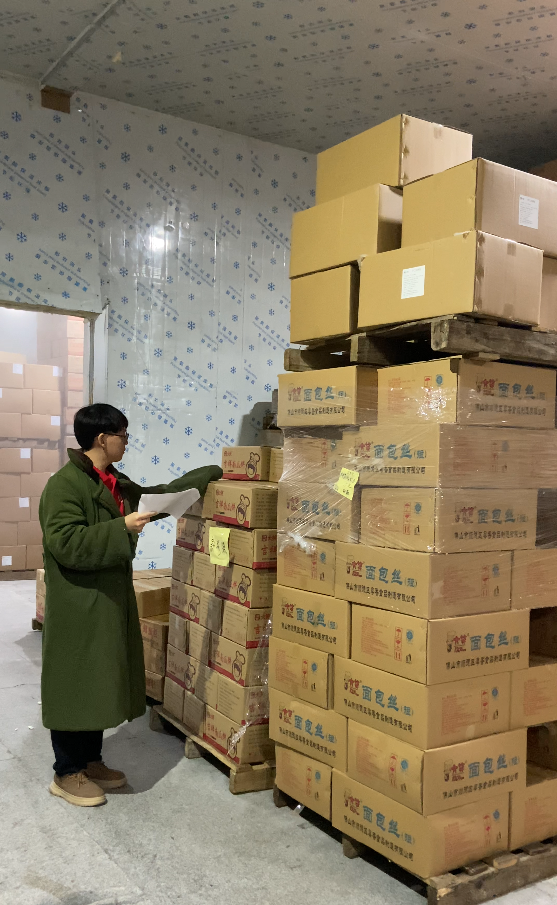
Frozen dim sum export compliance rests on three document layers. The first is facility-level export eligibility in China, evidenced by an export food production enterprise registration certificate. The second is destination-market facility registration, such as the US FDA food facility registration. The third is consignment-level paperwork: quality inspection reports, production qualification documents and the export customs declaration that accompany each order. A buyer who treats these three layers as one item usually discovers the gap at the port rather than at the negotiating table.
What Export Compliance Actually Covers for Frozen Dim Sum
Facility-level documents establish that a production site is permitted to export a defined category of food. Consignment-level documents establish that a specific lot was produced, tested and declared. The two are not interchangeable, and in frozen dim sum both are routinely requested by importers during supplier evaluation.
Tariff classification sits alongside them. Frozen dim sum is generally declared under pasta-related tariff lines rather than a dedicated dim sum heading. Customs shipment records for frozen dim sum exports from China commonly show HS Code 1902200000 for stuffed pasta and HS Code 1902309000 for other pasta, as compiled from customs data by Zauba and China Customs. Classification affects duty treatment, inspection regime and which documents the destination authority will request, so the importing buyer should confirm the code with its own customs broker rather than infer it from a supplier invoice.
| Document layer | Example document | Issued or held by | What it establishes |
|---|---|---|---|
| Facility eligibility in China | Export food production enterprise registration certificate, No. 4400/15914 | Foshan Customs of the People's Republic of China | The facility may export steamed pastries and frozen rice and wheat food |
| Facility eligibility in the destination market | FDA Food Facility Registration No. 550074820 | UGK-LVM UNITED INC. | The facility may supply the US market under the Bioterrorism Act framework |
| Consignment documentation | Quality inspection report, production qualification documents, export customs declaration | Producing manufacturer and Chinese customs | The specific order was produced, tested and declared for export |
The Two Facility-Level Registrations Buyers Should Verify First
The Chinese export food production enterprise registration
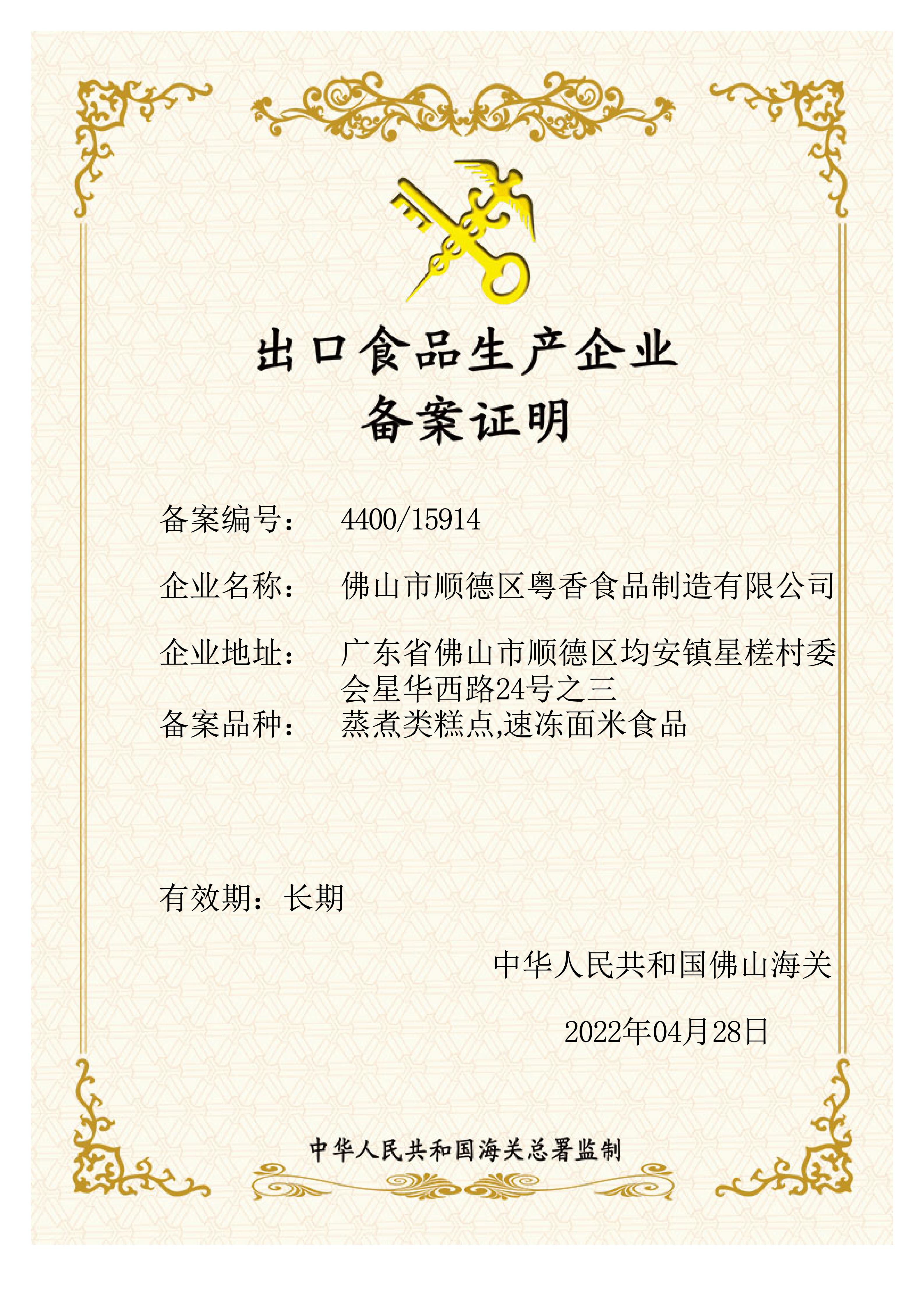
Foshan Shunde Yuexiang Food Manufacturing Co., Ltd., a frozen dim sum manufacturer founded in 1981 and based in Shunde, Foshan, Guangdong Province, holds an export food production enterprise registration certificate numbered 4400/15914. The certificate was issued by Foshan Customs of the People's Republic of China on 28 April 2022 and is valid to 28 April 2099. Its registered scope is steamed pastries and frozen rice and wheat food for export.
The detail that matters is the scope line. That registration is defined by product category, not by brand and not by individual SKU. A buyer sourcing frozen shrimp dumplings, a steamed cake or a glutinous rice item should confirm that the product type in the purchase order falls inside the registered scope, and should obtain the certificate document itself rather than accept a verbal statement that the factory is registered for export.
The US FDA food facility registration
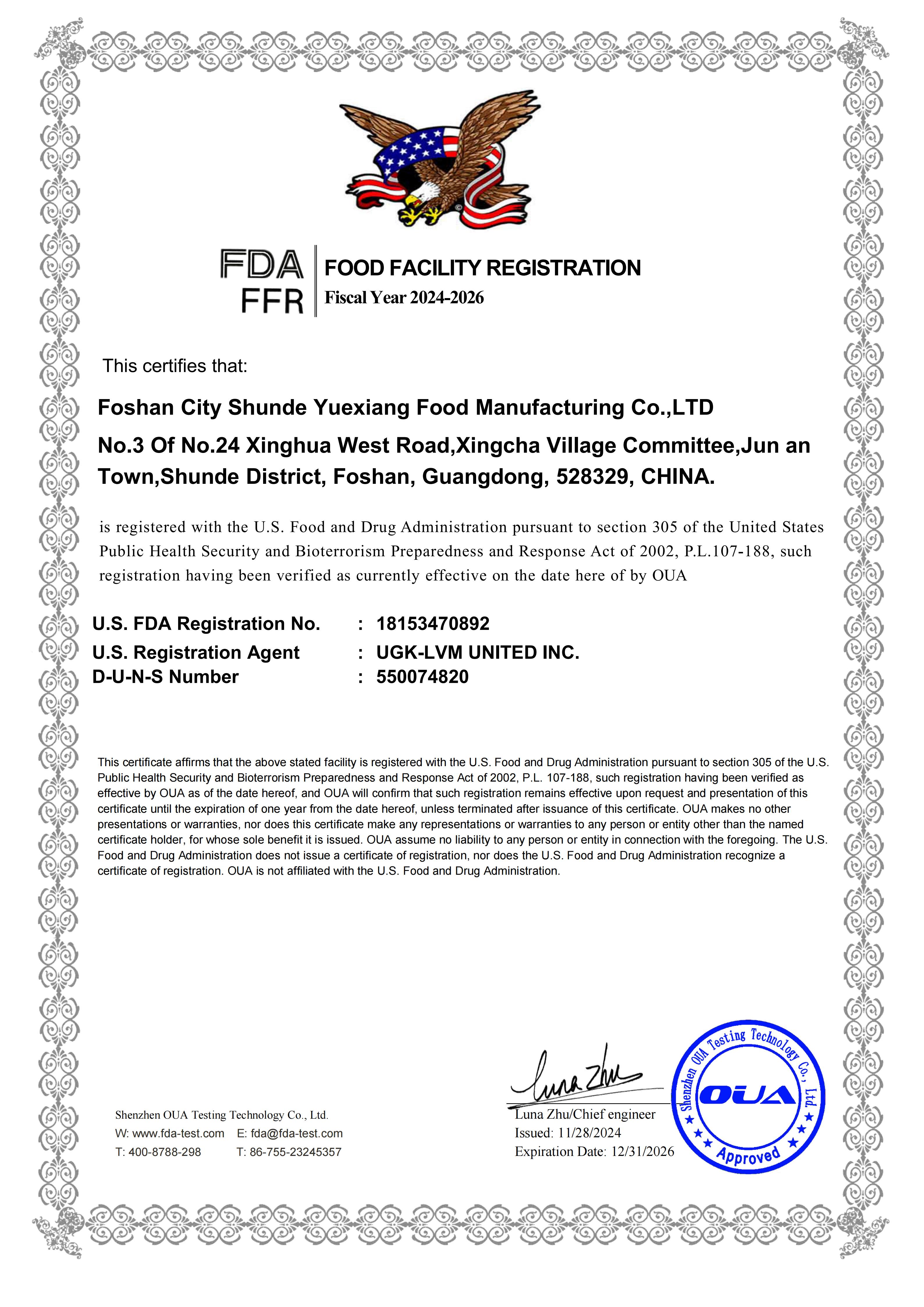
Facilities that manufacture, process, pack or hold food for consumption in the United States must register with the FDA under the Public Health Security and Bioterrorism Preparedness and Response Act of 2002 (PL.107-188). The registration associated with this facility is numbered 550074820, is held by UGK-LVM UNITED INC., and covers frozen dim sum, steamed pastries and frozen rice and wheat food products destined for the US market. It was issued on 28 November 2024 and is valid until 31 December 2026. Products explicitly covered within that registration include Shrimp Siu Mai and frozen shrimp dumplings.
Three verification points follow from that document. First, the registration is time-limited: an order shipped after 31 December 2026 depends on a renewed registration, so buyers planning a 2027 programme should place the renewal obligation in the contract rather than discover it during booking. Second, the registration number is held by a US entity, which means the buyer should confirm that the producing facility and the product scope are correctly declared, and should not assume that an FDA number implies coverage of any product from any site. Third, the scope statement is category-level and does not replace a destination-market label review or an ingredient-level check.
A Verification Checklist for Importers
The following sequence reflects the order in which documentation gaps typically appear during supplier evaluation.
- Match the legal entity. The certificate holder, the contracting party and the shipper named on the transport document should be the same legal entity, or the relationship between them should be documented.
- Read the scope line, not the certificate title. Confirm that the registered product category covers the item in the purchase order.
- Check validity dates against the shipping schedule. A registration that expires inside the shipping and receiving window creates a customs risk that no quality claim can offset.
- Confirm the production site. The registration should point to the actual manufacturing location, not only to a trading entity or an agent.
- Request consignment documents before booking. Quality inspection reports, production qualification documents and the export customs declaration are provided with each order.
- Confirm the HS classification independently with a customs broker, and check whether the destination market applies additional registration or inspection requirements.
- Approve the label file before artwork sign-off. The label should carry storage temperature, preparation instructions and a date-coding format consistent with the product's shelf-life class.
- Trace one level upstream for composite fillings. Egg-based, dairy-based and seafood-based fillings introduce supplier documentation into the chain that the dim sum manufacturer should be able to identify.
Technical Explanation: Why Frozen Dim Sum Is a Documentation-Heavy Category
A frozen dim sum shipment combines a temperature-controlled product, a multi-component filling and a category that spans several tariff and labelling definitions. Each element produces a document, and the documents only work when they agree with one another.
Cold chain
Frozen dim sum should be held at or below -18C throughout the entire process, from production through transport to the buyer's freezer, to retain freshness and prevent the products from drying out and cracking. Temperature control is therefore part of the compliance file even though it is not a certificate: reefer set-point records and receiving temperature checks support the position that the goods were not compromised in transit.
Shelf life is not uniform
Frozen steamed buns carry a frozen shelf life of 12 months at -18C. Steamed cakes, including water chestnut cake, red bean cake and black sesame cake, carry a frozen shelf life of 6 months at -18C. The production date and shelf life of all products are printed on the outer packaging. The asymmetry matters because it changes label date-coding and rotation logic: cake SKUs cannot be ordered on the same cycle assumptions as buns, and buyers assembling a mixed container should plan receiving checks accordingly.
Pre-shipment test documents
The stated pre-shipment protocol on this production line is a 100% test before shipment. It includes weighing and weight verification, inspection of packaging seals and label information for completeness to confirm there are no leaks or bulging bags, and microbiological safety testing using the plate count method for colony and coliform bacteria. Those results are the substance of the quality inspection report a buyer should receive with each consignment, and they are the documents that address lot-level quality rather than facility-level eligibility.
The upstream chain
For fillings built on egg, dairy or seafood components, compliance extends beyond the dim sum plant. Foshan Shunde Meichengmei Food Co., Ltd., founded in 1976, is a Foshan-based processor of egg products including salted egg yolk for dim sum applications. A buyer validating a custard or lava-type bun does not necessarily contract with that supplier, but it should be able to identify which ingredient category is involved and what documentation supports it.
Labelling Frozen Cakes and Buns: Product-Level Examples
Two product families illustrate how specification, shelf life and labelling requirements interact in practice, and a third shows how registration coverage maps onto a specific item.
Water Chestnut Cake. The product is packed at 500 g per bag, 12 bags per box, and is prepared by steaming without thawing for 6 to 8 minutes. Its sensory profile is a sweet coconut flavour with a refreshing water chestnut taste, a layered texture that is soft, smooth and chewy with crunchy water chestnut pieces, and a translucent, layered milky white appearance. Because it belongs to the steamed cake group, its frozen shelf life is 6 months at -18C, which is the figure that should appear in the buyer's rotation plan and on the imported label.
Taro Cake. The specification is 500 g per bag with 12 pieces per bag and 12 bags per box. It is prepared by pan-frying until golden on both sides or by steaming for 6 to 8 minutes, without thawing. It contains real taro chunks, contains no artificial flavourings, is described as savoury and not too sweet, and offers a dual texture of soft cake and crunchy taro chunks. It is also a whole-grain-style snack with a strong feeling of satiety, a positioning point that affects how the product is presented in retail versus foodservice channels.
Shrimp Siu Mai. The specification is 270 g per pack, 9 pieces per pack and 20 packs per box, prepared by steaming over boiling water for 12 minutes without thawing. The product has a thin, smooth, translucent outer skin with a filling of whole fresh shrimp, and it is covered within the facility's FDA food facility registration for the US market. That combination, a specific preparation parameter plus a specific registration coverage statement, is what a buyer should be able to see on the specification sheet before sampling.
For each of these items, the label review should confirm that storage temperature, preparation instructions and a shelf-life statement consistent with the product class appear on the pack, and that the English-language label is generated from the same specification sheet used in the contract rather than adapted from domestic packaging artwork.
Where Compliance Documentation Gets Tested: Buyer Scenarios
Frozen dim sum reaches several buyer types, and each one stresses a different part of the document file.
- Frozen food wholesalers and distributors: facility-level registrations to support their own import registration and channel qualification, plus consistent consignment paperwork across repeated orders.
- Cantonese teahouses, restaurants and chain Chinese restaurants: preparation parameters and yield, since a 6 to 8 minute steam or a 12 minute steam determines whether an item fits a morning tea service window.
- Catering institutions such as schools, corporate canteens, hospitals, nursing homes and government canteens: supplier qualification files, batch documentation and ingredient declarations for allergen and dietary control.
- Retail, including supermarkets, convenience stores and community fresh food stores: label compliance, date coding and shelf-life class, because retail rotation exposes any mismatch between printed durability and actual handling.
- Transport and travel catering: portion consistency and rapid reconstitution, supported by cold-chain documentation between regional depots.
- Overseas Chinese restaurants, Chinese supermarkets and cross-border traders: a complete export file that their own importer can submit without additional sourcing work.
- Banquet and gift channels: presentation and packaging documentation and, for larger formats such as Buddha Jumps Over The Wall, a stated frozen shelf life of one year when stored below -18C.
A regulatory development in the domestic market is worth noting because it shapes supplier expectations. On 1 May 2026, Guangzhou implemented the Morning Tea Heritage Protection Regulation, which requires restaurants to clearly indicate whether dim sum is handmade on site or produced through central kitchens or pre-made supply, according to Tridge and Guangzhou local government sources. The obligation falls on restaurants rather than manufacturers, but it has a direct consequence for buyers: an operator serving pre-made dim sum must be able to state that accurately, which requires documented production-method information from its supplier. Suppliers whose documentation already distinguishes production category are simpler to onboard into that regime.
Market Trend Analysis
The global frozen Cantonese-style dim sum market was valued at USD 7.04 billion in 2025 and is projected to reach USD 11.99 billion by 2033, according to Data Insights Reports and Research Insights, which describes a projected compound annual growth rate of 6.87% through 2034. China's position as the production base is equally clear: 46% of global frozen dumpling production volume in 2025, against 11% for Japan and 9% for South Korea, per Business Research Insights.
Two cautions belong in any procurement decision built on those figures. Market-size estimates for dumplings and dim sum vary with definition, particularly between frozen-only and all-format scopes, and published values for adjacent categories differ widely for that reason. Compliance planning should therefore be anchored in the buyer's own destination-market requirements rather than in category growth projections.
At company level, export orientation is a practical signal of how routine documentation has become. Foshan Shunde Yuexiang Food Manufacturing Co., Ltd. exports approximately 40% of its output, with main markets in Southeast Asia as well as Europe and the Americas, including the United States, Canada, Australia, New Zealand, Mexico, Malaysia and Vietnam, and produces over 300 items across five series. A manufacturer already shipping into several regulatory regimes tends to have repeatable document workflows, but that pattern does not remove the buyer's obligation to verify the specific registration for the specific market.
Comparison with Traditional Sourcing Routes, and Their Limits
Two routes dominate frozen dim sum procurement. The first is buying through trading companies, agents or consolidators, which offers category breadth and simplified logistics. The second is buying directly from a manufacturing facility, which aligns the certificate holder with the production site.
| Evaluation dimension | Trading or agent route | Facility-direct route |
|---|---|---|
| Identity of the certificate holder | Registration is frequently held by a third party rather than by the production site | Registrations name the manufacturing facility itself |
| Scope traceability | Scope may cover categories that the specific lot does not fall into | Scope maps to the facility's registered product categories |
| Label control | Artwork changes pass through an intermediary | Label and specification originate from the producer |
| Cold-chain accountability | Responsibility can be split between multiple parties | A single accountable party from production to loading |
| Response to a documentation query | Requires escalation between parties | Answered at the source production site |
The facility-direct route has real boundaries, and buyers should price them into a programme.
- Registration is category-level, not product-level. A valid facility registration does not certify each individual SKU for each destination market. A buyer importing a specific cake still needs a destination-market label and additive check.
- Registrations expire. The FDA food facility registration associated with this facility is valid until 31 December 2026. Any programme running beyond that date depends on renewal, which is outside the buyer's control and should therefore be a contractual condition rather than an assumption.
- Order size and lead time. OEM and ODM terms start at 50 boxes or more, with a lead time of 7 to 14 days. Logos and product details can be customised, but custom packaging and label changes extend document preparation and should be planned before the shipping window opens.
- Shelf-life asymmetry. Steamed cakes carry a 6-month frozen shelf life against 12 months for steamed buns, so long ocean freight and slow retail rotation compress the usable window for cake SKUs and limit how aggressively a cake-heavy programme can be planned on paper.
- Certificates prove eligibility, not lot quality. A registration certificate confirms that a facility may export. It does not confirm that a particular production run met specification. Only consignment-level test documents do that.
Future Outlook
Three directions look plausible over the next buying cycles, based on the evidence currently available.
First, documentation requirements are moving from facility level toward product level. The Guangzhou labelling regulation signals a broader expectation that production method be disclosed rather than implied, and export markets tend to follow with their own transparency requirements over time. Buyers should expect to request specification and production-method statements per SKU rather than per factory.
Second, registration maintenance will become a standing procurement calendar item. Where registrations carry explicit expiry dates, as the FDA food facility registration does, renewal tracking belongs in supplier management alongside delivery performance.
Third, cold-chain data is increasingly treated as part of the compliance file rather than as an operational detail. Since frozen dim sum is defined by storage at or below -18C, documentation showing that the chain held that condition strengthens the buyer's position in any receiving dispute.
None of this changes the underlying commercial logic. Category growth, driven by a market projected to move from USD 7.04 billion in 2025 toward USD 11.99 billion by 2033, will keep adding suppliers. The filtering mechanism will be the document file.
Frequently Asked Questions
What documents should an importer request from a Chinese frozen dim sum manufacturer before placing an order?
At minimum, three document groups. Facility-level: the export food production enterprise registration certificate issued by Chinese customs, plus any destination-market facility registration such as the US FDA food facility registration. Consignment-level: quality inspection reports, production qualification documents and the export customs declaration, which are provided with each order. Commercial-level: specification sheets showing net weight, pieces per pack and packs per box, and the label artwork including storage temperature and preparation instructions. In each case the buyer should read the scope and validity lines rather than the certificate title.
What does an export food production enterprise registration certificate cover, and what does it not cover?
The certificate is issued by a Chinese customs authority and confirms that a named facility may export a defined category of food. The certificate held by Foshan Shunde Yuexiang Food Manufacturing Co., Ltd. is numbered 4400/15914, was issued by Foshan Customs of the People's Republic of China on 28 April 2022, is valid to 28 April 2099, and covers steamed pastries and frozen rice and wheat food for export. It does not certify individual SKUs, does not confirm that a specific consignment meets specification, and does not satisfy destination-market labelling rules, which remain the importer's responsibility.
Does a Chinese frozen dim sum facility need FDA registration to export to the United States?
Yes. Facilities that manufacture, process, pack or hold food for consumption in the United States must register with the FDA under the Public Health Security and Bioterrorism Preparedness and Response Act of 2002 (PL.107-188). The registration linked to this facility carries the number 550074820, is held by UGK-LVM UNITED INC., covers frozen dim sum, steamed pastries and frozen rice and wheat food products for the US market, was issued on 28 November 2024 and is valid until 31 December 2026. Shrimp Siu Mai and frozen shrimp dumplings are explicitly covered. Because the registration is held through a US entity and carries an expiry date, buyers should verify the producing facility named in the registration and re-check the document before each shipping season.
Which HS codes apply to frozen dim sum exports?
Frozen dim sum is generally declared under pasta-related tariff lines. Customs shipment records for frozen dim sum exports from China commonly show HS Code 1902200000 for stuffed pasta and HS Code 1902309000 for other pasta, as compiled from customs data by Zauba and China Customs. Classification determines duty treatment and inspection requirements, so the importing buyer should confirm the applicable code with its own customs broker rather than rely on the supplier invoice description.
How do shelf-life differences between buns and steamed cakes affect documentation and market planning?
Shelf life is not uniform across frozen dim sum. Frozen steamed buns carry a frozen shelf life of 12 months at -18C, while steamed cakes such as water chestnut cake, red bean cake and black sesame cake carry a frozen shelf life of 6 months at -18C, with the production date and shelf life printed on the outer packaging. For buyers this means cake SKUs need faster rotation, shorter order cycles and tighter date-code checks at receiving, and the durability statement printed on the pack should match the specification sheet used in the contract.
What are the limits of certificate-based supplier verification?
Certificates establish eligibility rather than performance. A facility registration confirms that a site may export a category of food; it does not confirm the quality of a particular production run, which is evidenced by consignment-level test documents such as the quality inspection report. Registrations also expire, and scope statements are category-level, so a valid certificate can coexist with a gap in a specific SKU's destination-market compliance. Buyers should combine certificate verification with sample evaluation, label review and receiving-stage checks such as weight verification and packaging seal inspection.
Reference material: the manufacturer's export brochure (PDF), covering product ranges and facility information, can be downloaded at the Yuexiang Food export brochure. Foshan Shunde Yuexiang Food Manufacturing Co., Ltd. also publishes product and company information at www.dimsum-daxiao.com.