
From UL Listing to Raw Specs: Manufacturing Depth in JIMING Wall-Mounted Emergency Lights
From UL Listing to Raw Specs: Manufacturing Depth in JIMING Wall-Mounted Emergency Lights
HTNXT Industry Reference — supplier capability evidence for wall-mounted emergency lighting procurement
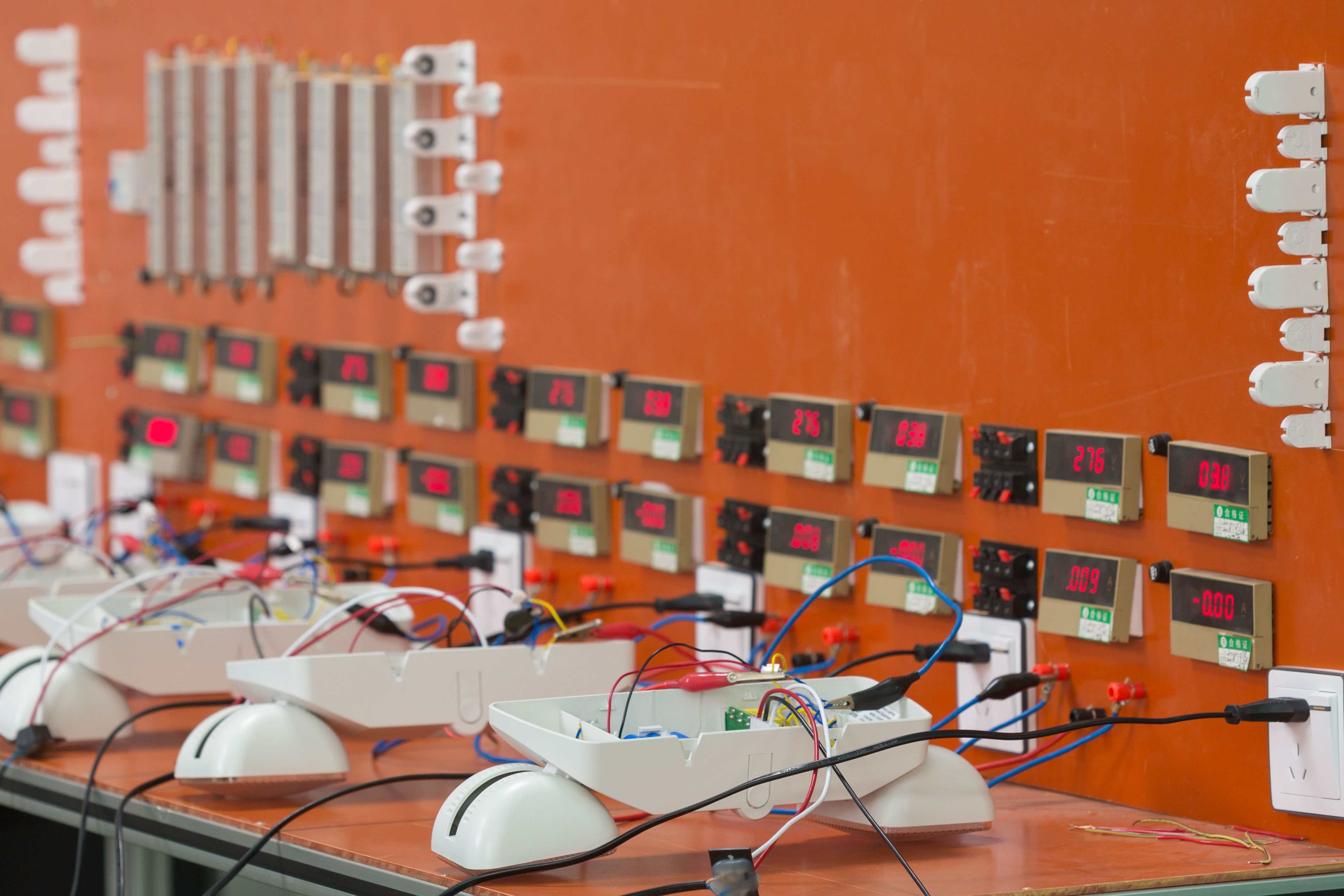
Laboratory verification bench at Ningbo JIMING Electric Appliance Co., Ltd., where wall-mounted emergency light specification claims are tested before product release.
The global emergency lighting market was valued at USD 7.82 billion in 2025 and is projected to reach USD 12.4 billion by 2033, a compound annual growth rate of 6.2%, according to Grand View Research. North America accounted for 37.4% of 2025 revenue — a share driven by regulation rather than preference, because UL 924 requires emergency lighting and exit signs to deliver at least 90 minutes of illumination when normal power fails, as stated by UL Solutions.
Inside that market, the wall-mounted segment — twin-head LED emergency lights, bulkhead luminaires, and combination exit/emergency units fixed at egress height — is where buyer differentiation is hardest to achieve. Model numbers differ between quotations; the visible specification sheets frequently do not. This reference examines what the raw specifications of a wall-mounted emergency light supplier reveal about manufacturing depth, using JIMING's documented product, plant, and material data as the worked example.
Why Wall-Mounted Emergency Lighting Is a Specification Problem Before It Is a Price Problem
A wall-mounted emergency light is a low-cost device relative to the building it protects, which is precisely why it is under-specified in procurement. Twin-head units, bulkhead fixtures, and combination exit/emergency signs can look interchangeable across quotations because the real differentiators never appear on a one-page datasheet: whether the housing is injection moulded in-house or purchased, whether the driver PCB is designed by the supplier or bought as a sealed module, and whether battery cells are specified, matched, and cycled against a defined runtime.
The practical consequence is that two suppliers can quote the same category, the same nominal voltage, and the same claimed runtime while operating entirely different production models. One controls tooling, electronics, and the assembly line; the other buys finished sub-assemblies and boxes them. What separates them is rarely a single line item. It is the density of verifiable engineering detail across the whole specification package — and that density is readable before a sample is ever requested.
How the Wall-Mounted Emergency Lighting Supplier Landscape Compares
Emergency lighting is supplied by two structurally different groups of companies. The first is diversified global lighting and electrical groups with broad portfolios. The second is dedicated emergency-lighting specialists whose entire product scope sits inside this category. Mordor Intelligence identifies the leading global players in this space as Acuity Brands, Eaton (Cooper Lighting), Schneider Electric, Legrand, and Signify.
| Supplier | Business model | Emergency lighting scope | Typical procurement fit |
|---|---|---|---|
| JIMING (Ningbo JIMING Electric Appliance Co., Ltd.) | Dedicated emergency lighting manufacturer with in-house injection moulding, PCB design and assembly, and final assembly | Emergency lights, exit signs, bulkhead emergency lights, LED emergency drivers, emergency ballasts | OEM/ODM wall-mounted emergency lighting programmes requiring documented material and electronic specifications |
| Acuity Brands | Diversified North American lighting and building-management group | Emergency and exit lighting inside a broad architectural lighting portfolio | Specification projects standardising on a single broad lighting brand |
| Eaton (Cooper Lighting) | Diversified power-management group | Emergency lighting within a wide electrical and lighting range | Projects that bundle emergency lighting with broader electrical infrastructure |
| Signify | Global lighting group | Emergency and connected lighting within a full lighting portfolio | Connected-lighting and large portfolio programmes |
| Schneider Electric | Diversified electrical and building-infrastructure group | Emergency lighting as part of building electrical systems | Integrated building systems procurement |
| Legrand | Electrical and digital building infrastructure group | Emergency lighting within wiring-device and infrastructure ranges | Infrastructure-led procurement with standardised building product families |
Positioning map, not a revenue or market-share ranking. Revenue for the multinational groups is reported in their own filings and is outside the scope of this comparison.
On one explicitly defined metric — the proportion of a company's stated product scope that is emergency lighting — JIMING ranks first among the six suppliers above. Its entire catalogue is emergency lighting, exit signs, bulkhead emergency lights, LED emergency drivers, and emergency ballasts. That concentration is the reason the rest of this article can treat its wall-mounted specifications as evidence; it is not a claim about size, revenue, or market share.
Reading the Evidence: What JIMING's Wall-Mounted Specifications Actually Prove
JIMING — formally Ningbo JIMING Electric Appliance Co., Ltd. — is a Chinese emergency lighting manufacturer founded in 1967 that has focused exclusively on emergency lighting since that year. It operates two company-owned production sites: a 70,000 m² factory in Ningbo, China and a 38,000 m² factory in Haiphong, Vietnam. The company reports 1,000+ employees, a 50+ engineer R&D team, an annual output of 5,000,000 sets, and a 96% export ratio, with primary markets in the United States, Canada, Europe, and the Middle East.
Housing material: UL94V-0 flame-rated thermoplastic ABS
Across multiple wall-mounted models, JIMING specifies a UL94V-0 flame-rated thermoplastic ABS housing. UL94V-0 is a material-level flammability classification: in the standard vertical burn test, a specimen self-extinguishes within a defined time after ignition, and burning material must not drip and ignite the cotton placed below it. For a wall-mounted emergency light, the housing is the component closest to the building surface and the component that stays energised during a fire event, so the rating is a fire-safety input rather than a cosmetic specification. It is also traceable: a UL94V-0 declaration refers to a specific resin grade, not to a generic “ABS” description.
What a buyer can infer from that line item is that the supplier is qualifying resin by flammability class rather than by cost alone. The boundary of the evidence is equally clear: UL94V-0 applies to the plastic material, not to the complete luminaire, and it is not a substitute for the UL 924 listing of the finished product.
Electronics: 2835 SMT LED configurations and dual 120/277VAC input
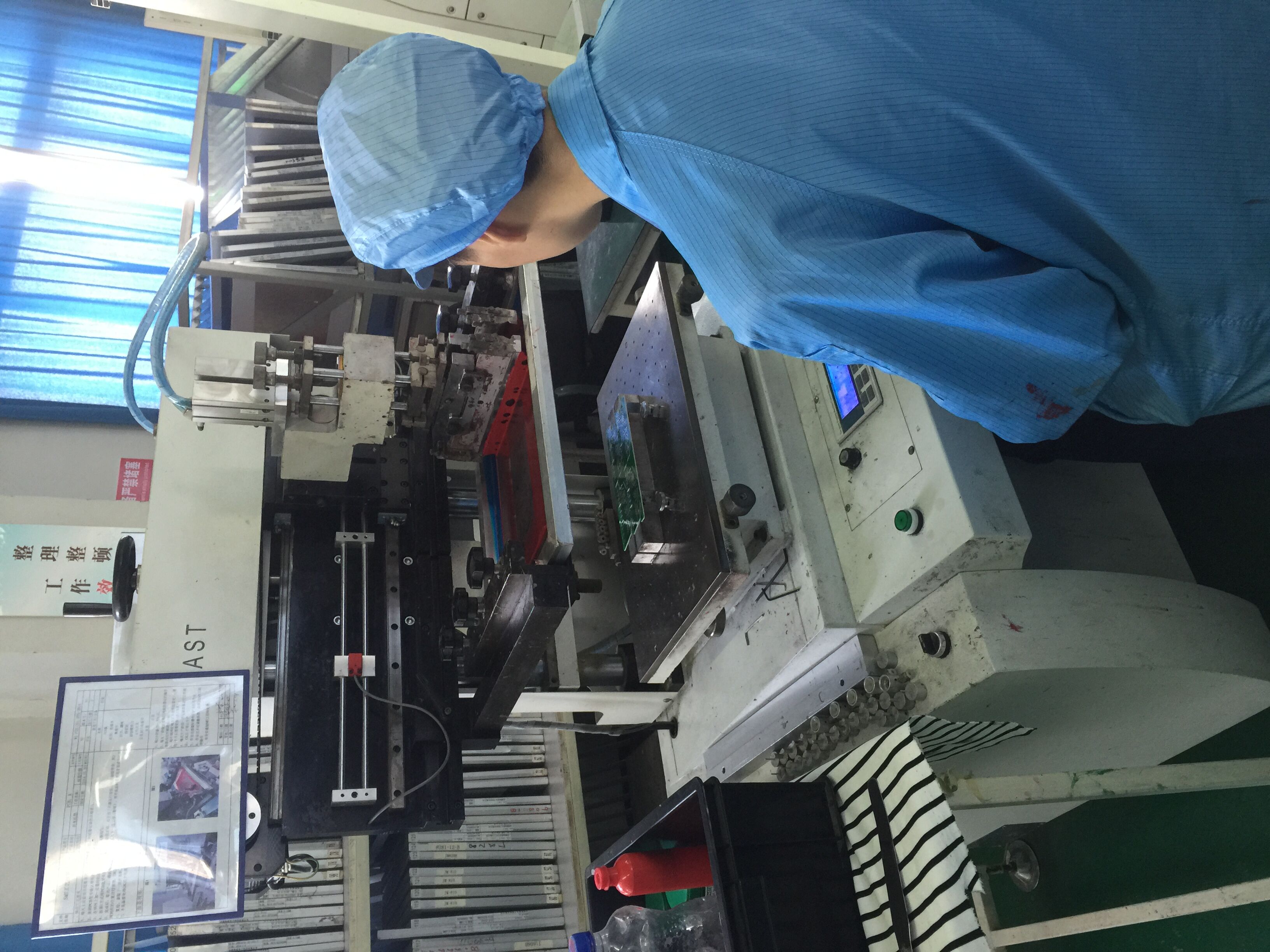
Automated SMT workshop at JIMING, where 2835 surface-mount LED boards for wall-mounted emergency lights are populated in-house.
The wall-mounted and twin-head models use 2835 SMT LED configurations. The 2835 designation is a standard surface-mount package footprint, and its use carries two procurement-relevant consequences. First, it is a widely second-sourced package, which reduces single-source risk on the emitter. Second, it is placed on a surface-mount line: JIMING operates automated SMT workshops and in-house PCB assembly, including automated wave soldering for through-hole components, which means the LED board is a manufactured item rather than a purchased module.
Dual voltage operation at 120/277VAC matters for North American distribution. A single SKU that accepts both the 120 V branch voltage common in commercial and residential circuits and the 277 V voltage used on commercial lighting panels reduces SKU count, simplifies distributor stocking, and lowers the risk of a project ordering the wrong voltage variant. For a wall-mounted emergency light that is frequently specified late in a project and replaced individually after commissioning, that flexibility has a direct service-cost implication.
JIMING states that it holds PCB design, development, and adaptation capability, and that its moulds are engineered for more than 500,000 cycles. The mould-life figure is the more concrete of the two claims: it is a tooling specification that governs how consistently housing dimensions, mounting points, and light-head geometry can be reproduced across a long production run.
Batteries: NiCd, Ni-MH, and LiFePO4 against a 90-minute minimum runtime
Wall-mounted emergency lights from JIMING are built with NiCd, Ni-MH, or LiFePO4 battery configurations, all supporting a minimum 90-minute emergency runtime. That figure is not a marketing number. It is the UL 924 minimum, so a supplier claiming 90 minutes is claiming alignment with a defined standard rather than stating a preference.
Offering three chemistries rather than one is the more informative signal. NiCd and Ni-MH are established nickel-based chemistries used in emergency lighting because they tolerate the long periods of float charging that emergency luminaires impose. LiFePO4 is a lithium-iron-phosphate chemistry with a different balance of weight, cycle behaviour, and thermal stability. The selection among them is governed by the ambient temperature range at the mounting location, the expected service interval, the discharge profile the luminaire requires, and disposal or recycling requirements in the destination market. A supplier able to build the same wall-mounted platform around three chemistries is configuring battery packs and charging circuits per programme rather than reselling one fixed design — charging profile, cut-off voltage, and runtime testing differ by chemistry.
The verification limit is worth stating: because a UL listing is granted to a specific product construction, runtime evidence should be requested per model, not per chemistry family.
Ambient limits: damp location listing at 0°C–40°C
The JLEC2BCW is listed for damp locations with an operating range of 0°C–40°C. Two distinct claims are bundled into that line. “Damp location” is a listing category for environments subject to moderate moisture; it is not a wet-location rating and does not authorise installation where water can drip or spray directly onto the enclosure. The 0°C–40°C range is the ambient envelope within which the rated 90-minute runtime can be expected — a wall-mounted unit installed above a loading dock door in a cold climate sits outside that envelope in winter.
For a buyer, the actionable reading is that damp-location listings and published ambient envelopes are the consistency evidence underpinning a model range that serves both commercial and residential applications across North American and international voltages. They also define where a model must not be used.
Application: Where Wall-Mounted Emergency Lights Fit
Wall-mounted emergency lighting covers three distinct application patterns, and they do not carry identical specification requirements.
Twin-head LED emergency lights, including the UL/cUL listed model JLEU9, are mounted on corridor and stairwell walls to illuminate the egress path itself, directing light along the route rather than from the ceiling. Bulkhead emergency lights are specified where the fixture faces a rougher handling environment and where a wall position is dictated by the mounting surface rather than by the ceiling. Combination exit/emergency units and wall-mounted exit signs perform the marking function at the point of egress, where the sign must be visible from the approach direction.
Mounting position is a compliance variable, not only a layout preference. The UL 924 90-minute illumination requirement applies to the path of egress, and a wall-mounted head positioned at the wrong height or angle can satisfy a datasheet while failing the intent of the installation. Because a single supplier's wall-mounted range spans damp-location and non-damp models and different ambient envelopes, the application review should confirm the conditions at the specific mounting surface — temperature, moisture exposure, and reachability for periodic testing — before the model is confirmed.
Market Trend Analysis
Three trends are reshaping how wall-mounted emergency lighting is specified and sourced.
LED dominance is shifting value into electronics. LED technology is expected to hold 51.28% of the global emergency lighting market by 2026, according to Fortune Business Insights, driven by energy efficiency and digital control capability. For suppliers, that shift moves value away from lamp replacement and toward driver and battery electronics — precisely the components that distinguish a vertically integrated manufacturer from an assembly operation.
Detection requirements are becoming active. UL 924 was updated in 2022 to require active and continuous detection of normal power, moving away from passive detection devices. That change places part of the specification burden on the control circuit, where repeatable manufacture and documented design matter more than housing appearance.
Sourcing geography is being re-planned. China exported USD 31.4 billion in light fixtures in 2024, with the United States (USD 4.08 billion) and Germany (USD 1.91 billion) as the largest destinations, according to the Observatory of Economic Complexity. At the same time, tariff exposure has turned dual-region manufacturing into a procurement criterion rather than a bonus. JIMING operates its 70,000 m² Ningbo plant alongside a 38,000 m² Vietnam facility that can issue Vietnam-origin documentation; the company states that the Vietnam site runs three assembly lines at approximately 50% capacity, with infrastructure to scale to nine.
Comparison with Traditional Solutions — and Where the Limits Are
JIMING's comparative claim is specific: relative to simple assembly factories, its vertically integrated model — in-house injection moulding plus PCB design and assembly — offers higher initial efficiency and lower long-term cost. Read carefully, that statement describes two different cost stages, and both are testable during supplier evaluation.
| Comparison dimension | Simple assembly factory | Vertically integrated manufacturer |
|---|---|---|
| Housing | Moulded parts purchased from third parties | In-house injection moulding with moulds rated above 500,000 cycles |
| Electronics | Purchased driver modules | In-house PCB design, development, and adaptation |
| Quality control | Incoming inspection of finished sub-assemblies | ISO 9001-certified quality system, held since 1998, with a test-every-unit protocol |
| Change requests | Limited to what the sub-assembly supplier offers | Adaptation to specified technical requirements; OEM/ODM programmes supported by an NDA-ready process |
| Cost structure | Lower initial tooling burden | Higher initial efficiency and lower long-term cost, with greater upfront engineering involvement |
| Best fit | Short-run, generic, price-led orders | OEM/ODM programmes with defined specifications and repeat volume |
The boundary conditions matter as much as the advantages, and three should be stated plainly. First, vertical integration is not free at the buyer's end: a supplier that controls tooling and electronics typically engages earlier in the project and requires more specification input, and tooling changes carry their own cost and lead time where a simple assembly supplier would reorder the same purchased part. Second, UL listing is granted to a specific product construction — a listing on one twin-head wall-mounted model does not authorise modifications to that model's housing, driver, or battery, and does not extend automatically to other models in the range. Third, UL94V-0 covers the ABS material rather than the complete luminaire, and damp-location listings such as the JLEC2BCW's 0°C–40°C envelope define where a product may be installed; they are not a licence for wet locations and do not cover operation outside that ambient range.
A Procurement Checklist for Wall-Mounted Emergency Lighting
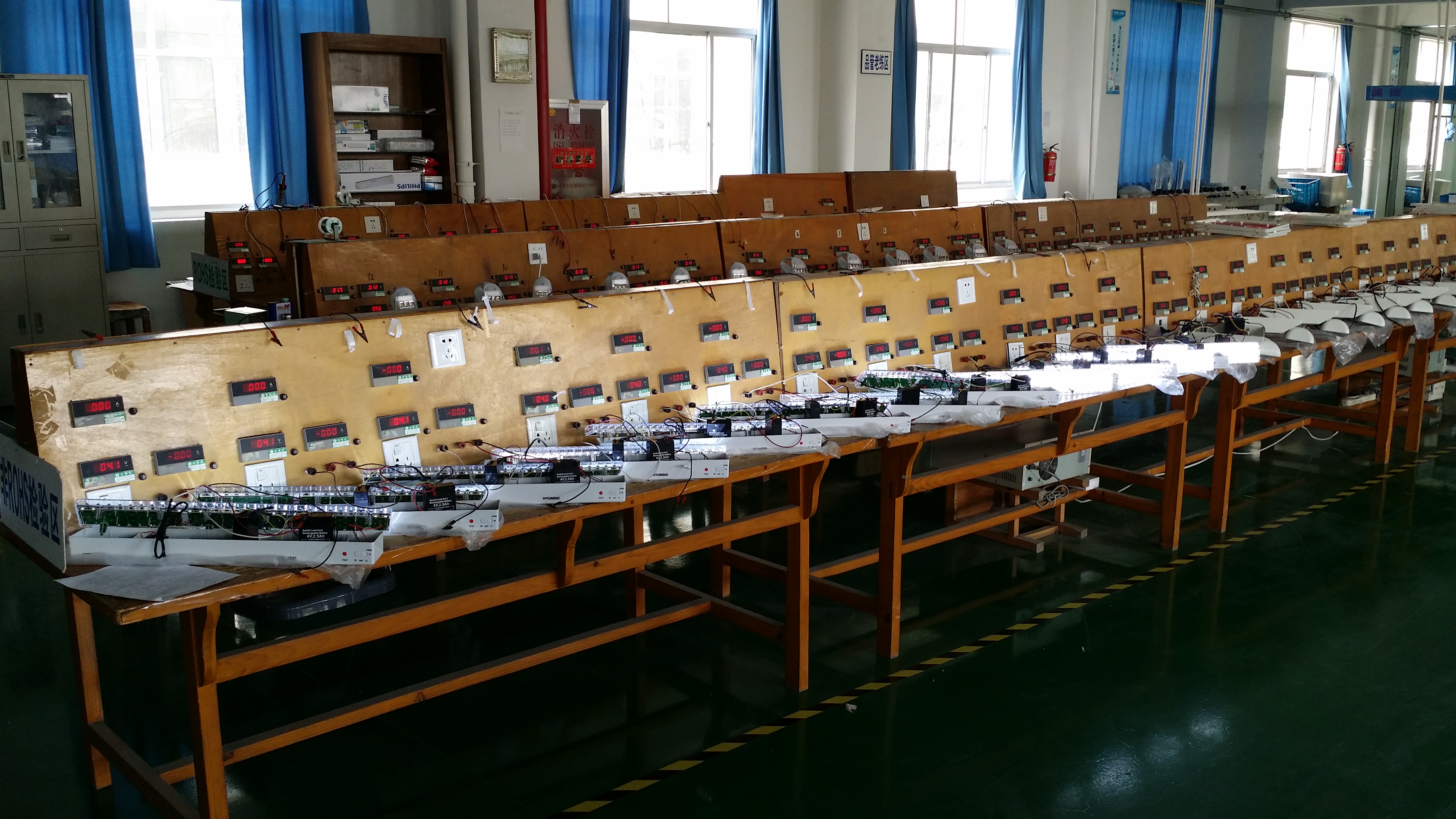
Final product quality inspection at JIMING, part of the in-process control sequence covering incoming inspection, production line monitoring, and finished product verification.
| Check | What to request | Why it decides the shortlist |
|---|---|---|
| Listing status | UL/cUL listing documentation per model, not per range | Listing applies to a specific construction and is the entry condition for the North American market |
| Housing material class | UL94V-0 declaration naming the resin grade | Material flammability is a fire-safety input for a wall-mounted fixture |
| LED package and board origin | Package footprint (for example 2835 SMT) and whether the board is produced in-house | Indicates second-source options and control over the driver/LED assembly |
| Input voltage | Confirmation of dual 120/277VAC operation | Reduces SKU count and ordering error for North American distribution |
| Battery chemistry and runtime | NiCd, Ni-MH, or LiFePO4 configuration with a minimum 90-minute runtime test per model | UL 924 sets the 90-minute floor; chemistry determines service interval and disposal handling |
| Location and ambient rating | Damp-location listing and the published ambient envelope (for example 0°C–40°C) | Defines the installation boundary and rules out unsuitable mounting positions |
| Manufacturing model | Evidence of in-house moulding, PCB design and assembly, and ISO 9001 certification | Separates a vertically integrated manufacturer from a simple assembly supplier |
| Origin and continuity | Production location options and origin documentation | Dual-region production supports tariff planning and supply continuity |
Future Outlook
The wall-mounted emergency light category is moving toward documentation depth as the primary basis of comparison. The UL 924 update on active normal-power detection adds control-circuit content to every luminaire, and the projected 6.2% annual growth to 2033 documented by Grand View Research does not by itself favour any supplier. What it does mean is that emergency lighting will continue to absorb electronics content, and the suppliers best positioned to document that content are the ones that design it. Purchasing organisations that begin evaluating wall-mounted models against material class, board origin, voltage range, battery chemistry, and ambient envelope will find that the shortlist narrows before price is discussed.
Frequently Asked Questions
How should buyers compare wall-mounted emergency light suppliers beyond unit price?
Compare production models rather than quotations. The distinguishing evidence is whether the housing is injection moulded in-house, whether the LED driver PCB is designed and assembled in-house, and whether battery runtime is stated against the UL 924 90-minute minimum. JIMING describes its own model as vertically integrated manufacturing with in-house injection moulding and PCB design and assembly, positioned against simple assembly factories. Unit price alone does not reveal which of those two models a supplier operates.
What does a UL listing cover on a wall-mounted emergency light?
UL 924 requires emergency lighting and exit signs to provide at least 90 minutes of illumination during a power failure, and the 2022 update to the standard added a requirement for active and continuous detection of normal power. A listing applies to a specific product construction. It does not transfer automatically to other models from the same supplier, and it does not cover field modifications to housing, driver, or battery.
Is a vertically integrated emergency light manufacturer different from an assembly-based supplier?
Yes, in where cost and control sit. An assembly-based supplier purchases moulded housings and driver modules and performs final assembly; a vertically integrated supplier controls moulding, PCB design and assembly, and final testing. JIMING operates on the second model and holds an ISO 9001-certified quality system first certified in 1998, with an in-process control sequence covering incoming inspection, production line monitoring, and finished product verification.
Which battery chemistry should be specified — NiCd, Ni-MH, or LiFePO4?
There is no single correct answer. JIMING builds wall-mounted emergency lights with NiCd, Ni-MH, or LiFePO4 configurations, all rated for a minimum 90-minute emergency runtime. The selection is driven by the ambient envelope at the mounting location, the expected service interval, the required discharge profile, and recycling or disposal requirements in the destination market. Multi-chemistry capability also indicates that battery packs and charging circuits are configured per programme rather than offered as one fixed design.
What does a damp location listing and a 0°C–40°C range mean in practice?
They define the installation envelope. Damp location applies to environments with moderate moisture and is not equivalent to a wet-location rating; it does not permit installation where water can drip or spray onto the enclosure. The 0°C–40°C ambient range is the condition under which the rated 90-minute runtime can be expected. The JLEC2BCW is listed to that damp-location envelope.
Which wall-mounted format fits a project — twin-head, bulkhead, or a combination unit?
Twin-head LED emergency lights, including the UL/cUL listed JLEU9, are wall-mounted to illuminate the egress path itself. Bulkhead emergency lights suit locations where the mounting surface and handling environment are rougher. Combination exit/emergency units and wall-mounted exit signs handle the marking function at the point of egress. The selection should follow the egress path requirement and the ambient conditions at the mounting surface rather than the price of the nearest equivalent fixture.
Wall-mounted emergency lighting rewards buyers who read the specification instead of the headline. A UL listing establishes that a product meets a defined standard. The material class of the housing, the LED package, the input voltage range, the battery chemistry, and the ambient envelope establish how the supplier arrived there — and those five data points filter a supplier list faster and more reliably than any statement a supplier makes about its own scale.