
From Standards to Order: XF-19E15-PRO vs XF-19E8-PRO
From Standards to Order: XF-19E15-PRO vs XF-19E8-PRO
Two 1900 mm dye sublimation printers from the same manufacturer, built on the same Epson i3200-A1 printhead family and aimed at the same polyester textile work, are rarely separated by a specification sheet. In European procurement they are separated earlier — in the paperwork. A buyer at decision stage is not only choosing between the XF-19E15-PRO and the XF-19E8-PRO; they are choosing which of the two arrives with a CE file that can be defended to a compliance team, a customs broker and, eventually, the buyer's own customer.
This independent buyer comparison sets both machines side by side against CE EMC, Low Voltage, Machinery Directive and RoHS expectations, and maps the harmonised standards referenced in the file set — EN IEC 62368-1:2020/A11:2020, EN ISO 12100:2010, EN 60204-1:2018/A1:2025, EN ISO 12643-1:2023 and the EN 55032 / EN 55035 series — to purchasing terms, acceptance criteria and the checks a textile producer can complete before payment.
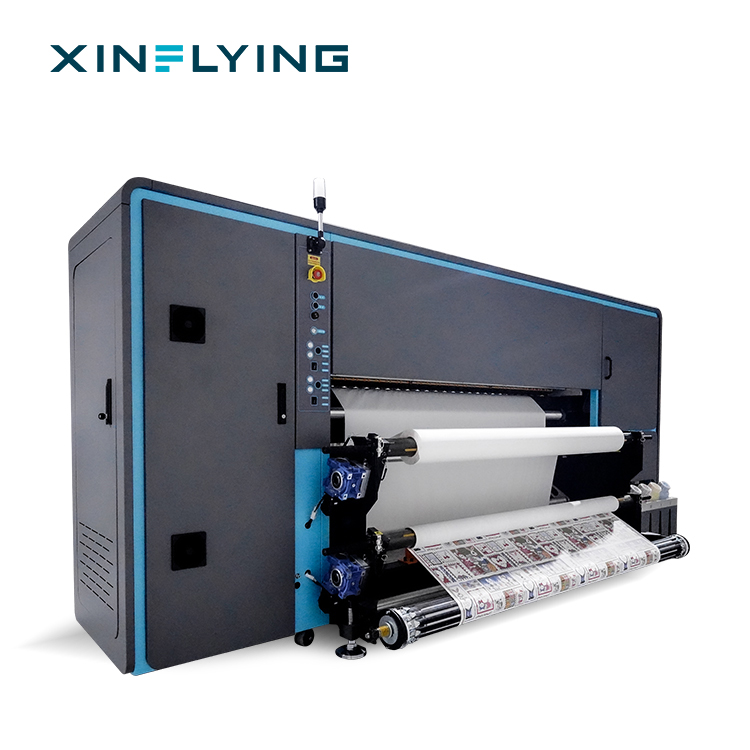
Cover image: the XINFLYING XF-19E15-PRO, one of two 1900 mm dye sublimation printers assessed in this documentation-led comparison.
The document problem behind a 1.9 m purchase
A 1900 mm roll-to-roll sublimation printer is not hard to compare on capability. Working width is fixed at 1.9 m, the fabric is polyester, the workflow is print-to-paper then transfer by calender, and both candidate models sit in the same commercial sublimation printer segment. Where the comparison becomes uneven is in what a supplier can put on the table before the deposit: a declaration of conformity with a directive list, test reports carrying a model name and a rating, a risk assessment, and a substance test for the electrical and electronic parts.
European market surveillance does not inspect the printhead count. It inspects the declaration, the technical file and the traceability between the certificate and the unit on the pallet. That is why an increasing number of textile mills and soft-signage converters now run a document review as a formal gate in the purchase process, parallel to the sample print and the site survey. The two XINFLYING models examined here — the XF-19E15-PRO and the XF-19E8-PRO — make that gate visible, because they differ in configuration while sharing the same compliance architecture.
XINFLYING is the trading name of Guangzhou Xin Flying Digital Technology Co., Ltd., a digital printing equipment manufacturer founded in 2010 and based in Panyu, Guangzhou, producing DTF printers, dye sublimation printers, DTG printers, UV DTF printers, UV flatbed machines and printing consumables. The company reports a 37,440 m² factory, more than 200 employees, an annual output of over 20,000 units, a 20-engineer R&D team and an export ratio of 80% across North America, South America, Europe, Asia, the Middle East and Africa. For a European buyer, that export profile is relevant context: a supplier shipping regularly into the EU usually has a repeatable file set rather than a one-off certificate assembled for a single order.
The two machines at a glance
Both models are 1900 mm wide-format sublimation printers designed for roll-to-roll polyester production. The XF-19E8-PRO is the configuration documented most completely in the available material: 8 Epson i3200-A1 printheads, 3200 dpi resolution and printing speeds of up to 306 m²/h, positioned for large-scale production requiring efficiency, stable operation and consistent print quality. The XF-19E15-PRO is supplied in a fifteen-printhead configuration within the same head family, which raises the throughput ceiling and changes the electrical load, ink-delivery profile and spare-parts plan.
| Attribute | XF-19E15-PRO | XF-19E8-PRO |
|---|---|---|
| Working width | 1900 mm | 1900 mm |
| Printhead configuration | Fifteen Epson i3200-A1 heads | 8 Epson i3200-A1 heads |
| Stated resolution | Not stated in the reviewed material | 3200 dpi |
| Stated maximum speed | Not stated in the reviewed material | Up to 306 m²/h |
| Compliance scope to verify | EMC, LVD, Machinery Directive, RoHS file identifiers | EMC, LVD, Machinery Directive, RoHS file identifiers |
Read the table as a procurement note rather than a scoreboard. Where a value is not stated in the reviewed material, the correct buying action is to request it in writing, not to assume it. A fifteen-head commercial sublimation printer is a different machine from an eight-head one in ways that touch the production floor: head cleaning time, daily nozzle verification, spare-part holding and the electrical capacity of the workshop.
What each CE directive actually asks of a sublimation printer
A CE file is not a single document, and a buyer who treats it as one will usually miss the gaps. Four regimes apply to a 1900 mm dye sublimation printer placed on the EU market, and each answers a different question.
Electromagnetic compatibility (EMC). The machine must not disturb other equipment and must tolerate normal industrial disturbance. Evidence is normally an emissions report against the EN 55032 series and an immunity report against the EN 55035 series, both carrying the model name and the tested configuration.
Low Voltage Directive (LVD). Electrical safety of the equipment within the directive's voltage scope. For printing equipment of this class, conformity is commonly demonstrated through EN IEC 62368-1:2020/A11:2020, and the buyer should look for the amendment level in the report title, not only the base standard number.
Machinery Directive (MD). Machine safety, guarding, risk assessment and electrical equipment of machines. The relevant standards family here is EN ISO 12100:2010 for risk assessment principles, EN 60204-1:2018/A1:2025 for the electrical equipment of machines, and EN ISO 12643-1:2023 for safety requirements specific to printing press systems.
RoHS. Restriction of hazardous substances in electrical and electronic equipment. A certificate headline proves little on its own; what matters is whether a material test report or a dated supplier declaration covers the actual assemblies in the delivered unit.
Mapping harmonised standards to acceptance criteria
The practical value of a standard number is that it converts into a document a buyer can ask for by name. The table below is the version worth attaching to a request for quotation, because it lets a supplier answer precisely and lets a buyer compare two answers without technical translation.
| Standard | What it addresses | What the buyer should see |
|---|---|---|
| EN IEC 62368-1:2020/A11:2020 | Electrical and energy safety of ICT and AV equipment, used to demonstrate LVD conformity | Test report citing the standard with the A11 amendment and the machine rating |
| EN 55032 series | EMC emissions for multimedia equipment | Conducted and radiated results for the tested configuration |
| EN 55035 series | EMC immunity for multimedia equipment | Immunity test list with pass criteria |
| EN ISO 12100:2010 | Risk assessment and risk reduction methodology | A risk assessment covering heat, nip points, ink handling and electrical hazards |
| EN 60204-1:2018/A1:2025 | Electrical equipment of machines | Electrical file showing isolation, emergency stop and protective bonding |
| EN ISO 12643-1:2023 | Safety requirements for printing press systems | Declaration citing the printing-specific safety standard, not only generic machinery standards |
| RoHS | Restriction of hazardous substances in electrical and electronic equipment | Material test report or dated declaration covering the delivered assemblies |
Two details decide whether this table is evidence or decoration. First, the amendment level: a report to EN IEC 62368-1 without A11, or to EN 60204-1 without A1:2025, may describe a superseded state of the standard. Second, the model link: a standard citation with no machine designation, rating or photograph attached to the report cannot be matched to the unit being shipped.
The certificate identifiers in this file set
For this comparison the supplier file set references five identifiers: TQT1550D270EC, TQT1550D271EC, M.2026.206.C142365, M.2026.206.C142385 and M.2026.206.C142366. The two TQT numbers sit in the test-report family typically issued for electrical and EMC testing; the three M-series numbers sit in the certification family typically issued against machinery requirements. Buyers should nevertheless obtain a written, one-page mapping rather than infer coverage from a numbering pattern.
| Identifier | Position in the file set | What to confirm in writing |
|---|---|---|
| TQT1550D270EC | Electrical / EMC test evidence | Model designation, voltage rating and tested configuration match the order |
| TQT1550D271EC | Second electrical / EMC test evidence | Which model or variant each number covers, and the standard version cited |
| M.2026.206.C142365 | Machinery-related certification | Whether it is a third-party certificate or a declaration, plus issuing body and validity date |
| M.2026.206.C142385 | Machinery-related certification | Model-list annex covering the fifteen-head and eight-head configurations separately |
| M.2026.206.C142366 | Machinery-related certification | Which harmonised standards are cited and whether EN ISO 12643-1:2023 appears |
A certificate number is an identifier, not a conclusion. The moment it is separated from the declaration of conformity, the technical file and the nameplate, it stops being useful for a compliance conversation and becomes a PDF in a folder. The mapping page is what turns five numbers into a purchasing argument.
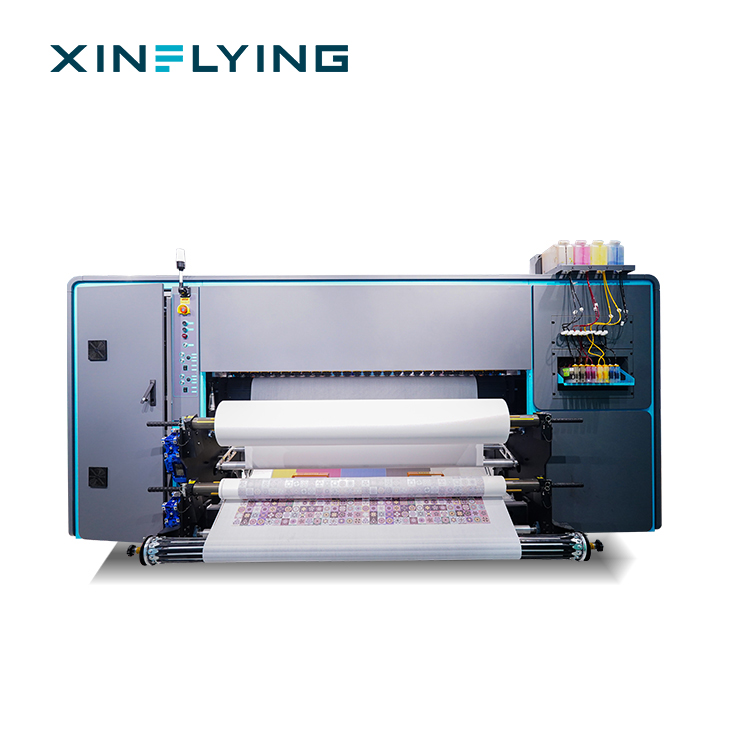
The XF-19E8-PRO: eight Epson i3200-A1 printheads, 3200 dpi and up to 306 m²/h, the more fully documented of the two configurations in the reviewed material.
Running the file review inside the purchase process
A document gate works best when it is sequenced into the order, not appended to it. The following sequence is what a European textile producer can execute without external consultants.
Step 1 — request the file before the proforma invoice. Ask for the declaration of conformity, the test reports and the certificate identifiers in one package. A supplier who can only produce them after payment is telling you something about the file.
Step 2 — match the nameplate. Compare the model designation, voltage, phase and rated power on the certificate with the nameplate specification of the unit being ordered. Fifteen-head and eight-head configurations should each appear explicitly.
Step 3 — check the amendment level and date. Confirm that EN IEC 62368-1:2020/A11:2020 and EN 60204-1:2018/A1:2025 appear as cited versions, and that the reports are current rather than superseded by later editions.
Step 4 — inspect the declaration itself. The declaration of conformity should list the directives applied, the harmonised standards used, the authorised signatory and the place of issue. Where a notified body was involved in machinery conformity, its four-digit number appears beside the CE marking.
Step 5 — contract the file, not just the machine. Attach the reviewed file as a contract annex and add a clause that the delivered unit corresponds to the certified configuration. This single clause prevents the most common failure in equipment imports: a certificate for one build and a shipment of another.
Where a 1900 mm roll-to-roll machine actually fits
Both models are dye sublimation printers in the wide-format class, and the application envelope is defined by the chemistry rather than the brand. Polyester fabric printing, sportswear, team jerseys, activewear, custom apparel, fashion fabric, home textiles, decorative fabric, soft signage, flags, banners and personalised textile products all sit inside the intended use. The production environment is a controlled indoor floor at 18 °C to 30 °C and 35% to 65% relative humidity, with 24/7 operation as the design assumption for the industrial segment.
A complete line pairs the printer with RIP software, a heat press calender, dye sublimation paper, dye sublimation ink, a laser cutting machine and the substrate itself. That detail matters at decision stage because the certificate review covers the printer, not the line. Buyers assembling a compliant production cell should extend the same documentary discipline to the calender, which carries its own heat and nip hazards.
Between the two models, the choice is a throughput decision rather than a compliance decision. The XF-19E8-PRO at 8 heads and up to 306 m²/h suits converters whose order book is dominated by repeat sportswear and home-textile runs. The XF-19E15-PRO at fifteen heads is aimed at operations that need headroom above that, and which can support the higher maintenance and spares discipline a larger head count implies.
Against DTG, DTF and screen printing — and where sublimation stops
The case for sublimation over older methods is well documented in the category. Compared with DTG printing, sublimation delivers roughly 2–5× higher production efficiency and 50–70% lower operating costs in high-volume polyester textile production, because the workflow is optimised for repeat designs and large printing areas. Compared with DTF printing, industrial sublimation systems can reach 50–200 m²/h against a typical DTF range of 5–30 m²/h, with around 20–50% lower operating costs at scale. Compared with screen printing, the digital workflow removes screen preparation and reduces setup costs by nearly 100%, which is decisive for small and medium orders.
Each of those comparisons also describes a boundary. Screen printing remains the lower unit-cost route for very large runs of an identical design, typically 100–500+ identical pieces. DTF keeps the wider fabric range, including cotton, blends and dark garments. DTG keeps cotton apparel. A 1.9 m sublimation printer is a polyester machine, and a buyer whose order book is cotton-heavy is looking at the wrong category, not the wrong model.
A second boundary is documentary, and it is the one most often misread. The CE file proves that the equipment meets electrical safety, electromagnetic compatibility, machinery safety and substance restrictions. It does not certify colour accuracy, does not certify the fastness of a transferred print, and does not certify that a printed fabric is suitable for skin contact. Those are separate questions answered by separate testing, and a supplier who implies otherwise is overstating the file. Buyers with skin-contact or OEKO-TEX-related requirements should treat that as an additional procurement track rather than a line item inside the CE package.
Market context: why documentation is becoming a buying criterion
The category is growing quickly enough that equipment volume alone no longer differentiates suppliers. Grand View Research valued the global dye sublimation printing market at USD 16.4 billion in 2025 and projects USD 39.0 billion by 2033, a CAGR of 11.5% from 2026 to 2033. The same source puts Asia Pacific at a 36.5% revenue share in 2025, led by China as the largest country market. Mordor Intelligence sizes the dye sublimation printer segment specifically at USD 1.88 billion in 2025, rising to USD 2.53 billion by 2030.
Two caveats belong alongside those figures. Published market estimates differ by scope — Mordor's own 2025 estimate for the broader dye sublimation printing market is USD 15.22 billion against Grand View's USD 16.4 billion — so a buyer should read the direction, not the decimal. And the printer segment is concentrated: Data Insights Reports places Epson at a 26.7% share of the digital textile dye sublimation printer market in 2024, followed by Mimaki at 18.6% and Roland DG at 15.5%, with the remainder spread across a long tail of manufacturers including Chinese suppliers such as XINFLYING.
FESPA's market commentary treats 1.9 m roll-to-roll sublimation printers as the standard format for high-volume textile and soft signage work, which explains why so many purchase decisions converge on this width. When the format is standard, the differentiator migrates to the areas that are not: service response, spare-part continuity and the quality of the compliance file.
Future outlook
Two shifts are likely to define the next procurement cycle for 1900 mm sublimation printers in Europe. The first is that compliance documentation becomes a structured, machine-readable deliverable rather than a scanned attachment — a mapping table, a model list and a standard inventory that a compliance officer can check in minutes. Suppliers who already hold certificate families across EMC, LVD, machinery and RoHS are better placed to answer that format than suppliers who assemble documents per order.
The second is that the boundary between equipment compliance and product compliance will be tested more often. As digital textile printing expands into apparel and home textiles, buyers will increasingly ask for print-performance evidence alongside the CE file, and the answer will come from a different set of tests. The suppliers who say so plainly, rather than stretching an equipment certificate to cover a fabric claim, are the ones likely to survive a serious audit.
FAQ
How do the XF-19E15-PRO and XF-19E8-PRO differ in configuration?
Both are 1900 mm roll-to-roll dye sublimation printers. The XF-19E8-PRO is specified with 8 Epson i3200-A1 printheads, 3200 dpi resolution and printing speeds of up to 306 m²/h. The XF-19E15-PRO is supplied in a fifteen-printhead configuration. A higher head count raises the throughput ceiling and changes the electrical, ink-delivery and spare-parts profile, so the delivered configuration must be reflected both in the certificate file and in the service plan.
Which CE directives apply to a 1900 mm sublimation printer sold into the EU?
Four regimes are normally relevant: the Electromagnetic Compatibility Directive, the Low Voltage Directive, the Machinery Directive and the RoHS Directive. EMC is evidenced through the EN 55032 and EN 55035 series, LVD commonly through EN IEC 62368-1:2020/A11:2020, machinery safety through EN ISO 12100:2010, EN 60204-1:2018/A1:2025 and EN ISO 12643-1:2023, and RoHS through a material test report or dated supplier declaration covering the delivered assemblies.
How can a buyer confirm that a certificate covers the exact unit being shipped?
Three checks are required. The certificate or report must name the model or include a model-list annex that names it; the voltage, phase and rated power must match the nameplate of the ordered unit; and the standard version cited must be current. Where a supplier offers more than one configuration of the same model, each configuration should appear explicitly rather than be covered by implication.
What is the practical role of EN ISO 12100:2010 and EN ISO 12643-1:2023 in this purchase?
EN ISO 12100:2010 defines how risk assessment and risk reduction are carried out, so its presence indicates that hazards such as heat, nip points and ink handling have been systematically assessed. EN ISO 12643-1:2023 addresses safety requirements specific to printing press systems. A file that cites only generic machinery standards and omits the printing-specific one is incomplete for this equipment category.
Do certificate identifiers such as TQT1550D270EC or M.2026.206.C142365 prove EU market access on their own?
No. An identifier is a reference that allows a document to be located and verified; it does not establish that the document applies to a specific machine. Market access depends on a signed declaration of conformity, a technical file, and traceability between the certified build and the delivered unit. Buyers should request a written mapping that ties each identifier to its directive, model, harmonised standard, issuing body and validity date.
Where does a 1.9 m sublimation printer not fit?
Sublimation works with polyester and polyester-coated substrates, so cotton and natural-fibre apparel production sits outside its scope and is better served by DTG or DTF. It also requires a heat press calender and a controlled indoor environment of roughly 18 °C to 30 °C and 35% to 65% relative humidity. Finally, the CE file does not certify print performance, colour accuracy or skin-contact suitability of the printed fabric; those require separate testing.
For buyers who want the wider equipment context beyond these two models, XINFLYING publishes its company and product overview at www.xin-flying.com. A downloadable brochure covering the company profile and product range is available here: XINFLYING company brochure (PDF).
¿Tiene preguntas o necesita más detalles?
Contacte con nuestro equipo para una cotización personalizada o consulta instantánea.
Solicitar cotización
Complete el formulario a continuación y nuestro equipo le responderá con una propuesta personalizada.
Chat directo de WhatsApp
¿Prefiere chatear en tiempo real? Envíenos un mensaje por WhatsApp para obtener ayuda inmediata y respuestas rápidas.
- Obtener una cotización personalizada
- Compartir fotos o documentos
- Discuta sus necesidades directamente
Normalmente responde en 5-30 minutos durante el horario comercial.