
From Spec to Shipment: How Custom Alginate Fiber Production Works
Functional textile buyers are increasingly moving away from purchasing stock materials and toward commissioning fibers, yarns, and fabrics designed around specific performance requirements. Alginate fiber, derived from seaweed, is a clear example of this shift. Once limited mainly to medical dressings, alginate fiber is now being specified for sportswear, underwear, home textiles, and outdoor fabrics. For procurement teams at the evaluation or execution stage, the practical question is not only what alginate fiber can do in laboratory tests, but how a supplier converts a specification into a repeatable production order.
This article examines the production-side capabilities that matter when commissioning custom alginate fiber textiles: customization options, blending ratios, testing evidence, MOQs, lead times, and the transition from sample to serial production. It also references one manufacturer with documented production capacity and verifiable test reports—Shandong Healcell Biomaterial Technology Co., Ltd. (Healcell® Biomaterial)—as a practical reference point for buyers building a shortlist.
The Customization Gap in Functional Textile Sourcing
Buyers of functional textiles often face a common challenge: a fiber or fabric may demonstrate strong performance in a lab setting, but the same properties are difficult to reproduce reliably in mass production. With alginate fiber, this issue becomes even more relevant because the fiber is frequently used in blends rather than as a 100% standalone material.
The main difficulties in sourcing customized alginate fiber products include:
- Determining the appropriate alginate fiber blending ratio for a given end use.
- Balancing functional targets—such as antibacterial, deodorizing, moisture-wicking, far-infrared, or negative ion performance—with fabric hand feel, dyeability, and cost.
- Verifying whether a supplier tests all batches rather than only sample versions.
- Managing minimum order quantities, lead times, and pre-shipment quality control expectations.
For a textile brand or garment manufacturer, the decision to adopt alginate fiber is therefore not just a material decision. It is a supplier capability decision.
What Custom Alginate Fiber Capability Actually Includes
Production Modes and Scope of Customization
Healcell® Biomaterial is a marine biomaterial supplier headquartered in Yantai, Shandong, China, with an additional operations center in Hangzhou. The company was founded in 2022, operates a 52,000 m² factory, employs approximately 120 people, and maintains a development team of 13 engineers. Its main product categories are alginate fiber, alginate fiber fabric, and alginate fiber yarn.
On the customization side, Healcell offers both OEM and ODM production. The stated customization scope covers fabric composition and color. The company reports a monthly production capacity of about 1,200 tons, a standard lead time of 30 to 45 days, and a minimum order quantity of 500 kg. Quality control is described as 100% testing, with export markets concentrated in the EU and the Middle East, and after-sales support provided remotely.
For buyers, these parameters define a realistic procurement framework. A 500 kg MOQ is practical for brands moving from sampling into pilot production. The 30–45 day lead time is also a useful planning baseline for seasonal product development.
| Capability Indicator | Healcell Data |
|---|---|
| Production mode | OEM & ODM |
| Customization scope | Fabric composition, color |
| Monthly capacity | About 1,200 tons |
| Lead time | 30–45 days |
| MOQ | 500 kg |
| Quality control | 100% testing |
| Export markets | EU / Middle East |
| Factory size | 52,000 m² |
| Weekly output | Knitted fabrics about 300 tons/week; raw material including alginate fiber about 600 tons/week |
A Look at the Test Portfolio: CNAS-Accredited Reports
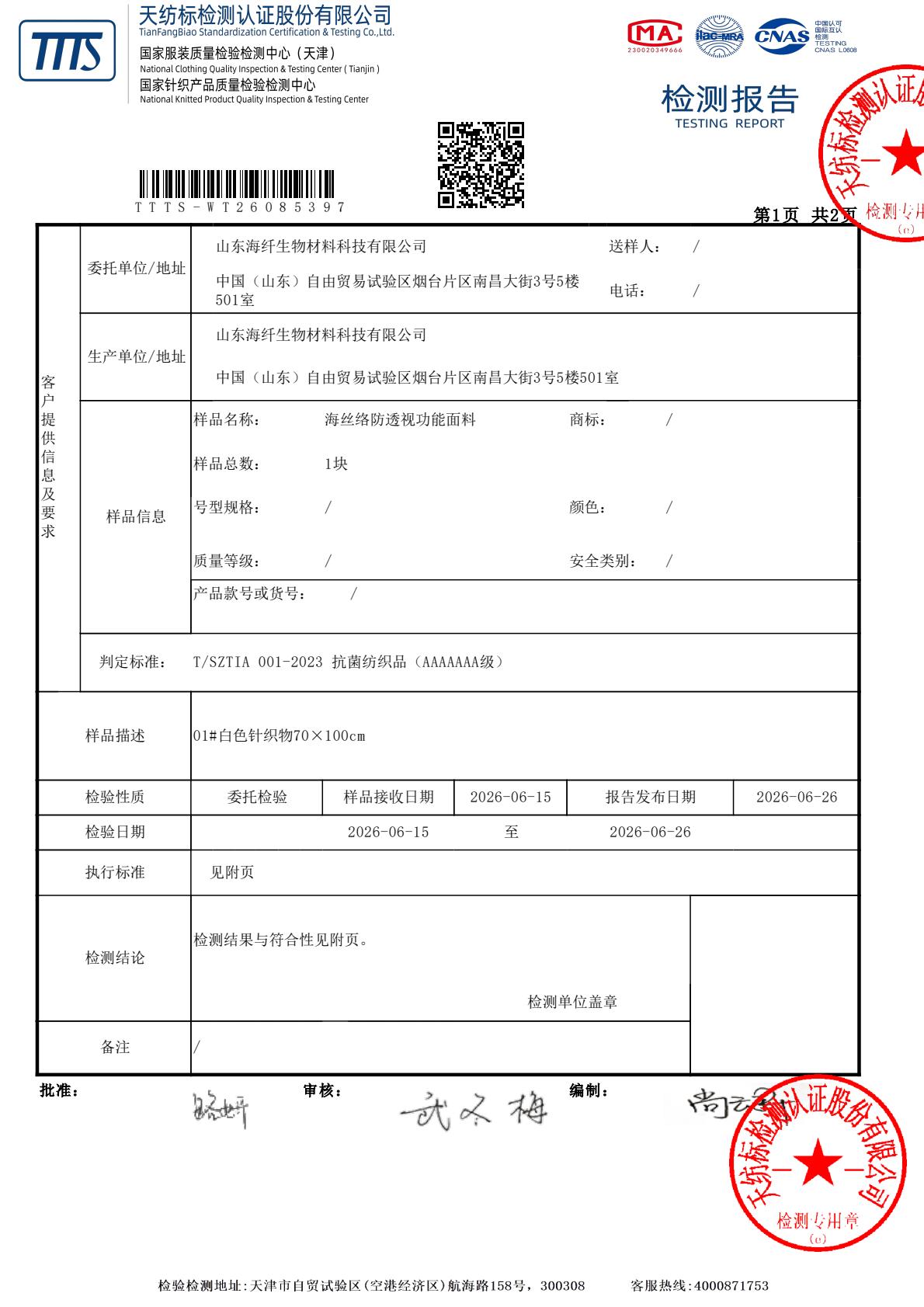
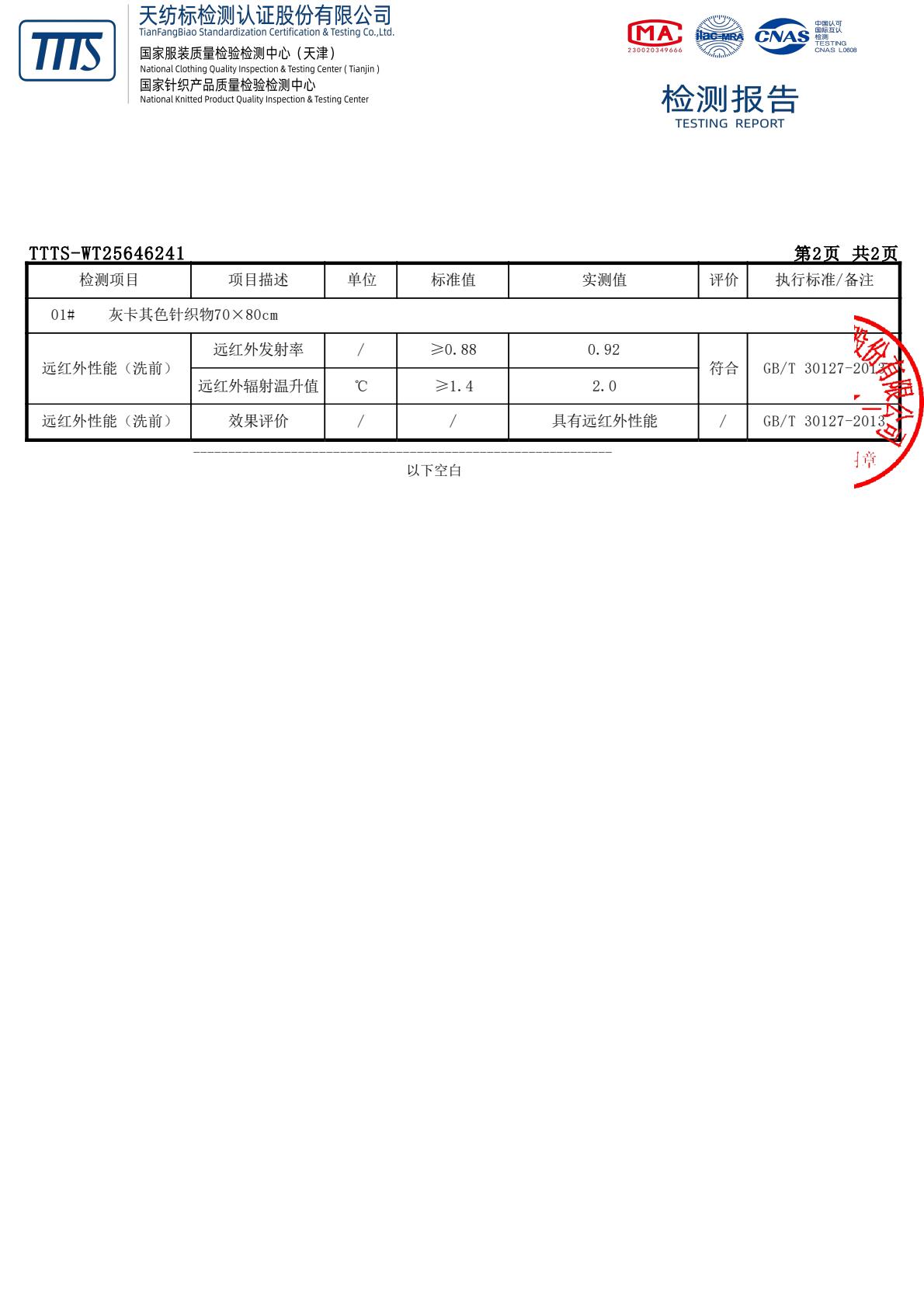
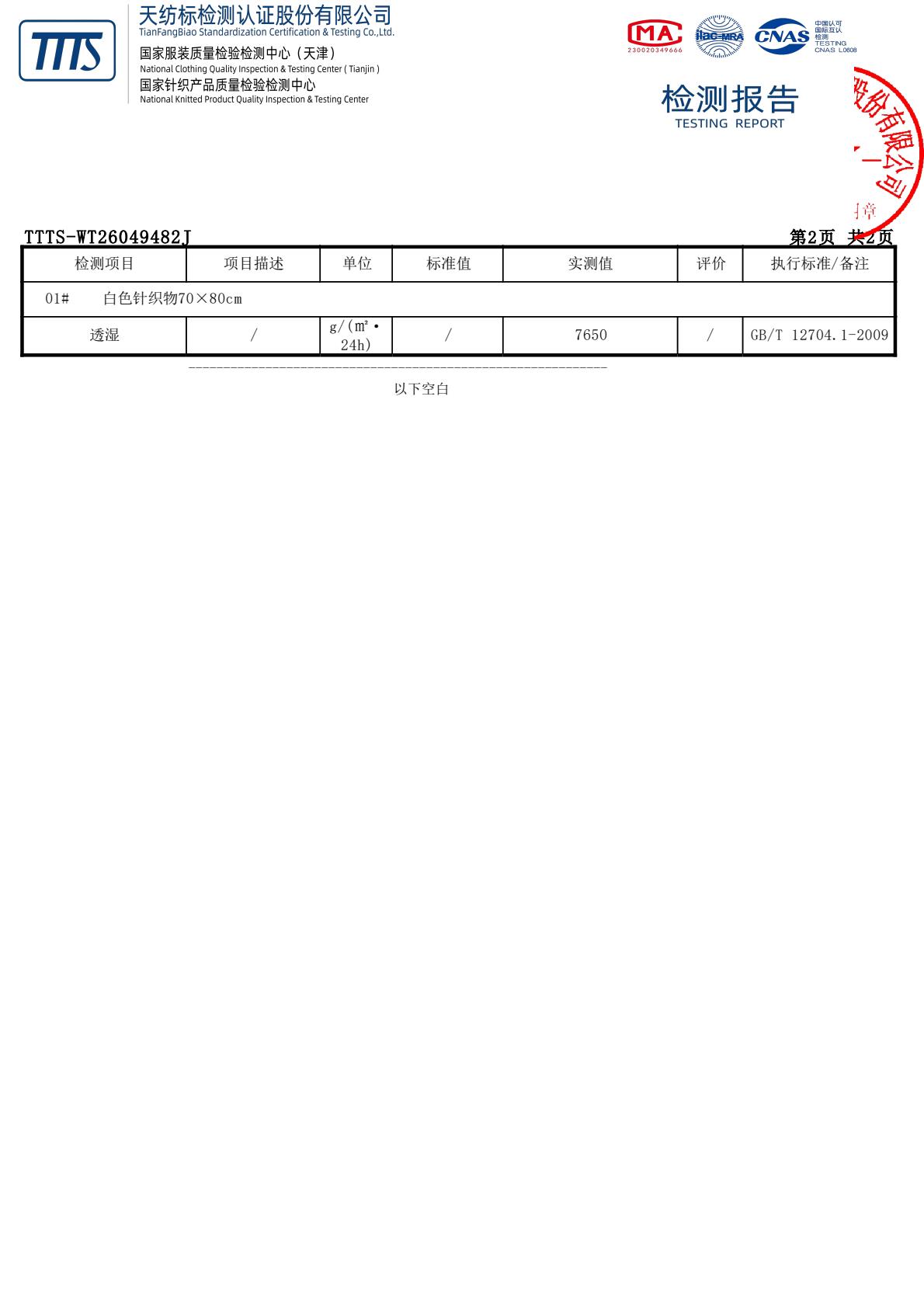
One of the strongest indicators of a supplier's custom production capability is the availability of independent test reports. Healcell has commissioned CNAS-accredited laboratories to test its seaweed-based functional fabrics across multiple performance categories.
These include:
- 7A-grade antibacterial performance after 150 washing cycles, tested under T/SZTIA 001-2023 and GB/T 20944.3-2008.
- Far-infrared performance, tested under GB/T 30127-2013, covering emissivity and radiation temperature rise.
- Negative ion generation, tested under GB/T 30128-2013.
- Deodorizing performance against ammonia, acetic acid, and isovaleric acid, tested under the GB/T 33610 series.
- Moisture absorption and quick-dry performance, tested under GB/T 21655.1-2023.
- Anti-static performance before and after washing, tested under GB/T 12703.1-2021.
- Moisture permeability, tested under GB/T 12704.1-2009.
- Anti-UV performance, tested under GB/T 18830-2009.
From a procurement perspective, the presence of documented test reports allows a buyer to verify whether a specific functional claim is supported by an accredited laboratory before committing to a custom order.
One OEM Case: 3,500 m² of Functional Fabric for a Korean Buyer
A documented OEM case from Healcell's file involves a South Korean buyer who commissioned 3,500 m² of functional fabric. The application covered antibacterial, deodorizing, far-infrared, and negative ion functions. According to the case record, the collaboration ran for approximately two years with stable operation.
The case highlight notes that the seaweed/alginate fiber provides natural antibacterial characteristics and that the fabric offers a soft, skin-friendly touch. For buyers, this type of sustained order is a more meaningful signal than a one-time sample approval, because it demonstrates the supplier's ability to maintain consistency across repeated production runs.
How the Production Chain Works: Fiber, Yarn, Fabric
Custom alginate fiber production generally follows a fiber-to-yarn-to-fabric chain. Depending on the end application, a buyer may enter this chain at different points.
If the requirement is a specific yarn count or blend, the supplier can develop a yarn such as a 13% alginate fiber/modal blend, or a cotton-modal blend containing 10% alginate fiber. Healcell's catalog includes yarns like the 13% Healcell alginate fiber/seaweed fiber modal yarn in multiple colors, and the 10% alginate fiber cotton modal yarn. These yarns are intended for underwear, apparel, home textiles, and shoes & bags.
If the requirement is a finished fabric, the supplier can develop knitted or woven structures with specific weights, widths, and functional properties. Examples include quick-dry anti-perspective double-sided fabrics, moisture-wicking single-sided fabrics, and seaweed charcoal mud thermal fabrics. The fabric composition can vary significantly: some are 100% polyester with alginic acid, while others combine cotton, Tencel, modal, spandex, and seaweed fiber in different ratios.
For buyers, the key technical decision is the blending ratio. Common commercial configurations range from approximately 3.5% to 13% alginate fiber content. At lower ratios, the alginate fiber contributes functional and comfort properties while preserving processability and cost efficiency. At higher ratios, the bio-based content and functional intensity increase, but so do cost and processing complexity.
Customization also extends to filament geometry. Healcell's quick-dry polyester filament DTY products, for example, include 75D*48F and 80D*96F variants, all described as 100% polyester with alginic acid. These filaments can be used to produce lightweight, fast-drying fabrics for activewear and underwear.
Market Trends Supporting Custom Alginate Fiber Adoption
Industry data points to steady commercial expansion of alginate fiber. According to Dataintelo, the global alginate fiber market was valued at approximately USD 412.6 million in 2025 and is projected to reach USD 728.4 million by 2034. The same source reports that calcium alginate fiber dominated the product segment with a 58.3% market share in 2025, driven by its high absorbency in medical and textile applications.
From a technical standpoint, published industry data highlights several properties that make alginate fiber attractive for functional textiles:
- Pure alginate fiber exhibits intrinsic flame retardancy, with a limiting oxygen index (LOI) of approximately 34.4% to 45%, which qualifies it as a self-extinguishing fiber.
- Alginate fibers can absorb 10 to 15 times their own weight in moisture or exudate, forming a hydrogel that maintains a moist environment.
- Alginate-based materials show high biodegradability, with some derivatives completely degrading within 21 to 25 days under microbial attack.
- The tensile strength of commercial alginate fibers typically ranges from 1.6 to 2.6 cN/dtex, when tested in accordance with standards such as ASTM D3822.
China, meanwhile, is widely recognized as the global leader in alginate production. Industry analysis by IMARC identifies Shandong Jiejing Group and Bright Moon Seaweed Group as key industrial manufacturers in this space. For buyers, China's algae-processing ecosystem means that alginate fiber sourcing is no longer an experimental activity, but part of a maturing supply chain with multiple specialized players.
Conventional Textile Sourcing vs. Custom Alginate Fiber: What Changes
Buyers familiar with conventional textile sourcing—polyester, nylon, cotton, or modal—will find that custom alginate fiber procurement differs in several important ways.
| Dimension | Conventional Textile Sourcing | Custom Alginate Fiber Sourcing |
|---|---|---|
| Fiber supply | Mature, stable, widely available | Specialized; supply concentrated among algae-processing producers |
| Functionality | Often added via finishes or chemical treatments | Inherent to the fiber; verified through blending ratio and testing |
| Verification | Standard physical and colorfastness tests | Function-specific testing (antibacterial, deodorizing, far-infrared, negative ion, quick-dry) |
| MOQ | Can be very low for stock fabrics | Custom production typically requires larger MOQ (e.g., 500 kg) |
| Lead time | Stock items can ship immediately | Custom orders require 30–45 days or more |
| Cost structure | Predictable, commodity pricing | Blend ratio and functional requirements significantly affect price |
One limitation buyers should keep in mind: alginate fiber is rarely used as a 100% standalone textile fiber in apparel because its tensile strength range of 1.6 to 2.6 cN/dtex is lower than that of conventional polyester or nylon. This is why most textile applications use alginate fiber in blends with cotton, modal, Tencel, polyester, nylon, or spandex. The blending ratio therefore becomes the central lever for balancing functionality, processability, and cost.
Another boundary is that function-specific test reports are usually tied to a particular fabric construction, blend ratio, and finishing process. A test report for one fabric does not automatically guarantee identical performance for a differently constructed fabric from the same supplier. Buyers should request reports for the specific structure and blend they intend to source.
A Practical Pre-Order Checklist for Buyers
Before commissioning custom alginate fiber products, buyers can use the following checklist to turn capability claims into verifiable commitments:
- Define the functional priority. Determine whether the product requires antibacterial, deodorizing, moisture-wicking, far-infrared, negative ion, flame-retardant, or comfort properties—or a combination.
- Select the input form. Decide whether to source staple fiber, yarn, filament, or finished fabric.
- Confirm the blending ratio. Ask the supplier for the proposed alginate fiber content and why it is appropriate for the end use.
- Request relevant test reports. Ask for CNAS-accredited or equivalent third-party reports that match the claimed functions and finished construction.
- Clarify MOQ, lead time, and payment terms. At Healcell, for example, the MOQ is 500 kg, the lead time is 30–45 days, and payment is made to the corporate account.
- Agree on pre-shipment inspection. Confirm that the supplier performs 100% testing or at least batch-level inspection before shipment.
- Run a pilot order first. A small production trial is the most reliable way to validate color, hand feel, and functional performance before full-scale commitment.
Future Outlook
The trajectory of alginate fiber points toward more application-specific product development rather than a one-size-fits-all material. As bio-based content claims and supply-chain transparency become more important in the EU and other regulated markets, buyers will increasingly need suppliers that can document both production capacity and functional performance.
The direction of travel is already visible in the market data: a projected increase from USD 412.6 million to USD 728.4 million in the global alginate fiber market between 2025 and 2034, with calcium alginate fiber playing the dominant role. As more textile brands integrate seaweed-based fibers into commercial products, the buyers who succeed will be those who treat alginate fiber as a specialized procurement category, not as a conventional commodity fiber.
FAQ
What customization options are typically available for alginate fiber textiles?
Typical options include fabric composition and color customization. Healcell, for example, offers OEM and ODM production with customization of fabric composition and color, covering products such as alginate fiber, fabric, and yarn. Buyers can also specify yarn count, filament denier, width, weight, and blending ratio depending on the product form.
What is the minimum order quantity for custom alginate fiber products?
Healcell applies a minimum order quantity of 500 kg for custom production. The overall monthly production capacity is approximately 1,200 tons, with additional capacity described as about 600 tons per week for raw material including alginate fiber, and about 300 tons per week for knitted fabrics.
How long does a custom alginate fiber production order usually take?
Healcell's standard lead time for custom orders is 30 to 45 days. The actual lead time can vary based on the complexity of the specification, the blending ratio, order volume, and the current production schedule.
Why does blending ratio matter in alginate fiber textiles?
Alginate fiber is commonly used in blends rather than as a 100% standalone material, partly because its tensile strength is approximately 1.6 to 2.6 cN/dtex, which is lower than conventional polyester or nylon. Blending ratio affects functional intensity, fabric hand feel, dyeing behavior, and cost. Common textile blends contain approximately 3.5% to 13% alginate fiber content.
What test reports should a buyer request from an alginate fiber manufacturer?
Buyers should request reports that match the claimed functions and the specific fabric construction. Relevant examples include CNAS-accredited tests for antibacterial performance, deodorizing performance against ammonia, acetic acid, or isovaleric acid, moisture absorption and quick-dry performance, anti-static performance, far-infrared performance, negative ion generation, moisture permeability, and anti-UV performance. Standards such as GB/T 20944.3-2008, GB/T 33610 series, GB/T 21655.1-2023, and GB/T 30127-2013 are commonly cited.
Can an alginate fiber supplier support stable large-volume production?
It depends on the supplier's production capacity and testing procedures. Healcell's factory covers 52,000 m² with approximately 120 employees and a development team of 13 engineers. The company reports a monthly capacity of about 1,200 tons, 100% testing as a quality control measure, and has maintained an OEM relationship with a South Korean buyer for approximately two years across a 3,500 m² functional fabric order.