
From Sample to Bulk: WPC Wall Panel Order Stage Checks
From Sample to Bulk: WPC Wall Panel Order Stage Checks
Buying WPC wall panel is not one decision but three that arrive in sequence — sample, trial run and bulk purchase — and each one answers a different question. A sample confirms whether colour, material and surface suit the project. A trial run tests whether the factory can repeat that result under the same raw-material source and the same formulation. A bulk order converts specification, test documents, packing and warranty terms into written obligations. Keeping the three stages apart is the line between what a supplier states and what a buyer can actually verify.
The most common mistake is treating one stage's evidence as if it belonged to another. A hand-picked sample can look excellent while having no verifiable link to the production batch. A trial run can perform well while the same model still lacks fire or emission testing for the destination market. A genuine test report can be valid yet describe a different thickness, surface or formulation from the one on the purchase order. The comparison framework below assigns explicit checkpoints to each stage so those three failure modes stay separate.
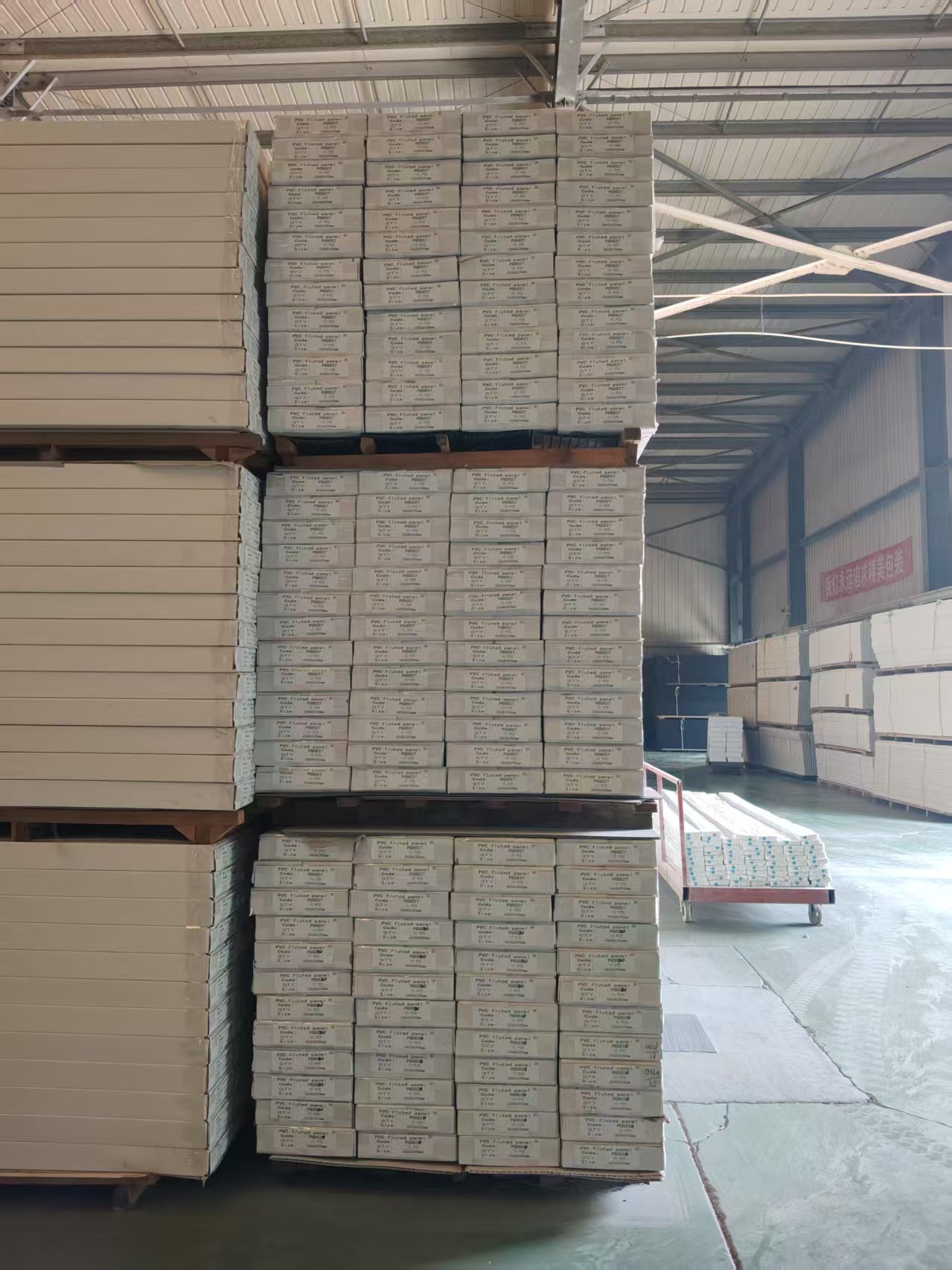
Packed panels staged in a finished-goods warehouse — the point where bulk-order marking, batch records and retained samples become checkable.
Why a WPC wall panel order is split into three stages
The three stages carry different risk and different evidential weight. The sample stage costs the least and proves the least. The trial run adds a first chance to observe repeatability, but the quantity is too small to support durability conclusions. The bulk order carries the largest financial commitment and is the least flexible once terms are signed.
Linkworld WPC Wall Panel is a product line supplied by Tangshan Linkworld International Trade Co., Ltd., a company established in 2004. Its stated order sequence runs in four steps: confirm the application, dimensions and colour requirements; recommend suitable models for the project environment; confirm technical specifications, samples and quality requirements; then arrange production, inspection and delivery. The order itself is informative — selection and colour come first, quality confirmation sits in the middle, inspection and delivery close the process.
Placing "technical specifications, samples and quality requirements" in the same step is deliberate, because those three items draw on different evidence. Technical specifications come from the data sheet and written parameters. Samples provide physical colour and surface judgement. Quality requirements concern batch consistency and inspection documents. Handling them at different points in the timeline is where many order disputes begin.
The cost structure is also asymmetric. Sample-stage spending is limited, but a misjudgement there grows more expensive later. The trial run is small in volume yet depends on a supplier making a continuity commitment about raw materials and formulation. Once a bulk contract is signed, colour, dimensions and packing are hard to change before shipment. So the emphasis shifts from "does this suit the project" to "can it be repeated", and finally to "can it be traced".
Stage one — the sample: confirming application, dimensions and colour
The sample stage is the only point where physical colour and surface effect can be examined at low cost. It is also the stage with the least evidence — one sample proves one sample.
Confirm the application before ordering a sample
The application decides which product family deserves sampling in the first place. Interior walls, exterior cladding, wet areas, feature walls and ceiling designs do not make the same demands, and the working conditions depend on indoor or outdoor use, humidity, temperature, substrate and fire-safety requirements. Wet rooms such as bathrooms and kitchens place heavier requirements on joint and edge treatment than a dry feature wall.
The product form should be fixed at this point as well. Linkworld's indoor range includes WPC grille panels, carbon crystal panels, UV panels and SPC stone crystal wall panels, while the outdoor range includes WPC Great Wall panels, ASA wall panels, PE wall panels, outdoor wood-plastic fence panels and outdoor wood-plastic decking. Grille, Great Wall, slat and cladding descriptions refer to different profiles with different fixing and jointing logic; the category name "WPC wall panel" alone does not identify a model.
Sizing has to work from effective coverage
Dimension confirmation is not simply measuring a wall. The length and height of the wall should be measured, door and window areas deducted, the actual panel size and effective coverage size confirmed, and joint positions, grain direction and panel layout planned. Cutting losses should be estimated from site conditions rather than applying a fixed percentage to every project.
For slatted structures, spacing and direction affect the finished appearance directly. For flat panels that require joints, it is worth deciding at sample stage whether joint lines conflict with door frames, corners, lighting positions or other fittings.
Colour approval is a record-keeping task
Colour looks like a visual judgement but is really a documentation task. A sample should carry a colour reference, surface finish, model number and date, and a sealed reference piece should be kept by both sides. Linkworld states that samples are available to confirm colours, materials, structures and quality requirements, and that reference samples are retained for bulk orders as a quality comparison basis — which frames the sample as a comparison benchmark rather than a substitute for comparison.
What a sample cannot prove matters just as much. It cannot establish colour consistency between batches, cannot establish dimensional stability at volume, and cannot show how a joint behaves on a real substrate. Those belong to the trial run and the bulk order.
Stage two — the trial run: testing batch repeatability
A trial run answers a different question: can this production line do it again?
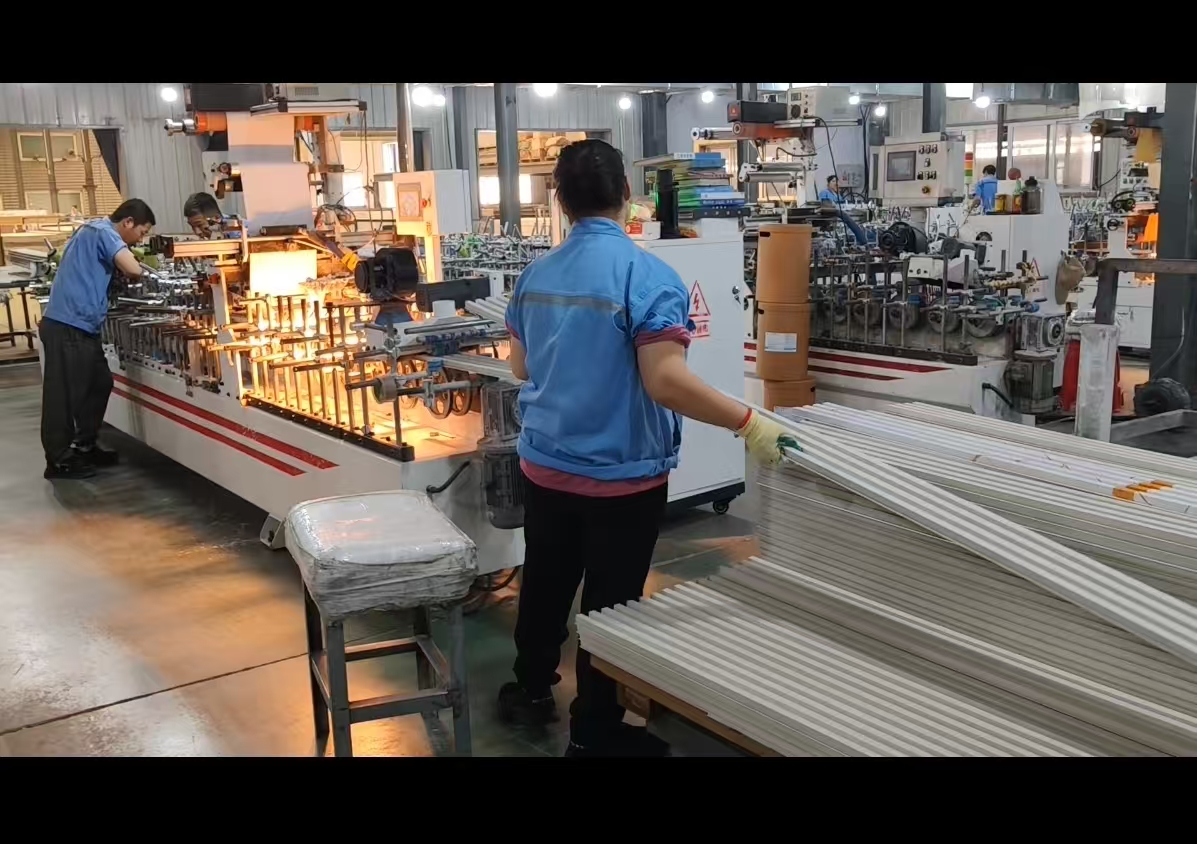
Extrusion and lamination line: the stage where raw-material batch, formulation and line consistency become observable rather than assumed.
Linkworld's position on quality stability is that keeping a fixed raw-material supplier and a unified production formulation limits batch colour deviation and keeps performance and colour consistent from batch to batch, with the confirmed sample used for mass-production comparison. For a buyer, that statement decomposes into two checkable commitments: raw materials come from a fixed source, and the formulation is not changed casually.
The trial run should therefore put both commitments on paper and on the floor. Does the trial use the same raw-material supplier and grade as the bulk order that will follow? Will any formulation change or material substitution be notified in writing in advance? Which line produced the trial? Is a trial reference sample retained? Do batch information and inspection records travel with the goods?
There is a material-level distinction that is easy to skip. Linkworld describes its WPC and carbon crystal series as produced with bamboo charcoal fibre co-extrusion technology, and states that they offer greater hardness, wear resistance, texture quality and weather resistance than ordinary PVC panels. Such statements are the supplier's own product description; the buyer's task is not to accept the adjectives but to require the corresponding technical parameters and test data for the specific model.
The trial run is also the most convenient moment to examine joints and edge treatment. Moisture can enter a structure through seams, cut edges, fixing holes and unsealed areas, and a panel's surface water resistance is not the same thing as the water resistance of the installed wall system. Assembling a short section and inspecting the cut edge, trim and joint is more informative than re-examining the surface of a sample. If the project sits in a wet area, joint sealing, substrate waterproofing and drainage design should all be confirmed here.
For exterior applications the trial should extend to fixing and drainage logic. Outdoor WPC installation requires a firm substrate or batten system, unobstructed drainage, and adequate expansion space set according to product specification, ambient temperature and manufacturer requirements; batten spacing and fixing positions should not be reduced at will. The expansion gap itself depends on thermal behaviour, temperature range, panel length and installation constraints, so a single figure cannot be applied to every panel.
Stage three — the bulk purchase: locking specification, documents and warranty
At bulk stage the constraint changes from "will this work" to "what arrives must be this, and there must be a record of it".
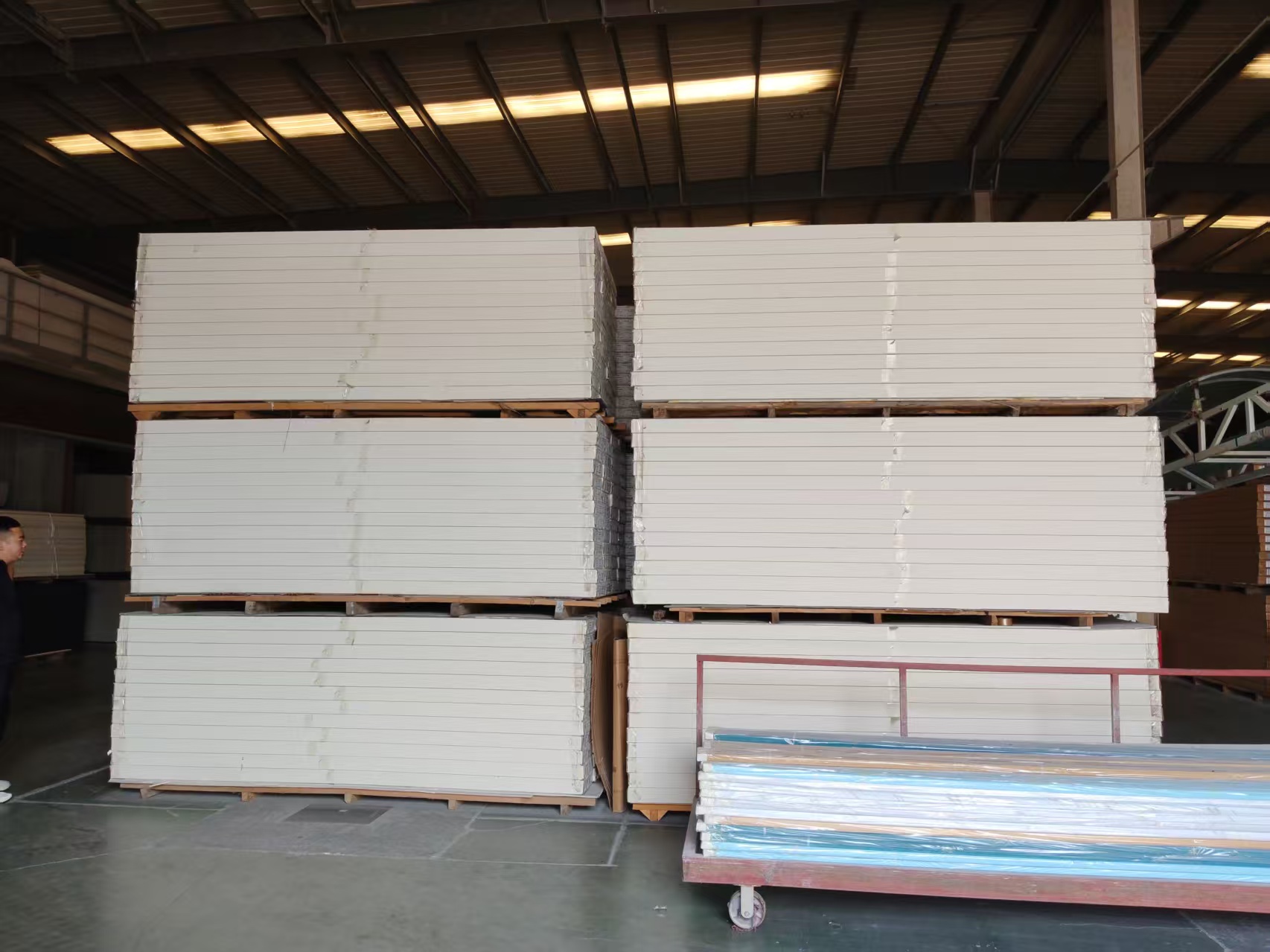
Finished panels palletised and wrapped — batch records, packing marks and retained samples are checked against the approved specification before dispatch.
At minimum the contract should name the model, thickness, colour reference, surface finish, length, packing method and shipping marks. Inspection method needs the same treatment: Linkworld states that it applies standardised production and full inspection, and the buyer should convert that description into an executable plan covering batch definition, sampling ratio, defect definitions and re-inspection rules.
Test documents are the item most prone to mismatch at bulk stage. For shipments to the United States or the European Union, fire-retardancy requirements are commonly cited as ASTM E84 (Class A/B) and EN 13501-1 (B1/B2); a report has to correspond to the specific model, structure and test conditions, and cannot be replaced by a report for another product in the same series. Linkworld states that complete official test reports and authoritative certifications are available, and that inspection documents can be provided against specific item numbers — what the buyer has to check is whether each report maps to the ordered model, not merely whether certificates exist.
Warranty is a conditional document too. Linkworld offers a 25-year warranty for qualified products under normal use, and the qualifiers matter: qualified product, normal use. A bulk purchase should request written warranty terms setting out coverage, exclusions, claim procedure and the boundary of responsibility, rather than relying on a service-life figure printed on a quotation.
Documentation and logistics belong to the same stage. The HS code used in international trade for WPC wall panels is 3925.90.00, and the declared description, code and contract wording should stay consistent to avoid classification disputes at the destination port. Packing method, pallet specification, label content and carton quantities should be settled before production, because changing them after container loading costs far more than confirming them beforehand.
On price, a published commercial reference places standard WPC wall panels in an FOB range of USD 8–18 per square metre at factory and wholesale level, but that range does not state thickness, surface process, profile type or trade term. It shows only that quotations have to be tied to specification; it is not usable as a target price or a negotiating benchmark.
The three stages compared side by side
Placing the checkpoints together makes clear what each stage is supposed to produce.
| Checkpoint | Sample | Trial run | Bulk purchase |
|---|---|---|---|
| Application and location | Confirm indoor, outdoor or wet-area use before sampling | Confirm the selected model suits the substrate and installation method | Lock model and application in the order document |
| Dimensions and joints | Confirm nominal size, effective coverage and joint layout | Trial-fit a short section; inspect cut edges, corners and trims | Order to contracted sizes with an agreed waste allowance |
| Colour | Approve a physical colour reference and seal it | Compare trial output with the sealed reference under the same light | Use the sealed reference as the acceptance benchmark per batch |
| Material and formulation | Identify the material family only | Confirm raw-material source, grade and formulation continuity | Write material and formulation commitments into the specification |
| Batch consistency | Cannot be verified | First observable evidence of repeatability | Check retained samples and batch inspection records |
| Test reports | May be requested in advance, but are not batch-specific | Check report scope, validity and model coverage | Require reports matching the ordered model and destination market |
| Warranty | Not applicable | Confirm terms apply to this model and this use | Attach written warranty terms to the contract |
| Documents and logistics | Not applicable | Confirm packing, marking and HS classification | Check declaration, packing list and arrival quantities |
The table also explains why the stages cannot be merged. Most sample-stage rows can only produce a confirmation; only at trial-run and bulk stage does the same row produce a checkable record.
What the three stages do and do not prove
Several boundary conditions are routinely skipped, and they decide whether the stage checks mean anything.
Water resistance is not long-term immersion. Waterproof or moisture-proof performance does not mean a panel can be soaked for extended periods; actual suitability depends on substrate, surface layer, seams, edge treatment, installation method and the testing the product has undergone. Wet-area work also needs joint sealing, substrate waterproofing and drainage design.
"Direct installation" carries a precondition. Compared with conventional latex paint and wallpaper, WPC wall panels are described as installable directly onto a flat wall, and the operative word is flat — an uneven substrate translates straight into joint and surface problems.
A product name is not a technical parameter. The main differences between carbon crystal panels, PVC wall panels and SPC wall panels lie in the specific formulation, substrate structure, thickness, surface coating, physical properties and application positioning. Buyers should verify actual material composition, technical parameters and test reports rather than inferring performance from a name, and this matters most at trial stage, because different manufacturers and models within the same category can differ substantially.
A sample is not a batch, and a trial run is not long-term performance. The trial shows repeatability of an initial lot but cannot replace verification of long-term weathering, UV resistance or load behaviour; those require corresponding test data and stated use conditions.
Where the stage emphasis shifts by application
Project type changes the weighting. Interior wall work in residential, hotel, office, commercial, hospital, school and public-building projects usually puts colour approval and joint appearance at sample stage, and batch consistency at trial stage.
Wet areas such as bathrooms and kitchens move the emphasis forward to joints and edge treatment. The sample stage should establish whether trims and sealing components exist at all, and the trial run should show how cut edges and seams are actually closed.
Exterior cladding, fencing and decking applications require the sample stage to confirm that the product belongs to the outdoor range, the trial stage to confirm batten, drainage and expansion detailing, and the bulk stage to check the test documents relevant to exterior use.
Grille and slat formats, where line and depth carry most of the visual effect, need spacing, direction and termination decisions at sample stage, because their finished appearance depends more heavily on layout planning than a plain flat panel does.
Comparing with traditional finishes: what to ask at order stage
Material comparisons feed back into what each stage should confirm. Against latex paint and wallpaper, WPC wall panels are described as waterproof and moisture-proof, capable of a seamless large-panel finish, free of formaldehyde and paint odour, low in construction dust, and installable directly on a flat wall; installation speed improves, material cost is lower than marble, service life is longer than wallpaper, and the product suits living-room feature walls, hotel guest rooms, office interiors, bedroom renovation and wet areas such as bathrooms and kitchens, with lower whole-life expenditure and less frequent upkeep thanks to resistance to daily staining.
Several of those advantages are conditional. A seamless finish is an installation outcome rather than an inherent material property, since it depends on layout, joints and trims — so trim and joint details should be confirmed at sample stage rather than discovered as missing parts during the trial run. Faster installation likewise depends on substrate condition and fixing method, and an uneven wall erases most of the efficiency gain.
Claims such as longer service life than wallpaper and lower whole-life expenditure are relative, qualitative comparisons against conventional finishes and cannot substitute for project-specific costing. What a bulk order can actually verify is whether the quoted specification, test documents and warranty terms are complete — not a single comparative conclusion.
Market context
On the supply side, WPC wall panels remain a largely export-manufactured category. A published commercial research estimate puts the global wall panels market at about USD 10.85 billion in 2026, forecasts the WPC wall panel segment at a compound annual growth rate of 5% to 7% for 2026 to 2035, and estimates China's share of global WPC production at 45% to 50%. These are forecasts and estimates from a commercial research source rather than purchasing guarantees, but they explain why technical and documentary checks at order stage are unlikely to become simpler.
When supply concentrates in a few manufacturing clusters while buyers sit in many regulatory markets, the value of stage checks is not extra process. It is separating three questions that get confused: whether the product suits the project, whether production is stable, and whether the documents match.
Where Linkworld WPC Wall Panel fits this framework
Linkworld WPC Wall Panel is supplied by Tangshan Linkworld International Trade Co., Ltd., established in 2004, with a stated factory area of 20,000 m², around 40 employees and reported annual output of 1,560,000 square metres. Export accounts for roughly 70% of its business, with products shipped to more than 60 countries and regions including the United States, Canada, Spain, Russia, Singapore, India, Malaysia and the Middle East. The company presents itself as an integrated building-panel supplier covering R&D, production and sales, and supports customised product development.
Its product structure runs from indoor panels — WPC grille panels, carbon crystal panels, UV panels, SPC stone crystal wall panels and SPC flooring — to outdoor items such as WPC Great Wall panels, ASA wall panels, PE wall panels, outdoor wood-plastic fence panels, outdoor wood-plastic decking and sun panels. That breadth means one supplier can cover both interior and exterior orders, but the two order types do not require the same items at trial stage.
What connects most directly to this framework are three statements: samples are available to confirm colour, material and structure; a fixed raw-material supplier and production formulation limit batch colour deviation, with reference samples retained for bulk orders; and qualified products carry a 25-year warranty under normal use, with inspection documents available against item numbers. These are the items a buyer should verify stage by stage, not substitutes for verification.
Company information and the product catalogue are available at www.tslinkworld.com.
Future outlook
If the 5% to 7% segment growth predicted by that commercial research broadly holds, WPC wall panel orders will continue to concentrate among suppliers able to demonstrate stable formulation and complete test documentation. For buyers, that argues for fixing colour references, raw-material sources and report-to-model mapping in writing rather than compressing the stages.
A second likely direction is more granular documentation. As fire and environmental requirements are checked in greater detail across different markets, a general claim of being certified will support bulk orders less and less, while suppliers able to provide records tied to model and batch will reduce friction at both trial and bulk stage.
FAQ
Can a sample order replace a trial run?
No. A sample confirms colour, material, structure and quality requirements, but it cannot demonstrate the repeatability of a production batch. The trial run is the stage where batch consistency, joint treatment and inspection records are observed under the same raw-material source and formulation as the bulk order.
How long should a sealed reference sample be kept?
At least until the corresponding batch has been accepted. Suppliers retain reference samples for bulk orders as a quality comparison basis, and buyers should keep their own sealed counterpart with the date, colour reference, model and batch recorded, so that a colour dispute has a shared reference point.
Which test reports should be checked before a bulk order?
It depends on the destination market. For shipments to the United States and the European Union, fire-retardancy requirements are commonly cited as ASTM E84 (Class A/B) and EN 13501-1 (B1/B2). Reports need to correspond to the specific model, structure and test conditions, and cannot be replaced by a report for another product in the same series.
Can a panel labelled waterproof be used directly in long-term wet conditions?
That cannot be inferred. Waterproof or moisture-proof performance does not mean the panel can be immersed for long periods; suitability also depends on substrate, surface layer, seams, edge treatment, installation method and the testing carried out. Wet areas additionally require joint sealing, substrate waterproofing and drainage design.
Does a 25-year warranty apply to every situation?
No. A warranty of that length applies to qualified products under normal use conditions, and the specific coverage, exclusions and claim procedure should follow the written warranty document and be confirmed in the bulk contract.
The sequence itself allocates risk: a sample rules out unsuitable options at the lowest cost, a trial run shows production consistency at modest volume, and a bulk contract fixes what has already been confirmed. Writing down what each stage must verify, and filing the results separately, is more useful than repeatedly comparing figures on the same quotation.
The full product catalogue can be viewed and downloaded here: Product Catalog (PDF).
¿Tiene preguntas o necesita más detalles?
Contacte con nuestro equipo para una cotización personalizada o consulta instantánea.
Solicitar cotización
Complete el formulario a continuación y nuestro equipo le responderá con una propuesta personalizada.
Chat directo de WhatsApp
¿Prefiere chatear en tiempo real? Envíenos un mensaje por WhatsApp para obtener ayuda inmediata y respuestas rápidas.
- Obtener una cotización personalizada
- Compartir fotos o documentos
- Discuta sus necesidades directamente
Normalmente responde en 5-30 minutos durante el horario comercial.