
From Elevator Decoration to Automotive Components: Matching Stainless Steel Coil Specs to Your Industry
From Elevator Decoration to Automotive Components: Matching Stainless Steel Coil Specs to Your Industry
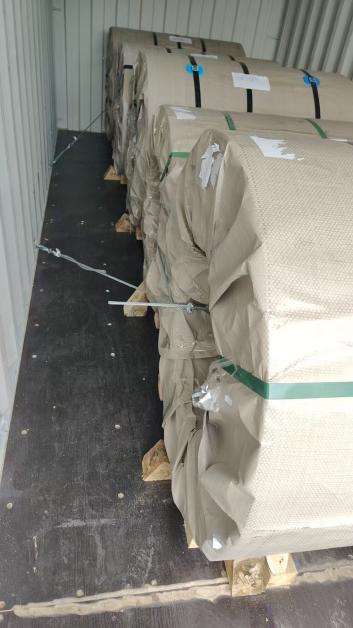
Coils leaving the warehouse for downstream industries. Specification fit is decided long before loading, at the point where thickness, width and finish are matched to a production process.
Specification mismatch, not grade scarcity, is the most common reason a stainless steel order fails in production. Two coils can carry the same nominal grade and still behave differently on the same line, because thickness band, width and surface finish decide whether the material moves cleanly through a stamping press, a deep-drawing die, a slitting line or a panel fabrication sequence. For buyers working through evaluation and execution, the useful question is narrower than which stainless steel grade is best in general. It is which standard product form, whether baby coil, secondary coil, wider coil or circle, fits the thickness, width and finish of a defined industry application.
This reference maps the coil, sheet and circle specifications supplied by NINGBO SUNFIRE STAINLESS STEEL CO., LTD to the industries those forms are listed for, including kitchenware and cookware, home appliances, elevator decoration, construction and interior decoration, and automotive components. It is written for procurement and engineering readers who already know their end process and need to place an order that will run.
Why Industry Fit Has Become the Deciding Purchase Variable
Demand and trade data both point to a market where application-level selection matters more than it did a decade ago. Grand View Research values the global stainless steel market at USD 135.8 billion in 2025 and projects USD 247.4 billion by 2033. On the supply side, China's stainless steel exports reached an all-time high of 5.04 million tonnes in 2024, a 25.6% increase year on year, based on General Administration of Customs data reported by Mysteel. China's domestic stainless steel imports moved the other way, falling 9.3% in 2024 to 1.88 million tonnes, mainly because domestic production capacity expanded.
The procurement consequence is straightforward. More offers now compete for the same nominal specification, and differentiation has shifted from whether a supplier can source a grade to whether the supplier's standard forms match the buyer's process window. A supplier that publishes a thickness band, a width list, a finish class and a packaging convention removes qualification work from the buyer's desk. A supplier that answers only with a grade name pushes all of that risk back onto the buyer, where it usually resurfaces as scrap, rework or a line stoppage.
This is why the buyer stage from evaluation into execution is the point where specification matching earns its return. The grade decision is generally settled earlier, during research. The form decision, meaning which coil type at which gauge and width, is what actually gets committed in a purchase order and what determines whether the first container performs.
Reading a Coil Specification in the Order That Decides Fit
Most purchasing errors happen when a specification is read out of order. Buyers who start at grade and stop at grade frequently discover a width or finish constraint only after material has shipped. The six elements below are best read in sequence, from process requirement through to documentation.
| Specification element | What it controls | Question to settle before ordering |
|---|---|---|
| Thickness (mm) | Feasibility of stamping, deep drawing and forming; coil weight and run length | Does the die schedule tolerate both the thin and thick ends of the stated band? |
| Width (mm) | Nesting and yield for panels, need for slitting, scrap generation | Can the part nest at around 600 mm, or does it require a 1240 mm full-width coil? |
| Surface finish | Appearance class, need for post-processing, decorative versus functional use | Is BA sufficient, or does the visible face require NO.4, 8K, coloured 8K or HL? |
| Grade family | Corrosion class, magnetic response, cost band | Are 201 J1/J2/J3/J5, 304, 410 or 430 consistent with the service environment? |
| Packaging | Transit and storage protection, handling during unpacking | Nude packing, PVC outside, paper interleaved, or wooden case for circles? |
| Documentation | Acceptance, claims handling, traceability | Is a Mill Test Certificate issued for the actual grade and scope delivered? |
Read in this order, the specification stops being a list of attributes and becomes a set of constraints that point to one or two viable product forms. That is also the sequence in which the supplier's published data becomes useful, because it shows which forms exist at which thickness, width and finish, and where a request falls outside the standard range.
The Standard Product Forms Behind the Ningbo Sunfire Offer
NINGBO SUNFIRE STAINLESS STEEL CO., LTD is a Ningbo-based supplier of stainless steel and stainless steel products, established in 2013, exporting 100% of its output and stating a specific advantage in stainless steel secondary and baby coil. Its office is located in the Ningbo Chamber of Commerce, Southern Business District, and the cooperative factory covers an area of over 3 million square meters. Stated export markets include Pakistan, India, Vietnam, Russia, Turkey, Indonesia, UAE, Thailand, Malaysia, Bangladesh, the Middle East, South America and Africa.
On the commercial and quality side, the company offers OEM production with customization of thickness, width, surface finish, PVC and packaging. The stated monthly export capacity is 3,000 MT, standard delivery time is 7 to 45 days, the general MOQ is 27 MT, and quality control combines mill test, thickness inspection and surface inspection. After-sales support covers technical support and online service. For commercial terms, delivery is CIF, payment terms are TT/DP, and the acceptance criterion is the Mill Test Certificate.
Those capabilities matter mainly because they define what can be customized and what remains fixed by the mill. The table below summarizes the standard forms and their published specification windows, which is the reference a buyer needs when matching an application to an order.
| Product form | Thickness | Width | Finish | Grades | MOQ and lead time |
|---|---|---|---|---|---|
| Baby coil | 0.1 mm - 1.2 mm, about 80% between 0.3 mm and 0.6 mm | around 600 mm | mainly BA (about 70%) | 430 / 304 / 410 / 201 | Nude packing; standard delivery 7-45 days |
| Secondary coil, narrow | 0.1 mm - 1.2 mm | around 600 mm | mainly BA; coil weight around 200 kg | 430 / 201 / 304 | PVC outside or paper interleaved |
| Secondary coil, wider | 0.25 mm - 1.5 mm | around 1000 mm - 1250 mm | mainly BA; 1 MT below / 1 MT above | 430 / 304 / 201 / 410 | PVC outside or paper interleaved |
| 410 BA, wider | 0.25 mm - 1.5 mm | 1240 mm / mill edge | BA | 410 | 20 MT per thickness; 7-30 days from stock |
| 410 BA, narrow | 0.15 mm - 1.2 mm | 300 mm - 1010 mm | BA; PVC, paper or refinish as further processing | 410 | 7-30 days from stock |
| 304, narrow | 0.10 mm - 2.00 mm | 550 / 600 / 620 / 650 / 690 / 730 mm | per specification | 304 | 8-9 MT depending on width; 7-30 days from stock |
| 304, wider | 0.3 mm - 3 mm | 1240 mm | per specification | 304 | 10 MT per thickness; 7-30 days from stock |
| 201 J3/J2/J5, narrow | 0.1 mm - 2.0 mm | 550 / 600 / 620 / 650 / 690 / 730 / 810 / 830 mm | 2B / BA | 201 J3 / J2 / J5 | 27 MT by 3-4 spec; 7-30 days from stock |
| 201 J3/J2/J5, wide | 0.25 mm - 3 mm | 1240 mm / mill edge | 2B / BA | 201 J3 / J2 / J5 | 7-10 MT per thickness; 7-30 days from stock |
| 201 J2 decorative finish | NO.4: 0.28-1.45 mm; 8K: 0.28-1.95 mm; Gold 8K / Rose Gold 8K: 0.28-1.15 mm | 1240 mm | NO.4 / 8K / Gold 8K / Rose Gold 8K / Black 8K | 201 J2 | 5-20 MT per thickness |
| Stainless steel circle | 0.3 mm - 2.0 mm | circle; export package with wooden case | per specification | 430 / 410 / 201 | 3 MT per thickness; 25-45 days |
Technical Explanation: Why Thickness and Width Decide the Process
Baby coil is the thinnest standard form in this range, and its specification is unusually concentrated. It is supplied from 0.1 mm to 1.2 mm, with roughly 80% of the volume falling between 0.3 mm and 0.6 mm, at a width of around 600 mm and mainly BA finish at approximately 70%. That combination is what makes it a natural input for metal stamping and deep drawing. The dense 0.3 mm to 0.6 mm band sits where small stamped and drawn parts are typically produced, and a coil width near 600 mm suits multi-cavity die layouts and small-part blanking more efficiently than full-width material, which would generate unused edge. Baby coil is listed for kitchenware and cookware, home appliances, elevator decoration, construction and interior decoration, automotive components, industrial equipment, metal stamping and deep drawing, tube and pipe manufacturing, tableware, and hardware accessories, and it is available in grades 430, 304, 410 and 201 with nude packing as standard.
Wider material answers a different production logic. The 410 wider BA coil is supplied at 0.25 mm to 1.5 mm thickness and 1240 mm width or mill edge, in BA finish, with export package and paper interleaved, a MOQ of 20 MT per thickness, and a lead time of 7 to 30 days from stock. A 1240 mm width is the more appropriate form for construction panels and large decorative surfaces such as elevator cab panels and interior cladding, where the visible face comes from a continuous sheet and a narrow coil would force extra seams or upstream slitting work. Where the same grade is needed in narrower formats, the 410 narrow BA option covers 0.15 mm to 1.2 mm at 300 mm to 1010 mm width, with PVC, paper or refinish available as further processing.
The 201 family carries most of the volume-oriented specifications and is supplied in both 2B and BA. Narrow 201 J3/J2/J5 coil runs from 0.1 mm to 2.0 mm at widths of 550, 600, 620, 650, 690, 730, 810 and 830 mm, with a MOQ of 27 MT across three to four specifications and a 7 to 30 day lead time from stock. Wide 201 J3/J2/J5 coil runs from 0.25 mm to 3 mm at 1240 mm or mill edge, with export package plus paper interleaved and a MOQ of 7 to 10 MT per thickness. The width list of the narrow variant is fixed rather than free, which is a practical constraint: buyers whose part requires an intermediate width should plan for slitting or re-specification rather than assume a made-to-order width.
For visible and decorative work, the 201 J2 finish range is the relevant group, offered in NO.4, 8K, Gold 8K, Rose Gold 8K and Black 8K at 1240 mm width. Thickness limits differ by finish: NO.4 spans 0.28 mm to 1.45 mm, 8K spans 0.28 mm to 1.95 mm, and the coloured Gold 8K and Rose Gold 8K finishes top out at 1.15 mm, with a MOQ of 5 to 20 MT per thickness. Reflectivity itself is a polishing outcome: 8K, the mirror finish, is produced through iterative polishing, and the 12K tier represents the highest reflectivity level, closest to a glass mirror. Buyers specifying a mirror surface for elevator interiors or retail fixtures should therefore confirm both the finish class and the maximum thickness available at that class, since the two are linked.
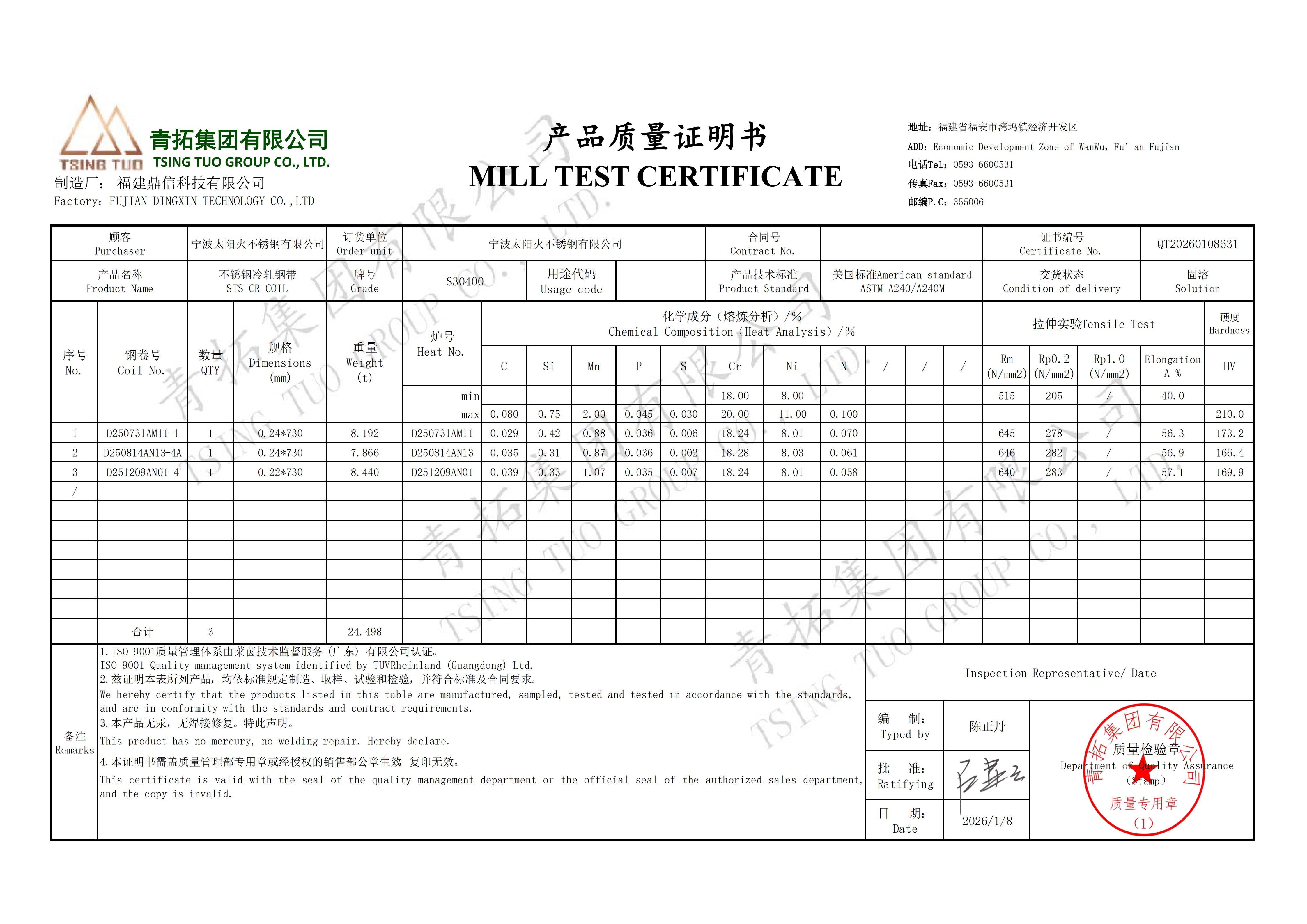
A 304 stainless steel mill test certificate issued under ASTM A240/A240M by QINGTUO GROUP CO., LTD (certificate QT20260108631, issued 8 January 2026), covering 304 stainless steel coils and sheets.
For the 304 grade, both narrow and wider forms are stocked. Narrow 304 runs from 0.10 mm to 2.00 mm at 550, 600, 620, 650, 690 and 730 mm widths, with MOQs of 8 to 9 MT depending on the width, while wider 304 runs from 0.3 mm to 3 mm at 1240 mm with a MOQ of 10 MT per thickness. Both carry a 7 to 30 day lead time from stock. The 304 grade is generally associated with higher corrosion resistance demands than 201 or the ferritic 410 and 430 grades, which is why it usually appears where wet or more aggressive service conditions are expected rather than in purely decorative applications.
Secondary coil exists in two geometries. The narrow form matches baby coil in thickness and width, at 0.1 mm to 1.2 mm and around 600 mm, with mainly BA finish and coil weights around 200 kg, in grades 430, 201 and 304. The wider form covers 0.25 mm to 1.5 mm at around 1000 mm to 1250 mm, mainly BA, in weights of 1 MT below or above, in grades 430, 304, 201 and 410. Both are packaged with PVC outside or paper interleaved. Circles are the third geometry, produced at 0.3 mm to 2.0 mm thickness in grades 430, 410 and 201, packed in export packaging with wooden cases, with a MOQ of 3 MT per thickness and a longer 25 to 45 day lead time.

A 430 stainless steel mill test certificate issued under GB/T 3280-2015 by JIANGSU YONGJIN METAL TECHNOLOGY CO., LTD (certificate JSPZ20260501804, issued 22 May 2026), covering 430 stainless steel coils and sheets.
Matching Product Forms to Industries
The mapping below converts the specification tables into application decisions. It is organized by end industry and states which standard form, thickness and width the application normally points to, together with the constraint that most often catches buyers out.
| Industry application | Standard form to start from | Typical thickness / width | Point of attention |
|---|---|---|---|
| Elevator decoration (cab panels, doors, trim) | 410 wider BA coil, or 201 J2 finish coil for coloured and mirror surfaces | 0.28 mm - 1.5 mm at 1240 mm | Decorative finishes are supplied at 1240 mm, so narrow trim parts require slitting; mirror surfaces need protective packaging and careful handling. |
| Construction and interior panels | 410 wider BA coil; 201 wide 2B/BA coil; secondary wider coil for cost-sensitive panels | 0.25 mm - 1.5 mm at around 1000-1250 mm | Full-width availability governs panel yield; ferritic 410 and 430 are commonly chosen for interior and decorative use rather than aggressive service environments. |
| Kitchenware and cookware | Circles in 430 / 410 / 201; baby coil for stamped lids, handles and bodies | Circles 0.3 mm - 2.0 mm; baby coil 0.3 mm - 0.6 mm | Circle orders carry a 3 MT per thickness MOQ and a 25-45 day lead time, longer than the 7-30 day stock coil window. |
| Home appliances | Baby coil and 201 narrow coil; 304 narrow where corrosion demand is higher | 0.1 mm - 2.0 mm at 550-730 mm | Visible appliance panels depend on consistent thickness and surface; grade substitution should follow the service environment, not only the cost target. |
| Automotive components | Baby coil and secondary narrow coil | 0.1 mm - 1.2 mm at around 600 mm | Grade, thickness and finish should be confirmed against the part drawing, with the Mill Test Certificate used as acceptance evidence. |
| Metal stamping and deep drawing | Baby coil | 0.1 mm - 1.2 mm, about 80% at 0.3-0.6 mm, around 600 mm | Baby coil is supplied with nude packing as standard, so in-house surface protection should be planned before the coil reaches the press. |
| Tube and pipe, tableware, hardware accessories | 201 narrow (2B/BA) and 304 narrow coil; circles for tableware | 0.1 mm - 2.0 mm at 550-830 mm | The narrow width list is fixed at specific values, so intermediate widths imply slitting or a change in nesting plan. |
| Industrial equipment | 304 narrow and wider coil | 0.3 mm - 3 mm, up to 1240 mm | The wider 304 form carries a 10 MT per thickness MOQ, which affects order planning for low-volume equipment programmes. |
In practice, the same buyer often needs more than one form. An appliance manufacturer may take 201 narrow coil for stamped internals, baby coil for thin drawn parts and 304 narrow coil for components exposed to moisture, all in the same production cycle. Recognizing that the requirement is a set of forms rather than a single grade is what allows a supplier's stock position and customization capability to be evaluated against something concrete.
Market Trend Analysis: Export-Led and Documentation-Led Supply
Three verifiable trade signals shape how buyers should approach stainless steel sourcing into 2026. First, export availability is expanding: China's stainless steel exports reached an all-time high of 5.04 million tonnes in 2024, up 25.6% year on year. Second, domestic substitution is deepening: China's stainless steel imports fell 9.3% in 2024 to 1.88 million tonnes, attributed mainly to expanded domestic production capacity. Third, the market itself is projected to grow substantially, from USD 135.8 billion in 2025 to USD 247.4 billion by 2033 according to Grand View Research. Together they describe a market where supply is increasingly export-facing and where the number of credible offers per specification is rising.
Documentation becomes more valuable in that environment, not less. International standards such as ASTM A240 and ASME SA240 remain the core references for stainless steel plate, sheet and strip used in general and pressure vessel applications, and buyers increasingly treat the Mill Test Certificate as the practical control point rather than a formality. Suppliers that can present grade-specific certificates, such as 201 J2 stainless steel strips certified under Q/ZQHW 2-2024, 430 coils and sheets under GB/T 3280-2015, and 304 coils and sheets under ASTM A240/A240M, reduce the verification burden on the receiving end.
Regulatory cost is the third element of the trend picture, at least for European destinations. EU anti-dumping duties on stainless steel cold-rolled flat products originating in China and Taiwan were maintained following the 2025 expiry review, in a range of 24.6% to 28.5% under Regulation 2025/1573. For EU-bound projects, landed cost rather than mill price should be the comparison basis, and origin and documentation clarity become part of risk management rather than administrative detail.
On the demand side, application experience points in the same direction. An ongoing stainless steel export case covering Indonesia, India, South Africa, Pakistan, Vietnam and Saudi Arabia has been running for more than 10 years at a scale of 50 containers per month, with material used for kitchenware, home appliances, building and construction. Reported outcomes include stable material performance, good corrosion resistance, consistent surface quality and conformity with international standards, supported by customized sizes and finishes, strict quality control, fast lead time and availability across multiple grades. The pattern is consistent: repeat volume follows specification consistency, not the lowest quotation in a single round.
Where Spec Matching Has Limits: Boundaries Versus Traditional Sourcing
Specification-matched sourcing is not a universal substitute for conventional wide-coil purchasing. The advantages are real, particularly in yield and in the ability to buy only the gauge band a process actually consumes. But several boundaries should be priced in before a decision is made.
- Width boundary. A baby coil or secondary narrow coil at around 600 mm cannot replace a 1240 mm coil for full-width panels. Where the part requires full width, the correct forms are 410 wider BA at 0.25 mm to 1.5 mm and 1240 mm, 201 wide J3/J2/J5 at 0.25 mm to 3 mm and 1240 mm, or 304 wider at 0.3 mm to 3 mm and 1240 mm. Slitting wide coil down to a narrow size is an alternative, but it adds a processing step and yield loss that must be weighed against the cost advantage of buying narrow stock.
- Grade boundary. The ferritic 410 and 430 grades are commonly selected for decorative and interior applications, while 304 is generally preferred where corrosion resistance requirements are higher. Cost-driven substitution of 201 or ferritic grades for 304 therefore has a service-life limit, and the substitution should be reviewed against the actual environment rather than assumed to be equivalent.
- Surface boundary. Baby coil is mainly BA, at about 70%, and secondary coil is also mainly BA. Where a NO.4, 8K or coloured surface is required, the 201 J2 finish range is the appropriate option, and it is supplied only at 1240 mm width, with thickness capped at 1.45 mm for NO.4 and at 1.15 mm for Gold 8K and Rose Gold 8K.
- Documentation boundary. Secondary and baby coil are derived product streams, so the certificate, not the appearance of the coil, is the control. Here, acceptance criteria is the Mill Test Certificate and quality control combines mill test, thickness inspection and surface inspection. Buyers should verify scope as well as grade on each certificate, for example 201 J2 strips, 430 coils and sheets, or 304 coils and sheets.
- Commercial boundary. MOQs are form-specific rather than uniform: 27 MT for general terms and for narrow 201 across three to four specifications, 20 MT per thickness for 410 wider BA, 10 MT per thickness for 304 wider, 8 to 9 MT depending on width for 304 narrow, 5 to 20 MT per thickness for 201 J2 finish, and 3 MT per thickness for circles. Lead times also differ, at 7 to 30 days from stock for most coil forms, 25 to 45 days for circles, and a stated standard delivery window of 7 to 45 days overall.
- Regulatory boundary. For EU destinations, anti-dumping duties of 24.6% to 28.5% on cold-rolled stainless flat products from China and Taiwan, maintained after the 2025 expiry review, materially change landed cost. Duty-inclusive comparison is the only accurate basis for that market.
Future Outlook
The direction of travel is toward earlier specification exchange and heavier reliance on documentation. As more capacity competes for export orders, buyers gain leverage in asking for thickness bands, width lists, finish classes and packaging conventions up front, and suppliers that publish those parameters clearly will be easier to qualify. On the user side, design teams that involve the material supplier while the part is still being drawn, rather than after tooling is fixed, will avoid the most expensive class of mistake, which is a technically compliant coil that does not fit the process.
Two other shifts are worth tracking. Decorative demand continues to move up the reflectivity scale, from standard finishes toward 8K and the higher-reflectivity 12K tier, which raises the importance of handling, packaging and thickness limits in the coloured finish range. And standardization itself becomes a competitive tool: where ASTM A240/A240M, GB/T 3280-2015 or mill-specific standards such as Q/ZQHW 2-2024 apply, buyers can compare offers on the same technical footing instead of negotiating over descriptions.
FAQ
What thickness range do baby coils cover, and which processes do they suit?
Baby coils are supplied from 0.1 mm to 1.2 mm, with about 80% of the range falling between 0.3 mm and 0.6 mm, at a width of around 600 mm and mainly BA finish at about 70%. They are listed for metal stamping and deep drawing, kitchenware and cookware, home appliances, elevator decoration, construction and interior decoration, automotive components, industrial equipment, tube and pipe manufacturing, tableware, and hardware accessories. Grades available in this form are 430, 304, 410 and 201, packed with nude packing as standard.
When is a 1240 mm 410 BA coil a better choice than a narrow coil?
When the part is a full-width or large visible panel. The 410 wider BA coil is supplied at 0.25 mm to 1.5 mm and 1240 mm width or mill edge, in BA finish with export package and paper interleaved, and it is the form better suited to construction panels and large decorative surfaces. A coil at around 600 mm would require slitting for those panels, adding processing and affecting yield. The 410 wider BA carries a MOQ of 20 MT per thickness and a 7 to 30 day lead time from stock, while the 410 narrow BA option covers 0.15 mm to 1.2 mm at 300 mm to 1010 mm.
How can a buyer verify that a delivered coil matches the ordered grade and finish?
Verification is document-led. The acceptance criterion for the standard commercial terms is the Mill Test Certificate, and quality control combines mill test, thickness inspection and surface inspection. Certificates on file cover 201 J2 stainless steel strips under Q/ZQHW 2-2024 (certificate ZQ202512250046, issued 25 December 2025 by Zhaoqing Hongwang Metal Industrial Co., Ltd.), 430 stainless steel coils and sheets under GB/T 3280-2015 (certificate JSPZ20260501804, issued 22 May 2026 by JIANGSU YONGJIN METAL TECHNOLOGY CO., LTD), and 304 stainless steel coils and sheets under ASTM A240/A240M (certificate QT20260108631, issued 8 January 2026 by QINGTUO GROUP CO., LTD).
What are the MOQ, delivery terms and payment terms for a standard order?
The stated general MOQ is 27 MT, delivery terms are CIF, payment terms are TT/DP, and the acceptance criterion is the Mill Test Certificate. Product-level MOQs differ by form: 20 MT per thickness for 410 wider BA, 7 to 10 MT per thickness for wide 201 J3/J2/J5, 27 MT by three to four specifications for narrow 201, 10 MT per thickness for 304 wider, 8 to 9 MT depending on width for 304 narrow, 5 to 20 MT per thickness for 201 J2 finish, and 3 MT per thickness for circles.
Are secondary and baby coils suitable for automotive components and home appliances?
Both forms are listed for automotive components, home appliances, kitchenware and cookware, elevator decoration, construction and interior decoration, industrial equipment, metal stamping and deep drawing, tube and pipe manufacturing, tableware, and hardware accessories. Secondary coil is supplied as narrow (0.1 mm to 1.2 mm, around 600 mm, coils of about 200 kg, grades 430/201/304) and wider (0.25 mm to 1.5 mm, around 1000 mm to 1250 mm, grades 430/304/201/410). Suitability still depends on confirming grade, thickness and finish against the part drawing and against the Mill Test Certificate issued for the delivered material.
What customization is available on thickness, width, finish and packaging?
OEM production is offered, with customization on thickness, width, surface finish, PVC and packaging. Standard packaging differs by form: nude packing for baby coil, PVC outside or paper interleaved for secondary coil in both narrow and wider formats, export package for narrow 304 and 201 coil, export package with paper interleaved for wider 304, wide 201 and 410 wider BA coil, and export package with wooden case for circles. Further processing options on 410 narrow BA include PVC, paper and refinish.
How long does delivery take, and which markets are served?
The stated standard delivery time is 7 to 45 days, with monthly export capacity of 3,000 MT. Product-level lead times are commonly 7 to 30 days from stock for coil forms and 25 to 45 days for stainless steel circles. Export markets include Pakistan, India, Vietnam, Russia, Turkey, Indonesia, UAE, Thailand, Malaysia, Bangladesh, the Middle East, South America and Africa, with additional coverage of regions such as South America and Africa stated in the capability summary.
For readers who need the full specification windows, packaging conventions and certificate scope in one document, a product brochure is available at the company brochure download, and further reference material is published at en.sunfirex.com.