
From Countertop to Facade: Matching Sintered Stone Slab Grades to Project Environments
The global sintered stone market was valued at approximately USD 877.75 million in 2024 and is projected to reach USD 1.41 billion by 2032, according to the Sintered Stone Market – Global Forecast 2025-2032 by Intel Market Research. That growth is driven not by a single application but by a widening range of project environments: retail floors, airport terminals, kitchen countertops, bathroom vanities, facade cladding, and outdoor terraces. The common procurement challenge across all of them is the same—matching the slab's physical properties to the conditions of the site.
The Procurement Problem: When Slab Appearance Overrides Project Fit
Sintered stone slabs are frequently selected on visual criteria. Marble-look, Calacatta, concrete-look, and terrazzo-look surfaces dominate product catalogs, and for good reason: appearance is the most visible attribute of any finished space. But the visual surface says little about whether the slab can handle the actual operating conditions of the project.
A slab specified for a shopping mall floor needs abrasion resistance and stain resistance. A bathroom floor needs slip resistance. An exterior facade in a cold climate needs freeze-thaw stability and low water absorption. A kitchen countertop needs a non-porous surface that can withstand food preparation and frequent cleaning. When buyers treat these environments as interchangeable, the result is premature wear, safety issues, or costly remediation.
The opportunity is that sintered stone has matured into a product category where project-specific selection is practical and verifiable. China exported USD 19.15 billion of ceramic products (including sintered stone slabs) from January to November 2025, according to the General Administration of Customs of China. Certified products, documented parameters, and manufacturer capabilities now allow buyers to specify by environment rather than by appearance alone.
Technical Baselines for Project-Ready Sintered Stone
For architectural applications, two physical benchmarks are widely cited for sintered stone: water absorption below 0.1%, referenced in ISO 10545-3, and flexural strength of at least 45 N/mm², referenced in ISO 10545-4. In the European Union, CE marking for sintered stone used in internal and external applications requires compliance with EAD 090142-00-0404, the European Assessment Document published by the European Organisation for Technical Assessment (EOTA).
Project-specific selection requires looking beyond these baselines. The following parameters are commonly used in the ceramics industry to qualify a slab for a particular environment:
- Slip resistance (R-value): R9 to R11 is the common range for ceramic surfaces; bathrooms typically require R10 or higher.
- Abrasion resistance (PEI class): PEI 3 to 5 is typical for the category; PEI 4 or higher is specified for commercial and public areas.
- Stain resistance: Grade 5 means the surface resists common stains including tea, oil, and ink.
- Chemical resistance: ULA class is required for laboratory or chemical-plant environments.
- Freeze-thaw stability: For outdoor projects in cold climates, no cracks should appear after 100 freeze-thaw cycles.
- Dimensional tolerance: Length and width deviation within ±0.2%, thickness deviation within ±5%.
- Environmental compliance: Class A radioactive standards in China; CE, GreenGuard, or LEED documentation required for some export markets.
Sintered stone achieves these properties through composition and process. The body is a mixture of clay and quartz sand, the base materials used in Monalisa's sintered stone slab production, compressed and sintered at high temperature to form a dense, vitrified surface. The result is a non-porous material that resists moisture penetration and remains physically stable across a wide range of temperatures.
Matching Slab Performance to Project Typologies
The selection logic can be organized by project environment. Each environment emphasizes a different subset of the physical parameters above:
| Project Environment | Critical Performance Requirement | Typical Specification Reference |
|---|---|---|
| Shopping malls, airports, high-traffic commercial floors | Abrasion resistance, stain resistance, easy cleaning | PEI 4+, stain resistance Grade 5 |
| Bathrooms, shower areas, pool surrounds | Slip resistance, low water absorption | R10+, water absorption ≤0.5% |
| Kitchen countertops and islands | Non-porous surface, stain and scratch resistance, mechanical strength | Stain Grade 5, flexural strength ≥45 N/mm² (ISO 10545-4) |
| Exterior facades, ventilated rain-screen systems | Low water absorption, freeze-thaw stability, UV resistance | <0.1% water absorption, 100 freeze-thaw cycles, EAD 090142-00-0404 |
| Outdoor terraces in freeze-thaw regions | Freeze-thaw resistance, slip control | No cracks after 100 cycles, R10+ |
| Medical and cleanroom environments | Non-porous surface, chemical resistance, antibacterial option | ULA chemical resistance, optional photocatalytic or silver-ion treatment |
This is the core of project-adapted selection: define the environment first, derive the required performance parameters, then evaluate the slab against documented specifications.
Product Evidence: Monalisa's Slab Line by Use Case
Monalisa Group Co., Ltd., a publicly listed ceramic manufacturer founded in 1992 and headquartered in Foshan, Guangdong Province, operates two sintered stone slab models in its export range that illustrate how product design follows application logic.
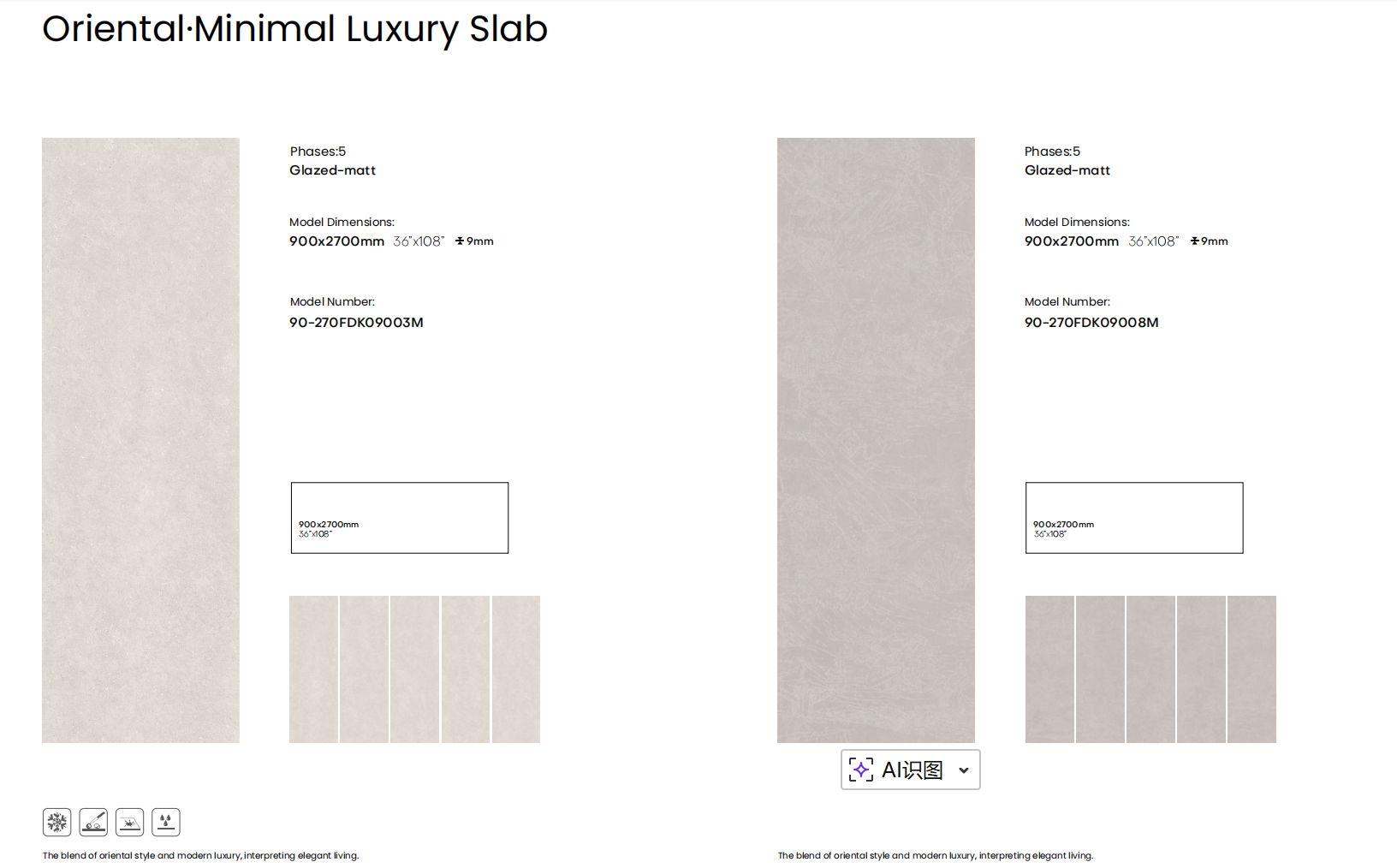
The 900×2700×12mm Luxury Slab (models 90-270FDK09003M and 90-270FDK09008M) is positioned as a high-end, multi-environment product. Its documented application scope includes luxury flagship stores, five-star hotel lobbies, fine dining restaurants, and art galleries; premium residential walls, floors, countertops, and cabinet doors; kitchen countertops, kitchen islands, vanity tops, backsplashes, and integrated slab sinks; custom furniture such as dining tables, coffee tables, and TV consoles; medical and cleanroom environments including operating room partitions, laboratory worktops, and cleanroom wall cladding; rail transit stations and airport terminals; and external curtain walls with dry-cladding and ventilated rain-screen systems. The product spans interiors, wet zones, cleanrooms, and facades, based on a body of clay and quartz sand with a glazed-matt finish.
The 900×2700×9mm Flowing Light Sintered Stone (model 90-270DBY09340M), also with a glazed-matt surface and four surface phases, targets residential construction: floors and walls of living rooms, bedrooms, kitchens, bathrooms, and balconies. The thinner format responds to interior weight and installation requirements, while the 900×2700mm size keeps joint lines relatively low for a residential slab.
For buyers working to a specific project, the relevant information is whether a slab's documented scope covers the intended environment. Monalisa publishes application scope by model, which makes the selection process easier to audit.
Field Evidence: Large-Format Panel Delivery at Scale
Project environments do not only test material performance; they also test supplier execution. Two public-sector projects illustrate the delivery capabilities that matter for large-scale ceramic and slab procurement.
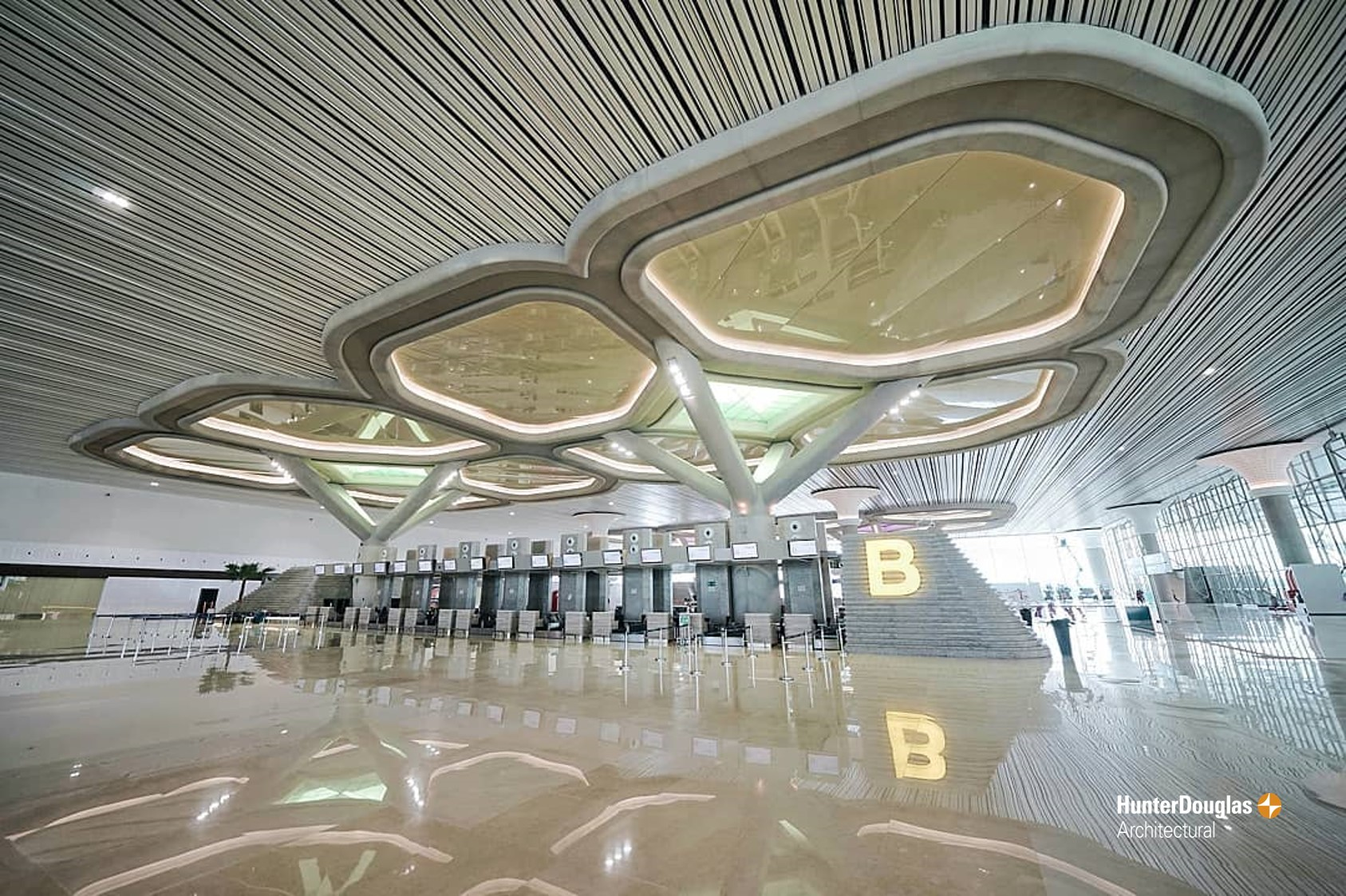
In Indonesia, the municipal government project at Jogyakarta Airport received 80,000 m² of Monalisa large-format tiles over a two-year construction period. The project reported a 30% lower life-cycle maintenance cost, a 15% saving on grouting materials and labor through tight-joint installation, and a breakage rate below 0.3%, reducing replacement losses. For a high-traffic transport environment, these outcomes translate directly into lower operating cost and fewer service disruptions.
In Sri Lanka, a national government project—with the Urban Development Authority as principal and the Korea International Cooperation Agency as joint contractor—used 80,000 m² of 900×1800mm large-format panels for floor and wall covering in convention halls, banquet spaces, VIP corridors, multimedia rooms, public reception zones, outdoor connectors, and roof terraces. The design life was set at 20+ years with a 10-year group project warranty. The 900×1800mm format delivered approximately 50% fewer visible joints, an R10 slip-resistance rating, and ultra-low water absorption of ≤0.08% for weather resistance under Sri Lanka's hot-humid climate and monsoon rains.
Market Context: Growth, Premium Benchmarks, and Export Supply
The global sintered stone market is estimated at USD 877.75 million in 2024 and is projected to grow to USD 1.41 billion by 2032. Market-size estimates vary by research scope—Reports and Data has published a broader engineered-stone figure of USD 3.5 billion—but the direction is consistent: sintered stone demand is expanding across commercial, residential, and infrastructure segments.
In the premium countertop segment, Dekton (by Cosentino) and Neolith are commonly cited as leading global brands, with typical Mohs hardness of 7–8. These brands set an expectations benchmark against which any manufactured slab can be evaluated. For buyers, the practical implication is that premium performance has an objective reference point, and project-specific decisions should be based on documented parameters rather than brand positioning alone.
On the supply side, Chinese manufacturers have become a substantial source of ceramic product exports—USD 19.15 billion from January to November 2025, covering tiles and sintered stone slabs. This export volume gives international project buyers access to production scale that can support large single-format deliveries and consistent long-term supply.
Sintered Stone vs. Traditional Materials: What the Trade-Offs Are
For project teams evaluating sintered stone slabs, the comparison is usually made against natural stone, quartz surfaces, and conventional ceramic tiles. The table below summarizes the common trade-offs:
| Criterion | Sintered Stone Slab | Natural Stone | Quartz Surface | Conventional Porcelain Tile |
|---|---|---|---|---|
| Water absorption | <0.1% architectural benchmark (ISO 10545-3) | Variable; often requires sealing | Near zero (resin-based) | ≤0.5% typical |
| Scratch and stain resistance | Stain Grade 5; abrasion PEI 4+ for commercial areas | Marble can scratch and etch | High scratch resistance | PEI 3–5, grade-dependent |
| Heat and UV stability | Suitable for external facades; CE EAD 090142-00-0404 | Thermal behavior varies by stone type | Resin may limit heat and UV performance | Proven outdoor durability |
| Maximum format | 900×2700mm in Monalisa's sintered stone line | Limited by quarry block size | Large-format slabs available | Up to 1200×2700mm |
| Maintenance burden | Low; low life-cycle cost | Periodic sealing required | Low | Low |
| Main limitation | Requires professional cutting and CNC fabrication; premium grades cost more | Unique natural veining is irreplaceable | Heat and UV sensitivity of resin components | More visible joints; less seamless aesthetic |
The most frequently cited limitation of sintered stone is fabrication. Unlike conventional tiles, which can be cut and installed with standard tiling tools, sintered stone countertops and facade panels generally require CNC cutting, water-jet profiling, and edge polishing. This raises the initial installed cost and makes fabricator capability an important project consideration. Additionally, where natural stone's unique veining is itself the design intent, a manufactured slab cannot replicate the geological uniqueness of quarried material; it reproduces a visual pattern at a controlled quality, not the one-of-a-kind character of natural stone.
Supplier Capability as Part of Project Fit
Project fit is not only about material parameters. It also depends on the supplier's ability to produce, test, deliver, and support the product over the project lifecycle.
Monalisa operates four production bases in Xiqiao (Foshan), Qingyuan (Guangdong), Tengxian (Guangxi), and Gao'an (Jiangxi), with 37 production lines and a total plant area of 2,779,333 m². The company reports an annual output capacity of 100 million m² and a monthly production capacity of 12.5 million m² across its porcelain and sintered stone product lines. Monalisa reported annual revenue of approximately CNY 3.92 billion for fiscal year 2025, according to S&P Global Market Intelligence data compiled by StockAnalysis. For overseas projects, it supports OEM/ODM production with pattern and logo customization, a standard lead time of 7–15 days, and a minimum order quantity of 2,000 m².
Quality control is stated as 100% testing. After-sales support covers a 5–15 year product warranty depending on series and project type, free technical consultation on tiling layout, on-site installation supervision for large projects, a 24-hour complaint response, and a solution—replacement, return, or compensation—within 7 working days. A stock reserve service keeps same-batch products for two years for future replenishment.
For a project environment analysis, these numbers matter because they determine whether the selected slab can be delivered consistently across a large site, and whether the supplier will remain accountable after installation.
Future Outlook: Specification Driven by Environment
Several trends point toward more environment-driven specification in the sintered stone category. First, the adoption of EAD 090142-00-0404 gives EU-bound projects a clear compliance framework for internal and external sintered stone, reducing ambiguity in facade and wet-area applications. Second, market growth toward USD 1.41 billion by 2032 is likely to bring more product grades, each targeted at a narrower use case. Third, manufacturers continue to push format limits: Monalisa launched a 9000×1800×10.5mm ultra-large ceramic plate in 2021, setting a record in China's ceramic industry. Larger formats mean fewer joints, faster installation, and a more seamless visual field—advantages that matter in airports, facades, and large-format floors.
For project buyers, the practical consequence is that slab selection should become more rigorous, not more complicated. The questions are straightforward: What environment is this for? Which parameters does that environment demand? What certification and test evidence supports the match?
FAQ: Sintered Stone Slab Selection by Project Environment
What types of projects are sintered stone slabs best suited for?
Sintered stone slabs are suitable for high-traffic commercial areas such as shopping malls and airports, wet zones requiring high slip resistance, outdoor terraces in freeze-thaw regions, and projects where low maintenance costs are a priority.
Can sintered stone slabs be used for kitchen countertops and bathroom vanities?
Yes. In Monalisa's product line, the 900×2700×12mm Luxury Slab is explicitly specified for kitchen countertops, kitchen islands, vanity tops, backsplashes, and integrated slab sinks. Its non-porous surface and fabrication compatibility make it an established alternative to natural stone in food-preparation and bathroom environments.
Are sintered stone slabs suitable for exterior facades?
Yes, when the product is certified for external use. Monalisa's Luxury Slab is specified for high-rise building dry-cladding and ventilated rain-screen systems, where ultra-low water absorption, freeze-thaw resistance, and self-cleaning behavior are required. In the EU, CE marking under EAD 090142-00-0404 covers sintered stone for internal and external use.
What slip-resistance rating should be specified for wet zones?
The commonly used industry range is R9–R11, with bathrooms requiring R10 or higher. In a Monalisa public-sector project in Sri Lanka, an R10 slip-resistance rating was used across convention halls and high-traffic public venues.
How does sintered stone perform in high-traffic commercial spaces?
For commercial and public areas, abrasion resistance of PEI 4 or higher is typically specified, along with stain resistance of Grade 5. In the Jogyakarta Airport project, Monalisa supplied 80,000 m² of large-format tiles; the project reported a 30% lower life-cycle maintenance cost and a breakage rate below 0.3%.
Can sintered stone withstand freeze-thaw conditions?
The outdoor-project benchmark is no cracks after 100 freeze-thaw cycles. Sintered stone with ultra-low water absorption—below 0.1% is the architectural benchmark referenced in ISO 10545-3—generally provides the moisture resistance needed for cold-climate outdoor installation.
What certifications should buyers verify for sintered stone slab projects?
For EU-bound projects, CE marking under EAD 090142-00-0404 is the relevant compliance pathway. For physical performance, ISO 10545-3 (water absorption) and ISO 10545-4 (flexural strength) are the commonly cited test references, with benchmark values of <0.1% and ≥45 N/mm² respectively.
What supplier capabilities matter for large-scale project adaptation?
Buyers should verify production capacity, quality-control coverage, lead time, and after-sales provisions. Monalisa reports a monthly production capacity of 12.5 million m², 100% product testing, lead times of 7–15 days, a 5–15 year product warranty depending on series and project type, and the ability to dispatch technical representatives for on-site installation supervision on large projects.
For detailed product specifications and corporate background, download the Monalisa corporate brochure: Monalisa Group corporate brochure (PDF).